Recognition: unknown
Nuclear level densities in the relativistic Hartree-Bogoliubov plus combinatorial framework
Pith reviewed 2026-05-08 16:24 UTC · model grok-4.3
The pith
The relativistic Hartree-Bogoliubov plus combinatorial framework describes experimental nuclear level densities and reproduces s-wave neutron resonance spacings with accuracy comparable to the best global models.
A machine-rendered reading of the paper's core claim, the machinery that carries it, and where it could break.
Core claim
Calculations performed within the relativistic Hartree-Bogoliubov plus combinatorial framework for even-even nuclei based on the relativistic energy density functionals DD-ME2, DD-PC1, and PC-PK1 provide a good description of the experimental level density and reproduce the s-wave neutron resonance spacings with an accuracy comparable to that of the best existing global models. Differences among the functionals in the nucleon effective mass at saturated nuclear matter are transmitted to the predicted level densities and form the main source of differences among the results.
What carries the argument
The relativistic Hartree-Bogoliubov plus combinatorial framework that computes level densities from self-consistent mean-field solutions combined with combinatorial state counting.
Load-bearing premise
The nucleon effective masses and pairing strengths from the chosen relativistic functionals are the dominant factors controlling level densities, without major missing contributions from deformation or continuum effects.
What would settle it
Finding a large number of even-even nuclei where the predicted level densities or resonance spacings deviate significantly from new experimental measurements.
Figures



read the original abstract
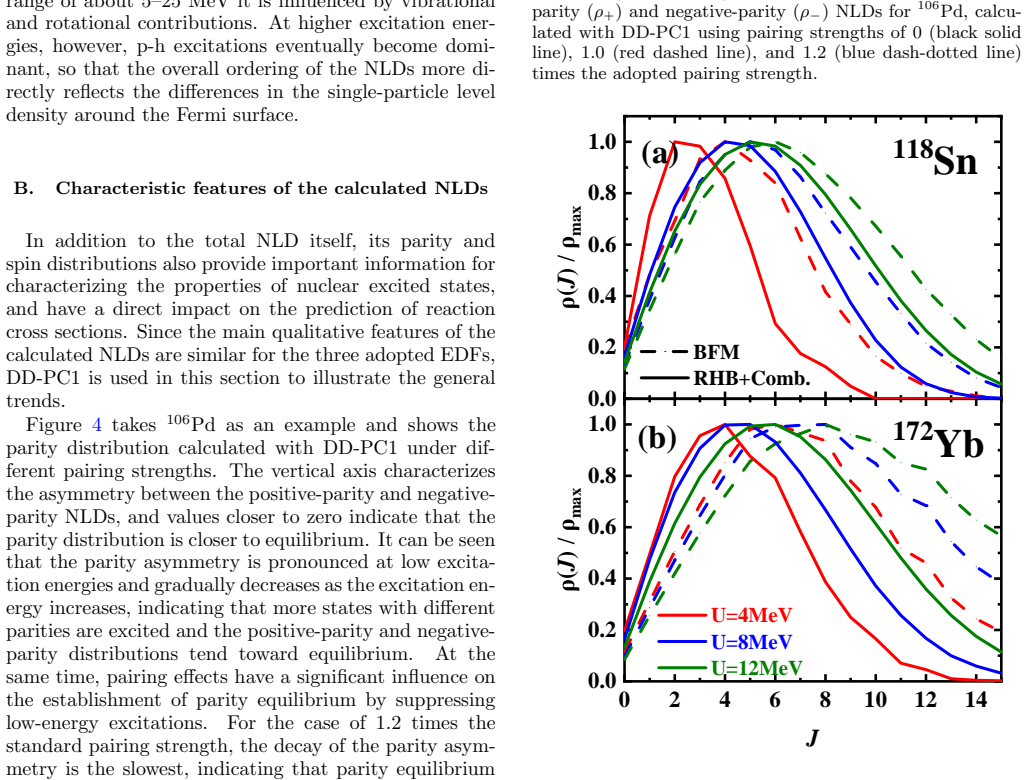
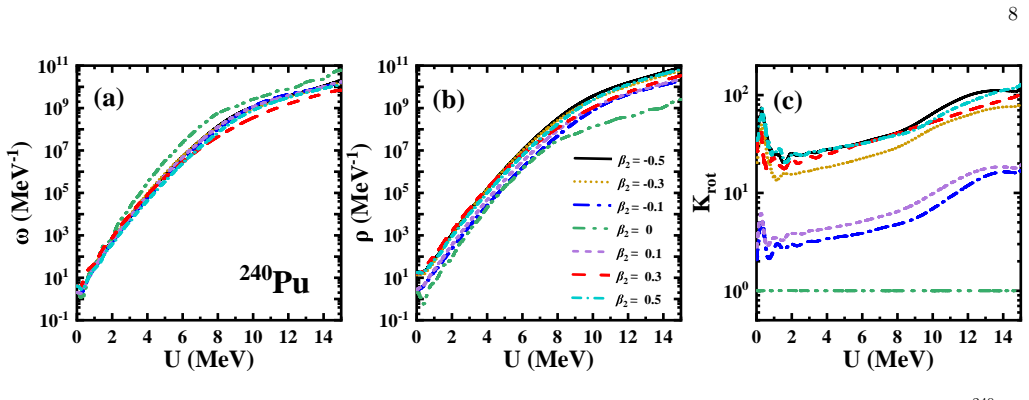
A systematic study of nuclear level densities has been carried out within the relativistic Hartree-Bogoliubov plus combinatorial framework. Calculations were performed for even-even nuclei with available experimental data, based on the relativistic energy density functionals DD-ME2, DD-PC1, and PC-PK1. The overall performance of the model is assessed against experimental data. On this basis, the effects of different functionals, pairing correlations, deformation, and other relevant factors on nuclear level densities are examined. The results show that the present framework provides a good description of the experimental level density and reproduces the s-wave neutron resonance spacings with an accuracy comparable to that of the best existing global models. Furthermore, differences among the adopted relativistic density functionals in the nucleon effective mass at saturated nuclear matter are transmitted to the predicted level densities and constitute the main source of the differences among the results obtained with the three functionals.
Editorial analysis
A structured set of objections, weighed in public.
Referee Report
Summary. The manuscript presents a systematic study of nuclear level densities for even-even nuclei using the relativistic Hartree-Bogoliubov (RHB) plus combinatorial framework. Calculations employ the relativistic energy density functionals DD-ME2, DD-PC1, and PC-PK1. The work assesses overall performance against experimental level densities, examines the effects of different functionals, pairing correlations, and deformation, and concludes that the framework provides a good description of experimental data while reproducing s-wave neutron resonance spacings (D0) with accuracy comparable to the best existing global models. Differences among the three functionals are attributed primarily to variations in the nucleon effective mass at saturation density.
Significance. If the central claims hold under quantitative scrutiny, the work is significant because it delivers a microscopic, largely parameter-free (no direct fitting to level densities) global approach to level densities grounded in established relativistic functionals calibrated only to ground-state properties. The explicit variation across functionals, pairing treatments, and deformation, together with the identification of effective mass as the dominant source of spread, provides useful diagnostic insight into the role of single-particle spectra. The combinatorial counting method offers a transparent alternative to statistical approximations and could support improved predictions for astrophysical and reaction applications.
major comments (3)
- Abstract: the central claim that the framework 'provides a good description of the experimental level density' and reproduces D0 'with an accuracy comparable to that of the best existing global models' is not accompanied by any quantitative error metrics (rms deviation, mean absolute error, or direct statistical comparison to other global models). Without such measures the assertion of comparable accuracy cannot be evaluated objectively.
- Results and discussion sections: although pairing correlations and the combinatorial cutoff are stated to have been varied, no quantitative sensitivity analysis is presented showing how changes in these ingredients affect the predicted level densities or the agreement with experiment. This information is load-bearing for assessing the robustness of the reported agreement.
- Methods: the selection criteria for the set of even-even nuclei with available experimental data are not specified. This omission affects the interpretation of the overall performance and the generality of the conclusions.
Simulated Author's Rebuttal
We thank the referee for the careful and constructive review of our manuscript. We have revised the paper to incorporate quantitative metrics, sensitivity analyses, and methodological clarifications as requested. Point-by-point responses to the major comments follow.
read point-by-point responses
-
Referee: Abstract: the central claim that the framework 'provides a good description of the experimental level density' and reproduces D0 'with an accuracy comparable to that of the best existing global models' is not accompanied by any quantitative error metrics (rms deviation, mean absolute error, or direct statistical comparison to other global models). Without such measures the assertion of comparable accuracy cannot be evaluated objectively.
Authors: We agree that quantitative error metrics strengthen the claims. In the revised manuscript we have added root-mean-square deviations and mean absolute errors for the level-density comparisons with experiment. We also include a direct statistical comparison of D0 reproduction against other global models (e.g., back-shifted Fermi-gas and Skyrme-based combinatorial approaches), confirming that the accuracy is comparable within the reported uncertainties. revision: yes
-
Referee: Results and discussion sections: although pairing correlations and the combinatorial cutoff are stated to have been varied, no quantitative sensitivity analysis is presented showing how changes in these ingredients affect the predicted level densities or the agreement with experiment. This information is load-bearing for assessing the robustness of the reported agreement.
Authors: We have performed additional calculations varying the pairing strength (within ranges consistent with ground-state binding) and the combinatorial cutoff energy. The revised Results section now contains a quantitative sensitivity analysis, including tables that report the resulting changes in level densities and the associated shifts in RMS deviations from experiment. The analysis shows that the overall agreement remains robust for moderate variations of these parameters. revision: yes
-
Referee: Methods: the selection criteria for the set of even-even nuclei with available experimental data are not specified. This omission affects the interpretation of the overall performance and the generality of the conclusions.
Authors: The nuclei were selected from the RIPL-3 database for experimental level densities and from the Atlas of Neutron Resonances for s-wave spacings, restricted to even-even systems with reliable data. We have now explicitly stated these selection criteria, the mass range considered, and the exact data sources in the Methods section of the revised manuscript. revision: yes
Circularity Check
No significant circularity; derivation self-contained
full rationale
The paper computes nuclear level densities from quasiparticle spectra generated by three established relativistic functionals (DD-ME2, DD-PC1, PC-PK1) whose parameters were fixed in prior literature to ground-state observables, then applies standard combinatorial counting. No parameter is refitted to level-density data, no self-citation supplies a uniqueness theorem or ansatz that forces the reported agreement, and the spread among functionals is explicitly traced to differences in effective mass rather than being defined into the result. The central claim therefore rests on an independent microscopic input plus a transparent counting procedure, with no step reducing by construction to the quantities being predicted.
Axiom & Free-Parameter Ledger
axioms (2)
- domain assumption Mean-field approximation in the relativistic Hartree-Bogoliubov framework is sufficient to generate single-particle spectra for level-density counting.
- domain assumption Pairing correlations can be treated at the BCS level within the RHB framework without affecting the overall level-density systematics.
Reference graph
Works this paper leans on
-
[1]
Hauser and H
W. Hauser and H. Feshbach, The inelastic scattering of neutrons, Phys. Rev.87, 366 (1952)
1952
-
[2]
Rajasekaran and V
M. Rajasekaran and V. Devanathan, Nuclear level den- sity and the mass distribution of fission fragments, Phys. Rev. C24, 2606 (1981)
1981
-
[3]
Rauscher, F.-K
T. Rauscher, F.-K. Thielemann, and K.-L. Kratz, Nu- clear level density and the determination of thermonu- clear rates for astrophysics, Phys. Rev. C56, 1613 (1997)
1997
-
[4]
Goriely, S
S. Goriely, S. Hilaire, and A. J. Koning, Improved pre- dictions of nuclear reaction rates with the talys reaction code for astrophysical applications, Astron. Astrophys. 487, 767 (2008)
2008
-
[5]
H. A. Bethe, An attempt to calculate the number of en- ergy levels of a heavy nucleus, Phys. Rev.50, 332 (1936)
1936
-
[6]
H. A. Bethe, Nuclear dynamics, theoretical, Rev. Mod. Phys.9, 69 (1937)
1937
-
[7]
W. Dilg, W. Schantl, H. Vonach, and M. Uhl, Level den- sity parameters for the back-shifted fermi gas model in the mass range 40<A<250, Nucl. Phys. A217, 269 (1973)
1973
-
[8]
A. V. Ignatyuk, G. N. Smirenkin, and A. S. Tishin, Phe- nomenological description of energy dependence of the level density parameter, Yad. Fiz.21, 485 (1975)
1975
-
[9]
Gilbert and A
A. Gilbert and A. Cameron, A composite nuclear-level density formula with shell corrections, Can. J. Phys.43, 1446 (1965)
1965
-
[10]
Guttormsen, M
M. Guttormsen, M. Aiche, F. L. Bello Garrote, L. A. Bernstein, D. L. Bleuel, Y. Byun, Q. Ducasse, T. K. Eriksen, F. Giacoppo, A. G¨ orgen, F. Gunsing, T. W. Ha- gen, B. Jurado, M. Klintefjord, A. C. Larsen, L. Lebois, B. Leniau, H. T. Nyhus, T. Renstrøm, S. J. Rose, E. Sahin, S. Siem, T. G. Tornyi, G. M. Tveten, A. Voinov, M. Wiedeking, and J. Wilson, Exp...
2015
-
[11]
Goriely, A.-C
S. Goriely, A.-C. Larsen, and D. M¨ ucher, Comprehensive test of nuclear level density models, Phys. Rev. C106, 044315 (2022)
2022
-
[12]
Zelevinsky and M
V. Zelevinsky and M. Horoi, Nuclear level density, ther- malization, chaos, and collectivity, Prog. Part. Nucl. Phys.105, 180 (2019)
2019
-
[13]
Plyaskin and R
V. Plyaskin and R. Kosilov, Level-density parameters in the back-shifted fermi gas model, Phys. At. Nucl.63, 752 (2000)
2000
-
[14]
von Egidy and D
T. von Egidy and D. Bucurescu, Systematics of nuclear level density parameters, Phys. Rev. C72, 044311 (2005)
2005
-
[15]
A. J. Koning, S. Hilaire, and S. Goriely, Global and local level density models, Nucl. Phys. A810, 13 (2008)
2008
-
[16]
Capote, M
R. Capote, M. Herman, P. Obloˇ zinsk´ y, P. Young, S. Goriely, T. Belgya, A. Ignatyuk, A. Koning, S. Hi- laire, V. Plujko, M. Avrigeanu, O. Bersillon, M. Chad- wick, T. Fukahori, Z. Ge, Y. Han, S. Kailas, J. Kopecky, V. Maslov, G. Reffo, M. Sin, E. Soukhovitskii, and P. Talou, RIPL – reference input parameter library for calculation of nuclear reactions a...
2009
-
[17]
R. A. Sen’kov and M. Horoi, High-performance algorithm to calculate spin- and parity-dependent nuclear level den- sities, Phys. Rev. C82, 024304 (2010)
2010
-
[18]
Sen’kov, M
R. Sen’kov, M. Horoi, and V. Zelevinsky, A high- performance fortran code to calculate spin- and parity- dependent nuclear level densities, Comput. Phys. Com- mun.184, 215 (2013)
2013
-
[19]
Sen’kov and V
R. Sen’kov and V. Zelevinsky, Nuclear level density: Shell-model approach, Phys. Rev. C93, 064304 (2016)
2016
-
[20]
Shimizu, Y
N. Shimizu, Y. Utsuno, Y. Futamura, T. Sakurai, T. Mizusaki, and T. Otsuka, Stochastic estimation of nu- clear level density in the nuclear shell model: An appli- cation to parity-dependent level density in 58Ni, Phys. Lett. B753, 13 (2016)
2016
-
[21]
J. Chen, M. Liu, C. Yuan, S. Chen, N. Shimizu, X. Sun, R. Xu, Y. Tian,et al., Shell-model-based investigation on level density of xe and ba isotopes, Phys. Rev. C107, 054306 (2023)
2023
-
[22]
W. E. Ormand and B. A. Brown, Microscopic calcula- tions of nuclear level densities with the lanczos method, Phys. Rev. C102, 014315 (2020)
2020
-
[23]
J. Wang, S. Dutta, L.-J. Wang, and Y. Sun, Projected shell model description of nuclear level density: Col- lective, pair-breaking, and multiquasiparticle regimes in even-even nuclei, Phys. Rev. C108, 034309 (2023)
2023
-
[24]
W. E. Ormand, Estimating the nuclear level density with the monte carlo shell model, Phys. Rev. C56, R1678 (1997)
1997
-
[25]
Alhassid, S
Y. Alhassid, S. Liu, and H. Nakada, Particle-number re- projection in the shell model monte carlo method: Ap- plication to nuclear level densities, Phys. Rev. Lett.83, 4265 (1999)
1999
-
[26]
J. A. White, S. E. Koonin, and D. J. Dean, Shell model monte carlo investigation of rare earth nuclei, Phys. Rev. C61, 034303 (2000)
2000
-
[27]
Alhassid, G
Y. Alhassid, G. F. Bertsch, and L. Fang, Nuclear level statistics: Extending shell model theory to higher tem- peratures, Phys. Rev. C68, 044322 (2003)
2003
-
[28]
Alhassid, S
Y. Alhassid, S. Liu, and H. Nakada, Spin projection in the shell model monte carlo method and the spin distribution 12 of nuclear level densities, Phys. Rev. Lett.99, 162504 (2007)
2007
-
[29]
Alhassid, M
Y. Alhassid, M. Bonett-Matiz, S. Liu, and H. Nakada, Direct microscopic calculation of nuclear level densities in the shell model monte carlo approach, Phys. Rev. C 92, 024307 (2015)
2015
-
[30]
Alhassid, Nuclear level densities: From empirical mod- els to microscopic methods, inCompound-Nuclear Re- actions, edited by J
Y. Alhassid, Nuclear level densities: From empirical mod- els to microscopic methods, inCompound-Nuclear Re- actions, edited by J. Escher, Y. Alhassid, L. A. Bern- stein, D. Brown, C. Fr¨ ohlich, P. Talou, and W. Younes (Springer International Publishing, Cham, 2021) pp. 97– 112
2021
-
[31]
F. N. Choudhury and S. D. Gupta, Nuclear level density with realistic interactions, Phys. Rev. C16, 757 (1977)
1977
-
[32]
Goriely, A new nuclear level density formula including shell and pairing correction in the light of a microscopic model calculation, Nucl
S. Goriely, A new nuclear level density formula including shell and pairing correction in the light of a microscopic model calculation, Nucl. Phys. A605, 28 (1996)
1996
-
[33]
Demetriou and S
P. Demetriou and S. Goriely, Microscopic nuclear level densities for practical applications, Nucl. Phys. A695, 95 (2001)
2001
-
[34]
A. N. Bezbakh, T. M. Shneidman, G. G. Adamian, and N. V. Antonenko, Level densities of heaviest nuclei, Eur. Phys. J. A50, 97 (2014)
2014
-
[35]
J. Zhao, T. Nikˇ si´ c, D. Vretenar,et al., Microscopic model for the collective enhancement of nuclear level densities, Phys. Rev. C102, 054606 (2020)
2020
-
[36]
Zhang, W
W. Zhang, W. Gao, G.-T. Zhang, and Z.-Y. Li, Level density of odd-a nuclei at saddle point, Nucl. Sci. Tech. 34, 124 (2023)
2023
-
[37]
Hilaire, J
S. Hilaire, J. Delaroche, and M. Girod, Combinatorial nu- clear level densities based on the gogny nucleon-nucleon effective interaction, Eur. Phys. J. A12, 169 (2001)
2001
-
[38]
S. Goko, H. Utsunomiya, S. Goriely, A. Makinaga, T. Kaihori, S. Hohara, H. Akimune, T. Yamagata, Y.- W. Lui, H. Toyokawa, A. J. Koning, and S. Hilaire, Par- tial photoneutron cross sections for the isomeric state 180Tam, Phys. Rev. Lett.96, 192501 (2006)
2006
-
[39]
Hilaire and S
S. Hilaire and S. Goriely, Global microscopic nuclear level densities within the HFB plus combinatorial method for practical applications, Nucl. Phys. A779, 63 (2006)
2006
-
[40]
Goriely, S
S. Goriely, S. Hilaire, and A. J. Koning, Improved mi- croscopic nuclear level densities within the hartree-fock- bogoliubov plus combinatorial method, Phys. Rev. C78, 064307 (2008)
2008
-
[41]
Hilaire, M
S. Hilaire, M. Girod, S. Goriely, and A. J. Kon- ing, Temperature-dependent combinatorial level densi- ties with the d1m gogny force, Phys. Rev. C86, 064317 (2012)
2012
-
[42]
Goriely, W
S. Goriely, W. Ryssens, S. Hilaire, and A. J. Kon- ing, Improved microscopic nuclear level densities within the triaxial hartree-fock-bogoliubov plus combinatorial method, Phys. Rev. C113, 014320 (2026)
2026
-
[43]
Ring, Relativistic mean field theory in finite nuclei, Prog
P. Ring, Relativistic mean field theory in finite nuclei, Prog. Part. Nucl. Phys.37, 193 (1996)
1996
-
[44]
Nikˇ si´ c, D
T. Nikˇ si´ c, D. Vretenar, and P. Ring, Relativistic nuclear energy density functionals: Mean-field and beyond, Prog. Part. Nucl. Phys.66, 519 (2011)
2011
-
[45]
Meng,Relativistic Density Functional for Nuclear Structure(2016)
J. Meng,Relativistic Density Functional for Nuclear Structure(2016)
2016
-
[46]
Li and J
J. Li and J. Meng, Nuclear magnetic moments in covari- ant density functional theory, Front. Phys.13, 132109 (2018)
2018
-
[47]
H. H. Xie and J. Li, Impact of intrinsic electromagnetic structure on the nuclear charge radius in relativistic den- sity functional theory, Phys. Rev. C110, 064319 (2024)
2024
-
[48]
Du and J
P. Du and J. Li, Exploring the neutron magic number in superheavy nuclei: Insights into N = 258, Particles7, 1086 (2024)
2024
-
[49]
Shang, Q
T. Shang, Q. Zhao, and J. Li, Pseudospin symmetry: Mi- croscopic origin of the ground-state inversion in neutron- rich odd-a cu isotopes, Phys. Lett. B850, 138527 (2024)
2024
-
[50]
J. Zang, D. Chen, R. Guo, J. Li, D. Yang, and Y. Shi, Coexistence of possible magnetic and chiral rotation in 129Cs and 131La: A microscopic investigation, Phys. Rev. C112, 034338 (2025)
2025
-
[51]
Geng, P.-X
K.-P. Geng, P.-X. Du, J. Li, and D.-L. Fang, Calculation of microscopic nuclear level densities based on covariant density functional theory, Nucl. Sci. Tech.34, 141 (2023)
2023
-
[52]
X. F. Jiang, X. H. Wu, P. W. Zhao, and J. Meng, Nuclear level density from relativistic density functional theory and combinatorial method, Phys. Lett. B , 138448 (2024)
2024
-
[53]
G. He, N. Tang, Y. Tian, Y. Cui, J. Li, Y. Xu, and R. Xu, Systematic study of microscopic nuclear level densities of sn isotopes within a relativistic framework*, Chin. Phys. C50, 054107 (2026)
2026
-
[54]
Vretenar, A
D. Vretenar, A. Afanasjev, G. Lalazissis, and P. Ring, Relativistic hartree–bogoliubov theory: static and dy- namic aspects of exotic nuclear structure, Phys. Rep. 409, 101 (2005)
2005
-
[55]
J. Meng, H. Toki, S. Zhou, S. Zhang, W. Long, and L. Geng, Relativistic continuum hartree bogoliubov the- ory for ground-state properties of exotic nuclei, Prog. Part. Nucl. Phys.57, 470 (2006)
2006
-
[56]
Nikˇ si´ c, N
T. Nikˇ si´ c, N. Paar, D. Vretenar, and P. Ring, Dirhb—a relativistic self-consistent mean-field frame- work for atomic nuclei, Comput. Phys. Commun.185, 1808 (2014)
2014
-
[57]
G. A. Lalazissis, T. Nikˇ si´ c, D. Vretenar, and P. Ring, New relativistic mean-field interaction with density- dependent meson-nucleon couplings, Phys. Rev. C71, 024312 (2005)
2005
-
[58]
Nikˇ si´ c, D
T. Nikˇ si´ c, D. Vretenar, and P. Ring, Relativistic nu- clear energy density functionals: Adjusting parameters to binding energies, Phys. Rev. C78, 034318 (2008)
2008
-
[59]
P. W. Zhao, Z. P. Li, J. M. Yao, and J. Meng, New parametrization for the nuclear covariant energy density functional with a point-coupling interaction, Phys. Rev. C82, 054319 (2010)
2010
-
[60]
Y. Tian, Z. Ma, and P. Ring, A finite range pairing force for density functional theory in superfluid nuclei, Phys. Lett. B676, 44 (2009)
2009
-
[61]
Tian, Z.-y
Y. Tian, Z.-y. Ma, and P. Ring, Separable pairing force for relativistic quasiparticle random-phase approxima- tion, Phys. Rev. C79, 064301 (2009)
2009
-
[62]
Aprahamian, D
A. Aprahamian, D. S. Brenner, R. F. Casten, R. L. Gill, and A. Piotrowski, First observation of a near-harmonic vibrational nucleus, Phys. Rev. Lett.59, 535 (1987)
1987
-
[63]
J. C. Batchelder, N. T. Brewer, R. E. Goans, R. Grzywacz, B. O. Griffith, C. Jost, A. Korgul, S. H. Liu, S. V. Paulauskas, E. H. Spejewski, and D. W. Stracener, Low-lying collective states in 120cd populated byβdecay of 120ag: Breakdown of the anharmonic vibrator model at the three-phonon level, Phys. Rev. C86, 064311 (2012)
2012
-
[64]
Banerjee, P
K. Banerjee, P. Roy, D. Pandit, J. Sadhukhan, S. Bhat- tacharya, C. Bhattacharya, G. Mukherjee, T. Ghosh, S. Kundu, A. Sen, T. Rana, S. Manna, R. Pandey, T. Roy, A. Dhal, M. Asgar, and S. Mukhopadhyay, Direct evidence of fadeout of collective enhancement in nuclear 13 level density, Physics Letters B772, 105 (2017)
2017
-
[65]
Santhosh, P
T. Santhosh, P. Rout, S. Santra, A. Shrivastava, G. Mo- hanto, S. Pandit, A. Pal, R. Gandhi, A. Baishya, and S. Dhuri, Experimental evidence of large collective en- hancement of nuclear level density and its significance in radiative neutron capture, Physics Letters B841, 137934 (2023)
2023
-
[66]
D. R. Inglis, Nuclear moments of inertia due to nucleon motion in a rotating well, Phys. Rev.103, 1786 (1956)
1956
-
[67]
Beliaev, Concerning the calculation of the nuclear mo- ment of inertia, Nuclear Physics24, 322 (1961)
S. Beliaev, Concerning the calculation of the nuclear mo- ment of inertia, Nuclear Physics24, 322 (1961)
1961
-
[68]
Renstrøm, H.-T
T. Renstrøm, H.-T. Nyhus, H. Utsunomiya, R. Schwengner, S. Goriely, A. C. Larsen, D. M. Filipescu, I. Gheorghe, L. A. Bernstein, D. L. Bleuel, T. Glodariu, A. G¨ orgen, M. Guttormsen, T. W. Hagen, B. V. Kheswa, Y.-W. Lui, D. Negi, I. E. Ruud, T. Shima, S. Siem, K. Takahisa, O. Tesileanu, T. G. Tornyi, G. M. Tveten, and M. Wiedeking, Low-energy enhancement...
2016
-
[69]
Guttormsen, S
M. Guttormsen, S. Goriely, A. C. Larsen, A. G¨ orgen, T. W. Hagen, T. Renstrøm, S. Siem, N. U. H. Syed, G. Tagliente, H. K. Toft, H. Utsunomiya, A. V. Voinov, and K. Wikan, Quasicontinuumγdecay of 91,92Zr: Benchmarking indirect (n, γ) cross section measurements for thesprocess, Phys. Rev. C96, 024313 (2017)
2017
-
[70]
Utsunomiya, S
H. Utsunomiya, S. Goriely, T. Kondo, C. Iwamoto, H. Akimune, T. Yamagata, H. Toyokawa, H. Harada, F. Kitatani, Y.-W. Lui, A. C. Larsen, M. Guttormsen, P. E. Koehler, S. Hilaire, S. P´ eru, M. Martini, and A. J. Koning, Photoneutron cross sections for mo isotopes: A step toward a unified understanding of (γ, n) and (n, γ) reactions, Phys. Rev. C88, 015805 (2013)
2013
-
[71]
T. K. Eriksen, H. T. Nyhus, M. Guttormsen, A. G¨ orgen, A. C. Larsen, T. Renstrøm, I. E. Ruud, S. Siem, H. K. Toft, G. M. Tveten, and J. N. Wilson, Pygmy resonance and low-energy enhancement in theγ-ray strength func- tions of pd isotopes, Phys. Rev. C90, 044311 (2014)
2014
-
[72]
H. K. Toft, A. C. Larsen, U. Agvaanluvsan, A. B¨ urger, M. Guttormsen, G. E. Mitchell, H. T. Nyhus, A. Schiller, S. Siem, N. U. H. Syed, and A. Voinov, Level densities andγ-ray strength functions in sn isotopes, Phys. Rev. C81, 064311 (2010)
2010
-
[73]
Markova, A
M. Markova, A. C. Larsen, P. von Neumann-Cosel, S. Bassauer, A. G¨ orgen, M. Guttormsen, F. L. B. Gar- rote, H. C. Berg, M. M. Bjørøen, T. K. Eriksen, D. Gjest- vang, J. Isaak, M. Mbabane, W. Paulsen, L. G. Peder- sen, N. I. J. Pettersen, A. Richter, E. Sahin, P. Scholz, S. Siem, G. M. Tveten, V. M. Valsdottir, and M. Wiedek- ing, Nuclear level densities ...
2022
-
[74]
Guttormsen, Y
M. Guttormsen, Y. Alhassid, W. Ryssens, K. Ay, M. Ozgur, E. Algin, A. Larsen, F. Bello Garrote, L. Cre- spo Campo, T. Dahl-Jacobsen, A. G¨ orgen, T. Hagen, V. Ingeberg, B. Kheswa, M. Klintefjord, J. Midtbø, V. Modamio, T. Renstrøm, E. Sahin, S. Siem, G. Tveten, and F. Zeiser, Strong enhancement of level densities in the crossover from spherical to deforme...
2021
-
[75]
Renstrøm, H
T. Renstrøm, H. Utsunomiya, H. T. Nyhus, A. C. Larsen, M. Guttormsen, G. M. Tveten, D. M. Filipescu, I. Ghe- orghe, S. Goriely, S. Hilaire, Y.-W. Lui, J. E. Midtbø, S. P´ eru, T. Shima, S. Siem, and O. Tesileanu, Verifica- tion of detailed balance forγabsorption and emission in dy isotopes, Phys. Rev. C98, 054310 (2018)
2018
-
[76]
Melby, M
E. Melby, M. Guttormsen, J. Rekstad, A. Schiller, S. Siem, and A. Voinov, Thermal and electromagnetic properties of 166Er and 167Er, Phys. Rev. C63, 044309 (2001)
2001
-
[77]
Agvaanluvsan, A
U. Agvaanluvsan, A. Schiller, J. A. Becker, L. A. Bern- stein, P. E. Garrett, M. Guttormsen, G. E. Mitchell, J. Rekstad, S. Siem, A. Voinov, and W. Younes, Level densities andγ-ray strength functions in 170,171,172Yb, Phys. Rev. C70, 054611 (2004)
2004
-
[78]
N. U. H. Syed, M. Guttormsen, F. Ingebretsen, A. C. Larsen, T. L¨ onnroth, J. Rekstad, A. Schiller, S. Siem, and A. Voinov, Level density andγ-decay properties of closed shell pb nuclei, Phys. Rev. C79, 024316 (2009)
2009
-
[79]
Guttormsen, B
M. Guttormsen, B. Jurado, J. N. Wilson, M. Aiche, L. A. Bernstein, Q. Ducasse, F. Giacoppo, A. G¨ orgen, F. Gun- sing, T. W. Hagen, A. C. Larsen, M. Lebois, B. Leniau, T. Renstrøm, S. J. Rose, S. Siem, T. Tornyi, G. M. Tveten, and M. Wiedeking, Constant-temperature level densities in the quasicontinuum of th and u isotopes, Phys. Rev. C88, 024307 (2013)
2013
-
[80]
Schiller, L
A. Schiller, L. Bergholt, M. Guttormsen, E. Melby, J. Rekstad, and S. Siem, Extraction of level density andγ strength function from primaryγspectra, Nucl. Instrum. Meth. A447, 498 (2000)
2000
discussion (0)
Sign in with ORCID, Apple, or X to comment. Anyone can read and Pith papers without signing in.