MidSteer: Optimal Affine Framework for Steering Generative Models
Pith reviewed 2026-05-10 08:34 UTC · model grok-4.3
The pith
MidSteer is a general affine framework for concept steering in generative models that relaxes optimality assumptions of prior LEACE-based methods to enable directed minimal-disturbance transformations.
A machine-rendered reading of the paper's core claim, the machinery that carries it, and where it could break.
Core claim
We introduce MidSteer (Minimal Disturbance concept Steering), a more general affine framework for concept manipulation that relaxes these assumptions and enables directed, minimal-disturbance transformations.
Load-bearing premise
The assumptions under which LEACE-Switch provides an optimal affine solution hold for the specific concept manipulations considered; MidSteer relaxes them but still relies on affine transformations being sufficient for effective steering.
Figures


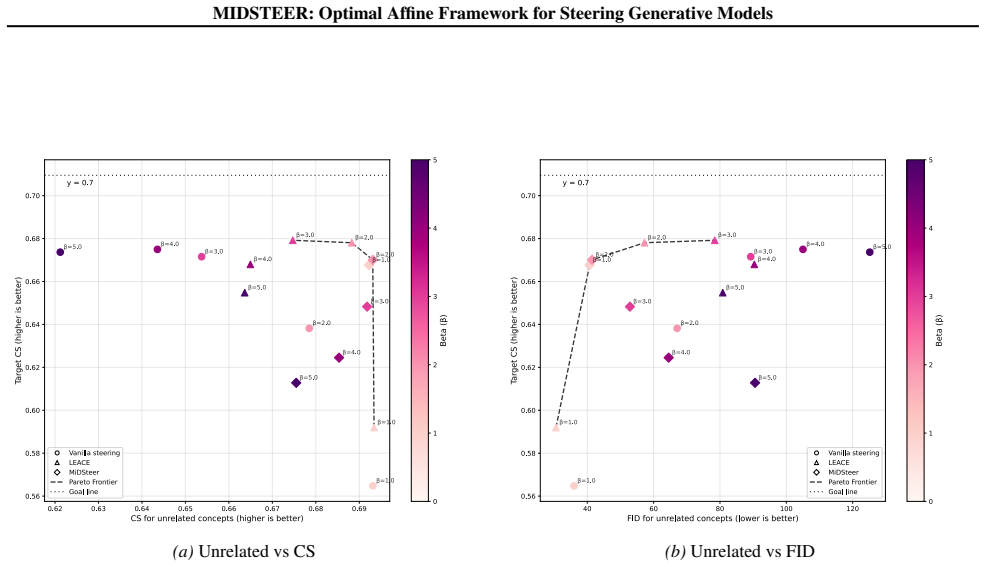


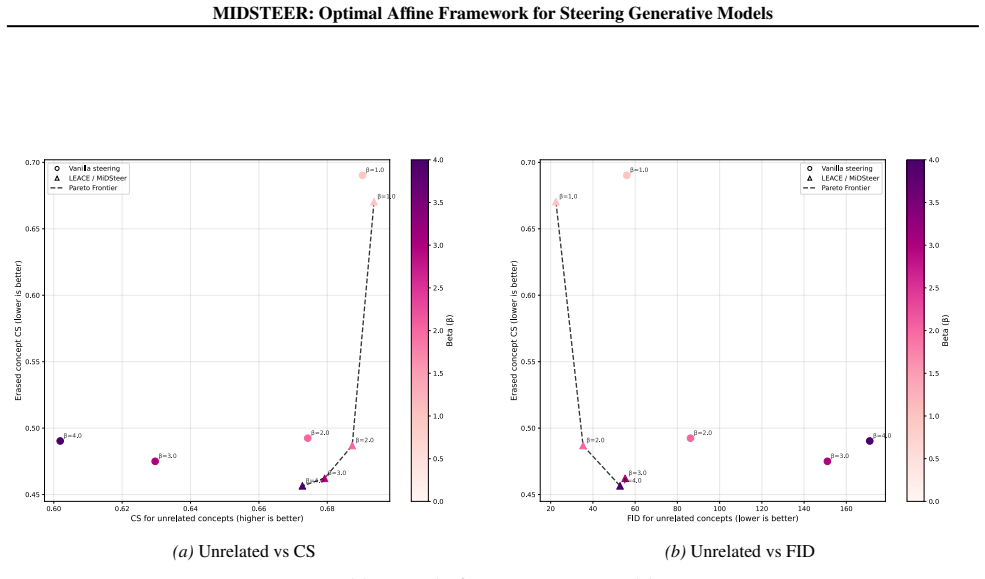
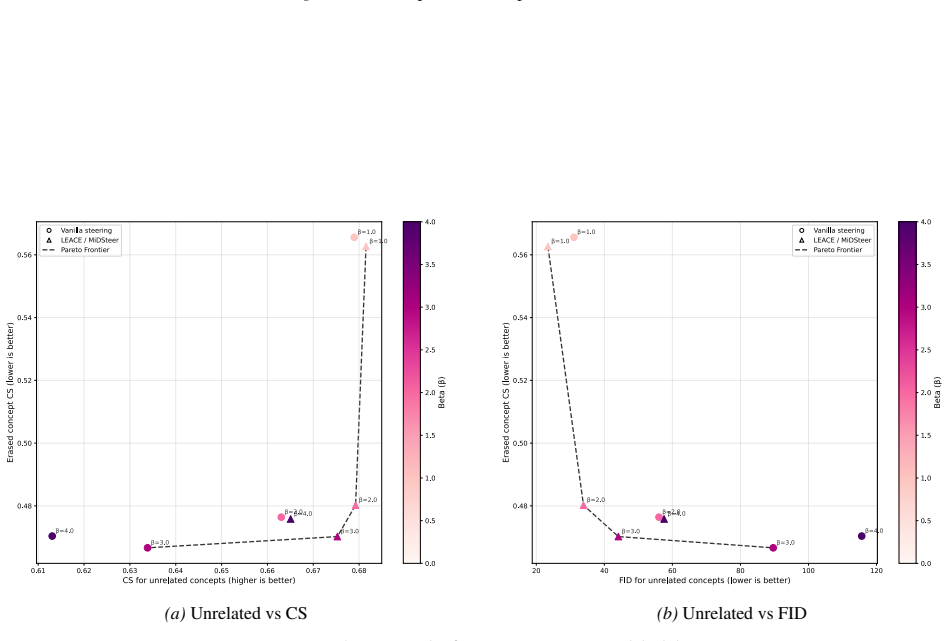
read the original abstract
Steering intermediate representations has emerged as a powerful strategy for controlling generative models, particularly in post-deployment alignment and safety settings. However, despite its empirical success, it currently lacks a comprehensive theoretical framework. In this paper, we bridge this gap by formalizing the theory of concept steering. First, we establish a link between steering and affine concept erasure, proving that the standard approach for removing unwanted behaviors is a special case of LEACE (a closed-form method for affine erasure). Next, we formulate a principled theoretical framework for concept switching, LEACE-Switch, and characterize the assumptions under which it provides an optimal affine solution. Building on this analysis, we then introduce MidSteer (Minimal Disturbance concept Steering), a more general affine framework for concept manipulation that relaxes these assumptions and enables directed, minimal-disturbance transformations. We demonstrate that MidSteer performs favorably across a range of tasks, modalities, and architectures, including vision diffusion models and large language models.
Editorial analysis
A structured set of objections, weighed in public.
Referee Report
Summary. The paper claims to formalize concept steering for generative models by proving that standard steering methods are a special case of LEACE affine erasure, characterizing the assumptions under which LEACE-Switch yields an optimal affine solution for concept switching, and introducing MidSteer as a relaxed affine framework for directed minimal-disturbance transformations. It supports these with empirical results showing favorable performance across vision diffusion models and large language models.
Significance. If the derivations hold, this provides a principled affine theory for post-hoc steering that could improve reliability in alignment and safety applications. The explicit relaxation of assumptions from LEACE-Switch and cross-modal empirical validation are strengths that would make the framework a useful reference for future steering work.
major comments (2)
- [Theoretical framework sections (post-abstract)] The central theoretical contribution rests on the claimed proof that standard steering is a special case of LEACE and the characterization of optimality assumptions for LEACE-Switch; however, the manuscript provides only high-level statements without the full derivations, error bounds, or explicit assumption lists (e.g., in the sections following the abstract), preventing verification that MidSteer indeed relaxes them without introducing new circularities or unstated restrictions on the representation space.
- [LEACE-Switch and MidSteer formulation] The optimality claim for LEACE-Switch and the minimal-disturbance guarantee for MidSteer are load-bearing; without the explicit conditions under which affine transformations suffice (referenced as relaxed in MidSteer) and any accompanying proof sketches or counterexample analysis, it is unclear whether the framework applies beyond the tested modalities or reduces to parameter fitting by construction.
minor comments (2)
- [Introduction] The abstract and introduction would benefit from a brief table or diagram contrasting the assumptions of LEACE, LEACE-Switch, and MidSteer to clarify the progression.
- [Experiments] Empirical sections should include more detail on baselines, exact metrics, and statistical significance to support the 'favorable performance' claim across architectures.
Simulated Author's Rebuttal
We thank the referee for the constructive feedback on our manuscript. We address each major comment point by point below, agreeing where the presentation requires expansion and outlining the specific revisions we will make.
read point-by-point responses
-
Referee: [Theoretical framework sections (post-abstract)] The central theoretical contribution rests on the claimed proof that standard steering is a special case of LEACE and the characterization of optimality assumptions for LEACE-Switch; however, the manuscript provides only high-level statements without the full derivations, error bounds, or explicit assumption lists (e.g., in the sections following the abstract), preventing verification that MidSteer indeed relaxes them without introducing new circularities or unstated restrictions on the representation space.
Authors: We agree that the main text presents the link to LEACE and the optimality characterization at a high level. In the revised manuscript we will add a dedicated appendix containing the complete derivations, including all error bounds and an explicit enumerated list of assumptions for both LEACE-Switch and MidSteer. The appendix will also include a direct comparison showing that the relaxation in MidSteer introduces no circularities and imposes no additional restrictions on the representation space beyond those already stated in the current text. revision: yes
-
Referee: [LEACE-Switch and MidSteer formulation] The optimality claim for LEACE-Switch and the minimal-disturbance guarantee for MidSteer are load-bearing; without the explicit conditions under which affine transformations suffice (referenced as relaxed in MidSteer) and any accompanying proof sketches or counterexample analysis, it is unclear whether the framework applies beyond the tested modalities or reduces to parameter fitting by construction.
Authors: We acknowledge that the conditions under which affine transformations are sufficient, together with proof sketches and counterexample analysis, were not provided. The revision will include (i) an explicit statement of the conditions for affine sufficiency, (ii) concise proof sketches for the optimality of LEACE-Switch and the minimal-disturbance property of MidSteer, and (iii) counterexamples illustrating cases where affine transformations are insufficient. These additions will clarify the scope of applicability and demonstrate that the framework is derived from the relaxed assumptions rather than being a post-hoc parameter fit. revision: yes
Axiom & Free-Parameter Ledger
axioms (2)
- domain assumption Standard removal of unwanted behaviors is a special case of LEACE affine erasure
- domain assumption Affine transformations can achieve directed minimal-disturbance concept steering
Reference graph
Works this paper leans on
-
[1]
arXiv preprint arXiv:2502.17601 , year=
Accessed: 2026-04-14. Bartoszcze, L., Munshi, S., Sukidi, B., Yen, J., Yang, Z., Williams-King, D., Le, L., Asuzu, K., and Maple, C. Representation engineering for large-language models: Survey and research challenges.CoRR, abs/2502.17601,
-
[5]
Emogen: Emotional image content generation with text-to-image diffusion models,
doi: 10.1109/CVPR52733.2024.00722. Naveed, H., Khan, A. U., Qiu, S., Saqib, M., An- war, S., Usman, M., Barnes, N., and Mian, A. A comprehensive overview of large language models. CoRR, abs/2307.06435, 2023. doi: 10.48550/ARXIV . 2307.06435. URLhttps://doi.org/10.48550/ arXiv.2307.06435. Panickssery, N., Gabrieli, N., Schulz, J., Tong, M., Hub- inger, E.,...
-
[6]
doi: 10.18653/v1/2024.acl-long
URL https://aclanthology.org/2023. acl-long.523/. Rimsky, N., Gabrieli, N., Schulz, J., Tong, M., Hubinger, E., and Turner, A. M. Steering llama 2 via contrastive activation addition. Association for Computational Lin- guistics, 2024. doi: 10.18653/V1/2024.ACL-LONG
-
[7]
URL https://doi.org/10.18653/v1/ 2024.acl-long.828. Schuhmann, C., Beaumont, R., Vencu, R., Gordon, C., Wightman, R., Cherti, M., Coombes, T., Katta, A., Mullis, C., Wortsman, M., Schramowski, P., Kundurthy, S., Crow- son, K., Schmidt, L., Kaczmarczyk, R., and Jitsev, J. LAION-5B: an open large-scale dataset for training next generation image-text models....
-
[9]
doi: 10.48550/ARXIV .2310.01405. URL https: //doi.org/10.48550/arXiv.2310.01405. 11 MIDSTEER: Optimal Affine Framework for Steering Generative Models A. Algorithm for computing covariances To estimate the covariances we use the algorithm by (Welford, 1962) on a sample of broad prompts (unrelated to the steering concepts). Given X with the dimension of bat...
work page internal anchor Pith review doi:10.48550/arxiv 1962
-
[10]
Find necessary conditions for optimality using Lagrange multipliers method
-
[11]
Show thatA ∗, b∗ satisfy the necessary conditions
-
[12]
15 MIDSTEER: Optimal Affine Framework for Steering Generative Models Let us formulate the Lagrangian
Show that optimisation problem is convex over linear constraints, and such, if a local solution exists, it is globally optimal and unique. 15 MIDSTEER: Optimal Affine Framework for Steering Generative Models Let us formulate the Lagrangian. HereΛ∈R d×k, because we haved·kconstraints on covariance matrix. L(A, b,Λ) = 1 2E h ∥AX+b−X∥ 2 2 i +⟨Λ,Cov(AX+b, Z) ...
-
[13]
Write a short story about a {}
-
[14]
Write a poem about a {}
-
[15]
What is the history of {}
-
[16]
What is the most famous {}?
-
[17]
What is the most expensive {}?
-
[18]
How to maintain a {}?
-
[19]
How to dispose of a {}?
-
[20]
How to transport a {}?
-
[21]
What is important to know about {}?
-
[22]
How to tell age of a {}?
-
[23]
What types of {} are there?
-
[24]
What are the most common {}?
-
[25]
Describe an appearance of {} in detail
-
[26]
How does {} look like?
-
[27]
How does {} sound like?
-
[28]
How does {} feel like?
-
[29]
How does {} behave like?
-
[30]
What is the purpose of {}?
-
[31]
What are the main components of a {}?
-
[32]
How to identify a {}?
-
[33]
Where can you find a {}?
-
[34]
What are the dangers of a {}?
-
[35]
What tools do you need for a {}?
-
[36]
How much does a {} typically cost?
-
[37]
What are alternatives to a {}?
-
[38]
How to choose a good {}?
-
[39]
What are common problems with a {}?
-
[40]
How long does a {} typically last?
-
[41]
What size is a typical {}?
-
[42]
What skills are needed to handle a {}?
-
[43]
What are the benefits of having a {}?
-
[44]
How has {} changed over time?
-
[45]
What cultures use {} the most?
-
[46]
How to test if a {} is working properly?
-
[47]
What safety precautions are needed for a {}?
-
[48]
How to upgrade or improve a {}?
-
[49]
How does weather affect a {}?
-
[50]
What are the environmental impacts of a {}? 21 MIDSTEER: Optimal Affine Framework for Steering Generative Models
-
[51]
How to measure the quality of a {}?
-
[52]
What accessories go with a {}?
-
[53]
How to protect a {} from damage?
-
[54]
What are myths about {}?
-
[55]
How to teach someone about a {}?
-
[56]
What industries use {}?
-
[57]
How is a {} different from similar things?
-
[58]
What are the legal considerations for owning a {}?
-
[59]
How to pack a {} for moving?
-
[60]
What are seasonal considerations for a {}?
-
[61]
How to customize a {}?
-
[62]
What are expert tips for using a {}?
-
[63]
How to troubleshoot issues with a {}?
-
[64]
What is the lifecycle of a {}?
-
[65]
How to estimate the value of a {}?
-
[66]
What are cultural significances of a {}?
-
[67]
How to take a picture of a {}?
-
[68]
How to make a sculpture of a {}?
-
[69]
What is the future of {}?
-
[70]
When was {} first mentioned in human history?
-
[71]
Write a song about {}
-
[72]
Write a positive review on a book about {}
-
[73]
Write a negative review on a book about {}
-
[74]
Do people make toys of {}?
-
[75]
How is {} used in the economy?
-
[76]
Write an abstract for a science paper about {}
-
[77]
How does temperature affect a {}?
-
[78]
What are the origins of the word {}?
-
[79]
What are superstitions about {}?
-
[80]
How to simulate a {} digitally?
-
[81]
What are the physics of a {}?
-
[82]
How to teach children about {}?
-
[83]
What are famous artworks featuring {}?
-
[84]
What are the nutritional aspects of a {}?
discussion (0)
Sign in with ORCID, Apple, or X to comment. Anyone can read and Pith papers without signing in.