Recognition: unknown
No model-independent evidence for a peak in binary black hole spin (mis)alignments
Pith reviewed 2026-05-08 15:51 UTC · model grok-4.3
The pith
No model-independent evidence for a peak in binary black hole spin tilts
A machine-rendered reading of the paper's core claim, the machinery that carries it, and where it could break.
Core claim
The central claim is that reports of a peak in binary black hole spin tilts are not robust: the data from the latest gravitational-wave catalog show no statistically significant or model-independent preference for aligned or misaligned spins, and the limited constraints per event prevent reliable identification of tilt-based subpopulations. Instead, the analysis recovers a clear correlation between black-hole mass and spin magnitude.
What carries the argument
Statistical tests for peaks and mass correlations in the spin-tilt distribution, applied to the fourth gravitational-wave transient catalog while marginalizing over population models and per-event measurement uncertainties.
If this is right
- Spin tilts cannot yet be used to separate isolated, dynamical, or triple formation channels for binary black holes.
- Analyses should prioritize spin-magnitude trends, which show a clearer mass dependence.
- Additional data will be required before tilt subpopulations can be confidently identified.
Where Pith is reading between the lines
- Better individual-event tilt constraints from future detectors could reveal a peak that current data miss.
- Mass-spin magnitude correlations may trace accretion or merger histories more directly than alignment does.
- Combining tilt data with other observables such as eccentricity could still help map formation pathways even without a tilt peak.
Load-bearing premise
The statistical framework and population models can reliably separate a genuine peak in tilts from noise or model errors despite weak constraints on each event's tilt.
What would settle it
A future catalog or reanalysis with tighter per-event tilt measurements that yields a statistically significant peak under multiple independent population models.
Figures



read the original abstract
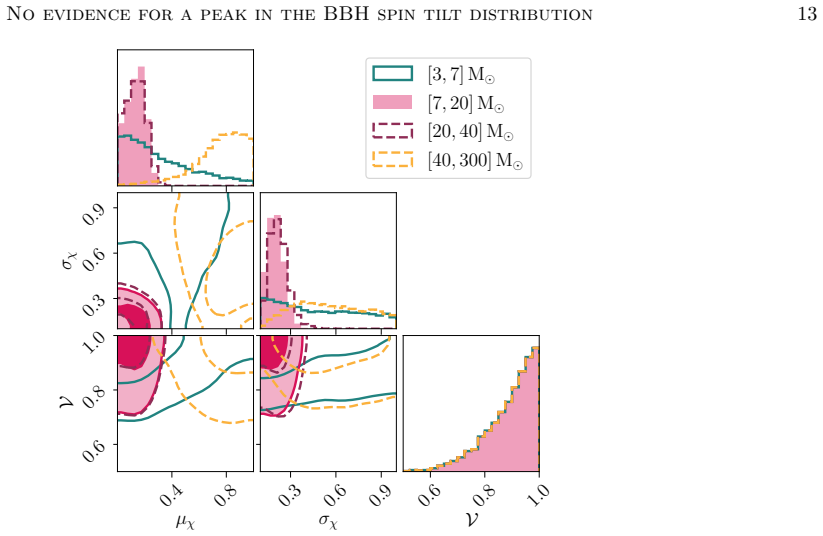
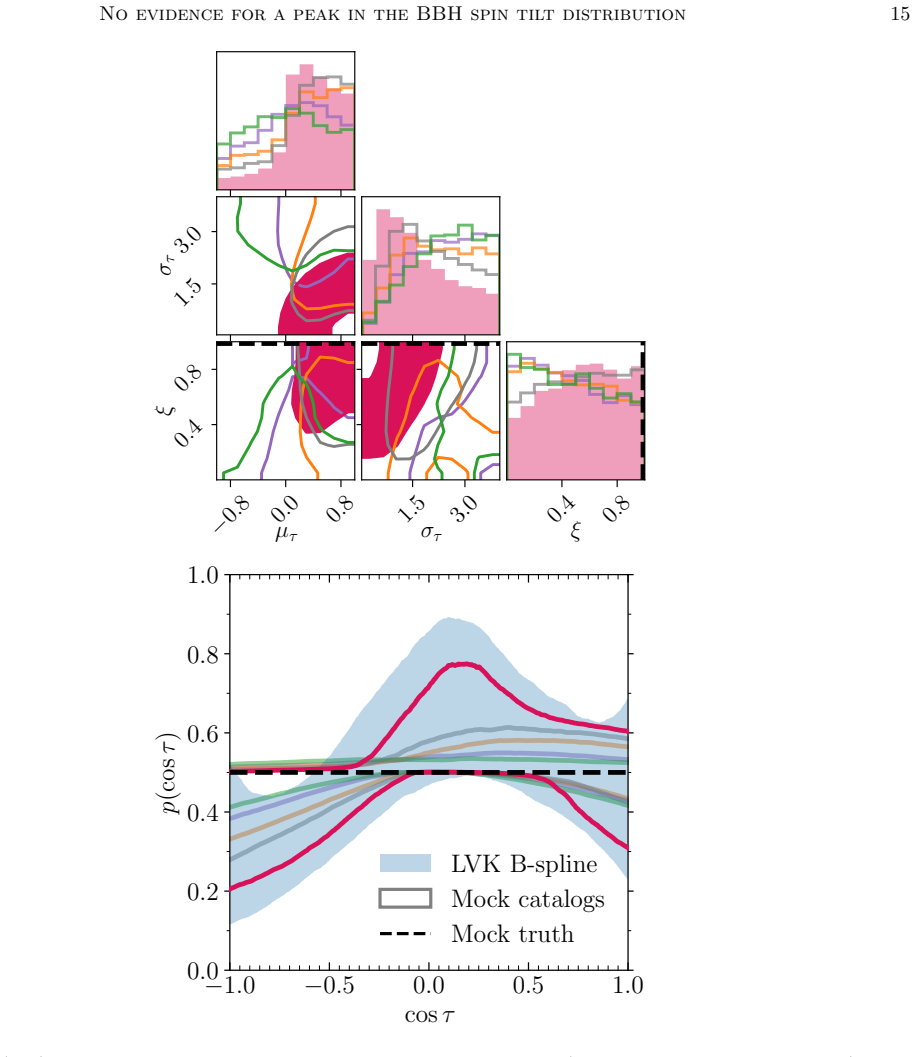
The degree of black-hole spin-orbit misalignment ("tilts") in the astrophysical population could be a powerful diagnostic to distinguish between binary formation in isolation, in dynamical environments, or in hierarchical triples. However, robust population-level spin tilt measurements are complicated by model misspecification as well as numerical and Poisson variance, ultimately owing to poor single-event constraints on tilts. Motivated by reports of a possible peak in the spin tilt distribution, we analyze the fourth LIGO-Virgo-KAGRA gravitational-wave transient catalog to test for preferred spin orientations at different black hole masses. We find that a peak in spin tilts is not statistically significant nor model independent. Since the data cannot be used to reliably identify subpopulations based on their spin tilt properties, we also consider a complementary approach: measuring the spin magnitude and tilt distributions at fixed mass scales. We find no confident correlation between mass and spin tilt, but we do confirm a confident correlation between spin magnitude and mass, corroborating recent analyses.
Editorial analysis
A structured set of objections, weighed in public.
Referee Report
Summary. The paper analyzes the GWTC-4 catalog to test for a peak in binary black hole spin tilts, concluding that any such peak lacks statistical significance and is not model-independent. It further reports no confident mass-tilt correlation but confirms a mass-spin magnitude correlation, attributing difficulties to poor single-event constraints, model misspecification, and variance.
Significance. If the central claim holds, the work usefully cautions against interpreting apparent tilt peaks as evidence for subpopulations or formation channels, while reinforcing the robustness of the mass-spin magnitude trend. It highlights the limitations of current data for tilt-based diagnostics and advocates complementary fixed-mass analyses.
major comments (1)
- The central claim that a peak is 'not statistically significant nor model independent' (abstract) depends on the hierarchical framework's ability to distinguish a narrow tilt peak from noise given broad per-event posteriors. A quantitative power analysis (e.g., recovery fraction for injected narrow peaks at cos θ = 1 under the adopted population models) is needed to establish that non-detection is informative rather than inconclusive due to limited sensitivity.
minor comments (2)
- Clarify in the methods section how post-hoc choices in binning or model selection were handled to avoid circularity in the model-independence assessment.
- Ensure all figures showing posterior distributions include explicit comparison to the null (flat or broad) model for direct visual assessment of deviation significance.
Simulated Author's Rebuttal
We thank the referee for their careful reading and constructive comments on our manuscript. The suggestion for a quantitative power analysis is well taken and directly strengthens the interpretation of our non-detection result. We address the comment below and have revised the manuscript accordingly.
read point-by-point responses
-
Referee: The central claim that a peak is 'not statistically significant nor model independent' (abstract) depends on the hierarchical framework's ability to distinguish a narrow tilt peak from noise given broad per-event posteriors. A quantitative power analysis (e.g., recovery fraction for injected narrow peaks at cos θ = 1 under the adopted population models) is needed to establish that non-detection is informative rather than inconclusive due to limited sensitivity.
Authors: We agree that a dedicated power analysis provides a more direct quantification of the framework's sensitivity. While our original results already show that tilt inferences are dominated by broad per-event posteriors (leading to large model-to-model variance and no robust peak across tested population models), we have added an injection-recovery study in the revised manuscript. We injected GWTC-4-like catalogs containing subpopulations with a narrow peak at cos θ = 1 (at fractions of 20–50%) and recovered them under the same hierarchical models used in the paper. The recovery fraction for a statistically significant peak is low (<30% even at 50% aligned fraction), confirming that the data lack the sensitivity to detect such features reliably. This supports our conclusion that the absence of evidence is informative rather than inconclusive, while preserving the model-independent nature of the claim. revision: yes
Circularity Check
No significant circularity detected
full rationale
The paper's central claim rests on hierarchical inference applied to public LIGO-Virgo-KAGRA catalog events to test for a peak in spin tilts. No load-bearing self-citations, self-definitional loops, or fitted parameters renamed as predictions are identifiable from the provided abstract and context. The non-detection of a statistically significant peak is presented as a data-driven statistical result rather than a quantity forced by construction from the inputs. The derivation chain is self-contained against external catalog data.
Axiom & Free-Parameter Ledger
Reference graph
Works this paper leans on
-
[1]
Aasi, J., et al. 2015, Class. Quant. Grav., 32, 074001, doi: 10.1088/0264-9381/32/7/074001
-
[2]
Abac, A. G., et al. 2025a, https://arxiv.org/abs/2508.18082
work page internal anchor Pith review arXiv
-
[3]
G., Abouelfettouh, I., Acernese, F., et al
Abac, A. G., et al. 2025b, Astrophys. J. Lett., 995, L18, doi: 10.3847/2041-8213/ae0c06
-
[4]
GWTC-4.0: Methods for Identifying and Characterizing Gravitational-wave Transients,
Abac, A. G., et al. 2025c, https://arxiv.org/abs/2508.18081
-
[5]
GWTC-4.0: Population Properties of Merging Compact Binaries
Abac, A. G., et al. 2025d, https://arxiv.org/abs/2508.18083
work page internal anchor Pith review arXiv
-
[6]
Abbott, R., et al. 2023, Phys. Rev. X, 13, 011048, doi: 10.1103/PhysRevX.13.011048
-
[7]
Abbott, R., et al. 2025a, GWTC-4.0: Parameter estimation data release, Zenodo, doi: 10.5281/zenodo.16053484
-
[8]
2025b, GWTC-4.0: O4a Search Sensitivity Estimates, doi: 10.5281/zenodo.16740117
Abbott, R., et al. 2025b, GWTC-4.0: O4a Search Sensitivity Estimates, doi: 10.5281/zenodo.16740117
-
[9]
2025c, GWTC-4.0 Cumulative Search Sensitivity Estimates, doi: 10.5281/zenodo.16740128
Abbott, R., et al. 2025c, GWTC-4.0 Cumulative Search Sensitivity Estimates, doi: 10.5281/zenodo.16740128
-
[10]
Abbott, R., et al. 2025d, GWTC-4.0: Population Properties of Merging Compact Binaries, Zenodo, doi: 10.5281/zenodo.16911563
-
[11]
2015, Classical and Quantum Gravity, 32, 024001, doi: 10.1088/0264-9381/32/2/024001
Acernese, F., et al. 2015, Class. Quant. Grav., 32, 024001, doi: 10.1088/0264-9381/32/2/024001
-
[12]
Progress of Theoretical and Experimental Physics , keywords =
Akutsu, T., et al. 2021, PTEP, 2021, 05A101, doi: 10.1093/ptep/ptaa125
-
[13]
L., Petrovich, C., & Fischer, C
Antonini, F., Rodriguez, C. L., Petrovich, C., & Fischer, C. L. 2018, Mon. Not. Roy. Astron. Soc., 480, L58, doi: 10.1093/mnrasl/sly126
-
[14]
Gravitational-wave constraints on the pair-instability mass gap and nuclear burning in massive stars
Antonini, F., Romero-Shaw, I., Callister, T., et al. 2025, https://arxiv.org/abs/2509.04637
work page internal anchor Pith review Pith/arXiv arXiv 2025
-
[15]
Ashton, G., et al. 2019, Astrophys. J. Suppl., 241, 27, doi: 10.3847/1538-4365/ab06fc
-
[16]
2024, https://arxiv.org/abs/2412.03461
Baibhav, V., & Kalogera, V. 2024, https://arxiv.org/abs/2412.03461
- [17]
-
[18]
Belczynski, K., et al. 2020, Astron. Astrophys., 636, A104, doi: 10.1051/0004-6361/201936528
-
[19]
2026, PhRvD, 113, 043048, doi: 10.1103/3mb7-vnft
Berti, E., Crescimbeni, F., Franciolini, G., et al. 2026, Phys. Rev. D, 113, 043048, doi: 10.1103/3mb7-vnft
-
[20]
Biscoveanu, S. 2026, Astrophys. J., 996, 95, doi: 10.3847/1538-4357/ae1a62
-
[21]
Biscoveanu, S., Isi, M., Varma, V., & Vitale, S. 2021, Phys. Rev. D, 104, 103018, doi: 10.1103/PhysRevD.104.103018
-
[22]
Blanchet, L. 2014, Living Reviews in Relativity, 17, 2, doi: 10.12942/lrr-2014-2
-
[23]
Buscicchio, R., Roebber, E., Goldstein, J. M., & Moore, C. J. 2019, PhRvD, 100, 084041, doi: 10.1103/PhysRevD.100.084041
-
[24]
Chatziioannou, K., Lovelace, G., Boyle, M., et al. 2018, Phys. Rev. D, 98, 044028, doi: 10.1103/PhysRevD.98.044028
-
[25]
Colleoni, M., Vidal, F. A. R., Garc´ ıa-Quir´ os, C., Ak¸ cay, S., & Bera, S. 2025, Phys. Rev. D, 111, 104019, doi: 10.1103/PhysRevD.111.104019
- [26]
-
[27]
Damour, T. 2001, Phys. Rev. D, 64, 124013, doi: 10.1103/PhysRevD.64.124013
-
[28]
2023, ApJ, 946, 16, doi: 10.3847/1538-4357/acb5ed
Edelman, B., Farr, B., & Doctor, Z. 2023, Astrophys. J., 946, 16, doi: 10.3847/1538-4357/acb5ed
-
[29]
Precision Requirements for Monte Carlo Sums within Hierarchical Bayesian Inference
Essick, R., & Farr, W. 2022, https://arxiv.org/abs/2204.00461
-
[30]
Essick, R., et al. 2025, Phys. Rev. D, 112, 102001, doi: 10.1103/44x3-hv3y
-
[31]
M., Vijaykumar, A., & Fishbach, M
Farah, A. M., Vijaykumar, A., & Fishbach, M. 2026, Astrophys. J. Lett., 1001, L40, doi: 10.3847/2041-8213/ae4e19
-
[32]
2019, The Astrophysical Journal, 887, 53, doi: 10.3847/1538-4357/ab518b
Justham, S. 2019, ApJ, 887, 53, doi: 10.3847/1538-4357/ab518b
-
[33]
Farr, W. M., Stevenson, S., Coleman Miller, M., et al. 2017, Nature, 548, 426, doi: 10.1038/nature23453
-
[34]
The Astrophysical Journal Letters , author =
Fishbach, M., Holz, D. E., & Farr, W. M. 2018, Astrophys. J. Lett., 863, L41, doi: 10.3847/2041-8213/aad800
-
[35]
Foreman-Mackey, D., Hogg, D. W., Lang, D., & Goodman, J. 2013, PASP, 125, 306, doi: 10.1086/670067
-
[36]
2019, ApJL, 881, L1, doi: 10.3847/2041-8213/ab339b
Fuller, J., & Ma, L. 2019, Astrophys. J. Lett., 881, L1, doi: 10.3847/2041-8213/ab339b
-
[37]
Gerosa, D., Berti, E., O’Shaughnessy, R., et al. 2018, Phys. Rev. D, 98, 084036, doi: 10.1103/PhysRevD.98.084036
-
[38]
2021, Nature Astronomy, 5, 749, doi: 10.1038/s41550-021-01398-w
Gerosa, D., & Fishbach, M. 2021, Nature Astron., 5, 749, doi: 10.1038/s41550-021-01398-w
-
[39]
Golomb, J., & Talbot, C. 2023, Phys. Rev. D, 108, 103009, doi: 10.1103/PhysRevD.108.103009
-
[40]
Green, R., Hoy, C., Fairhurst, S., et al. 2021, Phys. Rev. D, 103, 124023, doi: 10.1103/PhysRevD.103.124023
-
[41]
Guttman, N., Payne, E., Lasky, P. D., & Thrane, E. 2026, Astrophys. J., 996, 144, doi: 10.3847/1538-4357/ae17af
- [42]
-
[43]
Kalogera, V. 2000, Astrophys. J., 541, 319, doi: 10.1086/309400
-
[44]
doi:10.5281/zenodo.12537467 , version =
Koposov, S., Speagle, J., Barbary, K., et al. 2024, joshspeagle/dynesty: v2.1.4, v2.1.4 Zenodo, doi: 10.5281/zenodo.12537467
-
[45]
Krishnendu, N. V., & Ohme, F. 2022, Phys. Rev. D, 105, 064012, doi: 10.1103/PhysRevD.105.064012
-
[46]
Liu, B., & Lai, D. 2018, Astrophys. J., 863, 68, doi: 10.3847/1538-4357/aad09f No evidence for a peak in the BBH spin tilt distribution17
-
[47]
Mandel, I., Farr, W. M., & Gair, J. R. 2019, Mon. Not. Roy. Astron. Soc., 486, 1086, doi: 10.1093/mnras/stz896
-
[48]
Messenger, C., & Veitch, J. 2013, New J. Phys., 15, 053027, doi: 10.1088/1367-2630/15/5/053027
-
[49]
Hourihane, S. 2025, Phys. Rev. D, 112, 104046, doi: 10.1103/xq5g-zm7z
-
[50]
J., Ko, Z., Callister, T., & Chatziioannou, K
Miller, S. J., Ko, Z., Callister, T., & Chatziioannou, K. 2024, Phys. Rev. D, 109, 104036, doi: 10.1103/PhysRevD.109.104036
-
[51]
Signatures of a subpopulation of hierarchical mergers in the GWTC-4 gravitational-wave dataset
Plunkett, C., Callister, T., Zevin, M., & Vitale, S. 2026, https://arxiv.org/abs/2601.07908
work page internal anchor Pith review Pith/arXiv arXiv 2026
-
[52]
Pratten, G., Schmidt, P., Buscicchio, R., & Thomas, L. M. 2020, Phys. Rev. Res., 2, 043096, doi: 10.1103/PhysRevResearch.2.043096
-
[53]
Pratten, G., et al. 2021, Phys. Rev. D, 103, 104056, doi: 10.1103/PhysRevD.103.104056
-
[54]
Racine, E. 2008, Phys. Rev. D, 78, 044021, doi: 10.1103/PhysRevD.78.044021
-
[55]
2026, arXiv e-prints, arXiv:2603.17987, doi: 10.48550/arXiv.2603.17987
Ray, A., Mukherjee, S., Zevin, M., & Kalogera, V. 2026, https://arxiv.org/abs/2603.17987
-
[56]
Rodriguez, C. L., & Antonini, F. 2018, Astrophys. J., 863, 7, doi: 10.3847/1538-4357/aacea4
-
[57]
L., Zevin, M., Amaro-Seoane, P., et al
Rodriguez, C. L., Zevin, M., Amaro-Seoane, P., et al. 2019, Phys. Rev. D, 100, 043027, doi: 10.1103/PhysRevD.100.043027
-
[58]
Rasio, F. A. 2016, ApJL, 832, L2, doi: 10.3847/2041-8205/832/1/L2
-
[59]
Rodriguez, C. L., Weatherford, N. C., Coughlin, S. C., et al. 2022, ApJS, 258, 22, doi: 10.3847/1538-4365/ac2edf
-
[60]
Shaik, F. H., Lange, J., Field, S. E., et al. 2020, Phys. Rev. D, 101, 124054, doi: 10.1103/PhysRevD.101.124054
-
[61]
Speagle, J. S. 2020, Mon. Not. Roy. Astron. Soc., 493, 3132, doi: 10.1093/mnras/staa278
-
[62]
Stegmann, J., Antonini, F., Olejak, A., et al. 2026, Astrophys. J. Lett., 1000, L59, doi: 10.3847/2041-8213/ae52ec
-
[63]
Su, Y., Lai, D., & Liu, B. 2021, Phys. Rev. D, 103, 063040, doi: 10.1103/PhysRevD.103.063040
-
[64]
2025, Journal of Open Source Software, 10, 7753, doi: 10.21105/joss.07753
Talbot, C., Farah, A., Galaudage, S., Golomb, J., & Tong, H. 2025, Journal of Open Source Software, 10, 7753, doi: 10.21105/joss.07753
-
[65]
Talbot, C., & Golomb, J. 2023, Mon. Not. Roy. Astron. Soc., 526, 3495, doi: 10.1093/mnras/stad2968
-
[66]
2017, Physical Review D, 96, 023012, doi: 10.1103/PhysRevD.96.023012
Talbot, C., & Thrane, E. 2017, Phys. Rev. D, 96, 023012, doi: 10.1103/PhysRevD.96.023012
-
[67]
Tiwari, V. 2018, Class. Quant. Grav., 35, 145009, doi: 10.1088/1361-6382/aac89d
-
[68]
Tong, H., Callister, T. A., Fishbach, M., et al. 2025, https://arxiv.org/abs/2511.05316
-
[69]
Varma,et al., Surrogate models for precessing binary black hole simulations with unequal masses.Phys
Varma, V., Field, S. E., Scheel, M. A., et al. 2019, Phys. Rev. Research., 1, 033015, doi: 10.1103/PhysRevResearch.1.033015
-
[70]
Vijaykumar, A., Farah, A. M., & Fishbach, M. 2026, Astrophys. J. Lett., 999, L30, doi: 10.3847/2041-8213/ae4878
-
[71]
Vitale, S., Biscoveanu, S., & Talbot, C. 2022, Astron. Astrophys., 668, L2, doi: 10.1051/0004-6361/202245084
-
[72]
Vitale, S., Gerosa, D., Farr, W. M., & Taylor, S. R. 2020, in Handbook of Gravitational Wave Astronomy, ed. C. Bambi, S. Katsanevas, & K. D. Kokkotas (Singapore: Springer), 1–60, doi: 10.1007/978-981-15-4702-7 45-1
-
[73]
Vitale, S., Lynch, R., Raymond, V., et al. 2017a, Phys. Rev. D, 95, 064053, doi: 10.1103/PhysRevD.95.064053
-
[74]
Vitale, S., Lynch, R., Sturani, R., & Graff, P. 2017b, Class. Quant. Grav., 34, 03LT01, doi: 10.1088/1361-6382/aa552e
-
[75]
Vitale, S., & Mould, M. 2025, Phys. Rev. D, 112, 083015, doi: 10.1103/drsl-n3wz
-
[76]
Vousden, W. D., Farr, W. M., & Mandel, I. 2016, MNRAS, 455, 1919, doi: 10.1093/mnras/stv2422
-
[77]
E., Mould, M., Heinzel, J., & Vitale, S
Wolfe, N. E., Mould, M., Heinzel, J., & Vitale, S. 2025, https://arxiv.org/abs/2510.06220
-
[78]
Wolfe, N. E., Talbot, C., & Golomb, J. 2023, Phys. Rev. D, 107, 104056, doi: 10.1103/PhysRevD.107.104056
-
[79]
Yu, H., Ma, S., Giesler, M., & Chen, Y. 2020, Phys. Rev. D, 102, 123009, doi: 10.1103/PhysRevD.102.123009
discussion (0)
Sign in with ORCID, Apple, or X to comment. Anyone can read and Pith papers without signing in.