Recognition: unknown
HOLISMOKES XXI: Detecting strongly lensed type Ia supernovae from time series of multi-band LSST-like imaging data -- Part II
Pith reviewed 2026-05-08 16:19 UTC · model grok-4.3
The pith
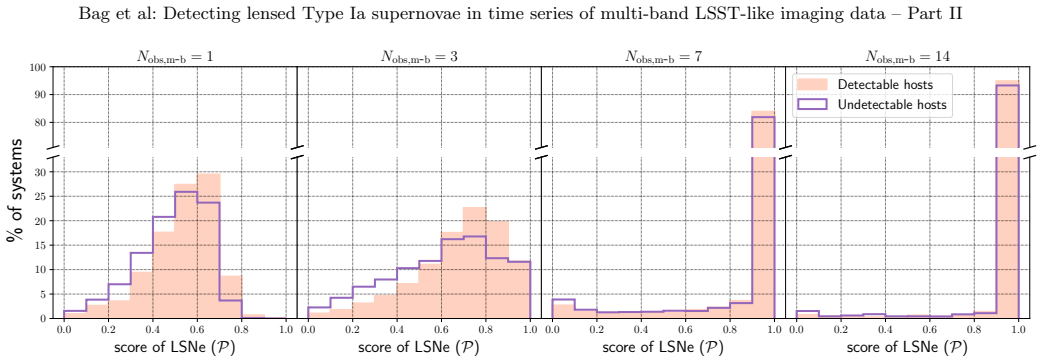
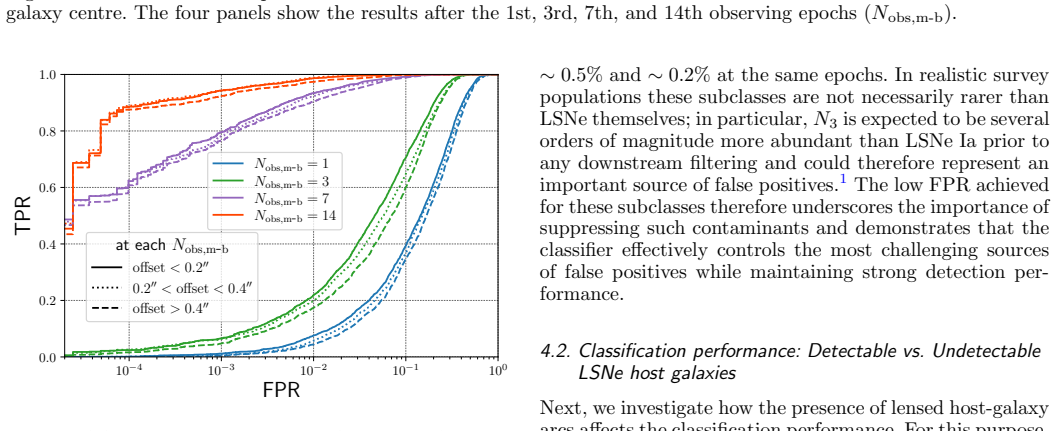
A deep learning model using convolutional LSTM detects strongly lensed Type Ia supernovae from realistic multi-band time-series images, achieving approximately 60 percent true-positive rate at a false-positive rate of order 10 to the minus
A machine-rendered reading of the paper's core claim, the machinery that carries it, and where it could break.
Core claim
We extend the previous convolutional LSTM framework by constructing realistic image time series from HSC PDR3 observations, introducing epoch-to-epoch PSF variations with variance-map corrections, simulated lensed arcs, SN light-curve variations, Poisson noise, and foreground SN Ia contaminants. Despite these additions, the model reaches a true-positive rate of ~60% at a false-positive rate of O(10^{-4}) by the seventh observation and ~80% by the tenth. We also examine confusion with sibling SNe in LRGs and identify mimicking configurations.
What carries the argument
The convolutional LSTM architecture that processes multi-band, multi-epoch image cutouts to capture spatiotemporal correlations and update classifications with each new observation.
If this is right
- The classifier supports real-time LSN searches in LSST alert streams.
- Detection performance improves rapidly with additional epochs of observation.
- Foreground lens-galaxy supernovae form an important false-positive class that must be distinguished.
- Specific configurations of sibling supernovae can be used to improve model robustness.
Where Pith is reading between the lines
- The robustness suggests the model is ready for deployment on early LSST data without extensive additional tuning.
- Similar time-series approaches could be tested for detecting other lensed transients such as core-collapse supernovae or quasars.
- If the low false-positive rate holds on real data, it would greatly reduce the resources needed for spectroscopic follow-up of candidates.
Load-bearing premise
The HSC PDR3-based simulations with injected lensed arcs, SN light-curve variations, Poisson noise, and PSF variations sufficiently capture the statistical properties of real LSST observations and all relevant false-positive classes.
What would settle it
Comparing the model's receiver operating characteristic curves on actual LSST observations against the simulated performance curves would confirm or refute the reported true-positive and false-positive rates.
Figures



read the original abstract
Strong gravitationally lensed supernovae (LSNe) are rare but extremely valuable probes of cosmology and astrophysics. Prompt identification within the alert streams of time-domain surveys such as the Rubin Legacy Survey of Space and Time (LSST) is essential for timely follow-up observations. In our previous study, Bag et al. (2026), we introduced a deep-learning framework for detecting LSNe Ia directly from multi-band, multi-epoch image cutouts. The model employs a convolutional LSTM architecture to capture spatiotemporal correlations in time-series imaging data, enabling classification updates as new observations arrive. In this work, we extend that framework by incorporating greater realism into the simulations. In particular, we present a method to construct realistic image time series from single-epoch observations by introducing epoch-to-epoch point spread function variations with corresponding variance-map corrections. The dataset is based on HSC PDR3 observations and includes simulated lensed host-galaxy arcs, SN light-curve variations, and Poisson noise. We also introduce an additional negative class consisting of SN Ia occurring in the foreground lens galaxy, representing a challenging source of false positives. Despite these additional complexities, the model retains strong performance. The receiver operating characteristic improves rapidly during the first few observations, reaching a true-positive rate of $\sim60\%$ at a false-positive rate of $\mathcal{O}(10^{-4})$ by the seventh observation and $\sim80\%$ by the tenth. We also investigate potential confusion with sibling SNe occurring in LRGs and identify the configurations that best mimic lensed systems. These results demonstrate that the image-time-series approach remains robust under more realistic observing conditions, and is well suited for real-time LSN searches in LSST and other time-domain surveys.
Editorial analysis
A structured set of objections, weighed in public.
Referee Report
Summary. This paper extends a prior convolutional LSTM framework for detecting strongly lensed Type Ia supernovae (LSNe Ia) from multi-band, multi-epoch image cutouts. It adds realism to HSC PDR3-based simulations by introducing epoch-to-epoch PSF variations with variance-map corrections, Poisson noise, simulated lensed host arcs, SN light-curve variations, and an extra negative class of foreground SN Ia in the lens galaxy. Despite these complexities, the model shows rapid improvement in ROC performance, reaching a true-positive rate of ~60% at a false-positive rate of O(10^{-4}) by the seventh observation and ~80% by the tenth, with additional analysis of confusion from sibling SNe in LRGs. The work concludes that the approach is robust and suitable for real-time LSST searches.
Significance. If the simulations prove representative, the results provide concrete evidence that a spatiotemporal deep-learning classifier can maintain useful detection efficiency under realistic multi-epoch conditions, which is valuable for prompt follow-up of rare LSNe Ia in LSST alert streams. The explicit addition of PSF variations, variance corrections, and a challenging foreground contaminant class strengthens the practical relevance beyond the earlier study.
major comments (1)
- [Abstract and dataset construction] The central performance claim (TPR ~60% at FPR O(10^{-4}) by epoch 7, ~80% by epoch 10) is obtained exclusively on a test set constructed from HSC PDR3 single-epoch images with added epoch-to-epoch PSF variations, variance-map corrections, Poisson noise, injected lensed arcs, SN light-curve variations, and foreground SN Ia contaminants. This construction implicitly assumes that the resulting statistical properties match those of real LSST difference imaging; unmodeled effects such as correlated read noise, filter-dependent depth variations, or additional variable-source classes (AGN, stellar flares) could alter the decision boundary. Because this assumption is load-bearing for the claim that the method is 'well suited for real-time LSN searches in LSST', a quantitative sensitivity test or direct comparison against more comprehensive LSST mocks is required.
minor comments (2)
- [Abstract] The abstract employs both ~ and mathcal{O} notation; ensure identical usage and explicit definitions appear in the main text and figure captions.
- [Methods] A table listing the exact simulation parameters (PSF variation model, noise levels, number of injected arcs, etc.) would improve reproducibility.
Simulated Author's Rebuttal
We thank the referee for their careful and constructive review of our manuscript. The concern about the degree of realism in our simulations relative to full LSST difference imaging is valid, and we have revised the text to acknowledge limitations while preserving the core results.
read point-by-point responses
-
Referee: The central performance claim (TPR ~60% at FPR O(10^{-4}) by epoch 7, ~80% by epoch 10) is obtained exclusively on a test set constructed from HSC PDR3 single-epoch images with added epoch-to-epoch PSF variations, variance-map corrections, Poisson noise, injected lensed arcs, SN light-curve variations, and foreground SN Ia contaminants. This construction implicitly assumes that the resulting statistical properties match those of real LSST difference imaging; unmodeled effects such as correlated read noise, filter-dependent depth variations, or additional variable-source classes (AGN, stellar flares) could alter the decision boundary. Because this assumption is load-bearing for the claim that the method is 'well suited for real-time LSN searches in LSST', a quantitative sensitivity test or direct comparison against more comprehensive LSST mocks is required.
Authors: We agree that our simulations, although they incorporate PSF variations, variance-map corrections, Poisson noise, lensed host arcs, SN light-curve variations, and foreground SN Ia contaminants, do not capture every possible effect present in real LSST difference imaging. Unmodeled contributions such as correlated read noise, filter-dependent depth variations, and additional variable-source classes (e.g., AGN or stellar flares) could in principle shift the decision boundary. In the revised manuscript we have added a new subsection (Section 5.3) that explicitly discusses these limitations and qualitatively assesses their likely impact on classifier performance. We have also revised the abstract and concluding paragraph to replace the phrase 'well suited for real-time LSN searches in LSST' with the more cautious statement that the approach 'shows promise under LSST-like conditions and merits further validation with more complete simulations.' A quantitative sensitivity test or direct comparison against comprehensive LSST mocks would require generation or access to substantially more advanced mock datasets and is outside the scope of the present study; such work is planned for a follow-up investigation. revision: partial
- Quantitative sensitivity tests to unmodeled effects (correlated read noise, AGN, stellar flares, filter-dependent depth variations) or direct comparison against full LSST mocks cannot be performed within the current revision.
Circularity Check
Minor self-citation to prior architecture paper; new performance metrics computed on independently generated simulations with added realism
full rationale
The paper cites Bag et al. (2026) only to introduce the convolutional LSTM framework and then evaluates an extended version on a fresh set of HSC PDR3-based simulations that inject epoch-to-epoch PSF variations, variance-map corrections, Poisson noise, lensed arcs, SN light-curve variations, and foreground SN Ia contaminants. The reported TPR/FPR values (∼60 % at O(10^{-4}) by epoch 7, ∼80 % by epoch 10) are measured directly on this new test set and do not reduce to any fitted parameter or self-cited equation by construction. No self-definitional loops, fitted-input-as-prediction, or load-bearing uniqueness theorems appear in the derivation chain. The self-citation is therefore non-load-bearing and the overall circularity remains minimal.
Axiom & Free-Parameter Ledger
free parameters (2)
- convLSTM architecture hyperparameters
- PSF variation model parameters
axioms (1)
- domain assumption HSC PDR3 single-epoch images plus injected lensed arcs and SN light curves plus Poisson noise plus PSF variations statistically match future LSST observations
Reference graph
Works this paper leans on
-
[1]
HOLISMOKES. IX. Neural network inference of strong-lens parameters and uncertainties from ground-based images. , keywords =. doi:10.1051/0004-6361/202244325 , archivePrefix =. 2206.11279 , primaryClass =
-
[2]
HOLISMOKES. I. Highly Optimised Lensing Investigations of Supernovae, Microlensing Objects, and Kinematics of Ellipticals and Spirals. , keywords =. doi:10.1051/0004-6361/202037757 , archivePrefix =. 2002.08378 , primaryClass =
-
[3]
A targeted search for strongly lensed supernovae with the Las Cumbres Observatory. , keywords =. doi:10.1093/mnras/stae2103 , archivePrefix =. 2111.01680 , primaryClass =
-
[4]
2007, ApJS, 172, 1, doi: 10.1086/516585
The Cosmic Evolution Survey (COSMOS): Overview. , keywords =. doi:10.1086/516585 , archivePrefix =. astro-ph/0612305 , primaryClass =
-
[5]
The Fourteenth Data Release of the Sloan Digital Sky Survey: First Spectroscopic Data from the Extended Baryon Oscillation Spectroscopic Survey and from the Second Phase of the Apache Point Observatory Galactic Evolution Experiment. , keywords =. doi:10.3847/1538-4365/aa9e8a , archivePrefix =. 1707.09322 , primaryClass =
-
[6]
The SDSS-IV Extended Baryon Oscillation Spectroscopic Survey: Baryon Acoustic Oscillations at Redshift of 0.72 with the DR14 Luminous Red Galaxy Sample. , keywords =. doi:10.3847/1538-4357/aacea5 , archivePrefix =. 1712.08064 , primaryClass =
-
[7]
Lensed quasar search via time variability with the HSC transient survey. , keywords =. doi:10.1051/0004-6361/201936806 , archivePrefix =. 1910.01140 , primaryClass =
-
[8]
Strongly lensed candidates from the HSC transient survey. , keywords =. doi:10.1051/0004-6361/202039376 , archivePrefix =. 2009.07854 , primaryClass =
-
[9]
Publications of the Astronomical Society of the Pacific , author =
Cosmic-Ray Rejection by Laplacian Edge Detection. , keywords =. doi:10.1086/323894 , archivePrefix =. astro-ph/0108003 , primaryClass =
-
[10]
Second data release of the Hyper Suprime-Cam Subaru Strategic Program. , keywords =. doi:10.1093/pasj/psz103 , archivePrefix =. 1905.12221 , primaryClass =
-
[11]
2014, ARA&A, 52, 107, https://doi.org/10.1146/annurev-astro-082812-141031
Observational Clues to the Progenitors of Type Ia Supernovae. , keywords =. doi:10.1146/annurev-astro-082812-141031 , archivePrefix =. 1312.0628 , primaryClass =
-
[12]
2018, PASJ, 70, S4, doi: 10.1093/pasj/psx066
The Hyper Suprime-Cam SSP Survey: Overview and survey design. , keywords =. doi:10.1093/pasj/psx066 , archivePrefix =. 1704.05858 , primaryClass =
-
[13]
The Subaru/XMM-Newton Deep Survey (SXDS). II. Optical Imaging and Photometric Catalogs. , keywords =. doi:10.1086/527321 , archivePrefix =. 0801.4017 , primaryClass =
-
[15]
Planck 2015 results. XIII. Cosmological parameters. , archivePrefix = "arXiv", eprint =. doi:10.1051/0004-6361/201525830 , adsurl =
-
[16]
HOLISMOKES: XIII. Strong-lens candidates at all mass scales and their environments from the Hyper-Suprime Cam and deep learning. , keywords =. doi:10.1051/0004-6361/202450927 , archivePrefix =. 2405.20383 , primaryClass =
-
[17]
The Hyper Suprime-Cam SSP transient survey in COSMOS: Overview. , keywords =. doi:10.1093/pasj/psz050 , archivePrefix =. 1904.09697 , primaryClass =
-
[18]
2022, MNRAS, 509, 3966, doi: 10.1093/mnras/stab2093
Galaxy Zoo DECaLS: Detailed visual morphology measurements from volunteers and deep learning for 314 000 galaxies. , keywords =. doi:10.1093/mnras/stab2093 , archivePrefix =. 2102.08414 , primaryClass =
-
[19]
2023, MNRAS, 526, 4768, doi: 10.1093/mnras/stad2919 38Pfeifle et al
Galaxy Zoo DESI: Detailed morphology measurements for 8.7M galaxies in the DESI Legacy Imaging Surveys. , keywords =. doi:10.1093/mnras/stad2919 , archivePrefix =. 2309.11425 , primaryClass =
-
[20]
The Hubble Ultra Deep Field. , keywords =. doi:10.1086/507302 , archivePrefix =. astro-ph/0607632 , primaryClass =
-
[21]
The MUSE Hubble Ultra Deep Field Survey. II. Spectroscopic redshifts and comparisons to color selections of high-redshift galaxies. , keywords =. doi:10.1051/0004-6361/201731195 , archivePrefix =. 1710.03773 , primaryClass =
-
[22]
HOLISMOKES. IV. Efficient mass modeling of strong lenses through deep learning. , keywords =. doi:10.1051/0004-6361/202039574 , archivePrefix =. 2010.00602 , primaryClass =
-
[23]
HOLISMOKES. VI. New galaxy-scale strong lens candidates from the HSC-SSP imaging survey. , keywords =. doi:10.1051/0004-6361/202141758 , archivePrefix =. 2107.07829 , primaryClass =
-
[24]
Evaluation of supervised neural networks for strong-lens searches in ground-based imaging surveys
HOLISMOKES: XI. Evaluation of supervised neural networks for strong-lens searches in ground-based imaging surveys. , keywords =. doi:10.1051/0004-6361/202347072 , archivePrefix =. 2306.03136 , primaryClass =
-
[25]
HOLISMOKES. II. Identifying galaxy-scale strong gravitational lenses in Pan-STARRS using convolutional neural networks. , keywords =. doi:10.1051/0004-6361/202038219 , archivePrefix =. 2004.13048 , primaryClass =
-
[26]
The strong gravitational lens finding challenge. , keywords =. doi:10.1051/0004-6361/201832797 , archivePrefix =. 1802.03609 , primaryClass =
-
[27]
An Extended Catalog of Galaxy-Galaxy Strong Gravitational Lenses Discovered in DES Using Convolutional Neural Networks. , keywords =. doi:10.3847/1538-4365/ab26b6 , archivePrefix =. 1905.10522 , primaryClass =
-
[28]
Finding strong gravitational lenses in the Kilo Degree Survey with Convolutional Neural Networks. , keywords =. doi:10.1093/mnras/stx2052 , archivePrefix =. 1702.07675 , primaryClass =
-
[29]
Prediction of Supernova Rates in Known Galaxy-Galaxy Strong-lens Systems. , keywords =. doi:10.3847/1538-4357/aad5ea , archivePrefix =. 1803.07569 , primaryClass =
-
[30]
Detectability and Characterisation of Strongly Lensed Supernova Lightcurves in the Zwicky Transient Facility. arXiv e-prints , keywords =. doi:10.48550/arXiv.2406.00052 , archivePrefix =. 2406.00052 , primaryClass =
-
[31]
Rates and Properties of Supernovae Strongly Gravitationally Lensed by Elliptical Galaxies in Time-domain Imaging Surveys. , keywords =. doi:10.3847/1538-4365/ab1fe0 , archivePrefix =. 1809.10147 , primaryClass =
-
[32]
LSST: From Science Drivers to Reference Design and Anticipated Data Products. , keywords =. doi:10.3847/1538-4357/ab042c , archivePrefix =. 0805.2366 , primaryClass =
-
[33]
TDCOSMO. I. An exploration of systematic uncertainties in the inference of H _ 0 from time-delay cosmography. , keywords =. doi:10.1051/0004-6361/201937351 , archivePrefix =. 1912.08027 , primaryClass =
-
[34]
STRIDES: a 3.9 per cent measurement of the Hubble constant from the strong lens system DES J0408-5354. , keywords =. doi:10.1093/mnras/staa828 , archivePrefix =. 1910.06306 , primaryClass =
-
[35]
Cosmology intertwined: A review of the particle physics, astrophysics, and cosmology associated with the cosmological tensions and anomalies. Journal of High Energy Astrophysics , keywords =. doi:10.1016/j.jheap.2022.04.002 , archivePrefix =. 2203.06142 , primaryClass =
work page internal anchor Pith review doi:10.1016/j.jheap.2022.04.002 2022
-
[36]
Statistical strong lensing. II. Cosmology and galaxy structure with time-delay lenses. , keywords =. doi:10.1051/0004-6361/202142062 , archivePrefix =. 2109.00009 , primaryClass =
-
[38]
2237+0305 : a new and unusual gravitational lens. , keywords =. doi:10.1086/113777 , adsurl =
-
[40]
TDCOSMO. IV. Hierarchical time-delay cosmography - joint inference of the Hubble constant and galaxy density profiles. , keywords =. doi:10.1051/0004-6361/202038861 , archivePrefix =. 2007.02941 , primaryClass =
-
[41]
2003, MNRAS, 340, 1214, doi: 10.1046/j.1365-8711.2003.06380.x
The Cosmic Lens All-Sky Survey - II. Gravitational lens candidate selection and follow-up. , keywords =. doi:10.1046/j.1365-8711.2003.06257.x , archivePrefix =. astro-ph/0211069 , primaryClass =
-
[42]
Overview and classification of candidates selected by two techniques
The STRong lensing Insights into the Dark Energy Survey (STRIDES) 2016 follow-up campaign - I. Overview and classification of candidates selected by two techniques. , keywords =. doi:10.1093/mnras/sty2329 , archivePrefix =. 1808.04838 , primaryClass =
-
[43]
The STRong lensing Insights into the Dark Energy Survey (STRIDES) 2017/2018 follow-up campaign: discovery of 10 lensed quasars and 10 quasar pairs. , keywords =. doi:10.1093/mnras/staa652 , archivePrefix =. 1912.09133 , primaryClass =
-
[44]
COSMOGRAIL. XVII. Time delays for the quadruply imaged quasar PG 1115+080. , keywords =. doi:10.1051/0004-6361/201833287 , archivePrefix =. 1804.09183 , primaryClass =
-
[45]
Deconvolution with Correct Sampling. , keywords =. doi:10.1086/305187 , archivePrefix =. astro-ph/9704059 , primaryClass =
-
[46]
Gravitationally lensed quasars and supernovae in future wide-field optical imaging surveys. , keywords =. doi:10.1111/j.1365-2966.2010.16639.x , archivePrefix =. 1001.2037 , primaryClass =
-
[47]
2019, Reports on Progress in Physics, 82, 126901, doi: 10.1088/1361-6633/ab4fc5
Strong gravitational lensing of explosive transients. Reports on Progress in Physics , keywords =. doi:10.1088/1361-6633/ab4fc5 , archivePrefix =. 1907.06830 , primaryClass =
-
[48]
Nature Communications , keywords =
Strongly lensed repeating fast radio bursts as precision probes of the universe. Nature Communications , keywords =. doi:10.1038/s41467-018-06303-0 , archivePrefix =. 1708.06357 , primaryClass =
-
[49]
Nature Communications , keywords =
Precision cosmology from future lensed gravitational wave and electromagnetic signals. Nature Communications , keywords =. doi:10.1038/s41467-017-01152-9 , archivePrefix =. 1703.04151 , primaryClass =
-
[50]
Riess, Adam G. and others. A Comprehensive Measurement of the Local Value of the Hubble Constant with 1 km s ^ −1 Mpc ^ −1 Uncertainty from the Hubble Space Telescope and the SH0ES Team. Astrophys. J. Lett. 2022. doi:10.3847/2041-8213/ac5c5b. arXiv:2112.04510
-
[51]
Time delay cosmography. , keywords =. doi:10.1007/s00159-016-0096-8 , archivePrefix =. 1605.05333 , primaryClass =
-
[52]
2010, ARA&A, 48, 87, doi: 10.1146/annurev-astro-081309-130924
Strong Lensing by Galaxies. , keywords =. doi:10.1146/annurev-astro-081309-130924 , archivePrefix =. 1003.5567 , primaryClass =
-
[53]
Discovering Gravitational Lenses through Measurements of Their Time Delays. , keywords =. doi:10.1086/430048 , archivePrefix =. astro-ph/0501518 , primaryClass =
-
[54]
Crossing Statistic: Reconstructing the Expansion History of the Universe
Shafieloo, Arman. Crossing Statistic: Reconstructing the Expansion History of the Universe. JCAP. 2012. doi:10.1088/1475-7516/2012/08/002. arXiv:1204.1109
-
[55]
Aghamousa, Amir and Shafieloo, Arman. Fast and Reliable Time Delay Estimation of Strong Lens Systems Using the Smoothing and Cross-correlation Methods. Astrophys. J. 2015. doi:10.1088/0004-637X/804/1/39. arXiv:1410.8122
-
[56]
Shafieloo, Arman and Alam, Ujjaini and Sahni, Varun and Starobinsky, Alexei A. Smoothing Supernova Data to Reconstruct the Expansion History of the Universe and its Age. Mon. Not. Roy. Astron. Soc. 2006. doi:10.1111/j.1365-2966.2005.09911.x. arXiv:astro-ph/0505329
-
[57]
Shafieloo, Arman. Model Independent Reconstruction of the Expansion History of the Universe and the Properties of Dark Energy. Mon. Not. Roy. Astron. Soc. 2007. doi:10.1111/j.1365-2966.2007.12175.x. arXiv:astro-ph/0703034
-
[58]
Shafieloo, Arman and Clarkson, Chris. Model independent tests of the standard cosmological model. Phys. Rev. D. 2010. doi:10.1103/PhysRevD.81.083537. arXiv:0911.4858
-
[59]
Bag, Satadru and Kim, Alex G. and Linder, Eric V. and Shafieloo, Arman. Be It Unresolved: Measuring Time Delays from Lensed Supernovae. Astrophys. J. 2021. doi:10.3847/1538-4357/abe238. arXiv:2010.03774
-
[60]
Discovering strongly lensed QSOs from unresolved light curves. , keywords =. doi:10.1093/mnras/stab241 , archivePrefix =. 2011.04667 , primaryClass =
-
[61]
The light-curve reconstruction method for measuring the time delay of gravitational lens systems. , keywords =. doi:10.1093/mnras/282.2.530 , archivePrefix =. astro-ph/9601164 , primaryClass =
-
[62]
Using a flux time series that is a linear combination of time-shifted light curves
Measuring time delays - I. Using a flux time series that is a linear combination of time-shifted light curves. , keywords =. doi:10.1093/mnras/stab1600 , archivePrefix =. 2101.11017 , primaryClass =
-
[63]
Using observations of the unresolved flux and astrometry
Measuring time delays - II. Using observations of the unresolved flux and astrometry. , keywords =. doi:10.1093/mnras/stab2432 , archivePrefix =. 2101.11024 , primaryClass =
-
[66]
Strong Lens Time Delay Challenge: II
Liao, Kai and others. Strong Lens Time Delay Challenge: II. Results of TDC1. Astrophys. J. 2015. doi:10.1088/0004-637X/800/1/11. arXiv:1409.1254
-
[67]
Aghanim, N. and others. Planck 2018 results. VI. Cosmological parameters. Astron. Astrophys. 2020. doi:10.1051/0004-6361/201833910. arXiv:1807.06209
-
[68]
Riess, Adam G. and Casertano, Stefano and Yuan, Wenlong and Macri, Lucas M. and Scolnic, Dan. Large Magellanic Cloud Cepheid Standards Provide a 1\. Astrophys. J. 2019. doi:10.3847/1538-4357/ab1422. arXiv:1903.07603
-
[69]
Wong, Kenneth C. and others. H0LiCOW XIII. A 2.4 per cent measurement of H0 from lensed quasars: 5.3 tension between early- and late-Universe probes. Mon. Not. Roy. Astron. Soc. 2020. doi:10.1093/mnras/stz3094. arXiv:1907.04869
-
[70]
Refsdal, Sjur and Bondi, H. , title = ". Monthly Notices of the Royal Astronomical Society , volume =. 1964 , month =. doi:10.1093/mnras/128.4.295 , url =
-
[71]
, year = 1964, month = jan, volume =
Refsdal, Sjur , title = ". Monthly Notices of the Royal Astronomical Society , volume =. 1964 , month =. doi:10.1093/mnras/128.4.307 , url =
-
[72]
The Hubble Time Inferred from 10 Time Delay Lenses. , keywords =. doi:10.1086/507583 , archivePrefix =. astro-ph/0607240 , primaryClass =
-
[73]
Masamune Oguri , title =. doi:10.1086/513093 , url =
-
[74]
H0LiCOW - V. New COSMOGRAIL time delays of HE 0435-1223: H _ 0 to 3.8 per cent precision from strong lensing in a flat CDM model. , keywords =. doi:10.1093/mnras/stw3006 , archivePrefix =. 1607.01790 , primaryClass =
-
[75]
TDCOSMO. V. Strategies for precise and accurate measurements of the Hubble constant with strong lensing. , keywords =. doi:10.1051/0004-6361/202039179 , archivePrefix =. 2008.06157 , primaryClass =
-
[76]
Mao, Shu-de and Schneider, Peter. Evidence for substructure in lens galaxies?. Mon. Not. Roy. Astron. Soc. 1998. doi:10.1046/j.1365-8711.1998.01319.x. arXiv:astro-ph/9707187
-
[77]
Metcalf, R. Benton and Madau, Piero. Compound gravitational lensing as a probe of dark matter substructure within galaxy halos. Astrophys. J. 2001. doi:10.1086/323695. arXiv:astro-ph/0108224
-
[78]
Direct Detection of Cold Dark Matter Substructure. , keywords =. doi:10.1086/340303 , archivePrefix =. astro-ph/0111456 , primaryClass =
-
[79]
D. Pooley and S. Rappaport and J. Blackburne and P. L. Schechter and J. Schwab and J. Wambsganss , title =. The Astrophysical Journal , abstract =. doi:10.1088/0004-637x/697/2/1892 , url =
-
[80]
Oguri, Masamune and Rusu, Cristian E. and Falco, Emilio E. , title = ". Monthly Notices of the Royal Astronomical Society , volume =. 2014 , month =. doi:10.1093/mnras/stu106 , url =
-
[81]
C. Y. Peng and C. D. Impey and E. E. Falco and C. S. Kochanek and J. Lehar and B. A. McLeod and H.-W. Rix and C. R. Keeton and J. A. Munoz , title =. The Astrophysical Journal , abstract =. doi:10.1086/307860 , url =
-
[82]
Mortlock, Daniel J. and Webster, Rachel L. and Francis, Paul J. , title = ". Monthly Notices of the Royal Astronomical Society , volume =. 1999 , month =. doi:10.1046/j.1365-8711.1999.02872.x , url =
-
[83]
J. Jim. The Initial Mass Function of Lens Galaxies from Quasar Microlensing , journal =. doi:10.3847/1538-4357/ab46b8 , url =
-
[84]
Kelly, Patrick L. and others. Multiple Images of a Highly Magnified Supernova Formed by an Early-Type Cluster Galaxy Lens. Science. 2015. doi:10.1126/science.aaa3350. arXiv:1411.6009
-
[85]
Goobar, A. and others. iPTF16geu: A multiply imaged, gravitationally lensed type Ia supernova. Science. 2017. doi:10.1126/science.aal2729. arXiv:1611.00014
discussion (0)
Sign in with ORCID, Apple, or X to comment. Anyone can read and Pith papers without signing in.