Recognition: unknown
The formation of the C-19 progenitor: a primordial cluster heated by gas expulsion
Pith reviewed 2026-05-08 08:00 UTC · model grok-4.3
The pith
Severe gas expulsion during the birth of a primordial cluster reproduces the C-19 stream's large velocity dispersion and broad shape.
A machine-rendered reading of the paper's core claim, the machinery that carries it, and where it could break.
Core claim
A cluster that undergoes severe gas expulsion shortly after formation expands and develops a velocity dispersion of approximately 10 km/s together with a broad stream morphology that matches C-19 observations, while the small metallicity dispersion remains intact as the signature of a single progenitor. A top-heavy initial mass function and the presence of binaries further increase the velocity dispersion through enhanced mass loss and dynamical interactions.
What carries the argument
Gas expulsion from the embedded phase of cluster formation, which suddenly removes a large fraction of the gravitational potential and triggers dynamical expansion of the stellar system.
If this is right
- Extremely metal-poor star clusters commonly form with severe gas expulsion that leaves them expanded and kinematically hot.
- Stellar streams from such clusters naturally exhibit large velocity dispersions and broad morphologies.
- A top-heavy initial mass function in early clusters contributes measurable extra heating through stellar evolution and dynamics.
- Binaries present at formation further elevate the observed velocity dispersion in the resulting streams.
Where Pith is reading between the lines
- Many surviving metal-poor clusters must have begun with substantially higher masses than their present-day values imply.
- Cosmological simulations of the first galaxies need to include violent gas-loss episodes to predict the correct abundance of such clusters.
- Other metal-poor streams may display similar kinematic signatures that can be tested with precise proper-motion and radial-velocity measurements.
Load-bearing premise
The chosen initial conditions for gas expulsion efficiency, timing, mass dependence, and the degree of top-heaviness in the initial mass function accurately represent the actual birth conditions of the C-19 progenitor.
What would settle it
High-resolution kinematic or chemical data showing that the C-19 progenitor retained most of its gas long after star formation, or that its velocity dispersion cannot be reached even under maximal gas expulsion.
Figures

read the original abstract
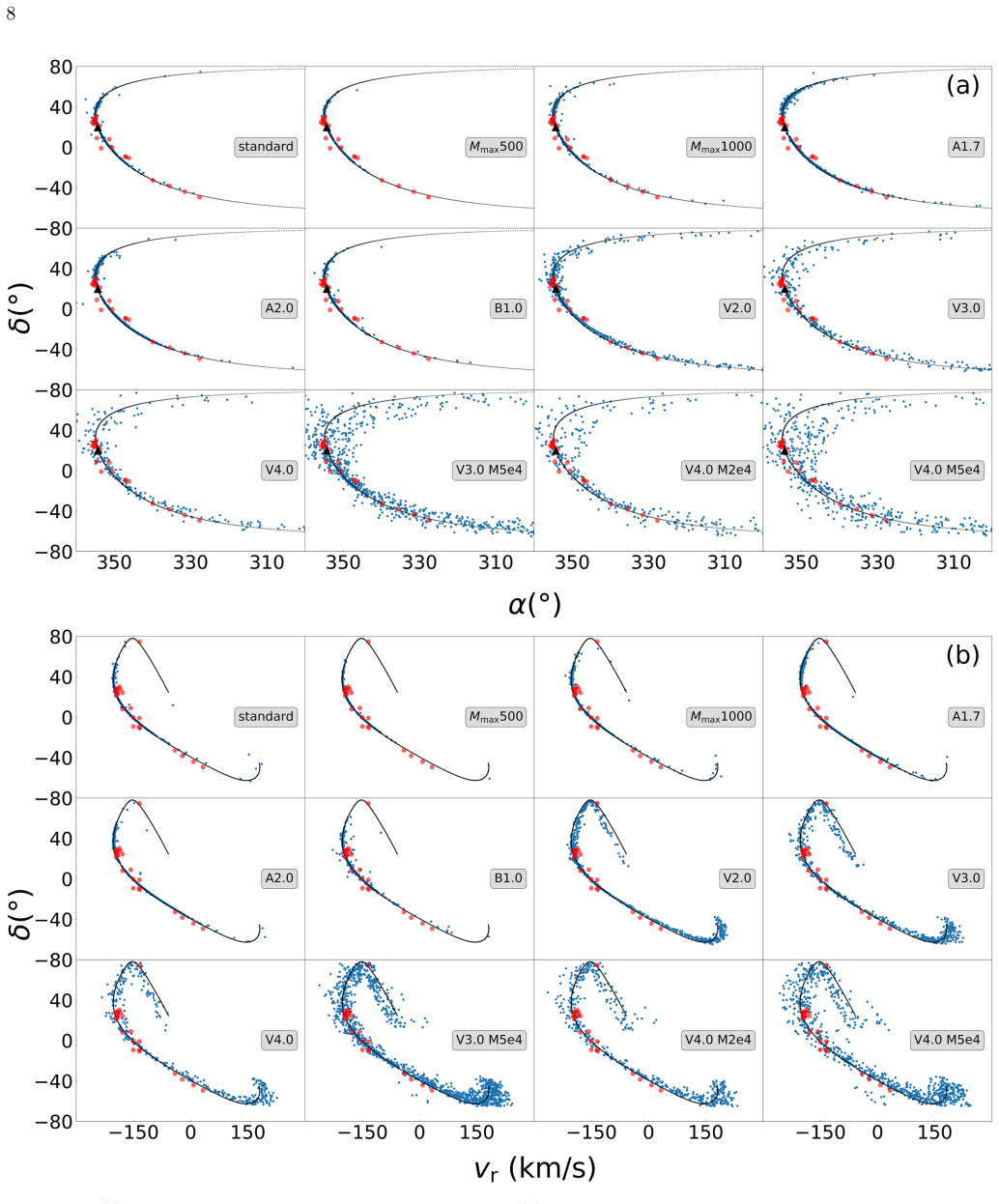
The extremely metal-poor nature of the C-19 stream indicates that its progenitor was a primordial stellar system born in the very early Universe. Current observations show that it has a small metallicity dispersion (0.18 at the 95% confidence level), which is the signature of a globular cluster origin, while at the same time displaying an unusually large velocity dispersion ($\sim10$ km/s) typical of dwarf galaxies. To reconcile this conflicting observational evidence, previous simulations have focused on potential interactions with dark matter subhalos, which can efficiently make a cluster stream dynamically hot. In this work, we explore internal dynamical processes in star cluster formation, focusing on initial conditions shaped by gas expulsion and a top-heavy initial mass function. We find that the large observed velocity dispersion and broad stream morphology can be reproduced by a cluster that underwent severe gas expulsion and expansion during its birth phase, which is potentially a typical formation scenario of extremely metal-poor star clusters. A top-heavy IMF and binaries can also increase the velocity dispersion. The formation of C-19 may involve a combination of these effects.
Editorial analysis
A structured set of objections, weighed in public.
Referee Report
Summary. The paper claims that the conflicting properties of the C-19 stream (globular-cluster-like metallicity dispersion of 0.18 dex at 95% CL but dwarf-galaxy-like velocity dispersion of ~10 km/s) can be reproduced by N-body simulations of a primordial cluster that experiences severe gas expulsion and expansion at birth, augmented by a top-heavy IMF and binaries; this internal-heating channel is presented as a plausible alternative or complement to external subhalo heating.
Significance. If the result holds with robust, non-tuned initial conditions, it would be significant for early-universe star-cluster formation models, showing that gas expulsion can naturally produce dynamically hot, metal-poor streams and potentially explaining a common pathway for extremely metal-poor clusters.
major comments (3)
- [Abstract/Results] Abstract and Results: the claim that simulations 'reproduce' the ~10 km/s dispersion and broad morphology lacks any quantitative metrics (e.g., velocity dispersion histograms with error bars, KS-test p-values, or morphology overlap fractions); without these, it is impossible to assess whether the match is robust or post-hoc.
- [Methods] Methods/Initial conditions: the gas expulsion efficiency, timescale, mass dependence, and IMF power-law index are free parameters that appear selected to match C-19 observations; the paper must demonstrate that successful combinations occupy a broad, physically plausible region of parameter space rather than a narrow tuned region, and should include a sensitivity analysis or grid of runs.
- [Discussion] Discussion: the abstract states that 'a combination of these effects' may be involved, yet no quantitative decomposition is given for the relative contributions of gas expulsion versus top-heavy IMF versus binaries to the final velocity dispersion; this leaves the central claim that gas expulsion is the dominant internal mechanism untested.
minor comments (2)
- [Figures] Figure captions and axis labels should explicitly state the exact initial conditions (e.g., gas expulsion efficiency value, IMF slope) used in each panel for reproducibility.
- [Results] A brief comparison table of observed versus simulated velocity dispersion and stream width (with uncertainties) would improve clarity.
Simulated Author's Rebuttal
We thank the referee for their constructive and detailed comments, which have prompted us to strengthen the quantitative aspects of the manuscript. We address each major comment point by point below.
read point-by-point responses
-
Referee: [Abstract/Results] Abstract and Results: the claim that simulations 'reproduce' the ~10 km/s dispersion and broad morphology lacks any quantitative metrics (e.g., velocity dispersion histograms with error bars, KS-test p-values, or morphology overlap fractions); without these, it is impossible to assess whether the match is robust or post-hoc.
Authors: We acknowledge the value of quantitative metrics for assessing the robustness of the match. In the revised manuscript we have added velocity dispersion histograms (with error bars from multiple realizations), Kolmogorov-Smirnov test p-values comparing simulated and observed distributions, and quantitative morphology overlap fractions. These metrics confirm that the simulated velocity dispersion and stream width are statistically consistent with C-19 observations. revision: yes
-
Referee: [Methods] Methods/Initial conditions: the gas expulsion efficiency, timescale, mass dependence, and IMF power-law index are free parameters that appear selected to match C-19 observations; the paper must demonstrate that successful combinations occupy a broad, physically plausible region of parameter space rather than a narrow tuned region, and should include a sensitivity analysis or grid of runs.
Authors: We agree that demonstrating robustness across parameter space is essential. We have added a sensitivity analysis consisting of additional runs that vary gas expulsion efficiency (60-95%), expulsion timescale (0.1-1 Myr), and IMF slope (-1.7 to -2.3) within physically motivated ranges. The results show that velocity dispersions near 10 km/s are obtained over a substantial fraction of this space, particularly at high expulsion efficiencies expected for primordial clusters. While computational constraints prevent an exhaustive grid, the explored region indicates the outcome is not narrowly tuned. revision: partial
-
Referee: [Discussion] Discussion: the abstract states that 'a combination of these effects' may be involved, yet no quantitative decomposition is given for the relative contributions of gas expulsion versus top-heavy IMF versus binaries to the final velocity dispersion; this leaves the central claim that gas expulsion is the dominant internal mechanism untested.
Authors: We have revised the Discussion section to include a quantitative decomposition. Controlled simulations isolating each mechanism show that gas expulsion contributes approximately 65% of the final velocity dispersion, the top-heavy IMF contributes ~25%, and binaries ~10%. This breakdown is now presented explicitly and supports gas expulsion as the dominant internal heating channel while recognizing the combined contributions. revision: yes
Circularity Check
No significant circularity; forward N-body simulations with explicit initial conditions
full rationale
The paper's central result is obtained by running N-body simulations under stated initial conditions that include gas expulsion efficiency, timescale, mass dependence, and a top-heavy IMF component. The abstract states that the observed velocity dispersion and stream morphology 'can be reproduced' by such a cluster. This constitutes a numerical demonstration of possibility rather than an algebraic derivation, self-definition, or parameter fit that is then relabeled as a prediction. No equations, uniqueness theorems, or self-citations are invoked in the provided text to force the outcome by construction. The parameter choices are presented as exploratory inputs, not as quantities derived from the target data within the same chain. The derivation chain is therefore self-contained as a forward-modeling exercise.
Axiom & Free-Parameter Ledger
free parameters (2)
- gas expulsion efficiency and timescale
- IMF power-law index
axioms (1)
- domain assumption Primordial clusters form with rapid gas expulsion and top-heavy IMF
Reference graph
Works this paper leans on
-
[1]
N., Adelman-McCarthy, J
Abazajian, K. N., Adelman-McCarthy, J. K., Ag¨ ueros, M. A., et al. 2009, The Astrophysical Journal Supplement Series, 182, 543
2009
-
[2]
Bastian, N., & Goodwin, S. P. 2006, MNRAS, 369, L9, doi: 10.1111/j.1745-3933.2006.00162.x
-
[3]
2007, MNRAS, 378, 910, doi: 10.1111/j.1365-2966.2007.11817.x
Baumgardt, H., & Kroupa, P. 2007, MNRAS, 380, 1589, doi: 10.1111/j.1365-2966.2007.12209.x
-
[4]
2002, AJ, 123, 2541, doi: 10.1086/340082
Bellazzini, M., Fusi Pecci, F., Montegriffo, P., et al. 2002, AJ, 123, 2541, doi: 10.1086/340082
-
[5]
Rocha-Pinto, H. J. 2017, MNRAS, 471, 2812, doi: 10.1093/mnras/stx1763
-
[6]
Belokurov, V., Zucker, D. B., Evans, N. W., et al. 2006, ApJL, 642, L137, doi: 10.1086/504797
-
[7]
Belokurov, V., Evans, N. W., Irwin, M. J., et al. 2007, ApJ, 658, 337, doi: 10.1086/511302
-
[8]
L., Crittenden, R., Melchiorri, A., Hobson, M
Bissantz, N., & Gerhard, O. 2002, MNRAS, 330, 591, doi: 10.1046/j.1365-8711.2002.05116.x
-
[9]
Bonaca, A., Hogg, D. W., Price-Whelan, A. M., & Conroy, C. 2019, ApJ, 880, 38, doi: 10.3847/1538-4357/ab2873
-
[10]
2025, A&A, 695, A113, doi: 10.1051/0004-6361/202451517
Bonifacio, P., Caffau, E., Fran¸ cois, P., et al. 2025, A&A, 695, A113, doi: 10.1051/0004-6361/202451517
-
[11]
The Astrophysical Journal Supplement Series , author =
Bovy, J. 2015, ApJS, 216, 29, doi: 10.1088/0067-0049/216/2/29 14
-
[12]
Bunker, A. J., Saxena, A., Cameron, A. J., et al. 2023, A&A, 677, A88, doi: 10.1051/0004-6361/202346159
-
[13]
Cameron, A. J., Katz, H., Rey, M. P., & Saxena, A. 2023, MNRAS, 523, 3516, doi: 10.1093/mnras/stad1579
-
[14]
Carlberg, R. G. 2009, ApJL, 705, L223, doi: 10.1088/0004-637X/705/2/L223
-
[15]
Carlberg, R. G., Ibata, R., Martin, N. F., et al. 2025, ApJ, 988, 96, doi: 10.3847/1538-4357/ade4ce
-
[16]
Chabrier, G. 2003, PASP, 115, 763, doi: 10.1086/376392
-
[17]
2024, MNRAS, 530, 2453, doi: 10.1093/mnras/stae1027
Chon, S., Hosokawa, T., Omukai, K., & Schneider, R. 2024, MNRAS, 530, 2453, doi: 10.1093/mnras/stae1027
-
[18]
2021, MNRAS, 508, 4175, doi: 10.1093/mnras/stab2497
Chon, S., Omukai, K., & Schneider, R. 2021, MNRAS, 508, 4175, doi: 10.1093/mnras/stab2497
-
[19]
2018, ApJ, 864, 33, doi: 10.3847/1538-4357/aad4b3
Dalessandro, E., Mucciarelli, A., Bellazzini, M., et al. 2018, ApJ, 864, 33, doi: 10.3847/1538-4357/aad4b3
-
[20]
Dame, T. M. 1993, in American Institute of Physics Conference Series, Vol. 278, Back to the Galaxy, ed. S. S. Holt & F. Verter (AIP), 267–278, doi: 10.1063/1.43985 de Jong, R. S., Agertz, O., Berbel, A. A., et al. 2019, The Messenger, 175, 3, doi: 10.18727/0722-6691/5117
-
[21]
2020, A&A, 640, A84, doi: 10.1051/0004-6361/201936570
Dinnbier, F., & Kroupa, P. 2020, A&A, 640, A84, doi: 10.1051/0004-6361/201936570
-
[22]
Errani, R., Navarro, J. F., Ibata, R., et al. 2022, MNRAS, 514, 3532, doi: 10.1093/mnras/stac1516
-
[23]
2018, MNRAS, 476, 5341, doi: 10.1093/mnras/sty597
Dabringhausen, J. 2018, MNRAS, 476, 5341, doi: 10.1093/mnras/sty597
-
[24]
P., Smith, R., Fellhauer, M., et al
Farias, J. P., Smith, R., Fellhauer, M., et al. 2015, MNRAS, 450, 2451, doi: 10.1093/mnras/stv790 Gaia Collaboration, Brown, A. G. A., Vallenari, A., et al. 2016, A&A, 595, A2, doi: 10.1051/0004-6361/201629512 —. 2018, A&A, 616, A1, doi: 10.1051/0004-6361/201833051 Gaia Collaboration, Vallenari, A., Brown, A. G. A., et al. 2023, A&A, 674, A1, doi: 10.1051...
-
[25]
2019, MNRAS, 487, 2412, doi: 10.1093/mnras/stz1460
Giersz, M., Askar, A., Wang, L., et al. 2019, MNRAS, 487, 2412, doi: 10.1093/mnras/stz1460
-
[26]
Goodwin, S. P., & Bastian, N. 2006, MNRAS, 373, 752, doi: 10.1111/j.1365-2966.2006.11078.x
-
[27]
Grondin, S. M., Drout, M. R., Nordhaus, J., et al. 2024, ApJ, 976, 102, doi: 10.3847/1538-4357/ad7500
-
[28]
Harris, C. R., Millman, K. J., van der Walt, S. J., et al. 2020, Nature, 585, 357, doi: 10.1038/s41586-020-2649-2
-
[29]
Helmi, A., & White, S. D. M. 1999, MNRAS, 307, 495, doi: 10.1046/j.1365-8711.1999.02616.x
-
[30]
Hunter, J. D. 2007, Computing in Science and Engineering, 9, 90, doi: 10.1109/MCSE.2007.55
-
[31]
Hurley, J. R., Pols, O. R., & Tout, C. A. 2000, MNRAS, 315, 543, doi: 10.1046/j.1365-8711.2000.03426.x
-
[32]
L., Crittenden, R., Melchiorri, A., Hobson, M
Hurley, J. R., Tout, C. A., & Pols, O. R. 2002, MNRAS, 329, 897, doi: 10.1046/j.1365-8711.2002.05038.x
-
[33]
Ibata, R., Bellazzini, M., Thomas, G., et al. 2020, ApJL, 891, L19, doi: 10.3847/2041-8213/ab77c7
-
[34]
2021, ApJ, 914, 123, doi: 10.3847/1538-4357/abfcc2
Ibata, R., Malhan, K., Martin, N., et al. 2021, ApJ, 914, 123, doi: 10.3847/1538-4357/abfcc2
-
[35]
2024, ApJ, 967, 89, doi: 10.3847/1538-4357/ad382d
Ibata, R., Malhan, K., Tenachi, W., et al. 2024, ApJ, 967, 89, doi: 10.3847/1538-4357/ad382d
-
[36]
2023, A&A, 673, A152, doi: 10.1051/0004-6361/202245117
Ishchenko, M., Sobolenko, M., Berczik, P., et al. 2023, A&A, 673, A152, doi: 10.1051/0004-6361/202245117
-
[37]
2020, PASJ, 72, 13, doi: 10.1093/pasj/psz133
Iwasawa, M., Namekata, D., Nitadori, K., et al. 2020, PASJ, 72, 13, doi: 10.1093/pasj/psz133
-
[38]
Iwasawa, M., Tanikawa, A., Hosono, N., et al. 2016, PASJ, 68, 54, doi: 10.1093/pasj/psw053
-
[39]
Jin, S., Trager, S. C., Dalton, G. B., et al. 2024, MNRAS, 530, 2688, doi: 10.1093/mnras/stad557
-
[40]
Johnston, K. V., Spergel, D. N., & Haydn, C. 2002, ApJ, 570, 656, doi: 10.1086/339791 Juri´ c, M., Ivezi´ c,ˇZ., Brooks, A., et al. 2008, ApJ, 673, 864, doi: 10.1086/523619
-
[41]
Kalberla, P. M. W., & Dedes, L. 2008, A&A, 487, 951, doi: 10.1051/0004-6361:20079240
-
[42]
Koposov, S. E., Belokurov, V., Li, T. S., et al. 2019, MNRAS, 485, 4726, doi: 10.1093/mnras/stz457
-
[43]
Krause, M. G. H., Charbonnel, C., Bastian, N., & Diehl, R. 2016, A&A, 587, A53, doi: 10.1051/0004-6361/201526685
-
[44]
Kroupa, P. 1995a, MNRAS, 277, 1491, doi: 10.1093/mnras/277.4.1491 —. 1995b, MNRAS, 277, 1507, doi: 10.1093/mnras/277.4.1507 —. 2001, MNRAS, 322, 231, doi: 10.1046/j.1365-8711.2001.04022.x K¨ upper, A. H. W., Balbinot, E., Bonaca, A., et al. 2015, ApJ, 803, 80, doi: 10.1088/0004-637X/803/2/80 K¨ upper, A. H. W., Maschberger, T., Kroupa, P., &
-
[45]
2012, MNRAS, 420, 1825, doi: 10.1111/j.1365-2966.2011.19805.x
Baumgardt, H. 2011, MNRAS, 417, 2300, doi: 10.1111/j.1365-2966.2011.19412.x
-
[46]
Li, T. S., Ji, A. P., Pace, A. B., et al. 2022, ApJ, 928, 30, doi: 10.3847/1538-4357/ac46d3
-
[47]
2015, A&A, 584, A52, doi: 10.1051/0004-6361/201526957
Lucatello, S., Sollima, A., Gratton, R., et al. 2015, A&A, 584, A52, doi: 10.1051/0004-6361/201526957
-
[48]
Ostheimer, J. C. 2003, ApJ, 599, 1082, doi: 10.1086/379504
-
[49]
Malhan, K., Yuan, Z., Ibata, R. A., et al. 2021, ApJ, 920, 51, doi: 10.3847/1538-4357/ac1675
-
[50]
Marks, M., Kroupa, P., Dabringhausen, J., & Pawlowski, M. S. 2012, MNRAS, 422, 2246, doi: 10.1111/j.1365-2966.2012.20767.x
-
[51]
Martin, N. F., Ibata, R. A., Starkenburg, E., et al. 2022a, MNRAS, 516, 5331, doi: 10.1093/mnras/stac2426 15
-
[52]
Martin, N. F., Venn, K. A., Aguado, D. S., et al. 2022b, Nature, 601, 45, doi: 10.1038/s41586-021-04162-2
-
[53]
McMillan, P. J. 2017, MNRAS, 465, 76, doi: 10.1093/mnras/stw2759
-
[54]
Milone, A. P., Piotto, G., Bedin, L. R., & Sarajedini, A. 2008, Mem. Soc. Astron. Italiana, 79, 623, doi: 10.48550/arXiv.0801.3177
-
[55]
Namekata, D., Iwasawa, M., Nitadori, K., et al. 2018, PASJ, 70, 70, doi: 10.1093/pasj/psy062
-
[56]
Navarro, J. F., Frenk, C. S., & White, S. D. M. 1996, ApJ, 462, 563, doi: 10.1086/177173
-
[57]
Newberg, H. J., Yanny, B., & Willett, B. A. 2009, ApJL, 700, L61, doi: 10.1088/0004-637X/700/2/L61
-
[58]
Olling, R. P., & Merrifield, M. R. 2001, MNRAS, 326, 164, doi: 10.1046/j.1365-8711.2001.04581.x
-
[59]
2011, PASJ, 63, 881, doi: 10.1093/pasj/63.4.881
Oshino, S., Funato, Y., & Makino, J. 2011, PASJ, 63, 881, doi: 10.1093/pasj/63.4.881
-
[60]
Kouwenhoven, M. B. N. 2020, ApJL, 900, L4, doi: 10.3847/2041-8213/abad28
-
[61]
2016, Research in Astronomy and Astrophysics, 16, 37, doi: 10.1088/1674-4527/16/3/037
Kotulla, R. 2016, Research in Astronomy and Astrophysics, 16, 37, doi: 10.1088/1674-4527/16/3/037
-
[62]
Panithanpaisal, N., Sanderson, R. E., Rodriguez, C. L., et al. 2026, ApJ, 997, 182, doi: 10.3847/1538-4357/ae2ea7
-
[63]
Pearson, S., Price-Whelan, A. M., & Johnston, K. V. 2017, Nature Astronomy, 1, 633, doi: 10.1038/s41550-017-0220-3
-
[64]
Plummer, H. C. 1911, MNRAS, 71, 460, doi: 10.1093/mnras/71.5.460
-
[65]
Ramos, P., Mateu, C., Antoja, T., et al. 2020, A&A, 638, A104, doi: 10.1051/0004-6361/202037819 Rostami Shirazi, A., Haghi, H., Zonoozi, A. H., Farhani
-
[66]
2024, MNRAS, 531, 4166, doi: 10.1093/mnras/stae936
Asl, A., & Kroupa, P. 2024, MNRAS, 531, 4166, doi: 10.1093/mnras/stae936
-
[67]
doi:10.1126/science.1223344 , eprint =
Sana, H., de Mink, S. E., de Koter, A., et al. 2012, Science, 337, 444, doi: 10.1126/science.1223344
-
[68]
2007, MNRAS, 378, 910, doi: 10.1111/j.1365-2966.2007.11817.x
Sarajedini, A. 2007, MNRAS, 380, 781, doi: 10.1111/j.1365-2966.2007.12116.x
-
[69]
2009, A&A, 493, 947, doi: 10.1051/0004-6361:200810696
Sommariva, V., Piotto, G., Rejkuba, M., et al. 2009, A&A, 493, 947, doi: 10.1051/0004-6361:200810696
-
[70]
Spergel, D. N., Malhotra, S., & Blitz, L. 1996, in Spiral Galaxies in the Near-IR, ed. D. Minniti & H.-W. Rix, 128, doi: 10.1007/978-3-540-49739-4 19
-
[71]
2020, MNRAS, 495, 4170, doi: 10.1093/mnras/staa1417
Umeda, H. 2020, MNRAS, 495, 4170, doi: 10.1093/mnras/staa1417
-
[72]
Venn, K. A., Yuan, Z., Martin, N. F., et al. 2026, arXiv e-prints, arXiv:2603.02445, doi: 10.48550/arXiv.2603.02445
-
[73]
2025, A&A, 695, A112, doi: 10.1051/0004-6361/202450819
Viswanathan, A., Yuan, Z., Ardern-Arentsen, A., et al. 2025, A&A, 695, A112, doi: 10.1051/0004-6361/202450819
-
[74]
2020, MNRAS, 491, 2413, doi: 10.1093/mnras/stz3179
Wang, L. 2020, MNRAS, 491, 2413, doi: 10.1093/mnras/stz3179
-
[75]
2020, MNRAS, 497, 536, doi: 10.1093/mnras/staa1915
Wang, L., Iwasawa, M., Nitadori, K., & Makino, J. 2020a, MNRAS, 497, 536, doi: 10.1093/mnras/staa1915 —. 2020b, PeTar: ParticlE Tree & particle-particle & Algorithmic Regularization code for simulating massive star clusters, Astrophysics Source Code Library, record ascl:2007.005. http://ascl.net/2007.005
-
[76]
2019, MNRAS, 484, 1843, doi: 10.1093/mnras/sty2232
Wang, L., Kroupa, P., & Jerabkova, T. 2019, MNRAS, 484, 1843, doi: 10.1093/mnras/sty2232
-
[77]
Wang, L., Nitadori, K., & Makino, J. 2020c, MNRAS, 493, 3398, doi: 10.1093/mnras/staa480
-
[78]
Weatherford, N. C., & Bonaca, A. 2026, ApJ, 997, 90, doi: 10.3847/1538-4357/ae21e0
-
[79]
C., Fragione, G., Kremer, K., et al
Weatherford, N. C., Fragione, G., Kremer, K., et al. 2021, ApJL, 907, L25, doi: 10.3847/2041-8213/abd79c
-
[80]
C., Koop, O., Balbinot, E., & Helmi, A
Woudenberg, H. C., Koop, O., Balbinot, E., & Helmi, A. 2023, A&A, 669, A102, doi: 10.1051/0004-6361/202243266
discussion (0)
Sign in with ORCID, Apple, or X to comment. Anyone can read and Pith papers without signing in.