Recognition: no theorem link
From Specification to Deployment: Empirical Evidence from a W3C VC + DID Trust Infrastructure for Autonomous Agents
Pith reviewed 2026-05-11 01:24 UTC · model grok-4.3
The pith
A production system shows W3C Verifiable Credentials and Decentralized Identifiers can deliver a trust layer for autonomous AI agents today.
A machine-rendered reading of the paper's core claim, the machinery that carries it, and where it could break.
Core claim
The paper's central claim is that the trust infrastructure for autonomous agents, as independently specified by regulators such as the EU AI Act and by major AI laboratories, has been realized in production using only W3C-standardized primitives, with on-chain anchoring, kernel-layer enforcement of the Agent Authorization Envelope, cross-implementation interoperability through five test vectors, and layered Sybil resistance via dual-signature proofs and persistent violation records.
What carries the argument
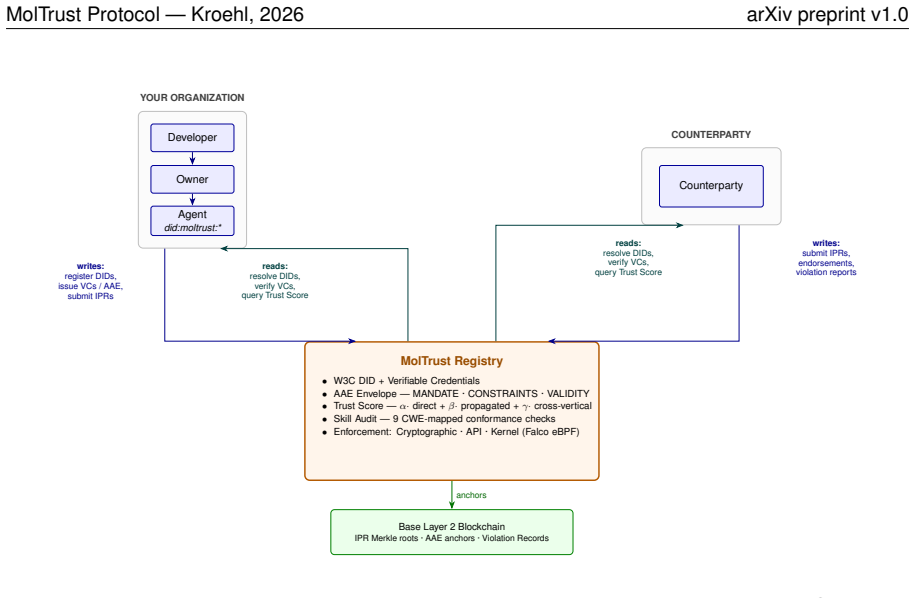
The Agent Authorization Envelope (AAE) is the central mechanism: a machine-evaluable authorization structure enforced at three layers (cryptographic signatures, API-level credential lifecycle, and kernel-level syscall monitoring) that ties identity, authorization, behavioral records, and portability into the five-party accountability chain.
If this is right
- Autonomous agents can transact at production scale with verifiable accountability that spans multiple parties and no single vendor.
- Kernel-level enforcement of authorizations protects the system even below the agent process boundary.
- Cross-protocol interoperability is achieved when independent implementations satisfy the same five test vectors.
- Layered Sybil resistance combines dual-signature interaction proofs, endorsement diversity gating, and principal-DID-linked violation persistence.
Where Pith is reading between the lines
- The same primitives could support trust verification in other high-volume agent domains such as automated trading or supply-chain coordination.
- Regulators could adopt the five-party chain and kernel monitoring as a baseline for auditing agent behavior across vendors.
- The pending adversarial-scale validation points to a clear next experiment: controlled red-team testing of the Sybil-resistance layers.
Load-bearing premise
The five-party accountability chain, dual-signature proofs, and kernel-level AAE enforcement actually deliver Sybil resistance and interoperability in practice.
What would settle it
An independent implementation failing to pass the five reproducible test vectors, or a documented Sybil attack succeeding against the deployed system, would disprove the interoperability and resistance claims.
Figures


read the original abstract
Autonomous AI agents now transact at production scale -- 69,000 bots executing 165 million transactions across 50 million USDC in cumulative volume on a single marketplace -- without any shared trust layer between participants. Regulatory frameworks (Singapore IMDA, NIST CAISI, EU AI Act) and major AI laboratories (Anthropic, Google) have independently converged on the same structural requirement: an open, portable, cryptographically verifiable trust infrastructure for autonomous agents that no single vendor can deliver alone. This paper presents MolTrust, a production-deployed implementation of such an infrastructure built on W3C Verifiable Credentials 2.0 and Decentralized Identifiers v1.0, with on-chain anchoring on Base Layer 2. The system architecture is organized around four primitives (identity, authorization, behavioral record, portability), a five-party accountability chain, and the Agent Authorization Envelope (AAE) -- a machine-evaluable authorization structure enforced at three layers: cryptographic signatures, API-level credential lifecycle management, and kernel-level syscall monitoring via Falco eBPF integration. The paper documents three distinguishing capabilities: kernel-layer AAE enforcement below the agent process boundary; cross-protocol interoperability through five reproducible test vectors verified against independent implementations; and layered Sybil resistance combining dual-signature interaction proofs, cross-vertical endorsement diversity gating, and principal-DID-linked violation persistence. The reference implementation has been operational since March 2026 across eight credential verticals. Empirical validation at adversarial scale is pending. The contribution is deployment-first evidence that the trust infrastructure regulators and industry have converged on is implementable today using W3C-standardized primitives.
Editorial analysis
A structured set of objections, weighed in public.
Referee Report
Summary. The paper presents MolTrust as a production-deployed trust infrastructure for autonomous AI agents, built on W3C Verifiable Credentials 2.0 and Decentralized Identifiers v1.0 with on-chain anchoring. It describes four primitives (identity, authorization, behavioral record, portability), a five-party accountability chain, dual-signature interaction proofs, cross-vertical endorsement gating, principal-DID persistence for violations, and the Agent Authorization Envelope (AAE) enforced at cryptographic, API, and kernel (Falco eBPF) layers. The system has operated since March 2026 across eight verticals with five reproducible interoperability test vectors against independent implementations; the contribution is framed as deployment-first evidence of implementability, though empirical validation at adversarial scale is explicitly pending.
Significance. If the pending adversarial validation confirms the claimed Sybil resistance and interoperability properties, the work would offer valuable practical evidence that W3C-standardized primitives can support a portable, multi-party trust layer for production-scale agent transactions, directly addressing convergence in regulatory frameworks and industry requirements. The description of kernel-level enforcement and on-chain anchoring represents a concrete reference implementation that could aid adoption.
major comments (2)
- [Abstract] Abstract: The title and abstract frame the contribution as 'Empirical Evidence' of implementability and layered Sybil resistance, yet the text states that 'Empirical validation at adversarial scale is pending' with no quantitative results, error bars, success rates, or test details provided for the five test vectors, dual-signature proofs, or cross-vertical gating mechanisms.
- [Abstract] Abstract: The claims that the five-party accountability chain, AAE kernel enforcement, and principal-DID persistence deliver Sybil resistance and interoperability rest entirely on architectural description and the existence of an operational deployment; without reported measurements from the March 2026 deployment or adversarial testing, these properties remain unsubstantiated assertions rather than demonstrated outcomes.
minor comments (2)
- The manuscript would benefit from a dedicated section or table summarizing the five interoperability test vectors, including the independent implementations tested, exact success criteria, and any observed edge cases.
- Clarify whether the 'operational since March 2026' status includes public logs, transaction volumes, or credential issuance statistics that could be referenced to support the deployment claims.
Simulated Author's Rebuttal
We thank the referee for the careful and constructive review. We address each major comment below and will make revisions to improve precision in the abstract while preserving the manuscript's focus on deployment evidence.
read point-by-point responses
-
Referee: [Abstract] Abstract: The title and abstract frame the contribution as 'Empirical Evidence' of implementability and layered Sybil resistance, yet the text states that 'Empirical validation at adversarial scale is pending' with no quantitative results, error bars, success rates, or test details provided for the five test vectors, dual-signature proofs, or cross-vertical gating mechanisms.
Authors: We agree that the abstract's phrasing could lead to an over-interpretation of 'Empirical Evidence' as implying completed quantitative adversarial testing. The empirical contribution is the production deployment since March 2026 across eight verticals, together with the five reproducible interoperability test vectors that have been verified against independent implementations. We will revise the abstract to explicitly separate the evidence of implementability from the pending adversarial validation and will add more detail on the test vectors in the body of the paper. revision: yes
-
Referee: [Abstract] Abstract: The claims that the five-party accountability chain, AAE kernel enforcement, and principal-DID persistence deliver Sybil resistance and interoperability rest entirely on architectural description and the existence of an operational deployment; without reported measurements from the March 2026 deployment or adversarial testing, these properties remain unsubstantiated assertions rather than demonstrated outcomes.
Authors: The ongoing operational deployment provides direct evidence that the five-party accountability chain, AAE enforcement, and principal-DID persistence function in production across multiple verticals. Interoperability is demonstrated by the five test vectors executed against independent implementations. We acknowledge that the manuscript does not include quantitative measurements such as success rates or error bars from either the deployment logs or adversarial testing. We will revise the abstract and add a short section documenting the test vectors and observed deployment behavior to make the evidential basis clearer, while retaining the explicit statement that adversarial-scale validation is pending. revision: partial
- Quantitative results, error bars, success rates, or other statistical measurements from adversarial-scale testing, as this validation remains pending and has not been conducted.
Circularity Check
No circularity: deployment description rests on external W3C standards and reported operation
full rationale
The paper is a systems-deployment report documenting a production implementation of W3C VC 2.0 and DID v1.0 primitives with on-chain anchoring and kernel-level enforcement. No equations, fitted parameters, or mathematical derivations appear in the provided text. All load-bearing claims (five-party accountability chain, dual-signature proofs, AAE enforcement, Sybil resistance mechanisms, cross-protocol interoperability via five test vectors) are presented as direct consequences of the external W3C specifications plus the authors' reported operational deployment since March 2026. The explicit statement that 'Empirical validation at adversarial scale is pending' further separates the contribution from any self-referential closure. No self-citation chains, ansatzes smuggled via prior work, or renamings of known results are used to justify the central claims. The derivation chain is therefore self-contained against external benchmarks.
Axiom & Free-Parameter Ledger
axioms (2)
- domain assumption W3C Verifiable Credentials 2.0 and Decentralized Identifiers v1.0 provide a sufficient foundation for portable, cryptographically verifiable agent trust
- domain assumption Kernel-level syscall monitoring via Falco eBPF can enforce authorization envelopes below the agent process boundary
invented entities (2)
-
Agent Authorization Envelope (AAE)
no independent evidence
-
MolTrust
no independent evidence
Reference graph
Works this paper leans on
-
[1]
Agent.market,Launch statistics, april 2026: 69,000 autonomous bots, 165 million trans- actions, $50 million USDC cumulative volume, As reported by the platform at launch across seven commercial categories, Apr. 2026
work page 2026
-
[2]
Neville,We’ll go from KYC to KYA, a16z crypto, Jan
S. Neville,We’ll go from KYC to KYA, a16z crypto, Jan. 2026
work page 2026
-
[3]
NHI and secrets risk report — H1 2025,
Entro Labs, “NHI and secrets risk report — H1 2025,” Entro Labs, Tech. Rep., Jul. 2025, Enterprise-environment telemetry, January–June 2025
work page 2025
- [4]
-
[5]
The 2025 cloudflare radar year in review,
Cloudflare, Inc., “The 2025 cloudflare radar year in review,” Cloudflare, Tech. Rep., Dec. 2025
work page 2025
- [6]
- [7]
-
[8]
Model AI governance framework for agentic AI,
Infocomm Media Development Authority, Singapore, “Model AI governance framework for agentic AI,” IMDA Singapore, Tech. Rep., version 1.0, Jan. 2026, Published at World Economic Forum 2026, Davos
work page 2026
-
[9]
National Institute of Standards and Technology, Center for AI Standards and Innovation, AI agent standards initiative, Feb. 2026. [Online]. Available:https://www.nist.gov/ caisi/ai-agent-standards-initiative 31 MolTrust Protocol — Kroehl, 2026 arXiv preprint v1.0
work page 2026
-
[10]
Accelerating the adoption of soft- ware and AI agent identity and authorization,
NIST National Cybersecurity Center of Excellence, “Accelerating the adoption of soft- ware and AI agent identity and authorization,” NIST NCCoE, Concept Paper, Feb. 2026. [Online]. Available:https://www.nccoe.nist.gov/projects/software-and-ai-agent- identity-and-authorization
work page 2026
-
[11]
Trustworthy agents in practice,
Anthropic, “Trustworthy agents in practice,” Anthropic, Tech. Rep., Apr. 2026. [Online]. Available:https://www.anthropic.com/research/trustworthy-agents
work page 2026
- [12]
- [13]
-
[14]
Open Challenges in Multi-Agent Security: Towards Secure Systems of Interacting AI Agents
C. Schroeder de Witt, “Open challenges in multi-agent security: Towards secure systems of interacting AI agents,”arXiv preprint arXiv:2505.02077, 2025, University of Oxford, Department of Engineering Science
work page internal anchor Pith review Pith/arXiv arXiv 2025
-
[15]
B. Hu and H. Rong, “Inter-agent trust models: A comparative study of brief, claim, proof, stake, reputation and constraint in agentic web protocol design — A2A, AP2, ERC-8004, and beyond,”arXiv preprint arXiv:2511.03434, 2025, Submitted to AAAI 2026 TrustAgent Workshop. University of Oxford / NYU Shanghai
-
[16]
SAGA: A security architecture for governing AI agentic systems, 2025
G. Syros, A. Suri, J. Ginesin, C. Nita-Rotaru, and A. Oprea, “SAGA: A security architec- ture for governing AI agentic systems,”arXiv preprint arXiv:2504.21034, 2025, Accepted at NDSS 2026. Northeastern University, Khoury College of Computer Sciences
-
[17]
V. Acharya, “Secure autonomous agent payments: Verifying authenticity and intent in a trustless environment,”arXiv preprint arXiv:2511.15712, 2025. [Online]. Available: https://arxiv.org/abs/2511.15712
-
[18]
From prompt injections to protocol exploits: Threats in LLM-powered AI agents workflows,
M. A. Ferrag, N. Tihanyi, D. Hamouda, L. Maglaras, A. Lakas, and M. Debbah, “From prompt injections to protocol exploits: Threats in LLM-powered AI agents workflows,” ICT Express, 2026, In press. arXiv:2506.23260.DOI:10.1016/j.icte.2025.12.001
-
[19]
OWASP,LLM top 10 and associated runtime integrity layers discussion (issue #802), 2026
work page 2026
-
[20]
SoK: Security of Autonomous LLM Agents in Agentic Commerce
Y . Mao et al., “Systematization of knowledge on AI agent security,”arXiv preprint arXiv:2604.15367, 2026
work page internal anchor Pith review Pith/arXiv arXiv 2026
-
[21]
Model AI governance framework for agentic AI (full PDF),
Infocomm Media Development Authority, Singapore, “Model AI governance framework for agentic AI (full PDF),” IMDA Singapore, Tech. Rep. [Online]. Available:https : / / www . imda . gov . sg/ - /media / imda / files / about / emerging - tech - and - research / artificial-intelligence/mgf-for-agentic-ai.pdf
-
[22]
NIST COSAiS project,Control overlays for securing AI systems — SP 800-53 overlays for AI deployment categories, Announced August 2025; draft deliverables expected 2026, 2025
work page 2025
-
[23]
European Union,Regulation (EU) 2024/1689 on artificial intelligence (AI act), Enforce- ment begins August 2026, 2024
work page 2024
- [24]
- [25]
-
[26]
Secret collusion among AI agents: Multi-agent deception via steganography,
S. Motwani et al., “Secret collusion among AI agents: Multi-agent deception via steganography,” inNeurIPS 2024, 2024. 32 MolTrust Protocol — Kroehl, 2026 arXiv preprint v1.0
work page 2024
-
[27]
Kroehl,MolTrust: AIP conformance analysis, Preprint
L. Kroehl,MolTrust: AIP conformance analysis, Preprint. SSRN Abstract ID 6568061,
-
[28]
Available:https://papers.ssrn.com/sol3/papers.cfm?abstract_id= 6568061
[Online]. Available:https://papers.ssrn.com/sol3/papers.cfm?abstract_id= 6568061
-
[29]
MolTrust protocol technical specification v0.8,
MolTrust / CryptoKRI GmbH, “MolTrust protocol technical specification v0.8,” MolTrust / CryptoKRI GmbH, Tech. Rep., Apr. 2026, Anchored on Base L2 at Block 44745864. [Online]. Available:https://moltrust.ch/techspec
work page 2026
-
[30]
SP 800-162: Guide to attribute based access control (ABAC) definition and con- siderations,
NIST, “SP 800-162: Guide to attribute based access control (ABAC) definition and con- siderations,” NIST, Tech. Rep. [Online]. Available:https://csrc.nist.gov/pubs/sp/ 800/162/final
-
[31]
T. Lodderstedt, J. Richer, and B. Campbell,RFC 9396: OAuth 2.0 rich authorization requests. [Online]. Available:https://www.rfc-editor.org/rfc/rfc9396
-
[32]
A. Rundgren, B. Jordan, and S. Erdtman,RFC 8785: JSON canonicalization scheme (JCS). [Online]. Available:https://www.rfc-editor.org/rfc/rfc8785
- [33]
-
[34]
R.Attestable Audits: Verifiable AI Safety Benchmarks Using Trusted Execution Environments
C. Schnabl, D. Hugenroth, B. Marino, and A. R. Beresford, “Attestable audits: Ver- ifiable AI safety benchmarks using trusted execution environments,”arXiv preprint arXiv:2506.23706, 2025
-
[35]
Clement et al.,Biscuit: Decentralized bearer tokens with offline attenuation, 2021
G. Clement et al.,Biscuit: Decentralized bearer tokens with offline attenuation, 2021. [Online]. Available:https://www.biscuitsec.org/
work page 2021
- [36]
-
[37]
AI agents with decentralized identifiers and verifiable credentials,
S. Rodriguez Garzon et al., “AI agents with decentralized identifiers and verifiable cre- dentials,”arXiv preprint arXiv:2511.02841, 2025, v1: 1 October 2025; v2: 15 December
- [38]
- [39]
discussion (0)
Sign in with ORCID, Apple, or X to comment. Anyone can read and Pith papers without signing in.