Recognition: 2 theorem links
· Lean TheoremFrom Pixels to Prompts: Vision-Language Models
Pith reviewed 2026-05-11 02:40 UTC · model grok-4.3
The pith
A mental map of vision-language models supplies structure to read new papers confidently and design systems without blind assembly of parts.
A machine-rendered reading of the paper's core claim, the machinery that carries it, and where it could break.
Core claim
The book provides a clear mental map of vision-language models that gives enough structure to read new papers with confidence and enough intuition to design systems without assembling components blindly, instead of offering an exhaustive catalog of datasets, benchmarks, and variants.
What carries the argument
The mental map itself: a non-exhaustive, intuition-focused overview that organizes how vision-language models connect visual input to language output, reasoning, and instruction following.
If this is right
- New papers become readable by fitting their contributions into the existing map rather than starting from zero.
- System design shifts from copying existing architectures to combining understood components with clear purpose.
- The gap between surface familiarity and operational knowledge narrows for people entering the field.
- Ongoing model releases can be integrated into the same framework instead of requiring separate learning each time.
Where Pith is reading between the lines
- The same map approach could be applied to other fast-moving multimodal areas to reduce knowledge fragmentation.
- Interactive versions of the map might let users explore component relationships directly rather than through text alone.
- In fields with high publication volume, targeted conceptual overviews may prove more useful for practitioners than comprehensive surveys.
- The structure could highlight common failure modes across models, making debugging more systematic.
Load-bearing premise
A non-exhaustive overview centered on intuition can still deliver lasting understanding without needing complete coverage of every dataset, benchmark, and model variant.
What would settle it
Readers who study the map still cannot interpret a new vision-language paper or design a working system with less trial-and-error than readers who rely only on scattered papers and code repositories.
Figures




read the original abstract
When you read a paper about a new Vision-Language Model today, it can be easy to forget how strange this idea would have sounded not so long ago. Teaching machines to see was already hard. Teaching them to read and generate language was already hard. Asking them to do both at once - and then to reason, answer questions, follow instructions, and sometimes even surprise us - still carries a quiet trace of science fiction, even as it becomes routine. This book was born from a simple feeling: \emph{it is too easy to get lost}. The field moves quickly, new model names appear constantly, and the gap between ``I know the buzzwords'' and ``I actually understand how this works'' can feel uncomfortably wide. I have felt that gap many times. If you are holding this book, you probably have too. My goal is not to provide an exhaustive catalog of every dataset, benchmark, and new model variant. Instead, I want to offer something more modest - and, I hope, more durable: a clear mental map of Vision-Language Models. Enough structure that you can read new papers with confidence; enough intuition that you can design your own systems without feeling as if you are assembling LEGO bricks blindly.
Editorial analysis
A structured set of objections, weighed in public.
Referee Report
Summary. The manuscript offers an expository overview of Vision-Language Models, with the central claim that a non-exhaustive, intuition-focused mental map can supply enough structure for readers to engage new VLM papers confidently and to design systems without assembling components blindly. It explicitly disclaims exhaustive coverage of datasets, benchmarks, or model variants, framing its contribution as durable pedagogical structure rather than completeness or novel technical results.
Significance. If the delivered mental map proves clear and durable, the work could hold meaningful pedagogical value in the fast-moving cs.AI field by reducing the gap between superficial buzzword knowledge and practical understanding, thereby supporting more effective paper reading and system design in multimodal models.
minor comments (2)
- Abstract: the text contains unrendered LaTeX such as ``it is too easy to get lost''; ensure consistent formatting and rendering in the final version.
- Throughout: repeated self-reference to ``this book'' creates ambiguity about the intended format and venue; clarify whether the manuscript is a journal article, survey, or book chapter.
Simulated Author's Rebuttal
We thank the referee for their positive assessment of the manuscript's pedagogical intent and for recommending minor revision. The work deliberately prioritizes a durable, intuition-focused mental map over exhaustive coverage of datasets or models, as stated in the abstract, to help readers navigate the fast-moving VLM literature with greater confidence.
Circularity Check
No significant circularity; purely expository overview
full rationale
The manuscript contains no derivations, equations, fitted parameters, predictions, or self-citations that could form a load-bearing chain. Its stated purpose is to supply an intuition-focused mental map for readers, explicitly disclaiming exhaustive coverage of datasets or models. No step reduces by construction to its own inputs, and the central claim remains independent of any internal fitting or renaming of results.
Axiom & Free-Parameter Ledger
Lean theorems connected to this paper
-
IndisputableMonolith/Foundation/ArithmeticFromLogic.leanreality_from_one_distinction unclear?
unclearRelation between the paper passage and the cited Recognition theorem.
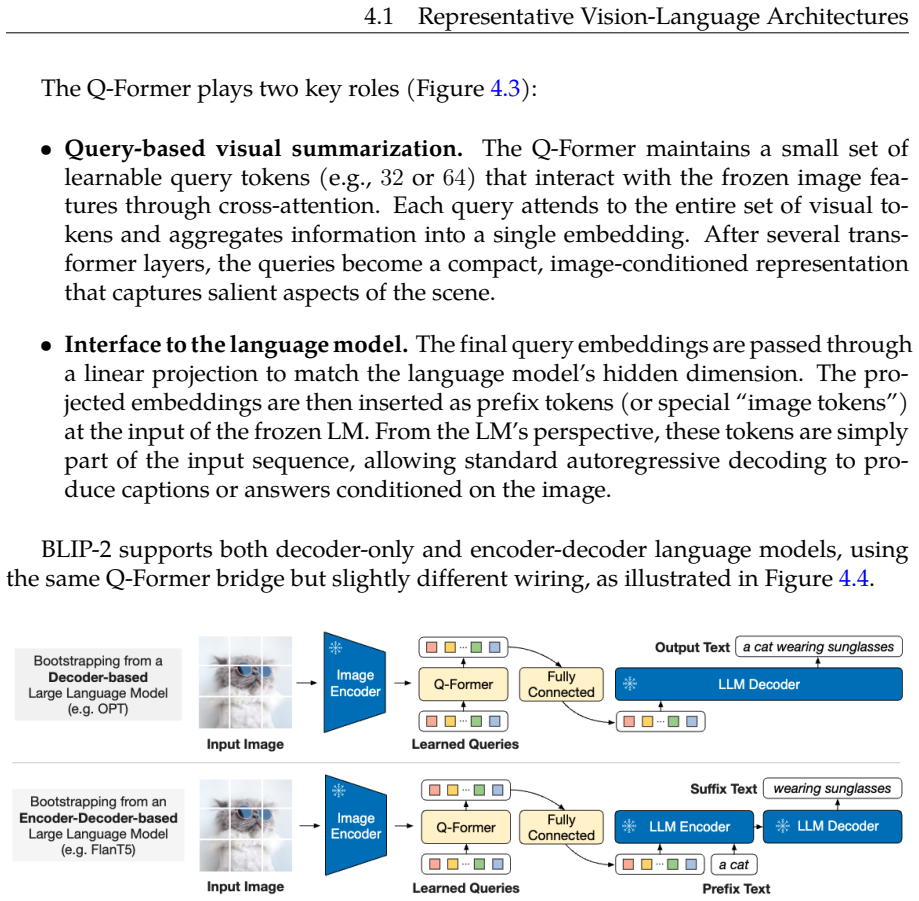
Core Building Blocks: visual encoder maps I to sequence of visual tokens v_j; language model conditions on visual tokens via cross-attention or prefix; fusion via adapters or Q-Former.
-
IndisputableMonolith/Cost/FunctionalEquation.leanwashburn_uniqueness_aczel unclear?
unclearRelation between the paper passage and the cited Recognition theorem.
Multimodal Alignment Objectives: contrastive alignment, generative language modeling, instruction tuning.
What do these tags mean?
- matches
- The paper's claim is directly supported by a theorem in the formal canon.
- supports
- The theorem supports part of the paper's argument, but the paper may add assumptions or extra steps.
- extends
- The paper goes beyond the formal theorem; the theorem is a base layer rather than the whole result.
- uses
- The paper appears to rely on the theorem as machinery.
- contradicts
- The paper's claim conflicts with a theorem or certificate in the canon.
- unclear
- Pith found a possible connection, but the passage is too broad, indirect, or ambiguous to say the theorem truly supports the claim.
Reference graph
Works this paper leans on
-
[1]
International Conference on Learning Representations (ICLR) , year =
An Image is Worth 16x16 Words: Transformers for Image Recognition at Scale , author =. International Conference on Learning Representations (ICLR) , year =
-
[2]
Proceedings of the 38th International Conference on Machine Learning (ICML) , year =
Learning Transferable Visual Models From Natural Language Supervision , author =. Proceedings of the 38th International Conference on Machine Learning (ICML) , year =
-
[3]
Ren, Shaoqing and He, Kaiming and Girshick, Ross and Sun, Jian , booktitle =. Faster
-
[4]
He, Kaiming and Gkioxari, Georgia and Doll. Mask. IEEE International Conference on Computer Vision (ICCV) , year =
-
[5]
Advances in Neural Information Processing Systems (NeurIPS) , year =
Attention Is All You Need , author =. Advances in Neural Information Processing Systems (NeurIPS) , year =
-
[6]
Advances in Neural Information Processing Systems (NeurIPS) , year =
Language Models are Few-Shot Learners , author =. Advances in Neural Information Processing Systems (NeurIPS) , year =
-
[7]
Training language models to follow instructions with human feedback
Training Language Models to Follow Instructions with Human Feedback , author =. arXiv preprint arXiv:2203.02155 , year =
work page internal anchor Pith review Pith/arXiv arXiv
-
[8]
LLaMA: Open and Efficient Foundation Language Models
LLaMA: Open and Efficient Foundation Language Models , author =. arXiv preprint arXiv:2302.13971 , year =
work page internal anchor Pith review Pith/arXiv arXiv
-
[9]
Proceedings of the 38th International Conference on Machine Learning (ICML) , year =
Scaling up Visual and Vision-Language Representation Learning With Noisy Text Supervision , author =. Proceedings of the 38th International Conference on Machine Learning (ICML) , year =
-
[10]
Lu, Jiasen and Batra, Dhruv and Parikh, Devi and Lee, Stefan , booktitle =
-
[11]
Tan, Hao and Bansal, Mohit , booktitle =
-
[12]
Advances in Neural Information Processing Systems (NeurIPS) , year =
Flamingo: a Visual Language Model for Few-Shot Learning , author =. Advances in Neural Information Processing Systems (NeurIPS) , year =
-
[13]
BLIP-2: Bootstrapping Language-Image Pre-training with Frozen Image Encoders and Large Language Models , author =. arXiv preprint arXiv:2301.12597 , year =
work page internal anchor Pith review arXiv
- [14]
-
[15]
IEEE Conference on Computer Vision and Pattern Recognition (CVPR) , year =
Show and Tell: A Neural Image Caption Generator , author =. IEEE Conference on Computer Vision and Pattern Recognition (CVPR) , year =
-
[16]
Lawrence and Parikh, Devi , booktitle =
Antol, Stanislaw and Agrawal, Aishwarya and Lu, Jiasen and Mitchell, Margaret and Batra, Dhruv and Zitnick, C. Lawrence and Parikh, Devi , booktitle =
-
[17]
Goyal, Yash and Khot, Tejas and Summers-Stay, Douglas and Batra, Dhruv and Parikh, Devi , booktitle =. Making the V in
-
[18]
IEEE Conference on Computer Vision and Pattern Recognition (CVPR) , year =
Deep Visual-Semantic Alignments for Generating Image Descriptions , author =. IEEE Conference on Computer Vision and Pattern Recognition (CVPR) , year =
-
[19]
IEEE International Conference on Computer Vision (ICCV) , year =
Flickr30k Entities: Collecting Region-to-Phrase Correspondences for Richer Image-to-Sentence Models , author =. IEEE International Conference on Computer Vision (ICCV) , year =
-
[20]
Empirical Methods in Natural Language Processing (EMNLP) , year =
ReferItGame: Referring to Objects in Photographs of Natural Scenes , author =. Empirical Methods in Natural Language Processing (EMNLP) , year =
-
[21]
Gradient-Based Learning Applied to Document Recognition , journal =
LeCun, Yann and Bottou, L. Gradient-Based Learning Applied to Document Recognition , journal =
- [22]
-
[23]
International Conference on Learning Representations (ICLR) , year =
Simonyan, Karen and Zisserman, Andrew , title =. International Conference on Learning Representations (ICLR) , year =
-
[24]
IEEE Conference on Computer Vision and Pattern Recognition (CVPR) , pages =
He, Kaiming and Zhang, Xiangyu and Ren, Shaoqing and Sun, Jian , title =. IEEE Conference on Computer Vision and Pattern Recognition (CVPR) , pages =
-
[25]
Feature Pyramid Networks for Object Detection , booktitle =
Lin, Tsung-Yi and Doll. Feature Pyramid Networks for Object Detection , booktitle =
-
[26]
Russakovsky, Olga and Deng, Jia and Su, Hao and Krause, Jonathan and Satheesh, Sanjeev and Ma, Sean and Huang, Zhiheng and Karpathy, Andrej and Khosla, Aditya and Bernstein, Michael and Berg, Alexander C. and Fei-Fei, Li , title =. International Journal of Computer Vision (IJCV) , year =
-
[27]
Proceedings of the 37th International Conference on Machine Learning (ICML) , year =
Chen, Ting and Kornblith, Simon and Norouzi, Mohammad and Hinton, Geoffrey , title =. Proceedings of the 37th International Conference on Machine Learning (ICML) , year =
-
[28]
IEEE Conference on Computer Vision and Pattern Recognition (CVPR) , year =
He, Kaiming and Fan, Haoqi and Wu, Yuxin and Xie, Saining and Girshick, Ross , title =. IEEE Conference on Computer Vision and Pattern Recognition (CVPR) , year =
-
[29]
Bootstrap Your Own Latent: A New Approach to Self-Supervised Learning , booktitle =
Grill, Jean-Bastien and Strub, Florian and Altch. Bootstrap Your Own Latent: A New Approach to Self-Supervised Learning , booktitle =. 2020 , volume =
work page 2020
-
[30]
Emerging Properties in Self-Supervised Vision Transformers , booktitle =
Caron, Mathilde and Touvron, Hugo and Misra, Ishan and J. Emerging Properties in Self-Supervised Vision Transformers , booktitle =. 2021 , pages =
work page 2021
-
[31]
Masked Autoencoders Are Scalable Vision Learners , booktitle =
He, Kaiming and Chen, Xinlei and Xie, Saining and Li, Yanghao and Doll. Masked Autoencoders Are Scalable Vision Learners , booktitle =. 2022 , pages =
work page 2022
- [32]
-
[33]
Long Short-Term Memory , journal =
Hochreiter, Sepp and Schmidhuber, J. Long Short-Term Memory , journal =
-
[34]
Learning Phrase Representations using
Cho, Kyunghyun and van Merri. Learning Phrase Representations using. Proceedings of the 2014 Conference on Empirical Methods in Natural Language Processing (EMNLP) , pages =
work page 2014
-
[35]
On the Opportunities and Risks of Foundation Models , author =
-
[36]
Language Models are Unsupervised Multitask Learners , author =
-
[37]
Devlin, Jacob and Chang, Ming-Wei and Lee, Kenton and Toutanova, Kristina , booktitle =. 2019 , pages =
work page 2019
-
[38]
Proceedings of the 32nd International Conference on Machine Learning (ICML) , pages =
Show, Attend and Tell: Neural Image Caption Generation with Visual Attention , author =. Proceedings of the 32nd International Conference on Machine Learning (ICML) , pages =
-
[39]
and Gotmare, Akhilesh and Joty, Shafiq and Xiong, Caiming and Hoi, Steven C
Li, Junnan and Selvaraju, Ramprasaath R. and Gotmare, Akhilesh and Joty, Shafiq and Xiong, Caiming and Hoi, Steven C. H. , booktitle =
-
[40]
Advances in Neural Information Processing Systems , year =
Visual Instruction Tuning , author =. Advances in Neural Information Processing Systems , year =
- [41]
-
[42]
Advances in Neural Information Processing Systems , year =
Language Is Not All You Need: Aligning Perception with Language Models , author =. Advances in Neural Information Processing Systems , year =
-
[43]
Proceedings of the IEEE/CVF Conference on Computer Vision and Pattern Recognition , year =
PaLI-X: On Scaling Up a Multilingual Vision and Language Model , author =. Proceedings of the IEEE/CVF Conference on Computer Vision and Pattern Recognition , year =
-
[44]
Zhai, Xiaohua and Wang, Xingyi and Mustafa, Basil and Kolesnikov, Alexander and Unterthiner, Thomas and Dehghani, Mostafa and Minderer, Matthias and Heigold, Georg and Gelly, Sylvain and Houlsby, Neil and others , booktitle =
-
[45]
Chen, Yen-Chun and Li, Linjie and Yu, Licheng and Kholy, Ahmed El and Ahmed, Faisal and Gan, Zhe and Cheng, Yu and Liu, Jingjing , booktitle =
-
[46]
Zhang, Pengchuan and Li, Xiujun and Hu, Xiaowei and Yang, Jianwei and Zhang, Lei and Wang, Lijuan and Choi, Yejin and Gao, Jianfeng , booktitle =
-
[47]
Parameter-Efficient Transfer Learning for
Houlsby, Neil and Giurgiu, Andrei and Jastrzebski, Stanislaw and Morrone, Bryan and de Laroussilhe, Quentin and Gesmundo, Andrea and Attariyan, Mona and Gelly, Sylvain , booktitle =. Parameter-Efficient Transfer Learning for
-
[48]
Hu, Edward J. and Shen, Yelong and Wallis, Phillip and Allen-Zhu, Zeyuan and Li, Yuanzhi and Wang, Shean and Wang, Lu and Chen, Weizhu , booktitle =
-
[49]
Piyush Sharma and Nan Ding and Sebastian Goodman and Radu Soricut , title =. Proceedings of the 56th Annual Meeting of the Association for Computational Linguistics (ACL) , year =
-
[50]
Proceedings of the IEEE/CVF Conference on Computer Vision and Pattern Recognition (CVPR) , year =
Soravit Changpinyo and Piyush Sharma and Nan Ding and Radu Soricut , title =. Proceedings of the IEEE/CVF Conference on Computer Vision and Pattern Recognition (CVPR) , year =
-
[51]
Visual Genome: Connecting Language and Vision Using Crowdsourced Dense Image Annotations , journal =
Ranjay Krishna and Yuke Zhu and Oliver Groth and Justin Johnson and Kenji Hata and Joshua Kravitz and Stephanie Chen and Yannis Kalantidis and Li. Visual Genome: Connecting Language and Vision Using Crowdsourced Dense Image Annotations , journal =. 2017 , volume =
work page 2017
-
[52]
Alina Kuznetsova and Hassan Rom and Neil Alldrin and Jasper Uijlings and Ivan Krasin and Jordi Pont. The Open Images Dataset V4: Unified Image Classification, Object Detection, and Visual Relationship Detection at Scale , booktitle =
-
[53]
Antoine Miech and Dimitri Zhukov and Jean. HowTo100M: Learning a Text-Video Embedding by Watching Hundred Million Narrated Video Clips , booktitle =
-
[54]
Proceedings of the IEEE/CVF International Conference on Computer Vision (ICCV) , year =
Max Bain and Arsha Nagrani and G\"ul Varol and Andrew Zisserman , title =. Proceedings of the IEEE/CVF International Conference on Computer Vision (ICCV) , year =
-
[55]
Proceedings of the IEEE Conference on Computer Vision and Pattern Recognition (CVPR) , year =
Jun Xu and Tao Mei and Ting Yao and Yong Rui , title =. Proceedings of the IEEE Conference on Computer Vision and Pattern Recognition (CVPR) , year =
-
[56]
Proceedings of the 30th International World Wide Web Conference (WWW) , year =
Krishna Srinivasan and Karthik Raman and Jiecao Chen and Michael Bendersky and Marc Najork , title =. Proceedings of the 30th International World Wide Web Conference (WWW) , year =
-
[57]
Harley and Alex Ufkes and Konstantinos G
Adam W. Harley and Alex Ufkes and Konstantinos G. Derpanis , title =. Proceedings of the International Conference on Document Analysis and Recognition (ICDAR) , year =
-
[58]
PubLayNet: Largest Dataset Ever for Document Layout Analysis , booktitle =
Xu Zhong and Jianbin Tang and Antonio Jimeno. PubLayNet: Largest Dataset Ever for Document Layout Analysis , booktitle =
-
[59]
Oleksii Sidorov and Ronghang Hu and Marcus Rohrbach and Amanpreet Singh , title =. Computer Vision --
-
[60]
Advances in Neural Information Processing Systems (NeurIPS), Datasets and Benchmarks Track , year =
Christoph Schuhmann and Romain Beaumont and Richard Vencu and Cade Gordon and Ross Wightman and Mehdi Cherti and Theo Coombes and Aarush Katta and Clayton Mullis and Mitchell Wortsman and Patrick Schramowski and Srivatsa Kundurthy and Katherine Crowson and Ludwig Schmidt and Robert Kaczmarczyk and Jenia Jitsev , title =. Advances in Neural Information Pro...
-
[61]
PaLI: A Jointly-Scaled Multilingual Language-Image Model , author =. 2022 , howpublished =
work page 2022
-
[62]
Proceedings of the IEEE/CVF Conference on Computer Vision and Pattern Recognition (CVPR) , year =
PaLI-X: On Scaling Up a Multilingual Vision and Language Model , author =. Proceedings of the IEEE/CVF Conference on Computer Vision and Pattern Recognition (CVPR) , year =
- [63]
-
[64]
LLaVA-NeXT-Interleave: Tackling Multi-Image, Video, and 3D in Large Multimodal Models , author =. 2024 , howpublished =
work page 2024
- [65]
-
[66]
Shuai Bai and Yuxuan Cai and Ruizhe Chen and Keqin Chen and Zesen Cheng and others , year =. Qwen3-
- [67]
-
[68]
InternVL3: Exploring Advanced Training and Test-Time Recipes for Open-Source Multimodal Models , author =. 2025 , howpublished =
work page 2025
-
[69]
Proceedings of the 5th Workshop on Vision and Language , year =
Multi30K: Multilingual English--German Image Descriptions , author =. Proceedings of the 5th Workshop on Vision and Language , year =
- [70]
-
[71]
Transactions of the Association for Computational Linguistics , volume =
From Image Descriptions to Visual Denotations: New Similarity Metrics for Semantic Inference over Event Descriptions , author =. Transactions of the Association for Computational Linguistics , volume =
-
[72]
Proceedings of the IEEE/CVF International Conference on Computer Vision (ICCV) , year =
nocaps: Novel Object Captioning at Scale , author =. Proceedings of the IEEE/CVF International Conference on Computer Vision (ICCV) , year =
-
[73]
Proceedings of the IEEE/CVF Conference on Computer Vision and Pattern Recognition (CVPR) , year =
GQA: A New Dataset for Real-World Visual Reasoning and Compositional Question Answering , author =. Proceedings of the IEEE/CVF Conference on Computer Vision and Pattern Recognition (CVPR) , year =
-
[74]
Marino, Kenneth and Rastegari, Mohammad and Farhadi, Ali and Mottaghi, Roozbeh , booktitle =
-
[75]
and Guo, Abigale and Lin, Chi and Grauman, Kristen and Wilson, Caroline and Bigham, Jeffrey P
Gurari, Danna and Li, Qing and Stangl, Amanda J. and Guo, Abigale and Lin, Chi and Grauman, Kristen and Wilson, Caroline and Bigham, Jeffrey P. , booktitle =
-
[76]
Proceedings of the European Conference on Computer Vision (ECCV) , year =
Modeling Context in Referring Expressions , author =. Proceedings of the European Conference on Computer Vision (ECCV) , year =
-
[77]
Kazemzadeh, Sahar and Ordonez, Vicente and Matten, Mark and Berg, Tamara , booktitle =
-
[78]
and Wang, Liwei and Cervantes, Chris M
Plummer, Bryan A. and Wang, Liwei and Cervantes, Chris M. and Caicedo, Juan C. and Hockenmaier, Julia and Lazebnik, Svetlana , booktitle =
-
[79]
Singh, Ankur and Natarajan, Vivek and Shah, Meet and Jiang, Yu and Chen, Xinlei and Batra, Dhruv and Parikh, Devi and Rohrbach, Marcus , booktitle =
-
[80]
Mathew, Minesh and Karatzas, Dimosthenis and Jawahar, C. V. , booktitle =
discussion (0)
Sign in with ORCID, Apple, or X to comment. Anyone can read and Pith papers without signing in.