Recognition: no theorem link
The diverse morphologies and evolution of low-luminosity edge-brightened radio galaxies
Pith reviewed 2026-05-11 03:26 UTC · model grok-4.3
The pith
Low-luminosity FRII radio galaxies sustain edge-brightened structures but form a diverse population with frequent restarting and remnant phases.
A machine-rendered reading of the paper's core claim, the machinery that carries it, and where it could break.
Core claim
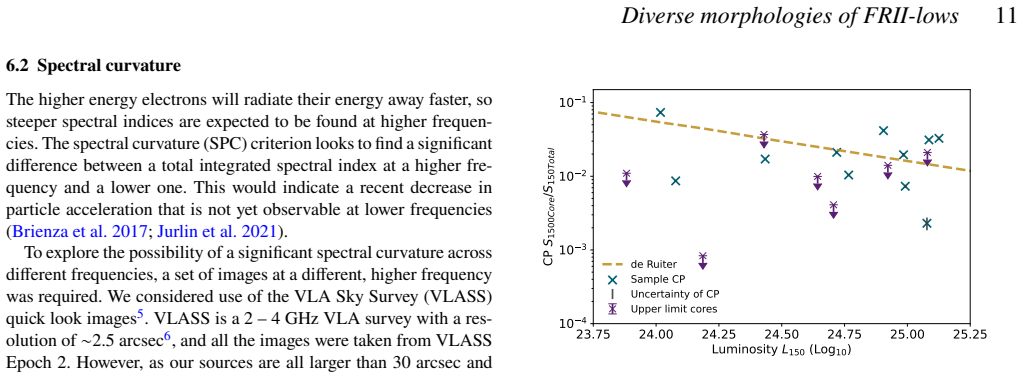
FRII source dynamics occur at low radio luminosities, but the population of low-luminosity edge-brightened RLAGN is highly diverse. In a representative sample of 19 such sources, the prevalence of cores is higher than in luminous FRIIs while the fraction with compact hotspots is comparable; approximately 32 per cent exhibit restarting or remnant behaviour and a similar fraction are active FRIIs with compact hotspots.
What carries the argument
1.5-GHz VLA imaging and spectral-index mapping to locate compact hotspots, cores, and restarting or remnant signatures in LOFAR-selected low-luminosity FRIIs.
If this is right
- FRII morphologies and jet termination can be maintained at luminosities three orders of magnitude below the traditional break value.
- Low-luminosity FRIIs contain a comparable number of hotspots but a higher fraction of cores than luminous FRIIs drawn from the same parent sample.
- Roughly one-third of low-luminosity FRIIs display restarting or remnant signatures, pointing to repeated activity cycles.
- Binary FRI/FRII labels oversimplify the evolutionary states present even within the edge-brightened class.
Where Pith is reading between the lines
- Jet power and local environment must interact more intricately than a simple luminosity threshold can capture.
- Remnant phases may contribute a larger share of the low-luminosity radio-galaxy population, altering integrated feedback estimates.
- Multi-wavelength follow-up of the same objects could reveal whether host-galaxy or accretion differences accompany the morphological diversity.
Load-bearing premise
Compact features detected in the 1.5-GHz VLA images and spectral index maps reliably mark physical hotspots, cores, and restarting or remnant activity without substantial misclassification from resolution, sensitivity, or projection effects.
What would settle it
Higher-resolution or multi-frequency observations that show many of the reported compact hotspots lack steep spectra or fail to terminate the jets would indicate that the structures are not true FRII termination sites.
Figures



read the original abstract
Fanaroff-Riley class I (FRI) radio galaxies show centre-brightened emission from disrupted lower power jets, while traditionally more luminous class II (FRIIs), are edge-brightened, with relativistic jets terminating in hotspots. Population studies of radio-loud AGN (RLAGN) with low frequency, deep, wide-field surveys have revealed FRII-like radio structures at lower luminosities. We present the first high-resolution morphological investigation of a representative LOFAR-selected sample of low-luminosity FRIIs, to determine whether this new population is physically distinct from traditional high-luminosity FRIIs. Using new $1.5$-GHz Jansky Very Large Array (VLA) observations for a sample of 19 low-luminosity FRIIs, from the LOFAR Two Metre Sky Survey Data Release 1 (LoTSS DR1), with luminosities up to three orders of magnitude lower than the typical FR break ($L_{150} = 10^{26}$ W Hz$^{-1}$). We examine the compact features and perform spectral index analysis to identify hotspots, cores and signatures of restarting or remnant activity. We find a higher prevalence of cores and a comparable number of hotspots in the low-luminosity FRII sample compared to a randomly-selected sample of luminous ($L_{150}>10^{26}$ W Hz$^{-1}$) FRIIs selected from the same parent LOFAR sample. Approximately 32 per cent of low-luminosity FRIIs show restarting or remnant behaviour, while $\sim 32$ per cent are active FRIIs with compact hotspots. Our results show that FRII source dynamics occur at low radio luminosities, but reinforce earlier conclusions that the population of low-luminosity edge-brightened RLAGN is highly diverse. Binary morphological classifications should be used cautiously as a first step towards more nuanced investigations of the complexity of jet life cycles and evolution.
Editorial analysis
A structured set of objections, weighed in public.
Referee Report
Summary. The manuscript presents 1.5 GHz VLA imaging and spectral-index analysis of 19 low-luminosity FRII radio galaxies (L_150 up to three orders of magnitude below the canonical FR break) selected from LoTSS DR1. The authors classify compact features to identify cores, hotspots, and signatures of restarting or remnant activity, reporting ~32% restarting/remnant sources and ~32% active FRIIs with compact hotspots, together with a higher core detection rate than in a luminous FRII comparison sample drawn from the same parent catalog. They conclude that FRII-like jet termination dynamics persist at low luminosities and that the low-luminosity edge-brightened population is morphologically diverse, warranting caution with binary classifications.
Significance. If the feature classifications hold, the work supplies direct observational evidence that edge-brightened morphologies and hotspot termination can occur well below traditional luminosity thresholds, extending the parameter space for studies of jet propagation and AGN life cycles. It reinforces the value of high-resolution, multi-frequency follow-up of low-frequency survey samples and supplies empirical fractions that can be compared against evolutionary models.
major comments (3)
- [§4] §4 (compact feature identification): The classification of hotspots and restarting/remnant activity is based on visual inspection of 1.5 GHz VLA images and spectral-index maps. At the low surface-brightness levels of the sample, the ~1–2 arcsec beam can blend or mimic compact features; without injected-source simulations or quantitative compactness/spectral-index thresholds, the robustness of the reported 32% restarting and 32% active-hotspot fractions cannot be assessed against resolution and sensitivity biases.
- [§5] §5 (comparison sample): The luminous FRII comparison sample is drawn from the same LoTSS parent catalog, yet the analysis does not quantify or correct for luminosity-dependent detection biases in identifying compact hotspots and cores. Because surface brightness scales with luminosity, the reported “comparable number of hotspots” and “higher prevalence of cores” may partly reflect differing completeness rather than intrinsic population differences.
- [Abstract and §6] Abstract and §6 (statistical presentation): The headline percentages (32% restarting/remnant, 32% active with hotspots) are given without binomial confidence intervals or discussion of small-number statistics (N=19). With such a modest sample, the diversity claim and the recommendation against binary classifications rest on fractions whose uncertainties are not reported.
minor comments (2)
- [Figures] Figure captions should explicitly state the restoring beam size and rms noise for each source to allow readers to evaluate the reliability of compact-feature detections.
- [Introduction] The introduction would benefit from a brief reference to recent statistical studies of low-luminosity FRIIs in LoTSS to place the morphological diversity result in context.
Simulated Author's Rebuttal
We thank the referee for their thorough and constructive review. We address each major comment point by point below, outlining the revisions that will be incorporated to improve the clarity and robustness of the analysis.
read point-by-point responses
-
Referee: [§4] §4 (compact feature identification): The classification of hotspots and restarting/remnant activity is based on visual inspection of 1.5 GHz VLA images and spectral-index maps. At the low surface-brightness levels of the sample, the ~1–2 arcsec beam can blend or mimic compact features; without injected-source simulations or quantitative compactness/spectral-index thresholds, the robustness of the reported 32% restarting and 32% active-hotspot fractions cannot be assessed against resolution and sensitivity biases.
Authors: We agree that visual classification at low surface brightness introduces potential subjectivity and that quantitative thresholds would strengthen the analysis. In the revised manuscript we will define explicit criteria for compact features (e.g., peak-to-local-background ratio >5 and spectral-index constraints where available) and add a dedicated paragraph in §4 discussing resolution and sensitivity biases. Full end-to-end injected-source simulations are beyond the scope of this initial morphological study but will be noted as desirable future work. These changes will allow readers to better evaluate the reported fractions. revision: partial
-
Referee: [§5] §5 (comparison sample): The luminous FRII comparison sample is drawn from the same LoTSS parent catalog, yet the analysis does not quantify or correct for luminosity-dependent detection biases in identifying compact hotspots and cores. Because surface brightness scales with luminosity, the reported “comparable number of hotspots” and “higher prevalence of cores” may partly reflect differing completeness rather than intrinsic population differences.
Authors: We acknowledge the importance of luminosity-dependent completeness. In the revised §5 we will explicitly compare the surface-brightness detection limits of the two samples, quantify the expected scaling of hotspot and core detectability with luminosity, and discuss whether the observed differences in core prevalence remain significant after accounting for these effects. This additional analysis will clarify the extent to which the reported trends are intrinsic. revision: partial
-
Referee: [Abstract and §6] Abstract and §6 (statistical presentation): The headline percentages (32% restarting/remnant, 32% active with hotspots) are given without binomial confidence intervals or discussion of small-number statistics (N=19). With such a modest sample, the diversity claim and the recommendation against binary classifications rest on fractions whose uncertainties are not reported.
Authors: We thank the referee for highlighting this omission. In the revised manuscript we will report binomial confidence intervals (Wilson score) for all headline percentages in both the abstract and §6, and add a short discussion of small-sample statistics and their implications for the diversity conclusion. This will provide a more accurate statistical context for the results. revision: yes
Circularity Check
No circularity: purely observational classification and sample comparison
full rationale
The paper is an empirical observational study. It selects a LOFAR sample, obtains new 1.5 GHz VLA images, performs visual and spectral-index classification of compact features (cores, hotspots, restarting/remnant signatures), and compares prevalence statistics to a control sample of luminous FRIIs drawn from the same parent catalog. No equations, model fits, predictions, or derivations are present. Classifications rest on direct image inspection rather than any fitted parameter or self-referential definition. Any self-citations to prior morphological work are not load-bearing for the central claims, which are new observational counts. The derivation chain is therefore self-contained and does not reduce to its inputs by construction.
Axiom & Free-Parameter Ledger
axioms (1)
- domain assumption Morphological features and spectral indices in radio images reliably identify physical hotspots, cores, and restarting or remnant activity states.
Reference graph
Works this paper leans on
- [1]
- [2]
-
[3]
Kolmogorov, A. N. , title =. Giornale dell'Istituto Italiano degli Attuari , volume =
-
[4]
The. A&A , author =. 2021 , keywords =. doi:10.1051/0004-6361/202140316 , abstract =
-
[5]
Special issue. A&A , author =. 2019 , keywords =. doi:10.1051/0004-6361/201833867 , abstract =
- [6]
-
[7]
The many lives of active galactic nuclei: cooling flows, black holes and the luminosities and colours of galaxies , volume =. MNRAS , author =. 2006 , keywords =. doi:10.1111/j.1365-2966.2005.09675.x , abstract =
-
[8]
High-energy particle acceleration at the radio-lobe shock of. MNRAS , author =. 2009 , note =
work page 2009
-
[9]
Shock heating in the nearby radio galaxy. ApJ , author =. 2007 , keywords =
work page 2007
-
[10]
Particle content, radio-galaxy morphology, and jet power: all radio-loud. MNRAS , author =. 2018 , keywords =. doi:10.1093/mnras/sty274 , abstract =
-
[11]
The environments of radio-loud. A&A , author =. 2019 , note =. doi:10.1051/0004-6361/201834019 , number =
-
[12]
A large-scale shock surrounding a powerful radio galaxy? , volume =. ApJL , author =. 2011 , keywords =. doi:10.1088/2041-8205/734/2/L28 , abstract =
-
[13]
An x-ray study of magnetic field strengths and particle content in the lobes of. ApJ , author =. 2005 , note =
work page 2005
-
[14]
An. Mon. Not. R. Astron. Soc , author =. 2008 , note =. doi:10.1111/j.1365-2966.2008.13162.x , abstract =
-
[15]
IEEE Journal of Selected Topics in Signal Processing , year = 2008, month = nov, volume = 2, pages =
Multiscale. IEEE Journal on Selected Topics in Signal Processing , author =. 2008 , note =. doi:10.1109/JSTSP.2008.2006388 , abstract =
- [16]
-
[17]
Condon, Q F and Otton, C and Reisen, G and In, Y and Taylor, G B Perley and Broderick, J J , year =
-
[18]
Condon, Jim , year =. An
- [19]
-
[20]
The Astrophysical Journal , author =
Quasi-. The Astrophysical Journal , author =. 1984 , keywords =
work page 1984
-
[21]
Astrophysics. A&A , author =. 2013 , keywords =. doi:10.1051/0004-6361/201322068 , abstract =
- [22]
- [23]
-
[24]
Large-scale jets in active galactic nuclei: multiwavelength mapping , volume =. MNRAS , author =. 2001 , keywords =
work page 2001
-
[25]
Jets and accretion processes in active galactic nuclei: further clues , volume =. MNRAS , author =. 1997 , keywords =
work page 1997
-
[26]
Multifrequency radio observations of. ApJ , author =. 1991 , keywords =
work page 1991
-
[27]
Astrophysics. A&A , author =. 2017 , keywords =. doi:10.1051/0004-6361/201630247 , abstract =
-
[28]
2004, MNRAS, 351, 1379, doi: 10.1111/j.1365-2966.2004.07876.x
Relativistic models of two low-luminosity radio jets:. MNRAS , author =. 2004 , keywords =. doi:10.1111/j.1365-2966.2004.07730.x , abstract =
- [29]
- [30]
- [31]
-
[32]
The kinematics in the pc-scale jets of. A&A , author =. 2010 , keywords =
work page 2010
- [33]
-
[34]
Duty cycle of the radio galaxy. A&A , author =. 2018 , keywords =. doi:10.1051/0004-6361/201832846 , abstract =
-
[35]
2020, A&A, 638, A29, doi: 10.1051/0004-6361/202037457
Radio spectral properties and jet duty cycle in the restarted radio galaxy. A&A , author =. 2020 , keywords =. doi:10.1051/0004-6361/202037457 , abstract =
-
[36]
A&A , author =. 2016 , keywords =. doi:10.1051/0004-6361/201526754 , abstract =
- [37]
-
[38]
Anticipated performance of the. arXiv e-prints , author =. 2019 , pages =
work page 2019
-
[39]
Ram Pressure Stripping of Disc Galaxies: The Role of the Inclination Angle , shorttitle =
Breaking the hierarchy of galaxy formation , volume =. MNRAS , author =. 2006 , keywords =. doi:10.1111/j.1365-2966.2006.10519.x , abstract =
- [40]
-
[41]
Australian Journal of Physics Astronomy Supplement , author =
The. Australian Journal of Physics Astronomy Supplement , author =. 1979 , pages =
work page 1979
-
[42]
Bock, J and Large, M I and Sadler, Elaine M , year =
-
[43]
The stratified two-sided jet of. A&A , author =. 2016 , keywords =. doi:10.1051/0004-6361/201526985 , abstract =
- [44]
-
[45]
The Astrophysical Journal Letters , author =
Symmetry in the changing jets of. The Astrophysical Journal Letters , author =. 2004 , keywords =
work page 2004
-
[46]
The nature and evolution of classical double radio sources from complete samples , volume =. AJ , author =. 1999 , keywords =
work page 1999
-
[47]
A., Ramsay, G., Andronov, I., et al
Cluster-subcluster mergers and the formation of narrow-angle tailed radio sources , volume =. MNRAS , author =. 1998 , keywords =. doi:10.1046/j.1365-8711.1998.01973.x , abstract =
-
[48]
Blanton, E L and Gregg, M D and Helfand, D J and Becker, R H and Leighly2,. 2001 , note =
work page 2001
-
[49]
A 'twin-exhaust' model for double radio sources , volume =. MNRAS , author =. 1974 , pages =
work page 1974
-
[50]
A dynamical interpretation of the radio jet in. MNRAS , author =. 1978 , pages =
work page 1978
-
[51]
A systematic study of radio-induced x-ray cavities in clusters, groups, and galaxies , volume =. ApJ , author =. 2004 , keywords =
work page 2004
- [52]
-
[53]
A model for the surface brightness of a turbulent low mach number jet. ApJ , author =. 1984 , note =
work page 1984
-
[54]
Beswick, R J and Argo, M K and Muxlow, T W B and Wrigley, N and Radcliffe, J F , year =. Star formation:
-
[55]
Best, Philip , year =
-
[56]
Astronomische Nachrichten , author =
Radio source populations:. Astronomische Nachrichten , author =. 2009 , note =. doi:10.1002/ASNA.200811152 , abstract =
-
[57]
On the prevalence of radio-loud active galactic nuclei in brightest cluster galaxies: implications for. MNRAS , author =. 2007 , keywords =. doi:10.1111/j.1365-2966.2007.11937.x , abstract =
-
[58]
The host galaxies of radio-loud active galactic nuclei: mass dependences, gas cooling and active galactic nuclei feedback , volume =. MNRAS , author =. 2005 , keywords =. doi:10.1111/j.1365-2966.2005.09192.x , abstract =
-
[59]
On the fundamental dichotomy in the local radio-. MNRAS , author =. 2012 , keywords =. doi:10.1111/j.1365-2966.2012.20414.x , abstract =
- [60]
- [61]
- [62]
-
[63]
Reviews of Modern Physics , author =
Theory of extragalactic radio sources , volume =. Reviews of Modern Physics , author =. 1984 , pages =
work page 1984
-
[64]
Overpressured cocoons in extragalactic radio sources , volume =. ApJ , author =. 1989 , pages =
work page 1989
-
[65]
Beckmann, Volker and Shrader, Chris R , year =. The. An
-
[66]
The Astrophysical Journal , author =
The. The Astrophysical Journal , author =. 1995 , pages =
work page 1995
-
[67]
A review of astrophysical jets , url =
Beall, J H , year =. A review of astrophysical jets , url =. Multifrequency
-
[68]
Radio. MNRAS , author =. 2015 , keywords =. doi:10.1093/mnras/stv1688 , abstract =
-
[69]
Astronomische Nachrichten , author =
The new class of. Astronomische Nachrichten , author =. 2016 , keywords =
work page 2016
-
[70]
Pilot study of the radio-emitting. A&A , author =. 2015 , keywords =. doi:10.1051/0004-6361/201425426 , abstract =
-
[71]
A&A , author =. 2018 , keywords =. doi:10.1051/0004-6361/201731333 , abstract =
-
[72]
Proceedings of the IEEE , author =
The. Proceedings of the IEEE , author =. 1973 , pages =. doi:10.1109/PROC.1973.9255 , abstract =
- [73]
- [74]
-
[75]
2004, MNRAS, 351, 1379, doi: 10.1111/j.1365-2966.2004.07876.x
On the jet speeds of classical double radio sources , volume =. MNRAS , author =. 2004 , keywords =. doi:10.1111/j.1365-2966.2004.07823.x , abstract =
- [76]
-
[77]
Monthly Notices of the Royal Astronomical Society , author =
The. Monthly Notices of the Royal Astronomical Society , author =. 2018 , note =. doi:10.1093/mnras/sty2038 , abstract =
-
[78]
A study of spectral ageing in the radio galaxy. MNRAS , author =. 1987 , pages =
work page 1987
-
[79]
Ageing and speeds in a representative sample of 21 classical double radio sources , volume =. MNRAS , author =. 1987 , pages =
work page 1987
-
[80]
Alam, Shadab and Albareti, Franco D and Allende Prieto, Carlos and Anders, F and Anderson, Scott F and Anderton, Timothy and Andrews, Brett H and Armengaud, Eric and Aubourg, Éric and Bailey, Stephen and Basu, Sarbani and Bautista, Julian E and Beaton, Rachael L and Beers, Timothy C and Bender, Chad F and Berlind, Andreas A and Beutler, Florian and Bhardw...
discussion (0)
Sign in with ORCID, Apple, or X to comment. Anyone can read and Pith papers without signing in.