Systematic frequency-collision analysis of the cross-resonance gate outside the straddling regime
Pith reviewed 2026-05-11 03:08 UTC · model grok-4.3
The pith
Far-detuned cross-resonance gates enlarge usable frequency regions and cut collisions compared to straddling designs.
A machine-rendered reading of the paper's core claim, the machinery that carries it, and where it could break.
Core claim
The cross-resonance gate operated in the far-detuned regime admits systematically larger collision-free frequency regions than the straddling regime. Numerical sweeps under realistic high-intensity drives identify these regions, which are then used to formulate frequency allocation as a linear program on a unit-cell lattice with periodic boundaries; the resulting optimal assignments yield substantially lower collision counts. Monte Carlo yield analysis establishes that a 10 percent collision-free yield for a 1024-qubit square lattice at a 0.1 percent two-qubit-gate error threshold requires a qubit-frequency spread of at most 6.8 MHz.
What carries the argument
The far-detuned cross-resonance gate, analyzed via numerical simulation of leakage and crosstalk under smoothly ramped high-intensity drives, which defines collision-free frequency bands that are then optimized by linear programming on periodic lattices.
If this is right
- Far-detuned designs allow qubit frequencies to be chosen with fewer constraints from neighboring qubits than straddling-regime designs.
- Linear programming on a periodic unit cell produces an optimal frequency map that minimizes collisions across the entire lattice.
- A roughly twofold tightening of current qubit-frequency spreads would suffice for 10 percent yield on 1024-qubit processors at the stated error threshold.
- The same collision-analysis framework can be reapplied to other all-microwave gates or to different lattice connectivities.
Where Pith is reading between the lines
- If the numerical collision model holds, the same far-detuned approach might relax frequency requirements in other scaling strategies such as tunable couplers or 3D architectures.
- A modest improvement in fabrication uniformity could therefore unlock larger fixed-frequency processors without changing the gate scheme.
- The linear-programming formulation could be extended to include additional constraints such as readout-resonator frequencies or control-line crosstalk.
Load-bearing premise
The numerical method accurately captures all relevant leakage and crosstalk channels for high-intensity, smoothly ramped drives in the far-detuned regime.
What would settle it
Measure two-qubit gate fidelities and collision rates on a fabricated multi-qubit device whose frequencies are assigned according to the paper's far-detuned collision-free conditions and compare the observed yield against the Monte Carlo prediction for the same frequency spread.
Figures


read the original abstract
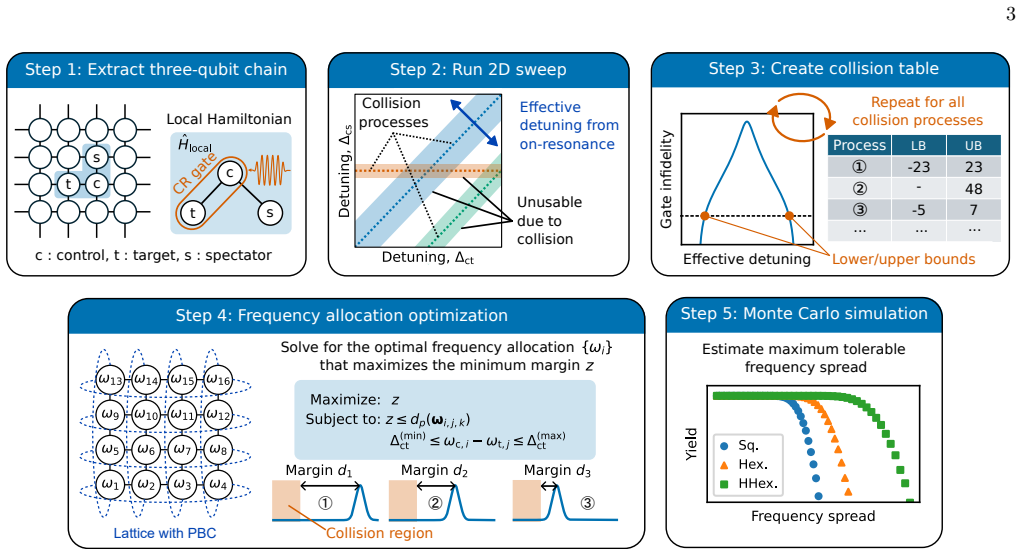
Frequency crowding remains a major obstacle to scaling fixed-frequency transmon processors. Among the widely used all-microwave two-qubit gates, the cross-resonance (CR) gate is particularly sensitive to qubit-frequency spread because the conventional straddling regime condition constrains assignable qubit frequencies tightly and makes the system susceptible to frequency collisions. Here, we propose and analyze the CR gate outside the straddling regime, which we refer to as the far-detuned regime, and evaluate frequency collisions using a numerical method that remains accurate under high-intensity, smoothly ramped microwave drives. Based on this analysis, we perform systematic parameter sweeps and provide collision-free conditions that define designable frequency regions in which qubit frequencies can be assigned consistently with surrounding qubit frequencies. Furthermore, we formulate frequency allocation as a linear programming optimization on a unit-cell lattice with periodic boundary conditions to obtain an optimal allocation. We demonstrate that far-detuned designs significantly reduce collisions compared with designs in the straddling regime. Monte Carlo yield analysis indicates that 10% collision-free yield for a 1024-qubit square lattice at a 0.1% two-qubit-gate error threshold requires $\sigma_{\mathrm{f}}/2\pi \le 6.8~\mathrm{MHz}$. Our findings suggest that this is feasible with an approximately twofold reduction in the state-of-the-art qubit-frequency spread.
Editorial analysis
A structured set of objections, weighed in public.
Referee Report
Summary. The paper analyzes the cross-resonance (CR) gate for fixed-frequency transmons in the far-detuned regime outside the conventional straddling regime. It introduces a numerical simulation approach asserted to remain accurate for high-intensity, smoothly ramped drives, derives collision-free frequency conditions through parameter sweeps, formulates frequency allocation as a linear-programming optimization on a periodic unit-cell lattice, and reports Monte Carlo yield estimates indicating that a 10% collision-free yield for a 1024-qubit square lattice at a 0.1% two-qubit error threshold requires qubit-frequency spread σ_f/2π ≤ 6.8 MHz, which the authors state is achievable via an approximately twofold reduction in current fabrication spreads.
Significance. If the numerical accuracy claim holds, the work supplies concrete, designable frequency regions and an optimization framework that could meaningfully relax frequency-crowding constraints for CR-based processors, offering a quantitative target (6.8 MHz spread) for fabrication improvements. The systematic sweeps, lattice LP formulation, and Monte Carlo sampling constitute a reproducible methodology that directly links microscopic collision conditions to macroscopic yield predictions.
major comments (2)
- The central numerical method for CR-gate collision analysis is stated in the abstract to remain accurate under high-intensity, smoothly ramped drives and to capture all relevant leakage/crosstalk channels outside the straddling regime, yet no benchmark validation (reproduction of known straddling boundaries, comparison to Floquet or perturbative results, or experimental cross-check) is provided. Because the collision-free conditions, designable regions, and the derived 6.8 MHz Monte Carlo yield threshold rest directly on these simulations, the absence of such validation is load-bearing for the quantitative claims.
- Monte Carlo yield section: the reported 10% yield at σ_f/2π = 6.8 MHz for the 1024-qubit lattice at 0.1% error threshold is obtained by sampling frequency allocations that satisfy the numerically derived collision-free conditions; any systematic bias in the underlying collision model therefore propagates directly into the yield curve and the conclusion that only a twofold reduction in state-of-the-art spread is required.
minor comments (2)
- The linear-programming formulation on the unit cell with periodic boundaries is presented without an explicit statement of the objective function or constraint matrix; adding these details would improve reproducibility.
- Figure captions and axis labels for the parameter-sweep and yield plots should explicitly indicate the two-qubit error threshold and the lattice size used in each panel.
Simulated Author's Rebuttal
We thank the referee for their detailed and constructive review of our manuscript. We appreciate the emphasis on validation of the numerical method and robustness of the Monte Carlo analysis, both of which are central to our quantitative claims. We address each major comment below and will incorporate revisions to strengthen the paper.
read point-by-point responses
-
Referee: The central numerical method for CR-gate collision analysis is stated in the abstract to remain accurate under high-intensity, smoothly ramped drives and to capture all relevant leakage/crosstalk channels outside the straddling regime, yet no benchmark validation (reproduction of known straddling boundaries, comparison to Floquet or perturbative results, or experimental cross-check) is provided. Because the collision-free conditions, designable regions, and the derived 6.8 MHz Monte Carlo yield threshold rest directly on these simulations, the absence of such validation is load-bearing for the quantitative claims.
Authors: We acknowledge that the current manuscript does not include explicit benchmark validations of the numerical integration method. Our approach relies on direct time-dependent Schrödinger equation integration with a standard adaptive Runge-Kutta solver applied to the driven transmon Hamiltonian, which is a conventional technique for capturing leakage and crosstalk under smooth ramps. To address the referee's concern, we will add a dedicated validation subsection (or appendix) in the revised manuscript. This will include: (i) reproduction of established CR gate fidelity and collision boundaries from the straddling regime using literature parameters, (ii) direct comparisons of leakage rates against Floquet theory for periodic driving and against perturbative effective-Hamiltonian calculations in the far-detuned limit, and (iii) convergence tests with respect to Hilbert-space truncation and time-step size. These additions will demonstrate consistency with known results and support the accuracy claim for the far-detuned regime. An experimental cross-check is outside the scope of this theoretical work, but the requested numerical benchmarks will be provided. revision: yes
-
Referee: Monte Carlo yield section: the reported 10% yield at σ_f/2π = 6.8 MHz for the 1024-qubit lattice at 0.1% error threshold is obtained by sampling frequency allocations that satisfy the numerically derived collision-free conditions; any systematic bias in the underlying collision model therefore propagates directly into the yield curve and the conclusion that only a twofold reduction in state-of-the-art spread is required.
Authors: We agree that any systematic bias in the collision model would directly affect the reported yield curves and the 6.8 MHz threshold. In the revised manuscript we will expand the Monte Carlo section with a sensitivity analysis: we will re-run the yield estimation while varying drive amplitude, ramp duration, and anharmonicity within physically plausible ranges, and we will report how these variations shift the collision-free regions and the resulting yield at the 0.1% error threshold. We will also add a discussion of potential model limitations (e.g., neglected higher-order drive terms or decoherence channels) and include error bands on the yield curves derived from these variations. This will make the quantitative conclusion about the required fabrication improvement more robust and transparent. revision: yes
Circularity Check
No significant circularity; yield derived from independent Monte Carlo sampling of numerically identified collision conditions
full rationale
The paper's derivation proceeds by direct numerical simulation of the cross-resonance gate in the far-detuned regime to extract collision-free frequency regions, followed by linear-programming optimization of frequency allocation on a lattice and Monte Carlo sampling to compute yield statistics. None of these steps reduces by construction to a fitted parameter, self-citation chain, or renamed input; the numerical method is presented as a forward computation whose accuracy is asserted rather than calibrated against the target yield metric. The enumerated circularity patterns are absent, and the central result remains an independent sampling outcome rather than a tautological restatement of its inputs.
Axiom & Free-Parameter Ledger
Reference graph
Works this paper leans on
-
[1]
2(c)] and control– target–spectator (c-t-s) [Fig
Three-qubit-chain topologies We study two kinds of three-qubit-chain topologies: target–control–spectator (t-c-s) [Fig. 2(c)] and control– target–spectator (c-t-s) [Fig. 2(d)] connection topologies. For both straddling and far-detuned frequency allocation, we extract both kinds of three-qubit chains from a large- scale lattice. In the t-c-s topology, the ...
-
[2]
Three-qubit-chain parameters To systematically identify collision conditions, we per- form systematic parameter sweeps over three-qubit-chain parameters. We define the three-qubit-chain parameter ω, which characterizes the chain as ω= (ω c, ωt, ωs, αc, αt, αs).(18) Here,ω c,ω t, andω s are the frequencies of the control, target, and spectator qubits, resp...
-
[3]
Infidelity estimate We estimate the gate error for each three-qubit-chain parameterωby combining two contributions: (i) un- wanted population transferϵ pop and (ii) coherent errors due to residualZZinteractionϵ ZZ . To quantify errors from unwanted population transfer during the CR gate we use ϵpop = 1 2n + 1 X (m,n)∈S ⊥ ZX (n) Rm,n + 1 2n X (m,n)∈Sleak(n...
-
[4]
Drive-power optimization via ac Stark shift We perform a simple optimization that mimics the ex- perimental fine-tuning of the CR drive power. The ac Stark shift provides a practical control knob for suppress- ing narrow frequency collisions during a CR operation. While the ac Stark shift scales approximately quadrat- ically with the drive amplitude Ω d, ...
-
[5]
Standardized collision margin To model the effect of fabrication-induced qubit- frequency spread on the collision margin, we assume that 10 lp 0 up 0.1% 1% 10% Gate infidelity (a) Collision-free window Collision window 0.1% infidelity Effective detuning 0 Standarized margin (b) dp FIG. 6. Schematic description of the standardized margind p as a function o...
-
[6]
Objective function We formulate the frequency allocation as a max–min optimization problem, aiming to maximize the smallest normalized margin over all three-qubit chains in a lattice. The optimization problem can be expressed as follows: Maximize {ωi} z Subject toz≤d p(ωi,j,k),∀p∈ P,(i, j, k)∈ E 3, ∆(min) ct ≤ω c,i −ω t,j ≤∆ (max) ct ,∀(i, j)∈ E 2, (30) w...
-
[7]
Required qubit-frequency spread for a 1024-qubit device Fault-tolerant surface-code operations with sufficiently low logical error rates are expected to require a physical gate error rate on the order of 10 −3 and the number of qubits on the order of 10 3 [52]. To assess how much re- duction in qubit-frequency spread is required to obtain a large-scale QP...
-
[8]
Yield curve The yield curves in Fig. 7(b) show that the simulated Monte Carlo results collapse approximately onto a com- mon curve when plotted against the normalized qubit- 12 frequency spreadσ f /zopt. This behavior can be under- stood using a simple independent failure model. Our optimization maximizes the minimum standard- ized distance to the set of ...
-
[9]
Notations and definitions We denote the set of full three-qubit Fock states asF(n) and define the computational and non- computational state sets as F(n) ={|0⟩,|1⟩, . . .} ⊗n,(C1) C(n) ={|0⟩,|1⟩} ⊗n,(C2) C(n) =F(n)\ C(n),(C3) where we assume that each transmon qubit is trun- cated at a sufficiently high level such that the trun- cation does not affect the...
-
[10]
Infidelity bound The average gate fidelityF avg of this CR-gate opera- tion is given by [24] Favg = Tr h ˆU † ZX ˜Uexp i 2 + Tr h ˜U † exp ˜Uexp i 2n(2n + 1) ,(C9) wherenis the number of qubits defining the computa- tional subspace. Consider the first term in Eq. (C9). Because ˆUZX has non-zero elements only inS ZX , Tr ˆU † ZX ˜Uexp = X (m,n)∈SZX ( ˆUZX ...
-
[11]
J. Koch, T. M. Yu, J. Gambetta, A. A. Houck, D. I. Schuster, J. Majer, A. Blais, M. H. Devoret, S. M. Girvin, and R. J. Schoelkopf, Charge-insensitive qubit design de- rived from the Cooper pair box, Phys. Rev. A76, 042319 (2007)
work page 2007
-
[12]
J. A. Schreier, A. A. Houck, J. Koch, D. I. Schuster, B. R. Johnson, J. M. Chow, J. M. Gambetta, J. Ma- jer, L. Frunzio, M. H. Devoret, S. M. Girvin, and R. J. Schoelkopf, Suppressing charge noise decoherence in su- perconducting charge qubits, Phys. Rev. B77, 180502 (2008)
work page 2008
-
[13]
Z. Li, P. Liu, P. Zhao, Z. Mi, H. Xu, X. Liang, T. Su, W. Sun, G. Xue, J.-N. Zhang,et al., Error per single- qubit gate below 10 −4 in a superconducting qubit, npj Quantum Information9, 111 (2023)
work page 2023
-
[14]
B. Chiaro and Y. Zhang, Active leakage cancellation in single qubit gates, Phys. Rev. Lett.135, 130601 (2025)
work page 2025
-
[15]
R. Li, K. Kubo, Y. Ho, Z. Yan, Y. Nakamura, and H. Goto, Realization of high-fidelity CZ gate based on a double-transmon coupler, Physical Review X14, 041050 (2024)
work page 2024
-
[16]
P. A. Spring, L. Milanovic, Y. Sunada, S. Wang, A. F. van Loo, S. Tamate, and Y. Nakamura, Fast multiplexed superconducting-qubit readout with intrinsic purcell fil- tering using a multiconductor transmission line, PRX Quantum6, 020345 (2025)
work page 2025
-
[17]
F. Marxer, J. Mro˙ zek, J. Andersson, L. Abdurakhimov, J. Adam, V. Bergholm, R. Beriwal, C. F. Chan, S. Dahl, S. R. Das,et al., Above 99.9% fidelity single-qubit gates, two-qubit gates, and readout in a single superconducting quantum device, arXiv:2508.16437 (2025)
work page internal anchor Pith review arXiv 2025
-
[18]
S. Inoue, R. Li, K. Kubo, Y. Ho, Y. Nakamura, and H. Goto, Parametrically driven iSWAP gate using a ca- pacitively shunted double-transmon coupler at the zero- flux sweet spot, arXiv:2604.27679 (2026)
work page internal anchor Pith review Pith/arXiv arXiv 2026
- [19]
-
[20]
J. B. Hertzberg, E. J. Zhang, S. Rosenblatt, E. Mage- san, J. A. Smolin, J.-B. Yau, V. P. Adiga, M. Sandberg, M. Brink, J. M. Chow, and J. S. Orcutt, Laser-annealing Josephson junctions for yielding scaled-up superconduct- ing quantum processors, npj Quantum Information7, 129 (2021)
work page 2021
-
[21]
E. J. Zhang, S. Srinivasan, N. Sundaresan, D. F. Bogorin, Y. Martin, J. B. Hertzberg, J. Timmerwilke, E. J. Pritch- ett, J.-B. Yau, C. Wang, W. Landers, E. P. Lewandowski, A. Narasgond, S. Rosenblatt, G. A. Keefe, I. Lauer, M. B. Rothwell, D. T. McClure, O. E. Dial, J. S. Or- cutt, M. Brink, and J. M. Chow, High-performance su- perconducting quantum proce...
work page 2022
-
[22]
C. Rigetti, A. Blais, and M. Devoret, Protocol for uni- versal gates in optimally biased superconducting qubits, Phys. Rev. Lett.94, 240502 (2005)
work page 2005
-
[23]
G. S. Paraoanu, Microwave-induced coupling of super- conducting qubits, Phys. Rev. B74, 140504(R) (2006)
work page 2006
-
[24]
J. M. Chow, A. D. Crcoles, J. M. Gambetta, C. Rigetti, B. R. Johnson, J. A. Smolin, J. R. Rozen, G. A. Keefe, M. B. Rothwell, M. B. Ketchen, and M. Steffen, Simple all-microwave entangling gate for fixed-frequency super- conducting qubits, Physical Review Letters107, 080502 (2011)
work page 2011
-
[25]
J. M. Chow, J. M. Gambetta, A. D. Crcoles, S. T. Merkel, J. A. Smolin, C. Rigetti, S. Poletto, G. A. Keefe, M. B. Rothwell, J. R. Rozen, M. B. Ketchen, and M. Steffen, Universal quantum gate set approaching fault-tolerant thresholds with superconducting qubits, Physical Review Letters109, 060501 (2012)
work page 2012
-
[26]
A. D. C´ orcoles, J. M. Gambetta, J. M. Chow, J. A. Smolin, M. Ware, J. Strand, B. L. T. Plourde, and M. Steffen, Process verification of two-qubit quantum gates by randomized benchmarking, Phys. Rev. A87, 030301 (2013)
work page 2013
-
[27]
S. Sheldon, E. Magesan, J. M. Chow, and J. M. Gam- betta, Procedure for systematically tuning up cross-talk in the cross-resonance gate, Phys. Rev. A93, 060302 (2016)
work page 2016
- [28]
-
[29]
D. C. McKay, S. Sheldon, J. A. Smolin, J. M. Chow, and J. M. Gambetta, Three-qubit randomized benchmarking, Phys. Rev. Lett.122, 200502 (2019)
work page 2019
-
[30]
V. Tripathi, M. Khezri, and A. N. Korotkov, Operation and intrinsic error budget of a two-qubit cross-resonance gate, Physical Review A100, 012301 (2019)
work page 2019
-
[31]
N. Sundaresan, I. Lauer, E. Pritchett, E. Magesan, P. Ju- rcevic, and J. M. Gambetta, Reducing unitary and spec- tator errors in cross resonance with optimized rotary echoes, PRX Quantum1, 020318 (2020)
work page 2020
-
[32]
A. Kandala, K. X. Wei, S. Srinivasan, E. Magesan, S. Carnevale, G. A. Keefe, D. Klaus, O. Dial, and D. C. McKay, Demonstration of a high-fidelity CNOT gate for fixed-frequency transmons with engineeredZZsuppres- sion, Phys. Rev. Lett.127, 130501 (2021)
work page 2021
-
[33]
E. Magesan and J. M. Gambetta, Effective Hamiltonian models of the cross-resonance gate, Physical Review A 101, 052308 (2020)
work page 2020
-
[34]
M. Malekakhlagh, E. Magesan, and D. C. McKay, First- principles analysis of cross-resonance gate operation, Phys. Rev. A102, 042605 (2020)
work page 2020
- [35]
-
[36]
A. Di Paolo, C. Leroux, T. M. Hazard, K. Serniak, S. Gustavsson, A. Blais, and W. D. Oliver, Extensible circuit-QED architecture via amplitude-and frequency- variable microwaves, arXiv:2204.08098 (2022)
-
[37]
K. Heya, M. Malekakhlagh, S. Merkel, N. Kanazawa, and E. Pritchett, Floquet analysis of frequency collisions, Phys. Rev. Appl.21, 024035 (2024)
work page 2024
- [38]
-
[39]
Y. Zhao, Y. Ye, H.-L. Huang, Y. Zhang, D. Wu, H. Guan, Q. Zhu, Z. Wei, T. He, S. Cao, F. Chen, T.-H. Chung, 23 H. Deng, D. Fan, M. Gong, C. Guo, S. Guo, L. Han, N. Li, S. Li, Y. Li, F. Liang, J. Lin, H. Qian, H. Rong, H. Su, L. Sun, S. Wang, Y. Wu, Y. Xu, C. Ying, J. Yu, C. Zha, K. Zhang, Y.-H. Huo, C.-Y. Lu, C.-Z. Peng, X. Zhu, and J.-W. Pan, Realization...
work page 2022
-
[40]
M. Khezri, A. Opremcak, Z. Chen, K. C. Miao, M. McEwen, A. Bengtsson, T. White, O. Naaman, D. Sank, A. N. Korotkov, Y. Chen, and V. Smelyan- skiy, Measurement-induced state transitions in a super- conducting qubit: Within the rotating-wave approxima- tion, Phys. Rev. Appl.20, 054008 (2023)
work page 2023
-
[41]
M. F. Dumas, B. Groleau-Par´ e, A. McDonald, M. H. Mu˜ noz Arias, C. Lled´ o, B. D’Anjou, and A. Blais, Measurement-induced transmon ionization, Phys. Rev. X14, 041023 (2024)
work page 2024
-
[42]
L. Xie, J. Zhai, Z. Zhang, J. Allcock, S. Zhang, and Y.-C. Zheng, Suppressing ZZ crosstalk of quantum computers through pulse and scheduling co-optimization, inPro- ceedings of the 27th ACM International Conference on Architectural Support for Programming Languages and Operating Systems, ASPLOS ’22 (Association for Com- puting Machinery, New York, NY, USA...
work page 2022
-
[43]
P. V. Klimov, A. Bengtsson, C. Quintana, A. Bourassa, S. Hong, A. Dunsworth, K. J. Satzinger, W. P. Liv- ingston, V. Sivak, M. Y. Niu, T. I. Andersen, Y. Zhang, D. Chik, Z. Chen, C. Neill, C. Erickson, A. Grajales Dau, A. Megrant, P. Roushan, A. N. Korotkov, J. Kelly, V. Smelyanskiy, Y. Chen, and H. Neven, Optimizing quantum gates towards the scale of log...
work page 2024
- [44]
- [45]
-
[46]
E. McKinney, I. G. Yusuf, G. Falstin, G. Agarwal, M. Hatridge, and A. K. Jones, Spectator-aware fre- quency allocation in tunable-coupler quantum architec- tures, arXiv:2409.18262 (2024)
-
[47]
H. Ai and Y.-x. Liu, Scalable parameter design for super- conducting quantum circuits with graph neural networks, Phys. Rev. Lett.135, 040601 (2025)
work page 2025
- [48]
-
[49]
A. Eickbusch, M. McEwen, V. Sivak, A. Bourassa, J. Atalaya, J. Claes, D. Kafri, C. Gidney, C. W. Warren, J. Gross, A. Opremcak, N. Zobrist, K. C. Miao, G. Roberts, K. J. Satzinger, A. Bengtsson, M. Neeley, W. P. Livingston, A. Greene, R. Acharya, L. Aghababaie Beni, G. Aigeldinger, R. Alcaraz, T. I. Andersen, M. Ansmann, F. Arute, K. Arya, A. As- faw, R. ...
work page 1994
-
[50]
C. Chamberland, G. Zhu, T. J. Yoder, J. B. Hertzberg, and A. W. Cross, Topological and subsystem codes on low-degree graphs with flag qubits, Phys. Rev. X10, 011022 (2020)
work page 2020
-
[51]
K. N. Smith, G. S. Ravi, J. M. Baker, and F. T. Chong, Scaling superconducting quantum computers with chiplet architectures, in2022 55th IEEE/ACM In- ternational Symposium on Microarchitecture (MICRO) (2022) pp. 1092–1109
work page 2022
-
[52]
S. Krinner, P. Kurpiers, B. Royer, P. Magnard, I. Tsit- silin, J.-C. Besse, A. Remm, A. Blais, and A. Wallraff, Demonstration of an all-microwave controlled-phase gate between far-detuned qubits, Phys. Rev. Appl.14, 044039 (2020)
work page 2020
- [53]
-
[54]
S. Shirai, S. Inoue, S. Tamate, R. Li, Y. Naka- mura, and A. Noguchi, High-fidelity all-microwave CZ gate with partial erasure-error detec- tion via a transmon coupler, arXiv:2511.01260 https://doi.org/10.48550/arXiv.2511.01260 (2025)
-
[55]
J. M. Chow, J. M. Gambetta, A. W. Cross, S. T. Merkel, C. Rigetti, and M. Steffen, Microwave-activated conditional-phase gate for superconducting qubits, New Journal of Physics15, 115012 (2013). 24
work page 2013
-
[56]
H. Paik, A. Mezzacapo, M. Sandberg, D. T. McClure, B. Abdo, A. D. C´ orcoles, O. Dial, D. F. Bogorin, B. L. T. Plourde, M. Steffen, A. W. Cross, J. M. Gambetta, and J. M. Chow, Experimental demonstration of a resonator- induced phase gate in a multiqubit circuit-QED system, Phys. Rev. Lett.117, 250502 (2016)
work page 2016
-
[57]
S. P. Premaratne, J.-H. Yeh, F. C. Wellstood, and B. S. Palmer, Implementation of a generalized controlled-not gate between fixed-frequency transmons, Phys. Rev. A 99, 012317 (2019)
work page 2019
-
[58]
F. Motzoi and F. K. Wilhelm, Improving frequency se- lection of driven pulses using derivative-based transition suppression, Phys. Rev. A88, 062318 (2013)
work page 2013
-
[59]
M. Werninghaus, D. J. Egger, F. Roy, S. Machnes, F. K. Wilhelm, and S. Filipp, Leakage reduction in fast super- conducting qubit gates via optimal control, npj Quantum Information7, 14 (2021)
work page 2021
-
[60]
B. Li, T. Calarco, and F. Motzoi, Experimental error suppression in cross-resonance gates via multi-derivative pulse shaping, npj Quantum Information10, 66 (2024)
work page 2024
-
[61]
E. Hyypp, A. Vepslinen, M. Papi, C. F. Chan, S. Inel, A. Landra, W. Liu, J. Luus, F. Marxer, C. Ockeloen- Korppi, S. Orbell, B. Tarasinski, and J. Heinsoo, Re- ducing leakage of single-qubit gates for superconducting quantum processors using analytical control pulse en- velopes, PRX Quantum5, 030353 (2024)
work page 2024
-
[62]
A. G. Fowler, M. Mariantoni, J. M. Martinis, and A. N. Cleland, Surface codes: Towards practical large-scale quantum computation, Phys. Rev. A86, 032324 (2012)
work page 2012
-
[63]
D. Litinski, A game of surface codes: Large-scale quan- tum computing with lattice surgery, Quantum3, 128 (2019)
work page 2019
-
[64]
I. S. Mihov and N. V. Vitanov, Qubit dynamics driven by smooth pulses of finite duration, Phys. Rev. A110, 052609 (2024)
work page 2024
-
[65]
X. Xu, Manabputra, C. Vignes, M. H. Ansari, and J. M. Martinis, Lattice Hamiltonians and stray interactions within quantum processors, Phys. Rev. Appl.22, 064030 (2024)
work page 2024
-
[66]
Gurobi Optimization, LLC, Gurobi Optimizer Reference Manual (2024)
work page 2024
-
[67]
W. Dai, S. Hazra, D. K. Weiss, P. D. Kurilovich, T. Con- nolly, H. K. Babla, S. Singh, V. R. Joshi, A. Z. Ding, P. D. Parakh, J. Venkatraman, X. Xiao, L. Frunzio, and M. H. Devoret, Characterization of drive-induced unwanted state transitions in superconducting circuits, Phys. Rev. X16, 011011 (2026)
work page 2026
-
[68]
L. B. Nguyen, G. Koolstra, Y. Kim, A. Morvan, T. Chis- tolini, S. Singh, K. N. Nesterov, C. J¨ unger, L. Chen, Z. Pedramrazi, B. K. Mitchell, J. M. Kreikebaum, S. Puri, D. I. Santiago, and I. Siddiqi, Blueprint for a high-performance fluxonium quantum processor, PRX Quantum3, 037001 (2022)
work page 2022
- [69]
-
[70]
P. Jurcevic, A. Javadi-Abhari, L. S. Bishop, I. Lauer, D. F. Bogorin, M. Brink, L. Capelluto, O. Gnlk, T. Itoko, N. Kanazawa, A. Kandala, G. A. Keefe, K. Krsulich, W. Landers, E. P. Lewandowski, D. T. McClure, G. Nan- nicini, A. Narasgond, H. M. Nayfeh, E. Pritchett, M. B. Rothwell, S. Srinivasan, N. Sundaresan, C. Wang, K. X. Wei, C. J. Wood, J.-B. Yau, ...
work page 2021
-
[71]
J. M. Martinis and M. R. Geller, Fast adiabatic qubit gates using onlyσ z control, Phys. Rev. A90, 022307 (2014)
work page 2014
-
[72]
Q. Ding, A. V. Oppenheim, P. T. Boufounos, S. Gustavs- son, J. A. Grover, T. A. Baran, and W. D. Oliver, Pulse design of baseband flux control for adiabatic controlled- phase gates in superconducting circuits, Phys. Rev. Appl. 23, 064013 (2025)
work page 2025
discussion (0)
Sign in with ORCID, Apple, or X to comment. Anyone can read and Pith papers without signing in.