Recognition: no theorem link
Trustworthiness in Digital Twin Systems: Systematic Review and Research Horizons
Pith reviewed 2026-05-12 01:23 UTC · model grok-4.3
The pith
A systematic review of digital twin papers identifies four patterns in how trust is prioritized across domains.
A machine-rendered reading of the paper's core claim, the machinery that carries it, and where it could break.
Core claim
By aggregating challenges and strategies across domains in the reviewed literature, distinct patterns of emphasis appear, with domains sharing similar spectra of trust concerns. This leads to four integration types—human-centred, safety-critical, context-specific, and technologically-driven—that reflect how trust is prioritised in different deployment contexts. Drawing on these types, the paper proposes directions such as developing trust-by-design principles for early-stage decisions, adding trust metadata to platform schemas, and examining how choices like federated architectures affect user trust.
What carries the argument
The systematic mapping of paper abstracts to a fixed set of seven trust challenges and seven trust-enhancing strategies, which surfaces the four domain-based integration types.
If this is right
- Trust-by-design principles can be developed to guide early-stage decision-making in digital twin projects.
- Adding trust metadata to platform schemas can prompt developers to consider trust factors systematically.
- Architectural choices such as federated digital twins can be studied for their specific effects on user trust.
- Domains sharing similar trust concerns can draw on each other's strategies rather than treating trust issues in isolation.
Where Pith is reading between the lines
- The four-type framework could be tested by applying it to newly published digital twin papers to check stability over time.
- Empirical user studies in each integration type could measure whether following the proposed strategies actually increases perceived trustworthiness.
- The approach might extend to other complex systems such as autonomous vehicles or smart grids that also combine technical and human factors.
Load-bearing premise
The selected digital twin review papers and the abstract-level mapping process together give an unbiased and complete picture of trust discussions in the wider digital twin literature.
What would settle it
A new collection of digital twin papers whose trust discussions fit none of the four integration types or were absent from the reviewed set would undermine the patterns and categories.
Figures
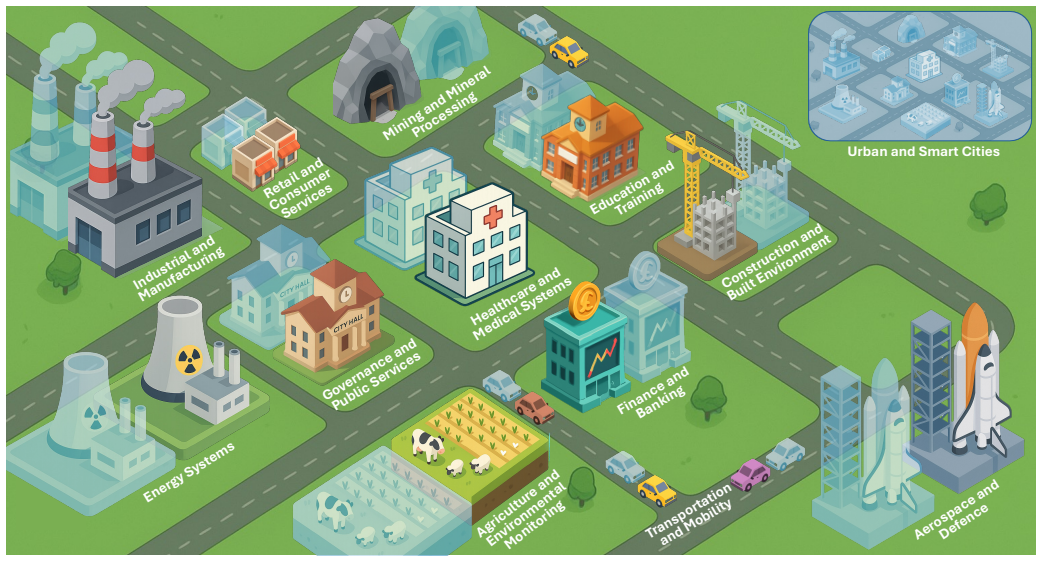


read the original abstract
Digital Twins (DTs) are increasingly deployed across application domains, yet the treatment of trust-related issues remains unevenly addressed. To examine whether and how trust is discussed in the current landscape, we conducted a systematic review of existing DT review papers and a mapping of their abstracts. Seven trust-related challenges and seven trust-enhancing strategies were defined to guide the analysis, enabling the trust focus of each paper to be characterised. By aggregating the challenges and strategies referenced across domains, distinct patterns of emphasis were observed. With certain domains consistently sharing similar spectrum of trust concerns, four integration types, including human-centred, safety-critical, context-specific, and technologically-driven, were identified as emergent categories reflecting how trust is prioritised in different deployment contexts. Drawing on the characteristics of these types, several preliminary directions for future research were proposed. These include the development of trust-by-design principles to inform early-stage decision-making, the inclusion of trust metadata in platform schemas to prompt systematic developer consideration of trust factors, and the exploration of how architectural choices, such as federated DTs, influence user trust.
Editorial analysis
A structured set of objections, weighed in public.
Referee Report
Summary. The paper conducts a systematic review of existing review papers on Digital Twins (DTs) across domains. It defines seven trust-related challenges and seven trust-enhancing strategies, then maps the abstracts of selected DT review papers to these categories. Aggregating the mappings by domain reveals patterns of emphasis, from which the authors derive four emergent integration types (human-centred, safety-critical, context-specific, and technologically-driven) that characterize how trust is prioritized in different deployment contexts. The work concludes by outlining preliminary future research directions, such as trust-by-design principles, trust metadata in platform schemas, and the impact of architectural choices like federated DTs.
Significance. If the derived typology holds, the paper provides a useful cross-domain synthesis that organizes disparate discussions of trustworthiness in DT literature and identifies shared patterns, which could help researchers and practitioners prioritize trust factors according to deployment context. The explicit aggregation step and proposal of integration types offer a structured lens beyond isolated domain reviews. Credit is due for the systematic framing and for surfacing concrete research horizons tied to the observed patterns.
major comments (2)
- [Methods / abstract mapping] The central claim that distinct patterns yield four integration types rests on the abstract-mapping process described in the methods. Abstracts are high-level summaries that frequently omit detailed trust discussions, mitigation approaches, or domain-specific nuances present in full texts; without a reported validation subset (e.g., full-text coding of a random sample) or inter-rater reliability metrics for the mapping, any systematic under- or over-representation directly propagates into the observed spectra and the resulting typology.
- [Trust challenges and strategies definition] The seven challenges and seven strategies are presented as author-defined constructs used to guide the analysis. The manuscript does not detail how these categories were derived (e.g., from a prior extraction of primary DT literature or from established trust frameworks), leaving open the possibility that the subsequent pattern detection and integration-type emergence partly reflect the chosen framing rather than purely emergent data.
minor comments (2)
- [Abstract] The abstract states that 'distinct patterns of emphasis were observed' but does not quantify the number of review papers included or the distribution across domains, which would help readers assess the robustness of the aggregation.
- [Conclusion / future directions] The proposed research directions (trust-by-design principles, trust metadata, federated DTs) are listed without explicit linkage back to which integration types they primarily address, reducing their actionability.
Simulated Author's Rebuttal
We thank the referee for the constructive feedback, which highlights opportunities to strengthen the transparency of our methods. We address each major comment below and will incorporate clarifications and additional details in the revised manuscript.
read point-by-point responses
-
Referee: [Methods / abstract mapping] The central claim that distinct patterns yield four integration types rests on the abstract-mapping process described in the methods. Abstracts are high-level summaries that frequently omit detailed trust discussions, mitigation approaches, or domain-specific nuances present in full texts; without a reported validation subset (e.g., full-text coding of a random sample) or inter-rater reliability metrics for the mapping, any systematic under- or over-representation directly propagates into the observed spectra and the resulting typology.
Authors: We acknowledge the inherent limitations of abstract-level mapping for capturing fine-grained nuances. Because the corpus consists of review papers whose abstracts are intended to summarise core themes, we judged this level sufficient for identifying broad patterns across domains. In the revision we will expand the methods section to explicitly justify the abstract-only approach, add a limitations paragraph discussing potential under-representation of details, and report a post-hoc validation exercise on a random 20 % sample of full texts together with inter-rater reliability statistics for the mapping process. revision: partial
-
Referee: [Trust challenges and strategies definition] The seven challenges and seven strategies are presented as author-defined constructs used to guide the analysis. The manuscript does not detail how these categories were derived (e.g., from a prior extraction of primary DT literature or from established trust frameworks), leaving open the possibility that the subsequent pattern detection and integration-type emergence partly reflect the chosen framing rather than purely emergent data.
Authors: The seven challenges and seven strategies were synthesised from a combination of established socio-technical trust frameworks (e.g., Mayer et al., 1995; McKnight et al., 2002) and an initial open coding of 15 prominent DT papers to surface recurring issues. We will insert a new subsection in the methods that documents this two-stage derivation, lists the source frameworks, and provides example excerpts from the initial coding, thereby allowing readers to evaluate the degree to which the typology is data-driven versus framework-guided. revision: yes
Circularity Check
No circularity: literature synthesis grounded in external sources
full rationale
The paper performs a systematic review by defining seven challenges and seven strategies to map abstracts of existing DT review papers, then aggregates observed patterns across domains to identify four emergent integration types. This process relies on external literature as input rather than reducing any claim to the paper's own definitions or prior self-citations by construction. No equations, fitted predictions, uniqueness theorems, or ansatzes are present. The typology is presented as an interpretive aggregation of referenced content, not a self-referential derivation. Per the hard rules, absent any quoted reduction of output to input, the circularity score is 0.
Axiom & Free-Parameter Ledger
axioms (1)
- domain assumption A systematic review of existing review papers sufficiently represents the current state of trustworthiness discussions in digital twin research.
invented entities (4)
-
Human-centred integration type
no independent evidence
-
Safety-critical integration type
no independent evidence
-
Context-specific integration type
no independent evidence
-
Technologically-driven integration type
no independent evidence
Reference graph
Works this paper leans on
-
[1]
Digital twin paradigm: A systematic literature review,
C. Semeraro, M. Lezoche, H. Panetto, and M. Dassisti, “Digital twin paradigm: A systematic literature review,”Computers in Industry, vol. 130, p. 103469, 2021
work page 2021
-
[2]
Digital twin: Manufacturing excellence through virtual factory replication,
M. Grieves, “Digital twin: Manufacturing excellence through virtual factory replication,”Digital Twin White Paper, 03 2015
work page 2015
-
[3]
Digital twin: Enabling technologies, challenges and open research,
A. Fuller, Z. Fan, C. Day, and C. Barlow, “Digital twin: Enabling technologies, challenges and open research,”IEEE Access, vol. 8, pp. 108952–108971, 2020
work page 2020
-
[4]
A comprehensive survey of digital twins: Applications, technologies and security challenges,
S. R. Jeremiah, A. El Azzaoui, N. N. Xiong, and J. H. Park, “A comprehensive survey of digital twins: Applications, technologies and security challenges,”Journal of Systems Architecture, vol. 151, p. 103120, 2024
work page 2024
-
[5]
The perils of leveraging evil digital twins as security-enhancing enablers,
S. Suhail, M. Iqbal, and R. Jurdak, “The perils of leveraging evil digital twins as security-enhancing enablers,”Commun. ACM, vol. 67, p. 39–42, Dec. 2023
work page 2023
-
[6]
Privacy and security challenges of the digital twin: systematic literature review,
M. Ku ˇstelega, R. Mekovec, and A. Shareef, “Privacy and security challenges of the digital twin: systematic literature review,”JUCS - Journal of Universal Computer Science, vol. 30, no. 13, pp. 1782– 1806, 2024
work page 2024
-
[7]
W. M. P. van der Aalst, O. Hinz, and C. Weinhardt, “Resilient digital twins,”Business & Information Systems Engineering, vol. 63, no. 6, pp. 615–619, 2021
work page 2021
-
[8]
C. Kelp and M. Simion, “What is trustworthiness?,”No ˆus, vol. 57, no. 3, pp. 667–683, 2023
work page 2023
-
[9]
Digital twin in manufacturing: A categorical literature review and classifica- tion,
W. Kritzinger, M. Karner, G. Traar, J. Henjes, and W. Sihn, “Digital twin in manufacturing: A categorical literature review and classifica- tion,”IFAC-PapersOnLine, vol. 51, no. 11, pp. 1016–1022, 2018. 16th IFAC Symposium on Information Control Problems in Manufacturing INCOM 2018
work page 2018
-
[10]
The digital twin paradigm for fu- ture NASA and U.S. air force vehicles,
E. Glaessgen and D. Stargel, “The digital twin paradigm for fu- ture NASA and U.S. air force vehicles,” inProceedings of the 53rd AIAA/ASME/ASCE/AHS/ASC Structures, Structural Dynamics, and Materials Conference (20th AIAA/ASME/AHS Adaptive Structures Conference, 14th AIAA), (Honolulu, Hawaii), p. 1818, AIAA, 04 2012
work page 2012
-
[11]
Digital twin: Values, challenges and enablers from a modeling perspective,
A. Rasheed, O. San, and T. Kvamsdal, “Digital twin: Values, challenges and enablers from a modeling perspective,”IEEE Access, vol. 8, pp. 21980–22012, 2020
work page 2020
-
[12]
The development of a digital twin concept system,
H. Duan, S. Gao, X. Yang, and Y . Li, “The development of a digital twin concept system,”Digital Twin, vol. 2, no. 3, p. 2530298, 2025
work page 2025
-
[13]
Digital twin in industries: A comprehensive survey,
M. Bokhtiar Al Zami, S. Shaon, V . Khanh Quy, and D. C. Nguyen, “Digital twin in industries: A comprehensive survey,”IEEE Access, vol. 13, pp. 47291–47336, 2025
work page 2025
-
[14]
G. Pronost, F. Mayer, M. Camargo, and L. Dupont, “Digital twins along the product lifecycle: A systematic literature review of applications in manufacturing,”Digital Twin, vol. 1, no. 2, p. 3, 2024
work page 2024
-
[15]
Industrial applications of digital twin technology in the mining sector: An overview,
J. Plav ˇsi´c and I. Mi ˇskovi´c, “Industrial applications of digital twin technology in the mining sector: An overview,”CIM Journal, vol. 14, no. 2, pp. 97–106, 2023
work page 2023
-
[16]
N. El Bazi, M. Mabrouki, O. Laayati, N. Ouhabi, H. El Hadraoui, F.-E. Hammouch, and A. Chebak, “Generic multi-layered digital-twin- framework-enabled asset lifecycle management for the sustainable mining industry,”Sustainability, vol. 15, no. 4, 2023
work page 2023
-
[17]
Cloud-edge hosted digital twins for coordinated control of distributed energy resources,
J. Han, Q. Hong, M. H. Syed, M. A. U. Khan, G. Yang, G. Burt, and C. Booth, “Cloud-edge hosted digital twins for coordinated control of distributed energy resources,”IEEE Transactions on Cloud Computing, vol. 11, no. 2, pp. 1242–1256, 2023
work page 2023
-
[18]
M. Valinejadshoubi, R. Sacks, F. Valdivieso, C. Corneau-Gauvin, and A. Kaptu ´e, “Digital twin construction in practice: A case study of closed-loop production control integrating bim, gis, and iot sensors,” Journal of Construction Engineering and Management, vol. 151, no. 11, p. 05025014, 2025
work page 2025
-
[19]
M. Baghalzadeh Shishehgarkhaneh, A. Keivani, R. C. Moehler, N. Jelo- dari, and S. Roshdi Laleh, “Internet of things (iot), building information modeling (bim), and digital twin (dt) in construction industry: A review, bibliometric, and network analysis,”Buildings, vol. 12, no. 10, 2022
work page 2022
-
[20]
A systematic review of a digital twin city: A new pattern of urban governance toward smart cities,
T. Deng, K. Zhang, and Z.-J. M. Shen, “A systematic review of a digital twin city: A new pattern of urban governance toward smart cities,”Journal of Management Science and Engineering, vol. 6, no. 2, pp. 125–134, 2021
work page 2021
-
[21]
Toward transportation digital twin systems for traffic safety and mobility: A review,
M. S. Irfan, S. Dasgupta, and M. Rahman, “Toward transportation digital twin systems for traffic safety and mobility: A review,”IEEE Internet of Things Journal, vol. 11, no. 14, pp. 24581–24603, 2024
work page 2024
-
[22]
Application and development prospect of digital twin technology in aerospace,
H. Yin Z and L. Wang, “Application and development prospect of digital twin technology in aerospace,”IFAC-PapersOnLine, vol. 53, no. 5, pp. 732–737, 2020. 3rd IFAC Workshop on Cyber-Physical & Human Systems CPHS 2020
work page 2020
-
[23]
Digital twin in the military field,
A. F. Mendi, T. Erol, and D. Do ˘gan, “Digital twin in the military field,” IEEE Internet Computing, vol. 26, no. 5, pp. 33–40, 2022
work page 2022
-
[24]
Medical digital twins: enabling precision medicine and medical artificial intelligence,
C. Sad ´ee, S. Testa, T. Barba, K. Hartmann, M. Schuessler, A. Thieme, G. M. Church, I. Okoye, T. Hernandez-Boussard, L. Hood, I. Shmule- vich, E. Kuhl, and O. Gevaert, “Medical digital twins: enabling precision medicine and medical artificial intelligence,”The Lancet Digital Health, 2025. Published 2025/08/04
work page 2025
-
[25]
Smart agriculture and digital twins: Applications and challenges in a vision of sustainability,
S. Cesco, P. Sambo, M. Borin, B. Basso, G. Orzes, and F. Mazzetto, “Smart agriculture and digital twins: Applications and challenges in a vision of sustainability,”European Journal of Agronomy, vol. 146, p. 126809, 2023
work page 2023
-
[26]
A hybrid teaching factory model towards personalized education 4.0,
D. Mourtzis, N. Panopoulos, and J. Angelopoulos, “A hybrid teaching factory model towards personalized education 4.0,”International Jour- nal of Computer Integrated Manufacturing, vol. 36, no. 12, pp. 1739– 1759, 2023
work page 2023
-
[27]
M. K ¨umpel, C. A. Mueller, and M. Beetz,Semantic Digital Twins for Retail Logistics, pp. 129–153. Cham: Springer International Publishing, 2021
work page 2021
-
[28]
The emerging digital twin bureaucracy in the 21st century,
S.-J. Eom, “The emerging digital twin bureaucracy in the 21st century,” Perspectives on Public Management and Governance, vol. 5, pp. 174– 186, 03 2022
work page 2022
-
[29]
Enhancing e-government with a digital twin for innovation management,
M. Anshari and M. Hamdan, “Enhancing e-government with a digital twin for innovation management,”Journal of Science and Technology Policy Management, vol. 14, pp. 1055–1065, 08 2022
work page 2022
-
[30]
Digital twin: Finan- cial technology’s next frontier of robo-advisor,
M. Anshari, M. N. Almunawar, and M. Masri, “Digital twin: Finan- cial technology’s next frontier of robo-advisor,”Journal of Risk and Financial Management, vol. 15, no. 4, 2022
work page 2022
-
[31]
Basic concepts and taxonomy of dependable and secure computing,
A. Avizienis, J.-C. Laprie, B. Randell, and C. Landwehr, “Basic concepts and taxonomy of dependable and secure computing,”IEEE Transactions on Dependable and Secure Computing, vol. 1, no. 1, pp. 11–33, 2004
work page 2004
-
[32]
Evaluating critical security issues of the iot world: Present and future challenges,
M. Frustaci, P. Pace, G. Aloi, and G. Fortino, “Evaluating critical security issues of the iot world: Present and future challenges,”IEEE Internet of Things Journal, vol. 5, no. 4, pp. 2483–2495, 2018
work page 2018
-
[33]
An architecture of an intelligent digital twin in a cyber-physical production system,
B. A. Talkhestani, T. Jung, B. Lindemann, N. Sahlab, N. Jazdi, W. Schloegl, and M. Weyrich, “An architecture of an intelligent digital twin in a cyber-physical production system,”at - Automatisierungstech- nik, vol. 67, no. 9, pp. 762–782, 2019
work page 2019
-
[34]
M. Mostert, A. Bredenoord, M. Biesaart, and J. Delden, “Big data in medical research and eu data protection law: challenges to the consent or anonymise approach,”European journal of human genetics : EJHG, vol. 24, 11 2015
work page 2015
-
[35]
International standards for digital twins,
E. Kumas ¸, “International standards for digital twins,”Acta Infologica, vol. 8, no. 2, p. 274–286, 2024
work page 2024
-
[37]
Digital twin-driven intrusion detection for industrial scada: A cyber-physical case study,
A. Sayghe, “Digital twin-driven intrusion detection for industrial scada: A cyber-physical case study,”Sensors, vol. 25, no. 16, 2025
work page 2025
-
[38]
C. Berger, P. Eichhammer, H. P. Reiser, J. Domaschka, F. J. Hauck, and G. Habiger, “A survey on resilience in the iot: Taxonomy, classification, and discussion of resilience mechanisms,”ACM Comput. Surv., vol. 54, Sept. 2021
work page 2021
-
[39]
Synchronization patterns for digital twin systems,
W. Alghamdi and E. Albassam, “Synchronization patterns for digital twin systems,”Journal of Applied Data Sciences, vol. 5, no. 3, pp. 1026–1037, 2024
work page 2024
-
[40]
K. Kobayashi and S. B. Alam, “Explainable, interpretable, and trust- worthy ai for an intelligent digital twin: A case study on remaining use- ful life,”Engineering Applications of Artificial Intelligence, vol. 129, p. 107620, 2024
work page 2024
-
[41]
Y . Wang, Z. Su, S. Guo, M. Dai, T. H. Luan, and Y . Liu, “A survey on digital twins: Architecture, enabling technologies, security and privacy, and future prospects,”IEEE Internet of Things Journal, vol. 10, no. 17, pp. 14965–14987, 2023
work page 2023
-
[42]
B. Giovanola and S. Tiribelli, “Beyond bias and discrimination: redefin- ing the ai ethics principle of fairness in healthcare machine-learning algorithms,”AI & SOCIETY, vol. 38, pp. 549–563, Apr 2023
work page 2023
-
[43]
H. Lee and U. Lee, “Toward dynamic consent for privacy-aware perva- sive health and well-being: A scoping review and research directions,” IEEE Pervasive Computing, vol. 21, no. 4, pp. 25–32, 2022
work page 2022
-
[44]
Digital twin: Where do humans fit in?,
A. Agrawal, R. Thiel, P. Jain, V . Singh, and M. Fischer, “Digital twin: Where do humans fit in?,”Automation in Construction, vol. 148, p. 104749, 2023
work page 2023
-
[45]
Investigating the operational complexity of digital workflows based on human cognitive aspects,
I. Horv ´ath and B. Berki, “Investigating the operational complexity of digital workflows based on human cognitive aspects,”Electronics, vol. 12, no. 3, 2023
work page 2023
-
[46]
Leveraging human factors in cybersecurity: an in- tegrated methodological approach,
A. Pollini, T. C. Callari, A. Tedeschi, D. Ruscio, L. Save, F. Chiarugi, and D. Guerri, “Leveraging human factors in cybersecurity: an in- tegrated methodological approach,”Cognition, Technology & Work, vol. 24, pp. 371–390, May 2022
work page 2022
-
[47]
Zero-trust hierarchical management in iot,
M. Samaniego and R. Deters, “Zero-trust hierarchical management in iot,” in2018 IEEE International Congress on Internet of Things (ICIOT), pp. 88–95, 2018
work page 2018
-
[48]
A survey of intrusion detection techniques for cyber-physical systems,
R. Mitchell and I.-R. Chen, “A survey of intrusion detection techniques for cyber-physical systems,”ACM Comput. Surv., vol. 46, Mar. 2014
work page 2014
-
[49]
Identity and access management for the internet of things (iot),
S. Talluri, “Identity and access management for the internet of things (iot),”Journal of Engineering and Applied Sciences Technology, pp. 1– 4, 03 2022
work page 2022
-
[50]
Internet of things – new security and privacy challenges,
R. H. Weber, “Internet of things – new security and privacy challenges,” Computer Law & Security Review, vol. 26, no. 1, pp. 23–30, 2010
work page 2010
-
[51]
Differential privacy for iot-enabled critical infrastructure: A comprehensive survey,
M. A. Husnoo, A. Anwar, R. K. Chakrabortty, R. Doss, and M. J. Ryan, “Differential privacy for iot-enabled critical infrastructure: A comprehensive survey,”IEEE Access, vol. 9, pp. 153276–153304, 2021
work page 2021
-
[52]
A survey on security and privacy of federated learning,
V . Mothukuri, R. M. Parizi, S. Pouriyeh, Y . Huang, A. Dehghantanha, and G. Srivastava, “A survey on security and privacy of federated learning,”Future Generation Computer Systems, vol. 115, pp. 619– 640, 2021
work page 2021
-
[53]
Secure multi-party learning: Fundamentals, frameworks, state of the art, trends, and challenges,
Y . Li, Y . Wang, Q. Fan, Z. Pan, Y . Wu, Z. Zhang, L. Zhu, and W. Zhou, “Secure multi-party learning: Fundamentals, frameworks, state of the art, trends, and challenges,”IEEE Transactions on Network Science and Engineering, vol. 12, no. 5, pp. 3864–3887, 2025
work page 2025
-
[54]
Data privacy threat modelling for autonomous systems: A survey from the gdpr’s perspective,
N. Azam, L. Michala, S. Ansari, and N. B. Truong, “Data privacy threat modelling for autonomous systems: A survey from the gdpr’s perspective,”IEEE Transactions on Big Data, vol. 9, no. 2, pp. 388– 414, 2023
work page 2023
-
[55]
A digital twin-based privacy enhancement mechanism for the automotive industry,
V . Damjanovic-Behrendt, “A digital twin-based privacy enhancement mechanism for the automotive industry,” in2018 International Confer- ence on Intelligent Systems (IS), pp. 272–279, 2018
work page 2018
-
[56]
Data life cycle management in big data analytics,
K. Rahul and R. K. Banyal, “Data life cycle management in big data analytics,”Procedia Computer Science, vol. 173, pp. 364–371, 2020. International Conference on Smart Sustainable Intelligent Computing and Applications under ICITETM2020
work page 2020
-
[57]
Digital twin-based anomaly detection with curriculum learning in cyber-physical systems,
Q. Xu, S. Ali, and T. Yue, “Digital twin-based anomaly detection with curriculum learning in cyber-physical systems,”ACM Trans. Softw. Eng. Methodol., vol. 32, July 2023
work page 2023
-
[59]
Beyond ai-powered context-aware services: the role of human–ai collaboration,
N. Jiang, X. Liu, H. Liu, E. T. K. Lim, C.-W. Tan, and J. Gu, “Beyond ai-powered context-aware services: the role of human–ai collaboration,” Industrial Management & Data Systems, vol. 123, pp. 2771–2802, 12 2022
work page 2022
-
[60]
S. Rana, “Ai-driven fault detection and predictive maintenance in elec- trical power systems: A systematic review of data-driven approaches, digital twins, and self-healing grids,”American Journal of Advanced Technology and Engineering Solutions, vol. 1, p. 258–289, Feb. 2025
work page 2025
-
[61]
Strategic adversarial attacks in ai-assisted decision making to reduce human trust and reliance,
Z. Lu, Z. Li, C.-W. Chiang, and M. Yin, “Strategic adversarial attacks in ai-assisted decision making to reduce human trust and reliance,” inProceedings of the Thirty-Second International Joint Conference on Artificial Intelligence, IJCAI-23(E. Elkind, ed.), pp. 3020–3028, International Joint Conferences on Artificial Intelligence Organization, 8 2023. Main Track
work page 2023
-
[62]
Ai and behavioral analytics in enhancing insider threat detection and mitigation,
S. Dommari, “Ai and behavioral analytics in enhancing insider threat detection and mitigation,”Available at SSRN 5259337, 2021
work page 2021
-
[63]
Security situation awareness system based on artificial intelli- gence,
H. Wu, “Security situation awareness system based on artificial intelli- gence,”Scalable Computing: Practice and Experience, vol. 25, no. 3, pp. 1301–1310, 2024
work page 2024
-
[64]
S. D. Okegbile and I. P. Gambo, “Artificial intelligence-driven security framework for internet of things-enhanced digital twin networks,” Internet of Things, vol. 31, p. 101564, 2025
work page 2025
-
[65]
J. A. Kassem, L. Zhong, A. Taal, and P. Grosso, “Adaptive services function chain orchestration for digital health twin use cases: Heuristic- boosted q-learning approach,” in2023 IEEE 9th International Confer- ence on Network Softwarization (NetSoft), pp. 187–191, 2023
work page 2023
-
[66]
S. Abutabenjeh, A.-M. Dimand, B. M. Brunjes, A. Azhar, and J. Nukpezah, “Collaboration, organizational capacity, and sustainabil- ity: The cross-sector governance of smart cities,”Public Administration Quarterly, vol. 48, no. 4, pp. 239–262, 2024
work page 2024
-
[67]
A theoretical framework to guide ai ethical decision making,
O. C. Ferrell, D. E. Harrison, L. K. Ferrell, H. Ajjan, and B. W. Hochstein, “A theoretical framework to guide ai ethical decision making,”AMS Review, vol. 14, pp. 53–67, Jun 2024
work page 2024
-
[68]
Outlining traceability: A principle for operationalizing accountability in computing systems,
J. A. Kroll, “Outlining traceability: A principle for operationalizing accountability in computing systems,” inProceedings of the 2021 ACM Conference on Fairness, Accountability, and Transparency, FAccT ’21, (New York, NY , USA), p. 758–771, Association for Computing Machinery, 2021
work page 2021
-
[69]
Stakeholders collabo- rations, challenges and emerging concepts in digital twin ecosystems,
N. Tripathi, H. Hietala, Y . Xu, and R. Liyanage, “Stakeholders collabo- rations, challenges and emerging concepts in digital twin ecosystems,” Information and Software Technology, vol. 169, p. 107424, 2024
work page 2024
-
[70]
The ethics of smart cities and urban science,
R. Kitchin, “The ethics of smart cities and urban science,”Philos Trans A Math Phys Eng Sci, vol. 374, Dec. 2016
work page 2016
-
[71]
A survey of data minimisation techniques in blockchain-based healthcare,
R. Mukta, H. young Paik, Q. Lu, and S. S. Kanhere, “A survey of data minimisation techniques in blockchain-based healthcare,”Computer Networks, vol. 205, p. 108766, 2022
work page 2022
-
[72]
G. Kambala, “Intelligent fault detection and self-healing architectures in distributed software systems for mission-critical applications,”In- ternational Journal of Scientific Research and Management (IJSRM), vol. 12, p. 1647–1657, Oct. 2024
work page 2024
- [73]
-
[74]
Synchronization of resilient complex networks under attacks,
P. Wang, G. Wen, X. Yu, W. Yu, and Y . Wan, “Synchronization of resilient complex networks under attacks,”IEEE Transactions on Systems, Man, and Cybernetics: Systems, vol. 51, no. 2, pp. 1116– 1127, 2021
work page 2021
-
[75]
A novel methodology for marine dual fuel engines sensors diagnostics and health management,
S. Stoumpos and G. Theotokatos, “A novel methodology for marine dual fuel engines sensors diagnostics and health management,”Inter- national Journal of Engine Research, vol. 23, p. 146808742199863, 02 2021
work page 2021
-
[76]
J. Leng, Q. Liu, S. Ye, J. Jing, Y . Wang, C. Zhang, D. Zhang, and X. Chen, “Digital twin-driven rapid reconfiguration of the automated manufacturing system via an open architecture model,”Robotics and Computer-Integrated Manufacturing, vol. 63, p. 101895, 2020
work page 2020
-
[77]
Cyber resilience framework for industrial control systems: Concepts, metrics, and insights,
M. A. Haque, G. K. De Teyou, S. Shetty, and B. Krishnappa, “Cyber resilience framework for industrial control systems: Concepts, metrics, and insights,” in2018 IEEE International Conference on Intelligence and Security Informatics (ISI), pp. 25–30, 2018
work page 2018
-
[78]
Chaos engineering for resilience assessment of digital twins,
M. Fogli, C. Giannelli, F. Poltronieri, C. Stefanelli, and M. Tortonesi, “Chaos engineering for resilience assessment of digital twins,”IEEE Transactions on Industrial Informatics, vol. 20, no. 2, pp. 1134–1143, 2024
work page 2024
-
[79]
Incident response planning and procedures,
N. A. Farok and M. F. Zolkipli, “Incident response planning and procedures,”Borneo International Journal eISSN 2636-9826, vol. 7, pp. 69–76, Jun. 2024
work page 2024
-
[80]
A distributed ledger approach to digital twin secure data sharing,
M. Dietz, B. Putz, and G. Pernul, “A distributed ledger approach to digital twin secure data sharing,” inData and Applications Security and Privacy XXXIII(S. N. Foley, ed.), (Cham), pp. 281–300, Springer International Publishing, 2019
work page 2019
-
[81]
Secure smart contract-based digital twins for the internet of things,
I. Pittaras, N. Fotiou, C. Karapapas, V . A. Siris, and G. C. Polyzos, “Secure smart contract-based digital twins for the internet of things,” Blockchain: Research and Applications, vol. 5, no. 1, p. 100168, 2024
work page 2024
-
[82]
A survey of verifiable compu- tation,
X. Yu, Z. Yan, and A. V . Vasilakos, “A survey of verifiable compu- tation,”Mobile Networks and Applications, vol. 22, pp. 438–453, Jun 2017
work page 2017
discussion (0)
Sign in with ORCID, Apple, or X to comment. Anyone can read and Pith papers without signing in.