Detection Defines Dephasing in Two-Dimensional Electronic Spectroscopy of Materials: Coherent Field Emission versus Incoherent Population Observables
Pith reviewed 2026-05-12 01:12 UTC · model grok-4.3
The pith
The detection observable used in two-dimensional electronic spectroscopy fundamentally shapes the apparent dephasing time extracted from the data.
A machine-rendered reading of the paper's core claim, the machinery that carries it, and where it could break.
Core claim
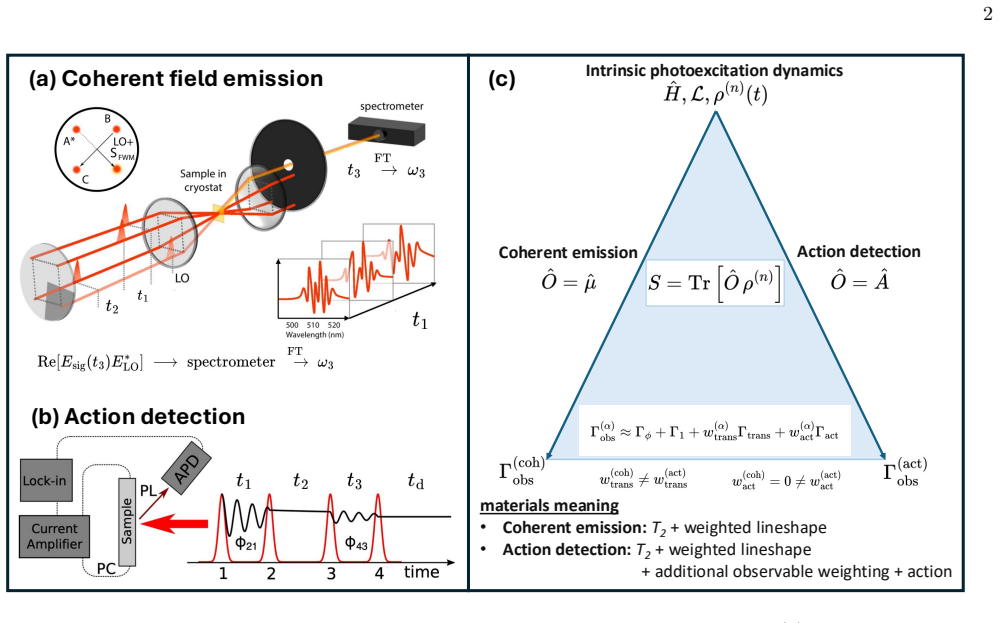
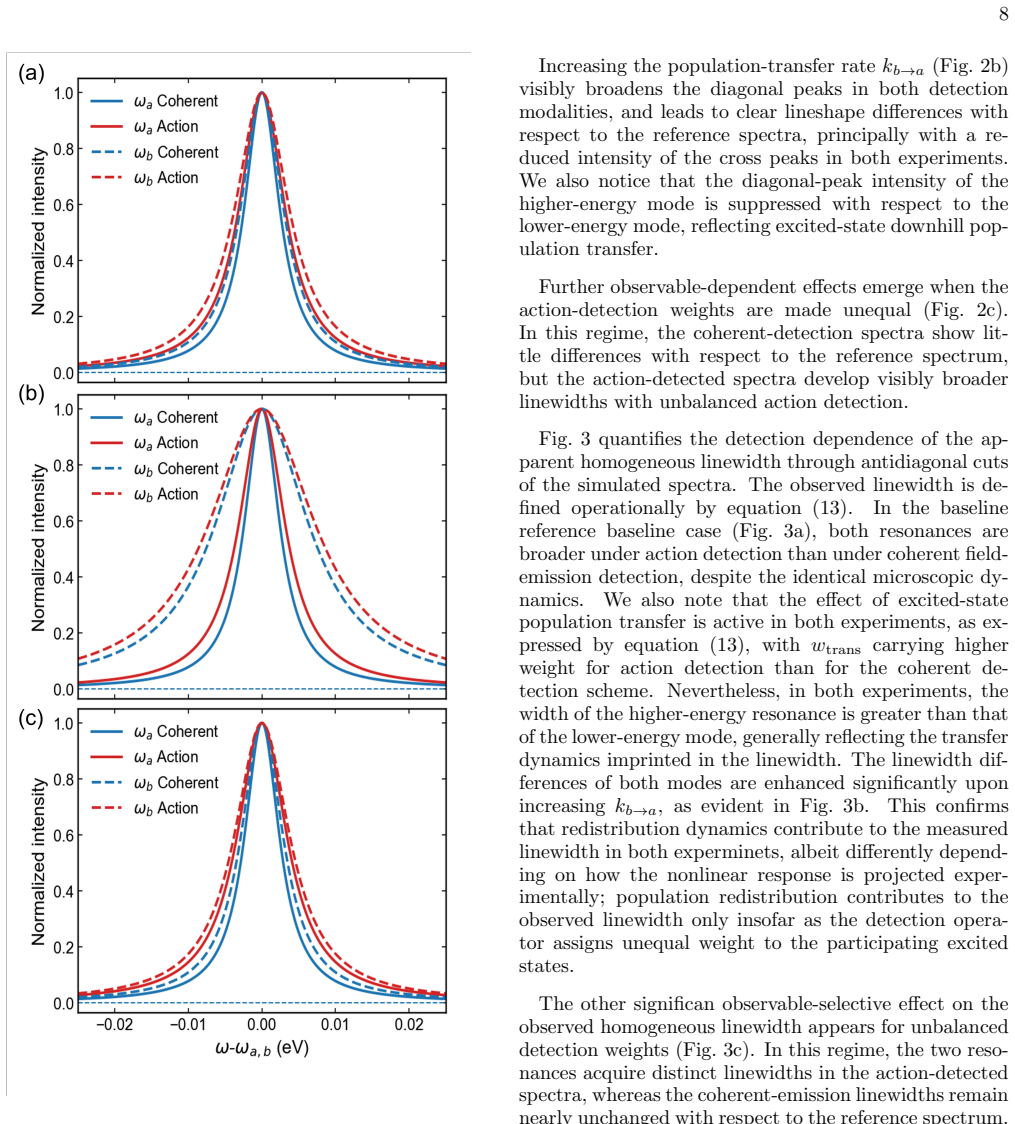
We develop a unified framework showing that changing the detection operator changes the operational definition of dephasing. For coherent emitted-field measurements, the observed linewidth largely retains its conventional connection to the optical coherence time T2. By contrast, in population-detected modalities such as photoluminescence-, photocurrent-, and other action-detected two-dimensional spectroscopies, the apparent linewidth can additionally encode excited-state population redistribution dynamics, leading naturally to an effective coherence time T2,eff. Using a coupled-mode model propagated under a common Liouvillian, we show that identical microscopic dynamics yield distinct appar
What carries the argument
A coupled-mode model propagated under a common Liouvillian superoperator, which enables direct comparison of coherent-emission and population-derived observables on identical microscopic dynamics.
If this is right
- Changing from coherent to population detection alters the apparent dephasing time without any change in the underlying system dynamics.
- Population-detected 2D spectra can reveal information about excited-state redistribution processes through their effective linewidths.
- Material characterization using different 2D spectroscopy modalities must account for the specific observable to avoid misinterpreting dephasing rates.
- The framework unifies the interpretation of spectra across field-emission and action-detected experiments.
Where Pith is reading between the lines
- This distinction suggests that performing both coherent and population-detected 2D spectroscopy on the same sample could help separate pure dephasing from population transfer effects.
- Discrepancies in reported linewidths across different experimental setups in the literature may partly arise from this observable dependence.
- The approach could be extended to more complex systems to predict how specific material interactions modify the difference between T2 and T2,eff.
Load-bearing premise
The assumption that a simple coupled-mode model under a shared Liouvillian captures the essential dynamics that distinguish coherent from population observables in actual condensed-phase materials.
What would settle it
An experiment on a well-characterized material system that measures identical homogeneous linewidths using both coherent field detection and population-based detection in 2D spectroscopy would challenge the central claim.
Figures

read the original abstract
The homogeneous spectral linewidth associated with light-matter interactions is a fundamental descriptor of the optical properties of materials, governed by the quantum dynamics of the condensed-matter system. We discuss here that the homogeneous linewidth measured by means of two-dimensional electronic spectroscopy depends not only on microscopic coherence loss, but also on the observable through which the nonequilibrium dynamics are projected onto the measurement. In this Perspective, we develop a unified framework showing that changing the detection operator changes the operational definition of dephasing. For coherent emitted-field measurements, the observed linewidth largely retains its conventional connection to the optical coherence time $(T_2$). By contrast, in population-detected modalities such as photoluminescence-, photocurrent-, and other action-detected two-dimensional spectroscopies, the apparent linewidth can additionally encode excited-state population redistribution dynamics, leading naturally to an effective coherence time \(T_{2,\mathrm{eff}}\). Using a coupled-mode model propagated under a common Liouvillian, we show that identical microscopic dynamics yield distinct apparent dephasing times when projected onto coherent-emission and population-derived observables. We posit that the detection observable is not merely how a two-dimensional spectrum is measured, but part of what the spectrum fundamentally means as a materials probe.
Editorial analysis
A structured set of objections, weighed in public.
Referee Report
Summary. The manuscript is a Perspective arguing that the homogeneous linewidth measured in two-dimensional electronic spectroscopy is operationally defined by the detection observable in addition to microscopic coherence loss. Coherent emitted-field measurements largely retain the conventional connection to the optical coherence time T2, while population-detected modalities (photoluminescence, photocurrent, and other action-detected 2D spectroscopies) incorporate excited-state population redistribution, yielding an effective coherence time T2,eff. The distinction is illustrated by propagating a coupled-mode model under a common Liouvillian, showing that identical microscopic dynamics produce different apparent linewidths depending on whether the observable projects onto coherent emission or incoherent population.
Significance. If the central distinction holds, the work offers a unifying conceptual lens for reconciling linewidth differences across coherent and action-detected 2D ES modalities in materials. The controlled use of a shared Liouvillian to compare observables without parameter fitting to target data is a clear strength, providing an existence proof that the projection operator itself reshapes the measured dephasing. This could prompt re-examination of literature discrepancies and encourage explicit inclusion of detection operators in theoretical modeling of condensed-phase spectra.
major comments (2)
- [Model section] Model section: the coupled-mode system is presented as demonstrating that identical dynamics yield distinct apparent dephasing times, yet the explicit form of the Liouvillian, the values of the coupling and decay parameters, and the quantitative linewidths extracted from each observable are not reported. Without these details it is difficult to judge the magnitude of the T2 versus T2,eff difference or its robustness to reasonable variations in the model.
- [Discussion] Generalization paragraph: the claim that the distinction applies to real condensed-matter systems rests on the assumption that the simple coupled-mode dynamics capture the dominant population-redistribution effects. No additional calculations with disorder, multiple modes, or system-bath interactions are shown to test whether the separation between coherent and population observables survives in more realistic Hamiltonians.
minor comments (2)
- [Theory framework] Notation for T2,eff is introduced in the abstract and main text but never given an explicit operator-level definition in terms of the population observable; adding a short equation relating the effective linewidth to the detection operator would improve clarity.
- [Figure 1] Figure captions (or the single illustrative figure) should state the specific parameter values used for the Liouvillian propagation so that readers can reproduce the apparent linewidth contrast.
Simulated Author's Rebuttal
We thank the referee for the positive assessment of our Perspective and for the constructive comments, which help clarify the presentation of the model and its scope. We address each major comment below and have incorporated revisions to improve transparency and discussion of assumptions.
read point-by-point responses
-
Referee: [Model section] Model section: the coupled-mode system is presented as demonstrating that identical dynamics yield distinct apparent dephasing times, yet the explicit form of the Liouvillian, the values of the coupling and decay parameters, and the quantitative linewidths extracted from each observable are not reported. Without these details it is difficult to judge the magnitude of the T2 versus T2,eff difference or its robustness to reasonable variations in the model.
Authors: We agree that providing these details will strengthen the manuscript. In the revised version, we will report the explicit form of the Liouvillian, the specific numerical values chosen for the coupling strength and decay rates, and the quantitative linewidths obtained from the coherent-emission and population observables. A brief note on the sensitivity of the T2 versus T2,eff distinction to small parameter changes will also be added. revision: yes
-
Referee: [Discussion] Generalization paragraph: the claim that the distinction applies to real condensed-matter systems rests on the assumption that the simple coupled-mode dynamics capture the dominant population-redistribution effects. No additional calculations with disorder, multiple modes, or system-bath interactions are shown to test whether the separation between coherent and population observables survives in more realistic Hamiltonians.
Authors: We acknowledge that the coupled-mode model is minimal and that further tests with disorder or extended system-bath models would be informative. As this is a Perspective whose primary aim is conceptual unification via an existence proof, we will revise the generalization paragraph to state the model assumptions more explicitly and to explain why the population-redistribution mechanism encoded in the detection operator is expected to remain relevant under more complex dynamics. A full numerical survey of realistic Hamiltonians lies beyond the present scope but is noted as a natural direction for follow-up work. revision: partial
Circularity Check
No significant circularity detected
full rationale
The paper advances a conceptual reframing that the detection observable operationally defines dephasing in 2D electronic spectroscopy, illustrated by propagating a coupled-mode model under a single shared Liouvillian to produce distinct apparent linewidths for coherent-field versus population observables. This construction functions as an existence proof for the distinction rather than a derivation that reduces to fitted parameters, self-referential definitions, or load-bearing self-citations. No equations or steps in the provided abstract or reader summary equate a prediction to its own input by construction, and the model is not tuned to reproduce target linewidths. The central claim therefore remains independent of the patterns that would trigger circularity flags.
Axiom & Free-Parameter Ledger
axioms (1)
- domain assumption System dynamics are governed by a common Liouvillian that includes both coherence decay and population redistribution
Reference graph
Works this paper leans on
-
[1]
author author D. M. \ Jonas ,\ title title Two-dimensional femtosecond spectroscopy , \ https://doi.org/10.1146/annurev.physchem.54.011002.103907 journal journal Annu. Rev. Phys. Chem. \ volume 54 ,\ pages 425--463 ( year 2003 ) NoStop
work page doi:10.1146/annurev.physchem.54.011002.103907 2003
-
[2]
author author M. Cho ,\ title title Coherent two-dimensional optical spectroscopy , \ https://doi.org/10.1021/cr078377b journal journal Chem. Rev. \ volume 108 ,\ pages 1331--1418 ( year 2008 ) NoStop
-
[3]
author author N. S. \ Ginsberg , author Y.-C. \ Cheng ,\ and\ author G. R. \ Fleming ,\ title title Two-dimensional electronic spectroscopy of molecular aggregates , \ https://doi.org/10.1021/ar9001075 journal journal Acc. Chem. Res. \ volume 42 ,\ pages 1352--1363 ( year 2009 ) NoStop
-
[4]
author author P. Nuernberger , author S. Ruetzel ,\ and\ author T. Brixner ,\ title title Multidimensional electronic spectroscopy of photochemical reactions , \ https://doi.org/10.1002/anie.201502974 journal journal Angew. Chem. Int. Ed. \ volume 54 ,\ pages 11368--11386 ( year 2015 ) NoStop
-
[5]
author author F. D. \ Fuller \ and\ author J. P. \ Ogilvie ,\ title title Experimental implementations of two-dimensional fourier transform electronic spectroscopy , \ https://doi.org/10.1146/annurev-physchem-040513-103623 journal journal Annu. Rev. Phys. Chem. \ volume 66 ,\ pages 667--690 ( year 2015 ) NoStop
-
[6]
author author G. Nardin , author T. M. \ Autry , author G. Moody , author R. Singh , author H. Li ,\ and\ author S. T. \ Cundiff ,\ title title Multi-dimensional coherent optical spectroscopy of semiconductor nanostructures: Collinear and non-collinear approaches , \ https://doi.org/10.1063/1.4913830 journal journal J. Appl. Phys. \ volume 117 ( year 2015...
-
[7]
author author T. A. \ Oliver ,\ title title Recent advances in multidimensional ultrafast spectroscopy , \ https://doi.org/10.1098/rsos.171425 journal journal R. Soc. Open Sci. \ volume 5 ( year 2018 ),\ 10.1098/rsos.171425 NoStop
-
[8]
author author Y.-x. \ Weng ,\ title title Detection of electronic coherence via two-dimensional electronic spectroscopy in condensed phase , \ https://doi.org/10.1063/1674-0068/31/cjcp1803055 journal journal Chin. J. Chem. Phys. \ volume 31 ,\ pages 135--151 ( year 2018 ) NoStop
-
[9]
author author E. Collini ,\ title title 2D electronic spectroscopic techniques for quantum technology applications , \ https://doi.org/10.1021/acs.jpcc.1c02693 journal journal J. Phys. Chem. C \ volume 125 ,\ pages 13096--13108 ( year 2021 ) NoStop
-
[10]
author author S. Biswas , author J. Kim , author X. Zhang ,\ and\ author G. D. \ Scholes ,\ title title Coherent two-dimensional and broadband electronic spectroscopies , \ https://doi.org/10.1021/acs.chemrev.1c00623 journal journal Chem. Rev. \ volume 122 ,\ pages 4257--4321 ( year 2022 ) NoStop
-
[11]
author author E. Fresch , author F. V. \ Camargo , author Q. Shen , author C. C. \ Bellora , author T. Pullerits , author G. S. \ Engel , author G. Cerullo ,\ and\ author E. Collini ,\ title title Two-dimensional electronic spectroscopy , \ https://doi.org/10.1038/s43586-023-00267-2 journal journal Nat. Rev. Methods Primers \ volume 3 ,\ pages 84 ( year 2...
-
[12]
author author P. F. \ Tekavec , author G. A. \ Lott ,\ and\ author A. H. \ Marcus ,\ title title Fluorescence-detected two-dimensional electronic coherence spectroscopy by acousto-optic phase modulation , \ https://doi.org/10.1063/1.2800560 journal journal J. Chem. Phys. \ volume 127 ,\ pages 214307 ( year 2007 ) NoStop
-
[13]
author author A. K. \ De , author D. Monahan , author J. M. \ Dawlaty ,\ and\ author G. R. \ Fleming ,\ title title Two-dimensional fluorescence-detected coherent spectroscopy with absolute phasing by confocal imaging of a dynamic grating and 27-step phase cycling , \ https://doi.org/10.1063/1.4874697 journal journal J. Chem. Phys. \ volume 140 ,\ pages 1...
-
[14]
author author P. Gr \'e goire , author E. Vella , author M. Dyson , author C. M. \ Baz \'a n , author R. Leonelli , author N. Stingelin , author P. N. \ Stavrinou , author E. R. \ Bittner ,\ and\ author C. Silva ,\ title title Excitonic coupling dominates the homogeneous photoluminescence excitation linewidth in semicrystalline polymeric semiconductors , ...
-
[15]
author author P. Gr \'e goire , author A. R. \ Srimath Kandada , author E. Vella , author C. Tao , author R. Leonelli ,\ and\ author C. Silva ,\ title title Incoherent population mixing contributions to phase-modulation two-dimensional coherent excitation spectra , \ https://doi.org/10.1063/1.4994987 journal journal J. Chem. Phys. \ volume 147 ,\ pages 11...
-
[16]
author author S. Draeger , author S. Roeding ,\ and\ author T. Brixner ,\ title title Rapid-scan coherent 2D fluorescence spectroscopy , \ https://doi.org/10.1364/OE.25.003259 journal journal Opt. Express \ volume 25 ,\ pages 3259--3267 ( year 2017 ) NoStop
-
[17]
author author S. Goetz , author D. Li , author V. Kolb , author J. Pflaum ,\ and\ author T. Brixner ,\ title title Coherent two-dimensional fluorescence micro-spectroscopy , \ https://doi.org/10.1364/OE.26.003915 journal journal Opt. Express \ volume 26 ,\ pages 3915--3925 ( year 2018 ) NoStop
-
[18]
author author L. Bruder , author U. Bangert , author M. Binz , author D. Uhl ,\ and\ author F. Stienkemeier ,\ title title Coherent multidimensional spectroscopy in the gas phase , \ https://doi.org/10.1088/1361-6455/ab319f journal journal J. Phys. B: At. Mol. Opt. Phys. \ volume 52 ,\ pages 183501 ( year 2019 ) NoStop
-
[19]
author author P. Mal \'y \ and\ author T. Man c al ,\ title title Signatures of exciton delocalization and exciton--exciton annihilation in fluorescence-detected two-dimensional coherent spectroscopy , \ https://doi.org/10.1021/acs.jpclett.8b02178 journal journal J. Phys. Chem. Lett. \ volume 9 ,\ pages 5654--5659 ( year 2018 ) NoStop
-
[20]
author author P. Mal \'y , author J. L \"u ttig , author S. Mueller , author M. H. \ Schreck , author C. Lambert ,\ and\ author T. Brixner ,\ title title Coherently and fluorescence-detected two-dimensional electronic spectroscopy: Direct comparison on squaraine dimers , \ https://doi.org/10.1039/D0CP03218B journal journal Phys. Chem. Chem. Phys. \ ( year...
-
[21]
author author D. Pale c ek , author P. Edlund , author E. Gustavsson , author S. Westenhoff ,\ and\ author D. Zigmantas ,\ title title Potential pitfalls of early-time dynamics in two-dimensional electronic spectroscopy , \ https://doi.org/10.1063/1.5079817 journal journal J. Chem. Phys. \ volume 151 ,\ pages 024201 ( year 2019 ) NoStop
-
[22]
author author A. A. S. \ Halsey , author F. Damtie ,\ and\ author K. J. \ Karki ,\ title title Differentiation of true nonlinear and incoherent mixing of linear signals in action-detected 2D spectroscopy , \ https://doi.org/10.1021/acs.jpca.9b01129 journal journal J. Phys. Chem. A \ volume 123 ,\ pages 4119--4124 ( year 2019 ) NoStop
-
[23]
author author S. Mueller \ and\ author T. Brixner ,\ title title Molecular coherent three-quantum two-dimensional fluorescence spectroscopy , \ https://doi.org/10.1021/acs.jpclett.0c00987 journal journal J. Phys. Chem. Lett. \ volume 11 ,\ pages 5139--5147 ( year 2020 ) NoStop
-
[24]
author author D. Sharkangelou , author A. Javed , author F. Sessa , author X. Solinas , author M. Joffre ,\ and\ author J. P. \ Ogilvie ,\ title title Phase-modulated rapid-scanning fluorescence-detected two-dimensional electronic spectroscopy , \ https://doi.org/10.1063/5.0057649 journal journal J. Chem. Phys. \ volume 155 ( year 2021 ),\ 10.1063/5.00576...
-
[25]
author author E. Guti \'e rrez-Meza , author R. Malatesta , author H. Li , author I. Bargigia , author A. R. \ Srimath Kandada , author D. A. \ Valverde-Ch \'a vez , author S.-M. \ Kim , author H. Li , author N. Stingelin , author S. Tretiak , et al. ,\ title title Frenkel biexcitons in hybrid HJ photophysical aggregates , \ https://doi.org/10.1126/sciadv...
-
[26]
author author A. Liu , author D. B. \ Almeida , author L. A. \ Padilha ,\ and\ author S. T. \ Cundiff ,\ title title Perspective: Multidimensional coherent spectroscopy of perovskite nanocrystals , \ https://doi.org/10.1088/2515-7639/ac4fa5 journal journal J. Phys. Mater. \ volume 5 ,\ pages 021002 ( year 2022 ) NoStop
-
[27]
author author M. Bruschi , author F. Gallina ,\ and\ author B. Fresch ,\ title title Simulating action- 2D electronic spectroscopy of quantum dots: insights on the exciton and biexciton interplay from detection-mode and time-gating , \ https://doi.org/10.1039/D2CP04270C journal journal Phys. Chem. Chem. Phys. \ volume 24 ,\ pages 27645--27659 ( year 2022 ) NoStop
-
[28]
author author A. Jayachandran , author S. Mueller ,\ and\ author T. Brixner ,\ title title Fluorescence-detected two-quantum photon echoes via cogwheel phase cycling , \ https://doi.org/10.1021/acs.jpclett.2c03372 journal journal J. Phys. Chem. Lett. \ volume 13 ,\ pages 11710--11719 ( year 2022 ) NoStop
-
[29]
author author M. Bruschi , author L. Bolzonello , author F. Gallina ,\ and\ author B. Fresch ,\ title title Unifying nonlinear response and incoherent mixing in action- 2D electronic spectroscopy , \ https://doi.org/10.1021/acs.jpclett.3c01670 journal journal J. Phys. Chem. Lett. \ volume 14 ,\ pages 6872--6879 ( year 2023 ) NoStop
-
[30]
author author M. Bruschi ,\ title Theoretical and Computational Insights into Nonlinear Response in Action-2D Electronic Spectroscopy ,\ @noop Ph.D. thesis ,\ school Universit \`a degli Studi di Padova ( year 2024 ) NoStop
work page 2024
-
[31]
author author L. Bolzonello , author M. Bruschi , author B. Fresch ,\ and\ author N. F. \ van Hulst ,\ title title Nonlinear optical spectroscopy of molecular assemblies: What is gained and lost in action detection? \ https://doi.org/10.1021/acs.jpclett.3c02824 journal journal J. Phys. Chem. Lett. \ volume 14 ,\ pages 11438--11446 ( year 2023 ) NoStop
-
[32]
author author A. Javed , author J. L \"u ttig , author K. Charv \'a tov \'a , author S. E. \ Sanders , author R. Willow , author M. Zhang , author A. T. \ Gardiner , author P. Mal \'y ,\ and\ author J. P. \ Ogilvie ,\ title title Photosynthetic energy transfer: Missing in action (detected spectroscopy)? \ https://doi.org/10.1021/acs.jpclett.4c02665 journa...
-
[33]
author author A. Jayachandran , author S. Mueller ,\ and\ author T. Brixner ,\ title title Cogwheel phase cycling in population-detected optical coherent multidimensional spectroscopy , \ https://doi.org/10.1063/5.0233694 journal journal J. Chem. Phys. \ volume 161 ,\ pages 224201 ( year 2024 ) NoStop
-
[34]
author author Z. M. \ Faitz , author D. Im , author C. J. \ Blackwell , author M. S. \ Arnold ,\ and\ author M. T. \ Zanni ,\ title title A spectrometer design that eliminates incoherent mixing signals in 2D action spectroscopies , \ https://doi.org/10.1063/5.0229181 journal journal J. Chem. Phys. \ volume 161 ( year 2024 ),\ 10.1063/5.0229181 NoStop
-
[35]
author author M. Bruschi , author R. Zambon , author F. Gallina ,\ and\ author B. Fresch ,\ title title Influence of excitonic coupling, static disorder, and coherent dynamics in action- 2D electronic spectroscopy of a molecular dimer model , \ https://doi.org/10.1063/5.0276191 journal journal J. Chem. Phys. \ volume 163 ( year 2025 ),\ 10.1063/5.0276191 NoStop
-
[36]
Chain \'a tov \'a \ and\ author P
author author K. Chain \'a tov \'a \ and\ author P. Mal \`y ,\ title title Spectro-temporal symmetry in action-detected optical spectroscopy: Highlighting excited-state dynamics in large systems , \ https://doi.org/10.1063/5.0255316 journal journal J. Chem. Phys. \ volume 162 ( year 2025 ),\ 10.1063/5.0255316 NoStop
-
[37]
author author K. J. \ Rueda Espinosa , author L. E. \ Herrera Rodriguez ,\ and\ author A. A. \ Kananenka ,\ title title Theory and simulations of fluorescence-detected two-dimensional electronic spectroscopy: From rigorous quantum mechanics to simple kinetic models , \ https://doi.org/10.1021/acs.jctc.5c01863 journal journal J. Chem. Theory Comput. \ volu...
-
[38]
author author H. Li , author A. Gauthier-Houle , author P. Gr \'e goire , author E. Vella , author C. Silva-Acuna ,\ and\ author E. R. \ Bittner ,\ title title Probing polaron excitation spectra in organic semiconductors by photoinduced-absorption-detected two-dimensional coherent spectroscopy , \ https://doi.org/10.1016/j.chemphys.2016.07.004 journal jou...
-
[39]
author author G. Nardin , author T. M. \ Autry , author K. L. \ Silverman ,\ and\ author S. T. \ Cundiff ,\ title title Multidimensional coherent photocurrent spectroscopy of a semiconductor nanostructure , \ https://doi.org/10.1364/OE.21.028617 journal journal Opt. Express \ volume 21 ,\ pages 28617--28627 ( year 2013 ) NoStop
-
[40]
author author K. J. \ Karki , author J. R. \ Widom , author J. Seibt , author I. Moody , author M. C. \ Lonergan , author T. Pullerits ,\ and\ author A. H. \ Marcus ,\ title title Coherent two-dimensional photocurrent spectroscopy in a pbs quantum dot photocell , \ https://doi.org/10.1038/ncomms6869 journal journal Nat. Commun. \ volume 5 ,\ pages 5869 ( ...
-
[41]
author author E. Vella , author H. Li , author P. Gr \'e goire , author S. M. \ Tuladhar , author M. S. \ Vezie , author S. Few , author C. M. \ Baz \'a n , author J. Nelson , author C. Silva-Acuna ,\ and\ author E. R. \ Bittner ,\ title title Ultrafast decoherence dynamics govern photocarrier generation efficiencies in polymer solar cells , \ https://doi...
-
[42]
author author A. A. \ Bakulin , author C. Silva ,\ and\ author E. Vella ,\ title title Ultrafast spectroscopy with photocurrent detection: Watching excitonic optoelectronic systems at work , \ https://doi.org/10.1021/acs.jpclett.5b01955 journal journal J. Phys. Chem. Lett. \ volume 7 ,\ pages 250--258 ( year 2016 ) NoStop
-
[43]
author author Q. Bian , author F. Ma , author S. Chen , author Q. Wei , author X. Su , author I. A. \ Buyanova , author W. M. \ Chen , author C. S. \ Ponseca Jr , author M. Linares , author K. J. \ Karki , et al. ,\ title title Vibronic coherence contributes to photocurrent generation in organic semiconductor heterojunction diodes , \ https://doi.org/10.1...
-
[44]
author author L. Bolzonello , author F. Bernal-Texca , author L. G. \ Gerling , author J. Ockova , author E. Collini , author J. Martorell ,\ and\ author N. F. \ Van Hulst ,\ title title Photocurrent-detected 2D electronic spectroscopy reveals ultrafast hole transfer in operating PM6/Y6 organic solar cells , \ https://doi.org/10.1021/acs.jpclett.1c00822 j...
-
[45]
author author Q. Chen , author Y. H. \ Kwok , author W. Zhou , author G. Chen ,\ and\ author S. Mukamel ,\ title title Time-dependent simulation of photocurrent-detected two-dimensional spectroscopy of open systems , \ https://doi.org/10.1063/5.0067362 journal journal J. Chem. Phys. \ volume 155 ( year 2021 ),\ 10.1063/5.0067362 NoStop
-
[46]
author author I. Bargigia , author E. Guti \'e rrez-Meza , author D. A. \ Valverde-Ch \'a vez , author S. R. \ Marques , author A. R. \ Srimath Kandada ,\ and\ author C. Silva ,\ title title Identifying incoherent mixing effects in the coherent two-dimensional photocurrent excitation spectra of semiconductors , \ https://doi.org/10.1063/5.0121635 journal ...
-
[47]
author author E. Amarotti , author L. Bolzonello , author S.-H. \ Lee , author D. Zigmantas , author N.-G. \ Park , author N. van Hulst ,\ and\ author T. Pullerits ,\ title title Photocurrent detected 2D spectroscopy via a pulse shaper: insights and strategies for optimally untangling the nonlinear response , \ https://doi.org/10.1364/OE.566553 journal jo...
-
[48]
author author E. W. \ Martin , author J. Horng , author H. G. \ Ruth , author E. Y. \ Paik , author M.-H. \ Wentzel , author H. Deng ,\ and\ author S. Cundiff ,\ title title Encapsulation narrows and preserves the excitonic homogeneous linewidth of exfoliated monolayer mose2 , \ https://doi.org/10.1103/PhysRevApplied.14.021002 journal journal Phys. Rev. A...
-
[49]
author author L. Guo , author C.-A. \ Chen , author Z. Zhang , author D. M. \ Monahan , author Y.-H. \ Lee ,\ and\ author G. R. \ Fleming ,\ title title Lineshape characterization of excitons in monolayer ws2 by two-dimensional electronic spectroscopy , \ https://doi.org/10.1039/D0NA00240B journal journal Nanoscale Adv. \ volume 2 ,\ pages 2333--2338 ( ye...
-
[50]
author author U. Bangert , author F. Stienkemeier ,\ and\ author L. Bruder ,\ title title High-resolution two-dimensional electronic spectroscopy reveals the homogeneous line profile of chromophores solvated in nanoclusters , \ https://doi.org/10.1038/s41467-022-31021-z journal journal Nat. Commun. \ volume 13 ( year 2021 ),\ 10.1038/s41467-022-31021-z NoStop
-
[51]
author author B. De , author P. Kumar , author K. K. \ Maurya , author R. Tripathi ,\ and\ author R. Singh ,\ title title Quantitative lineshape analysis for arbitrary inhomogeneity in two-dimensional coherent spectroscopy , \ https://doi.org/10.1364/OL.564956 journal journal Opt. Lett. \ ( year 2025 ),\ 10.1364/OL.564956 NoStop
-
[52]
note We retain explicit vector notation for electromagnetic fields and macroscopic polarization where required, but suppress vector indices in operator expressions after projection onto the detection axis for notational clarity. Stop
-
[53]
author author T. Gellen , author J. Lem ,\ and\ author D. B. \ Turner ,\ title title Probing homogeneous line broadening in cdse nanocrystals using multidimensional electronic spectroscopy , \ https://doi.org/10.1021/acs.nanolett.6b05068 journal journal Nano Lett. \ volume 17 ,\ pages 2809--2815 ( year 2017 ) NoStop
-
[54]
author author S. Mueller , author S. Draeger , author X.-N. \ Ma , author M. Hensen , author T. Kenneweg , author W. Pfeiffer ,\ and\ author T. Brixner ,\ title title Fluorescence-detected two-quantum and one-quantum--two-quantum 2d electronic spectroscopy , \ https://doi.org/10.1021/acs.jpclett.8b00541 journal journal J. Phys. Chem. Lett. \ volume 9 ,\ p...
-
[55]
author author J. R \'e hault , author M. Maiuri , author A. Oriana ,\ and\ author G. Cerullo ,\ title title Two-dimensional electronic spectroscopy with birefringent wedges , \ https://doi.org/10.1063/1.4902938 journal journal Rev. Sci. Instrum. \ volume 85 ( year 2014 ),\ 10.1063/1.4902938 NoStop
-
[56]
author author W. Zhu , author R. Wang , author C. Zhang , author G. Wang , author Y. Liu , author W. Zhao , author X. Dai , author X. Wang , author G. Cerullo , author S. T. \ Cundiff ,\ and\ author M. Xiao ,\ title title Broadband two-dimensional electronic spectroscopy in an actively phase-stabilized pump--probe configuration , \ https://doi.org/10.1364...
-
[57]
author author K. M. \ Farrell \ and\ author M. Zanni ,\ title title Phase-stable shot-to-shot measurement of third- and fifth-order two-quantum correlation spectra using a pulse shaper in the pump--probe geometry , \ https://doi.org/10.1063/5.0097019 journal journal J. Chem. Phys. \ volume 157 ,\ pages 014203 ( year 2022 ) NoStop
-
[58]
u ttig , author P. A. \ Rose , author P. Mal \'y , author A. Turkin , author M. B \
author author J. L \"u ttig , author P. A. \ Rose , author P. Mal \'y , author A. Turkin , author M. B \"u hler , author C. Lambert , author J. Krich ,\ and\ author T. Brixner ,\ title title High-order pump--probe and high-order two-dimensional electronic spectroscopy on the example of squaraine oligomers , \ https://doi.org/10.1063/5.0139090 journal jour...
-
[59]
author author M. Cai , author X. Zhang , author Z. Cheng , author T.-f. \ Yan ,\ and\ author H. Dong ,\ title title Extracting double-quantum coherence in two-dimensional electronic spectroscopy under pump--probe geometry , \ https://doi.org/10.1063/5.0198255 journal journal Rev. Sci. Instrum. \ volume 95 ( year 2024 ),\ 10.1063/5.0198255 NoStop
-
[60]
author author D. Timmer , author D. C. \ L\"unemann , author A. De Sio , author G. Cerullo ,\ and\ author C. Lienau ,\ title title Disentangling signal contributions in two-dimensional electronic spectroscopy in the pump--probe geometry , \ https://doi.org/10.1063/5.0256813 journal journal J. Chem. Phys. \ volume 162 ( year 2025 ),\ 10.1063/5.0256813 NoStop
-
[61]
author author A. Tokmakoff ,\ title title Two-dimensional line shapes derived from coherent third-order nonlinear spectroscopy , \ https://doi.org/10.1021/jp993207r journal journal J. Phys. Chem. A \ volume 104 ,\ pages 4247--4255 ( year 2000 ) NoStop
-
[62]
author author D. B. \ Turner \ and\ author K. A. \ Nelson ,\ title title Coherent measurements of high-order electronic correlations in quantum wells , \ https://doi.org/10.1038/nature09286 journal journal Nature \ volume 466 ,\ pages 1089--1092 ( year 2010 ) NoStop
-
[63]
author author K. A. \ Koch , author C. Silva-Acu \ n a ,\ and\ author A. R. \ Srimath Kandada ,\ https://doi.org/10.48550/arXiv.2601.16101 title Biexcitons in Ruddlesden--Popper metal halides probed by nonlinear coherent spectroscopy , \ ( year 2026 ),\ note arXiv:2601.16101 [cond-mat.mtrl-sci] NoStop
-
[64]
author author S. A. \ Shah , author H. Li , author E. R. \ Bittner , author C. Silva ,\ and\ author A. Piryatinski ,\ title title QuDPy : A python-based tool for computing ultrafast nonlinear optical responses , \ https://doi.org/10.1016/j.cpc.2023.108891 journal journal Comput. Phys. Commun. \ volume 292 ,\ pages 108891 ( year 2023 ) NoStop
-
[65]
author author C. L. \ Smallwood , author R. Ulbricht , author M. W. \ Day , author T. Schr \"o der , author K. M. \ Bates , author T. M. \ Autry , author G. Diederich , author E. Bielejec , author M. E. \ Siemens ,\ and\ author S. T. \ Cundiff ,\ title title Hidden silicon-vacancy centers in diamond , \ https://doi.org/10.1103/PhysRevLett.126.213601 journ...
-
[66]
author author Y. Zheng , author E. Rojas-Gatjens , author M. Lee , author E. Reichmanis ,\ and\ author C. Silva-Acu \ n a ,\ title title Unveiling multiquantum excitonic correlations in push-pull polymer semiconductors , \ https://doi.org/10.1021/acs.jpclett.4c00065 journal journal J. Phys. Chem. Lett. \ volume 15 ,\ pages 3705--3712 ( year 2024 ) NoStop
-
[67]
author author H. J. \ Kanyeow , author E. Guti \'e rrez-Meza , author H. Li , author Q. He , author M. Heeney , author N. Stingelin , author E. R. \ Bittner , author C. Silva-Acu \ n a , author H. Li ,\ and\ author F. Thouin ,\ https://doi.org/10.48550/arXiv.2411.14675 title Quantum dynamics of photophysical aggregates in conjugated polymers , \ ( year 20...
-
[68]
author author E. Guti \'e rrez-Meza ,\ title Exciton Quantum Dynamics in -Conjugated Polymers Probed by Two-Dimensional Coherent Excitation Spectroscopy ,\ @noop Ph.D. thesis ,\ school Georgia Institute of Technology ( year 2021 ) NoStop
work page 2021
-
[69]
author author H. J. \ Kantrow ,\ title Understanding Photophysical Processes in Polymer Semiconductors: From Flexible-Chain to Ribbon-Like Materials ,\ @noop Ph.D. thesis ,\ school Georgia Institute of Technology ( year 2026 ) NoStop
work page 2026
-
[70]
author author F. C. \ Spano \ and\ author C. Silva ,\ title title H -and J -aggregate behavior in polymeric semiconductors , \ https://doi.org/10.1146/annurev-physchem-040513-103639 journal journal Annu. Rev. Phys. Chem. \ volume 65 ,\ pages 477--500 ( year 2014 ) NoStop
-
[71]
author author O. G. \ Reid , author J. A. N. \ Malik , author G. Latini , author S. Dayal , author N. Kopidakis , author C. Silva , author N. Stingelin ,\ and\ author G. Rumbles ,\ title title The influence of solid-state microstructure on the origin and yield of long-lived photogenerated charge in neat semiconducting polymers , \ https://doi.org/10.1002/...
-
[72]
author author F. Paquin , author H. Yamagata , author N. J. \ Hestand , author M. Sakowicz , author N. B \'e rub \'e , author M. C \^o t \'e , author L. X. \ Reynolds , author S. A. \ Haque , author N. Stingelin , author F. C. \ Spano , et al. ,\ title title Two-dimensional spatial coherence of excitons in semicrystalline polymeric semiconductors: Effect ...
-
[73]
author author F. Thouin , author S. Neutzner , author D. Cortecchia , author V. A. \ Dragomir , author C. Soci , author T. Salim , author Y. M. \ Lam , author R. Leonelli , author A. Petrozza , author A. R. S. \ Kandada , et al. ,\ title title Stable biexcitons in two-dimensional metal-halide perovskites with strong dynamic lattice disorder , \ https://do...
-
[74]
author author K. A. \ Koch , author E. Rojas-Gatjens , author M. G \'o mez-Dominguez , author J.-P. \ Correa-Baena , author C. Silva-Acu \ n a ,\ and\ author A. R. S. \ Kandada ,\ title title Spectroscopic signatures of biexcitons: A case study in Ruddlesden--Popper lead-halides , \ https://doi.org/10.1063/5.0271075 journal journal J. Chem. Phys. \ volume...
-
[75]
author author M. A. \ Nielsen \ and\ author I. L. \ Chuang ,\ @noop title Quantum computation and quantum information \ ( publisher Cambridge university press ,\ year 2010 ) NoStop
work page 2010
-
[76]
author author F. Arute , author K. Arya , author R. Babbush , author D. Bacon , author J. C. \ Bardin , author R. Barends , author R. Biswas , author S. Boixo , author F. G. \ Brandao , author D. A. \ Buell , et al. ,\ title title Quantum supremacy using a programmable superconducting processor , \ https://doi.org/10.1038/s41586-019-1666-5 journal journal...
-
[77]
author author Google Quantum AI ,\ title title Suppressing quantum errors by scaling a surface code logical qubit , \ https://doi.org/10.1038/s41586-022-05434-1 journal journal Nature \ volume 614 ,\ pages 676--681 ( year 2023 ) NoStop
-
[78]
author author N. Yoshioka , author M. Amico , author W. Kirby , author P. Jurcevic , author A. Dutt , author B. Fuller , author S. Garion , author H. Haas , author I. Hamamura , author A. Ivrii , et al. ,\ title title Krylov diagonalization of large many-body hamiltonians on a quantum processor , \ https://doi.org/10.1038/s41467-025-59716-z journal journa...
-
[79]
author author J. Robledo-Moreno , author M. Motta , author H. Haas , author A. Javadi-Abhari , author P. Jurcevic , author W. Kirby , author S. Martiel , author K. Sharma , author S. Sharma , author T. Shirakawa , et al. ,\ title title Chemistry beyond the scale of exact diagonalization on a quantum-centric supercomputer , \ https://doi.org/10.1126/sciadv...
discussion (0)
Sign in with ORCID, Apple, or X to comment. Anyone can read and Pith papers without signing in.