Quantum Transport in Disordered Spin Networks: Emergent Timescales and Competing Pathways
Pith reviewed 2026-05-12 03:11 UTC · model grok-4.3
The pith
Strong internal hybridization in spin clusters generates effective detuning that parametrically slows global relaxation in disordered networks.
A machine-rendered reading of the paper's core claim, the machinery that carries it, and where it could break.
Core claim
Using a two-dimensional tight-binding model with dipolar interactions and local dephasing, geometric heterogeneity in small spin networks produces hierarchical coupling strengths and separation of dynamical timescales. A minimal three-site model shows that strong internal hybridization generates an effective detuning suppressing transfer to weakly coupled sites, yielding a parametrically enhanced relaxation time in the weak-dephasing regime. Nonequilibrium steady-state transport calculations and simulations of disordered configurations corroborate this picture, demonstrating orders-of-magnitude slowing of relaxation when hierarchical couplings are present.
What carries the argument
Effective detuning from strong internal hybridization in a three-site cluster, which suppresses weak inter-cluster transfer and produces parametrically longer relaxation.
If this is right
- Cluster-level equilibration occurs faster than global network equilibration.
- Relaxation time becomes parametrically enhanced specifically in the weak-dephasing regime.
- Nonequilibrium steady-state currents slow by orders of magnitude when hierarchical couplings are present.
- Geometry and connectivity control the emergence of multiple transport timescales in open spin systems.
Where Pith is reading between the lines
- The same detuning mechanism could appear in larger or three-dimensional disordered spin networks and affect transport in solid-state spin baths.
- Controlled experiments with small spin ensembles, such as those realized in diamond defects, could directly test the predicted orders-of-magnitude differences in relaxation.
- Network design for quantum information transfer might use geometry to tune cluster hybridization and thereby control relaxation rates.
Load-bearing premise
A small finite two-dimensional network with only dipolar interactions and purely local dephasing captures the essential physics of real disordered spin systems without needing longer-range couplings or non-Markovian bath dynamics.
What would settle it
Direct measurement of relaxation times in a controlled three-spin system with strong internal hybridization versus uniform weak couplings, under weak dephasing, showing whether the hybridized case exhibits parametrically longer relaxation.
Figures




read the original abstract
Quantum transport in disordered systems poses intriguing fundamental questions about the interplay of disorder, interactions, and decoherence, with important implications for nanoscale energy transfer and quantum information transfer. Here, we investigate the emergence of multiple transport timescales in the dissipative dynamics of a spin impurity coupled to a small, spatially disordered network of spins. Using a two-dimensional tight-binding model with dipolar interactions and local dephasing, we demonstrate that geometric heterogeneity leads to hierarchical coupling strengths and pronounced separation of dynamical timescales. By analyzing different metrics for dynamics, we identify distinct relaxation timescales associated with cluster-level equilibration and global equilibration. A minimal three-site model reveals the physical origin of the longest timescale: strong internal hybridization generates an effective detuning that suppresses transfer to other weakly coupled sites, yielding a parametrically enhanced relaxation time in the weak-dephasing regime. We corroborate this picture with nonequilibrium steady-state transport calculations and simulations of disordered spin configurations, demonstrating orders-of-magnitude slowing of relaxation when hierarchical couplings are present. Our results highlight the central role of geometry and connectivity in spin networks and open quantum systems in general, and provide experimentally relevant predictions for relaxation times in small spin baths.
Editorial analysis
A structured set of objections, weighed in public.
Referee Report
Summary. The manuscript investigates quantum transport in small disordered spin networks via a 2D tight-binding model with dipolar interactions and local dephasing. It shows that geometric heterogeneity produces hierarchical couplings and separated dynamical timescales, with cluster equilibration distinct from global equilibration. A minimal three-site model is used to derive that strong internal hybridization creates an effective detuning suppressing transfer to weakly coupled sites, yielding parametrically enhanced relaxation times in the weak-dephasing regime. This picture is supported by nonequilibrium steady-state calculations and ensemble simulations of disordered configurations, which exhibit orders-of-magnitude slowing when hierarchical couplings are present.
Significance. If the central derivation holds, the work provides a transparent physical mechanism linking geometry, disorder, and decoherence to emergent slow timescales in open quantum systems. This is relevant for nanoscale energy transfer and spin-bath dynamics in quantum information contexts, and the parametric enhancement offers falsifiable predictions for relaxation rates in small networks.
major comments (2)
- [minimal three-site model] Three-site model derivation (the minimal model section): the adiabatic elimination yielding the effective detuning assumes a clear separation J ≫ γ and J ≫ residual external couplings. The disordered 2D dipolar ensemble does not enforce this hierarchy uniformly; configurations with comparable couplings will invalidate the perturbative step, and the slowest Lindblad eigenvalue will not exhibit the claimed parametric enhancement. The manuscript should either restrict the ensemble to verified hierarchies or quantify the fraction of samples where the assumption fails.
- [simulations of disordered spin configurations] Numerical simulations of disordered configurations: the reported orders-of-magnitude slowing is presented without error bars on the slowest eigenvalue or explicit checks that the weak-dephasing regime (γ small) is maintained across the sampled disorder realizations. If post-selection of configurations with strong internal hybridization is implicit, this must be stated and the selection criterion quantified.
minor comments (2)
- [abstract] The abstract and introduction use 'parametrically enhanced' without a precise definition (e.g., scaling with a specific small parameter); this should be clarified with reference to the analytic expression for the longest timescale.
- [model definition] Notation for the dipolar interaction strength and dephasing rate γ is introduced without an explicit table of symbols; a short notation table would improve readability.
Simulated Author's Rebuttal
We thank the referee for the careful reading and constructive comments on our manuscript. The points raised regarding the assumptions in the minimal model and the statistical robustness of the simulations are well taken. We address each major comment below and have revised the manuscript accordingly to strengthen the presentation while preserving the central claims.
read point-by-point responses
-
Referee: [minimal three-site model] Three-site model derivation (the minimal model section): the adiabatic elimination yielding the effective detuning assumes a clear separation J ≫ γ and J ≫ residual external couplings. The disordered 2D dipolar ensemble does not enforce this hierarchy uniformly; configurations with comparable couplings will invalidate the perturbative step, and the slowest Lindblad eigenvalue will not exhibit the claimed parametric enhancement. The manuscript should either restrict the ensemble to verified hierarchies or quantify the fraction of samples where the assumption fails.
Authors: We agree that the adiabatic elimination in the three-site model requires a clear separation of scales (J ≫ γ and J ≫ residual couplings) for the effective detuning to be valid. The minimal model is presented as an illustrative derivation of the mechanism rather than a universal description of every configuration. In the ensemble simulations, the pronounced slowing of the slowest eigenvalue is observed specifically in realizations exhibiting strong internal hybridization and hierarchical couplings, consistent with the geometric heterogeneity emphasized in the abstract and main text. To address the concern, we will add a supplementary analysis in the revised manuscript that quantifies the fraction of sampled configurations satisfying a hierarchy criterion (e.g., the ratio of the largest intra-cluster coupling to the largest external coupling exceeding 5). We will also show that the parametric enhancement of the relaxation time correlates strongly with this measure, thereby clarifying the regime of applicability without restricting the ensemble a priori. revision: yes
-
Referee: [simulations of disordered spin configurations] Numerical simulations of disordered configurations: the reported orders-of-magnitude slowing is presented without error bars on the slowest eigenvalue or explicit checks that the weak-dephasing regime (γ small) is maintained across the sampled disorder realizations. If post-selection of configurations with strong internal hybridization is implicit, this must be stated and the selection criterion quantified.
Authors: We acknowledge the need for statistical rigor in the ensemble results. The simulations sample configurations from the full disordered ensemble without post-selection; the orders-of-magnitude slowing appears as a natural consequence in those realizations where geometric heterogeneity produces strongly hybridized clusters. In the revised manuscript we will (i) report error bars on the slowest Lindblad eigenvalue, computed as the standard error of the mean over the ensemble, and (ii) include an explicit check of the weak-dephasing condition by showing the distribution of relevant J/γ ratios across samples. We will also add a scatter plot correlating a quantitative hierarchy measure (ratio of intra- to inter-cluster couplings) with the observed relaxation time, thereby making transparent that the effect is tied to the presence of hierarchical structure rather than any hidden selection. revision: yes
Circularity Check
No circularity: timescales derived from direct master-equation analysis and minimal-model diagonalization
full rationale
The paper obtains the longest relaxation timescale by numerically solving the Lindblad master equation on disordered networks and on a minimal three-site subsystem, then interpreting the slow eigenvalue via hybridization-induced detuning in the weak-dephasing limit. This follows from the explicit Hamiltonian (dipolar couplings) plus local dephasing dissipator without redefining the target quantity in terms of itself. Nonequilibrium steady-state currents and ensemble simulations supply independent corroboration. No load-bearing self-citation, fitted parameter renamed as prediction, or ansatz smuggled via prior work appears in the derivation chain. The skeptic concern about rate hierarchies is a validity question, not a circularity reduction.
Axiom & Free-Parameter Ledger
axioms (2)
- domain assumption Dipolar interaction form is an adequate approximation for the spin-spin couplings in the network.
- domain assumption Dephasing is local and Markovian.
Reference graph
Works this paper leans on
-
[1]
Liouvillian spectrum Dissipative dynamics can be characterized by analyz- ing the eigenvalues and eigenstates of the Liouvillian, Eq. (4). The decay rate, denoted byγ, is given by the neg- ative real part of each eigenvalue, while the imaginary part determines the corresponding oscillation frequency. We present our results for configuration A in Figs. 18-...
-
[2]
MFPT and residence times We study the dynamics using the following measures: population dynamics from a certain initial condition, pu- rity of the state Tr[ρ(t) 2], and and measures for survival and transfer times, which we now define by modifying the traditional definitions of the mean first passage time. Consider anN+ 2 site system; the network itself i...
-
[3]
This expression admits an equivalent spectral represen- tation
Integrated relaxation and transfer measures We consider open system dynamics generated by a Li- ouvillian superoperator ˆL, ˙ˆρ(t) =ˆLˆρ(t),ˆρ(t) =e ˆLt ˆρ(0).(A5) Assuming that population in the physical subspace de- cays at long times, as ensured for example by introducing an absorbing trap, ⟨i|ρ(t→ ∞)|i⟩= 0,∀i(A6) the time integrated density matrix is ...
-
[4]
20 the histogram of all pair- wise couplings,J ij across the bath
Pairwise coupling distribution We first examine in Fig. 20 the histogram of all pair- wise couplings,J ij across the bath. AsNincreases at a fixed density, the distribution develops an additional weight at smallJ ij values. This is expected: Enlarging the system adds more distant pairs, and since the inter- action decays as a power law with distance, thes...
-
[5]
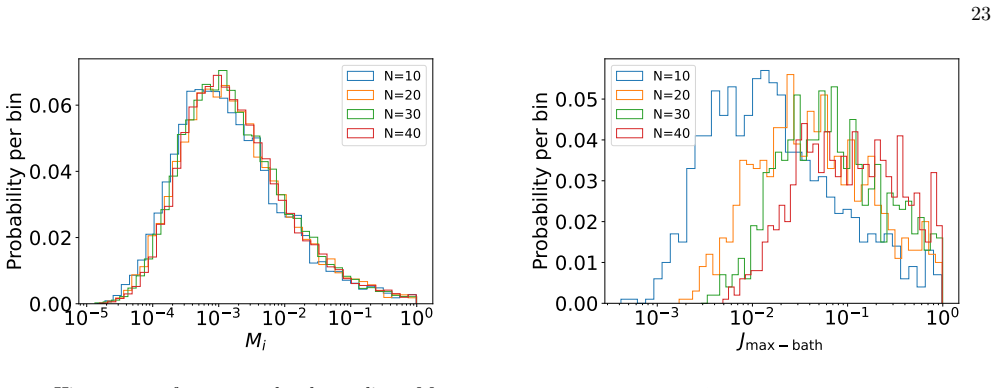
Local observables To focus on local effects, we now analyze site re- solved observables defined “row-wise” from the Hamil- tonian matrix. We define the following observables: S(1) i = X j̸=i |Jij|, S (2) i = sX j̸=i |Jij|2, M i = max j̸=i |Jij|. (B1) 10 4 10 3 10 2 10 1 100 S(1) i 0.00 0.02 0.04 0.06 0.08Probability per bin N=10 N=20 N=30 N=40 FIG. 21.His...
-
[6]
Global extreme statistics We define the maximum coupling of theN-spin bath as J(bath) max = max i,j |Jij|.(B2) In contrast to local observables, the histogram ofJ (bath) max systematically shifts toward larger values asNincreases; see Fig. 24. This behavior is expected since the total number of pairwise couplings scales asN 2, and therefore the probabilit...
-
[7]
(ii) Global extreme couplings scale with system size
Physical interpretation The combined analysis of local and global observables leads to clear conclusions: (i) Local geometric statistics are controlled by density and remain invariant withN. (ii) Global extreme couplings scale with system size. Appendix C: Ensemble statistics of finite spin baths: Fixed radius The analysis presented in Figs. 25-26 corresp...
-
[8]
C. Creatore, M. A. Parker, S. Emmott, and A. W. Chin, Efficient biologically inspired photocell enhanced by de- localized quantum states, Physical Review Letters111, 253601 (2013)
work page 2013
-
[9]
A. Fruchtman, R. G´ omez-Bombarelli, B. W. Lovett, and E. M. Gauger, Photocell optimization using dark state protection, Physical Review Letters117, 203603 (2016)
work page 2016
-
[10]
A. D. Sio and C. Lienau, Vibronic coupling in organic semiconductors for photovoltaics, Physical Chemistry Chemical Physics19, 18813 (2017), published on 26 June 2017
work page 2017
-
[11]
D. M. Rouse, E. M. Gauger, and B. W. Lovett, Optimal 25 power generation using dark states in dimers strongly coupled to their environment, New Journal of Physics 21, 063025 (2019)
work page 2019
-
[12]
N. Cavassilas, D. Suchet, A. Delamarre, J.-F. Guille- moles, F. Michelini, M. Bescond, and M. Lannoo, Opti- mized operation of quantum-dot intermediate-band so- lar cells deduced from electronic transport modeling, Physical Review Applied13, 044035 (2020)
work page 2020
-
[13]
L. Hu and A. Mandelis, Advanced characterization methods of carrier transport in quantum dot photo- voltaic solar cells, Journal of Applied Physics129, 10.1063/5.0029440 (2021)
-
[14]
Bose, Quantum communication through an unmod- ulated spin chain, Phys
S. Bose, Quantum communication through an unmod- ulated spin chain, Phys. Rev. Lett.91, 207901 (2003)
work page 2003
-
[15]
R. J. Chapman, M. Santandrea, Z. Huang, G. Corrielli, A. Crespi, M.-H. Yung, R. Osellame, and A. Peruzzo, Experimental perfect quantum state transfer, Nature Communications7, 11339 (2016)
work page 2016
-
[16]
X. Li, Y. Ma, J. Han, T. Chen, Y. Xu, W. Cai, H. Wang, Y. Song, Z.-Y. Xue, Z.-q. Yin, and L. Sun, Perfect quan- tum state transfer in a superconducting qubit chain with parametrically tunable couplings, Phys. Rev. Appl.10, 054009 (2018)
work page 2018
-
[17]
M. Mohseni, P. Rebentrost, S. Lloyd, and A. Aspuru- Guzik, Environment-assisted quantum walks in pho- tosynthetic energy transfer, The Journal of Chemical Physics129, 174106 (2008)
work page 2008
-
[18]
M. B. Plenio and S. F. Huelga, Dephasing-assisted transport: quantum networks and biomolecules, New Journal of Physics10, 113019 (2008)
work page 2008
- [19]
-
[20]
A. W. Chin, A. Datta, F. Caruso, S. F. Huelga, and M. B. Plenio, Noise-assisted energy transfer in quantum networks and light-harvesting complexes, New Journal of Physics12, 065002 (2010)
work page 2010
-
[21]
A. W. Chin, S. F. Huelga, and M. B. Plenio, Coher- ence and decoherence in biological systems: principles of noise-assisted transport and the origin of long-lived coherences, Philosophical Transactions of the Royal So- ciety A: Mathematical, Physical and Engineering Sci- ences370, 3638 (2012)
work page 2012
-
[22]
J. Wu, R. J. Silbey, and J. Cao, Generic mechanism of optimal energy transfer efficiency: A scaling theory of the mean first-passage time in exciton systems, Phys. Rev. Lett.110, 200402 (2013)
work page 2013
-
[23]
A. Mattioni, F. Caycedo-Soler, S. F. Huelga, and M. B. Plenio, Design principles for long-range energy transfer at room temperature, Physical Review X11, 041003 (2021)
work page 2021
-
[24]
M. Mohseni, A. Shabani, S. Lloyd, and H. Rabitz, Energy-scales convergence for optimal and robust quan- tum transport in photosynthetic complexes, The Jour- nal of Chemical Physics140, 035102 (2014)
work page 2014
-
[25]
N. Trautmann and P. Hauke, Trapped-ion quantum sim- ulation of excitation transport: Disordered, noisy, and long-range connected quantum networks, Physical Re- view A97, 023606 (2018)
work page 2018
-
[26]
E. Zerah-Harush and Y. Dubi, Universal origin for environment-assisted quantum transport in exciton transfer networks, The Journal of Physical Chemistry Letters9, 1689 (2018)
work page 2018
-
[27]
E. Zerah-Harush and Y. Dubi, Effects of disorder and interactions in environment assisted quantum transport, Phys. Rev. Res.2, 023294 (2020)
work page 2020
-
[28]
M. Cygorek, M. Cosacchi, A. Vagov, V. M. Axt, B. W. Lovett, J. Keeling, and E. M. Gauger, Simulation of open quantum systems by automated compression of arbitrary environments, Nature Physics18, 662 (2022)
work page 2022
-
[29]
A. Kurt, M. A. C. Rossi, and J. Piilo, Quantum trans- port efficiency in noisy random-removal and small-world networks, Journal of Physics A: Mathematical and The- oretical56, 145301 (2023)
work page 2023
- [30]
-
[31]
M. Lawrence, M. Pocrnic, E. Fung, J. Carrasquilla, E. M. Gauger, and D. Segal, Discovery of energy land- scapes toward optimized quantum transport: Environ- mental effects and long-range tunneling, Phys. Rev. Res. 8, 013163 (2026)
work page 2026
-
[32]
P. Rebentrost, M. Mohseni, I. Kassal, S. Lloyd, and A. Aspuru-Guzik, Environment-assisted quantum transport, New J. Phys.11, 033003 (2009)
work page 2009
-
[33]
A. R. Coates, B. W. Lovett, and E. M. Gauger, Local- isation determines the optimal noise rate for quantum transport, New Journal of Physics23, 123014 (2021)
work page 2021
-
[35]
Design Principles for Enhanced Quantum Transport with Site-Dependent Noise
M. Lawrence, E. Wang, and D. Segal, Design principles for enhanced quantum transport with site-dependent noise, arXiv preprint (2026), arXiv:2604.23005 [quant- ph]
work page internal anchor Pith review Pith/arXiv arXiv 2026
-
[36]
C. Zu, F. Machado, B. Ye, J. Greiner, R. Markham, J. Choi, J. Koˇ sata, C. H. Baldwin, M. Zaletel, and N. Y. Yao, Emergent hydrodynamics in a strongly interacting dipolar spin ensemble, Nature597, 45 (2021)
work page 2021
-
[37]
A. R. Coates, B. W. Lovett, and E. M. Gauger, From goldilocks to twin peaks: multiple optimal regimes for quantum transport in disordered networks, Physical Chemistry Chemical Physics25, 10103 (2023)
work page 2023
-
[38]
Y. Cho, D. Jasrasaria, K. G. Ray, D. M. Tennant, V. Lordi, J. L. DuBois, and Y. J. Rosen, Simulating noise on a quantum processor: interactions between a qubit and resonant two-level system bath, Quantum Sci- ence and Technology7, 045001 (2022)
work page 2022
-
[39]
H.-P. Breuer and F. Petruccione, Decoherence, inThe Theory of Open Quantum Systems(Oxford University Press, Oxford, 2007) Chap. Decoherence, pp. 219–282
work page 2007
-
[40]
A. Nitzan,Chemical Dynamics in Condensed Phases: Relaxation, Transfer, and Reactions in Condensed Molecular Systems, Oxford Graduate Texts (OUP Ox- ford, 2013)
work page 2013
-
[41]
Manzano, A short introduction to the lindblad mas- ter equation, AIP Advances10, 025106 (2020)
D. Manzano, A short introduction to the lindblad mas- ter equation, AIP Advances10, 025106 (2020)
work page 2020
-
[42]
A. Rivas and S. F. Huelga,Open Quantum Systems: An Introduction, 1st ed., SpringerBriefs in Physics (Springer, Berlin, Heidelberg, 2011) p. 97
work page 2011
- [43]
- [44]
-
[45]
ˇZnidariˇ c, Relaxation times of dissipative many-body quantum systems, Phys
M. ˇZnidariˇ c, Relaxation times of dissipative many-body quantum systems, Phys. Rev. E92, 042143 (2015)
work page 2015
-
[46]
T. Mori and T. Shirai, Resolving a discrepancy be- tween liouvillian gap and relaxation time in boundary- dissipated quantum many-body systems, Phys. Rev. Lett.125, 230604 (2020)
work page 2020
-
[47]
T. Mori and T. Shirai, Symmetrized liouvillian gap in markovian open quantum systems, Phys. Rev. Lett. 130, 230404 (2023)
work page 2023
-
[48]
D.-W. Xiao and C. Chen, Metastability in the dissipa- tive quantum rabi model, Phys. Rev. A113, 013735 (2026)
work page 2026
-
[49]
B. Zhou, X. Wang, and S. Chen, Exponential size scaling of the liouvillian gap in boundary-dissipated systems with anderson localization, Phys. Rev. B106, 064203 (2022)
work page 2022
-
[50]
Y.-N. Zhou, Universal predictors for mixing time more than liouvillian gap (2026), arXiv:2601.06256 [quant- ph]
work page internal anchor Pith review arXiv 2026
-
[51]
E. M. Kessler, G. Giedke, A. Imamoglu, S. F. Yelin, M. D. Lukin, and J. I. Cirac, Dissipative phase transi- tion in a central spin system, Phys. Rev. A86, 012116 (2012)
work page 2012
-
[52]
M. Fitzpatrick, N. M. Sundaresan, A. C. Y. Li, J. Koch, and A. A. Houck, Observation of a dissipative phase transition in a one-dimensional circuit qed lattice, Phys. Rev. X7, 011016 (2017)
work page 2017
-
[54]
T. Haga, Oscillating-mode gap: An indicator of phase transitions in open quantum many-body systems, Phys. Rev. B110, 104303 (2024)
work page 2024
-
[55]
Mori, Liouvillian-gap analysis of open quantum many-body systems in the weak dissipation limit, Phys
T. Mori, Liouvillian-gap analysis of open quantum many-body systems in the weak dissipation limit, Phys. Rev. B109, 064311 (2024)
work page 2024
-
[56]
F. Minganti, A. Biella, N. Bartolo, and C. Ciuti, Spec- tral theory of liouvillians for dissipative phase transi- tions, Phys. Rev. A98, 042118 (2018)
work page 2018
-
[57]
T. Fink, A. Schade, S. H¨ ofling, C. Schneider, and A. Imamoglu, Signatures of a dissipative phase tran- sition in photon correlation measurements, Nature Physics14, 365 (2018)
work page 2018
-
[58]
J. T. Young, A. V. Gorshkov, M. Foss-Feig, and M. F. Maghrebi, Nonequilibrium fixed points of coupled ising models, Phys. Rev. X10, 011039 (2020)
work page 2020
-
[59]
N. Shibata and H. Katsura, Dissipative spin chain as a non-hermitian kitaev ladder, Phys. Rev. B99, 174303 (2019)
work page 2019
-
[60]
K. Wang, F. Piazza, and D. J. Luitz, Hierarchy of re- laxation timescales in local random liouvillians, Phys. Rev. Lett.124, 100604 (2020)
work page 2020
-
[61]
N. D. Hartmann, J. L. Li, and D. J. Luitz, Fate of dissi- pative hierarchy of timescales in the presence of unitary dynamics, Phys. Rev. B109, 054203 (2024)
work page 2024
-
[62]
O. E. Sommer, F. Piazza, and D. J. Luitz, Many-body hierarchy of dissipative timescales in a quantum com- puter, Phys. Rev. Res.3, 023190 (2021)
work page 2021
-
[63]
T. Haga, M. Nakagawa, R. Hamazaki, and M. Ueda, Quasiparticles of decoherence processes in open quan- tum many-body systems: Incoherentons, Phys. Rev. Res.5, 043225 (2023)
work page 2023
-
[64]
F. Ares, P. Calabrese, and S. Murciano, The quantum mpemba effects, Nature Reviews Physics7, 451 (2025)
work page 2025
-
[65]
L. K. Joshi, J. Franke, A. Rath, F. Ares, S. Murciano, F. Kranzl, R. Blatt, P. Zoller, B. Vermersch, P. Cal- abrese, C. F. Roos, and M. K. Joshi, Observing the quantum mpemba effect in quantum simulations, Phys. Rev. Lett.133, 010402 (2024)
work page 2024
- [66]
-
[67]
D. Liu, J. Yuan, H. Ruan, Y. Xu, S. Luo, J. He, X. He, Y. Ma, and J. Wang, Speeding up quantum heat engines by the mpemba effect, Phys. Rev. A110, 042218 (2024)
work page 2024
- [68]
-
[69]
A. K. Chatterjee, S. Takada, and H. Hayakawa, Mul- tiple quantum mpemba effect: Exceptional points and oscillations, Phys. Rev. A110, 022213 (2024)
work page 2024
-
[70]
A. K. Chatterjee, S. Takada, and H. Hayakawa, Quan- tum mpemba effect in a quantum dot with reservoirs, Phys. Rev. Lett.131, 080402 (2023)
work page 2023
-
[71]
X. Wang and J. Wang, Mpemba effects in nonequilib- rium open quantum systems, Phys. Rev. Res.6, 033330 (2024)
work page 2024
-
[72]
Longhi, Quantum mpemba effect from non-normal dynamics, Entropy27, 10.3390/e27060581 (2025)
S. Longhi, Quantum mpemba effect from non-normal dynamics, Entropy27, 10.3390/e27060581 (2025)
-
[73]
P. Calabrese, The quantum mpemba effect in closed sys- tems: from theory to experiment, Journal of Statisti- cal Mechanics: Theory and Experiment2026, 034002 (2026)
work page 2026
- [74]
- [75]
-
[76]
Y. Li, W. Li, and X. Li, Ergotropic mpemba effect in non-markovian quantum systems, Phys. Rev. A112, 032209 (2025)
work page 2025
-
[77]
T. V. Tscherbul and P. Brumer, Long-lived quasista- tionary coherences in a v-type system driven by inco- herent light, Phys. Rev. Lett.113, 113601 (2014)
work page 2014
-
[78]
T. V. Tscherbul and P. Brumer, Partial secular bloch- redfield master equation for incoherent excitation of multilevel quantum systems, J. Chem. Phys.142, 104107 (2015)
work page 2015
- [79]
- [80]
- [81]
-
[82]
F. Ivander, N. Anto-Sztrikacs, and D. Segal, Hyperac- celeration of quantum thermalization dynamics by by- 27 passing long-lived coherences: An analytical treatment, Phys. Rev. E108, 014130 (2023)
work page 2023
discussion (0)
Sign in with ORCID, Apple, or X to comment. Anyone can read and Pith papers without signing in.