Recognition: 2 theorem links
· Lean TheoremSeasonScapes: Learning Large-scale Re-lightable 3D Landscapes with Seasonal Variation from Sparse Webcams
Pith reviewed 2026-05-12 01:57 UTC · model grok-4.3
The pith
Projecting sparse webcam images onto 3D meshes and filling gaps with diffusion models yields seasonal, relightable landscapes.
A machine-rendered reading of the paper's core claim, the machinery that carries it, and where it could break.
Core claim
By projecting timestamp-specific images onto a 3D mesh we construct seasonal 3D landscapes that reflect natural appearance changes over time; conditional diffusion models then perform image-guided inpainting directly on the mesh to handle occlusions and missing data, after which the completed meshes support relighting by standard physically-based renderers.
What carries the argument
Projection of timestamped images onto a shared 3D mesh followed by conditional diffusion inpainting performed on the mesh surface.
If this is right
- Seasonal 3D models become feasible for areas spanning 50 km by 60 km using only sparse, publicly available webcam streams.
- The same meshes can be relit under arbitrary illumination without retraining the underlying model.
- Natural yearly appearance shifts are encoded directly in the mesh textures rather than added as post-process effects.
Where Pith is reading between the lines
- The approach could be tested on non-mountain environments such as forests or coastal zones where seasonal foliage or snow cover changes are similarly strong.
- Combining the mesh outputs with satellite imagery might reduce reliance on ground-level webcams for even larger scales.
- Real-time applications in virtual tourism or climate visualization become practical once the inpainted meshes are exported to game engines.
Load-bearing premise
Conditional diffusion models can inpaint the 3D mesh accurately enough to restore occlusions and missing data while keeping the natural seasonal appearance changes intact and without adding visible artifacts.
What would settle it
Render the completed meshes under novel lighting and compare the output images against real webcam frames captured at the same locations but different seasons or times of day; systematic mismatches or inpainting artifacts would disprove the claim.
Figures



read the original abstract
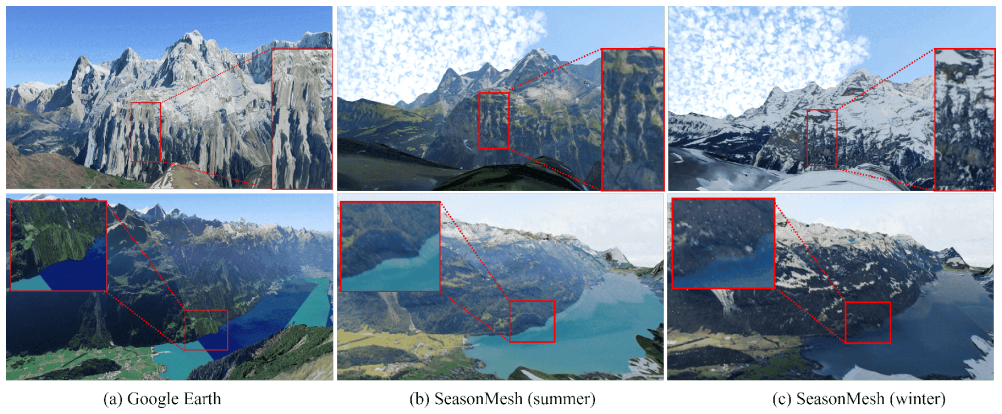
We introduce SeasonScapes framework and a the SeasonScapes dataset: Swiss Sparse-view Mountain Scenes with Seasonal Changes that covers over 50 km x 60 km, composed of more than 85,000 webcam images captured from 32 different locations across 13 timestamps throughout a full year. By projecting these timestamp-specific images onto a 3D mesh, we construct seasonal 3D landscapes that reflect natural appearance changes over time. To address occlusions and missing data, we leverage conditional diffusion models for image-guided inpainting directly on the mesh. The resulting completed meshes can be further relighted using standard physically-based renderer.
Editorial analysis
A structured set of objections, weighed in public.
Referee Report
Summary. The paper introduces the SeasonScapes framework and a corresponding dataset of Swiss sparse-view mountain scenes with seasonal changes, spanning over 50 km × 60 km and comprising more than 85,000 webcam images from 32 locations across 13 timestamps in a full year. It describes projecting timestamp-specific images onto 3D meshes to construct seasonal 3D landscapes, then applying conditional diffusion models for image-guided inpainting directly on the mesh to handle occlusions and missing data, with the completed meshes intended for relighting via standard physically-based renderers.
Significance. If the claims hold, the work would provide a scalable pipeline for creating large-scale, relightable 3D models of natural landscapes that capture real seasonal appearance changes from sparse, publicly available webcam imagery. The dataset scale (50×60 km coverage) is a clear strength and could support downstream applications in environmental monitoring, VR/AR, and graphics. The integration of projection with diffusion-based mesh inpainting represents an attempt to address practical challenges in real-world 3D reconstruction from uncontrolled sources.
major comments (2)
- [Abstract] Abstract: The pipeline is outlined but supplies no quantitative validation, error metrics, or ablation results; support for the inpainting quality and seasonal fidelity claims cannot be assessed from the available text. This is load-bearing because the central contribution rests on faithful preservation of natural seasonal variations after inpainting.
- [Method] Method description (projection and inpainting steps): The manuscript relies on conditional diffusion models for direct image-guided inpainting on the 3D mesh without bounding error from the required 2D-to-mesh mapping (UV parameterization, multi-view rendering, or implicit representation) or providing evidence that fine-grained seasonal cues (snow cover, foliage color, lighting) are preserved rather than hallucinated. This assumption is central to the re-lightable seasonal landscapes claim.
minor comments (1)
- [Abstract] Abstract contains a grammatical error: 'We introduce SeasonScapes framework and a the SeasonScapes dataset' should read 'We introduce the SeasonScapes framework and the SeasonScapes dataset'.
Simulated Author's Rebuttal
We thank the referee for their constructive feedback on our manuscript. We address each major comment below and commit to revisions that strengthen the quantitative support and methodological details for our claims.
read point-by-point responses
-
Referee: [Abstract] Abstract: The pipeline is outlined but supplies no quantitative validation, error metrics, or ablation results; support for the inpainting quality and seasonal fidelity claims cannot be assessed from the available text. This is load-bearing because the central contribution rests on faithful preservation of natural seasonal variations after inpainting.
Authors: We agree that the current abstract and manuscript text do not include quantitative metrics or ablations, which limits assessment of the inpainting and seasonal fidelity claims. In the revised manuscript we will update the abstract to highlight key quantitative results (e.g., inpainting FID/LPIPS scores and seasonal consistency metrics across timestamps) and add a new experimental section with ablation studies on the diffusion inpainting components and error metrics demonstrating preservation of seasonal cues such as snow cover and foliage color. revision: yes
-
Referee: [Method] Method description (projection and inpainting steps): The manuscript relies on conditional diffusion models for direct image-guided inpainting on the 3D mesh without bounding error from the required 2D-to-mesh mapping (UV parameterization, multi-view rendering, or implicit representation) or providing evidence that fine-grained seasonal cues (snow cover, foliage color, lighting) are preserved rather than hallucinated. This assumption is central to the re-lightable seasonal landscapes claim.
Authors: We acknowledge that the method section currently lacks explicit error bounds on the 2D-to-mesh projection and direct evidence that seasonal cues are preserved rather than hallucinated by the diffusion model. We will revise the method description to detail the UV parameterization and projection pipeline, include an analysis of projection-induced errors (e.g., via multi-view consistency checks), and add targeted experiments (qualitative and quantitative) showing that fine-grained cues like snow cover, foliage color, and lighting are transferred from the input images rather than synthesized. revision: yes
Circularity Check
No significant circularity; pipeline applies standard projection and diffusion techniques to new data
full rationale
The derivation chain consists of collecting a new webcam dataset, projecting images onto an existing 3D mesh construction, applying conditional diffusion models for inpainting (a pre-existing technique), and using standard physically-based rendering for relighting. No equations or steps reduce the central claims to fitted parameters by construction, self-definitions, or load-bearing self-citations. The approach is self-contained against external benchmarks for mesh projection and diffusion inpainting, with the novelty residing in the seasonal dataset and application rather than any circular redefinition of inputs as outputs.
Axiom & Free-Parameter Ledger
axioms (2)
- standard math Images can be accurately projected onto a 3D mesh to represent scene appearance
- domain assumption Conditional diffusion models can generate plausible completions for occluded or missing mesh regions while preserving seasonal context
Lean theorems connected to this paper
-
IndisputableMonolith/Foundation/AlexanderDuality.leanalexander_duality_circle_linking unclear?
unclearRelation between the paper passage and the cited Recognition theorem.
By projecting these timestamp-specific images onto a 3D mesh, we construct seasonal 3D landscapes... leverage conditional diffusion models for image-guided inpainting directly on the mesh... train a relightable Gaussian Splat model with appearance Multi-Layer Perceptron.
-
IndisputableMonolith/Cost/FunctionalEquation.leanwashburn_uniqueness_aczel unclear?
unclearRelation between the paper passage and the cited Recognition theorem.
We propose SeasonScapes framework for relightable 3D landscape creation that leverages diffusion priors to inpaint unseen regions with high fidelity.
What do these tags mean?
- matches
- The paper's claim is directly supported by a theorem in the formal canon.
- supports
- The theorem supports part of the paper's argument, but the paper may add assumptions or extra steps.
- extends
- The paper goes beyond the formal theorem; the theorem is a base layer rather than the whole result.
- uses
- The paper appears to rely on the theorem as machinery.
- contradicts
- The paper's claim conflicts with a theorem or certificate in the canon.
- unclear
- Pith found a possible connection, but the passage is too broad, indirect, or ambiguous to say the theorem truly supports the claim.
Reference graph
Works this paper leans on
-
[1]
An Intro to the Earth Engine Python API, 2025
Guillaume Attard. An Intro to the Earth Engine Python API, 2025. https://developers.google.com/earth- engine/tutorials/community/intro-to-python-api. 4
work page 2025
-
[2]
Barron, Ben Mildenhall, Dor Verbin, Pratul P
Jonathan T. Barron, Ben Mildenhall, Dor Verbin, Pratul P. Srinivasan, and Peter Hedman. Mip-nerf 360: Unbounded anti-aliased neural radiance fields, 2022. 3
work page 2022
-
[3]
Bar- ron, Ce Liu, and Hendrik P.A
Mark Boss, Raphael Braun, Varun Jampani, Jonathan T. Bar- ron, Ce Liu, and Hendrik P.A. Lensch. Nerd: Neural re- flectance decomposition from image collections. InICCV,
-
[4]
Jan Brejcha, Michal Luk ´aˇc, Yannick Hold-Geoffroy, Oliver Wang, and Martin ˇCad´ık. Landscapear: Large scale out- door augmented reality by matching photographs with ter- rain models using learned descriptors. InEuropean Confer- ence on Computer Vision, pages 295–312. Springer, 2020. 2
work page 2020
-
[5]
Texfusion: Synthesizing 3d textures with text-guided image diffusion models, 2023
Tianshi Cao, Karsten Kreis, Sanja Fidler, Nicholas Sharp, and Kangxue Yin. Texfusion: Synthesizing 3d textures with text-guided image diffusion models, 2023. 3
work page 2023
-
[6]
D. Chen, G. Baatz, K ¨oser, S. Tsai, R. Vedantham, T. Pyl- vanainen, K. Roimela, X. Chen, J. Bach andM. Pollefeys, B. Girod, and R. Grzeszczuk. City-scale landmark identifica- tion on mobile devices.InProceedings of Computer Vision and Pattern Recognition (CVPR), 2011. 2
work page 2011
-
[7]
Text2tex: Text-driven tex- ture synthesis via diffusion models, 2023
Dave Zhenyu Chen, Yawar Siddiqui, Hsin-Ying Lee, Sergey Tulyakov, and Matthias Nießner. Text2tex: Text-driven tex- ture synthesis via diffusion models, 2023. 3
work page 2023
-
[8]
It3d: Improved text- to-3d generation with explicit view synthesis, 2023
Yiwen Chen, Chi Zhang, Xiaofeng Yang, Zhongang Cai, Gang Yu, Lei Yang, and Guosheng Lin. It3d: Improved text- to-3d generation with explicit view synthesis, 2023. 2
work page 2023
-
[9]
Automatic 3d reconstruction from multi-date satellite images, 2017
Gabriele Facciolo, Carlo De Franchis, and Enric Meinhardt- Llopis. Automatic 3d reconstruction from multi-date satellite images, 2017. 2
work page 2017
-
[10]
Citygpt: Empowering urban spatial cognition of large language models, 2025
Jie Feng, Tianhui Liu, Yuwei Du, Siqi Guo, Yuming Lin, and Yong Li. Citygpt: Empowering urban spatial cognition of large language models, 2025. 2
work page 2025
-
[11]
Bermano, Gal Chechik, and Daniel Cohen-Or
Rinon Gal, Yuval Alaluf, Yuval Atzmon, Or Patashnik, Amit H. Bermano, Gal Chechik, and Daniel Cohen-Or. An image is worth one word: Personalizing text-to-image gen- eration using textual inversion, 2022. 3
work page 2022
-
[12]
Vision meets robotics: The kitti dataset.Interna- tional Journal of Robotics Research (IJRR), 2013
Andreas Geiger, Philip Lenz, Christoph Stiller, and Raquel Urtasun. Vision meets robotics: The kitti dataset.Interna- tional Journal of Robotics Research (IJRR), 2013. 2
work page 2013
- [13]
-
[14]
Denoising dif- fusion probabilistic models
Jonathan Ho, Ajay Jain, and Pieter Abbeel. Denoising dif- fusion probabilistic models. InNeurIPS, pages 6840–6851,
-
[15]
Adversarial texture optimization from rgb-d scans, 2020
Jingwei Huang, Justus Thies, Angela Dai, Abhijit Kundu, Chiyu Max Jiang, Leonidas Guibas, Matthias Nießner, and Thomas Funkhouser. Adversarial texture optimization from rgb-d scans, 2020. 2
work page 2020
-
[16]
Rellis-3d dataset: Data, benchmarks and analysis,
Peng Jiang, Philip Osteen, Maggie Wigness, and Srikanth Saripalli. Rellis-3d dataset: Data, benchmarks and analysis,
-
[17]
Tensoir: Tensorial inverse rendering
Haian Jin, Isabella Liu, Peijia Xu, Xiaoshuai Zhang, Song- fang Han, Sai Bi, Xiaowei Zhou, Zexiang Xu, and Hao Su. Tensoir: Tensorial inverse rendering. InCVPR, 2023. 3
work page 2023
-
[18]
Neural gaffer: Relighting any object via diffusion
Haian Jin, Yuan Li, Fujun Luan, Yuanbo Xiangli, Sai Bi, Kai Zhang, Zexiang Xu, Jin Sun, and Noah Snavely. Neural gaffer: Relighting any object via diffusion. InAdvances in Neural Information Processing Systems, 2024. 3
work page 2024
-
[19]
Conerf: Controllable neural radiance fields
Kacper Kania, Kwang Moo Yi, Marek Kowalski, Tomasz Trzci´nski, and Andrea Tagliasacchi. Conerf: Controllable neural radiance fields. InProceedings of the IEEE/CVF Con- ference on Computer Vision and Pattern Recognition, pages 18623–18632, 2022. 3
work page 2022
-
[20]
Mitra, Andrea Vedaldi, and David Novotny
Animesh Karnewar, Niloy J. Mitra, Andrea Vedaldi, and David Novotny. Holofusion: Towards photo-realistic 3d gen- erative modeling, 2023. 2
work page 2023
-
[21]
Screened Poisson Sur- face Reconstruction.ACM Transactions on Graphics, 32,
Michael Kazhdan and Hugues Hoppe. Screened Poisson Sur- face Reconstruction.ACM Transactions on Graphics, 32,
-
[22]
3d gaussian splatting for real-time radiance field rendering, 2023
Bernhard Kerbl, Georgios Kopanas, Thomas Leimk ¨uhler, and George Drettakis. 3d gaussian splatting for real-time radiance field rendering, 2023. 3
work page 2023
-
[23]
Bernhard Kerbl, Andreas Meuleman, Georgios Kopanas, Michael Wimmer, Alexandre Lanvin, and George Drettakis. A hierarchical 3d gaussian representation for real-time ren- dering of very large datasets.ACM Transactions on Graph- ics, 43(4), 2024. 2
work page 2024
-
[24]
Johannes Kopf, Chi-Wing Fu, Daniel Cohen-Or, Oliver Deussen, Dani Lischinski, and Tien-Tsin Wong. Solid tex- ture synthesis from 2d exemplars.ACM Transactions on Graphics (Proceedings of SIGGRAPH 2007), 26(3):2:1–2:9,
work page 2007
-
[25]
Wildgaussians: 3d gaussian splatting in the wild, 2024
Jonas Kulhanek, Songyou Peng, Zuzana Kukelova, Marc Pollefeys, and Torsten Sattler. Wildgaussians: 3d gaussian splatting in the wild, 2024. 2, 3, 6
work page 2024
-
[26]
Control-nerf: Editable feature volumes for scene rendering and manipulation
Verica Lazova, Vladimir Guzov, Kyle Olszewski, Sergey Tulyakov, and Gerard Pons-Moll. Control-nerf: Editable feature volumes for scene rendering and manipulation. In Proceedings of the IEEE/CVF Winter Conference on Appli- cations of Computer Vision, pages 4340–4350, 2023. 3
work page 2023
-
[27]
Matrixcity: A large-scale city dataset for city-scale neural rendering and beyond
Yixuan Li, Lihan Jiang, Linning Xu, Yuanbo Xiangli, Zhen- zhi Wang, Dahua Lin, and Bo Dai. Matrixcity: A large-scale city dataset for city-scale neural rendering and beyond. In Proceedings of the IEEE/CVF International Conference on Computer Vision, pages 3205–3215, 2023. 2
work page 2023
-
[28]
Gus-ir: Gaussian splatting with unified shading for inverse rendering, 2024
Zhihao Liang, Hongdong Li, Kui Jia, Kailing Guo, and Qi Zhang. Gus-ir: Gaussian splatting with unified shading for inverse rendering, 2024. 3
work page 2024
-
[29]
Gs-ir: 3d gaussian splatting for inverse rendering
Zhihao Liang, Qi Zhang, Ying Feng, Ying Shan, and Kui Jia. Gs-ir: 3d gaussian splatting for inverse rendering. InCVPR,
-
[30]
Citygaussian: Real-time high-quality large-scale scene rendering with gaussians
Yang Liu, Chuanchen Luo, Lue Fan, Naiyan Wang, Jun- ran Peng, and Zhaoxiang Zhang. Citygaussian: Real-time high-quality large-scale scene rendering with gaussians. In European Conference on Computer Vision, pages 265–282. Springer, 2025. 2
work page 2025
-
[31]
Qi Ma, Runyi Yang, Bin Ren, Nicu Sebe, Ender Konukoglu, Luc Van Gool, and Danda Pani Paudel. Cityloc: 6dof pose distributional localization for text descriptions in large-scale scenes with gaussian representation, 2025. 2
work page 2025
-
[32]
Ricardo Martin-Brualla, Noha Radwan, Mehdi S. M. Sajjadi, Jonathan T. Barron, Alexey Dosovitskiy, and Daniel Duck- worth. NeRF in the Wild: Neural Radiance Fields for Un- constrained Photo Collections. InCVPR, 2021. 2, 3
work page 2021
-
[33]
Sdedit: Guided image synthesis and editing with stochastic differential equa- tions, 2022
Chenlin Meng, Yutong He, Yang Song, Jiaming Song, Jia- jun Wu, Jun-Yan Zhu, and Stefano Ermon. Sdedit: Guided image synthesis and editing with stochastic differential equa- tions, 2022. 3
work page 2022
-
[34]
Srinivasan, Matthew Tancik, Jonathan T
Ben Mildenhall, Pratul P. Srinivasan, Matthew Tancik, Jonathan T. Barron, Ravi Ramamoorthi, and Ren Ng. Nerf: Representing scenes as neural radiance fields for view syn- thesis, 2020. 3
work page 2020
-
[35]
Chong Mou, Xintao Wang, Liangbin Xie, Yanze Wu, Jian Zhang, Zhongang Qi, Ying Shan, and Xiaohu Qie. T2i- adapter: Learning adapters to dig out more controllable abil- ity for text-to-image diffusion models, 2023. 3
work page 2023
-
[36]
Extracting triangular 3d models, materials, and lighting from images
Jacob Munkberg, Jon Hasselgren, Tianchang Shen, Jun Gao, Wenzheng Chen, Alex Evans, Thomas M¨uller, and Sanja Fi- dler. Extracting triangular 3d models, materials, and lighting from images. InCVPR, 2022. 3
work page 2022
-
[37]
A multi-modal graphical model for scene analysis
Sarah Taghavi Namin, Mohammad Najafi, Mathieu Salz- mann, and Lars Petersson. A multi-modal graphical model for scene analysis. In2015 IEEE Winter Conference on Applications of Computer Vision, pages 1006–1013. IEEE,
-
[38]
Dinov2: Learning robust visual features with- out supervision, 2024
Maxime Oquab, Timoth ´ee Darcet, Th ´eo Moutakanni, Huy V o, Marc Szafraniec, Vasil Khalidov, Pierre Fernandez, Daniel Haziza, Francisco Massa, Alaaeldin El-Nouby, Mah- moud Assran, Nicolas Ballas, Wojciech Galuba, Russell Howes, Po-Yao Huang, Shang-Wen Li, Ishan Misra, Michael Rabbat, Vasu Sharma, Gabriel Synnaeve, Hu Xu, Herv ´e Je- gou, Julien Mairal, ...
work page 2024
-
[39]
Magic123: One image to high-quality 3d object generation using both 2d and 3d diffusion priors, 2023
Guocheng Qian, Jinjie Mai, Abdullah Hamdi, Jian Ren, Aliaksandr Siarohin, Bing Li, Hsin-Ying Lee, Ivan Sko- rokhodov, Peter Wonka, Sergey Tulyakov, and Bernard Ghanem. Magic123: One image to high-quality 3d object generation using both 2d and 3d diffusion priors, 2023. 2
work page 2023
-
[40]
Nerf on-the-go: Exploiting uncertainty for distractor-free nerfs in the wild, 2024
Weining Ren, Zihan Zhu, Boyang Sun, Jiaqi Chen, Marc Pollefeys, and Songyou Peng. Nerf on-the-go: Exploiting uncertainty for distractor-free nerfs in the wild, 2024. 2
work page 2024
-
[41]
Texture: Text-guided texturing of 3d shapes, 2023
Elad Richardson, Gal Metzer, Yuval Alaluf, Raja Giryes, and Daniel Cohen-Or. Texture: Text-guided texturing of 3d shapes, 2023. 2
work page 2023
-
[42]
Image based geo-localization in the alps, 2015
Olivier Saurer, Georges Baatz, Kevin K¨oser, L’ubor Ladick´y, and Marc Pollefeys. Image based geo-localization in the alps, 2015. 2
work page 2015
-
[43]
Deep unsupervised learning using nonequilibrium thermodynamics
Jascha Sohl-Dickstein, Eric Weiss, Niru Maheswaranathan, and Surya Ganguli. Deep unsupervised learning using nonequilibrium thermodynamics. InICML, pages 2256– 2265, 2015. 3
work page 2015
-
[44]
Make-it-3d: High-fidelity 3d creation from a single image with diffusion prior, 2023
Junshu Tang, Tengfei Wang, Bo Zhang, Ting Zhang, Ran Yi, Lizhuang Ma, and Dong Chen. Make-it-3d: High-fidelity 3d creation from a single image with diffusion prior, 2023. 2
work page 2023
-
[45]
Greg Turk. Texture synthesis on surfaces. InProceedings of the 28th Annual Conference on Computer Graphics and Interactive Techniques, page 347–354, New York, NY , USA,
-
[46]
Association for Computing Machinery. 2
-
[47]
Mega-nerf: Scalable construction of large- scale nerfs for virtual fly-throughs
Haithem Turki, Deva Ramanan, and Mahadev Satya- narayanan. Mega-nerf: Scalable construction of large- scale nerfs for virtual fly-throughs. InProceedings of the IEEE/CVF Conference on Computer Vision and Pattern Recognition (CVPR), pages 12922–12931, 2022. 2
work page 2022
-
[48]
Kavisha Vidanapathirana, Joshua Knights, Stephen Hausler, Mark Cox, Milad Ramezani, Jason Jooste, Ethan Griffiths, Shaheer Mohamed, Sridha Sridharan, Clinton Fookes, and Peyman Moghadam. Wildscenes: A benchmark for 2d and 3d semantic segmentation in large-scale natural environ- ments.The International Journal of Robotics Research, 44 (4):532–549, 2025. 2
work page 2025
-
[49]
Clip-nerf: Text-and-image driven manip- ulation of neural radiance fields
Can Wang, Menglei Chai, Mingming He, Dongdong Chen, and Jing Liao. Clip-nerf: Text-and-image driven manip- ulation of neural radiance fields. InProceedings of the IEEE/CVF Conference on Computer Vision and Pattern Recognition, pages 3835–3844, 2022. 3
work page 2022
-
[50]
Zhou Wang, Eero P Simoncelli, and Alan C Bovik. Multi- scale structural similarity for image quality assessment.The Thrity-Seventh Asilomar Conference on Signals, Systems & Computers, 2:1398–1402, 2003. 6
work page 2003
-
[51]
Maggie Wigness, Sungmin Eum, John G Rogers, David Han, and Heesung Kwon. A rugd dataset for autonomous nav- igation and visual perception in unstructured outdoor envi- ronments. InInternational Conference on Intelligent Robots and Systems (IROS), 2019. 2
work page 2019
-
[52]
Zirui Wu, Jianteng Chen, Laijian Li, Shaoteng Wu, Zhikai Zhu, Kang Xu, Martin R. Oswald, and Jie Song. 3d gaus- sian inverse rendering with approximated global illumina- tion, 2025. 3
work page 2025
-
[53]
Ip- adapter: Text compatible image prompt adapter for text-to- image diffusion models, 2023
Hu Ye, Jun Zhang, Sibo Liu, Xiao Han, and Wei Yang. Ip- adapter: Text compatible image prompt adapter for text-to- image diffusion models, 2023. 3
work page 2023
-
[54]
3d reconstruction from satellite imagery using deep learning
Tim Yngesj ¨o. 3d reconstruction from satellite imagery using deep learning. Master’s thesis, Link ¨oping University, De- partment of Electrical Engineering, Computer Vision, 2021. 2
work page 2021
-
[55]
xatlas: Mesh parameterization / uv unwrap- ping library, 2022
Jonathan Young. xatlas: Mesh parameterization / uv unwrap- ping library, 2022. 4
work page 2022
-
[56]
Point-based radiance fields for controllable human motion synthesis, 2023
Haitao Yu, Deheng Zhang, Peiyuan Xie, and Tianyi Zhang. Point-based radiance fields for controllable human motion synthesis, 2023. 3
work page 2023
-
[57]
Mip-splatting: Alias-free 3d gaussian splat- ting, 2023
Zehao Yu, Anpei Chen, Binbin Huang, Torsten Sattler, and Andreas Geiger. Mip-splatting: Alias-free 3d gaussian splat- ting, 2023. 3
work page 2023
-
[58]
Paint3d: Paint anything 3d with lighting-less texture diffusion models,
Xianfang Zeng, Xin Chen, Zhongqi Qi, Wen Liu, Zibo Zhao, Zhibin Wang, Bin Fu, Yong Liu, and Gang Yu. Paint3d: Paint anything 3d with lighting-less texture diffusion models,
-
[59]
Coarf: Controllable 3d artistic style transfer for radiance fields, 2024
Deheng Zhang, Clara Fernandez-Labrador, and Christopher Schroers. Coarf: Controllable 3d artistic style transfer for radiance fields, 2024. 3
work page 2024
-
[60]
Rise-sdf: A relightable information-shared signed distance field for glossy object inverse rendering
Deheng Zhang, Jingyu Wang, Shaofei Wang, Marko Miha- jlovic, Sergey Prokudin, Hendrik Lensch, and Siyu Tang. Rise-sdf: A relightable information-shared signed distance field for glossy object inverse rendering. InInternational Conference on 3D Vision (3DV), 2025. 3
work page 2025
-
[61]
Adding conditional control to text-to-image diffusion models
Lvmin Zhang, Anyi Rao, and Maneesh Agrawala. Adding conditional control to text-to-image diffusion models. In 2023 IEEE/CVF International Conference on Computer Vi- sion (ICCV), pages 3813–3824, 2023. 3
work page 2023
-
[62]
The unreasonable effectiveness of deep features as a perceptual metric.CVPR, 2018
Richard Zhang, Phillip Isola, Alexei A Efros, Eli Shechtman, and Oliver Wang. The unreasonable effectiveness of deep features as a perceptual metric.CVPR, 2018. 6
work page 2018
-
[63]
Srinivasan, Dor Verbin, Keunhong Park, Ricardo Martin Brualla, and Philipp Henzler
Xiaoming Zhao, Pratul P. Srinivasan, Dor Verbin, Keunhong Park, Ricardo Martin Brualla, and Philipp Henzler. IllumiN- eRF: 3D Relighting Without Inverse Rendering. InNeurIPS,
-
[64]
Gaussiangrasper: 3d language gaussian splatting for open-vocabulary robotic grasping,
Yuhang Zheng, Xiangyu Chen, Yupeng Zheng, Songen Gu, Runyi Yang, Bu Jin, Pengfei Li, Chengliang Zhong, Zeng- mao Wang, Lina Liu, et al. Gaussiangrasper: 3d lan- guage gaussian splatting for open-vocabulary robotic grasp- ing.arXiv preprint arXiv:2403.09637, 2024. 3
-
[65]
I2-sdf: Intrinsic indoor scene reconstruction and editing via raytracing in neural sdfs
Jingsen Zhu, Yuchi Huo, Qi Ye, Fujun Luan, Jifan Li, Dian- bing Xi, Lisha Wang, Rui Tang, Wei Hua, Hujun Bao, et al. I2-sdf: Intrinsic indoor scene reconstruction and editing via raytracing in neural sdfs. InProceedings of the IEEE/CVF Conference on Computer Vision and Pattern Recognition, pages 12489–12498, 2023. 3
work page 2023
discussion (0)
Sign in with ORCID, Apple, or X to comment. Anyone can read and Pith papers without signing in.