Recognition: no theorem link
High Precision Hydraulic Excavator Control for Heavy-Duty Grading
Pith reviewed 2026-05-12 04:24 UTC · model grok-4.3
The pith
A split autonomous controller achieves 1.8 cm grading precision on different hydraulic excavators by adapting low-level loops through calibration.
A machine-rendered reading of the paper's core claim, the machinery that carries it, and where it could break.
Core claim
The authors claim that a two-part controller consisting of a hydraulic-aware low-level loop tailored to the machine's architecture and a coordinating path-tracking layer, adapted via calibration, delivers autonomous heavy-duty grading at expert speed on both load-sensing and negative-flow-control excavators, producing 1.8 cm RMSE versus 4.7 cm RMSE for the commercial baseline while maintaining maximum function pressure instead of stalling.
What carries the argument
The hydraulic-aware low-level loop, which is made specific to each excavator's hydraulic architecture and tuned through calibration to account for machine dynamics and soil interaction.
Load-bearing premise
A calibration process can adapt the low-level hydraulic loop to new machine architectures and soil conditions without leaving large unmodeled effects that would degrade performance.
What would settle it
Running the calibrated controller on a third excavator or different soil and measuring grading RMSE at or above the commercial 4.7 cm level, or observing premature stalling under load.
Figures


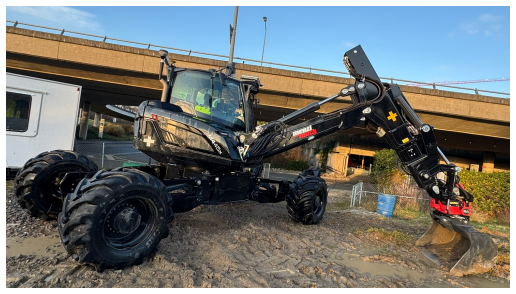

read the original abstract
High-precision heavy-duty grading is a common step in earthworks, traditionally carried out manually by skilled operators. Removing a significant amount of material while achieving a high-precision surface requires substantial machine-specific experience. Different hydraulic architectures react differently to operator inputs and soil interaction forces, which makes generalizable controllers challenging. In this paper, we present an autonomous controller that achieves high-precision grading at expert-operator speed on Load Sensing and Negative Flow Control machines alike. We split our controller into two parts: (1) a hydraulic-aware low-level loop that is hydraulic architecture-specific and (2) a path-tracking layer that coordinates joint motions and responses. Through a calibration process, our technique is applicable to load-sensing and negative-flow-control machinery. To showcase its versatility, we benchmark our approach on two excavators with different hydraulics and compare it against a commercial state-of-the-art solution. Our technique (RMSE 1.8~cm) outperforms the commercial solution (RMSE 4.7~cm) in precision by a factor of 2.6 and improves machine usage by leveraging the maximum function pressure, as opposed to commercial solutions that stall prematurely.
Editorial analysis
A structured set of objections, weighed in public.
Referee Report
Summary. The paper presents an autonomous controller for high-precision heavy-duty grading on hydraulic excavators. It splits the system into a hydraulic-architecture-specific low-level loop (for Load-Sensing and Negative-Flow-Control machines) and a path-tracking layer that coordinates joint motions. The approach relies on a calibration process to generalize across machines and is benchmarked on two excavators against a commercial baseline, claiming 1.8 cm RMSE (vs. 4.7 cm) for a 2.6x precision improvement while better utilizing maximum function pressure without premature stalling.
Significance. If the experimental claims hold under scrutiny, this would represent a meaningful advance in practical autonomous construction robotics by offering a calibratable controller that works across common hydraulic architectures without extensive per-machine modeling. The physical experiments on two distinct excavators and direct comparison to a commercial state-of-the-art solution are clear strengths that ground the work in real-world applicability.
major comments (1)
- [§5 (Benchmarking and Results)] §5 (Benchmarking and Results): The reported RMSE values (1.8 cm vs. 4.7 cm) and factor-of-2.6 outperformance are presented without details on trial count, statistical tests, specific soil conditions, or the calibration procedure (inputs/outputs, number of free parameters, or how soil interaction forces are incorporated). This is load-bearing for the central claim of reliable adaptation via calibration to different machines and conditions without significant unmodeled dynamics.
minor comments (1)
- [Abstract] Abstract: The claim of operating at 'expert-operator speed' is not supported by any quantitative comparison to human operators or metrics on cycle time.
Simulated Author's Rebuttal
We thank the referee for their constructive feedback. We address the major comment below and will revise the manuscript to provide the requested experimental details.
read point-by-point responses
-
Referee: The reported RMSE values (1.8 cm vs. 4.7 cm) and factor-of-2.6 outperformance are presented without details on trial count, statistical tests, specific soil conditions, or the calibration procedure (inputs/outputs, number of free parameters, or how soil interaction forces are incorporated). This is load-bearing for the central claim of reliable adaptation via calibration to different machines and conditions without significant unmodeled dynamics.
Authors: We agree that additional details on the experimental protocol are needed to fully support the central claims. In the revised manuscript, Section 5 will be expanded to report the total number of trials (including breakdown by machine and condition), the statistical analysis performed on the RMSE values (e.g., mean, standard deviation, and any hypothesis testing), a description of the soil conditions and types used during testing, and a full account of the calibration procedure specifying its inputs and outputs, the number of free parameters, and how soil interaction forces are incorporated or compensated. These additions will strengthen the evidence for reliable cross-machine adaptation. revision: yes
Circularity Check
No significant circularity in derivation chain
full rationale
The paper presents a control architecture for autonomous excavator grading that splits into a hydraulic-architecture-specific low-level loop and a coordinating path-tracking layer, with applicability to different machines achieved via an unspecified calibration process. Validation consists of physical experiments on two excavators (Load-Sensing and Negative-Flow-Control) with direct RMSE comparison to a commercial baseline. No mathematical derivation, equations, or predictive steps are described in the provided text that reduce claimed performance to self-defined quantities, fitted parameters renamed as predictions, or self-citation chains. The contribution is self-contained as an empirical engineering result.
Axiom & Free-Parameter Ledger
free parameters (1)
- calibration parameters
axioms (1)
- domain assumption Hydraulic dynamics of load-sensing and negative-flow-control systems can be adequately captured by an architecture-specific low-level controller after calibration
Reference graph
Works this paper leans on
-
[1]
Koji Aoshima and Martin Servin. Examining the simulation-to-reality gap of a wheel loader digging in de- formable terrain.Multibody System Dynamics, July 2024. ISSN 1573-272X. doi: 10.1007/s11044-024-10005-5
-
[2]
Ehsan Rezazadeh Azar and Vineet R Kamat. Earth- moving equipment automation: a review of technical advances and future outlook.Tcon, 22:247–265. URL https://www.itcon.org/2017/13
work page 2017
-
[3]
Caterpillar. Cat grade for excavators. https://www.cat.co m/en US/products/new/technology/grade/grade/159698 04.html. Accessed: 2025-11-10
work page 2025
-
[4]
Hoang Vu Dao and Kyoung Kwan Ahn. Active Distur- bance Rejection Contouring Control of Robotic Excava- tors with Output Constraints and Sliding Mode Observer. Applied Sciences, 12(15):7453, 2022. ISSN 2076-3417. doi: 10.3390/app12157453
-
[5]
Hoang Vu Dao, Seonjun Na, Duc Giap Nguyen, and Ky- oung Kwan Ahn. High accuracy contouring control of an excavator for surface flattening tasks based on extended state observer and task coordinate frame approach.Au- tomation in Construction, 130:103845, October 2021. ISSN 0926-5805. doi: 10.1016/j.autcon.2021.103845
-
[6]
Dell, editor.Hydraulic Systems for Mobile Equipment
Timothy W. Dell, editor.Hydraulic Systems for Mobile Equipment. G-W Publisher, 2023
work page 2023
-
[7]
Pascal Egli and Marco Hutter. A General Approach for the Automation of Hydraulic Excavator Arms Using Reinforcement Learning.IEEE Robotics and Automation Letters, 7(2):5679–5686, April 2022. ISSN 2377-3766. doi: 10.1109/LRA.2022.3152865
-
[8]
Pascal Egli, Lorenzo Terenzi, and Marco Hutter. Re- inforcement Learning-Based Bucket Filling for Au- tonomous Excavation.IEEE Transactions on Field Robotics, 1:170–191, 2024. doi: 10.1109/TFR.2024.3 432508
- [9]
-
[10]
Towards Learning Boulder Excavation with Hydraulic Excavators
Jonas Gruetter, Lorenzo Terenzi, Pascal Egli, and Marco Hutter. Towards Learning Boulder Excavation with Hydraulic Excavators. 2025. doi: 10.48550/arXiv.2 509.17683
-
[11]
Trimble Inc. Trimble earthworks. https://heavyindus try.trimble.com/en/products/grade-control-excavators. Accessed: 2025-11-10
work page 2025
-
[12]
Inkyu Jang, Junha Kim, Dongjae Lee, Changhyeon Kim, Changsuk Oh, Youngbum Kim, Sangwook Woo, Heejee Sung, and H. Jin Kim. Towards Fully Integrated Au- tonomous Excavation: Autonomous Excavator for Pre- cise Earth Cutting and Onboard Landscape Inspection. IEEE Robotics & Automation Magazine, 32(3):88–102,
-
[13]
doi: 10.1109/MRA.2024.3400772
-
[14]
Learning Excavation of Rigid Objects with Offline Reinforcement Learning
Shiyu Jin, Zhixian Ye, and Liangjun Zhang. Learning Excavation of Rigid Objects with Offline Reinforcement Learning. 2023. doi: 10.48550/arXiv.2303.16427
-
[15]
Dominic Jud, Philipp Leemann, Simon Kerscher, and Marco Hutter. Autonomous Free-Form Trenching Using a Walking Excavator.IEEE Robotics and Automation Letters, 4(4):3208–3215, 2019. doi: 10.1109/LRA.2019 .2925758
-
[16]
Kwangmin Kim, Minji Kim, Dongmok Kim, and Dongjun Lee. Modeling and velocity-field control of autonomous excavator with main control valve.Au- tomatica, 104:67–81, 2019. ISSN 0005-1098. doi: 10.1016/j.automatica.2019.02.041
-
[17]
Youngbum Kim and Jinwhan Kim. Enhanced Hydraulic Excavator Control via Semi-automatic Grading Control Using Reinforcement Learning.International Journal of Control, Automation and Systems, 23(3):896–906, 2025. ISSN 2005-4092. doi: 10.1007/s12555-024-0213-9
-
[18]
Chang Seop Lee, Jangho Bae, and Daehie Hong. Contour control for leveling work with robotic excavator.Inter- national Journal of Precision Engineering and Manufac- turing, 14(12):2055–2060, December 2013. ISSN 2005-
work page 2055
-
[19]
doi: 10.1007/s12541-013-0278-5
-
[20]
Minhyeong Lee, Hyelim Choi, ChangU Kim, Jihyun Moon, Dongmok Kim, and Dongjun Lee. Precision Motion Control of Robotized Industrial Hydraulic Exca- vators via Data-Driven Model Inversion.IEEE Robotics and Automation Letters, 7(2):1912–1919, April 2022. ISSN 2377-3766. doi: 10.1109/LRA.2022.3142389
-
[21]
Review of Flow-Matching Technology for Hydraulic Systems.Processes, 10(12): 2482, December 2022
Ruichuan Li, Qiyou Sun, Xinkai Ding, Yisheng Zhang, Wentao Yuan, and Tong Wu. Review of Flow-Matching Technology for Hydraulic Systems.Processes, 10(12): 2482, December 2022. ISSN 2227-9717. doi: 10.3390/ pr10122482
work page 2022
-
[22]
Qingkai Lu, Yifan Zhu, and Liangjun Zhang. Exca- vation Reinforcement Learning Using Geometric Rep- resentation.IEEE Robotics and Automation Letters, 7 (2):4472–4479, April 2022. ISSN 2377-3766. doi: 10.1109/LRA.2022.3150511
-
[23]
Data-Driven Model Predictive Control of an Hydraulic Excavator via Local Model Networks
Salim Msaad, Leonardo Cecchin, Ozan Demir, and Lorenzo Fagiano. Data-Driven Model Predictive Control of an Hydraulic Excavator via Local Model Networks. In 2025 American Control Conference (ACC), page 85–90,
work page 2025
-
[24]
doi: 10.23919/ACC63710.2025.11107493
-
[25]
Huynh A. D. Nguyen and Quang P. Ha. Robotic au- tonomous systems for earthmoving equipment operating in volatile conditions and teaming capacity: a survey. Robotica, 41(2):486–510, February 2023. ISSN 0263- 5747, 1469-8668. doi: 10.1017/S0263574722000339
-
[26]
Zhao, Chenfeng Xu, Chen Tang, Chenran Li, Mingyu Ding, Masayoshi Tomizuka, and Wei Zhan
Filippo A. Spinelli, Pascal Egli, Julian Nubert, Fang Nan, Thilo Bleumer, Patrick Goegler, Stephan Brockes, Ferdinand Hofmann, and Marco Hutter. Reinforcement Learning Control for Autonomous Hydraulic Material Handling Machines with Underactuated Tools.Inter- national Conference on Intelligent Robots and Systems, page 12694–12701, October 2024. ISSN 2153-...
-
[27]
Sergiy Sydorenko. Negative flow control vs load sensing - which one is better? https://www.insanehydraulics.com /letstalk/nfcvsls.html, 2025. Accessed: 2025-12-04
work page 2025
-
[28]
Toward Autonomous Excavation Planning.IEEE Transactions on Field Robotics, 1:292–317, 2024
Lorenzo Terenzi and Marco Hutter. Toward Autonomous Excavation Planning.IEEE Transactions on Field Robotics, 1:292–317, 2024. ISSN 2997-1101. doi: 10.1109/TFR.2024.3485037
-
[29]
Dongyun Wang, Lijuan Zheng, Hongxiang Yu, Wu Zhou, and Liping Shao. Robotic excavator motion control using a nonlinear proportional-integral controller and cross-coupled pre-compensation.Automation in Con- struction, 64:1–6, April 2016. ISSN 09265805. doi: 10.1016/j.autcon.2015.12.024
-
[30]
Jian Wang, Hao Zhang, Peng Hao, and Hua Deng. Observer-Based Approximate Affine Nonlinear Model Predictive Controller for Hydraulic Robotic Excavators with Constraints.Processes, 11(7), 2023. ISSN 2227-
work page 2023
-
[31]
Multidisciplinary Digital Publishing Institute
doi: 10.3390/pr11071918. Multidisciplinary Digital Publishing Institute
-
[32]
Tao Wang and Qingfeng Wang. Efficiency analysis and evaluation of energy-saving pressure-compensated circuit for hybrid hydraulic excavator.Automation in Construction, 47:62–68, November 2014. ISSN 0926-
work page 2014
-
[33]
doi: 10.1016/j.autcon.2014.07.012
-
[34]
Zhao, Chenfeng Xu, Chen Tang, Chenran Li, Mingyu Ding, Masayoshi Tomizuka, and Wei Zhan
Lennart Werner, Fang Nan, Pol Eyschen, Filippo A. Spinelli, Hongyi Yang, and Marco Hutter. Dynamic Throwing with Robotic Material Handling Machines. In 2024 IEEE/RSJ International Conference on Intelligent Robots and Systems (IROS), pages 98–104, 2024. doi: 10.1109/IROS58592.2024.10802743
-
[35]
Lennart Werner, Pol Eyschen, Sean Costello, Pierluigi Micarelli, and Marco Hutter. Calibrated dynamic mod- eling for force and payload estimation in hydraulic machinery.Construction Robotics, 9(2), October 2025. ISSN 2509-8780. doi: 10.1007/s41693-025-00169-7
-
[36]
Au- tomated Grading Operation for Hydraulic Excavators
Jiaqi Xu, Bradley Thompson, and Hwan-Sik Yoon. Au- tomated Grading Operation for Hydraulic Excavators. InSAE Technical Paper 2014-01-2405, 2014. doi: 10.4271/2014-01-2405
-
[37]
Teng Yang, Bin Zhang, Haocen Hong, Yuanlong Chen, Huayong Yang, Tongman Wang, and Donghui Cao. Mo- tion control for earth excavation robot based on force pre-load and cross-coupling compensation.Automation in Construction, 141:104402, 2022. ISSN 09265805. doi: 10.1016/j.autcon.2022.104402
-
[38]
An autonomous excavator system for material loading tasks.Science Robotics, 6(55): eabc3164, 2021
Liangjun Zhang, Jinxin Zhao, Pinxin Long, Liyang Wang, Lingfeng Qian, Feixiang Lu, Xibin Song, and Dinesh Manocha. An autonomous excavator system for material loading tasks.Science Robotics, 6(55): eabc3164, 2021. doi: 10.1126/scirobotics.abc3164
-
[39]
John G Ziegler and Nathaniel B Nichols. Optimum settings for automatic controllers.Transactions of the American society of mechanical engineers, 64(8):759– 765, 1942. APPENDIXA HYDRAULICBACKGROUND A. Load Sensing Hydraulic Model The simplified load-sensing circuit in Figure 15 shows the pressure feedback loop of an LS function. The pump senses the pressur...
work page 1942
discussion (0)
Sign in with ORCID, Apple, or X to comment. Anyone can read and Pith papers without signing in.