Recognition: 2 theorem links
· Lean TheoremA Superconducting Levitating Oscillator with < 1 μHz Resonance Linewidth
Pith reviewed 2026-05-12 04:01 UTC · model grok-4.3
The pith
A milligram superconducting oscillator levitated at millikelvin temperatures achieves a resonance linewidth below 0.8 microhertz.
A machine-rendered reading of the paper's core claim, the machinery that carries it, and where it could break.
Core claim
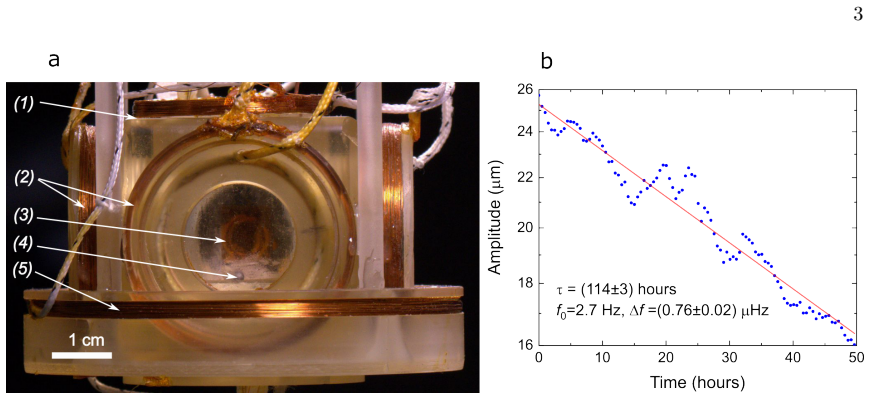
We have built a milligram-mass superconducting oscillator operating at millikelvin temperatures showing extremely low dissipation rate, with the oscillator ring-down time exceeding 110 hours. This corresponds to the resonance linewidth of less than 0.8 μHz. The experimental setup is highly tunable and is compatible with adiabatic nuclear demagnetisation, promising even lower temperatures and lower dissipation levels in the future.
What carries the argument
The magnetically levitated superconducting oscillator, which provides tether-free confinement at millikelvin temperatures to minimize external coupling.
If this is right
- The device can resolve forces as small as a few femtonewtons from dilute impurities in superfluid helium.
- Compatibility with nuclear demagnetization opens a path to still narrower linewidths at lower temperatures.
- The absence of a mechanical tether satisfies the isolation requirement for laboratory tests of wavefunction collapse or quantum gravity on macroscopic objects.
- The tunable magnetic trap allows systematic variation of trap frequency and geometry while preserving the low-dissipation regime.
Where Pith is reading between the lines
- If the dissipation remains low at the microkelvin regime reachable by nuclear demagnetization, the oscillator could become sensitive to gravitational wave backgrounds or other weak fundamental interactions.
- The same levitation geometry might be adapted to test whether macroscopic superposition states can be maintained long enough to observe interference.
- Precision force sensing at this level could be extended to searches for new short-range forces or fifth-force candidates.
Load-bearing premise
The measured ring-down time arises from intrinsic material and vacuum dissipation rather than from undetected external noise, thermal fluctuations, or instrumental artifacts.
What would settle it
Repeating the ring-down measurement after deliberately introducing a controlled external damping mechanism or raising the temperature by a known amount and checking whether the linewidth increases proportionally.
Figures


read the original abstract
Experiments aimed at quantifying the interface between quantum and classical physics necessarily require a high degree of isolation from the environment: wavefunction collapse and quantum gravity effects at laboratory scales are predicted to be very subtle. Ideally, such tests would be performed in a closed system at extremely low temperatures in order to rule out any external influence and thermal fluctuations. Cryogenic levitated macroscopic bodies are excellent candidates for an accurate laboratory approximation of such systems, as a tether to another body would violate the requirement for the system to be fully closed. Here we report a significant milestone on the way to a practically suitable approximation of such closed system. We have built a milligram-mass superconducting oscillator operating at millikelvin temperatures showing extremely low dissipation rate, with the oscillator ring-down time exceeding 110 hours. This corresponds to the resonance linewidth of less than 0.8 $\mu$Hz. The experimental setup is highly tunable and is compatible with adiabatic nuclear demagnetisation, promising even lower temperatures and lower dissipation levels in the future. We demonstrate the capability of our device by measuring drag from $^3$He impurities in superfluid $^4$He at a level of $\sim10^{-8}$ with the drag force in the femtonewton range.
Editorial analysis
A structured set of objections, weighed in public.
Referee Report
Summary. The paper reports construction of a milligram-mass superconducting levitating oscillator at millikelvin temperatures with extremely low dissipation, evidenced by a ring-down time exceeding 110 hours (corresponding to resonance linewidth <0.8 μHz). The device is tunable, compatible with adiabatic nuclear demagnetisation for further cooling, and demonstrates sensitivity to ³He impurity drag in superfluid ⁴He at the ~10^{-8} level (femtonewton forces).
Significance. If the isolation and intrinsic-dissipation attribution hold, this constitutes a notable experimental milestone toward closed macroscopic systems for quantum-classical interface tests. The combination of levitation, millikelvin operation, and femtonewton sensitivity is a strength; the tunability and future cooling path are also positive.
major comments (1)
- [Abstract and ring-down results] The central claim equates the observed >110-hour ring-down directly to intrinsic low dissipation (yielding <0.8 μHz linewidth via the stated Δf = 1/(2π τ_energy) relation). This requires that external contributions (residual gas, trap vibrations, flux noise, readout back-action) are negligible at the claimed precision, yet the manuscript provides no quantitative upper bounds from controls such as temperature dependence, trap-stiffness variation, or readout-power sweeps to exclude them; the ³He-drag sensitivity demonstration shows detection capability but does not bound the baseline decay channels.
minor comments (2)
- [Methods or results] Clarify the exact definition and measurement protocol for ring-down time (amplitude vs. energy) and any averaging or fitting procedures used to extract the >110-hour value.
- [Abstract and main results] Include explicit error bars, calibration details, and exclusion criteria for the linewidth claim to support the stated precision.
Simulated Author's Rebuttal
We thank the referee for their positive summary and for the constructive major comment. We address it in detail below and will make revisions to strengthen the manuscript.
read point-by-point responses
-
Referee: [Abstract and ring-down results] The central claim equates the observed >110-hour ring-down directly to intrinsic low dissipation (yielding <0.8 μHz linewidth via the stated Δf = 1/(2π τ_energy) relation). This requires that external contributions (residual gas, trap vibrations, flux noise, readout back-action) are negligible at the claimed precision, yet the manuscript provides no quantitative upper bounds from controls such as temperature dependence, trap-stiffness variation, or readout-power sweeps to exclude them; the ³He-drag sensitivity demonstration shows detection capability but does not bound the baseline decay channels.
Authors: We agree with the referee that the manuscript would be improved by providing more explicit quantitative upper bounds on external dissipation mechanisms to support the attribution of the long ring-down time to intrinsic losses. While the paper discusses the cryogenic environment and low temperatures making residual gas and other external effects unlikely, we did not include dedicated control measurements or bounds. In the revised manuscript, we will add a new section detailing a dissipation budget. This will include: estimates of residual gas damping based on the known vacuum level in the cryostat (which is below 10^{-10} mbar at mK, leading to damping rates orders of magnitude smaller than observed); bounds on trap vibrations from the measured acceleration noise spectrum and the levitation stiffness; upper limits on flux noise from the SQUID readout characteristics; and analysis of readout back-action from the measurement power used. Regarding the ³He-drag demonstration, it indeed calibrates the force sensitivity, but the baseline ring-down is performed in the absence of ³He, and we will clarify how this null result, combined with the sensitivity, bounds any undetected drag. We believe these additions will address the concern without requiring new experiments, though we note that full temperature and power dependence sweeps would be ideal but are not currently available in the dataset. revision: partial
Circularity Check
No circularity: direct experimental report with transparent conversion from measured ring-down time
full rationale
The paper presents an experimental result: measured amplitude ring-down time exceeding 110 hours for a levitated superconducting oscillator, converted to resonance linewidth <0.8 μHz via the standard relation Δf = 1/(2π τ_energy) with τ_energy = τ_amp/2. This is a definitional identity from linear damped-oscillator theory, not a fitted parameter renamed as prediction, not a self-citation load-bearing step, and not an ansatz smuggled in. No derivation chain exists that reduces the central claim to its own inputs by construction. The attribution of the observed decay to intrinsic dissipation is an interpretive assumption (addressed by the skeptic), but the paper does not claim to derive or prove that attribution via any internal equation or prior self-citation; it reports the measured quantity and notes compatibility with future lower temperatures. The device is shown to detect small external drags (~10^{-8} from ³He), but this does not create circularity in the linewidth calculation itself. The report is self-contained against external benchmarks of ring-down measurements.
Axiom & Free-Parameter Ledger
axioms (2)
- domain assumption Superconducting levitation can be maintained with low dissipation at millikelvin temperatures.
- domain assumption The system can be isolated sufficiently to achieve ring-down times of days.
Lean theorems connected to this paper
-
IndisputableMonolith/Cost/FunctionalEquation.leanwashburn_uniqueness_aczel unclear?
unclearRelation between the paper passage and the cited Recognition theorem.
ring-down time exceeding 110 hours... resonance linewidth of less than 0.8 μHz... drag from ³He impurities... femtonewton range
-
IndisputableMonolith/Foundation/RealityFromDistinction.leanreality_from_one_distinction unclear?
unclearRelation between the paper passage and the cited Recognition theorem.
Experiments aimed at quantifying the interface between quantum and classical physics... closed system at extremely low temperatures
What do these tags mean?
- matches
- The paper's claim is directly supported by a theorem in the formal canon.
- supports
- The theorem supports part of the paper's argument, but the paper may add assumptions or extra steps.
- extends
- The paper goes beyond the formal theorem; the theorem is a base layer rather than the whole result.
- uses
- The paper appears to rely on the theorem as machinery.
- contradicts
- The paper's claim conflicts with a theorem or certificate in the canon.
- unclear
- Pith found a possible connection, but the passage is too broad, indirect, or ambiguous to say the theorem truly supports the claim.
Reference graph
Works this paper leans on
-
[1]
J. M. Goodkind, The superconducting gravimeter, Review of scientific instruments70, 4131 (1999)
work page 1999
-
[2]
C. M. Will, Focus issue: Gravity probe B, Classical and Quantum Gravity32, 220301 (2015)
work page 2015
-
[3]
C. Gonzalez-Ballestero, M. Aspelmeyer, L. Novotny, R. Quidant, and O. Romero-Isart, Levitodynamics: Levitation and control of microscopic objects in vacuum, Science374, eabg3027 (2021)
work page 2021
- [4]
-
[5]
J. Hofer, R. Gross, G. Higgins, H. Huebl, O. F. Kieler, R. Kleiner, D. Koelle, P. Schmidt, J. A. Slater, M. Trupke, K. Uhl, T. Weimann, W. Wieczorek, and M. Aspelmeyer, High-Q magnetic levitation and control of superconducting microspheres at millikelvin temperatures, Physical Review Letters131, 1 (2023)
work page 2023
-
[6]
T. M. Fuchs, D. G. Uitenbroek, J. Plugge, N. van Halteren, J.-P. van Soest, A. Vinante, H. Ulbricht, and T. H. Oosterkamp, Measuring gravity with milligram levitated masses, Science Advances10, eadk2949 (2024)
work page 2024
- [7]
-
[8]
C. Timberlake, G. Gasbarri, A. Vinante, A. Setter, and H. Ulbricht, Acceleration sensing with mag- netically levitated oscillators above a superconductor, Applied Physics Letters115(2019)
work page 2019
- [9]
-
[10]
L. Lami, J. S. Pedernales, and M. B. Plenio, Testing the quantumness of gravity without entanglement, Physical Review X14, 021022 (2024)
work page 2024
-
[11]
A. Vinante, P. Falferi, G. Gasbarri, A. Setter, C. Timberlake, and H. Ulbricht, Ultralow mechanical damping with Meissner-levitated ferromagnetic microparticles, Physical Review Applied13, 064027 (2020)
work page 2020
-
[12]
M. Array´ as, J. L. Trueba, C. Uriarte, and D. E. Zmeev, Design of a system for controlling a levitating sphere in superfluid 3He at extremely low temperatures, Scientific Reports11, 1 (2021). 7
work page 2021
-
[13]
M. Array´ as, F. Bettsworth, R. P. Haley, R. Schanen, J. L. Trueba, C. Uriarte, V. V. Zavjalov, and D. E. Zmeev, Progress on levitating a sphere in cryogenic fluids, Journal of Low Temperature Physics 212, 363 (2023)
work page 2023
-
[14]
D. Bradley, M. Follows, I. Miller, R. Oswald, and M. Ward, Simple design for dilution refrigerator with base temperature of 2.3 mk, Cryogenics34, 549 (1994)
work page 1994
-
[15]
D. Cousins, S. N. Fisher, A. Gu´ enault, R. P. Haley, I. Miller, G. R. Pickett, G. Plenderleith, P. Skyba, P. Thibault, and M. Ward, An advanced dilution refrigerator designed for the new Lancaster mi- crokelvin facility, Journal of low temperature physics114, 547 (1999)
work page 1999
-
[16]
D. Schmoranzer, A. Luck, E. Collin, and A. Fefferman, Cryogenic broadband vibration measurement on a cryogen-free dilution refrigerator, Cryogenics98, 102 (2019)
work page 2019
-
[17]
G. R. Pickett, Cooling metals to the microkelvin regime, then and now, Physica B: Condensed Matter 280, 467 (2000)
work page 2000
- [18]
-
[19]
J. Yan, J. Yao, V. Shvarts, R.-R. Du, and X. Lin, Cryogen-free one hundred microkelvin refrigerator, Review of Scientific Instruments92(2021)
work page 2021
-
[20]
O. F. Schilling, The design of a very high-q superconductor electromechanical clock, Brazilian journal of physics37, 425 (2007)
work page 2007
-
[21]
See supplementary information
-
[22]
D. E. Zmeev, A method for driving an oscillator at a quasi-uniform velocity, Journal of Low Temper- ature Physics175, 480 (2014)
work page 2014
-
[23]
R. J. Donnelly and C. F. Barenghi, The observed properties of liquid helium at the saturated vapor pressure, Journal of physical and chemical reference data27, 1217 (1998)
work page 1998
-
[24]
J. J¨ ager, B. Schuderer, and W. Schoepe, Turbulent and laminar drag of superfluid helium on an oscillating microsphere, Physical Review Letters74, 566 (1995)
work page 1995
-
[25]
J. J¨ ager, B. Schuderer, and W. Schoepe, Translational oscillations of a microsphere in superfluid helium, Physica B210, 201 (1995)
work page 1995
-
[26]
E. L. Andronikashvili, A direct observation of two kinds of motion in helium II, J. Phys. (U. S. S. R.) 10, 201 (1946)
work page 1946
-
[27]
P. Hendry and P. V. McClintock, Continuous flow apparatus for preparing isotopically pure 4He, Cryogenics27, 131 (1987)
work page 1987
-
[28]
A. Kostarev, M. K. Abdosamadi, H. Sugimoto, M. Fujii, A. Jannasch, and E. Schaffer, Attonewton force resolution measurements with silicon nanospheres at the thermal noise limit in ambient-temperature liquids, Nano Letters25, 13476 (2025)
work page 2025
- [29]
-
[30]
V. B. Eltsov and V. L’vov, Amplitude of waves in the kelvin-wave cascade, JETP Letters111, 389 (2020)
work page 2020
- [31]
-
[32]
Y. Leng, R. Li, X. Kong, H. Xie, D. Zheng, P. Yin, F. Xiong, T. Wu, C.-K. Duan, Y. Du,et al., Mechanical dissipation below 1µHz with a cryogenic diamagnetic levitated micro-oscillator, Physical Review Applied15, 024061 (2021)
work page 2021
- [33]
-
[34]
D. Zmeev, A method for driving an oscillator at a quasi-uniform velocity, Journal of Low Temperature Physics175, 480 (2014)
work page 2014
-
[35]
D. E. Zmeev, P. Walmsley, A. Golov, P. V. McClintock, S. N. Fisher, and W. Vinen, Dissipation of quasiclassical turbulence in superfluid he 4, Physical review letters115, 155303 (2015)
work page 2015
-
[36]
D. I. Bradley, S. N. Fisher, A. M. Gu´ enault, R. P. Haley, C. R. Lawson, G. R. Pickett, R. Schanen, M. Skyba, V. Tsepelin, and D. E. Zmeev, Breaking the superfluid speed limit in a fermionic condensate, 8 Nature Physics12, 1017 (2016)
work page 2016
- [37]
- [38]
-
[39]
A. B. Abdel-Aziz, A. A. El-Zomrawy, M. M. B. El-Sabbah, and I. M. Ghayad, Electrodeposition of lead and lead-tin alloy on copper using an eco-friendly methanesulfonate plating bath, Journal of Materials Research and Technology18, 2166 (2022)
work page 2022
-
[40]
B. Tollens, Ueber ammon-alkalische silberl¨ o”sung als reagens auf aldehyd, Berichte der deutschen chemischen Gesellschaft15, 1635 (1882)
-
[41]
J. M. Lock and W. L. Bragg, Penetration of magnetic fields into superconductors iii. measurements on thin films of tin, lead and indium, inProceedings of the Royal Society of London. Series A. Mathematical and Physical Sciences, Vol. 208 (1951) pp. 391–408
work page 1951
-
[42]
T. J. Greytak and J. H. Wernick, The penetration depth in several hard superconductors, Journal of Physics and Chemistry of Solids25, 535 (1964)
work page 1964
-
[43]
R. F. Gasparovic and W. L. McLean, Superconducting penetration depth of lead, Physical Review B 2, 2519 (1970)
work page 1970
- [44]
-
[45]
R. S. Van Dyck Jr, D. Farnham, S. Zafonte, and P. Schwinberg, Ultrastable superconducting magnet system for a penning trap mass spectrometer, Review of scientific instruments70, 1665 (1999)
work page 1999
-
[46]
R. Blaauwgeers, M. Blazkova, M. ˇCloveˇ cko, V. Eltsov, R. de Graaf, J. Hosio, M. Krusius, D. Schmoranzer, W. Schoepe, L. Skrbek,et al., Quartz tuning fork: thermometer, pressure-and vis- cometer for helium liquids, Journal of Low Temperature Physics146, 537 (2007)
work page 2007
-
[47]
Pobell,Matter and methods at low temperatures, Vol
F. Pobell,Matter and methods at low temperatures, Vol. 2 (Springer, 2007)
work page 2007
-
[48]
J. Bardeen, G. Baym, and D. Pines, Interactions Between He-3 Atoms in Dilute Solutions of He-3 in Superfluid He-4, Physical Review Letters17, 372 (1966)
work page 1966
-
[49]
J. Sengers, Y.-Y. L. Wang, B. Kamgar-Parsi, and J. Dorfman, Kinetic theory of drag on objects in nearly free molecular flow, Physica A: Statistical Mechanics and its Applications413, 409 (2014)
work page 2014
-
[50]
Andreev, Surface tension of weak helium isotope solutions, Sov
A. Andreev, Surface tension of weak helium isotope solutions, Sov. Phys. JETP23, 939 (1966)
work page 1966
-
[51]
O. Kirichek, C. R. Lawson, C. J. Kinane, A. J. Caruana, S. Langridge, T. R. Charlton, and P. V. Mc- Clintock, Density profile of 3he in a nanoscale 3he-4he superfluid film determined by neutron scattering, Communications Physics7, 181 (2024). 9 SUPPLEMENT AR Y INFORMA TION A. LEVIT A TION SETUP AND HELIUM CELL We have performed experiments levitating a 2 ...
work page 2024
discussion (0)
Sign in with ORCID, Apple, or X to comment. Anyone can read and Pith papers without signing in.