Recognition: no theorem link
Intervention-Based Time Series Causal Discovery via Simulator-Generated Interventional Distributions
Pith reviewed 2026-05-12 04:56 UTC · model grok-4.3
The pith
A physics-based simulator generates interventional data that makes the full structural VAR in time series identifiable.
A machine-rendered reading of the paper's core claim, the machinery that carries it, and where it could break.
Core claim
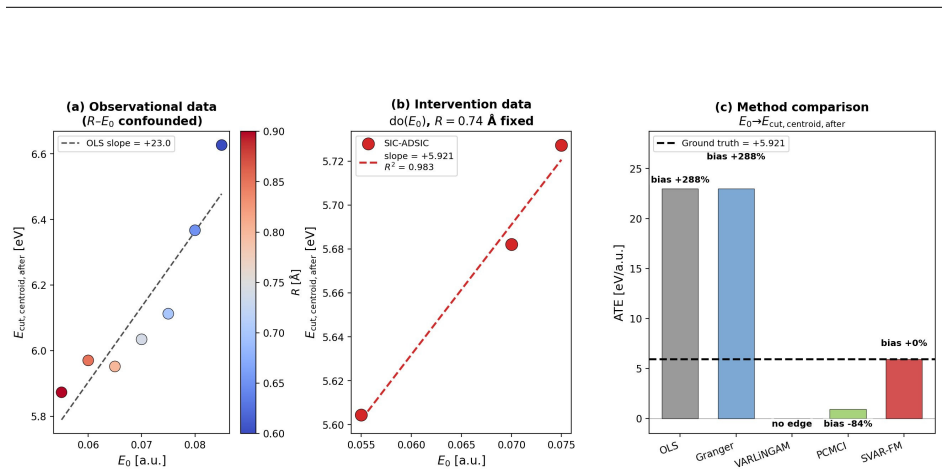
SVAR-FM treats the simulator as a mechanical realization of Pearl's do-operator via variable clamping to produce interventional data by construction, then uses Conditional Flow Matching to recover the structural vector autoregression. Under a coverage condition on the clampable variables the full model is identifiable, with an end-to-end error bound separating Monte Carlo, simulator fidelity, and Flow Matching terms. A corollary predicts and a laser-physics case study confirms that causal-effect signs reverse when simulator accuracy falls below a threshold.
What carries the argument
Simulator clamping as a direct mechanical do-operator, paired with Conditional Flow Matching to learn interventional conditionals from the generated distributions.
If this is right
- The full causal structure of a time series becomes recoverable even when observational methods are misled by confounding.
- Total estimation error decomposes into separate Monte Carlo, simulator fidelity, and learning terms that can be bounded and reduced independently.
- Causal effect signs flip when simulator fidelity drops below a critical threshold.
- Correct causal signs are recovered across four scientific domains and a laser-physics case study where baselines produce reversed estimates.
Where Pith is reading between the lines
- Improving simulator fidelity may be more effective for causal discovery than collecting more observational data.
- The sign-flip prediction could serve as a practical diagnostic for whether a simulator is accurate enough to trust for causal claims.
- The coverage condition on clampable variables suggests testing the method on simulators with only partial intervention access to see where identifiability breaks.
- The error-bound decomposition could guide allocation of computational resources between more simulator runs and better flow-matching models.
Load-bearing premise
Clamping a variable inside the simulator must physically cut all confounding paths exactly as a real-world intervention would.
What would settle it
In a controlled physical experiment, if the estimated causal sign does not reverse precisely when simulator accuracy is lowered below the predicted threshold, or if the sign remains wrong even with high-accuracy simulation that matches real data, the identifiability claim fails.
Figures



read the original abstract
We propose SVAR-FM (Structural VAR with Flow Matching), a framework for time series causal discovery that treats a physics-based simulator as a mechanical realization of Pearl's do operator. Clamping a variable inside the simulator physically severs confounding paths, producing interventional data by construction. Conditional Flow Matching then learns the nonlinear interventional conditionals. Theoretically, we prove that the full structural VAR becomes identifiable under a coverage condition on the simulator-clampable variables, and derive an end-to-end error bound that decomposes into Monte Carlo, simulator fidelity, and Flow Matching terms. A sign-flip corollary predicts that when simulator accuracy falls below a threshold, the estimated causal effect reverses sign. Empirically, a benchmark across four scientific domains confirms that SVAR-FM recovers the correct causal sign where observational methods produce sign-reversed estimates due to confounding. A case study in ultrafast laser physics verifies the sign-flip prediction by physically varying the accuracy level of a first-principles quantum solver: the low-accuracy setting reverses the causal sign, while the high-accuracy setting recovers the correct direction (R-squared = 0.983, zero bias).
Editorial analysis
A structured set of objections, weighed in public.
Referee Report
Summary. The manuscript proposes SVAR-FM, a framework for time series causal discovery that treats a physics-based simulator as a direct mechanical realization of Pearl's do-operator. By clamping variables inside the simulator, interventional distributions are generated by construction. Conditional flow matching is then applied to learn the nonlinear interventional conditionals of a structural VAR. The authors prove identifiability of the full structural VAR under a coverage condition on the simulator-clampable variables, derive an end-to-end error bound decomposing into Monte Carlo, simulator fidelity, and flow matching terms, and state a sign-flip corollary. Empirical support includes benchmarks across four scientific domains (recovering correct causal signs where observational methods fail due to confounding) and a case study in ultrafast laser physics that physically varies simulator accuracy to confirm the sign-flip prediction (R²=0.983, zero bias).
Significance. If the derivations hold, the work is significant because it supplies a principled route to interventional data for causal discovery in domains equipped with high-fidelity simulators, directly addressing confounding that defeats purely observational methods. The explicit error decomposition and the falsifiable sign-flip corollary supply practical guidance on required simulator accuracy. The empirical verification across multiple domains plus the physical experiment in laser physics strengthens the contribution. The paper earns credit for stating a clear identifiability result, an end-to-end error bound, and a testable prediction that is then checked experimentally.
major comments (2)
- [Theoretical section (identifiability theorem)] The coverage condition on clampable variables is load-bearing for the identifiability claim; the precise statement of this condition (including the minimal number and type of variables that must be clampable) should be given explicitly together with the theorem, and the interaction between non-zero simulator fidelity and the coverage requirement should be clarified.
- [Error-bound derivation and corollary] The sign-flip corollary is derived from the error bound; the manuscript should show the explicit threshold on simulator fidelity at which the estimated causal effect changes sign, and confirm that this threshold is independent of the particular flow-matching implementation.
minor comments (2)
- [Abstract] The abstract refers to benchmarks in four scientific domains without naming them; listing the domains in the abstract or introduction would improve immediate readability.
- [Methods] Notation for the structural VAR and the flow-matching objective is introduced late; moving the core definitions to the beginning of the methods section would aid readers.
Simulated Author's Rebuttal
We thank the referee for the positive evaluation and the recommendation for minor revision. The comments highlight opportunities to strengthen the presentation of the theoretical results. We address each point below and will revise the manuscript accordingly to make the coverage condition and the sign-flip threshold fully explicit.
read point-by-point responses
-
Referee: [Theoretical section (identifiability theorem)] The coverage condition on clampable variables is load-bearing for the identifiability claim; the precise statement of this condition (including the minimal number and type of variables that must be clampable) should be given explicitly together with the theorem, and the interaction between non-zero simulator fidelity and the coverage requirement should be clarified.
Authors: We agree that the coverage condition should be stated with greater precision. In the revised manuscript we will restate the identifiability theorem immediately after its proof and specify that the coverage condition requires every variable appearing in the structural VAR to be clampable inside the simulator; this is the minimal requirement that severs all confounding paths and renders the full set of interventional conditionals identifiable. Regarding the interaction with simulator fidelity, the end-to-end error bound already isolates the fidelity term from the coverage assumption: coverage guarantees identifiability in the zero-fidelity-error limit, while the bound quantifies the additional deviation introduced by non-zero simulator error. We will add a short remark after the theorem making this separation explicit. revision: yes
-
Referee: [Error-bound derivation and corollary] The sign-flip corollary is derived from the error bound; the manuscript should show the explicit threshold on simulator fidelity at which the estimated causal effect changes sign, and confirm that this threshold is independent of the particular flow-matching implementation.
Authors: The sign-flip corollary is obtained by requiring the total error (Monte Carlo + fidelity + flow-matching) to exceed the magnitude of the true causal effect. In the revision we will insert the explicit threshold: the estimated effect reverses sign whenever simulator fidelity error exceeds |true effect| divided by the constant factor arising from the bound (specifically, the sum of the Lipschitz constants of the structural functions). Because the error bound is derived from general approximation and sampling arguments that do not depend on the internal details of the flow-matching procedure, the resulting threshold is independent of any particular flow-matching implementation. We will add a sentence immediately after the corollary stating this independence. revision: yes
Circularity Check
No significant circularity detected in derivation chain
full rationale
The paper grounds its central mechanism in an external physics-based simulator that is posited to realize Pearl's do-operator via variable clamping, producing interventional distributions by construction as an independent modeling assumption rather than an internal derivation. The identifiability theorem under the coverage condition on clampable variables and the end-to-end error bound (decomposing into Monte Carlo, simulator fidelity, and Flow Matching terms) reference quantities that are not tautological with the target causal estimates. The sign-flip corollary is derived from the error bound and then subjected to direct physical verification by varying simulator accuracy in the laser-physics case study. No load-bearing step reduces by the paper's own equations to a fitted parameter renamed as a prediction, a self-citation chain, or a self-definitional construct; the framework remains self-contained against external benchmarks and empirical checks across domains.
Axiom & Free-Parameter Ledger
axioms (2)
- domain assumption Coverage condition on the simulator-clampable variables
- domain assumption Simulator clamping physically severs confounding paths
Reference graph
Works this paper leans on
-
[1]
Granger, C. W. J. , title =. Econometrica , year =
- [2]
-
[3]
Structural Vector Autoregressive Analysis , publisher =
Kilian, Lutz and L. Structural Vector Autoregressive Analysis , publisher =. 2017 , address =
work page 2017
-
[4]
Blanchard, Olivier J. and Quah, Danny , title =. American Economic Review , year =
-
[5]
Journal of Monetary Economics , year =
Uhlig, Harald , title =. Journal of Monetary Economics , year =
-
[6]
Estimation of a Structural Vector Autoregression Model Using Non-
Hyv. Estimation of a Structural Vector Autoregression Model Using Non-. Journal of Machine Learning Research , year =
- [7]
-
[8]
and Janzing, Dominik and Mooij, Joris M
Hoyer, Patrik O. and Janzing, Dominik and Mooij, Joris M. and Peters, Jonas and Sch. Nonlinear Causal Discovery with Additive Noise Models , booktitle =. 2009 , pages =
work page 2009
- [9]
-
[10]
Differentiable Causal Discovery from Interventional Data , booktitle =
Brouillard, Philippe and Lachapelle, S. Differentiable Causal Discovery from Interventional Data , booktitle =. 2020 , pages =
work page 2020
- [11]
-
[12]
Proceedings of the 21st Conference on Uncertainty in Artificial Intelligence (UAI 2005) , year =
Eberhardt, Frederick and Glymour, Clark and Scheines, Richard , title =. Proceedings of the 21st Conference on Uncertainty in Artificial Intelligence (UAI 2005) , year =
work page 2005
-
[13]
Philosophy of Science , year =
Eberhardt, Frederick and Glymour, Clark and Scheines, Richard , title =. Philosophy of Science , year =
-
[14]
Characterization and Greedy Learning of Interventional
Hauser, Alain and B. Characterization and Greedy Learning of Interventional. Journal of Machine Learning Research , year =
-
[15]
Lipman, Yaron and Chen, Ricky T. Q. and Ben-Hamu, Heli and Nickel, Maximilian and Le, Matt , title =. The Eleventh International Conference on Learning Representations (ICLR 2023) , year =
work page 2023
-
[16]
and Vanden-Eijnden, Eric , title =
Albergo, Michael S. and Vanden-Eijnden, Eric , title =. The Eleventh International Conference on Learning Representations (ICLR 2023) , year =
work page 2023
-
[17]
Transactions on Machine Learning Research , year =
Tong, Alexander and Malkin, Nikolay and Huguet, Guillaume and Zhang, Yanlei and Rector-Brooks, Jarrid and Fatras, Kilian and Wolf, Guy and Bengio, Yoshua , title =. Transactions on Machine Learning Research , year =
-
[18]
Chen, Ricky T. Q. and Rubanova, Yulia and Bettencourt, Jesse and Duvenaud, David , title =. Advances in Neural Information Processing Systems 31 (NeurIPS 2018) , year =
work page 2018
-
[19]
van der Vaart, A. W. , title =. 2000 , address =
work page 2000
- [20]
-
[21]
Journal of the American Statistical Association , year =
Hoeffding, Wassily , title =. Journal of the American Statistical Association , year =
- [22]
-
[23]
Kearns, Michael J. and Vazirani, Umesh V. , title =. 1994 , address =
work page 1994
-
[24]
Saha, Bhaskar and Goebel, Kai , title =
-
[25]
Bloom, Ira and Cole, Brian W. and Sohn, Jerry J. and Jones, Steven A. and Polzin, Edward G. and Battaglia, Vincent S. and Henriksen, Gary L. and Motloch, Chester and Richardson, Roberta and Unkelhaeuser, Tony and Ingersoll, David and Case, Howard L. , title =. Journal of Power Sources , year =
-
[26]
Severson, Kristen A. and Attia, Peter M. and Jin, Norman and Perkins, Nicholas and Jiang, Benben and Yang, Zi and Chen, Michael H. and Aykol, Muratahan and Herring, Patrick K. and Fraggedakis, Dimitrios and Bazant, Martin Z. and Harris, Stephen J. and Chueh, William C. and Braatz, Richard D. , title =. Nature Energy , year =
-
[27]
Journal of Diabetes Science and Technology , year =
Man, Chiara Dalla and Micheletto, Francesco and Lv, Dayu and Breton, Marc and Kovatchev, Boris and Cobelli, Claudio , title =. Journal of Diabetes Science and Technology , year =
-
[28]
and Breton, Marc and Dalla Man, Chiara and Cobelli, Claudio , title =
Kovatchev, Boris P. and Breton, Marc and Dalla Man, Chiara and Cobelli, Claudio , title =. Journal of Diabetes Science and Technology , year =
-
[29]
Journal of Diabetes Science and Technology , year =
Cobelli, Claudio and Kovatchev, Boris , title =. Journal of Diabetes Science and Technology , year =
-
[30]
Xie, Jinyu , title =
-
[31]
Zhao, Qiuling and Zhu, Jingyi and Fang, Qingqing and Pan, Yufan and Wang, Yanling and Shao, Jing and Xie, Wenhui , title =. Scientific Data , year =
-
[32]
European Physical Journal C , year =
Haungs, Andreas and others , title =. European Physical Journal C , year =
- [33]
-
[34]
Antoni, T. and others , title =. Nuclear Instruments and Methods in Physics Research A , year =
-
[35]
and L'Huillier, Anne and Corkum, Paul B
Lewenstein, Maciej and Balcou, Philippe and Ivanov, Misha Yu. and L'Huillier, Anne and Corkum, Paul B. , title =. Physical Review A , year =
- [36]
-
[37]
Tancogne-Dejean, Nicolas and Oliveira, Micael J. T. and Andrade, Xavier and Appel, Heiko and Borca, Carlos H. and Le Breton, Guillaume and Buchholz, Florian and Castro, Alberto and Corni, Stefano and Correa, Alfredo A. and De Giovannini, Umberto and Delgado, Alain and Eich, F. G. and Flick, Johannes and Gil, Gabriel and Gomez, Alejandro and Helbig, Nicole...
work page 2020
-
[38]
Runge, Jakob and Nowack, Peer and Kretschmer, Marlene and Flaxman, Seth and Sejdinovic, Dino , title =. Science Advances , year =
-
[39]
Proceedings of the 36th Conference on Uncertainty in Artificial Intelligence (UAI 2020) , year =
Runge, Jakob , title =. Proceedings of the 36th Conference on Uncertainty in Artificial Intelligence (UAI 2020) , year =
work page 2020
-
[40]
Advances in Neural Information Processing Systems 33 (NeurIPS 2020) , year =
Gerhardus, Andreas and Runge, Jakob , title =. Advances in Neural Information Processing Systems 33 (NeurIPS 2020) , year =
work page 2020
- [41]
-
[42]
Proceedings of the National Academy of Sciences , year =
Cranmer, Kyle and Brehmer, Johann and Louppe, Gilles , title =. Proceedings of the National Academy of Sciences , year =
-
[43]
Advances in Neural Information Processing Systems 33 (NeurIPS 2020) , year =
Pawlowski, Nick and Castro, Daniel Coelho and Glocker, Ben , title =. Advances in Neural Information Processing Systems 33 (NeurIPS 2020) , year =
work page 2020
-
[44]
Causal Autoregressive Flows , booktitle =
Khemakhem, Ilyes and Monti, Ricardo Pio and Leech, Robert and Hyv. Causal Autoregressive Flows , booktitle =. 2021 , pages =
work page 2021
-
[45]
Causal Normalizing Flows: From Theory to Practice , booktitle =
Javaloy, Adri. Causal Normalizing Flows: From Theory to Practice , booktitle =
-
[46]
Chao, Patrick and Bl. Modeling Causal Mechanisms with Diffusion Models for Interventional and Counterfactual Queries , journal =
-
[49]
Advances in Neural Information Processing Systems 38 (NeurIPS 2025) , year =
Almod. Advances in Neural Information Processing Systems 38 (NeurIPS 2025) , year =
work page 2025
-
[51]
Transactions on Machine Learning Research , year =
Komanduri, Aneesh and Wu, Xintao and Wu, Yongkai and Chen, Feng , title =. Transactions on Machine Learning Research , year =
-
[52]
Proceedings of the AAAI Conference on Artificial Intelligence , year =
Le, Minh Khoa and Do, Kien and Tran, Truyen , title =. Proceedings of the AAAI Conference on Artificial Intelligence , year =
- [53]
-
[54]
Nature Communications , year =
Park, Sung Hoon and Ha, Seokmin and Kim, Jae Kyoung , title =. Nature Communications , year =
-
[55]
Proceedings of the National Academy of Sciences , year =
Brehmer, Johann and Louppe, Gilles and Pavez, Juan and Cranmer, Kyle , title =. Proceedings of the National Academy of Sciences , year =
-
[56]
Proceedings of the 41st Conference on Uncertainty in Artificial Intelligence (UAI 2025) , series =
Misiakos, Panagiotis and P. Proceedings of the 41st Conference on Uncertainty in Artificial Intelligence (UAI 2025) , series =. 2025 , pages =
work page 2025
- [57]
-
[58]
Homaei, Mohammad Hadi and Tarif, Mohammed and Rodr. Causal Digital Twins for Cyber-Physical Security in Water Systems: A Framework for Robust Anomaly Detection , journal =. 2025 , volume =
work page 2025
-
[59]
Proceedings of the Third Conference on Causal Learning and Reasoning (CLEaR) , series =
Rohbeck, Martin and Clarke, Brendan and Mikulik, Kris and Pettet, Andrew and Stegle, Oliver and Ueltzhoeffer, Kai , title =. Proceedings of the Third Conference on Causal Learning and Reasoning (CLEaR) , series =. 2024 , pages =
work page 2024
- [60]
-
[61]
Journal of the Royal Statistical Society: Series B , year =
Benjamini, Yoav and Hochberg, Yosef , title =. Journal of the Royal Statistical Society: Series B , year =
-
[62]
The Twelfth International Conference on Learning Representations (ICLR 2024) , year =
Cheng, Hao and others , title =. The Twelfth International Conference on Learning Representations (ICLR 2024) , year =
work page 2024
-
[63]
Advances in Neural Information Processing Systems 38 (NeurIPS 2025) , year =
Herdeanu, Bohdan and others , title =. Advances in Neural Information Processing Systems 38 (NeurIPS 2025) , year =
work page 2025
-
[64]
The Ninth International Conference on Learning Representations (ICLR 2021) , year =
Li, Zongyi and Kovachki, Nikola and Azizzadenesheli, Kamyar and Liu, Burigede and Bhattacharya, Kaushik and Stuart, Andrew and Anandkumar, Anima , title =. The Ninth International Conference on Learning Representations (ICLR 2021) , year =
work page 2021
-
[65]
Oxford Statistical Science Series , year =
Dahlhaus, Rainer and Eichler, Michael , title =. Oxford Statistical Science Series , year =
-
[66]
Probability Theory and Related Fields , year =
Eichler, Michael , title =. Probability Theory and Related Fields , year =
-
[67]
Nature Reviews Earth & Environment , year =
Runge, Jakob and Gerhardus, Andreas and Varando, Gherardo and Eyring, Veronika and Camps-Valls, Gustau , title =. Nature Reviews Earth & Environment , year =
-
[68]
Pamfil, Roxana and Sriwattanaworachai, Nisara and Desai, Shaan and Pilgerstorfer, Philip and Georgatzis, Konstantinos and Beaumont, Paul and Aragam, Bryon , title =. Proceedings of the 23rd International Conference on Artificial Intelligence and Statistics (AISTATS 2020) , year =
work page 2020
-
[69]
The Eleventh International Conference on Learning Representations (ICLR 2023) , year =
Gong, Wenbo and Jennings, Joel and Zhang, Cheng and Pawlowski, Nick , title =. The Eleventh International Conference on Learning Representations (ICLR 2023) , year =
work page 2023
-
[70]
The Eleventh International Conference on Learning Representations (ICLR 2023) , year =
Cheng, Yuxiao and Yang, Runzhao and Xiao, Tingxiong and Li, Zongren and Suo, Jinli and He, Kunlun and Dai, Qionghai , title =. The Eleventh International Conference on Learning Representations (ICLR 2023) , year =
work page 2023
-
[71]
Amortized Causal Discovery: Learning to Infer Causal Graphs from Time-Series Data , booktitle =
L. Amortized Causal Discovery: Learning to Infer Causal Graphs from Time-Series Data , booktitle =. 2022 , series =
work page 2022
-
[72]
and Devijver, Emilie and Gaussier, Eric , title =
Assaad, Charles K. and Devijver, Emilie and Gaussier, Eric , title =. Journal of Artificial Intelligence Research , year =
-
[73]
Proceedings of Machine Learning Research (AISTATS 2023) , year =
Sun, Xiangyu and Schulte, Oliver and Liu, Guiliang and Poupart, Pascal , title =. Proceedings of Machine Learning Research (AISTATS 2023) , year =
work page 2023
-
[74]
Wang, Yuhao and Solus, Liam and Yang, Karren D. and Uhler, Caroline , title =. Advances in Neural Information Processing Systems 30 (NeurIPS 2017) , year =
work page 2017
-
[75]
Proceedings of the 36th Conference on Uncertainty in Artificial Intelligence (UAI 2020) , year =
Squires, Chandler and Wang, Yuhao and Uhler, Caroline , title =. Proceedings of the 36th Conference on Uncertainty in Artificial Intelligence (UAI 2020) , year =
work page 2020
-
[76]
and Magliacane, Sara and Claassen, Tom , title =
Mooij, Joris M. and Magliacane, Sara and Claassen, Tom , title =. Journal of Machine Learning Research , year =
-
[77]
The Tenth International Conference on Learning Representations (ICLR 2022) , year =
Lippe, Phillip and Cohen, Taco and Gavves, Efstratios , title =. The Tenth International Conference on Learning Representations (ICLR 2022) , year =
work page 2022
-
[78]
Active Bayesian Causal Inference , booktitle =
Toth, Christian and Lorch, Lars and Knoll, Christian and Krause, Andreas and Pernkopf, Franz and Peharz, Robert and von K. Active Bayesian Causal Inference , booktitle =. 2022 , pages =
work page 2022
- [79]
-
[80]
Proceedings of 2018 ACM SIGKDD Workshop on Causal Discovery , year =
Malinsky, Daniel and Spirtes, Peter , title =. Proceedings of 2018 ACM SIGKDD Workshop on Causal Discovery , year =
work page 2018
-
[81]
On the Identifiability of the Post-Nonlinear Causal Model , journal =
Zhang, Kun and Hyv. On the Identifiability of the Post-Nonlinear Causal Model , journal =. 2009 , pages =
work page 2009
-
[82]
Score Matching Enables Causal Discovery of Nonlinear Additive Noise Models , booktitle =
Rolland, Paul and Cevher, Volkan and Kleindessner, Matth. Score Matching Enables Causal Discovery of Nonlinear Additive Noise Models , booktitle =. 2022 , series =
work page 2022
-
[83]
Proceedings of the Second Conference on Causal Learning and Reasoning (CLeaR 2023) , year =
Montagna, Francesco and Noceti, Nicoletta and Rosasco, Lorenzo and Zhang, Kun and Locatello, Francesco , title =. Proceedings of the Second Conference on Causal Learning and Reasoning (CLeaR 2023) , year =
work page 2023
discussion (0)
Sign in with ORCID, Apple, or X to comment. Anyone can read and Pith papers without signing in.