Recognition: 2 theorem links
· Lean TheoremTrajDLM: Topology-Aware Block Diffusion Language Model for Trajectory Generation
Pith reviewed 2026-05-12 02:52 UTC · model grok-4.3
The pith
Block diffusion on discrete road segments generates realistic trajectories up to 2.8 times faster than prior topology-aware methods.
A machine-rendered reading of the paper's core claim, the machinery that carries it, and where it could break.
Core claim
The central discovery is that trajectories can be generated by first encoding the road network topology into embeddings, then applying block-wise diffusion to denoise sequences of road segments, and finally sampling with topology constraints to ensure the result forms valid paths. This yields strong performance on local similarity metrics on three city datasets, generation speeds up to 2.8 times higher than previous methods, and the ability to transfer zero-shot to new transportation modes and domains.
What carries the argument
Block diffusion language model backbone that processes sequences in parallel blocks, integrated with topology-aware embeddings and constrained sampling to enforce road network coherence.
If this is right
- Faster production of synthetic datasets for what-if analyses in transportation and urban planning.
- Ability to use a single model for multiple cities and modes through zero-shot transfer.
- Better balance of computational efficiency and fidelity to fine-grained trajectory patterns.
- Scalable alternative to autoregressive or search-based decoding for graph-structured sequences.
Where Pith is reading between the lines
- The success of block processing suggests similar efficiency gains could apply to other sequence generation tasks involving discrete graph elements.
- If the method generalizes, it could support privacy-preserving data augmentation for machine learning models in mobility prediction.
- Extending the constraints beyond topology to include time or speed limits might further improve realism in specific applications.
Load-bearing premise
The premise that discrete road segment sequences, when denoised in blocks and constrained by topology, will avoid artifacts and produce paths as coherent as those from continuous or exhaustive search methods.
What would settle it
A test where the model is applied to a fourth city dataset and the generated trajectories exhibit higher rates of invalid road connections or lower scores on local similarity metrics than reported.
Figures


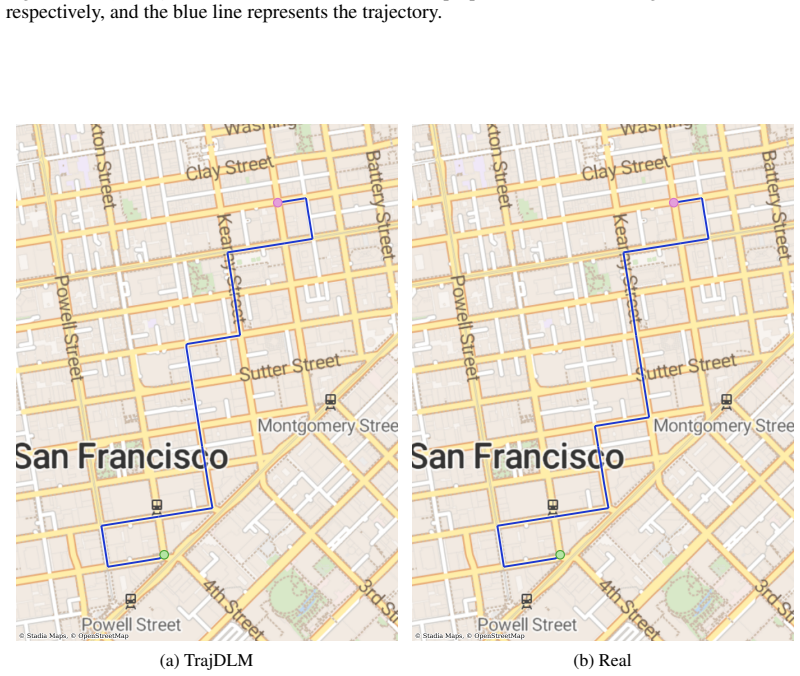
read the original abstract
Generating high-fidelity synthetic GPS trajectories is increasingly important for applications in transportation, urban planning, and what-if scenario simulation, especially as privacy concerns limit access to real-world mobility data. Existing trajectory generation models face a trade-off between efficiency and faithfulness to road network topology: continuous-space methods enable fast generation but ignore the road network, while topology-aware approaches rely on search-based autoregressive decoding that limits generation speed. We propose TrajDLM, a topology-aware trajectory generation framework based on block diffusion language models that bridges this gap. TrajDLM models trajectories as sequences of discrete road segments, combining a block diffusion backbone for efficient denoising, topology-aware embeddings from a road network encoder, and topology-constrained sampling to ensure coherent and realistic trajectories. Across three city-scale datasets, TrajDLM achieves strong performance on fine-grained local similarity metrics while being up to $2.8\times$ faster than prior work, and demonstrates strong zero-shot transfer across domains, including unseen transportation modes. These results highlight the effectiveness of block-wise discrete diffusion as a scalable approach to accurate and efficient trajectory generation. Our code is available at https://github.com/cruiseresearchgroup/TrajDLM/
Editorial analysis
A structured set of objections, weighed in public.
Referee Report
Summary. The paper introduces TrajDLM, a topology-aware trajectory generation model based on block diffusion language models. Trajectories are represented as discrete sequences of road segments; the architecture combines a block diffusion backbone for efficient parallel denoising, a road network graph encoder for topology-aware embeddings, and constrained sampling during generation to enforce road-network coherence. Empirical evaluation on three city-scale datasets reports competitive or superior performance on fine-grained local similarity metrics, generation speedups of up to 2.8× relative to prior autoregressive or search-based methods, and strong zero-shot transfer to unseen cities and transportation modes. Code is released.
Significance. If the reported gains hold under rigorous scrutiny, the work offers a practical advance in synthetic mobility data generation by reconciling the speed of diffusion-based sampling with topological fidelity. The block-wise discrete diffusion formulation and its integration with graph encoders constitute a reusable architectural pattern for constrained sequence generation. Zero-shot cross-domain transfer and open-source code further increase the potential impact for privacy-preserving urban simulation and transportation research.
major comments (2)
- [§4.2, §5.1] §4.2 and §5.1: the topology-constrained sampling procedure is described at a high level but lacks an explicit statement of how the constraint is enforced inside the block-denoising loop (e.g., whether it is a hard mask, a soft penalty, or a post-hoc rejection step). Without this detail it is impossible to determine whether the reported similarity improvements are attributable to the learned model or to the constraint itself.
- [Table 2] Table 2 (main results): the 2.8× speedup is reported without accompanying wall-clock timings on identical hardware, batch sizes, or sequence lengths for all baselines. Because generation time in diffusion models depends on the number of denoising steps and block size, the headline efficiency claim cannot be assessed for fairness or reproducibility from the current presentation.
minor comments (3)
- [Abstract, §1, §4.1] The abstract and §1 refer to “fine-grained local similarity metrics” without naming them; the precise definitions (e.g., edit distance, Fréchet distance on road-segment sequences, or custom local overlap scores) should appear in §4.1 or an appendix.
- [§3.1] §3.1: the notation for block diffusion (e.g., the block size B and the forward-process variance schedule) is introduced without a compact summary equation; adding a single boxed equation would improve readability.
- [§5.3] The zero-shot transfer experiments in §5.3 would benefit from an explicit statement of which transportation modes were held out and whether the road-network encoder was frozen or fine-tuned.
Simulated Author's Rebuttal
We thank the referee for the positive assessment, the recommendation for minor revision, and the constructive comments on methodological clarity and experimental reporting. We address each major comment below and will update the manuscript accordingly to improve reproducibility and transparency.
read point-by-point responses
-
Referee: [§4.2, §5.1] §4.2 and §5.1: the topology-constrained sampling procedure is described at a high level but lacks an explicit statement of how the constraint is enforced inside the block-denoising loop (e.g., whether it is a hard mask, a soft penalty, or a post-hoc rejection step). Without this detail it is impossible to determine whether the reported similarity improvements are attributable to the learned model or to the constraint itself.
Authors: We agree that the description of the topology-constrained sampling in §4.2 and §5.1 is high-level and would benefit from greater precision. The constraint is enforced as a hard mask inside the block-denoising loop: at each denoising step for a block, the output logits over candidate road segments are element-wise multiplied by a binary adjacency mask derived from the road-network graph encoder, zeroing out probabilities for non-adjacent segments before the softmax and sampling. This mask is recomputed per block using the current partial trajectory prefix and the pre-encoded graph topology. We will revise the manuscript to include this explicit mechanism, a step-by-step description of the loop, and pseudocode in the appendix. This clarification will make clear that the constraint is an integrated component of the generative process rather than a post-processing step. revision: yes
-
Referee: [Table 2] Table 2 (main results): the 2.8× speedup is reported without accompanying wall-clock timings on identical hardware, batch sizes, or sequence lengths for all baselines. Because generation time in diffusion models depends on the number of denoising steps and block size, the headline efficiency claim cannot be assessed for fairness or reproducibility from the current presentation.
Authors: We acknowledge that the efficiency results in Table 2 would be more convincing with explicit timing details. The 2.8× figure reflects average wall-clock generation time per trajectory measured on the same hardware (NVIDIA A100 80GB GPU) using a batch size of 32 and trajectories of comparable length (approximately 40–60 road segments). TrajDLM uses 100 denoising steps with block size 8, while the autoregressive baselines decode sequentially. We will add a supplementary table listing wall-clock times, hardware, batch sizes, sequence lengths, number of denoising steps, and block sizes for every baseline and dataset to support direct reproducibility and fair comparison. revision: yes
Circularity Check
No significant circularity in derivation chain
full rationale
The paper presents TrajDLM as an architectural combination of block diffusion language models, a road network graph encoder for topology-aware embeddings, and topology-constrained sampling during generation. All performance claims (similarity metrics, speedups, zero-shot transfer) are grounded in empirical evaluation on three city-scale datasets rather than any derivation or prediction that reduces to fitted parameters or self-defined quantities by construction. No equations, uniqueness theorems, or ansatzes are invoked that equate outputs to inputs; the method is explicitly a novel synthesis of existing components (diffusion, graph encoding, constrained decoding) with code released for reproduction. This satisfies the criteria for a self-contained, non-circular derivation.
Axiom & Free-Parameter Ledger
Lean theorems connected to this paper
-
IndisputableMonolith/Cost/FunctionalEquation.lean (J-uniqueness, Aczél classification)washburn_uniqueness_aczel unclear?
unclearRelation between the paper passage and the cited Recognition theorem.
TrajDLM models trajectories as sequences of discrete road segments, combining a block diffusion backbone for efficient denoising, topology-aware embeddings from a road network encoder, and topology-constrained sampling
-
IndisputableMonolith/Foundation/RealityFromDistinction.leanreality_from_one_distinction unclear?
unclearRelation between the paper passage and the cited Recognition theorem.
Block diffusion language model backbone... NELBO objective... topology-constrained sampling
What do these tags mean?
- matches
- The paper's claim is directly supported by a theorem in the formal canon.
- supports
- The theorem supports part of the paper's argument, but the paper may add assumptions or extra steps.
- extends
- The paper goes beyond the formal theorem; the theorem is a base layer rather than the whole result.
- uses
- The paper appears to rely on the theorem as machinery.
- contradicts
- The paper's claim conflicts with a theorem or certificate in the canon.
- unclear
- Pith found a possible connection, but the passage is too broad, indirect, or ambiguous to say the theorem truly supports the claim.
Reference graph
Works this paper leans on
-
[1]
M. Arriola, S. S. Sahoo, A. Gokaslan, Z. Yang, Z. Qi, J. Han, J. T. Chiu, and V . Kuleshov. Block diffusion: Interpolating between autoregressive and diffusion language models. InThe Thirteenth International Conference on Learning Representations, 2025
work page 2025
- [2]
- [3]
-
[4]
T. Bie, M. Cao, K. Chen, L. Du, M. Gong, Z. Gong, Y . Gu, J. Hu, Z. Huang, Z. Lan, et al. Llada2. 0: Scaling up diffusion language models to 100b.arXiv preprint arXiv:2512.15745, 2025
work page internal anchor Pith review arXiv 2025
- [5]
- [6]
-
[7]
J. Cao, T. Zheng, Q. Guo, Y . Wang, J. Dai, S. Liu, J. Yang, J. Song, and M. Song. Holistic semantic representation for navigational trajectory generation. InProceedings of the AAAI Conference on Artificial Intelligence, volume 39, pages 40–48, 2025
work page 2025
- [8]
-
[9]
L. Chen, M. T. Özsu, and V . Oria. Robust and fast similarity search for moving object trajectories. InProceedings of the 2005 ACM SIGMOD international conference on Management of data, pages 491–502, 2005
work page 2005
- [10]
-
[11]
Y .-A. De Montjoye, C. A. Hidalgo, M. Verleysen, and V . D. Blondel. Unique in the crowd: The privacy bounds of human mobility.Scientific reports, 3(1):1376, 2013
work page 2013
-
[12]
B. Deng, L. Ding, L. Ji, C. Chen, X. Jing, B. Qu, and D. Yang. Marionette: Fine-grained conditional generative modeling of spatiotemporal human trajectory data beyond imitation. In Proceedings of the 31st ACM SIGKDD Conference on Knowledge Discovery and Data Mining V . 2, pages 463–473, 2025
work page 2025
- [13]
-
[14]
J. Feng, Z. Yang, F. Xu, H. Yu, M. Wang, and Y . Li. Learning to simulate human mobility. In Proceedings of the 26th ACM SIGKDD international conference on knowledge discovery & data mining, pages 3426–3433, 2020
work page 2020
-
[15]
S. Gambs, M.-O. Killijian, and M. N. del Prado Cortez. Next place prediction using mobility markov chains. InProceedings of the first workshop on measurement, privacy, and mobility, pages 1–6, 2012. 10
work page 2012
-
[16]
M. C. Gonzalez, C. A. Hidalgo, and A.-L. Barabasi. Understanding individual human mobility patterns.nature, 453(7196):779–782, 2008
work page 2008
- [17]
- [18]
-
[19]
T. S. Jepsen, C. S. Jensen, and T. D. Nielsen. Graph convolutional networks for road networks. In Proceedings of the 27th ACM SIGSPATIAL International Conference on Advances in Geographic Information Systems, SIGSPATIAL ’19, page 460–463, New York, NY , USA, 2019. Association for Computing Machinery
work page 2019
- [20]
- [21]
-
[22]
G. Jin, Y . Liang, Y . Fang, Z. Shao, J. Huang, J. Zhang, and Y . Zheng. Spatio-temporal graph neural networks for predictive learning in urban computing: A survey.IEEE transactions on knowledge and data engineering, 36(10):5388–5408, 2023
work page 2023
-
[23]
E. Keogh and C. A. Ratanamahatana. Exact indexing of dynamic time warping.Knowledge and information systems, 7(3):358–386, 2005
work page 2005
-
[24]
T. N. Kipf and M. Welling. Semi-supervised classification with graph convolutional networks. arXiv preprint arXiv:1609.02907, 2016
work page internal anchor Pith review Pith/arXiv arXiv 2016
- [25]
- [26]
-
[27]
L. Li, H. Xue, Y . Song, and F. Salim. T-jepa: A joint-embedding predictive architecture for trajectory similarity computation. InProceedings of the 32nd ACM international conference on advances in geographic information systems, pages 569–572, 2024
work page 2024
-
[28]
P. Li, J. Wang, H. Zhang, X. Shi, N. Koshizuka, C. Shimizu, and R. Jiang. Trajflow: Nation-wide pseudo GPS trajectory generation with flow matching models. InThe Fourteenth International Conference on Learning Representations, 2026
work page 2026
- [29]
-
[30]
X. Liu, H. Chen, and C. Andris. trajgans: Using generative adversarial networks for geo-privacy protection of trajectory data (vision paper). InLocation privacy and security workshop, pages 1–7, 2018
work page 2018
-
[31]
A. Lou, C. Meng, and S. Ermon. Discrete diffusion modeling by estimating the ratios of the data distribution.arXiv preprint arXiv:2310.16834, 2023
work page internal anchor Pith review arXiv 2023
-
[32]
Y . Lv, Y . Duan, W. Kang, Z. Li, and F.-Y . Wang. Traffic flow prediction with big data: A deep learning approach.Ieee transactions on intelligent transportation systems, 16(2):865–873, 2014
work page 2014
-
[33]
S. Nie, F. Zhu, Z. You, X. Zhang, J. Ou, J. Hu, J. Zhou, Y . Lin, J.-R. Wen, and C. Li. Large language diffusion models.arXiv preprint arXiv:2502.09992, 2025. 11
work page internal anchor Pith review Pith/arXiv arXiv 2025
-
[34]
Y . Qin, H. Wu, W. Ju, X. Luo, and M. Zhang. A diffusion model for poi recommendation.ACM Transactions on Information Systems, 42(2):1–27, 2023
work page 2023
-
[35]
R. Rombach, A. Blattmann, D. Lorenz, P. Esser, and B. Ommer. High-resolution image synthesis with latent diffusion models. InProceedings of the IEEE/CVF conference on computer vision and pattern recognition, pages 10684–10695, 2022
work page 2022
-
[36]
S. S. Sahoo, M. Arriola, Y . Schiff, A. Gokaslan, E. Marroquin, J. T. Chiu, A. Rush, and V . Kuleshov. Simple and effective masked diffusion language models.Advances in Neural Information Processing Systems, 37:130136–130184, 2024
work page 2024
-
[37]
J. Sohl-Dickstein, E. Weiss, N. Maheswaranathan, and S. Ganguli. Deep unsupervised learning using nonequilibrium thermodynamics. InInternational conference on machine learning, pages 2256–2265. pmlr, 2015
work page 2015
-
[38]
Q. Team. Qwen3 technical report, 2025
work page 2025
-
[39]
M. Tizzoni, P. Bajardi, A. Decuyper, G. Kon Kam King, C. M. Schneider, V . Blondel, Z. Smoreda, M. C. González, and V . Colizza. On the use of human mobility proxies for modeling epidemics.PLoS computational biology, 10(7):e1003716, 2014
work page 2014
-
[40]
H. Wang, Q. Zhang, Y . Wu, D. Jin, X. Wang, L. Zhu, and L. Yu. Synthesizing human trajectories based on variational point processes.IEEE Trans. on Knowl. and Data Eng., 36(4):1785–1799, Apr. 2024
work page 2024
-
[41]
Y . Wang, J. Cao, W. Huang, Z. Liu, T. Zheng, and M. Song. Spatiotemporal gated traffic trajectory simulation with semantic-aware graph learning.Information Fusion, 108:102404, 2024
work page 2024
-
[42]
A. Wesolowski, N. Eagle, A. J. Tatem, D. L. Smith, A. M. Noor, R. W. Snow, and C. O. Buckee. Quantifying the impact of human mobility on malaria.Science, 338(6104):267–270, 2012
work page 2012
-
[43]
N. Wu, X. W. Zhao, J. Wang, and D. Pan. Learning effective road network representation with hierarchical graph neural networks. InProceedings of the 26th ACM SIGKDD International Conference on Knowledge Discovery & Data Mining, KDD ’20, page 6–14, New York, NY , USA, 2020. Association for Computing Machinery
work page 2020
-
[44]
D. Xie, F. Li, and J. M. Phillips. Distributed trajectory similarity search.Proceedings of the VLDB Endowment, 10(11):1478–1489, 2017
work page 2017
-
[45]
C. Yang and G. Gidofalvi. Fast map matching, an algorithm integrating hidden markov model with precomputation.International Journal of Geographical Information Science, 32(3):547 – 570, 2018
work page 2018
-
[46]
L. Yang, Z. Zhang, Y . Song, S. Hong, R. Xu, Y . Zhao, W. Zhang, B. Cui, and M.-H. Yang. Diffusion models: A comprehensive survey of methods and applications.ACM computing surveys, 56(4):1–39, 2023
work page 2023
-
[47]
J. Ye, Z. Xie, L. Zheng, J. Gao, Z. Wu, X. Jiang, Z. Li, and L. Kong. Dream 7b: Diffusion large language models.arXiv preprint arXiv:2508.15487, 2025
work page internal anchor Pith review Pith/arXiv arXiv 2025
-
[48]
L. Yu, W. Zhang, J. Wang, and Y . Yu. Seqgan: Sequence generative adversarial nets with policy gradient. InProceedings of the AAAI conference on artificial intelligence, volume 31, 2017
work page 2017
-
[49]
J. Yuan, Y . Zheng, C. Zhang, W. Xie, X. Xie, G. Sun, and Y . Huang. T-drive: driving directions based on taxi trajectories. InProceedings of the 18th SIGSPATIAL International conference on advances in geographic information systems, pages 99–108, 2010
work page 2010
- [50]
- [51]
- [52]
- [53]
- [54]
-
[55]
Z. Zhou, L. Chen, H. Tong, and D. Song. dllm: Simple diffusion language modeling, 2026
work page 2026
-
[56]
Y . Zhu, Y . Ye, S. Zhang, X. Zhao, and J. Yu. Difftraj: Generating gps trajectory with diffusion probabilistic model.Advances in Neural Information Processing Systems, 36:65168–65188, 2023
work page 2023
-
[57]
Y . Zhu, J. J. Yu, X. Zhao, Q. Liu, Y . Ye, W. Chen, Z. Zhang, X. Wei, and Y . Liang. Controltraj: Controllable trajectory generation with topology-constrained diffusion model. InProceedings of the 30th ACM SIGKDD Conference on Knowledge Discovery and Data Mining, pages 4676–4687, 2024
work page 2024
-
[58]
Y . Zhu, J. J. Yu, X. Zhao, X. Zhou, L. Han, X. Wei, and Y . Liang. Unitraj: Learning a universal trajectory foundation model from billion-scale worldwide traces. InThe Thirty-ninth Annual Conference on Neural Information Processing Systems, 2025. A Limitations While TrajDLM improves trajectory generation in both fidelity and efficiency, several limitatio...
work page 2025
discussion (0)
Sign in with ORCID, Apple, or X to comment. Anyone can read and Pith papers without signing in.