Recognition: 2 theorem links
· Lean TheoremHydrodynamical simulation of wind production from hot accretion flows in tidal disruption events
Pith reviewed 2026-05-12 02:49 UTC · model grok-4.3
The pith
The viscosity parameter decides whether hot accretion flows in tidal disruption events launch unbound winds or produce bound convective outflows.
A machine-rendered reading of the paper's core claim, the machinery that carries it, and where it could break.
Core claim
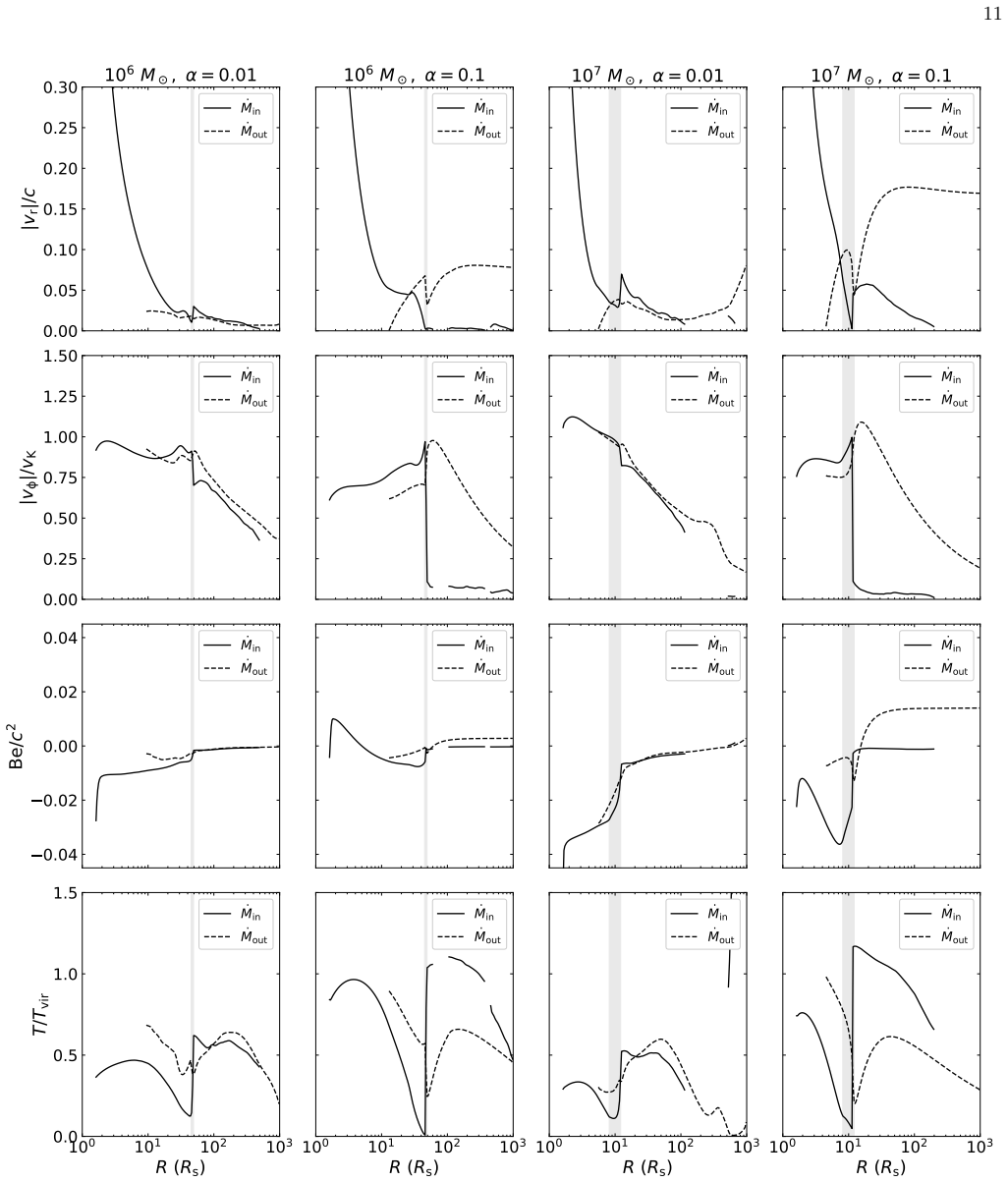
For a viscosity parameter of 0.1 the simulations produce mildly relativistic unbound winds at approximately 0.1c that originate predominantly outside the accretion flow along the equatorial plane and carry a kinetic energy of about 10 to the minus four times the Eddington luminosity; for alpha equal to 0.01 bound convective outflows dominate instead.
What carries the argument
The viscosity parameter alpha, which sets the strength of angular momentum transport and thereby determines whether outflows are unbound winds or bound convective flows.
If this is right
- More massive black holes accrete a larger fraction of the debris and launch faster winds.
- The temperature of the disrupted star's debris has negligible effect on the resulting accretion flow and wind properties.
- The unbound winds may account for delayed radio brightening seen in some tidal disruption events around one thousand days after disruption.
- Radio and X-ray surveys could detect intermediate-mass black holes by identifying signatures of such winds.
- At low viscosity the outflows differ from the true winds found in active galactic nuclei and X-ray binaries.
Where Pith is reading between the lines
- If viscosity values near 0.1 are typical in tidal disruption events then their feedback to galaxies operates differently from other sub-Eddington systems.
- Measured wind speeds near 0.1c in tidal disruption events could constrain the effective viscosity and test the simulation setup.
- Equatorial wind launching implies different interactions with surrounding material than polar outflows would produce.
- Adding radiative cooling to the simulations would show whether the hot-flow assumption breaks and changes the predicted wind characteristics.
Load-bearing premise
The accretion flow stays hot and advection-dominated with negligible radiative cooling and the initial stellar debris conditions match real tidal disruption events.
What would settle it
An observation showing that TDEs with conditions corresponding to alpha of 0.1 produce mostly bound outflows rather than unbound winds at 0.1c, or that the wind kinetic energy deviates substantially from 10 to the minus four times the Eddington luminosity.
Figures



read the original abstract
Wind is a key mechanism for supermassive black hole (SMBH) feedback to their host galaxies. In tidal disruption events (TDEs), black holes spend most of their time accreting at highly sub-Eddington rates, implying that feedback from persistent sub-Eddington winds could be significant. We investigate the effects of black hole mass, viscosity parameter and stellar debris temperature on the properties of winds from hot accretion flows in TDEs. We find that more massive black holes yield a higher accreted fraction and launch faster winds, while the debris temperature has a negligible influence on the accretion flow. For $\alpha=0.1$, the mildly-relativistic unbound winds ($\sim 0.1c$) are launched predominantly from the outside of the accretion flows along the equatorial plane, with a kinetic energy of $\sim10^{-4}L_\mathrm{Edd}$. In contrast, convective bound outflows dominate for $\alpha=0.01$, which differs from the true winds typically seen in active galactic nuclei and X-ray binaries. Potential applications for explaining delayed radio brightening in TDEs at $\sim10^3$ days and for searching for intermediate-mass black holes through radio and X-ray surveys are also discussed.
Editorial analysis
A structured set of objections, weighed in public.
Referee Report
Summary. The manuscript presents hydrodynamical simulations of hot, advection-dominated accretion flows in tidal disruption events (TDEs). It explores the dependence of wind properties on black hole mass, viscosity parameter α, and initial stellar debris temperature. The central results are that more massive black holes produce higher accreted fractions and faster winds, debris temperature has negligible effect, α=0.1 yields mildly relativistic unbound winds (~0.1c) launched from the outer equatorial regions with kinetic energy ~10^{-4} L_Edd, while α=0.01 produces dominant convective bound outflows.
Significance. If robust, these findings address sub-Eddington accretion and wind feedback in TDEs, a regime where persistent winds may contribute significantly to SMBH feedback. The reported parameter dependences and distinction between wind regimes could help interpret delayed radio brightening at ~10^3 days and guide radio/X-ray searches for intermediate-mass black holes.
major comments (2)
- [Methods] The distinction between unbound winds for α=0.1 and convective outflows for α=0.01 is load-bearing for the main claim, yet the manuscript provides no resolution or convergence tests to establish that the reported wind speeds (~0.1c) and energies (~10^{-4} L_Edd) are numerically converged.
- [Simulation setup] The assumption of a purely hot, advection-dominated flow without radiative losses underpins the wind-launching mechanism and the α-dependence; without a test run including cooling, it is unclear whether the equatorial unbound winds persist in more realistic TDE conditions.
minor comments (2)
- [Abstract] The abstract states that debris temperature has negligible influence but does not quantify the range of temperatures explored or show supporting figures.
- [Discussion] The discussion of applications to delayed radio emission at ~10^3 days would benefit from a brief estimate linking the simulated wind kinetic energy to expected radio luminosity.
Simulated Author's Rebuttal
We thank the referee for their thorough review and constructive feedback on our manuscript. We have carefully considered each comment and provide point-by-point responses below. Where appropriate, we have revised the manuscript to address the concerns raised.
read point-by-point responses
-
Referee: [Methods] The distinction between unbound winds for α=0.1 and convective outflows for α=0.01 is load-bearing for the main claim, yet the manuscript provides no resolution or convergence tests to establish that the reported wind speeds (~0.1c) and energies (~10^{-4} L_Edd) are numerically converged.
Authors: We agree with the referee that demonstrating numerical convergence is essential for the reliability of our results. In the revised manuscript, we have added convergence tests by running simulations at higher resolution (increased by a factor of 2 in each dimension). The wind speeds and kinetic energies remain consistent within 15%, confirming that our reported values are numerically converged. We have included these tests in a new appendix. revision: yes
-
Referee: [Simulation setup] The assumption of a purely hot, advection-dominated flow without radiative losses underpins the wind-launching mechanism and the α-dependence; without a test run including cooling, it is unclear whether the equatorial unbound winds persist in more realistic TDE conditions.
Authors: The purely hot flow assumption is a standard approximation for advection-dominated accretion flows at sub-Eddington rates, where cooling is inefficient. To address this, we have added a paragraph in the discussion section estimating the cooling timescale and arguing that it does not significantly affect the wind launching in our models. However, performing a full simulation with radiative cooling would require substantial additional computational resources and code modifications, which we consider beyond the current scope. We have noted this as a limitation and a direction for future work. revision: partial
Circularity Check
No significant circularity; results from explicit hydrodynamical simulations
full rationale
The paper reports outcomes of numerical hydrodynamical simulations of hot accretion flows, with parameters such as viscosity α, black-hole mass, and debris temperature chosen and varied as inputs. The central claims (e.g., mildly relativistic winds for α=0.1 versus convective outflows for α=0.01) are direct outputs of the runs under the advection-dominated assumption, not analytical derivations or predictions that reduce to fitted quantities or self-citations by construction. No load-bearing self-citation chains, self-definitional steps, or renamed empirical patterns are evident in the provided abstract and description.
Axiom & Free-Parameter Ledger
free parameters (3)
- viscosity parameter alpha
- black hole mass
- stellar debris temperature
axioms (2)
- domain assumption The accretion flow is hot and advection-dominated without significant radiative cooling.
- standard math Standard hydrodynamical equations with viscosity prescription apply to the TDE debris.
Lean theorems connected to this paper
-
IndisputableMonolith/Cost/FunctionalEquation.leanwashburn_uniqueness_aczel (J-cost uniqueness) unclear?
unclearRelation between the paper passage and the cited Recognition theorem.
For alpha=0.1, the mildly-relativistic unbound winds (~0.1c) are launched predominantly from the outside of the accretion flows along the equatorial plane, with a kinetic energy of ~10^{-4} L_Edd. In contrast, convective bound outflows dominate for alpha=0.01
-
IndisputableMonolith/Foundation/ArithmeticFromLogic.leanreality_from_one_distinction unclear?
unclearRelation between the paper passage and the cited Recognition theorem.
The evolution of hot accretion flows in TDEs is described by the conservation laws of mass, momentum, and internal energy (Eqs. 1-3) with alpha-prescription viscosity nu=alpha sqrt(GM r)
What do these tags mean?
- matches
- The paper's claim is directly supported by a theorem in the formal canon.
- supports
- The theorem supports part of the paper's argument, but the paper may add assumptions or extra steps.
- extends
- The paper goes beyond the formal theorem; the theorem is a base layer rather than the whole result.
- uses
- The paper appears to rely on the theorem as machinery.
- contradicts
- The paper's claim conflicts with a theorem or certificate in the canon.
- unclear
- Pith found a possible connection, but the passage is too broad, indirect, or ambiguous to say the theorem truly supports the claim.
Reference graph
Works this paper leans on
-
[1]
1995, ApJL, 438, L37, doi: 10.1086/187709
Regev, O. 1995, ApJL, 438, L37, doi: 10.1086/187709
-
[2]
Szuszkiewicz, E. 1988, ApJ, 332, 646, doi: 10.1086/166683
-
[3]
D., van Velzen, S., Horesh, A., & Zauderer, B
Alexander, K. D., van Velzen, S., Horesh, A., & Zauderer, B. A. 2020, SSRv, 216, 81, doi: 10.1007/s11214-020-00702-w
-
[4]
D., Margutti, R., Gomez, S., et al
Alexander, K. D., Margutti, R., Gomez, S., et al. 2025, arXiv e-prints, arXiv:2506.12729, doi: 10.48550/arXiv.2506.12729
-
[5]
Anumarlapudi, A., Dobie, D., Kaplan, D. L., et al. 2024, ApJ, 974, 241, doi: 10.3847/1538-4357/ad64d3
-
[6]
2000, ApJ, 545, 772, doi: 10.1086/317835
Ayal, S., Livio, M., & Piran, T. 2000, ApJ, 545, 772, doi: 10.1086/317835
-
[7]
Bai, X.-N., & Stone, J. M. 2013, ApJ, 767, 30, doi: 10.1088/0004-637X/767/1/30 14 Barniol Duran, R., Nakar, E., & Piran, T. 2013, ApJ, 772, 78, doi: 10.1088/0004-637X/772/1/78
-
[8]
Begelman, M. C. 2012, MNRAS, 420, 2912, doi: 10.1111/j.1365-2966.2011.20071.x
-
[9]
Begelman, M. C., & Meier, D. L. 1982, ApJ, 253, 873, doi: 10.1086/159688
-
[10]
Blagorodnova, N., Cenko, S. B., Kulkarni, S. R., et al. 2019, ApJ, 873, 92, doi: 10.3847/1538-4357/ab04b0
-
[11]
Blandford, R. D., & Begelman, M. C. 1999, MNRAS, 303, L1, doi: 10.1046/j.1365-8711.1999.02358.x —. 2004, MNRAS, 349, 68, doi: 10.1111/j.1365-2966.2004.07425.x
-
[12]
Bonnerot, C., & Stone, N. C. 2021, SSRv, 217, 16, doi: 10.1007/s11214-020-00789-1
-
[13]
Brown, J. S., Kochanek, C. S., Holoien, T. W. S., et al. 2018, MNRAS, 473, 1130, doi: 10.1093/mnras/stx2372
-
[14]
2023, MNRAS, 521, 4180, doi: 10.1093/mnras/stad804
Bu, D.-F., Chen, L., Mou, G., Qiao, E., & Yang, X.-H. 2023a, MNRAS, 521, 4180, doi: 10.1093/mnras/stad804
-
[15]
2019, ApJ, 875, 147, doi: 10.3847/1538-4357/ab12ea —
Bu, D.-F., Qiao, E., & Yang, X.-H. 2019, ApJ, 875, 147, doi: 10.3847/1538-4357/ab12ea —. 2023b, MNRAS, 523, 4136, doi: 10.1093/mnras/stad1696
-
[16]
2022, MNRAS, 516, 2833, doi: 10.1093/mnras/stac2399
Bu, D.-F., Qiao, E., Yang, X.-H., et al. 2022, MNRAS, 516, 2833, doi: 10.1093/mnras/stac2399
-
[17]
2026, A&A, 705, A4, doi: 10.1051/0004-6361/202556161
Bu, D.-F., Yang, X.-H., Chen, L., Yang, C., & Mou, G. 2026, A&A, 705, A4, doi: 10.1051/0004-6361/202556161
-
[18]
2025, in New Frontiers in GRMHD Simulations, ed
Bu, D.-F., & Yuan, F. 2025, in New Frontiers in GRMHD Simulations, ed. C. Bambi, Y. Mizuno, S. Shashank, & F. Yuan, 305–325, doi: 10.1007/978-981-97-8522-3 9
-
[19]
2016, ApJ, 818, 83, doi: 10.3847/0004-637X/818/1/83
Bu, D.-F., Yuan, F., Gan, Z.-M., & Yang, X.-H. 2016, ApJ, 818, 83, doi: 10.3847/0004-637X/818/1/83
-
[20]
Cendes, Y., Berger, E., Alexander, K. D., et al. 2022, ApJ, 938, 28, doi: 10.3847/1538-4357/ac88d0 —. 2024, ApJ, 971, 185, doi: 10.3847/1538-4357/ad5541
-
[21]
B., Cucchiara, A., Roth, N., et al
Cenko, S. B., Cucchiara, A., Roth, N., et al. 2016, ApJL, 818, L32, doi: 10.3847/2041-8205/818/2/L32
-
[22]
Coughlin, E. R., Nixon, C., Begelman, M. C., & Armitage, P. J. 2016, MNRAS, 459, 3089, doi: 10.1093/mnras/stw770
-
[23]
2019, MNRAS, 483, 565, doi: 10.1093/mnras/sty3134
Curd, B., & Narayan, R. 2019, MNRAS, 483, 565, doi: 10.1093/mnras/sty3134
-
[24]
Miller, M. C. 2018, ApJL, 859, L20, doi: 10.3847/2041-8213/aab429
-
[25]
A., Narayan, R., Ostriker, E., & Yi, I
Esin, A. A., Narayan, R., Ostriker, E., & Yi, I. 1996, ApJ, 465, 312, doi: 10.1086/177421
-
[26]
J., van Velzen, S., Miller-Jones, J
Goodwin, A. J., van Velzen, S., Miller-Jones, J. C. A., et al. 2022, MNRAS, 511, 5328, doi: 10.1093/mnras/stac333
-
[27]
Goodwin, A. J., Burn, M., Anderson, G. E., et al. 2025, ApJS, 278, 36, doi: 10.3847/1538-4365/adbe80
-
[28]
Guillochon, J., Nicholl, M., Villar, V. A., et al. 2018, ApJS, 236, 6, doi: 10.3847/1538-4365/aab761
-
[29]
Hawley, J. F., & Balbus, S. A. 2002, ApJ, 573, 738, doi: 10.1086/340765
-
[30]
Hawley, J. F., Balbus, S. A., & Stone, J. M. 2001, ApJL, 554, L49, doi: 10.1086/320931
-
[31]
Hawley, J. F., Guan, X., & Krolik, J. H. 2011, ApJ, 738, 84, doi: 10.1088/0004-637X/738/1/84
-
[32]
Hayes, J. C., Norman, M. L., Fiedler, R. A., et al. 2006, ApJS, 165, 188, doi: 10.1086/504594
-
[33]
Hills, J. G. 1975, Nature, 254, 295, doi: 10.1038/254295a0
-
[34]
Hirose, S., Krolik, J. H., & Stone, J. M. 2006, ApJ, 640, 901, doi: 10.1086/499153
-
[35]
Horesh, A., Cenko, S. B., & Arcavi, I. 2021, Nature Astronomy, 5, 491, doi: 10.1038/s41550-021-01300-8
-
[36]
Hung, T., Cenko, S. B., Roth, N., et al. 2019, ApJ, 879, 119, doi: 10.3847/1538-4357/ab24de
-
[37]
Igumenshchev, I. V., & Abramowicz, M. A. 1999, MNRAS, 303, 309, doi: 10.1046/j.1365-8711.1999.02220.x —. 2000, ApJS, 130, 463, doi: 10.1086/317354
-
[38]
V., Narayan, R., & Abramowicz, M
Igumenshchev, I. V., Narayan, R., & Abramowicz, M. A. 2003, ApJ, 592, 1042, doi: 10.1086/375769
-
[39]
2016, ApJ, 830, 125, doi: 10.3847/0004-637X/830/2/125
Jiang, Y.-F., Guillochon, J., & Loeb, A. 2016, ApJ, 830, 125, doi: 10.3847/0004-637X/830/2/125
-
[40]
Jin, C. C., Li, D. Y., Jiang, N., et al. 2025, arXiv e-prints, arXiv:2501.09580, doi: 10.48550/arXiv.2501.09580
-
[41]
Kara, E., Dai, L., Reynolds, C. S., & Kallman, T. 2018, MNRAS, 474, 3593, doi: 10.1093/mnras/stx3004
-
[42]
King, A., & Pounds, K. 2015, ARA&A, 53, 115, doi: 10.1146/annurev-astro-082214-122316
-
[43]
King, A. R., Pringle, J. E., & Livio, M. 2007, MNRAS, 376, 1740, doi: 10.1111/j.1365-2966.2007.11556.x
-
[44]
2022, ApJ, 939, 83, doi: 10.3847/1538-4357/ac8c2f
Kino, M., Takahashi, M., Kawashima, T., et al. 2022, ApJ, 939, 83, doi: 10.3847/1538-4357/ac8c2f
-
[45]
Kormendy, J., & Ho, L. C. 2013, ARA&A, 51, 511, doi: 10.1146/annurev-astro-082708-101811
work page internal anchor Pith review doi:10.1146/annurev-astro-082708-101811 2013
-
[46]
2024, ApJ, 977, 63, doi: 10.3847/1538-4357/ad8ba5
Lei, X., Wu, Q., Li, H., et al. 2024, ApJ, 977, 63, doi: 10.3847/1538-4357/ad8ba5
-
[47]
2025, arXiv e-prints, arXiv:2509.25877, doi: 10.48550/arXiv.2509.25877
Li, D., Zhang, W., Yang, J., et al. 2025, arXiv e-prints, arXiv:2509.25877, doi: 10.48550/arXiv.2509.25877
-
[48]
2023, MNRAS, 521, 3237, doi: 10.1093/mnras/stad736
Li, J., & Qiao, E. 2023, MNRAS, 521, 3237, doi: 10.1093/mnras/stad736
-
[49]
2025, ApJL, 989, L9, doi: 10.3847/2041-8213/adf205
Lin, Z., Wang, Y., Bu, D.-F., Mao, J., & Liu, J. 2025, ApJL, 989, L9, doi: 10.3847/2041-8213/adf205
-
[50]
2022, MNRAS, 512, 291, doi: 10.1093/mnras/stac181
Liodakis, I. 2022, MNRAS, 512, 291, doi: 10.1093/mnras/stac181
-
[51]
F., Wang, Y., Cheng, H., & Yuan, W
Liu, M., Liu, B. F., Wang, Y., Cheng, H., & Yuan, W. 2025a, MNRAS, 539, 69, doi: 10.1093/mnras/staf459 —. 2025b, MNRAS, 541, 1231, doi: 10.1093/mnras/staf1060 15
-
[52]
2020, MNRAS, 492, 686, doi: 10.1093/mnras/stz3405
Lu, W., & Bonnerot, C. 2020, MNRAS, 492, 686, doi: 10.1093/mnras/stz3405
-
[53]
Ma, R.-Y., Roberts, S. R., Li, Y.-P., & Wang, Q. D. 2019, MNRAS, 483, 5614, doi: 10.1093/mnras/sty3039
-
[54]
Machida, M., Hayashi, M. R., & Matsumoto, R. 2000, ApJL, 532, L67, doi: 10.1086/312553
-
[55]
2001, PASJ, 53, L1, doi: 10.1093/pasj/53.1.L1
Machida, M., Matsumoto, R., & Mineshige, S. 2001, PASJ, 53, L1, doi: 10.1093/pasj/53.1.L1
-
[56]
2021, MNRAS, 507, 4196, doi: 10.1093/mnras/stab2418 —
Matsumoto, T., & Piran, T. 2021, MNRAS, 507, 4196, doi: 10.1093/mnras/stab2418 —. 2024, ApJ, 971, 49, doi: 10.3847/1538-4357/ad58ba
-
[57]
McKinney, J. C., Tchekhovskoy, A., & Blandford, R. D. 2012, MNRAS, 423, 3083, doi: 10.1111/j.1365-2966.2012.21074.x
-
[58]
2019, ApJ, 872, 151, doi: 10.3847/1538-4357/ab010f
Mockler, B., Guillochon, J., & Ramirez-Ruiz, E. 2019, ApJ, 872, 151, doi: 10.3847/1538-4357/ab010f
-
[59]
2025, arXiv e-prints, arXiv:2510.14715, doi: 10.48550/arXiv.2510.14715
Mou, G. 2025, arXiv e-prints, arXiv:2510.14715, doi: 10.48550/arXiv.2510.14715
-
[60]
2025, arXiv e-prints, arXiv:2510.25033, doi: 10.48550/arXiv.2510.25033
Mou, G., & Shu, X. 2025, arXiv e-prints, arXiv:2510.25033, doi: 10.48550/arXiv.2510.25033
-
[61]
2022, MNRAS, 510, 3650, doi: 10.1093/mnras/stab3742
Mou, G., Wang, T., Wang, W., & Yang, J. 2022, MNRAS, 510, 3650, doi: 10.1093/mnras/stab3742
-
[62]
2021, MNRAS, 507, 1684, doi: 10.1093/mnras/stab2261
Mou, G., & Wang, W. 2021, MNRAS, 507, 1684, doi: 10.1093/mnras/stab2261
-
[63]
2021, ApJ, 908, 197, doi: 10.3847/1538-4357/abd475
Mou, G., Dou, L., Jiang, N., et al. 2021, ApJ, 908, 197, doi: 10.3847/1538-4357/abd475
-
[64]
Narayan, R., Igumenshchev, I. V., & Abramowicz, M. A. 2000, ApJ, 539, 798, doi: 10.1086/309268
-
[65]
Narayan, R., McClintock, J. E., & Yi, I. 1996, ApJ, 457, 821, doi: 10.1086/176777
-
[66]
Narayan, R., & Yi, I. 1994, ApJL, 428, L13, doi: 10.1086/187381 —. 1995a, ApJ, 444, 231, doi: 10.1086/175599 —. 1995b, ApJ, 452, 710, doi: 10.1086/176343
-
[67]
Nolthenius, R. A., & Katz, J. I. 1982, ApJ, 263, 377, doi: 10.1086/160511
-
[68]
Novikov, I. D., & Thorne, K. S. 1973, in Black Holes (Les Astres Occlus), ed. C. Dewitt & B. S. Dewitt, 343–450
work page 1973
-
[69]
2005, ApJ, 628, 368, doi: 10.1086/430728
Ohsuga, K., Mori, M., Nakamoto, T., & Mineshige, S. 2005, ApJ, 628, 368, doi: 10.1086/430728
-
[70]
, archivePrefix = "arXiv", eprint =
Pang, B., Pen, U.-L., Matzner, C. D., Green, S. R., & Liebend¨ orfer, M. 2011, MNRAS, 415, 1228, doi: 10.1111/j.1365-2966.2011.18748.x
-
[71]
Pen, U.-L., Matzner, C. D., & Wong, S. 2003, ApJL, 596, L207, doi: 10.1086/379339
-
[72]
Peng, S., Li, Z., Sjouwerman, L. O., et al. 2020, ApJ, 894, 61, doi: 10.3847/1538-4357/ab855d
-
[73]
Perlman, E. S., Meyer, E. T., Wang, Q. D., et al. 2022, ApJ, 925, 143, doi: 10.3847/1538-4357/ac3bba
-
[74]
2021, MNRAS, 508, 4667, doi: 10.1093/mnras/stab2779
Pillepich, A., Nelson, D., Truong, N., et al. 2021, MNRAS, 508, 4667, doi: 10.1093/mnras/stab2779
-
[75]
2024, arXiv e-prints, arXiv:2410.19047, doi: 10.48550/arXiv.2410.19047
Plotko, P., Winter, W., Lunardini, C., & Yuan, C. 2024, arXiv e-prints, arXiv:2410.19047, doi: 10.48550/arXiv.2410.19047
-
[76]
Poutanen, J., Lipunova, G., Fabrika, S., Butkevich, A. G., & Abolmasov, P. 2007, MNRAS, 377, 1187, doi: 10.1111/j.1365-2966.2007.11668.x
-
[77]
Qiao, E., & Liu, B. F. 2018, MNRAS, 477, 210, doi: 10.1093/mnras/sty652
-
[78]
2000, ApJ, 539, 809, doi: 10.1086/309267
Quataert, E., & Gruzinov, A. 2000, ApJ, 539, 809, doi: 10.1086/309267
-
[79]
Rees, M. J. 1988, Nature, 333, 523, doi: 10.1038/333523a0
-
[80]
2015, MNRAS, 453, 3213, doi: 10.1093/mnras/stv1802
Sadowski, A., & Narayan, R. 2015, MNRAS, 453, 3213, doi: 10.1093/mnras/stv1802
discussion (0)
Sign in with ORCID, Apple, or X to comment. Anyone can read and Pith papers without signing in.