Recognition: no theorem link
Reionization History and Neutrino Mass
Pith reviewed 2026-05-12 03:45 UTC · model grok-4.3
The pith
Reionization histories can move the best-fit neutrino mass sum to positive values and include 0.06 eV in the 95% interval.
A machine-rendered reading of the paper's core claim, the machinery that carries it, and where it could break.
Core claim
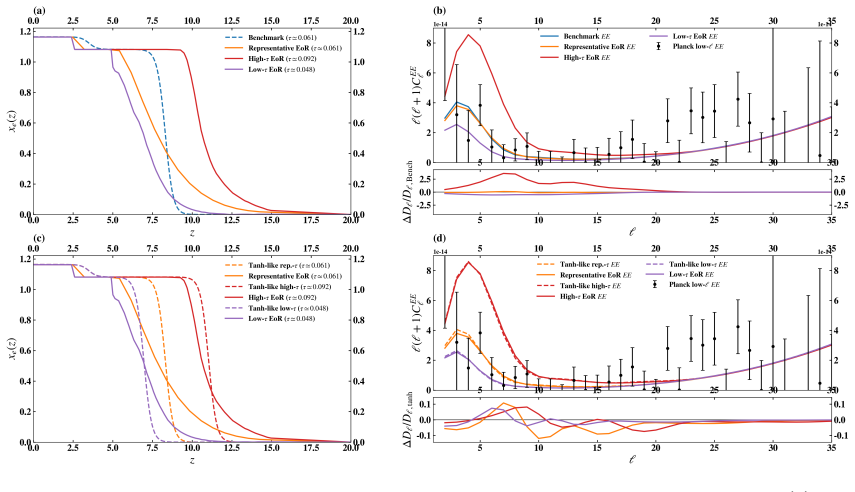
In a frequentist analysis combining CMB and BAO observations, some reionization histories shift the best-fit ∑mν to a positive value and bring ∑mν ≃ 0.06 eV into the 95% confidence interval. The Δχ²(∑mν) profiles for a high-τ history and a two-step tanh-like history of the same τ are nearly identical, showing that the total optical depth drives the change while reionization details play a minor role.
What carries the argument
The total optical depth τ from reionization, which alters the damping of CMB fluctuations and thus the joint constraints on ∑mν with BAO data.
If this is right
- The apparent anomaly of negative best-fit neutrino mass can be mitigated by higher-τ reionization models.
- The expected neutrino mass sum of 0.06 eV enters the allowed region at 95% confidence.
- Reionization history shape beyond total τ has minimal impact on the neutrino mass posterior shape.
- The resolution occurs without invoking physics beyond ΛCDM.
Where Pith is reading between the lines
- Astrophysical observations constraining reionization could independently test if this effect is physical or requires further data scrutiny.
- More precise future CMB polarization data will require careful joint modeling of reionization to avoid shifting neutrino mass inferences.
- This may indicate similar modeling sensitivities for other parameters in combined cosmological analyses.
Load-bearing premise
The tested reionization histories represent plausible astrophysical cases and that no other unmodeled systematics in the data are responsible for the posterior shift.
What would settle it
An independent low measurement of the reionization optical depth τ would eliminate the shift to positive ∑mν if reanalyzing the CMB and BAO data with that fixed τ.
Figures


read the original abstract
Recent baryon acoustic oscillation (BAO) distance measurements, when combined with Cosmic Microwave Background (CMB) observations in the $\Lambda$CDM framework, lead to a preference for negative neutrino masses. We investigate whether this neutrino mass anomaly can be alleviated by a class of astrophysically motivated reionization histories. Using a frequentist analysis, we find that some reionization histories can move the best-fit value of $\sum m_\nu$ to a positive value and bring $\sum m_\nu\simeq0.06~{\rm eV}$ into the 95\% confidence interval. To separate the effect of the total optical depth from that of the details of the reionization history, we compare a high-$\tau$ history with a two-step tanh-like reionization history of the same $\tau$. The resulting $\Delta\chi^2(\sum m_\nu)$ profiles are nearly identical. This indicates that the effect is mainly driven by the total optical depth, while the details of the reionization history play only a minor role.
Editorial analysis
A structured set of objections, weighed in public.
Referee Report
Summary. The paper claims that recent BAO and CMB data in the ΛCDM framework prefer negative neutrino masses, but certain astrophysically motivated reionization histories can shift the best-fit ∑m_ν to positive values and bring ∑m_ν ≃ 0.06 eV inside the 95% confidence interval. Using frequentist profiling, it isolates the effect by showing that a high-τ reionization history and a two-step tanh-like history with identical total optical depth τ produce nearly identical Δχ²(∑m_ν) profiles, indicating that the total τ drives the shift while details of the history are sub-dominant.
Significance. If the result holds, the work is significant because it demonstrates how reionization modeling uncertainties, primarily through total optical depth τ, can impact neutrino mass constraints from cosmological data and potentially resolve the apparent negative-mass preference without new physics. The frequentist isolation of the τ effect via matched-τ model comparisons is a clear strength, as is the focus on a concrete, testable shift in the Δχ² profile. This highlights the τ–A_s–∑m_ν degeneracy and encourages more flexible reionization treatments in precision cosmology analyses.
minor comments (3)
- The abstract is concise but could briefly indicate the specific reionization histories considered (e.g., naming the high-τ and two-step tanh-like models) to better orient the reader.
- In the results, the claim that the Δχ²(∑m_ν) profiles are 'nearly identical' would be strengthened by a quantitative metric, such as the maximum pointwise deviation or integrated difference between the curves.
- Notation for reionization parameters and the neutrino mass sum should be defined explicitly on first use, with consistent units throughout.
Simulated Author's Rebuttal
We thank the referee for their report. The provided summary accurately reflects the content and approach of our manuscript, including the use of frequentist profiling to isolate the role of total optical depth τ.
Circularity Check
No significant circularity
full rationale
The paper conducts a frequentist fit of external BAO and CMB datasets to reionization models parameterized by total optical depth τ (and secondary details). The central claim—that certain histories shift the best-fit ∑mν from negative to positive values and bring 0.06 eV inside the 95% interval—is obtained directly from the profiled Δχ²(∑mν) surfaces on those data. No equation in the manuscript defines a quantity in terms of itself, renames a fitted parameter as a prediction, or imports a uniqueness result from the authors' prior work. The comparison of high-τ versus two-step histories with matched τ is an explicit numerical test on the same likelihood, not a self-referential reduction. The derivation chain is therefore self-contained against the input data.
Axiom & Free-Parameter Ledger
free parameters (1)
- total optical depth tau
axioms (1)
- domain assumption LambdaCDM cosmological model
Reference graph
Works this paper leans on
-
[1]
Updated fit to three neutrino mixing: exploring the accelerator-reactor complementarity
I. Esteban, M. C. Gonzalez-Garcia, M. Maltoni, et al., “Updated fit to three neutrino mixing: exploring the accelerator-reactor complementarity”,JHEP01(2017) 087
work page 2017
-
[2]
NuFIT: Three-Flavour Global Analyses of Neutrino Oscillation Experiments
M. Concepcion Gonzalez-Garcia, M. Maltoni, and T. Schwetz, “NuFIT: Three-Flavour Global Analyses of Neutrino Oscillation Experiments”,Universe07(2021) 459
work page 2021
-
[3]
DESI 2024 VI: cosmological constraints from the measurements of baryon acoustic oscillations
Adame, A.G. and others, “DESI 2024 VI: cosmological constraints from the measurements of baryon acoustic oscillations”,JCAP02(2025) 021
work page 2024
-
[4]
Constraints on Neutrino Physics from DESI DR2 BAO and DR1 Full Shape
Elbers, W., Aviles, A. and others, “Constraints on Neutrino Physics from DESI DR2 BAO and DR1 Full Shape”,Phys. Rev. D112(2025) 083513
work page 2025
-
[5]
Negative neutrino masses as a mirage of dark energy
Elbers, Willem, Frenk, Carlos S. and others, “Negative neutrino masses as a mirage of dark energy”,Phys. Rev. D111(2025) 063534
work page 2025
- [6]
-
[7]
Cosmological neutrino mass: a frequentist overview in light of DESI
D. Chebat, C. Y` eche, and others, “Cosmological neutrino mass: a frequentist overview in light of DESI”, arXiv: 2507.12401, astro-ph.CO, 2025
-
[8]
DESI 2024 VI: Cosmological Constraints from the Measurements of Baryon Acoustic Oscillations
A. G. Adame and others, “DESI 2024 VI: Cosmological Constraints from the Measurements of Baryon Acoustic Oscillations”, arXiv: 2404.03002, astro-ph.CO
work page internal anchor Pith review Pith/arXiv arXiv 2024
-
[9]
doi:10.48550/arXiv.2601.14559 , archiveprefix =
DES Collaboration and others, “Dark Energy Survey Year 6 Results: Cosmological Con- straints from Galaxy Clustering and Weak Lensing”, arXiv: 2601.14559, astro-ph.CO, 2026
-
[10]
The Atacama Cosmology Telescope: DR6 constraints on extended cosmological models
Calabrese, Erminia and others, “The Atacama Cosmology Telescope: DR6 constraints on extended cosmological models”,JCAP11(2025) 063
work page 2025
-
[11]
Living at the Edge: A Critical Look at the Cosmological Neutrino Mass Bound
Naredo-Tuero, Daniel and others, “Living at the Edge: A Critical Look at the Cosmological Neutrino Mass Bound”,Phys. Rev. D110(2024) 123537
work page 2024
-
[12]
Positive Neutrino Masses with DESI DR2 via Matter Conversion to Dark Energy
Ahlen, S. P. and others, “Positive Neutrino Masses with DESI DR2 via Matter Conversion to Dark Energy”,Phys. Rev. Lett135(2025) 081003. 8
work page 2025
-
[13]
Turning a negative neutrino mass into a positive optical depth
Jhaveri, Tanisha, Karwal, Tanvi and Hu, Wayne, “Turning a negative neutrino mass into a positive optical depth”,Phys. Rev. D112(2025) 043541
work page 2025
-
[14]
The Cosmic Linear Anisotropy Solving System (CLASS). Part II: Approximation schemes
D. Blas, J. Lesgourgues, and T. Tram, “The Cosmic Linear Anisotropy Solving System (CLASS). Part II: Approximation schemes”,JCAP07(2011) 034
work page 2011
-
[15]
Planck2018 results: VI. Cosmological parameters
N. Aghanim, Y. Akrami, M. Ashdown, J. Aumont, C. Baccigalupi, M. Ballardini, A. J. Banday, R. B. Barreiro, N. Bartolo, S. Basak, et al., “Planck2018 results: VI. Cosmological parameters”,Astron. Astrophys.641(2020) A6
work page 2020
-
[16]
The Cosmic Linear Anisotropy Solving System (CLASS) I: Overview
Lesgourgues, Julien, “The Cosmic Linear Anisotropy Solving System (CLASS) I: Overview”, arXiv:1104.2932, astro-ph.IM, 2011
work page Pith review arXiv 2011
-
[17]
Qin, Yuxiang, Mesinger, Andrei and others, “Percent-level timing of reionisation: Self- consistent, implicit-likelihood inference from XQR-30+ Lyαforest data”,Publ. Astron. Soc. Austral.42(2025) e049
work page 2025
-
[18]
COM PowerSpect CMB-EE-full R3.01.txt
Planck Legacy Archive, “COM PowerSpect CMB-EE-full R3.01.txt”, https://irsa.ipac.caltech.edu/data/Planck/release 3/ancillary-data/cosmoparams
-
[19]
Planck2018 results. I. Overview and the cosmological legacy ofPlanck
Planck Collaboration, Aghanim, N. and others, “Planck2018 results. I. Overview and the cosmological legacy ofPlanck”,Astron. Astrophys.641(2020) A1
work page 2020
-
[20]
CMB lensing from Planck PR4 maps
Carron, Julien, Mirmelstein, Mark and Lewis, Antony, “CMB lensing from Planck PR4 maps”, JCAP09(2022) 039
work page 2022
-
[21]
Qu, Frank J., Sherwin, Blake D., Madhavacheril, Mathew S. and others, “The Atacama Cosmology Telescope: A Measurement of the DR6 CMB Lensing Power Spectrum and Its Implications for Structure Growth”,Astrophys. J.962(2024) 112
work page 2024
-
[22]
Unified and Consistent Structure Growth Measurements from Joint ACT, SPT, andPlanckCMB Lensing
Qu, Frank J., Ge, Fei, Wu, W. L. Kimmy and others, “Unified and Consistent Structure Growth Measurements from Joint ACT, SPT, andPlanckCMB Lensing”,Phys. Rev. Lett. 136(2026) 021001
work page 2026
-
[23]
Cosmology from CMB lensing and delensedEE power spectra using 2019–2020 SPT-3G polarization data
Ge, F., Millea, M., Camphuis, E. and others, “Cosmology from CMB lensing and delensedEE power spectra using 2019–2020 SPT-3G polarization data”,Phys. Rev. D111(2025) 083534
work page 2019
-
[24]
DESI DR2 results. II. Measurements of baryon acoustic oscil- lations and cosmological constraints
Abdul Karim, M. and others, “DESI DR2 results. II. Measurements of baryon acoustic oscil- lations and cosmological constraints”,Phys. Rev. D112(2025) 083515
work page 2025
-
[25]
Procoli: Profiles of cosmological likelihoods
Karwal, Tanvi, Patel, Yashvi and others, “Procoli: Profiles of cosmological likelihoods”, arXiv:2401.14225, astro-ph.CO, 2024
-
[26]
MontePython 3: boosted MCMC sampler and other features
Brinckmann, Thejs and Lesgourgues, Julien, “MontePython 3: boosted MCMC sampler and other features”, arXiv:1804.07261, astro-ph.CO, 2018
work page Pith review arXiv 2018
-
[27]
Audren, Benjamin, Lesgourgues, Julien, Benabed, Karim and Prunet, Simon, “Conservative Constraints on Early Cosmology: an illustration of the Monte Python cosmological parameter inference code”,JCAP02(2013) 001
work page 2013
-
[28]
Addressing Tensions in ΛCDM Cosmology by an Increase in the Optical Depth to Reionization
Sailer, Noah and others, “Addressing Tensions in ΛCDM Cosmology by an Increase in the Optical Depth to Reionization”,Phys. Rev. Lett.136(2026) 081002. 9
work page 2026
discussion (0)
Sign in with ORCID, Apple, or X to comment. Anyone can read and Pith papers without signing in.