Recognition: no theorem link
Progressive Photorealistic Simplification
Pith reviewed 2026-05-12 03:51 UTC · model grok-4.3
The pith
Images can be simplified photorealistically by iteratively removing objects and inpainting gaps while preserving realism.
A machine-rendered reading of the paper's core claim, the machinery that carries it, and where it could break.
Core claim
The paper introduces progressive semantic image simplification as an iterative framework that reduces scene complexity through controlled removal and inpainting of elements. At each step the output remains a plausible natural photograph. The method combines VLM-guided selection of what to remove with generative editing and a learned verifier inside a Select-Remove-Verify pipeline. The full process is further distilled into an image-to-video model that predicts coherent simplification sequences directly from a single input image.
What carries the argument
The Select-Remove-Verify pipeline, which uses vision-language models to prioritize removable elements, generative inpainting to restore backgrounds, and a verifier to enforce photorealism after each step.
Load-bearing premise
That VLM selection, inpainting, and verification together can keep every intermediate image free of visible artifacts and scene inconsistencies.
What would settle it
A generated simplification sequence that exhibits obvious mismatches in lighting, shadows, or object boundaries after only a few removal steps.
Figures


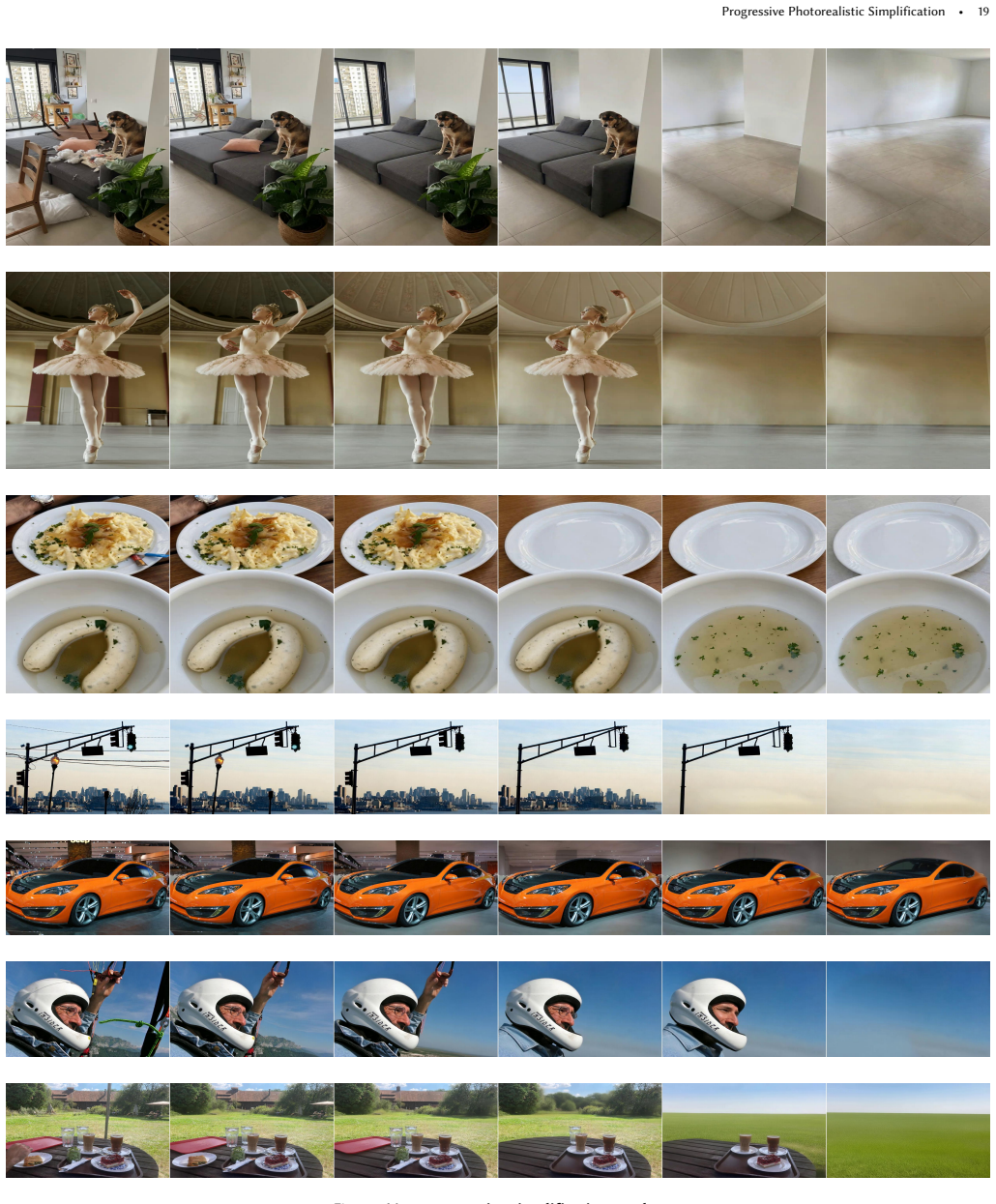

read the original abstract
Existing image simplification techniques often rely on Non-Photorealistic Rendering (NPR), transforming photographs into stylized sketches, cartoons, or paintings. While effective at reducing visual complexity, such approaches typically sacrifice photographic realism. In this work, we explore a complementary direction: simplifying images while preserving their photorealistic appearance. We introduce progressive semantic image simplification, a framework that iteratively reduces scene complexity by removing and inpainting elements in a controlled manner. At each step, the resulting image remains a plausible natural photograph. Our method combines semantic understanding with generative editing, leveraging Vision-Language Models (VLMs) to identify and prioritize elements for removal, and a learned verifier to ensure photorealism and coherence throughout the process. This is implemented via an iterative Select-Remove-Verify pipeline that produces high-quality simplification trajectories. To improve efficiency, we further distill this process into an image-to-video generation model that directly predicts coherent simplification sequences from a single input image. Beyond generating cleaner and more focused compositions, our approach enables applications such as content-aware decluttering, semantic layer decomposition, and interactive editing. More broadly, our work suggests that simplification through structured content removal can serve as a practical mechanism for guiding visual interpretation within the photorealistic domain, complementing traditional abstraction methods.
Editorial analysis
A structured set of objections, weighed in public.
Referee Report
Summary. The paper introduces progressive semantic image simplification, a framework that iteratively reduces image complexity via VLM-guided element selection, generative inpainting for removal, and a learned verifier to enforce photorealism and coherence at each step. The process is distilled into an image-to-video model that predicts simplification sequences directly from a single input, enabling applications such as content-aware decluttering and semantic decomposition while preserving photographic realism.
Significance. If validated, the approach would offer a practical photorealistic complement to traditional NPR methods, with potential utility in interactive editing and visual interpretation tasks. The distillation step addresses efficiency, and the iterative Select-Remove-Verify loop is a plausible engineering pipeline. However, the lack of any reported quantitative results, ablations, or multi-step evaluations in the manuscript limits assessment of whether the central guarantee of artifact-free outputs holds.
major comments (3)
- [Method description] The learned verifier is described only as 'learned' with no architecture, training corpus, loss functions, thresholds, or multi-step evaluation protocol provided. This is load-bearing for the claim that the Select-Remove-Verify loop reliably prevents accumulated artifacts from generative inpainting across iterations.
- [Abstract and evaluation] No quantitative results, ablation studies, failure cases, or metrics (e.g., LPIPS, perceptual consistency, or human ratings on trajectories longer than 2 steps) are reported to support the assertion that each output remains a 'plausible natural photograph.' This undermines verification of the iterative photorealism guarantee.
- [Distillation section] The distillation into an image-to-video model is presented as an efficiency improvement, but without details on how the training data is generated from the iterative pipeline or any comparison of quality/consistency between the original loop and the distilled model, the claim that it 'directly predicts coherent simplification sequences' cannot be assessed.
minor comments (2)
- [Abstract] The abstract and method overview would benefit from explicit notation for the iterative process (e.g., defining the state after each removal step) to improve clarity for readers.
- [Implementation] References to specific VLM and inpainting models used (e.g., versions or fine-tuning details) are missing, which is standard for reproducibility in CV papers.
Simulated Author's Rebuttal
We thank the referee for the detailed and constructive comments. We have revised the manuscript to provide the requested details on the verifier, add quantitative evaluations and ablations, and expand the distillation section with data generation and comparison information.
read point-by-point responses
-
Referee: [Method description] The learned verifier is described only as 'learned' with no architecture, training corpus, loss functions, thresholds, or multi-step evaluation protocol provided. This is load-bearing for the claim that the Select-Remove-Verify loop reliably prevents accumulated artifacts from generative inpainting across iterations.
Authors: We agree that the verifier requires more detailed specification to support the iterative photorealism claims. In the revised manuscript, we have added Section 3.3 describing the verifier as a binary classifier operating on CLIP image embeddings, trained on a corpus of 50k synthetic clean/artifacted image pairs generated via controlled inpainting perturbations. Training uses binary cross-entropy loss with an acceptance threshold of 0.75, and we include a multi-step protocol evaluating rejection rates over trajectories of length 5–10. revision: yes
-
Referee: [Abstract and evaluation] No quantitative results, ablation studies, failure cases, or metrics (e.g., LPIPS, perceptual consistency, or human ratings on trajectories longer than 2 steps) are reported to support the assertion that each output remains a 'plausible natural photograph.' This undermines verification of the iterative photorealism guarantee.
Authors: We acknowledge that the original submission emphasized the framework over extensive benchmarking. The revised version includes a new Experiments section reporting LPIPS and perceptual consistency scores across simplification trajectories, ablation studies isolating the verifier and VLM selection components, and a human study with ratings on photorealism for trajectories up to 5 steps. Failure cases (e.g., residual artifacts in cluttered scenes) are now discussed with examples in the supplementary material. revision: yes
-
Referee: [Distillation section] The distillation into an image-to-video model is presented as an efficiency improvement, but without details on how the training data is generated from the iterative pipeline or any comparison of quality/consistency between the original loop and the distilled model, the claim that it 'directly predicts coherent simplification sequences' cannot be assessed.
Authors: We have expanded the distillation section to explain that training data is generated by executing the full iterative Select-Remove-Verify pipeline on 10k source images to produce input-to-sequence pairs. The revised manuscript now includes direct comparisons: the distilled model retains 90% of the iterative pipeline's human-rated coherence while achieving 15x faster inference, with sequence consistency metrics (e.g., frame-to-frame LPIPS) reported for both approaches. revision: yes
Circularity Check
No circularity: engineering pipeline with independent components
full rationale
The paper presents a practical iterative framework (Select-Remove-Verify) relying on external VLMs for element selection, off-the-shelf generative inpainting, and a separately learned verifier. No equations, predictions, or first-principles claims reduce by construction to fitted parameters or self-citations. The central claim of maintaining photorealism is an empirical engineering assertion, not a mathematical derivation that loops back to its inputs. Self-contained against external benchmarks like standard inpainting models and VLM capabilities.
Axiom & Free-Parameter Ledger
invented entities (1)
-
learned verifier
no independent evidence
Reference graph
Works this paper leans on
-
[1]
ACM Transactions on Graphics (TOG) , volume=
Real-time edge-aware image processing with the bilateral grid , author=. ACM Transactions on Graphics (TOG) , volume=. 2007 , publisher=
work page 2007
-
[2]
ACM transactions on graphics (TOG) , volume=
Edge-preserving decompositions for multi-scale tone and detail manipulation , author=. ACM transactions on graphics (TOG) , volume=. 2008 , publisher=
work page 2008
-
[3]
and Siddappa, Nagendraswamy and Manjunath, C
M P, Pavan Kumar and Poornima, B. and Siddappa, Nagendraswamy and Manjunath, C. , year =. A comprehensive survey on non-photorealistic rendering and benchmark developments for image abstraction and stylization , volume =. Iran Journal of Computer Science , doi =
-
[4]
State of the “Art”: A Taxonomy of Artistic Stylization Techniques for Images and Video , volume =
Jan Eric Kyprianidis and John Collomosse and Tinghuai Wang and Tobias Isenberg , journal =. State of the “Art”: A Taxonomy of Artistic Stylization Techniques for Images and Video , volume =
-
[5]
ACM transactions on graphics (TOG) , volume=
Stylization and abstraction of photographs , author=. ACM transactions on graphics (TOG) , volume=. 2002 , publisher=
work page 2002
-
[6]
ACM Transactions On Graphics (TOG) , volume=
Real-time video abstraction , author=. ACM Transactions On Graphics (TOG) , volume=. 2006 , publisher=
work page 2006
-
[7]
Proceedings of the 25th annual conference on Computer graphics and interactive techniques , pages=
Painterly rendering with curved brush strokes of multiple sizes , author=. Proceedings of the 25th annual conference on Computer graphics and interactive techniques , pages=
-
[8]
IEEE Transactions on Image Processing , volume=
Artistic edge and corner enhancing smoothing , author=. IEEE Transactions on Image Processing , volume=. 2007 , publisher=
work page 2007
-
[9]
Computer Graphics Forum , volume=
Image and video abstraction by anisotropic Kuwahara filtering , author=. Computer Graphics Forum , volume=. 2009 , organization=
work page 2009
-
[10]
Henry Kang and Seungyong Lee and Charles K. Chui , journal=. Flow-Based Image Abstraction , year=
-
[11]
Sander and Adam Finkelstein , title =
Jingwan Lu and Pedro V. Sander and Adam Finkelstein , title =. Proceedings of ACM SIGGRAPH symposium on Interactive 3D Graphics and Games , year =
-
[12]
Proceedings of the IEEE conference on computer vision and pattern recognition , pages=
Image style transfer using convolutional neural networks , author=. Proceedings of the IEEE conference on computer vision and pattern recognition , pages=
-
[13]
Proceedings of the 46th Graphics Interface Conference (GI 2020) , pages =
Rosa Azami and David Mould , title =. Proceedings of the 46th Graphics Interface Conference (GI 2020) , pages =. 2020 , doi =
work page 2020
-
[14]
SIGGRAPH Asia 2015 Technical Briefs , year =
Shugo Yamaguchi and Takuya Kato and Tsukasa Fukusato and Chie Furusawa and Shigeo Morishima , title =. SIGGRAPH Asia 2015 Technical Briefs , year =. doi:10.1145/2820903.2820917 , publisher =
-
[15]
ACM Transactions on Graphics (TOG) , volume=
Clipasso: Semantically-aware object sketching , author=. ACM Transactions on Graphics (TOG) , volume=. 2022 , publisher=
work page 2022
-
[16]
Proceedings of the IEEE/CVF International Conference on Computer Vision , pages=
Clipascene: Scene sketching with different types and levels of abstraction , author=. Proceedings of the IEEE/CVF International Conference on Computer Vision , pages=
-
[17]
IEEE Transactions on image processing , volume=
Region filling and object removal by exemplar-based image inpainting , author=. IEEE Transactions on image processing , volume=. 2004 , publisher=
work page 2004
-
[18]
Proceedings of the IEEE/CVF international conference on computer vision , pages=
Segment anything , author=. Proceedings of the IEEE/CVF international conference on computer vision , pages=
-
[19]
Advances in neural information processing systems , volume=
Laion-5b: An open large-scale dataset for training next generation image-text models , author=. Advances in neural information processing systems , volume=
- [20]
- [21]
-
[22]
XDoG: An eXtended difference-of-Gaussians compendium including advanced image stylization , year =
Winnem\". XDoG: An eXtended difference-of-Gaussians compendium including advanced image stylization , year =. Comput. Graph. , pages =
-
[23]
Computer Graphics Forum , title =
Li, Simin and Wen, Qiang and Zhao, Shuang and Sun, Zixun and He, Shengfeng , year =. Computer Graphics Forum , title =
-
[24]
IEEE transactions on image processing , volume=
NIMA: Neural image assessment , author=. IEEE transactions on image processing , volume=. 2018 , publisher=
work page 2018
-
[25]
Proceedings of the IEEE/CVF winter conference on applications of computer vision , pages=
Resolution-robust large mask inpainting with fourier convolutions , author=. Proceedings of the IEEE/CVF winter conference on applications of computer vision , pages=
-
[26]
Proceedings of the IEEE/CVF Conference on Computer Vision and Pattern Recognition , pages=
Deep saliency prior for reducing visual distraction , author=. Proceedings of the IEEE/CVF Conference on Computer Vision and Pattern Recognition , pages=
-
[27]
Proceedings of the AAAI Conference on Artificial Intelligence , year=
Attentive eraser: Removing objects from images with diffusion models , author=. Proceedings of the AAAI Conference on Artificial Intelligence , year=
-
[28]
Proceedings of the IEEE/CVF International Conference on Computer Vision (ICCV) , year=
OmniEraser: Removing Objects and Their Effects from Images , author=. Proceedings of the IEEE/CVF International Conference on Computer Vision (ICCV) , year=
-
[29]
Proceedings of the IEEE/CVF Winter Conference on Applications of Computer Vision , year=
SimpSON: Simplifying scenes by object neutralization , author=. Proceedings of the IEEE/CVF Winter Conference on Applications of Computer Vision , year=
-
[30]
arXiv preprint arXiv:2401.XXXX , year=
Visual Jenga: Object Removal via Counterfactual Inpainting , author=. arXiv preprint arXiv:2401.XXXX , year=
-
[31]
Advances in Neural Information Processing Systems , volume=
Diffsketcher: Text guided vector sketch synthesis through latent diffusion models , author=. Advances in Neural Information Processing Systems , volume=
-
[32]
European Conference on Computer Vision , pages=
Objectdrop: Bootstrapping counterfactuals for photorealistic object removal and insertion , author=. European Conference on Computer Vision , pages=. 2024 , organization=
work page 2024
- [33]
- [34]
-
[35]
Proceedings of the IEEE Conference on Computer Vision and pattern Recognition , pages=
Finding distractors in images , author=. Proceedings of the IEEE Conference on Computer Vision and pattern Recognition , pages=
-
[36]
Alina Kuznetsova and Hassan Rom and Neil Alldrin and Jasper Uijlings and Ivan Krasin and Jordi Pont-Tuset and Shahab Kamali and Stefan Popov and Matteo Malloci and Alexander Kolesnikov and Tom Duerig and Vittorio Ferrari , title =. 2020 , journal =
work page 2020
-
[37]
Wan: Open and Advanced Large-Scale Video Generative Models
Wan: Open and Advanced Large-Scale Video Generative Models , author=. arXiv preprint arXiv:2503.20314 , year=
work page internal anchor Pith review Pith/arXiv arXiv
-
[38]
Video models are zero-shot learners and reasoners
Video models are zero-shot learners and reasoners , author=. arXiv preprint arXiv:2509.20328 , year=
work page internal anchor Pith review arXiv
-
[39]
arXiv preprint arXiv:2511.19435 , year=
Are Image-to-Video Models Good Zero-Shot Image Editors? , author=. arXiv preprint arXiv:2511.19435 , year=
-
[40]
ChronoEdit: Towards Temporal Reasoning for Image Editing and World Simulation , author=. arXiv preprint arXiv:2510.04290 , year=
-
[41]
A new measure of rank correlation , author=. Biometrika , volume=. 1938 , publisher=
work page 1938
- [42]
-
[43]
arXiv preprint arXiv:2104.03133 , year=
Image Composition Assessment with Saliency-augmented Multi-pattern Pooling , author=. arXiv preprint arXiv:2104.03133 , year=
-
[44]
Art and Illusion: A Study in the Psychology of Pictorial Representation , author =. 1960 , publisher =
work page 1960
-
[45]
Vision: A Computational Investigation into the Human Representation and Processing of Visual Information , author =. 2010 , publisher =
work page 2010
-
[46]
Vision and Art: The Biology of Seeing , author =. 2008 , publisher =
work page 2008
-
[47]
Vision Science: Photons to Phenomenology , author =. 1999 , publisher =
work page 1999
-
[48]
The Science of Art: Optical Themes in Western Art from Brunelleschi to Seurat , author =. 1992 , publisher =
work page 1992
-
[49]
A source book of Gestalt psychology , pages =
Wertheimer, Max , title =. A source book of Gestalt psychology , pages =
-
[50]
Proceedings of the 21st annual conference on Computer graphics and interactive techniques , pages=
Computer-generated pen-and-ink illustration , author=. Proceedings of the 21st annual conference on Computer graphics and interactive techniques , pages=
-
[51]
Proceedings of the 24th annual conference on Computer graphics and interactive techniques , pages=
Computer-generated watercolor , author=. Proceedings of the 24th annual conference on Computer graphics and interactive techniques , pages=
-
[52]
Proceedings of the 27th annual conference on Computer graphics and interactive techniques , pages=
Escherization , author=. Proceedings of the 27th annual conference on Computer graphics and interactive techniques , pages=
-
[53]
and Oliver, Nuria and Curless, Brian and Salesin, David H
Hertzmann, Aaron and Jacobs, Charles E. and Oliver, Nuria and Curless, Brian and Salesin, David H. , title =. Proceedings of the 28th Annual Conference on Computer Graphics and Interactive Techniques , pages =. 2001 , isbn =. doi:10.1145/383259.383295 , abstract =
-
[54]
Defining pictorial style: Lessons from linguistics and computer graphics , author=. Axiomathes , volume=. 2005 , publisher=
work page 2005
-
[55]
An invitation to discuss computer depiction , year =
Durand, Fr\'. An invitation to discuss computer depiction , year =. Proceedings of the 2nd International Symposium on Non-Photorealistic Animation and Rendering , pages =. doi:10.1145/508530.508550 , abstract =
discussion (0)
Sign in with ORCID, Apple, or X to comment. Anyone can read and Pith papers without signing in.