Recognition: no theorem link
Astrons: Reissner-Nordstr\"om Primordial Naked Singularities
Pith reviewed 2026-05-12 04:30 UTC · model grok-4.3
The pith
A population of primordial ultra-massive charged compact objects is subject to tight physical constraints and does not produce late-time cosmic acceleration in the standard model.
A machine-rendered reading of the paper's core claim, the machinery that carries it, and where it could break.
Core claim
Astrons are primordial, ultra-massive, electrically charged compact objects whose geometry is Reissner-Nordström. Constraints arise from charge saturation during formation, persistence against screening in plasma, and the scaling of their mutual interaction energy, which behaves as a^{-4} in homogeneous cosmology. This prevents the population from driving asymptotic late-time acceleration, though they might seed early cosmic structures as dark components rather than observed luminous objects.
What carries the argument
The Reissner-Nordström geometry of highly charged compact objects combined with the homogeneous FLRW scaling of their interaction energy.
Load-bearing premise
That ordinary accretion saturation applies to these ultra-massive objects and that the interaction energy of the charged population scales exactly as a^{-4} in the homogeneous FLRW description without additional contributions from inhomogeneities.
What would settle it
Observation of a compact object with charge significantly exceeding the saturation value from standard accretion, or cosmological measurements indicating a sustained acceleration phase linked to a charged component rather than a transitory one.
Figures


read the original abstract
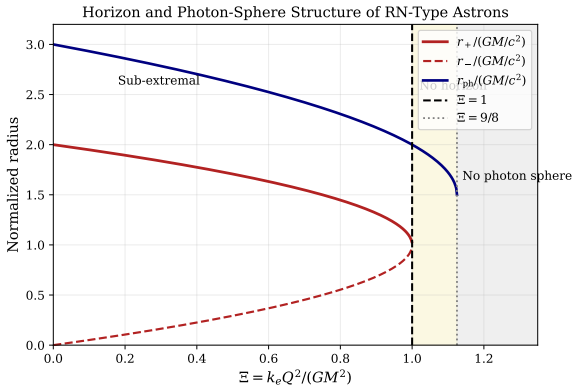
We summarize a set of constraints on a proposed population of primordial, ultra-massive, electrically charged compact objects, which we call astrons. The analysis combines charge generation, charge saturation, persistence of the charge in an ionized medium, screening by the intergalactic plasma, the Reissner--Nordstr\"om geometry of highly charged compact objects, lensing, and the cosmological implications of a sparse charged population. We also discuss the possible relation to the early structures revealed by the James Webb Space Telescope: if astrons are relevant there, they would be primordial dark seeds rather than luminous objects directly observed at high redshift. The resulting scenario is sharply constrained. Ordinary accretion saturation gives charges far below the large-charge phenomenological benchmark, screening is a serious plasma-physics issue, and a large charge can place the exterior geometry deep in the super-extremal regime. As expected at the level of a homogeneous Friedmann--Lema\^{\i}tre--Robertson--Walker (FLRW) description, the interaction energy of a population of charged objects scales as \(a^{-4}\), so the simplest perfect-fluid reduction does not generate asymptotically late-time acceleration; any acceleration era tied to that homogeneous component can only be transitory. The astron scenario should be regarded as a constrained framework whose viability depends on plasma physics and on a cosmological treatment beyond the homogeneous approximation.
Editorial analysis
A structured set of objections, weighed in public.
Referee Report
Summary. The manuscript proposes a population of primordial ultra-massive electrically charged compact objects termed 'astrons,' modeled as Reissner-Nordström naked singularities. It presents a synthesis of constraints from charge generation, accretion saturation, persistence in ionized media, plasma screening, RN geometry (including super-extremal cases), lensing, and cosmological evolution. In the homogeneous FLRW framework, the charged population's interaction energy is shown to scale as a^{-4}, implying that the simplest perfect-fluid description does not produce late-time acceleration. The scenario is described as sharply constrained, with potential relevance to JWST early structures only if astrons serve as dark seeds. Viability is said to depend on detailed plasma physics and extensions beyond homogeneous cosmology.
Significance. If the results hold, this work is significant in providing a constrained framework for primordial charged singularities, correctly noting that homogeneous scaling precludes asymptotic acceleration and identifying plasma screening as a key obstacle. The integration of general relativity, plasma physics, and cosmology is a strength, offering a balanced view that avoids overclaiming observational links to JWST data. No machine-checked proofs or code are included, but the emphasis on falsifiable elements like lensing and the call for non-homogeneous treatments adds value. The assessment highlights gaps that future work must address.
major comments (2)
- [Cosmological implications] Cosmological implications section: The statement that the interaction energy of the charged population scales as a^{-4} in homogeneous FLRW (leading to no asymptotic acceleration) is central to the no-acceleration claim. This derives from standard perfect-fluid treatment, but the manuscript notes potential modifications from plasma screening and inhomogeneities without providing an explicit calculation of screened Coulomb energy in expanding spacetime or metric back-reaction. This approximation is load-bearing for the conclusion that any acceleration is only transitory.
- [Charge saturation] Charge saturation section: The claim that ordinary accretion saturation produces charges far below the large-charge phenomenological benchmark is used to argue the scenario is sharply constrained. However, the text does not include the specific derivation or numerical comparison to the benchmark, making it difficult to verify the extent of the constraint and its implications for the overall model.
minor comments (2)
- [Abstract] The term 'astrons' is introduced without immediate definition or context; adding a brief explanatory phrase would improve accessibility for readers.
- [Notation] The use of a for the scale factor in a^{-4} is clear but should be explicitly linked to the FLRW metric definition in the cosmological section for consistency.
Simulated Author's Rebuttal
We thank the referee for their careful and constructive review of our manuscript. We address each of the major comments below and have made revisions to the manuscript where appropriate.
read point-by-point responses
-
Referee: [Cosmological implications] Cosmological implications section: The statement that the interaction energy of the charged population scales as a^{-4} in homogeneous FLRW (leading to no asymptotic acceleration) is central to the no-acceleration claim. This derives from standard perfect-fluid treatment, but the manuscript notes potential modifications from plasma screening and inhomogeneities without providing an explicit calculation of screened Coulomb energy in expanding spacetime or metric back-reaction. This approximation is load-bearing for the conclusion that any acceleration is only transitory.
Authors: We appreciate the referee's focus on this key aspect. The a^{-4} scaling arises directly from treating the charged population as a perfect fluid in the homogeneous FLRW metric, where the Coulomb interaction energy density scales identically to radiation. This is a standard result in charged cosmological models. The manuscript explicitly qualifies this as holding 'at the level of a homogeneous Friedmann–Lemaître–Robertson–Walker (FLRW) description' and notes that plasma screening and inhomogeneities could modify the behavior. We agree that a full explicit calculation of the screened Coulomb energy in an expanding spacetime, incorporating metric back-reaction, is not included, as it would require a detailed non-homogeneous treatment beyond the paper's scope. We have revised the text to more clearly highlight this as a limitation of the homogeneous approximation and to reinforce the call for future work on non-homogeneous cosmology. revision: partial
-
Referee: [Charge saturation] Charge saturation section: The claim that ordinary accretion saturation produces charges far below the large-charge phenomenological benchmark is used to argue the scenario is sharply constrained. However, the text does not include the specific derivation or numerical comparison to the benchmark, making it difficult to verify the extent of the constraint and its implications for the overall model.
Authors: We thank the referee for this observation. To improve verifiability, we have added the explicit derivation of the saturation charge from standard accretion processes in the revised manuscript. This includes the relevant equations and a numerical comparison demonstrating that the saturated charges are significantly below the large-charge benchmark (by several orders of magnitude), thereby strengthening the argument that the scenario is sharply constrained by charge saturation. revision: yes
Circularity Check
No circularity: standard FLRW scaling applied without reduction to fitted inputs or self-citations.
full rationale
The paper states that interaction energy scales as a^{-4} 'as expected at the level of a homogeneous FLRW description' and concludes that the perfect-fluid reduction yields no asymptotic late-time acceleration. This follows directly from standard cosmological scaling (number density ∝ a^{-3}, Coulomb energy ∝ a^{-1}) applied to charged objects treated as a perfect fluid; it is not derived from or equivalent to any paper-specific ansatz, fit, or self-citation. Charge saturation is compared against an external 'large-charge phenomenological benchmark' without claiming the benchmark itself as a derived prediction. The final assessment that viability depends on plasma physics and inhomogeneous cosmology is presented as an open constraint rather than a closed derivation. No load-bearing step reduces by construction to the paper's own inputs.
Axiom & Free-Parameter Ledger
axioms (2)
- standard math Reissner-Nordström geometry describes the exterior of highly charged compact objects
- domain assumption Homogeneous FLRW metric for cosmological evolution
invented entities (1)
-
astrons
no independent evidence
Reference graph
Works this paper leans on
-
[1]
C. Corianò, P. H. Frampton and L. Torcellini, “The Case for Astrons,” in preparation
-
[2]
Electromagnetic accelerating universe,
P. H. Frampton, “Electromagnetic accelerating universe,” Phys. Lett. B 835(2022) 137480, arXiv:2210.10632
-
[3]
A model of dark matter and energy,
P. H. Frampton, “A model of dark matter and energy,” Mod. Phys. Lett. A 38(2023) 2350032, arXiv:2301.10719
-
[4]
Astrophysical Black Holes: A Review,
C. Bambi, “Astrophysical Black Holes: A Review,” arXiv:1906.03871 [astro-ph.HE]
-
[5]
M. Zajacek and A. Tursunov, “Electric charge of black holes: Is it really always negligible?,” arXiv:1904.04654 [astro-ph.GA]
-
[6]
On the charge of the Galactic centre black hole,
M. Zajacek, A. Tursunov, A. Eckart and S. Britzen, “On the charge of the Galactic centre black hole,” Mon. Not. Roy. Astron. Soc.480(2018) 4408
work page 2018
-
[7]
Dark matter from primordial black holes would hold charge,
I. J. Araya, N. D. Padilla, M. E. Rubio, J. Sureda, J. Magaña and L. Oso- rio, “Dark matter from primordial black holes would hold charge,” JCAP 02(2023) 030, arXiv:2207.05829 [astro-ph.CO]
-
[8]
Constraints on Long- Ranged Interactions Between Dark Matter and the Standard Model,
Z. Bogorad, P. W. Graham and H. Ramani, “Constraints on Long- Ranged Interactions Between Dark Matter and the Standard Model,” arXiv:2410.07324 [hep-ph]
-
[9]
Black holes in the early Universe,
B. J. Carr and S. W. Hawking, “Black holes in the early Universe,” Mon. Not. Roy. Astron. Soc.168(1974) 399
work page 1974
-
[10]
The first billion years according to JWST,
A. Adamo et al., “The first billion years according to JWST,” Nature As- tron.9(2025) 1134
work page 2025
-
[11]
Spectroscopic confirmation of two luminous galaxies at a redshift of 14,
S. Carniani et al., “Spectroscopic confirmation of two luminous galaxies at a redshift of 14,” Nature633(2024) 318
work page 2024
-
[12]
Accelerated formation of ultra-massive galaxies in the first billion years,
M. Xiao et al., “Accelerated formation of ultra-massive galaxies in the first billion years,” Nature635(2024) 311
work page 2024
-
[13]
Hydrostatic equilibrium and gravitational collapse of relativistic charged fluid balls,
J. D. Bekenstein, “Hydrostatic equilibrium and gravitational collapse of relativistic charged fluid balls,” Phys. Rev. D4(1971) 2185
work page 1971
-
[14]
Electrically charged compact stars and formation of charged black holes,
S. Ray, A. L. Espindola, M. Malheiro, J. P. S. Lemos and V . T. Zanchin, “Electrically charged compact stars and formation of charged black holes,” Phys. Rev. D68(2003) 084004
work page 2003
-
[15]
E. Poisson,A Relativist’s Toolkit: The Mathematics of Black-Hole Me- chanics, Cambridge University Press, Cambridge, 2004
work page 2004
-
[16]
Direct collapse black hole formation via high-velocity collisions of protogalaxies,
K. Inayoshi, E. Visbal and K. Kashiyama, “Direct collapse black hole formation via high-velocity collisions of protogalaxies,” Mon. Not. Roy. Astron. Soc.453(2015) 1692
work page 2015
-
[17]
S. Chon, T. Hosokawa and N. Yoshida, “Radiation hydrodynamics simu- lations of the formation of direct-collapse supermassive stellar systems,” Mon. Not. Roy. Astron. Soc.475(2018) 4104
work page 2018
-
[18]
Direct Collapse to Supermassive Black Hole Seeds with Radiative Transfer: Isolated Halos,
Y . Luo, K. Ardaneh, I. Shlosman, K. Nagamine, J. H. Wise and M. C. Begelman, “Direct Collapse to Supermassive Black Hole Seeds with Radiative Transfer: Isolated Halos,” Mon. Not. Roy. Astron. Soc. 476(2018) 3523
work page 2018
-
[19]
The Physics of the Intergalactic Medium,
A. A. Meiksin, “The Physics of the Intergalactic Medium,” Rev. Mod. Phys.81(2009) 1405
work page 2009
-
[20]
The Evolution of the Intergalactic Medium,
M. McQuinn, “The Evolution of the Intergalactic Medium,” Ann. Rev. Astron. Astrophys.54(2016) 313
work page 2016
-
[21]
Baryons in the Warm- Hot Intergalactic Medium,
R. Davé, R. Cen, J. P. Ostriker, G. L. Bryan, L. Hernquist, N. Katz, D. H. Weinberg, M. L. Norman and B. O’Shea, “Baryons in the Warm- Hot Intergalactic Medium,” Astrophys. J.552(2001) 473
work page 2001
-
[22]
J. Tumlinson, M. S. Peeples and J. K. Werk, “The Circumgalactic Medium,” Ann. Rev. Astron. Astrophys.55(2017) 389
work page 2017
-
[23]
Kappa distributions: theory and applica- tions in space plasmas,
V . Pierrard and M. Lazar, “Kappa distributions: theory and applica- tions in space plasmas,” Sol. Phys.267(2010) 153, arXiv:1003.3532 [physics.space-ph]
-
[24]
Understanding Kappa Distributions: A Toolbox for Space Science and Astrophysics,
G. Livadiotis and D. J. McComas, “Understanding Kappa Distributions: A Toolbox for Space Science and Astrophysics,” Space Sci. Rev.175 (2013) 183
work page 2013
-
[25]
Debye screening under non-equilibrium plasma conditions,
H. J. Fahr and M. Heyl, “Debye screening under non-equilibrium plasma conditions,” Astron. Astrophys.589(2016) A85
work page 2016
-
[26]
Debye screening of non-Abelian plasmas in curved spacetimes,
E. Alonso-Monsalve and D. I. Kaiser, “Debye screening of non-Abelian plasmas in curved spacetimes,” Phys. Rev. D108(2023) 125010
work page 2023
-
[27]
Gravitational Field of a Spinning Mass as an Example of Algebraically Special Metrics,
R. P. Kerr, “Gravitational Field of a Spinning Mass as an Example of Algebraically Special Metrics,” Phys. Rev. Lett.11(1963) 237
work page 1963
-
[28]
Metric of a Rotating, Charged Mass,
E. T. Newman, E. Couch, K. Chinnapared, A. Exton, A. Prakash and R. Torrence, “Metric of a Rotating, Charged Mass,” J. Math. Phys.6 (1965) 918
work page 1965
-
[29]
Global structure of the Kerr family of gravitational fields,
B. Carter, “Global structure of the Kerr family of gravitational fields,” Phys. Rev.174(1968) 1559
work page 1968
-
[30]
Singular hypersurfaces and thin shells in general relativity,
W. Israel, “Singular hypersurfaces and thin shells in general relativity,” Nuovo Cim. B44(1966) 1; erratum Nuovo Cim. B48(1967) 463
work page 1966
-
[31]
Gravitational Vacuum Condensate Stars
P. O. Mazur and E. Mottola, “Gravitational vacuum condensate stars,” Proc. Natl. Acad. Sci. USA101(2004) 9545, arXiv:gr-qc/0407075
work page Pith review arXiv 2004
-
[32]
Schwarzschild black hole lensing,
K. S. Virbhadra and G. F. R. Ellis, “Schwarzschild black hole lensing,” Phys. Rev. D62(2000) 084003
work page 2000
-
[33]
Gravitational lensing in the strong field limit,
V . Bozza, “Gravitational lensing in the strong field limit,” Phys. Rev. D 66(2002) 103001
work page 2002
-
[34]
Reissner–Nordström black hole lensing,
E. F. Eiroa, G. E. Romero and D. F. Torres, “Reissner–Nordström black hole lensing,” Phys. Rev. D66(2002) 024010
work page 2002
-
[35]
C. Corianò, A. Costantini, M. Dell’Atti and L. Delle Rose, “Neutrino and Photon Lensing by Black Holes: Radiative Lens Equations and Post- Newtonian Contributions,” JHEP07(2015) 160, arXiv:1504.01322 [hep- ph]
-
[36]
C. Corianò, L. Delle Rose, M. M. Maglio and M. Serino, “Electroweak Corrections to Photon Scattering, Polarization and Lensing in a Gravita- tional Background and the Near Horizon Limit,” JHEP01(2015) 091, arXiv:1411.2804 [hep-ph]
-
[37]
S. Navaset al.(Particle Data Group), “Review of Particle Physics,” Prog. Theor. Exp. Phys.2024(2024) 083C01
work page 2024
-
[38]
Weinberg,Cosmology, Oxford University Press, Oxford, 2008
S. Weinberg,Cosmology, Oxford University Press, Oxford, 2008
work page 2008
-
[39]
S. Dodelson and F. Schmidt,Modern Cosmology, 2nd ed., Academic Press, London, 2020
work page 2020
-
[40]
Buchert,On average properties of inhomogeneous fluids in general relativity
T. Buchert, “On Average Properties of Inhomogeneous Fluids in General Relativity: Dust Cosmologies,” Gen. Relativ. Gravit.32(2000) 105–125, arXiv:gr-qc/9906015
-
[41]
C. Clarkson, G. F. R. Ellis, J. Larena and O. Umeh, “Does the Growth of Structure Affect Our Dynamical Models of the Universe? The Averaging, Backreaction and Fitting Problems in Cosmology,” Rep. Prog. Phys.74 (2011) 112901
work page 2011
-
[42]
A new framework for analyzing the effects of small scale inhomogeneities in cosmology
S. R. Green and R. M. Wald, “A new framework for analyzing the effects of small scale inhomogeneities in cosmology,” Phys. Rev. D83(2011) 084020, arXiv:1011.4920 [gr-qc]
work page Pith review arXiv 2011
-
[43]
Cosmological solutions with charged black holes,
R. Bibi, T. Clifton and J. Durk, “Cosmological solutions with charged black holes,” Gen. Relativ. Gravit.49(2017) 98. 9
work page 2017
discussion (0)
Sign in with ORCID, Apple, or X to comment. Anyone can read and Pith papers without signing in.