Recognition: 2 theorem links
· Lean TheoremQuantum Hypergraph Partitioning
Pith reviewed 2026-05-12 04:25 UTC · model grok-4.3
The pith
Quantum optimization can find probability distributions over hypergraph partitions that optimize fairness objectives like maximin imbalance.
A machine-rendered reading of the paper's core claim, the machinery that carries it, and where it could break.
Core claim
We formulate quadratic hypergraph objectives that let the QAOA measurement distribution serve as a solution distribution optimizing maximin and minimax goals, and we show this quantum approach, together with its multi-objective extension, outperforms polynomial-time classical approximations based on semidefinite programming and hyperplane rounding for balanced partitioning and distributional fairness tasks.
What carries the argument
Quadratic hypergraph objectives for standard and multi-objective QAOA, which encode maximin and minimax distributional fairness directly so that the quantum state's measurement probabilities become the desired partition distribution.
If this is right
- Balanced hypergraph partitioning, polarized community discovery, and distributional fairness objectives fall under one unified quantum optimization framework.
- Optimization problems whose solution is naturally a distribution over discrete objects can be addressed directly by QAOA without post-processing to a single answer.
- Low-depth quantum circuits can deliver better fairness scores than classical SDP approximations for workforce scheduling and related maximin problems.
- The same quadratic formulation allows multi-angle QAOA to handle multiple fairness criteria simultaneously.
Where Pith is reading between the lines
- If the distributional formulation holds up, similar quantum approaches could be tested on other fairness problems in scheduling or network design where worst-case expectations matter more than average performance.
- Classical approximation algorithms might be strengthened by incorporating ideas from the quantum measurement distribution to better sample diverse partitions.
- The framework suggests examining whether the quantum advantage persists when the hypergraphs grow to sizes where exact classical solutions become intractable.
Load-bearing premise
That the quadratic hypergraph objectives formulated for QAOA faithfully capture the intended maximin and minimax distributional fairness goals without introducing artifacts that favor the quantum sampler.
What would settle it
If QAOA fails to outperform the SDP-based classical approximations on the fairness objectives when both are run on additional large real-world hypergraphs, the performance advantage claim would be falsified.
Figures



read the original abstract
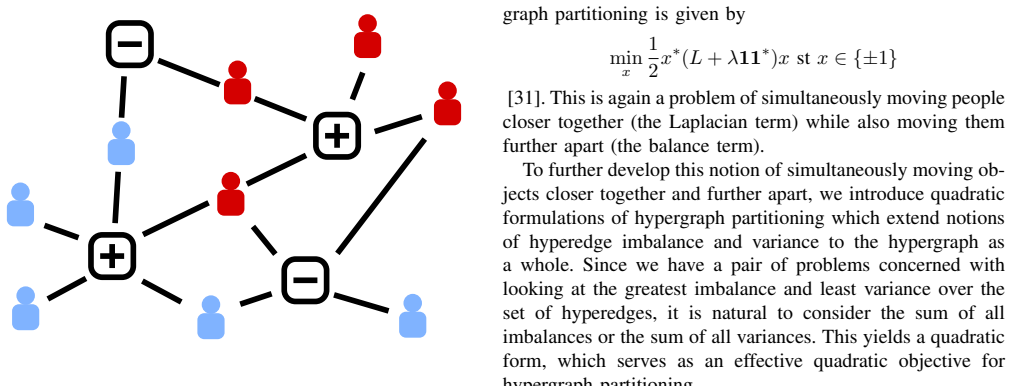
Quantum optimization algorithms are inherently probabilistic, yet they are most often used to search for a single high-quality solution. In this paper, we instead study hypergraph partitioning problems in which the desired output is itself a probability distribution over partitions. We introduce a distributional perspective on hypergraph partitioning motivated by maximin and minimax objectives such as Fair Cut Cover, and we show how these objectives align naturally with the measurement distribution produced by QAOA. To motivate the formulation, we introduce a workforce-scheduling-inspired toy problem, the Greatest Expected Imbalance problem, in which the goal is to minimize the worst expected imbalance across hyperedges. We then develop QAOA-based quantum solvers that represent distributional solutions natively through quantum states, together with quadratic hypergraph objectives suitable for standard and multi-objective QAOA. These formulations connect balanced hypergraph partitioning, polarized community discovery, and distributional fairness under a unified quantum optimization framework. For comparison, we provide optimal polynomial-time classical approximation algorithms based on semidefinite programming and hyperplane rounding. Experiments on real-world and synthetic hypergraphs demonstrate that low-depth multi-angle QAOA can outperform these classical approximation baselines on the proposed objectives, highlighting the potential of quantum algorithms for optimization problems where the solution is a distribution rather than a single partition.
Editorial analysis
A structured set of objections, weighed in public.
Referee Report
Summary. The manuscript introduces a distributional perspective on hypergraph partitioning motivated by maximin and minimax fairness objectives (e.g., Fair Cut Cover and the Greatest Expected Imbalance toy problem). It formulates quadratic hypergraph cost functions suitable for QAOA (including multi-angle variants), develops corresponding quantum solvers that natively represent distributions via measurement, provides SDP-based classical approximation algorithms with hyperplane rounding for comparison, and reports experiments on real-world and synthetic hypergraphs claiming that low-depth multi-angle QAOA outperforms the classical baselines on the proposed objectives.
Significance. If the central experimental claim holds after addressing the proxy and reporting issues, the work would provide a concrete demonstration of quantum advantage for optimization problems whose output is a probability distribution over partitions rather than a single solution. The unification of balanced hypergraph partitioning, polarized community discovery, and distributional fairness under a QAOA framework, together with the provision of matching classical SDP baselines, would be a useful contribution to quantum optimization for fairness-constrained problems.
major comments (2)
- [Abstract and quadratic objectives formulation] Abstract and the section developing the quadratic hypergraph objectives: the central claim that low-depth multi-angle QAOA outperforms SDP baselines on the proposed objectives rests on replacing the non-linear maximin/minimax (min/max over expected imbalances) with quadratic proxies. No explicit argument or numerical check is given that these proxies preserve the ordering or relative quality of distributions with respect to the true fairness metrics; if they do not, any observed QAOA advantage could be an artifact of the surrogate landscape rather than evidence of superiority on the motivating goals. The SDP baselines are also derived for the quadratic, so internal consistency does not establish the headline claim.
- [Experiments] Experimental results section: the claim of outperformance lacks reported details on the number of instances, data splits, error bars, statistical significance tests, or controls for post-hoc instance selection. Without these, it is impossible to verify robustness of the result or rule out that the advantage is driven by particular hypergraph families or optimization choices.
minor comments (2)
- [Toy problem and QAOA formulation] Clarify the precise mapping from the Greatest Expected Imbalance toy problem to the quadratic cost functions used in QAOA; a short derivation or example would help readers assess faithfulness.
- [Figures] Ensure all figures include error bars or variance information consistent with the experimental methodology discussion.
Simulated Author's Rebuttal
We thank the referee for the constructive and detailed feedback. We address each major comment below, clarifying our approach and committing to revisions that strengthen the presentation of the quadratic surrogates and experimental details.
read point-by-point responses
-
Referee: [Abstract and quadratic objectives formulation] Abstract and the section developing the quadratic hypergraph objectives: the central claim that low-depth multi-angle QAOA outperforms SDP baselines on the proposed objectives rests on replacing the non-linear maximin/minimax (min/max over expected imbalances) with quadratic proxies. No explicit argument or numerical check is given that these proxies preserve the ordering or relative quality of distributions with respect to the true fairness metrics; if they do not, any observed QAOA advantage could be an artifact of the surrogate landscape rather than evidence of superiority on the motivating goals. The SDP baselines are also derived for the quadratic, so internal consistency does not establish the headline claim.
Authors: We appreciate the referee's emphasis on validating the quadratic surrogates against the original non-linear fairness objectives. The quadratic hypergraph cost functions are derived directly from expansions of the expected imbalance terms in the Greatest Expected Imbalance and Fair Cut Cover problems, yielding quadratic forms that penalize partition imbalances in a manner aligned with maximin/minimax goals while remaining compatible with QAOA. This derivation is presented in the manuscript as a practical unification of distributional fairness with quantum optimization. We acknowledge that an explicit numerical check confirming preservation of distribution orderings under the true metrics versus the proxy would further support the claim. In revision, we will add an appendix containing such a validation: for a collection of sampled distributions over partitions, we will compute both the quadratic objective and the exact non-linear fairness metric, reporting correlation coefficients and rank preservation rates. Regarding the SDP baselines, they are intentionally matched to the quadratic objectives to enable an apples-to-apples comparison of quantum and classical methods on the same landscape; the headline claim concerns outperformance on these quadratic objectives, which we motivate as faithful surrogates for the fairness goals. We will revise the abstract and introduction to explicitly frame the results in terms of the quadratic proxies while retaining the fairness motivation. revision: yes
-
Referee: [Experiments] Experimental results section: the claim of outperformance lacks reported details on the number of instances, data splits, error bars, statistical significance tests, or controls for post-hoc instance selection. Without these, it is impossible to verify robustness of the result or rule out that the advantage is driven by particular hypergraph families or optimization choices.
Authors: We agree that the experimental section requires expanded reporting to allow full verification of robustness. The manuscript evaluates QAOA and SDP on a mix of real-world hypergraphs drawn from public datasets and synthetically generated instances with controlled properties. In the revision, we will explicitly report: the total number of instances (broken down by real-world versus synthetic), the precise generation parameters and selection criteria for synthetic hypergraphs (to demonstrate absence of post-hoc filtering), any relevant data partitioning, error bars computed from multiple independent QAOA runs with different random seeds, and the results of statistical significance tests (e.g., paired Wilcoxon tests) on the performance differences. Aggregate results over the complete set of instances will be presented to address selection bias concerns. revision: yes
Circularity Check
No significant circularity; derivation chain is self-contained with independent objectives and external baselines
full rationale
The paper defines maximin/minimax distributional objectives (e.g., Greatest Expected Imbalance) independently of QAOA, then introduces quadratic hypergraph cost functions as a variational proxy suitable for QAOA's expectation-value optimization. Classical SDP+rounding baselines are derived directly for these same quadratic objectives, providing an external reference point. No equation reduces a claimed prediction or result to a fitted parameter or self-citation by construction; the 'natural alignment' statement is motivational framing rather than a load-bearing derivation step. Experiments compare QAOA performance against these independent classical approximations on real and synthetic instances, keeping the chain non-circular.
Axiom & Free-Parameter Ledger
Lean theorems connected to this paper
-
IndisputableMonolith/Cost/FunctionalEquation.leanwashburn_uniqueness_aczel unclear?
unclearRelation between the paper passage and the cited Recognition theorem.
We define the imbalance of an edge e for a vector x as the squared expectation of X_e, E[X_e]^2 = (p_e^* x)^2 = x^* M_e x ... M := P diag(w) P^* and V := diag(P w) − M
-
IndisputableMonolith/Foundation/AbsoluteFloorClosure.leanreality_from_one_distinction unclear?
unclearRelation between the paper passage and the cited Recognition theorem.
the semidefinite programming relaxation of Max Cut is given by max_{A spsd} 1/4 ⟨L, A⟩_F s.t. diag(A) = 1 ... hyperplane rounding X = sign(B Y)
What do these tags mean?
- matches
- The paper's claim is directly supported by a theorem in the formal canon.
- supports
- The theorem supports part of the paper's argument, but the paper may add assumptions or extra steps.
- extends
- The paper goes beyond the formal theorem; the theorem is a base layer rather than the whole result.
- uses
- The paper appears to rely on the theorem as machinery.
- contradicts
- The paper's claim conflicts with a theorem or certificate in the canon.
- unclear
- Pith found a possible connection, but the passage is too broad, indirect, or ambiguous to say the theorem truly supports the claim.
Reference graph
Works this paper leans on
-
[1]
Challenges and opportunities in quantum optimization.Nature Reviews Physics, pages 1–18, 2024
Amira Abbas, Andris Ambainis, Brandon Augustino, Andreas B ¨artschi, Harry Buhrman, Carleton Coffrin, Giorgio Cortiana, Vedran Dunjko, Daniel J Egger, Bruce G Elmegreen, et al. Challenges and opportunities in quantum optimization.Nature Reviews Physics, pages 1–18, 2024
work page 2024
-
[2]
Hyper-optimized tensor network contraction.Quantum, 5:410, March 2021
Johnnie Gray and Stefanos Kourtis. Hyper-optimized tensor network contraction.Quantum, 5:410, March 2021
work page 2021
-
[3]
Springer Science & Business Media, 2013
Jingsheng Jason Cong and Joseph R Shinnerl.Multilevel optimization in VLSICAD, volume 14. Springer Science & Business Media, 2013
work page 2013
-
[4]
Mesh: A flexible distributed hypergraph processing system
Benjamin Heintz, Rankyung Hong, Shivangi Singh, Gaurav Khandelwal, Corey Tesdahl, and Abhishek Chandra. Mesh: A flexible distributed hypergraph processing system. In2019 IEEE International Conference on Cloud Engineering (IC2E), pages 12–22. IEEE, 2019
work page 2019
-
[5]
Benjamin Heintz and Abhishek Chandra. Beyond graphs: toward scalable hypergraph analysis systems.ACM SIGMETRICS Performance Evaluation Review, 41(4):94–97, 2014
work page 2014
-
[6]
Yue Gao, Zizhao Zhang, Haojie Lin, Xibin Zhao, Shaoyi Du, and Changqing Zou. Hypergraph learning: Methods and practices.IEEE transactions on pattern analysis and machine intelligence, 44(5):2548– 2566, 2020
work page 2020
-
[7]
Justin Sybrandt and Ilya Safro. Fobe and hobe: First-and high-order bipartite embeddings.ACM KDD 2020 Workshop on Mining and Learning with Graphs, preprint arXiv:1905.10953, 2020
-
[8]
Learning with hypergraphs: Clustering, classification, and embedding
Denny Zhou, Jiayuan Huang, and Bernhard Sch ¨olkopf. Learning with hypergraphs: Clustering, classification, and embedding. InAdvances in neural information processing systems, pages 1601–1608, 2007
work page 2007
-
[9]
Faster transit routing by hyper partitioning
Daniel Delling, Julian Dibbelt, Thomas Pajor, and Tobias Z ¨undorf. Faster transit routing by hyper partitioning. In17th Workshop on Algorithmic Approaches for Transportation Modelling, Optimization, and Systems (ATMOS 2017), pages 8–1. Schloss Dagstuhl–Leibniz- Zentrum f ¨ur Informatik, 2017
work page 2017
-
[10]
Scalable shared-memory hypergraph partitioning, 2020
Lars Gottesb ¨uren, Tobias Heuer, Peter Sanders, and Sebastian Schlag. Scalable shared-memory hypergraph partitioning, 2020
work page 2020
-
[11]
High-quality hypergraph partition- ing, 2021
Sebastian Schlag, Tobias Heuer, Lars Gottesb ¨uren, Yaroslav Akhremtsev, Christian Schulz, and Peter Sanders. High-quality hypergraph partition- ing, 2021
work page 2021
-
[12]
Justin Sybrandt, Ruslan Shaydulin, and Ilya Safro. Hypergraph parti- tioning with embeddings.IEEE Transactions on Knowledge and Data Engineering, 34(6):2771–2782, 2020
work page 2020
-
[13]
Ruslan Shaydulin, Jie Chen, and Ilya Safro. Relaxation-based coarsening for multilevel hypergraph partitioning.SIAM Multiscale Modeling and Simulation, 17:482–506, 2019
work page 2019
-
[14]
Quantum algorithm for the set splitting problem
Sean Borneman. Quantum algorithm for the set splitting problem. In2024 IEEE International Conference on Quantum Computing and Engineering (QCE), volume 2, pages 410–411. IEEE, 2024
work page 2024
-
[15]
Recent advances in graph partitioning
Aydin Buluc, Henning Meyerhenke, Ilya Safro, Peter Sanders, and Christian Schulz. Recent advances in graph partitioning. InAlgorithm Engineering: Selected Results and Surveys, volume 9220, pages 117–
-
[16]
¨Umit V . C ¸ ataly¨urek, Karen D. Devine, Marcelo Fonseca Faraj, Lars Gottesb¨uren, Tobias Heuer, Henning Meyerhenke, Peter Sanders, Sebas- tian Schlag, Christian Schulz, Daniel Seemaier, and Dorothea Wagner. More recent advances in (hyper)graph partitioning, 2022
work page 2022
-
[17]
Distributional policy optimization: An alternative approach for continuous control, 2019
Chen Tessler, Guy Tennenholtz, and Shie Mannor. Distributional policy optimization: An alternative approach for continuous control, 2019
work page 2019
-
[18]
Learning Cut Distributions with Quantum Optimization
Bao Bach, Cameron Ibrahim, Reuben Tate, Jad Salem, Stephan Ei- denbenz, and Ilya Safro. Learning cut distributions with quantum optimization.arXiv preprint arXiv:2604.14381, 2026
work page internal anchor Pith review Pith/arXiv arXiv 2026
-
[19]
Expected maximin fairness in max-cut and other combinatorial optimization problems, 2024
Jad Salem, Reuben Tate, and Stephan Eidenbenz. Expected maximin fairness in max-cut and other combinatorial optimization problems, 2024
work page 2024
-
[20]
Z. Wang, S. Hadfield, Z. Jiang, and E. G. Rieffel. Quantum approximate optimization algorithm for MaxCut: A fermionic view.Phys. Rev. A, 97(2):022304, 2018
work page 2018
-
[21]
Subhash Khot, Guy Kindler, Elchanan Mossel, and Ryan O’Donnell. Optimal inapproximability results for max-cut and other 2-variable csps? SIAM Journal on Computing, 37(1):319–357, 2007
work page 2007
-
[22]
Michel X Goemans and David P Williamson. Improved approximation algorithms for maximum cut and satisfiability problems using semidefi- nite programming.Journal of the ACM (JACM), 42(6):1115–1145, 1995
work page 1995
-
[23]
A Quantum Approximate Optimization Algorithm
Edward Farhi, Jeffrey Goldstone, and Sam Gutmann. A quantum approximate optimization algorithm.arXiv preprint arXiv:1411.4028, 2014
work page internal anchor Pith review Pith/arXiv arXiv 2014
-
[24]
Differentiable learning of quantum circuit born machines.Physical Review A, 98(6):062324, 2018
Jin-Guo Liu and Lei Wang. Differentiable learning of quantum circuit born machines.Physical Review A, 98(6):062324, 2018
work page 2018
-
[25]
Do quantum circuit born machines general- ize?Quantum Science and Technology, 8(3):035021, 2023
Kaitlin Gili, Mohamed Hibat-Allah, Marta Mauri, Chris Ballance, and Alejandro Perdomo-Ortiz. Do quantum circuit born machines general- ize?Quantum Science and Technology, 8(3):035021, 2023
work page 2023
-
[26]
Expected maximin fairness in max-cut and other combinatorial optimization problems
Jad Salem, Reuben Tate, and Stephan Eidenbenz. Expected maximin fairness in max-cut and other combinatorial optimization problems. arXiv preprint arXiv:2410.02589, 2024
-
[27]
Quantum ap- proximate multi-objective optimization.Nature Computational Science, pages 1–10, 2025
Ayse Kotil, Elijah Pelofske, Stephanie Riedm ¨uller, Daniel J Egger, Stephan Eidenbenz, Thorsten Koch, and Stefan Woerner. Quantum ap- proximate multi-objective optimization.Nature Computational Science, pages 1–10, 2025
work page 2025
-
[28]
A survey on workforce scheduling and routing problems
J Arturo Castillo-Salazar, Dario Landa-Silva, and Rong Qu. A survey on workforce scheduling and routing problems. InProceedings of the 9th International Conference on the Practice and Theory of Automated Timetabling (PATAT 2012), pages 283–302, 2012
work page 2012
-
[29]
Discovering polarized communities in signed networks
Francesco Bonchi, Edoardo Galimberti, Aristides Gionis, Bruno Ordoz- goiti, and Giancarlo Ruffo. Discovering polarized communities in signed networks. InProceedings of the 28th acm international conference on information and knowledge management, pages 961–970, 2019
work page 2019
-
[30]
Jingxuan Chen, Hanna Westerheim, Zo ¨e Holmes, Ivy Luo, Theshani Nu- radha, Dhrumil Patel, Soorya Rethinasamy, Kathie Wang, and Mark M Wilde. Slack-variable approach for variational quantum semidefinite programming.Physical Review A, 112(2):022607, 2025
work page 2025
-
[31]
Jacobo Pad ´ın-Mart´ınez, Vicente P. Soloviev, Alejandro Borrallo- Rentero, Ant ´on Rodr ´ıguez-Otero, Raquel Alfonso-Rodr ´ıguez, and Michal Krompiec. Pauli correlation encoding for budget-constrained optimization, 2026
work page 2026
-
[32]
Cambridge university press, 2010
Michael A Nielsen and Isaac L Chuang.Quantum computation and quantum information. Cambridge university press, 2010
work page 2010
-
[33]
Multi-angle quantum approximate optimization algorithm.Scientific Reports, 12(1):6781, 2022
Rebekah Herrman, Phillip C Lotshaw, James Ostrowski, Travis S Hum- ble, and George Siopsis. Multi-angle quantum approximate optimization algorithm.Scientific Reports, 12(1):6781, 2022
work page 2022
-
[34]
Sujay Kazi, Mart ´ın Larocca, Marco Farinati, Patrick J Coles, M Cerezo, and Robert Zeier. Analyzing the quantum approximate optimization algorithm: ans ¨atze, symmetries, and lie algebras.PRX Quantum, 6(4):040345, 2025
work page 2025
-
[35]
Ruslan Shaydulin and Stefan M Wild. Exploiting symmetry reduces the cost of training qaoa.IEEE Transactions on Quantum Engineering, 2:1–9, 2021
work page 2021
-
[36]
Paul J. Goulart and Yuwen Chen. Clarabel: An interior-point solver for conic programs with quadratic objectives, 2024
work page 2024
-
[37]
Benson, Rediet Abebe, Michael T
Austin R. Benson, Rediet Abebe, Michael T. Schaub, Ali Jadbabaie, and Jon Kleinberg. Simplicial closure and higher-order link prediction. Proceedings of the National Academy of Sciences, 115(48), November 2018
work page 2018
- [38]
-
[39]
Class of models for random hypergraphs.Physical Review E, 106(6), December 2022
Marc Barthelemy. Class of models for random hypergraphs.Physical Review E, 106(6), December 2022
work page 2022
-
[40]
Howard Karloff. How good is the goemans-williamson max cut algorithm? InProceedings of the twenty-eighth annual ACM symposium on Theory of Computing, pages 427–434, 1996
work page 1996
-
[41]
High-quality hypergraph partition- ing.ACM Journal of Experimental Algorithmics, 27:1–39, 2023
Sebastian Schlag, Tobias Heuer, Lars Gottesb ¨uren, Yaroslav Akhremtsev, Christian Schulz, and Peter Sanders. High-quality hypergraph partition- ing.ACM Journal of Experimental Algorithmics, 27:1–39, 2023
work page 2023
-
[42]
Aggregative Coarsening for Multilevel Hypergraph Partitioning
Ruslan Shaydulin and Ilya Safro. Aggregative Coarsening for Multilevel Hypergraph Partitioning. In Gianlorenzo D’Angelo, editor,17th Inter- national Symposium on Experimental Algorithms (SEA 2018), volume 103 ofLeibniz International Proceedings in Informatics (LIPIcs), pages 2:1–2:15, Dagstuhl, Germany, 2018. Schloss Dagstuhl–Leibniz-Zentrum fuer Informatik
work page 2018
-
[43]
Mlqaoa: Graph learning ac- celerated hybrid quantum-classical multilevel qaoa
Bao Bach, Jose Falla, and Ilya Safro. Mlqaoa: Graph learning ac- celerated hybrid quantum-classical multilevel qaoa. In2024 IEEE International Conference on Quantum Computing and Engineering (QCE), volume 01, pages 1–12, 2024
work page 2024
-
[44]
Hayato Ushijima-Mwesigwa, Ruslan Shaydulin, Christian FA Negre, Susan M Mniszewski, Yuri Alexeev, and Ilya Safro. Multilevel combi- natorial optimization across quantum architectures.ACM Transactions on Quantum Computing, 2(1):1–29, 2021
work page 2021
discussion (0)
Sign in with ORCID, Apple, or X to comment. Anyone can read and Pith papers without signing in.