Recognition: 2 theorem links
· Lean TheoremPassive optical superresolution at the quantum limit
Pith reviewed 2026-05-12 04:48 UTC · model grok-4.3
The pith
Reformulating imaging as quantum measurement identifies optimal receivers that recover sub-Rayleigh spatial details beyond the diffraction limit.
A machine-rendered reading of the paper's core claim, the machinery that carries it, and where it could break.
Core claim
Treating passive optical imaging as a quantum estimation problem yields detection strategies, including spatial-mode demultiplexing, that attain the quantum Cramér-Rao and Chernoff bounds and thereby surpass the performance of conventional direct imaging for classifying, localizing, and imaging sub-Rayleigh incoherent sources.
What carries the argument
Quantum Cramér-Rao bounds together with spatial-mode demultiplexing receivers that perform the optimal projective measurement on the optical field.
Load-bearing premise
Practical receivers can be built and operated without adding classical noise or loss that would prevent reaching the quantum bounds.
What would settle it
A laboratory demonstration in which a spatial-mode demultiplexer measures two incoherent point sources separated by less than the Rayleigh distance and achieves the quantum-limited error rate or variance while direct imaging falls short.
Figures


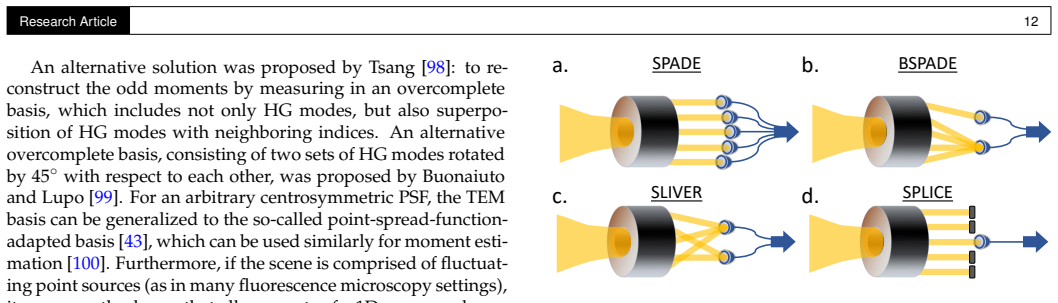


read the original abstract
For more than a century, the diffraction limit has defined the resolution achievable by passive optical imaging systems. Although some resolution improvement can be gained through classical data processing of the image, it is limited by the noise arising from quantum nature of light. Minimizing the effect of this noise requires quantum treatment of optical imaging. By reformulating imaging as a problem of quantum measurement and estimation, it becomes possible to identify optimal detection strategies that recover spatial information previously thought inaccessible. This review summarizes the theoretical framework that underpins this development, from the formulation of quantum Cram\'er-Rao bounds and Chernoff bounds to the construction of receivers that attain them, such as those based on spatial-mode demultiplexing. We show how these methods can beat conventional imaging in the classification, localization, and imaging of sub-Rayleigh incoherent sources. We then discuss extensions to multiparameter and partially coherent scenarios, and highlight the unifying connections between estimation and discrimination tasks. Finally, we survey recent experimental demonstrations that approach quantum-limited resolution and outline emerging applications in microscopy, astronomy, and optical sensing.
Editorial analysis
A structured set of objections, weighed in public.
Referee Report
Summary. This review summarizes the quantum estimation framework for passive optical imaging, reformulating the diffraction limit via quantum Cramér-Rao bounds and Chernoff bounds. It presents optimal receivers such as spatial-mode demultiplexing (SPADE) that attain these bounds, shows improvements over conventional imaging for classification, localization, and imaging of sub-Rayleigh incoherent sources, discusses extensions to multiparameter and partially coherent cases, and surveys experimental demonstrations approaching the quantum limit.
Significance. If the summarized results hold, the review is significant for unifying quantum measurement theory with optical imaging, providing a consolidated resource on how quantum strategies recover information inaccessible to classical methods. It credits the theoretical attainability of bounds through standard quantum optics arguments and includes connections between estimation and discrimination tasks plus experimental progress, which can inform applications in microscopy, astronomy, and sensing.
minor comments (4)
- Abstract: the claim that optimal strategies 'recover spatial information previously thought inaccessible' would benefit from a brief qualifier noting this applies specifically in the sub-Rayleigh regime under the stated assumptions on source incoherence.
- Section on SPADE receivers: the description of how these attain the quantum bound could include a short note on the role of mode orthogonality to make the construction more self-contained for readers.
- Experimental survey: the discussion of demonstrations approaching quantum-limited resolution would be strengthened by explicitly stating the gap to the bound (e.g., in dB or factor) for at least one cited work.
- Notation: the multiparameter quantum Fisher information is introduced without a cross-reference to its single-parameter reduction; adding this would improve readability across sections.
Simulated Author's Rebuttal
We thank the referee for their positive and accurate summary of the manuscript, for recognizing its significance in unifying quantum measurement theory with optical imaging, and for recommending minor revision. No specific major comments were provided in the report.
Circularity Check
No significant circularity; review summarizes independent prior results
full rationale
This is a review paper summarizing the quantum estimation framework, QCRB derivations, SPADE receivers, and extensions for sub-Rayleigh sources from established quantum optics literature. No new derivations are introduced that reduce by construction to fitted inputs, self-definitions, or load-bearing self-citations within the paper itself. Central claims rest on standard quantum measurement arguments and externally verifiable prior results, with the derivation chain remaining self-contained against external benchmarks.
Axiom & Free-Parameter Ledger
Lean theorems connected to this paper
-
IndisputableMonolith/Cost/FunctionalEquation.leanwashburn_uniqueness_aczel unclear?
unclearRelation between the paper passage and the cited Recognition theorem.
The QFI matrix, defined as IQ(θ)ij = −2 ∂²F(ρ̂(θ),ρ̂(θ+Δθ))/∂Δθi∂Δθj |Δθ=0, gives the coefficients for this quadratic decrease...
-
IndisputableMonolith/Foundation/AlexanderDuality.leanalexander_duality_circle_linking unclear?
unclearRelation between the paper passage and the cited Recognition theorem.
SPADE ... demultiplexing the image-plane photons in terms of a judicious spatial-mode basis ... can achieve the quantum limit
What do these tags mean?
- matches
- The paper's claim is directly supported by a theorem in the formal canon.
- supports
- The theorem supports part of the paper's argument, but the paper may add assumptions or extra steps.
- extends
- The paper goes beyond the formal theorem; the theorem is a base layer rather than the whole result.
- uses
- The paper appears to rely on the theorem as machinery.
- contradicts
- The paper's claim conflicts with a theorem or certificate in the canon.
- unclear
- Pith found a possible connection, but the passage is too broad, indirect, or ambiguous to say the theorem truly supports the claim.
Reference graph
Works this paper leans on
-
[1]
J. M. Guerra, “Photon tunneling microscopy , ” Appl. Opt.29, 37413752 (1990)
work page 1990
-
[2]
Scanning near-field optical microscopy with aperture probes: Fundamentals and applications,
B. Hecht, B. Sick, U. P . Wild, V . Deckert, R. Zenobi, O. J. Martin, and D. W. Pohl, “Scanning near-field optical microscopy with aperture probes: Fundamentals and applications, ” The J. Chem. Phys. 112, 77617774 (2000)
work page 2000
-
[3]
Tip-enhanced near-field optical microscopy ,
A. Hartschuh, “Tip-enhanced near-field optical microscopy , ” Ange- wandte Chemie Int. Ed. 47, 81788191 (2008)
work page 2008
-
[4]
Progress of high-resolution photon scanning tunneling mi- croscopy due to a nanometric fiber probe,
M. Ohtsu, “Progress of high-resolution photon scanning tunneling mi- croscopy due to a nanometric fiber probe, ” J. lightwave technology 13, 12001221 (1995)
work page 1995
-
[5]
Introduction to fourier optics. 3rd,
J. W. Goodman, “Introduction to fourier optics. 3rd, ” Roberts Co. Publ. 3 (2005)
work page 2005
-
[6]
S. W. Hell and J. Wichmann, “Breaking the diffraction resolution limit by stimulated emission: stimulated-emission-depletion fluorescence microscopy , ” Opt. letters19, 780782 (1994)
work page 1994
-
[7]
Sub-diffraction-limit imaging by stochastic optical reconstruction microscopy (storm),
M. J. Rust, M. Bates, and X. Zhuang, “Sub-diffraction-limit imaging by stochastic optical reconstruction microscopy (storm), ” Nat. methods 3, 793796 (2006)
work page 2006
-
[8]
Imaging intracellular fluorescent proteins at nanometer resolu- tion,
E. Betzig, G. H. Patterson, R. Sougrat, O. W. Lindwasser, S. Olenych, J. S. Bonifacino, M. W. Davidson, J. Lippincott-Schwartz, and H. F . Hess, “Imaging intracellular fluorescent proteins at nanometer resolu- tion, ” science313, 16421645 (2006)
work page 2006
-
[9]
Ultra-high resolution imaging by fluorescence photoactivation localization microscopy ,
S. T . Hess, T . P . Girirajan, and M. D. Mason, “Ultra-high resolution imaging by fluorescence photoactivation localization microscopy , ” Bio- phys. journal 91, 42584272 (2006)
work page 2006
-
[10]
Beitrage zur theorie des mikroskops und der mikroskopis- chen wahrnehmung,
E. Abbe, “Beitrage zur theorie des mikroskops und der mikroskopis- chen wahrnehmung, ” Arch. fur mikroskopische Anat. 9, 413418 (1873)
-
[11]
Xxxi. investigations in optics, with special reference to the spectroscope,
F . Lord Rayleigh, “Xxxi. investigations in optics, with special reference to the spectroscope, ” The London, Edinburgh, Dublin Philos. Mag. J. Sci. 8, 261274 (1879)
-
[12]
On spectroscopic resolving power,
C. M. Sparrow, “On spectroscopic resolving power, ” Astrophys. J. 44, 76 (1916)
work page 1916
-
[13]
G. de Villiers and E. R. Pike, The Limits of Resolution (CRC Press, Boca Raton, 2016)
work page 2016
-
[14]
CramérRao sensitivity limits for astronomical instru- ments: implications for interferometer design,
J. Zmuidzinas, “CramérRao sensitivity limits for astronomical instru- ments: implications for interferometer design, ” J. Opt. Soc. Am. A 20, 218233 (2003)
work page 2003
-
[15]
E. D. Feigelson and G. J. Babu, Modern Statistical Methods for As- tronomy (Cambridge University Press, Cambridge, 2012)
work page 2012
-
[16]
Fisher information theory for parameter estimation in single molecule microscopy: tutorial,
J. Chao, E. Sally Ward, and R. J. Ober, “Fisher information theory for parameter estimation in single molecule microscopy: tutorial, ” J. Opt. Soc. Am. A 33, B36 (2016)
work page 2016
-
[17]
A. von Diezmann, Y . Shechtman, and W. E. Moerner, “Three- Dimensional Localization of Single Molecules for Super-Resolution Imaging and Single-Particle T racking, ” Chem. Rev. 117, 72447275 (2017)
work page 2017
-
[18]
E. L. Lehmann and G. Casella, Theory of Point Estimation (Springer, 2003)
work page 2003
-
[19]
H. L. Van T rees and K. L. Bell, eds., Bayesian Bounds for Parameter Estimation and Nonlinear Filtering/T racking (Wiley-IEEE, Piscataway , 2007)
work page 2007
-
[20]
Conservative classical and quantum resolution limits for incoherent imaging,
M. Tsang, “Conservative classical and quantum resolution limits for incoherent imaging, ” J. Mod. Opt.65, 13851391 (2018)
work page 2018
-
[21]
Quantum-inspired multi-parameter adaptive bayesian estimation for sensing and imag- ing,
K. K. Lee, C. N. Gagatsos, S. Guha, and A. Ashok, “Quantum-inspired multi-parameter adaptive bayesian estimation for sensing and imag- ing, ” IEEE J. Sel. T op. Signal Process. (2022)
work page 2022
-
[22]
C. W. Helstrom, Quantum detection and estimation theory (Academic Press, 1976)
work page 1976
-
[23]
A new approach to cramér-rao bounds for quantum state estimation,
H. Nagaoka, “A new approach to cramér-rao bounds for quantum state estimation, ” IEICE T ech. Rep.IT 89-42, 914 (1989)
work page 1989
-
[24]
Statistical distance and the geom- etry of quantum states,
S. L. Braunstein and C. M. Caves, “Statistical distance and the geom- etry of quantum states, ” Phys. Rev. Lett. 72, 34393443 (1994)
work page 1994
-
[25]
Hayashi, Quantum Information Theory: Mathematical Foundation (Springer, Berlin, 2017), 2nd ed
M. Hayashi, Quantum Information Theory: Mathematical Foundation (Springer, Berlin, 2017), 2nd ed
work page 2017
-
[26]
H. L. Van T rees and K. Bell,Detection Estimation and Modulation The- ory , Part I: Detection, Estimation, and Filtering Theory (John Wiley & Sons, Hoboken, New Jersey , 2013), 2nd ed
work page 2013
-
[27]
On the chernoff bound for efficiency of quantum hypoth- esis testing,
V . KARGIN, “On the chernoff bound for efficiency of quantum hypoth- esis testing, ” The Ann. Stat.33, 959–976 (2005)
work page 2005
-
[28]
The Chernoff lower bound for symmetric quantum hypothesis testing,
M. Nussbaum and A. Szkoa, “The Chernoff lower bound for symmetric quantum hypothesis testing, ” The Ann. Stat. 37 (2009). ArXiv:quant- ph/0607216. Research Article 19
-
[29]
Discriminating states: The quantum chernoff bound,
K. M. Audenaert, J. Calsamiglia, R. Munoz-T apia, E. Bagan, L. Masanes, A. Acin, and F . Verstraete, “Discriminating states: The quantum chernoff bound, ” Phys. review letters 98, 160501 (2007)
work page 2007
-
[30]
J. W. Goodman, Statistical Optics (Willey , New Jersey , 2015)
work page 2015
-
[31]
Quantum nonlocality in weak-thermal-light interferometry ,
M. Tsang, “Quantum nonlocality in weak-thermal-light interferometry , ” Phys. Rev. Lett. 107, 270402 (2011)
work page 2011
-
[33]
Estimation of object parameters by a quantum-limited optical system,
C. W. Helstrom, “Estimation of object parameters by a quantum-limited optical system, ” J. Opt. Soc. Am. 60, 233239 (1970)
work page 1970
-
[34]
Reading out fisher information from the zeros of the point spread function,
M. Paúr, B. Stoklasa, D. Koutn, J. eháek, Z. Hradil, J. Grover, A. Krzic, and L. Sánchez-Soto, “Reading out fisher information from the zeros of the point spread function, ” Opt. letters 44, 31143117 (2019)
work page 2019
-
[35]
M.-J. Tsai and K.-P . Dunn, “Performance Limitations on Parameter Es- timation of Closely Spaced Optical T argets Using Shot-Noise Detector Model, ” T ech. Rep. ADA073462, Lincoln Laboratory , MIT (1979)
work page 1979
-
[36]
Model-based two-object resolution from observations having counting statistics,
E. Bettens, D. Van Dyck, A. J. den Dekker, J. Sijbers, and A. van den Bos, “Model-based two-object resolution from observations having counting statistics, ” Ultramicroscopy77, 3748 (1999)
work page 1999
-
[37]
High- resolution electron microscopy and electron tomography: resolution versus precision,
S. Van Aert, A. J. den Dekker, D. Van Dyck, and A. van den Bos, “High- resolution electron microscopy and electron tomography: resolution versus precision, ” J. Struct. Biol.138, 2133 (2002)
work page 2002
-
[38]
Beyond Rayleigh’s criterion: A resolution measure with application to single-molecule microscopy ,
S. Ram, E. S. Ward, and R. J. Ober, “Beyond Rayleigh’s criterion: A resolution measure with application to single-molecule microscopy , ” Proc. National Acad. Sci. United States Am. 103, 44574462 (2006)
work page 2006
-
[39]
A. Uhlmann, “The "transition probability" in the state space of a*- algebra, ” Reports on Math. Phys.9, 273279 (1976)
work page 1976
-
[40]
M. Tsang, “Poisson Quantum Information, ” Quantum5, 527 (2021)
work page 2021
-
[41]
Far-field superresolution of thermal electro- magnetic sources at the quantum limit,
R. Nair and M. Tsang, “Far-field superresolution of thermal electro- magnetic sources at the quantum limit, ” Phys. Rev. Lett. 117, 190801 (2016)
work page 2016
-
[42]
Ultimate precision bound of quantum and subwavelength imaging,
C. Lupo and S. Pirandola, “Ultimate precision bound of quantum and subwavelength imaging, ” Phys. Rev. Lett.117, 190802 (2016)
work page 2016
-
[43]
Optimal measurements for resolution beyond the rayleigh limit,
J. Rehacek, M. Paúr, B. Stoklasa, Z. Hradil, and L. L. Sánchez-Soto, “Optimal measurements for resolution beyond the rayleigh limit, ” Opt. Lett. 42, 231234 (2017)
work page 2017
-
[44]
Fundamental limit of resolving two point sources limited by an arbitrary point spread function,
R. Kerviche, S. Guha, and A. Ashok, “Fundamental limit of resolving two point sources limited by an arbitrary point spread function, ” IEEE Int. Symp. on Inf. Theory - Proc. (2017)
work page 2017
-
[45]
Attaining the quantum limit of passive imaging,
H. Krovi, S. Guha, and J. H. Shapiro, “Attaining the quantum limit of passive imaging, ” arXiv preprint arXiv:1609.00684 (2016)
-
[46]
Quantum-optimal detection of one- versus-two incoherent sources with arbitrary separation,
X.-M. Lu, R. Nair, and M. Tsang, “Quantum-optimal detection of one- versus-two incoherent sources with arbitrary separation, ” arXiv [quant- ph] (2016)
work page 2016
-
[47]
Quantum- optimal detection of one-versus-two incoherent optical sources with arbitrary separation,
X.-M. Lu, H. Krovi, R. Nair, S. Guha, and J. H. Shapiro, “Quantum- optimal detection of one-versus-two incoherent optical sources with arbitrary separation, ” npj Quantum Inf. 4, 64 (2018)
work page 2018
-
[48]
Quantum limits and optimal receivers for passive sub- diffraction imaging,
M. R. Grace, “Quantum limits and optimal receivers for passive sub- diffraction imaging, ” Ph.D. thesis, The University of Arizona (2022)
work page 2022
-
[49]
The quantum theory of optical coherence,
R. J. Glauber, “The quantum theory of optical coherence, ” Phys. Rev. 130, 2529 (1963)
work page 1963
-
[50]
Quantum limits on optical resolution,
M. I. Kolobov and C. Fabre, “Quantum limits on optical resolution, ” Phys. Rev. Lett. 85, 37893792 (2000)
work page 2000
-
[51]
Real applications of quantum imaging,
M. Genovese, “Real applications of quantum imaging, ” J. Opt. 18, 073002 (2016)
work page 2016
-
[52]
Quantum metrology and its application in biology ,
M. A. T aylor and W. P . Bowen, “Quantum metrology and its application in biology , ” Phys. Reports615, 159 (2016)
work page 2016
-
[53]
Modes and states in quantum optics,
C. Fabre and N. T reps, “Modes and states in quantum optics, ” Rev. Mod. Phys. 92, 035005 (2020)
work page 2020
-
[54]
H. Defienne, W. P . Bowen, M. Chekhova, G. B. Lemos, D. Oron, S. Ramelow, N. T reps, and D. Faccio, “Advances in quantum imaging, ” Nat. Photonics 18, 1024–1036 (2024)
work page 2024
-
[55]
Beating rayleigh’s curse by imaging using phase information,
W.-K. Tham, H. Ferretti, and A. M. Steinberg, “Beating rayleigh’s curse by imaging using phase information, ” Phys. Rev. Lett. 118, 070801 (2017)
work page 2017
-
[56]
A generalization of the Fréchet-Cramér in- equality to the case of Bayes estimation,
M. P . Schützenberger, “A generalization of the Fréchet-Cramér in- equality to the case of Bayes estimation, ” Bull. Amer. Math. Soc. 63, 142 (1957)
work page 1957
-
[57]
Quantum limits to optical point-source localization,
M. Tsang, “Quantum limits to optical point-source localization, ” Optica 2, 646653 (2015)
work page 2015
-
[58]
Resurgence of Rayleigh’s curse in the presence of partial coherence,
W. Larson and B. E. A. Saleh, “Resurgence of Rayleigh’s curse in the presence of partial coherence, ” Optica 5, 13821389 (2018)
work page 2018
-
[59]
Resurgence of Rayleigh’s curse in the pres- ence of partial coherence: comment,
M. Tsang and R. Nair, “Resurgence of Rayleigh’s curse in the pres- ence of partial coherence: comment, ” Optica 6, 400401 (2019)
work page 2019
-
[60]
Surpassing rayleigh limit: Fisher infor- mation analysis of partially coherent source(s),
K. K. Lee and A. Ashok, “Surpassing rayleigh limit: Fisher infor- mation analysis of partially coherent source(s), ” in Proceedings Vol- ume 11136, Optics and Photonics for Information Processing XIII, vol. 11136 (SPIE, 2019), p. 9096
work page 2019
-
[61]
Back to sources the role of losses and coherence in super-resolution imaging revisited,
S. Kurdzialek, “Back to sources the role of losses and coherence in super-resolution imaging revisited, ” Quantum6, 697 (2022)
work page 2022
-
[62]
Resurgence of Rayleigh’s curse in the presence of partial coherence: reply ,
W. Larson and B. E. A. Saleh, “Resurgence of Rayleigh’s curse in the presence of partial coherence: reply , ” Optica6, 402403 (2019)
work page 2019
-
[63]
Quantum Fisher information with coherence,
Z. Hradil, J. eháek, L. Sánchez-Soto, and B.-G. Englert, “Quantum Fisher information with coherence, ” Optica6, 14371440 (2019)
work page 2019
-
[64]
Coherence effects on estimating two-point separation,
K. Liang, K. Liang, S. A. Wadood, S. A. Wadood, A. N. Vamivakas, A. N. Vamivakas, A. N. Vamivakas, A. N. Vamivakas, and A. N. Vami- vakas, “Coherence effects on estimating two-point separation, ” Optica 8, 243248 (2021)
work page 2021
-
[65]
S. A. Wadood, K. Liang, Y . Zhou, J. Y ang, M. A. Alonso, X.-F . Qian, T . Malhotra, S. M. Hashemi Rafsanjani, A. N. Jordan, R. W. Boyd, and A. N. Vamivakas, “Experimental demonstration of superresolution of partially coherent light sources using parity sorting, ” Opt. Express 29, 2203422043 (2021)
work page 2021
-
[66]
Quantum channel identification problem,
A. Fujiwara, “Quantum channel identification problem, ” Phys. Rev. A 63, 042304 (2001)
work page 2001
-
[67]
F . Y ang, R. Nair, M. Tsang, C. Simon, and A. I. Lvovsky , “Fisher in- formation for far-field linear optical superresolution via homodyne or heterodyne detection in a higher-order local oscillator mode, ” Phys. Rev. A 96, 063829 (2017)
work page 2017
-
[68]
Quantum hypothesis testing for exoplanet de- tection,
Z. Huang and C. Lupo, “Quantum hypothesis testing for exoplanet de- tection, ” Phys. Rev. Lett.127, 130502 (2021)
work page 2021
-
[69]
Strong converse and stein’s lemma in quantum hypothesis testing,
T . Ogawa and H. Nagaoka, “Strong converse and stein’s lemma in quantum hypothesis testing, ” IEEE T rans. on Inf. Theory 46, 2428– 2433 (2000)
work page 2000
-
[70]
Quantum limited spatial resolution of NV-diamond magnetometry ,
N. Deshler, D. Daly , A. Majumder, K. Saha, and S. Guha, “Quantum limited spatial resolution of NV-diamond magnetometry , ” arXiv [quant- ph] (2025)
work page 2025
-
[71]
Identifying objects at the quantum limit for superresolution imaging,
M. R. Grace and S. Guha, “Identifying objects at the quantum limit for superresolution imaging, ” Phys. Rev. Lett.129, 180502 (2022)
work page 2022
-
[72]
Discriminating quantum states: The multiple chernoff distance,
K. Li, “Discriminating quantum states: The multiple chernoff distance, ” The Ann. Stat. 44, 1661–1679 (2016)
work page 2016
-
[73]
D. T riggiani and C. Lupo, “Achieving quantum-limited sub-rayleigh identification of incoherent optical sources with arbitrary intensities, ” Quantum Sci. T echnol. 11, 015028 (2026)
work page 2026
-
[74]
Approaching quantum-limited imaging resolution without prior knowledge of the ob- ject location,
M. R. Grace, Z. Dutton, A. Ashok, and S. Guha, “Approaching quantum-limited imaging resolution without prior knowledge of the ob- ject location, ” JOSA A 37, 12881299 (2020). Publisher: Optica Pub- lishing Group
work page 2020
-
[75]
Compatibility in multiparameter quantum metrology ,
S. Ragy , M. Jarzyna, and R. Demkowicz-Dobrzaski, “Compatibility in multiparameter quantum metrology , ” Phys. Rev. A94, 052108 (2016)
work page 2016
-
[76]
Modern description of Rayleigh’s criterion,
S. Zhou and L. Jiang, “Modern description of Rayleigh’s criterion, ” Phys. Rev. A 99, 013808 (2019)
work page 2019
-
[77]
Discrimination and estimation of incoherent sources under misalignment,
J. De Almeida, J. Kołody ´nski, C. Hirche, M. Lewenstein, and M. Sko- tiniotis, “Discrimination and estimation of incoherent sources under misalignment, ” Phys. Rev. A103, 022406 (2021)
work page 2021
-
[78]
Quantum theory of superresolu- tion for two incoherent optical point sources,
M. Tsang, R. Nair, and X.-M. Lu, “Quantum theory of superresolu- tion for two incoherent optical point sources, ” Phys. Rev. X 6, 031033 (2016)
work page 2016
-
[79]
Attaining quantum limited precision of localizing an object in passive imaging,
A. Sajjad, M. R. Grace, Q. Zhuang, and S. Guha, “Attaining quantum limited precision of localizing an object in passive imaging, ” Phys. Rev. A 104, 022410 (2021)
work page 2021
-
[80]
On super-resolution imaging as a multiparameter estimation problem,
A. Chrostowski, R. Demkowicz-Dobrzaski, M. Jarzyna, and K. Ba- naszek, “On super-resolution imaging as a multiparameter estimation problem, ” Int. J. Quantum Inf.15, 1740005 (2017)
work page 2017
-
[81]
Beating the rayleigh limit using two- photon interference,
M. Parniak, S. Borówka, K. Boroszko, W. Wasilewski, K. Banaszek, Research Article 20 and R. Demkowicz-Dobrzaski, “Beating the rayleigh limit using two- photon interference, ” Phys. review letters121, 250503 (2018)
work page 2018
discussion (0)
Sign in with ORCID, Apple, or X to comment. Anyone can read and Pith papers without signing in.