Recognition: no theorem link
Big Mysteries Survey: Physicists' Views on Cosmology, Black Holes, Quantum Mechanics, and Quantum Gravity
Pith reviewed 2026-05-13 01:25 UTC · model grok-4.3
The pith
A survey of physicists finds that many positions presented as consensus actually have only narrow majorities or pluralities of support.
A machine-rendered reading of the paper's core claim, the machinery that carries it, and where it could break.
Core claim
The survey provides a snapshot of physicists' views on issues in cosmology, black-hole physics, quantum mechanics, quantum gravity, and anthropic coincidences. A central finding is that several positions often described publicly as field-wide consensus views are, in practice, supported by much narrower majorities or by pluralities rather than majorities.
What carries the argument
The collection and analysis of self-reported opinions from a large number of physicists on controversial foundational topics.
If this is right
- Public statements about consensus on foundational questions should include qualifiers about the actual level of agreement.
- Research programs in areas such as quantum gravity may draw from a wider range of approaches than a strong consensus would imply.
- Discussions of interpretations in quantum mechanics and cosmology should account for substantial minority or plurality positions.
- The field may remain more open to competing ideas on black hole physics and anthropic coincidences than is commonly portrayed.
Where Pith is reading between the lines
- Repeating the survey at intervals could reveal whether new evidence shifts the balance of opinions over time.
- Similar opinion-gathering efforts in other scientific domains might uncover comparable differences between perceived and actual agreement.
- Inclusive formats for conferences and review articles could better reflect the documented diversity of views.
Load-bearing premise
The conclusions rest on the assumption that the physicists who responded to the survey are representative of the entire community and that their answers honestly reflect their professional judgments.
What would settle it
A follow-up survey using different sampling methods or a much larger respondent pool that finds substantially stronger majorities for the positions currently reported as having narrower support would undermine the central claim.
Figures




read the original abstract
We present results from the Big Mysteries Survey, a large-scale survey conducted through the American Physical Society's Physics Magazine on foundational and controversial topics in contemporary physics. The survey provides a snapshot of physicists' views on issues in cosmology, black-hole physics, quantum mechanics, quantum gravity, and anthropic coincidences. A central finding is that several positions often described publicly as field-wide ``consensus'' views are, in practice, supported by much narrower majorities or by pluralities rather than majorities.
Editorial analysis
A structured set of objections, weighed in public.
Referee Report
Summary. The manuscript reports results from the Big Mysteries Survey, conducted via the American Physical Society's Physics Magazine, on physicists' views regarding foundational topics in cosmology, black-hole physics, quantum mechanics, quantum gravity, and anthropic coincidences. The central claim is that several positions frequently presented as field-wide consensus are supported only by narrow majorities or pluralities among respondents rather than strong majorities.
Significance. If the survey sample is representative and the methodology transparent, the work supplies empirical data on opinion distributions that could correct overstated consensus narratives in public and educational contexts. It highlights genuine diversity on issues such as quantum interpretations and black-hole information, which may inform targeted research and communication strategies. The broad topical coverage is a positive feature.
major comments (3)
- [Abstract and Methods] Abstract and (presumed) Methods section: No sample size, response rate, demographic breakdown of respondents, or question wording is reported. These details are required to determine whether the headline percentages actually demonstrate narrower-than-claimed majorities, as unaccounted self-selection or ambiguous phrasing could shift the distributions substantially.
- [Results (various topic subsections)] Results sections on individual topics: Percentages for each position are presented without confidence intervals, standard errors, or tests against a 50% threshold. This leaves open whether the reported 'narrow majorities' or 'pluralities' are statistically distinguishable from even splits or from sampling noise.
- [Discussion] Discussion: No quantitative or qualitative treatment of selection bias (e.g., APS Magazine readership self-selection) or response bias (e.g., social-desirability effects on quantum-foundations questions) is provided. Without bounding these effects, the claim that the observed distributions generalize beyond the convenience sample cannot be sustained.
minor comments (2)
- [Figures and Tables] Tables and figures should report the exact number of responses per question so readers can judge precision directly.
- [Introduction and References] The manuscript would benefit from citing earlier surveys on physicists' opinions (e.g., on quantum interpretations) to place the new results in context.
Simulated Author's Rebuttal
We thank the referee for the constructive feedback, which identifies important areas for improving transparency and statistical presentation in our survey manuscript. We address each major comment below.
read point-by-point responses
-
Referee: [Abstract and Methods] Abstract and (presumed) Methods section: No sample size, response rate, demographic breakdown of respondents, or question wording is reported. These details are required to determine whether the headline percentages actually demonstrate narrower-than-claimed majorities, as unaccounted self-selection or ambiguous phrasing could shift the distributions substantially.
Authors: The full Methods section describes the survey administration through APS Physics Magazine and provides question wording in supplementary materials, but we agree these details should be more prominent. We will revise the abstract to include the total sample size, response rate, and key demographic breakdowns (e.g., career stage and subfield). This will allow readers to better evaluate the reported percentages without altering the core findings. revision: yes
-
Referee: [Results (various topic subsections)] Results sections on individual topics: Percentages for each position are presented without confidence intervals, standard errors, or tests against a 50% threshold. This leaves open whether the reported 'narrow majorities' or 'pluralities' are statistically distinguishable from even splits or from sampling noise.
Authors: We will add 95% confidence intervals to all percentages in the Results sections and include binomial proportion tests (or equivalent) to assess whether observed majorities or pluralities differ significantly from 50%. These additions will clarify which distributions are statistically distinguishable from even splits while preserving the descriptive nature of the survey. revision: yes
-
Referee: [Discussion] Discussion: No quantitative or qualitative treatment of selection bias (e.g., APS Magazine readership self-selection) or response bias (e.g., social-desirability effects on quantum-foundations questions) is provided. Without bounding these effects, the claim that the observed distributions generalize beyond the convenience sample cannot be sustained.
Authors: We will add a dedicated Limitations subsection to the Discussion that qualitatively addresses selection bias from APS Magazine readership and potential response bias on interpretive questions. We will explicitly note that the results represent a snapshot of engaged respondents rather than a fully representative census of the physics community and will moderate generalizability claims accordingly. A precise quantitative bound on these biases is not feasible with existing data. revision: partial
Circularity Check
No circularity: empirical survey reporting with no derivation chain
full rationale
The paper reports direct results from a voluntary survey of physicists' opinions on foundational topics in physics. There are no equations, model derivations, fitted parameters, predictions, or self-citations that reduce any claimed finding to its own inputs by construction. The central observation about narrower-than-publicized majorities follows immediately from tabulating the collected response percentages; no additional logical step equates the output to the sampling inputs. The analysis is therefore self-contained as a descriptive empirical snapshot.
Axiom & Free-Parameter Ledger
Reference graph
Works this paper leans on
-
[1]
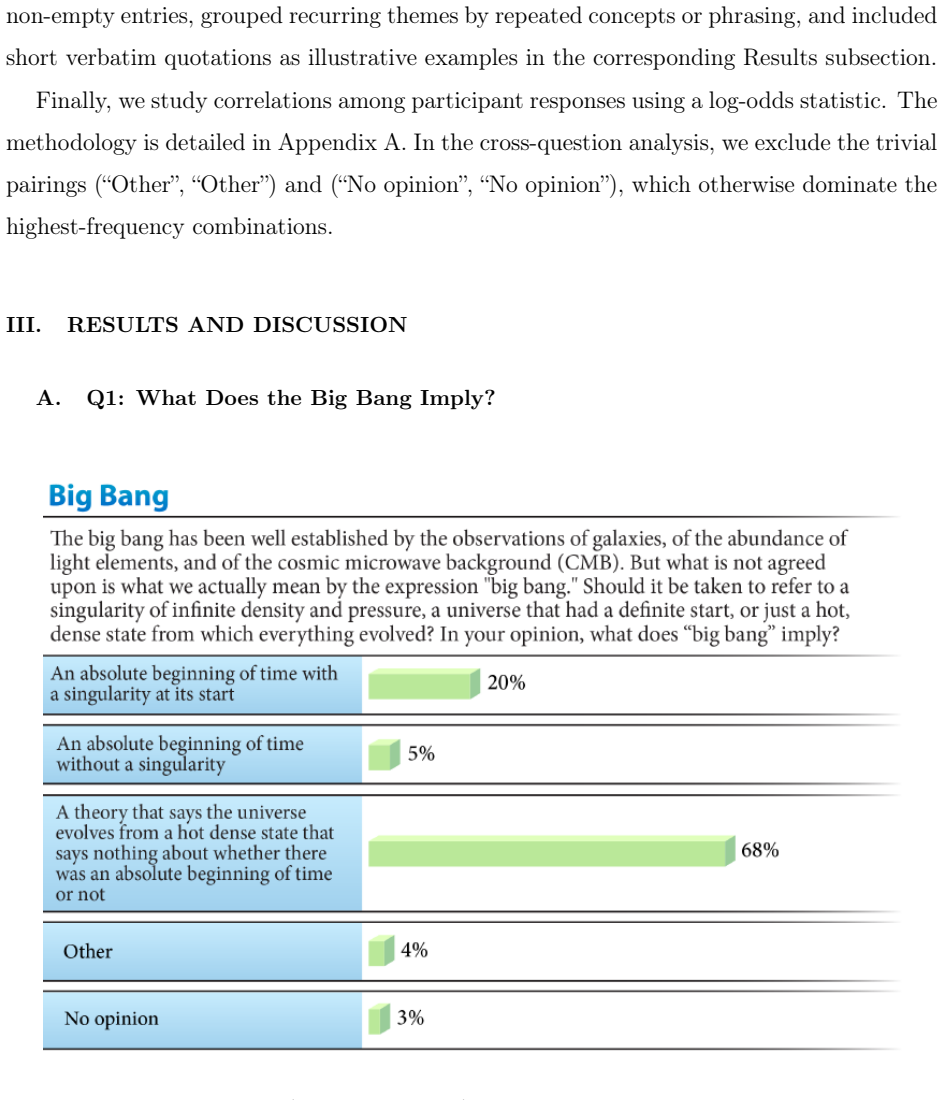
Question 1: Big Bang Meaning Question. The big bang has been well established by the observations of galaxies, of the abundance of light elements, and of the cosmic microwave background (CMB). But what is not agreed upon is what we actually mean by the phrase big bang. Should it be taken to refer to a singularity of infinite density and pressure, a univer...
-
[2]
The big bang theory leaves unresolved questions
Question 2: Early-Universe Puzzles Question. The big bang theory leaves unresolved questions. One basic problem is that the universe exhibits an unexpected uniformity, even on spatial scales so vast that they could not be causally connected: light could not have traveled such distances within the lifetime of the cosmos. Another is the exquisitely flat cur...
-
[3]
Question 3: Dark Matter or Modified Gravity Question. The observed rotation rates of galaxies are faster than expected, given the gravitational pull of the light-emitting matter contained in the galaxies. These rotation rates and related observations (e.g., clusters of galaxies, baryonic acoustic oscillation, and cosmic microwave background anisotropies) ...
-
[4]
Question 4: Cause of Cosmic Acceleration Question. Observations of supernovae suggest that the cosmic expansion is not slowing down—as would be expected if gravity were the only force acting between galaxies. What 25 is the most likely candidate to be causing the universe to accelerate in its expansion? Answer Count ( ±1σ) Percent (±1σ) A constant-density...
-
[5]
Question 5: Hubble Tension Question. The current cosmic expansion rate, or Hubble parameter, can be measured in two distinct ways. One involves gauging the distance to stars and supernovae in the local universe—correspondingto“latetimes” incosmichistory. Thesecondinvolvesmeasurements of more distant signals coming from the CMB and large-scale galaxy surve...
-
[6]
Question 6: Anthropic Coincidences Question. The values for nature’s physical constants—from the strength of nuclear forces to the mass of the electron—are not determined by current theories, It has been suggested that if these values had been slightly different, the universe would likely not have formed complex structures and—eventually—life. This idea h...
-
[7]
Question 7: Quantum Mechanics Interpretations Question. Quantum mechanics can provide exceptionally accurate predictions of real-world phenomena. Yet, physicists cannot explain how the reality we experience emerges from the laws of quantum mechanics—a question that many “interpretations” of quantum mechanics attempt to solve (for a quick review, check out...
-
[8]
Question 8: Matter Crossing an Event Horizon Question. When a black hole gobbles up a star or planet or spaceship, the matter is thought to cross an “event horizon”—a boundary beyond which no signals can escape. In your opinion, what happens to the matter upon crossing this horizon? Answer Count ( ±1σ) Percent (±1σ) It is crushed into a singularity 672 ± ...
-
[9]
Question 9: Black Hole Information Question. The stuff that falls inside a black hole becomes stuck forever, or does it? Stephen Hawking and other physicists predicted that black holes slowly radiate thermal energy. But that poses a problem: the ingoing stuff has intrinsic properties (like quantum spin and quark flavors), and calculations predict that thi...
-
[10]
Uniting quantum mechanics with gravity is one of the hardest problems facing physicists
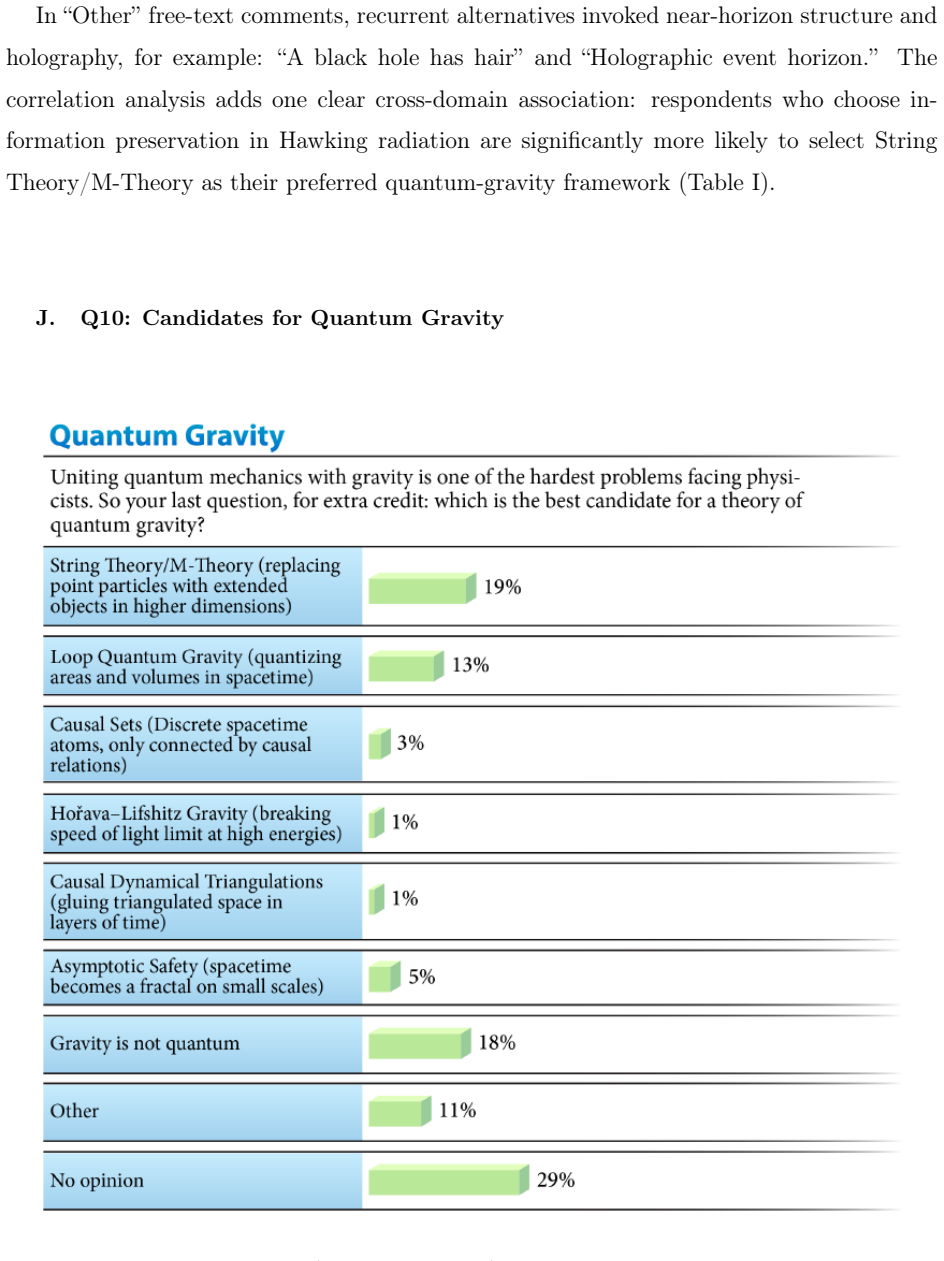
Question 10: Quantum Gravity Candidates Question. Uniting quantum mechanics with gravity is one of the hardest problems facing physicists. So your last question, for extra credit: which is the best candidate for a theory of quantum gravity? Answer Count ( ±1σ) Percent (±1σ) String Theory/M-Theory (replacing point particles with extended objects in higher ...
- [11]
-
[12]
M. Schirber and M. Rini, Take the big mysteries in physics survey,Physics (APS) (2025), special feature announcing the APS Big Mysteries Survey; accessed 2026-02-24
work page 2025
-
[13]
Hawking, The beginning of time, The Stephen Hawking Foundation website (2012), accessed 2026-02-22
S. Hawking, The beginning of time, The Stephen Hawking Foundation website (2012), accessed 2026-02-22
work page 2012
-
[14]
N. Afshordi and P. Halper,Battle of the Big Bang: The New Tales of Our Cosmic Origins (University of Chicago Press, 2025)
work page 2025
-
[15]
A. H. Guth, Phys. Rev. D23, 347 (1981)
work page 1981
- [16]
-
[17]
D. Scott, Proc. Int. Sch. Phys. Fermi200, 133 (2020), arXiv:1804.01318 [astro-ph.CO]
- [18]
- [19]
- [20]
- [21]
-
[22]
M. Kamionkowski and A. G. Riess, Annu. Rev. Nucl. Part. Sci.73, 153 (2023)
work page 2023
-
[23]
Planck 2018 results. VI. Cosmological parameters
Planck Collaboration, N. Aghanim, Y. Akrami, et al. , Astron. Astrophys. 641, A6 (2020), arXiv:1807.06209 [astro-ph.CO]
work page internal anchor Pith review Pith/arXiv arXiv 2020
-
[24]
A. G. Riess, W. Yuan, L. M. Macri, D. Scolnic, D. Brout, S. Casertano, D. O. Jones, Y. Mu- rakami, L. Breuval, T. G. Brink, A. V. Filippenko, S. Hoffmann, G. Itose, S. W. Jha, W. D. Kenworthy, J. Mackenty, B. E. Stahl, and W. Zheng, Astrophys. J. Lett.934, L7 (2022), arXiv:2112.04510 [astro-ph.CO]
work page internal anchor Pith review Pith/arXiv arXiv 2022
-
[25]
Carter, in Confrontation of Cosmological Theories with Observational Data , IAU Sympo- sium, Vol
B. Carter, in Confrontation of Cosmological Theories with Observational Data , IAU Sympo- sium, Vol. 63 (Cambridge University Press, 1974) pp. 291–298
work page 1974
-
[26]
L. A. Barnes and G. F. Lewis,A Fortunate Universe: Life in a Finely Tuned Cosmos (Cam- bridge University Press, 2016)
work page 2016
- [27]
-
[28]
Gibney, Nature (2025), news feature; accessed 2026-02-24
E. Gibney, Nature (2025), news feature; accessed 2026-02-24
work page 2025
- [29]
-
[30]
B. S. DeWitt and N. Graham, eds.,The Many-Worlds Interpretation of Quantum Mechanics (Princeton University Press, Princeton, 1973)
work page 1973
- [31]
- [32]
-
[33]
G. C. Ghirardi, A. Rimini, and T. Weber, Phys. Rev. D34, 470 (1986)
work page 1986
-
[34]
J. M. M. Senovilla, Gen. Relativ. Gravit.54, 151 (2022)
work page 2022
- [35]
-
[36]
L. Susskind, The Black Hole War: My Battle with Stephen Hawking to Make the World Safe for Quantum Mechanics (Little, Brown and Company, New York, 2008)
work page 2008
- [37]
discussion (0)
Sign in with ORCID, Apple, or X to comment. Anyone can read and Pith papers without signing in.