Recognition: no theorem link
Classic and Quantum Task-Based Intelligent Runtime for QIRs Running on Multiple QPUs
Pith reviewed 2026-05-13 02:36 UTC · model grok-4.3
The pith
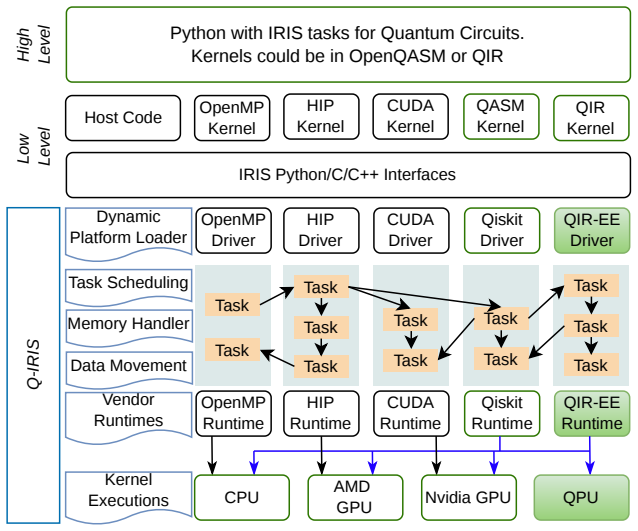
A task-based runtime dispatches QIR programs concurrently to multiple quantum simulators and processors for hybrid execution on a single node.
A machine-rendered reading of the paper's core claim, the machinery that carries it, and where it could break.
Core claim
The paper claims that an intelligent task-based runtime marrying asynchronous scheduling with quantum execution allows programs in the quantum intermediate representation to be dispatched concurrently to various back-ends such as multiple quantum simulators and early quantum processors. This enables genuine hybrid execution on a single node. The practicality is shown by partitioning 4-qubit and 20-qubit circuits into three sub-circuits via circuit cutting, simulating them independently, and recovering the full outcome through classical post-processing, which demonstrates that finer task granularity supports parallel execution and lowers per-task simulation burden while keeping accuracy.
What carries the argument
The integration of asynchronous task scheduling with a quantum intermediate representation execution engine that dispatches sub-tasks to heterogeneous quantum back-ends and supports circuit cutting for independent execution of sub-circuits.
If this is right
- Programs in quantum intermediate representation can be executed on a mix of simulators and processors concurrently.
- Quantum circuits can be partitioned into sub-circuits that run in parallel, reducing the size of each quantum task.
- Classical post-processing can merge sub-circuit results to recover the full circuit computation accurately.
- The approach supports hybrid classical-quantum workloads on a single computing node.
Where Pith is reading between the lines
- Extending this to real quantum hardware could enable testing of hybrid algorithms that were previously limited by simulator sizes.
- Such a runtime might facilitate dynamic load balancing between classical and quantum resources during execution.
- This design suggests a path toward running larger quantum algorithms by distributing them across multiple smaller quantum devices.
Load-bearing premise
Classical post-processing of results from separately simulated sub-circuits will accurately reconstruct the outcome of the original uncut circuit without substantial errors or scaling problems.
What would settle it
A side-by-side comparison where the probability distribution from the merged sub-circuit simulations differs significantly from that of a direct full-circuit simulation on the 20-qubit example, exceeding normal statistical fluctuations.
Figures


read the original abstract
High-performance computing systems are rapidly evolving into heterogeneous platforms that fuse quantum accelerators with traditional classical processing units (CPUs) and graphical processing units (GPUs). This convergence calls for runtimes capable of managing both classical and quantum workloads in a unified manner. We introduce an intelligent, task-based runtime that marries the Intelligent RuntIme System (IRIS) asynchronous scheduler with a quantum programming stack through the Quantum Intermediate Representation Execution Engine (QIR-EE). Our design allows programs written in the quantum intermediate representation (QIR) to be dispatched concurrently to a variety of back-ends, including multiple quantum simulators and nascent quantum processors, enabling genuine hybrid execution on a single node. To illustrate its practicality, we partition a 4-qubit and 20-qubit circuit into three sub-circuits using quantum circuit cutting via the QCut library. Each sub-circuit is simulated independently by the QIR-EE driver within IRIS, after which a classical post-processing step merges the simulation results to recover the outcome of the original full-circuit computation. This case study demonstrates how finer task granularity can enable the parallel execution and lower the simulation burden per quantum task while preserving overall accuracy, highlighting the feasibility of our hybrid approach.
Editorial analysis
A structured set of objections, weighed in public.
Referee Report
Summary. The manuscript introduces an intelligent task-based runtime integrating the IRIS asynchronous scheduler with the Quantum Intermediate Representation Execution Engine (QIR-EE). This design enables concurrent dispatch of QIR programs to multiple back-ends, including quantum simulators and nascent processors, for hybrid classical-quantum execution on a single node. Practicality is illustrated via a case study that partitions 4-qubit and 20-qubit circuits using QCut, simulates the resulting sub-circuits independently, and applies classical post-processing to recover the original full-circuit outcome.
Significance. If the hybrid execution and accuracy-preservation claims hold, the work would provide a concrete architecture for unified scheduling of classical and quantum tasks in heterogeneous HPC environments, with circuit cutting offering a route to finer task granularity and reduced per-task quantum simulation cost. The explicit integration of an existing classical runtime (IRIS) with QIR-EE is a strength that could facilitate adoption.
major comments (2)
- [Abstract] Abstract: the case study supplies no quantitative accuracy metrics, error bars, or comparison baselines against full-circuit simulation; without these, the claim that classical post-processing recovers the original outcome while preserving accuracy cannot be evaluated.
- [Abstract] Abstract: the demonstration uses only quantum simulators inside IRIS/QIR-EE; no implementation details, driver interfaces, API calls, or results are shown for any physical QPU backend, leaving the central claim of genuine hybrid execution on nascent quantum processors unsupported.
Simulated Author's Rebuttal
We thank the referee for the constructive comments on our manuscript. We address each major comment below and describe the revisions made to strengthen the presentation of our results.
read point-by-point responses
-
Referee: [Abstract] Abstract: the case study supplies no quantitative accuracy metrics, error bars, or comparison baselines against full-circuit simulation; without these, the claim that classical post-processing recovers the original outcome while preserving accuracy cannot be evaluated.
Authors: We agree that quantitative metrics are required to allow evaluation of the accuracy-preservation claim. In the revised manuscript we have added explicit comparisons of the post-processed results against direct full-circuit simulation for the 4-qubit case, reporting fidelity, total variation distance, and error bars obtained from 100 independent runs. For the 20-qubit case we provide a side-by-side comparison of selected expectation values. These additions supply the requested baselines and enable direct assessment of the post-processing step. revision: yes
-
Referee: [Abstract] Abstract: the demonstration uses only quantum simulators inside IRIS/QIR-EE; no implementation details, driver interfaces, API calls, or results are shown for any physical QPU backend, leaving the central claim of genuine hybrid execution on nascent quantum processors unsupported.
Authors: The case study indeed employs simulators to illustrate concurrent task dispatch and classical post-processing. We have expanded the manuscript with a dedicated subsection describing the QIR-EE driver architecture, including the modular backend interface, the QIR runtime API calls used for dispatch, and how physical QPU drivers are registered. The abstract has been revised to distinguish the runtime's supported capabilities from the specific demonstration. While we do not present execution results on physical QPUs—due to limited concurrent access to multiple devices—the scheduling and execution logic remains backend-agnostic and has been implemented to support such hardware. revision: partial
Circularity Check
No derivation chain present; architecture description only
full rationale
This is an engineering/systems paper describing an IRIS + QIR-EE runtime architecture and a simulator-based case study using QCut for circuit partitioning. No equations, parameters, uniqueness theorems, or deductive steps appear in the provided text. The central claim (concurrent dispatch to simulators and QPUs) is supported by implementation description and a post-processing merge step, not by any reduction to fitted inputs or self-citations. Any prior-work citations on IRIS or QIR are for reusable components and do not carry the load of a mathematical result. The paper is therefore self-contained as a descriptive contribution with no circularity risk.
Axiom & Free-Parameter Ledger
Reference graph
Works this paper leans on
-
[1]
PennyLane: Automatic differentiation of hybrid quantum-classical computations
V . Bergholm, J. Izaac, M. Schuld, and et al., “Pennylane: Automatic differentiation of hybrid quantum-classical computations,” 2022. [Online]. Available: https://arxiv.org/abs/1811.04968
work page internal anchor Pith review Pith/arXiv arXiv 2022
-
[2]
Quantum computing with Qiskit,
A. Javadi-Abhari, M. Treinish, K. Krsulich, C. J. Wood, J. Lishman, J. Gacon, S. Martiel, P. D. Nation, L. S. Bishop, A. W. Cross, B. R. Johnson, and J. M. Gambetta, “Quantum computing with Qiskit,” 2024
work page 2024
-
[3]
A practical quantum instruction set architecture,
R. S. Smith, M. J. Curtis, and W. J. Zeng, “A practical quantum instruction set architecture,” 2016
work page 2016
-
[4]
IRIS: A performance- portable framework for cross-platform heterogeneous computing,
J. Kim, S. Lee, B. Johnston, and J. S. Vetter, “IRIS: A performance- portable framework for cross-platform heterogeneous computing,”IEEE Transactions on Parallel and Distributed Systems, 2024
work page 2024
-
[5]
IRIS reimagined: Advancements in intelligent runtime system for task-based programming,
N. R. Miniskar, S. Lee, J. Beau, A. Young, M. A. H. Monil, P. Valero- Lara, and J. S. Vetter, “IRIS reimagined: Advancements in intelligent runtime system for task-based programming,” inWorkshop on Asyn- chronous Many-Task Systems and Applications. Springer, 2024, pp. 46–58
work page 2024
- [6]
-
[7]
A cross- platform execution engine for the quantum intermediate representation,
E. Wong, V . Leyton-Ortega, D. Claudino, S. R. Johnson, A. J. Adams, S. Afrose, M. Gowrishankar, A. Cabrera, and T. S. Humble, “A cross- platform execution engine for the quantum intermediate representation,” The Journal of Supercomputing, vol. 81, no. 16, p. 1521, 2025
work page 2025
-
[8]
B. Johnston, N. R. Miniskar, A. Young, M. A. H. Monil, S. Lee, and J. S. Vetter, “IRIS: Exploring performance scaling of the intelligent runtime system and its dynamic scheduling policies,” in2024 IEEE International Parallel and Distributed Processing Symposium Workshops (IPDPSW). IEEE, 2024, pp. 58–67
work page 2024
-
[9]
Iris-mash: Efficient multi-device asynchronous multi-stream heterogeneous computing,
N. R. Miniskar, A. R. Young, M. A. H. Monil, K. Asifuzzaman, B. John- ston, K. Teranishi, and J. S. Vetter, “Iris-mash: Efficient multi-device asynchronous multi-stream heterogeneous computing,” inProceedings of the 54th International Conference on Parallel Processing, 2025, pp. 764–773. TABLE II BACKEND EXPERIMENTS ON HARDWARE AND A STATE SIMULATOR(100SH...
-
[10]
IRIS-DMEM: Efficient memory management for heterogeneous computing,
N. R. Miniskar, M. A. H. Monil, P. Valero-Lara, F. Y . Liu, and J. S. Vetter, “IRIS-DMEM: Efficient memory management for heterogeneous computing,” in2023 IEEE High Performance Extreme Computing Conference (HPEC). IEEE, 2023, pp. 1–7
work page 2023
-
[11]
Q-iris: The evolution of the iris task- based runtime to enable classical-quantum workflows,
N. R. Miniskar, M. A. H. Monil, E. Wong, V . L. Ortega, J. S. Vetter, S. R. Johnson, and T. Humble, “Q-iris: The evolution of the iris task- based runtime to enable classical-quantum workflows,” inProceedings of the Supercomputing Asia and International Conference on High Performance Computing in Asia Pacific Region Workshops, 2026, pp. 323–329
work page 2026
-
[12]
XACC Developers, “XACC,” https://github.com/ORNL-QCI/xacc, 2025, accessed: 2025-01-13
work page 2025
-
[13]
Quantum AI Team and Collaborators, “QSIM,” Jun. 2025. [Online]. Available: https://doi.org/10.5281/zenodo.4067237
-
[14]
IonQ Developers, “IonQ,” 2026, trapped-Ion Quantum Computing Company. Last accessed: March 11, 2026. [Online]. Available: https://ionq.com
work page 2026
-
[15]
QIR-EE Developers, “QIR-EE,” [Computer Software] https://doi.org/10.11578/qiree/dc.20250114.1, 2025. [Online]. Available: https://github.com/ORNL-QCI/qiree
-
[16]
Doubly optimal parallel wire cutting without ancilla qubits,
H. Harada, K. Wada, and N. Yamamoto, “Doubly optimal parallel wire cutting without ancilla qubits,”PRX Quantum, vol. 5, no. 4, p. 040308, 2024
work page 2024
-
[17]
Last accessed: February 14, 2026
QCut Developers, “QCut,” 2026, published as computer software. Last accessed: February 14, 2026. [Online]. Available: https://github.com/JooNiv/QCut
work page 2026
-
[18]
Quantum Computing User Program,
Oak Ridge Leadership Computing Facility, “Quantum Computing User Program,” https://docs.olcf.ornl.gov/quantum/quantum access.html, 2026, accessed: 2026-03-11
work page 2026
-
[19]
Pennylane Lightning Simulator,
Xanadu, “Pennylane Lightning Simulator,” https://docs.pennylane.ai/projects/lightning/en/stable/index.html, 2025, accessed: 2026-03-11
work page 2025
discussion (0)
Sign in with ORCID, Apple, or X to comment. Anyone can read and Pith papers without signing in.