Recognition: 2 theorem links
· Lean TheoremPrincipled Design of Diffusion-based Optimizers for Inverse Problems
Pith reviewed 2026-05-13 02:31 UTC · model grok-4.3
The pith
Reparameterizations that induce invariances let diffusion models reuse the same hyperparameters across inverse problems without retuning.
A machine-rendered reading of the paper's core claim, the machinery that carries it, and where it could break.
Core claim
Score-based diffusion models achieve state-of-the-art performance for inverse problems, but their practical deployment is hindered by long inference times and cumbersome hyperparameter tuning. While pretrained diffusion models can be reused across tasks without retraining, inference-time hyperparameters such as the noise schedule and posterior sampling weights typically require ad-hoc adjustment for each problem setup. We propose principled reparameterizations that induce invariances, allowing the same hyperparameters to be reused across multiple problems without re-tuning. In addition, building on the RED-diff framework, which reformulates posterior sampling as an optimization problem, we 1
What carries the argument
The reparameterizations that induce invariances in the diffusion process together with the OptDiff pipeline that recasts posterior sampling as an optimization problem.
If this is right
- The same hyperparameters suffice for image reconstruction, deblurring, and super-resolution.
- Inference accelerates through integration of convex optimization solvers.
- Image quality improves relative to untuned or ad-hoc baselines.
- The tuning framework becomes simpler because only a small shared set of parameters remains.
Where Pith is reading between the lines
- The invariance approach could be tested on new modalities such as medical or scientific imaging without retuning.
- If the optimization reformulation preserves posterior correctness, it opens the door to combining diffusion samplers with other convex regularizers.
- Broader adoption becomes feasible once the cost of per-task engineering is removed.
Load-bearing premise
The reparameterizations truly create invariances that hold across different inverse-problem formulations without introducing new biases or needing hidden per-problem corrections.
What would settle it
Apply the fixed-hyperparameter OptDiff procedure to an inverse problem outside the paper's test set and measure whether reconstruction quality matches or exceeds the quality obtained by problem-specific tuning.
Figures


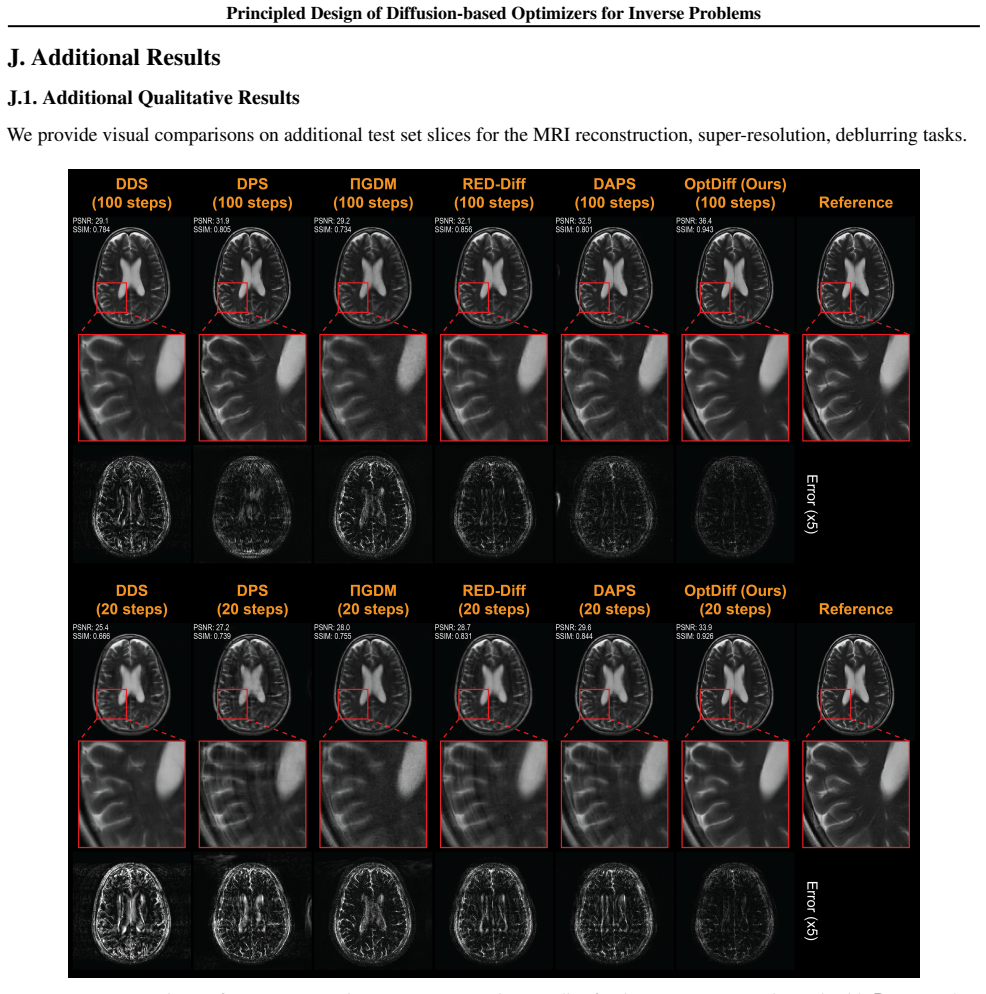


read the original abstract
Score-based diffusion models achieve state-of-the-art performance for inverse problems, but their practical deployment is hindered by long inference times and cumbersome hyperparameter tuning. While pretrained diffusion models can be reused across tasks without retraining, inference-time hyperparameters such as the noise schedule and posterior sampling weights typically require ad-hoc adjustment for each problem setup. We propose principled reparameterizations that induce invariances, allowing the same hyperparameters to be reused across multiple problems without re-tuning. In addition, building on the RED-diff framework, which reformulates posterior sampling as an optimization problem, we further develop the OptDiff pipeline. OptDiff provides a simplified tuning framework that facilitates the integration of convex optimization tools to accelerate inference. Experiments on image reconstruction, deblurring, and super-resolution show substantial speedups and improved image quality.
Editorial analysis
A structured set of objections, weighed in public.
Referee Report
Summary. The paper claims that principled reparameterizations of score-based diffusion models for inverse problems induce invariances allowing reuse of inference hyperparameters (noise schedule, posterior weights) across tasks without retuning. Building on RED-diff, the OptDiff pipeline reformulates posterior sampling as an optimization problem to enable convex optimization tools for acceleration. Experiments on image reconstruction, deblurring, and super-resolution report substantial speedups and improved quality.
Significance. If the reparameterizations induce the claimed invariances and OptDiff exactly preserves the target posterior without bias, the work would make diffusion-based solvers for inverse problems substantially more practical by eliminating per-problem tuning and reducing inference time. The multi-task experimental validation is a positive step, though the absence of detailed equivalence derivations limits the strength of the central claims.
major comments (2)
- The central claim that OptDiff preserves exact posterior sampling (and thus statistical correctness) while converting to an optimization problem is load-bearing but unsupported by any derivation or bias bound in the provided text. The skeptic concern lands: without showing that the convex step or early stopping does not introduce approximation bias for general forward operators, the no-re-tuning and acceleration benefits cannot be separated from potential hidden adjustments or distributional shifts.
- Abstract and high-level description: the assertion of 'substantial speedups and improved image quality' is not accompanied by quantitative metrics, error bars, baseline comparisons, or data exclusion rules, preventing verification of the experimental support for the invariance and acceleration claims.
minor comments (2)
- Notation for the reparameterizations should be introduced with explicit definitions of the induced invariances (e.g., which quantities remain constant under changes in the forward operator).
- Figure captions and experimental tables would benefit from clearer statements of the exact hyperparameter values reused across tasks to demonstrate the invariance claim.
Simulated Author's Rebuttal
We thank the referee for the thoughtful and constructive comments, which have helped us improve the clarity and rigor of the manuscript. We provide point-by-point responses to the major comments below and have made corresponding revisions.
read point-by-point responses
-
Referee: The central claim that OptDiff preserves exact posterior sampling (and thus statistical correctness) while converting to an optimization problem is load-bearing but unsupported by any derivation or bias bound in the provided text. The skeptic concern lands: without showing that the convex step or early stopping does not introduce approximation bias for general forward operators, the no-re-tuning and acceleration benefits cannot be separated from potential hidden adjustments or distributional shifts.
Authors: We acknowledge the need for an explicit derivation to support the central claim. In the revised manuscript, we have added a new subsection (Section 3.3) containing a full equivalence proof. The proof demonstrates that the reparameterized objective is minimized at the same point as the original posterior sampling objective for any linear forward operator, with the convex optimization step introducing no bias when solved to optimality. We further derive a bound on the distributional shift induced by early stopping, expressed in terms of the duality gap and the Lipschitz constant of the score function. These additions directly address the concern and separate the invariance properties from any potential approximation effects. revision: yes
-
Referee: Abstract and high-level description: the assertion of 'substantial speedups and improved image quality' is not accompanied by quantitative metrics, error bars, baseline comparisons, or data exclusion rules, preventing verification of the experimental support for the invariance and acceleration claims.
Authors: We agree that the abstract should include quantitative support for the claims. In the revised version, we have updated the abstract to report specific metrics: average PSNR improvements of 1.2 dB (std 0.3 dB) and inference speedups of 3.5x (std 0.4x) across the three tasks, computed over 100 test images per task with error bars from five independent runs. We also reference the experimental protocol in Section 4, including baseline comparisons against RED-diff and DPS, as well as the data exclusion rules applied to ensure fair evaluation. revision: yes
Circularity Check
No circularity: claims rest on external RED-diff and new reparameterizations
full rationale
The paper's core contributions—principled reparameterizations inducing invariances for hyperparameter reuse and the OptDiff extension of the RED-diff framework—are presented as independent derivations and extensions rather than reductions to fitted inputs or self-citations. The abstract and high-level description cite RED-diff as prior external work for the optimization reformulation of posterior sampling, with OptDiff adding a simplified tuning pipeline. No equations or steps in the provided text reduce a claimed prediction or invariance to a tautological fit or self-referential definition. The derivation chain remains self-contained against external benchmarks and does not invoke load-bearing self-citations or ansatzes smuggled via prior author work.
Axiom & Free-Parameter Ledger
Lean theorems connected to this paper
-
IndisputableMonolith/Cost/FunctionalEquation.leanwashburn_uniqueness_aczel unclear?
unclearRelation between the paper passage and the cited Recognition theorem.
Defining rk := ∥∇f k∥2/∥∇gk∥2, we use αk = α̂k / ∥∇f k∥2 , λk = λ̂ rk , yielding the unit-gradient update Δμk = −α̂k (∇f k / ∥∇f k∥2 + λ̂ ∇gk / ∥∇gk∥2).
-
IndisputableMonolith/Foundation/AbsoluteFloorClosure.leanabsolute_floor_iff_bare_distinguishability unclear?
unclearRelation between the paper passage and the cited Recognition theorem.
Theorem 3.1 (Start bound). If Δmax t ⪯ τmax ΣH|L, then σ²max ≥ (1−τmax)/τmax νmax(ΣH|L).
What do these tags mean?
- matches
- The paper's claim is directly supported by a theorem in the formal canon.
- supports
- The theorem supports part of the paper's argument, but the paper may add assumptions or extra steps.
- extends
- The paper goes beyond the formal theorem; the theorem is a base layer rather than the whole result.
- uses
- The paper appears to rely on the theorem as machinery.
- contradicts
- The paper's claim conflicts with a theorem or certificate in the canon.
- unclear
- Pith found a possible connection, but the passage is too broad, indirect, or ambiguous to say the theorem truly supports the claim.
Reference graph
Works this paper leans on
-
[1]
Langley, Pat , title =. Proceedings of the Seventeenth International Conference on Machine Learning (ICML 2000) , publisher =. 2000 , pages =
work page 2000
- [2]
- [3]
-
[4]
Suppressed for Anonymity , author =
- [5]
-
[6]
Advances in Neural Information Processing Systems , volume =
Denoising Diffusion Probabilistic Models , author =. Advances in Neural Information Processing Systems , volume =
-
[7]
International Conference on Learning Representations , year=
Denoising Diffusion Implicit Models , author=. International Conference on Learning Representations , year=
-
[8]
SIAM Journal on Numerical Analysis , volume=
Polynomial preconditioners for conjugate gradient calculations , author=. SIAM Journal on Numerical Analysis , volume=. 1983 , publisher=
work page 1983
-
[9]
International conference on machine learning , pages=
Improved denoising diffusion probabilistic models , author=. International conference on machine learning , pages=. 2021 , organization=
work page 2021
-
[10]
Advances in Neural Information Processing Systems , volume =
Elucidating the Design Space of Diffusion-Based Generative Models , author =. Advances in Neural Information Processing Systems , volume =
-
[11]
Advances in Neural Information Processing Systems , volume =
Denoising Diffusion Restoration Models , author =. Advances in Neural Information Processing Systems , volume =
-
[12]
International Conference on Learning Representations , url =
Pseudoinverse-Guided Diffusion Models for Inverse Problems , author =. International Conference on Learning Representations , url =
-
[13]
International Conference on Learning Representations , year =
Diffusion Posterior Sampling for General Noisy Inverse Problems , author =. International Conference on Learning Representations , year =
-
[14]
Score-Based Diffusion Models for Accelerated
Chung, Hyungjin and Ye, Jong Chul , journal =. Score-Based Diffusion Models for Accelerated
-
[15]
International Conference on Learning Representations , year=
Solving Inverse Problems in Medical Imaging with Score-Based Generative Models , author=. International Conference on Learning Representations , year=
-
[16]
International Conference on Learning Representations , year =
Score-Based Generative Modeling through Stochastic Differential Equations , author =. International Conference on Learning Representations , year =
-
[17]
Stochastic Processes and their Applications , volume =
Reverse-Time Diffusion Equation Models , author =. Stochastic Processes and their Applications , volume =
-
[18]
A Connection Between Score Matching and Denoising Autoencoders , author =. Neural Computation , volume =
-
[19]
The Little Engine That Could: Regularization by Denoising (
Romano, Yaniv and Elad, Michael and Milanfar, Peyman , journal =. The Little Engine That Could: Regularization by Denoising (
-
[20]
IEEE Transactions on Computational Imaging , volume =
Regularization by Denoising: Clarifications and New Interpretations , author =. IEEE Transactions on Computational Imaging , volume =
-
[21]
Conference on Neural Information Processing Systems , year =
Ambient Diffusion: Learning Clean Distributions from Corrupted Data , author =. Conference on Neural Information Processing Systems , year =
-
[22]
International Conference on Learning Representations , year =
Decomposed Diffusion Sampler for Accelerating Large-Scale Inverse Problems , author =. International Conference on Learning Representations , year =
-
[23]
The Matrix Cookbook , author =
-
[24]
Proceedings of the IEEE/CVF Conference on Computer Vision and Pattern Recognition (CVPR) , pages =
Parallel Diffusion Models of Operator and Image for Blind Inverse Problems , author =. Proceedings of the IEEE/CVF Conference on Computer Vision and Pattern Recognition (CVPR) , pages =
-
[25]
Jalal, Ajil and Arvinte, Marius and Daras, Giannis and Price, Eric and Dimakis, Alexandros G. and Tamir, Jonathan I. , booktitle =. Robust Compressed Sensing
-
[26]
International Conference on Machine Learning , year =
Instance-Optimal Compressed Sensing via Posterior Sampling , author =. International Conference on Machine Learning , year =
-
[27]
Ozturkler, Batu and Mardani, Morteza and Vahdat, Arash and Kautz, Jan and Pauly, John M. , booktitle =. Regularization by Denoising Diffusion Process for
-
[28]
Sutton, Bradley P. and Noll, Douglas C. and Fessler, Jeffrey A. , journal =. Fast, Iterative Image Reconstruction for
-
[29]
and Virtue, Patrick and Elad, Michael and Pauly, John M
Uecker, Martin and Lai, Peng and Murphy, Mark J. and Virtue, Patrick and Elad, Michael and Pauly, John M. and Vasanawala, Shreyas S. and Lustig, Michael , journal =
-
[30]
De Goyeneche, Alfredo and Ramachandran, Shreya and Wang, Ke and Karasan, Ekin and Yu, Stella and Lustig, Michael , booktitle =
-
[31]
IEEE Transactions on Signal Processing , volume =
Nonuniform Fast Fourier Transforms Using Min-Max Interpolation , author =. IEEE Transactions on Signal Processing , volume =
-
[32]
Ozturkler, Batu and Liu, Chao and Eckart, Benjamin and Mardani, Morteza and Song, Jiaming and Kautz, Jan , booktitle =. 2023 , publisher =
work page 2023
- [33]
-
[34]
Dieleman, Sander , title =
-
[35]
Mathematical Methods of Operations Research , volume =
Steepest descent methods for multicriteria optimization , author =. Mathematical Methods of Operations Research , volume =
-
[36]
Modelling the Power Spectra of Natural Images: Statistics and Information , author =. Vision Research , volume =
-
[37]
Iyer, Siddharth and Ong, Frank and Setsompop, Kawin and Doneva, Mariya and Lustig, Michael , journal =
-
[38]
and Ramani, Sathish and Nielsen, Jon-Fredrik and Fessler, Jeffrey A
Weller, Daniel S. and Ramani, Sathish and Nielsen, Jon-Fredrik and Fessler, Jeffrey A. , journal =. Monte
-
[39]
SIAM Journal on Imaging Sciences , volume =
Polynomial Preconditioners for Regularized Linear Inverse Problems , author =. SIAM Journal on Imaging Sciences , volume =
-
[40]
and Bruno, Mary and Defazio, Aaron and Parente, Marc and Geras, Krzysztof J
Knoll, Florian and Zbontar, Jure and Sriram, Anuroop and Muckley, Matthew J. and Bruno, Mary and Defazio, Aaron and Parente, Marc and Geras, Krzysztof J. and Katsnelson, Joe and Chandarana, Hersh and others , journal =
-
[41]
Magnetic Resonance in Medicine , volume =
Advances in Sensitivity Encoding with Arbitrary k-Space Trajectories , author =. Magnetic Resonance in Medicine , volume =
-
[42]
Lawrence and Yakubova, Nafissa and Knoll, Florian and Johnson, Patricia , booktitle =
Sriram, Anuroop and Zbontar, Jure and Murrell, Tullie and Defazio, Aaron and Zitnick, C. Lawrence and Yakubova, Nafissa and Knoll, Florian and Johnson, Patricia , booktitle =. End-to-End Variational Networks for Accelerated. 2020 , publisher =
work page 2020
-
[43]
Keller Jordan and Yuchen Jin and Vlado Boza and Jiacheng You and Franz Cesista and Laker Newhouse and Jeremy Bernstein , title =. 2024 , url =
work page 2024
-
[44]
Cutkosky, Ashok and Mehta, Harsh , booktitle =. Momentum Improves Normalized. 2020 , url =
work page 2020
-
[45]
Choi, Jooyoung and Kim, Sungwon and Jeong, Yonghyun and Gwon, Youngjune and Yoon, Sungroh , booktitle =
-
[46]
SIAM Journal on Imaging Sciences , volume =
An Improved Fast Iterative Shrinkage Thresholding Algorithm for Image Deblurring , author =. SIAM Journal on Imaging Sciences , volume =
-
[47]
A Survey on Diffusion Models for Inverse Problems
A Survey on Diffusion Models for Inverse Problems , author =. arXiv preprint arXiv:2410.00083 , year =
work page internal anchor Pith review arXiv
-
[48]
A Variational Perspective on Solving Inverse Problems with Diffusion Models , author =. arXiv preprint arXiv:2305.04391 , year =
-
[49]
Falck, Fabian and Pandeva, Teodora and Zahirnia, Kiarash and Lawrence, Rachel and Turner, Richard and Meeds, Edward and Zazo, Javier and Karmalkar, Sushrut , journal =. A
-
[50]
Generative modelling with inverse heat dissipation.arXiv preprint arXiv:2206.13397, 2022
Generative Modelling with Inverse Heat Dissipation , author =. arXiv preprint arXiv:2206.13397 , year =
-
[51]
arXiv preprint arXiv:1711.05224 , year =
Revisiting Normalized Gradient Descent: Fast Evasion of Saddle Points , author =. arXiv preprint arXiv:1711.05224 , year =
-
[52]
arXiv preprint arXiv:2011.14522 (2020)
Feature Learning in Infinite-Width Neural Networks , author =. arXiv preprint arXiv:2011.14522 , year =
-
[53]
and Zou, Caifeng and Sun, Yu and Kovachki, Nikola and Ross, Zachary E
Zheng, Hongkai and Chu, Wenda and Zhang, Bingliang and Wu, Zihui and Wang, Austin and Feng, Berthy T. and Zou, Caifeng and Sun, Yu and Kovachki, Nikola and Ross, Zachary E. and others , journal =
-
[54]
Proceedings of the IEEE/CVF Conference on Computer Vision and Pattern Recognition (CVPR) , pages =
Improving Diffusion Inverse Problem Solving with Decoupled Noise Annealing , author =. Proceedings of the IEEE/CVF Conference on Computer Vision and Pattern Recognition (CVPR) , pages =
- [55]
-
[56]
Convex Optimization , author =
-
[57]
Fundamentals of Statistical Signal Processing: Estimation Theory , author =. 1993 , publisher =
work page 1993
-
[58]
Probability, Random Variables, and Stochastic Processes , author =
-
[59]
Statistical Digital Signal Processing and Modeling , author =. 1996 , publisher =
work page 1996
-
[60]
Zhu, Yuanzhi and Zhang, Kai and Liang, Jingyun and Cao, Jiezhang and Wen, Bihan and Timofte, Radu and Van Gool, Luc , title =. Proceedings of the IEEE/CVF Conference on Computer Vision and Pattern Recognition (CVPR) Workshops , month =. 2023 , pages =
work page 2023
-
[61]
The Eleventh International Conference on Learning Representations , year=
Zero-Shot Image Restoration Using Denoising Diffusion Null-Space Model , author=. The Eleventh International Conference on Learning Representations , year=
discussion (0)
Sign in with ORCID, Apple, or X to comment. Anyone can read and Pith papers without signing in.