Recognition: 2 theorem links
· Lean TheoremA self-adjoint Fourier-type model for the iQuad wavefront sensor
Pith reviewed 2026-05-13 05:06 UTC · model grok-4.3
The pith
The linearized operator for the iQuad wavefront sensor is self-adjoint because it matches the two-dimensional finite Hilbert transform.
A machine-rendered reading of the paper's core claim, the machinery that carries it, and where it could break.
Core claim
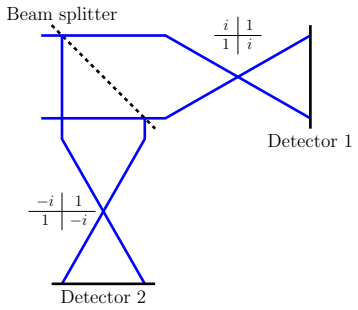
We establish a comprehensive mathematical framework for the iQuad WFS, including its forward models and linearizations based on the Fréchet derivative. We reveal a connection between the iQuad WFS and the 2d finite Hilbert transform and demonstrate that the linear iQuad WFS operator is self-adjoint - a unique property among Fourier-type WFSs. Additionally, we introduce the double iQuad WFS, a two-path configuration that combines two rotated iQuad WFSs. This design addresses the limitations of the single iQuad WFS by suppressing poorly-seen phase components. Moreover, the double setup simplifies the mathematical modeling. We also highlight iQuad similarities to the widely used pyramid WFS and
What carries the argument
The linear iQuad WFS operator obtained as the Fréchet derivative of the focal-plane intensity model with the four-quadrant phase mask; this operator is shown to coincide with the 2D finite Hilbert transform and is therefore self-adjoint.
If this is right
- Self-adjointness permits symmetric-matrix techniques that simplify inversion for wavefront reconstruction.
- The double iQuad configuration removes directions that are poorly sensed by a single mask.
- Mathematical parallels to the pyramid sensor allow reuse of existing reconstruction methods.
- Addition of modulation increases the sensor's usable dynamic range.
- The closed-form model supports development of fast, model-based reconstruction algorithms.
Where Pith is reading between the lines
- Symmetric operators may reduce conditioning problems when solving large reconstruction systems in real-time adaptive optics.
- The Hilbert-transform identification could suggest analogous analyses for other phase-mask sensors.
- Experimental comparison of single and double iQuad data on the same telescope would test whether the predicted suppression of blind spots occurs in practice.
Load-bearing premise
The forward models and their Fréchet-derivative linearizations accurately capture the physical behavior of the iQuad sensor with its four-quadrant phase mask under the stated optical conditions.
What would settle it
Direct numerical verification that the adjoint of the discretized linear operator equals the operator itself; mismatch would disprove self-adjointness.
Figures



read the original abstract
Advanced adaptive optics (AO) systems can use Fourier-type wavefront sensing to correct optical distortions encountered in ground-based telescopes, AO-assisted retinal imaging, and free-space optical communications (FSOC). Recently, a novel Fourier-type wavefront sensor (WFS) known as the iQuad WFS has been introduced. Its design features a focal plane tessellation with a four-quadrant phase mask (FQPM) that incorporates a $\pm \pi/2$ phase shift between adjacent quadrants. In this work, we establish a comprehensive mathematical framework for the iQuad WFS, including its forward models and linearizations based on the Fr\'echet derivative. We reveal a connection between the iQuad WFS and the 2d finite Hilbert transform and demonstrate that the linear iQuad WFS operator is self-adjoint - a unique property among Fourier-type WFSs. Additionally, we introduce the double iQuad WFS, a two-path configuration that combines two rotated iQuad WFSs. This design addresses the limitations of the single iQuad WFS by suppressing poorly-seen phase components. Moreover, the double setup simplifies the mathematical modeling. We also highlight iQuad similarities to the widely used pyramid wavefront sensor (PWFS). Finally, we extend the concept of modulation to the iQuad WFS, further enhancing its versatility. The theoretical analysis presented here lays the groundwork for the development of fast and robust model-based wavefront reconstruction algorithms for the iQuad WFS, paving the way for future applications in AO instruments.
Editorial analysis
A structured set of objections, weighed in public.
Referee Report
Summary. The paper develops a mathematical framework for the iQuad wavefront sensor (WFS), which uses a focal-plane four-quadrant phase mask with ±π/2 shifts between quadrants. It constructs forward models, obtains the linear operator via the Fréchet derivative, establishes an explicit connection between this operator and the 2D finite Hilbert transform, and proves that the linear iQuad operator is self-adjoint. The work also introduces a double iQuad WFS (two rotated paths) to suppress poorly sensed phase components, notes similarities to the pyramid WFS, and extends the concept of modulation to the iQuad design, with the goal of enabling model-based reconstruction algorithms for adaptive optics.
Significance. If the self-adjointness result and the Hilbert-transform identification hold, the paper supplies a concrete theoretical advantage for the iQuad WFS that is absent from other Fourier-type sensors: the linear operator admits a symmetric inner-product structure that can simplify inversion, preconditioning, or iterative solvers. The double-iQuad configuration and the modulation extension are practical additions that directly address known limitations of single-path Fourier sensors. The work therefore provides both an analytical foundation and a concrete hardware variant that could accelerate development of fast, robust AO reconstructors.
major comments (2)
- [§3.2, Eq. (8)] §3.2, Eq. (8): the Fréchet derivative linearization is stated to produce the finite-Hilbert-transform operator, but the derivation assumes that the phase mask discontinuities lie exactly at the quadrant boundaries and that the pupil function is compactly supported; the paper does not verify that the resulting operator remains self-adjoint when these idealizations are relaxed to realistic finite-aperture or diffraction-limited cases.
- [§4.1, Theorem 1] §4.1, Theorem 1: the uniqueness claim that self-adjointness is 'unique among Fourier-type WFSs' is supported only by the specific ±π/2 quadrant shifts; an explicit operator comparison (or at least a reference to the known non-self-adjoint forms of the pyramid or Zernike WFS linearizations) is needed to make the statement load-bearing rather than illustrative.
minor comments (3)
- [§5] The notation for the double iQuad WFS (two rotated paths) is introduced in §5 without a clear diagram showing the relative rotation angle and the combined measurement vector; a single figure would improve readability.
- [Eq. (3)] Several forward-model integrals (e.g., Eq. (3)) retain the full nonlinear phase exponential; the transition to the linearized form should be accompanied by an explicit statement of the small-phase assumption used in the Fréchet derivative.
- [Introduction] The abstract and introduction cite the pyramid WFS only for qualitative similarity; a short paragraph contrasting the iQuad mask geometry with the pyramid's four-facet layout would help readers unfamiliar with both sensors.
Simulated Author's Rebuttal
We thank the referee for their careful reading of the manuscript and for the constructive comments, which help clarify the scope of our theoretical results. We address each major comment below and indicate the revisions we will make.
read point-by-point responses
-
Referee: [§3.2, Eq. (8)] the Fréchet derivative linearization is stated to produce the finite-Hilbert-transform operator, but the derivation assumes that the phase mask discontinuities lie exactly at the quadrant boundaries and that the pupil function is compactly supported; the paper does not verify that the resulting operator remains self-adjoint when these idealizations are relaxed to realistic finite-aperture or diffraction-limited cases.
Authors: We agree that the derivation in §3.2 relies on the idealized assumptions of exact alignment of phase-mask discontinuities with quadrant boundaries and compact support of the pupil function. These standard idealizations permit the closed-form identification with the 2D finite Hilbert transform and the subsequent self-adjointness proof. In non-ideal settings the operator becomes a perturbation, but our work is deliberately focused on the exact mathematical framework rather than numerical verification of approximate cases. We will add an explicit statement of the assumptions together with a clarifying remark that self-adjointness is proven strictly within the ideal model. revision: partial
-
Referee: [§4.1, Theorem 1] the uniqueness claim that self-adjointness is 'unique among Fourier-type WFSs' is supported only by the specific ±π/2 quadrant shifts; an explicit operator comparison (or at least a reference to the known non-self-adjoint forms of the pyramid or Zernike WFS linearizations) is needed to make the statement load-bearing rather than illustrative.
Authors: The self-adjoint property follows directly from the particular choice of ±π/2 phase steps, which produces the symmetric finite-Hilbert structure; other Fourier-type sensors employ different phase masks (e.g., the pyramid WFS with its roof-prism or ±π steps) whose linearizations are known to be non-self-adjoint. We will strengthen the discussion in §4.1 by adding a brief comparison and appropriate references to the established non-self-adjoint linear operators of the pyramid and Zernike wavefront sensors, thereby making the uniqueness statement substantive rather than merely illustrative. revision: yes
Circularity Check
No significant circularity in derivation chain
full rationale
The paper constructs forward models from the four-quadrant phase mask geometry, applies the Fréchet derivative to obtain the linear operator, and then proves self-adjointness by exhibiting an explicit isomorphism to the 2D finite Hilbert transform (via integration by parts or Fourier symmetry). These steps rely on standard operator theory and the explicit phase-shift definition; they do not reduce to fitted parameters, self-referential definitions, or load-bearing self-citations. The uniqueness claim among Fourier-type sensors follows directly from the specific ±π/2 quadrant shifts rather than from an imported theorem. The double-iQuad and modulation extensions are likewise derived from the same operator without circular reuse of the target result. The framework is therefore self-contained against external mathematical benchmarks.
Axiom & Free-Parameter Ledger
axioms (2)
- domain assumption The Fréchet derivative provides a valid linearization of the iQuad WFS forward model.
- domain assumption The four-quadrant phase mask with ±π/2 shifts produces the described Fourier-type response.
invented entities (1)
-
double iQuad WFS
no independent evidence
Reference graph
Works this paper leans on
-
[1]
V. Chambouleyron, J. K. Wallace, R. Jensen-Clem, and B. Macintosh. Coronagraph-based wavefront sensors for the high Strehl regime.Opt. Express, 32(27):47706–47720, Dec 2024
work page 2024
-
[2]
B. L. Ellerbroek. Efficient computation of minimum-variance wave-front recon- structors with sparse matrix techniques.JOSA A, 19(9):1803–1816, 2002
work page 2002
-
[3]
M. Eslitzbichler, C. Pechstein, and R. Ramlau. AnH1-Kaczmarz reconstructor for atmospheric tomography.Journal of Inverse and Ill-Posed Problems, 21(3):431– 450, 06 2013
work page 2013
-
[4]
O. Fauvarque, V. Hutterer, P. Janin-Potiron, J. Duboisset, C. Correia, B. Ne- ichel, J.-F. Sauvage, T. Fusco, I. Shatokhina, R. Ramlau, V. Chambouleyron, and Y. Brûlé. The ıQuad sensor: a new Fourier-based wave front sensor derived from the 4 quadrants coronagraph. InProceedings of the 6th AO4ELT Conference, pages 1–13, June 2019
work page 2019
-
[5]
O. Fauvarque, B. Neichel, T. Fusco, J.-F. Sauvage, and O. Girault. General for- malism for Fourier-based wave front sensing.Optica, 3(12):1440–1452, 12 2016
work page 2016
-
[6]
V. Hutterer, A. Neubauer, and J. Shatokhina. A mathematical framework for nonlinear wavefront reconstruction in adaptive optics systems with Fourier-type wavefront sensing.Inverse Problems, 39(3):035007, Feb 2023
work page 2023
-
[7]
V. Hutterer, R. Ramlau, and I. Shatokhina. Real-time adaptive optics with pyra- mid wavefront sensors: part I. A theoretical analysis of the pyramid sensor model. Inverse Problems, 35(4):045007, Mar 2019. 18
work page 2019
-
[8]
V. Hutterer, R. Ramlau, and I. Shatokhina. Real-time adaptive optics with pyra- mid wavefront sensors: part II. Accurate wavefront reconstruction using iterative methods.Inverse Problems, 35(4):045008, Mar 2019
work page 2019
-
[9]
N’Diaye, M., Dohlen, K., Fusco, T., and Paul, B. Calibration of quasi-static aberrations in exoplanet direct-imaging instruments with a Zernike phase-mask sensor.A&A, 555:A94, 2013
work page 2013
- [10]
-
[11]
R. Ramlau and G. Teschke. Regularization of Sobolev Embedding Operators and Applications Part I: Fourier and Wavelet based Methods.Sampling Theory In Signal And Image Processing, 3:175–196, 2004
work page 2004
-
[12]
Roddier.Adaptive Optics in Astronomy
F. Roddier.Adaptive Optics in Astronomy. Cambridge University, 1999
work page 1999
-
[13]
F. Roddier and C. Roddier. Stellar coronograph with phase mask.Publications of the Astronomical Society of the Pacific, 109(737):815, Jul 1997
work page 1997
-
[14]
M. C. Roggemann and B. M. Welsh.Imaging through Turbulence. CRC Press, 1996
work page 1996
-
[15]
TheFour-Quadrant Phase-Mask Coronagraph
D.Rouan, P.Riaud, A.Boccaletti, Y.Clénet, andA.Labeyrie. TheFour-Quadrant Phase-Mask Coronagraph. I. Principle.Publications of the Astronomical Society of the Pacific, 112(777):1479, Nov 2000
work page 2000
-
[16]
R. V. Shack and B. C. Platt. Production and use of a lenticular Hartmann screen. Journal of the Optical Society of America, 61(5):656, 1971
work page 1971
-
[17]
I. Shatokhina, V. Hutterer, and R. Ramlau. Review on methods for wavefront reconstruction from pyramid wavefront sensor data.Journal of Astronomical Tele- scopes, Instruments, and Systems, 6(1):1 – 39, 2020
work page 2020
-
[18]
E. M. Stein and G. Weiss.Introduction to Fourier Analysis on Euclidean Spaces, volume 32 ofPrinceton Mathematical Series. Princeton University Press, Prince- ton, NJ, 1971
work page 1971
-
[19]
R.K. Tyson and B.W. Frazier.Principles of Adaptive Optics. Academic Press, 1991
work page 1991
- [20]
-
[21]
F. Zernike and F. J. M. Stratton. Diffraction Theory of the Knife-Edge Test and its Improved Form, The Phase-Contrast Method.Monthly Notices of the Royal Astronomical Society, 94(5):377–384, 03 1934. 19 A. Appendix Theorem A.1.LetΩ,Ω ′,Ω ′′ be subsets ofR2 andf∈L 1(Ω×Ω ′ ×Ω ′′). Assume that p.v. Z Ω′ Z Ω′′ f(x, y, x ′, y′, x′′, y′′) (x′ −x)(y ′ −y)(x ′′ −...
work page 1934
discussion (0)
Sign in with ORCID, Apple, or X to comment. Anyone can read and Pith papers without signing in.