Recognition: 2 theorem links
· Lean TheoremMitigating Action-Relation Hallucinations in LVLMs via Relation-aware Visual Enhancement
Pith reviewed 2026-05-13 05:35 UTC · model grok-4.3
The pith
Identifying action-sensitive attention heads and boosting focus on relevant image regions reduces action-relation hallucinations in large vision-language models.
A machine-rendered reading of the paper's core claim, the machinery that carries it, and where it could break.
Core claim
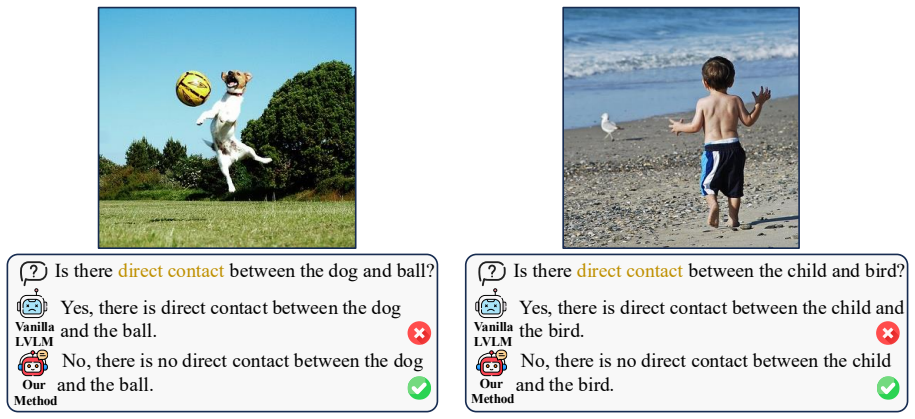
We empirically observe that the primary cause of action-relation hallucinations in LVLMs is the insufficient attention allocated to visual information. Thus, we propose a framework to locate action-relevant image regions and enhance the LVLM's attention to those regions. Specifically, we define the Action-Relation Sensitivity (ARS) score to identify attention heads that are most sensitive to action-relation changes, thereby localizing action-relevant image regions that contain key visual cues. Then, we propose the Relation-aware Visual Enhancement (RVE) method to enhance the LVLM's attention to these action-relevant image regions.
What carries the argument
The Action-Relation Sensitivity (ARS) score, which ranks attention heads by sensitivity to action-relation changes, paired with Relation-aware Visual Enhancement (RVE) that raises attention weights on the identified action-relevant image regions.
If this is right
- LVLMs produce more accurate descriptions of object interactions at almost no extra inference cost.
- The same attention-enhancement technique generalizes to lowering spatial-relation and object hallucinations.
- Targeted boosting of relation-sensitive heads offers a lightweight way to improve visual grounding without retraining the full model.
Where Pith is reading between the lines
- The ARS scoring approach could be adapted to detect and correct other hallucination categories by swapping the sensitivity criterion.
- Running the enhancement at training time instead of inference might produce models that require less post-hoc correction for relation errors.
- Extending the method to video or multi-image inputs could address hallucinations involving temporal or cross-image relations.
Load-bearing premise
Insufficient attention to visual information is the main driver of action-relation hallucinations rather than other factors such as training data or model capacity.
What would settle it
A controlled test that applies the ARS-based region identification and attention boost yet shows no reduction in action-relation hallucination rates compared with the unmodified baseline model.
Figures


read the original abstract
Large Vision-Language Models (LVLMs) have achieved remarkable performance on diverse vision-language tasks. However, LVLMs still suffer from hallucinations, generating text that contradicts the visual input. Existing research has primarily focused on mitigating object hallucinations, but often overlooks more complex relation hallucinations, particularly action relations involving interactions between objects. In this study, we empirically observe that the primary cause of action-relation hallucinations in LVLMs is the insufficient attention allocated to visual information. Thus, we propose a framework to locate action-relevant image regions and enhance the LVLM's attention to those regions. Specifically, we define the Action-Relation Sensitivity (ARS) score to identify attention heads that are most sensitive to action-relation changes, thereby localizing action-relevant image regions that contain key visual cues. Then, we propose the Relation-aware Visual Enhancement (RVE) method to enhance the LVLM's attention to these action-relevant image regions. Extensive experiments demonstrate that, compared to existing baselines, our method achieves superior performance in mitigating action-relation hallucinations with negligible additional inference cost. Furthermore, it effectively generalizes to spatial-relation hallucinations and object hallucinations.
Editorial analysis
A structured set of objections, weighed in public.
Referee Report
Summary. The paper claims that action-relation hallucinations in LVLMs arise primarily from insufficient attention to visual tokens. It introduces an Action-Relation Sensitivity (ARS) score to identify attention heads sensitive to action-relation changes and localize relevant image regions, followed by a Relation-aware Visual Enhancement (RVE) procedure that boosts attention to those regions during inference. Experiments are said to show that the resulting method outperforms existing baselines on action-relation hallucination benchmarks while adding negligible inference cost and generalizing to spatial-relation and object hallucinations.
Significance. If the motivating observation and reported gains hold under controlled conditions, the work would supply a lightweight, head-localized intervention for a class of hallucinations that most prior mitigation techniques have not addressed, offering a practical route to improved relational reasoning in deployed LVLMs.
major comments (2)
- [Abstract / §1] Abstract and §1: the central premise that 'the primary cause of action-relation hallucinations ... is the insufficient attention allocated to visual information' is stated as an empirical observation, yet no LVLMs, datasets, prompt templates, attention-measurement protocol, or control conditions are specified. Because this observation directly motivates both the ARS head-selection step and the RVE enhancement, its lack of documentation renders the entire pipeline's rationale unverifiable.
- [§3] §3 (Method): the definitions of the ARS score and the subsequent region-localization procedure are introduced without an explicit statement of how ARS thresholds or head-selection criteria are chosen; if these choices are tuned on the same evaluation sets used to report gains, the performance improvements may be partly circular.
minor comments (2)
- [§4] §4 (Experiments): report the exact number of runs, random seeds, and statistical significance tests (e.g., paired t-tests or Wilcoxon) for all claimed improvements over baselines.
- [Figure 2 / §3.2] Figure 2 and §3.2: clarify the precise mathematical formulation of RVE (including any scaling factors or masking operations) so that the negligible-inference-cost claim can be reproduced from the text alone.
Simulated Author's Rebuttal
We thank the referee for the constructive and detailed feedback. The two major comments highlight important issues of verifiability and potential circularity in our empirical motivation and method design. We address each point below and commit to revisions that strengthen the manuscript without altering its core claims.
read point-by-point responses
-
Referee: [Abstract / §1] Abstract and §1: the central premise that 'the primary cause of action-relation hallucinations ... is the insufficient attention allocated to visual information' is stated as an empirical observation, yet no LVLMs, datasets, prompt templates, attention-measurement protocol, or control conditions are specified. Because this observation directly motivates both the ARS head-selection step and the RVE enhancement, its lack of documentation renders the entire pipeline's rationale unverifiable.
Authors: We agree that the empirical foundation for the central premise requires explicit documentation to be verifiable. The observation was derived from internal preliminary experiments (attention weight comparisons on action-relation vs. non-relation prompts), but these details were omitted from the submitted version for brevity. In the revised manuscript we will insert a new paragraph in §1 (and a supporting subsection in the appendix) that specifies: the LVLMs examined (LLaVA-1.5-7B/13B, InstructBLIP, Qwen-VL), the prompt templates and datasets used for the observation (subsets of Visual Genome and a custom action-relation prompt set), the exact attention-measurement protocol (mean attention mass on visual tokens for perturbed vs. original queries), and the control conditions (hallucination rate under visual masking). This addition will make the motivating claim fully reproducible while preserving the original narrative flow. revision: yes
-
Referee: [§3] §3 (Method): the definitions of the ARS score and the subsequent region-localization procedure are introduced without an explicit statement of how ARS thresholds or head-selection criteria are chosen; if these choices are tuned on the same evaluation sets used to report gains, the performance improvements may be partly circular.
Authors: We acknowledge the need for explicit, non-circular selection rules. The ARS score (Eq. 1) ranks heads by the absolute change in visual-token attention under action-relation perturbation; we select the top 20 % of heads by this ranking (a fixed percentile chosen once on a small development split of Visual Genome that is disjoint from all reported test benchmarks). Region localization thresholds the resulting attention map at the 75th percentile, again a fixed value validated only on the same held-out development split. In the revised §3.2–3.3 we will state these criteria verbatim, add a sentence confirming that no hyper-parameter search was performed on the action-relation hallucination test sets, and include a brief sensitivity table (varying the percentile from 60–85 %) to demonstrate robustness. These changes eliminate any appearance of circularity. revision: yes
Circularity Check
No circularity: derivation chain is self-contained and independent of its inputs
full rationale
The paper motivates its framework from an empirical observation on attention allocation in LVLMs, then defines ARS as a new sensitivity metric over attention heads and RVE as an attention-enhancement procedure applied to localized regions. These steps are constructive definitions rather than reductions; the reported performance improvements are presented as outcomes of experiments on external benchmarks, with no equations or procedures shown to be equivalent to the inputs by construction. No self-citations, fitted parameters renamed as predictions, or uniqueness theorems appear in the load-bearing chain. The method therefore remains non-circular and externally falsifiable.
Axiom & Free-Parameter Ledger
axioms (1)
- domain assumption Action-relation hallucinations primarily stem from insufficient attention to visual information
invented entities (2)
-
Action-Relation Sensitivity (ARS) score
no independent evidence
-
Relation-aware Visual Enhancement (RVE)
no independent evidence
Lean theorems connected to this paper
-
IndisputableMonolith/Foundation/RealityFromDistinction.leanreality_from_one_distinction unclear?
unclearRelation between the paper passage and the cited Recognition theorem.
we empirically observe that the primary cause of action-relation hallucinations in LVLMs is the insufficient attention allocated to visual information
-
IndisputableMonolith/Cost/FunctionalEquation.leanwashburn_uniqueness_aczel unclear?
unclearRelation between the paper passage and the cited Recognition theorem.
define the Action-Relation Sensitivity (ARS) score ... ARS(l,h) = ∥A(l,h) − Â(l,h)∥F / ½(∥A∥F + ∥Â∥F)
What do these tags mean?
- matches
- The paper's claim is directly supported by a theorem in the formal canon.
- supports
- The theorem supports part of the paper's argument, but the paper may add assumptions or extra steps.
- extends
- The paper goes beyond the formal theorem; the theorem is a base layer rather than the whole result.
- uses
- The paper appears to rely on the theorem as machinery.
- contradicts
- The paper's claim conflicts with a theorem or certificate in the canon.
- unclear
- Pith found a possible connection, but the passage is too broad, indirect, or ambiguous to say the theorem truly supports the claim.
Reference graph
Works this paper leans on
-
[1]
Shikra: Unleashing Multimodal LLM's Referential Dialogue Magic
Shikra: Unleashing multimodal llm's referential dialogue magic , author=. arXiv preprint arXiv:2306.15195 , year=
work page internal anchor Pith review Pith/arXiv arXiv
-
[2]
A Survey on Hallucination in Large Vision-Language Models
A survey on hallucination in large vision-language models , author=. arXiv preprint arXiv:2402.00253 , year=
work page internal anchor Pith review arXiv
-
[3]
International conference on machine learning , pages=
Blip-2: Bootstrapping language-image pre-training with frozen image encoders and large language models , author=. International conference on machine learning , pages=. 2023 , organization=
work page 2023
-
[4]
DeepSeek-VL: Towards Real-World Vision-Language Understanding , author=. 2024 , eprint=
work page 2024
-
[5]
Proceedings of the IEEE/CVF Conference on Computer Vision and Pattern Recognition (CVPR) , month =
Chen, Zhe and Wu, Jiannan and Wang, Wenhai and Su, Weijie and Chen, Guo and Xing, Sen and Zhong, Muyan and Zhang, Qinglong and Zhu, Xizhou and Lu, Lewei and Li, Bin and Luo, Ping and Lu, Tong and Qiao, Yu and Dai, Jifeng , title =. Proceedings of the IEEE/CVF Conference on Computer Vision and Pattern Recognition (CVPR) , month =. 2024 , pages =
work page 2024
-
[6]
Unified Hallucination Detection for Multimodal Large Language Models , author=. Proceedings of the 62nd Annual Meeting of the Association for Computational Linguistics (Volume 1: Long Papers) , pages=
-
[7]
Proceedings of the IEEE/CVF Conference on Computer Vision and Pattern Recognition , pages=
Throne: An object-based hallucination benchmark for the free-form generations of large vision-language models , author=. Proceedings of the IEEE/CVF Conference on Computer Vision and Pattern Recognition , pages=
-
[8]
mPLUG-Owl: Modularization Empowers Large Language Models with Multimodality
mplug-owl: Modularization empowers large language models with multimodality , author=. arXiv preprint arXiv:2304.14178 , year=
-
[9]
Proceedings of the 2023 conference on empirical methods in natural language processing , pages=
Evaluating object hallucination in large vision-language models , author=. Proceedings of the 2023 conference on empirical methods in natural language processing , pages=
work page 2023
-
[10]
Evaluation and analysis of hal- lucination in large vision-language models
Evaluation and analysis of hallucination in large vision-language models , author=. arXiv preprint arXiv:2308.15126 , year=
-
[11]
Proceedings of the AAAI Conference on Artificial Intelligence , volume=
Detecting and preventing hallucinations in large vision language models , author=. Proceedings of the AAAI Conference on Artificial Intelligence , volume=
-
[12]
12th International Conference on Learning Representations, ICLR 2024 , year=
ANALYZING AND MITIGATING OBJECT HALLUCINATION IN LARGE VISION-LANGUAGE MODELS , author=. 12th International Conference on Learning Representations, ICLR 2024 , year=
work page 2024
-
[13]
Proceedings of the IEEE/CVF Conference on Computer Vision and Pattern Recognition (CVPR) , month =
Yu, Tianyu and Yao, Yuan and Zhang, Haoye and He, Taiwen and Han, Yifeng and Cui, Ganqu and Hu, Jinyi and Liu, Zhiyuan and Zheng, Hai-Tao and Sun, Maosong and Chua, Tat-Seng , title =. Proceedings of the IEEE/CVF Conference on Computer Vision and Pattern Recognition (CVPR) , month =. 2024 , pages =
work page 2024
-
[14]
Proceedings of the IEEE/CVF Conference on Computer Vision and Pattern Recognition , pages=
Opera: Alleviating hallucination in multi-modal large language models via over-trust penalty and retrospection-allocation , author=. Proceedings of the IEEE/CVF Conference on Computer Vision and Pattern Recognition , pages=
-
[15]
Proceedings of the IEEE/CVF Conference on Computer Vision and Pattern Recognition (CVPR) , month =
Yu, Qifan and Li, Juncheng and Wei, Longhui and Pang, Liang and Ye, Wentao and Qin, Bosheng and Tang, Siliang and Tian, Qi and Zhuang, Yueting , title =. Proceedings of the IEEE/CVF Conference on Computer Vision and Pattern Recognition (CVPR) , month =. 2024 , pages =
work page 2024
-
[16]
Cracking the code of hallucination in lvlms with vision-aware head divergence , author=. Proceedings of the 63rd Annual Meeting of the Association for Computational Linguistics (Volume 1: Long Papers) , pages=
-
[17]
arXiv preprint arXiv:2507.00898 , year=
ONLY: One-Layer Intervention Sufficiently Mitigates Hallucinations in Large Vision-Language Models , author=. arXiv preprint arXiv:2507.00898 , year=
-
[18]
Beyond hallucinations: Enhancing lvlms through hallucination-aware direct preference optimization,
Beyond hallucinations: Enhancing lvlms through hallucination-aware direct preference optimization , author=. arXiv preprint arXiv:2311.16839 , year=
-
[19]
Aligning Large Multimodal Models with Factually Augmented RLHF
Sun, Zhiqing and Shen, Sheng and Cao, Shengcao and Liu, Haotian and Li, Chunyuan and Shen, Yikang and Gan, Chuang and Gui, Liangyan and Wang, Yu-Xiong and Yang, Yiming and Keutzer, Kurt and Darrell, Trevor. Aligning Large Multimodal Models with Factually Augmented RLHF. Findings of the Association for Computational Linguistics: ACL 2024. 2024. doi:10.1865...
-
[20]
Science China Information Sciences , volume=
Woodpecker: Hallucination correction for multimodal large language models , author=. Science China Information Sciences , volume=. 2024 , publisher=
work page 2024
-
[21]
Proceedings of the IEEE/CVF Conference on Computer Vision and Pattern Recognition , pages=
Mitigating object hallucinations in large vision-language models through visual contrastive decoding , author=. Proceedings of the IEEE/CVF Conference on Computer Vision and Pattern Recognition , pages=
-
[22]
Proceedings of the 41st International Conference on Machine Learning , pages=
HALC: object hallucination reduction via adaptive focal-contrast decoding , author=. Proceedings of the 41st International Conference on Machine Learning , pages=
-
[23]
Proceedings of the Computer Vision and Pattern Recognition Conference , pages=
Mitigating object hallucinations in large vision-language models with assembly of global and local attention , author=. Proceedings of the Computer Vision and Pattern Recognition Conference , pages=
-
[24]
Findings of the Association for Computational Linguistics: ACL 2024 , pages=
Mitigating hallucinations in large vision-language models with instruction contrastive decoding , author=. Findings of the Association for Computational Linguistics: ACL 2024 , pages=
work page 2024
-
[25]
Proceedings of the Computer Vision and Pattern Recognition Conference , pages=
ClearSight: Visual Signal Enhancement for Object Hallucination Mitigation in Multimodal Large Language Models , author=. Proceedings of the Computer Vision and Pattern Recognition Conference , pages=
-
[26]
arXiv preprint arXiv:2404.18624 , year=
Do Vision & Language Decoders use Images and Text equally? How Self-consistent are their Explanations? , author=. arXiv preprint arXiv:2404.18624 , year=
-
[27]
Less is More: Mitigating Multimodal Hallucination from an EOS Decision Perspective , author=. Proceedings of the 62nd Annual Meeting of the Association for Computational Linguistics (Volume 1: Long Papers) , pages=
-
[28]
Why Is Spatial Reasoning Hard for VLMs? An Attention Mechanism Perspective on Focus Areas , author=
-
[29]
See What You Are Told: Visual Attention Sink in Large Multimodal Models , author=
-
[30]
Proceedings of the Computer Vision and Pattern Recognition Conference , pages=
Devils in middle layers of large vision-language models: Interpreting, detecting and mitigating object hallucinations via attention lens , author=. Proceedings of the Computer Vision and Pattern Recognition Conference , pages=
-
[31]
Hallucination of Multimodal Large Language Models: A Survey
Hallucination of multimodal large language models: A survey , author=. arXiv preprint arXiv:2404.18930 , year=
work page internal anchor Pith review Pith/arXiv arXiv
-
[32]
Findings of the association for computational linguistics: ACL 2024 , pages=
The revolution of multimodal large language models: A survey , author=. Findings of the association for computational linguistics: ACL 2024 , pages=
work page 2024
-
[33]
Proceedings of the Computer Vision and Pattern Recognition Conference , pages=
A survey of state of the art large vision language models: Benchmark evaluations and challenges , author=. Proceedings of the Computer Vision and Pattern Recognition Conference , pages=
-
[34]
International Conference on Machine Learning , pages=
Evaluating and Analyzing Relationship Hallucinations in Large Vision-Language Models , author=. International Conference on Machine Learning , pages=. 2024 , organization=
work page 2024
-
[35]
arXiv preprint arXiv:2406.09121 , year=
MMRel: A Relation Understanding Benchmark in the MLLM Era , author=. arXiv preprint arXiv:2406.09121 , year=
-
[36]
Findings of the Association for Computational Linguistics: ACL 2025 , pages=
Reefknot: A comprehensive benchmark for relation hallucination evaluation, analysis and mitigation in multimodal large language models , author=. Findings of the Association for Computational Linguistics: ACL 2025 , pages=
work page 2025
-
[37]
Head Pursuit: Probing Attention Specialization in Multimodal Transformers , author=
-
[38]
13th International Conference on Learning Representations, ICLR 2025 , pages=
RETRIEVAL HEAD MECHANISTICALLY EXPLAINS LONG-CONTEXT FACTUALITY , author=. 13th International Conference on Learning Representations, ICLR 2025 , pages=. 2025 , organization=
work page 2025
-
[39]
Do Vision Transformers See Like Convolutional Neural Networks? , url =
Raghu, Maithra and Unterthiner, Thomas and Kornblith, Simon and Zhang, Chiyuan and Dosovitskiy, Alexey , booktitle =. Do Vision Transformers See Like Convolutional Neural Networks? , url =
-
[40]
Layer by layer: Uncovering hidden representations in language models , author=. arXiv preprint arXiv:2502.02013 , year=
-
[41]
Advances in neural information processing systems , volume=
Instructblip: Towards general-purpose vision-language models with instruction tuning , author=. Advances in neural information processing systems , volume=
-
[42]
Object Hallucination in Image Captioning
Object hallucination in image captioning , author=. arXiv preprint arXiv:1809.02156 , year=
-
[43]
Proceedings of the IEEE/CVF conference on computer vision and pattern recognition , pages=
Improved baselines with visual instruction tuning , author=. Proceedings of the IEEE/CVF conference on computer vision and pattern recognition , pages=
-
[44]
Liu, Haotian and Li, Chunyuan and Li, Yuheng and Li, Bo and Zhang, Yuanhan and Shen, Sheng and Lee, Yong Jae , year=
-
[45]
European Conference on Computer Vision , pages=
Sharegpt4v: Improving large multi-modal models with better captions , author=. European Conference on Computer Vision , pages=. 2024 , organization=
work page 2024
-
[46]
AMBER: An LLM-free Multi-dimensional Benchmark for MLLMs Hallucination Evaluation , author=. 2024 , eprint=
work page 2024
-
[47]
European Conference on Computer Vision , pages=
Paying more attention to image: A training-free method for alleviating hallucination in lvlms , author=. European Conference on Computer Vision , pages=. 2024 , organization=
work page 2024
-
[48]
MME: A Comprehensive Evaluation Benchmark for Multimodal Large Language Models
Mme: A comprehensive evaluation benchmark for multimodal large language models , author=. arXiv preprint arXiv:2306.13394 , year=
work page internal anchor Pith review Pith/arXiv arXiv
-
[49]
European conference on computer vision , pages=
Mmbench: Is your multi-modal model an all-around player? , author=. European conference on computer vision , pages=. 2024 , organization=
work page 2024
-
[50]
Proceedings of the IEEE/CVF conference on computer vision and pattern recognition , pages=
Mmmu: A massive multi-discipline multimodal understanding and reasoning benchmark for expert agi , author=. Proceedings of the IEEE/CVF conference on computer vision and pattern recognition , pages=
discussion (0)
Sign in with ORCID, Apple, or X to comment. Anyone can read and Pith papers without signing in.