Recognition: 2 theorem links
· Lean TheoremPolar Complexity: A New Descriptive Complexity with Applications to Source and Joint Source-Channel Coding
Pith reviewed 2026-05-15 05:40 UTC · model grok-4.3
The pith
Polar complexity measures the shortest polar-compressed length needed for exact sequence reconstruction.
A machine-rendered reading of the paper's core claim, the machinery that carries it, and where it could break.
Core claim
Polar complexity is the minimum polar-compression length required for exact reconstruction of a binary sequence via successive cancellation decoding; representing each sequence by its polar complexity followed by the compressed bits yields a strictly lossless prefix-free source code whose normalized rate approaches entropy for binary memoryless sources under suitable conditions.
What carries the argument
Polar complexity: the minimum polar-compression length (PCL) that permits exact recovery of a given sequence by polar compression and successive cancellation decoding.
If this is right
- The two-stage scheme is strictly lossless and prefix-free for any finite binary sequence.
- Normalized average length asymptotically reaches source entropy for binary memoryless sources under the stated conditions.
- The encoder needs no prior knowledge of source statistics yet remains robust across different distributions.
- Integrating the source code with polar channel coding produces an adaptive joint source-channel scheme whose candidate length set is optimized by dynamic programming.
Where Pith is reading between the lines
- The same length-selection idea could be applied to other polar-code constructions to obtain similar complexity measures.
- Dynamic programming optimization of candidate sets may generalize to other adaptive coding problems where complexity must be traded against error rate.
- Because the method works without distribution knowledge, it may simplify system design in settings where source statistics are unknown or time-varying.
Load-bearing premise
The normalized average compression length approaches source entropy only under certain unspecified conditions on the source and the polar construction.
What would settle it
A direct calculation showing that, for a fixed binary symmetric source and growing block length, the scheme's average normalized length remains bounded away from the source entropy.
Figures


read the original abstract
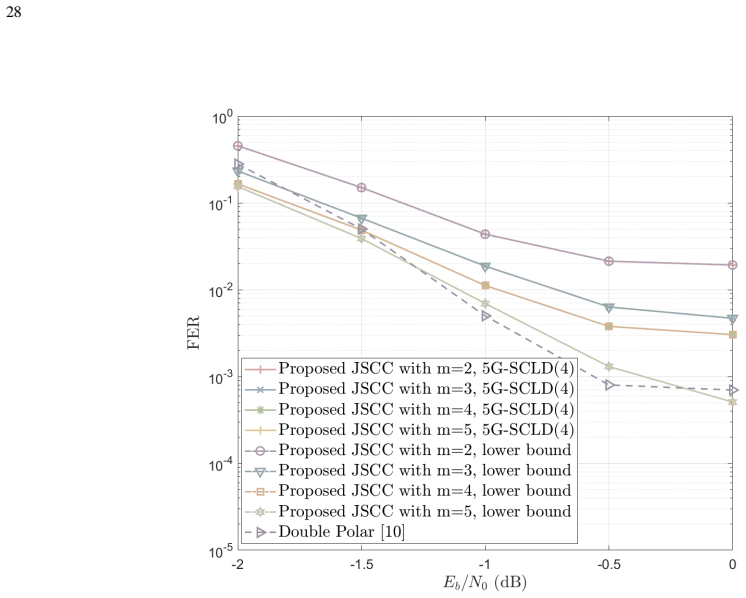
This paper first presents a new approach to evaluating the descriptive complexity of finite-length binary sequences. Specifically, we investigate the sequence-wise recovery behavior induced by polar compression and successive cancellation decoding (SCD), and define the polar complexity of a sequence as the minimum polar-compression length (PCL) required for its exact reconstruction. To compute the polar complexity efficiently, we further develop both a bisection-search algorithm and a low-complexity estimation method. We then propose a polar-based two-stage source coding scheme, in which each source sequence is represented by its polar complexity followed by the corresponding polar-compressed sequence. The proposed scheme is strictly lossless and prefix-free. In addition, for BMSs, the normalized average compression length of the proposed scheme can asymptotically approach the source entropy under certain conditions. Simulation results further demonstrate that the scheme can operate without prior knowledge of the source statistics and remains robust across different source distributions. Finally, we integrate the proposed polar source coding with polar channel coding to develop an adaptive double-polar joint source-channel coding (JSCC) scheme, where the encoder and decoder share a predefined set of candidate PCLs to balance error performance and decoding complexity. We formulate the design of the candidate-PCL set as an optimization problem and solve it efficiently via dynamic programming. Simulation results show that the proposed adaptive double-polar JSCC scheme provides a flexible performance-complexity tradeoff and outperforms existing polar-code-based JSCC baselines.
Editorial analysis
A structured set of objections, weighed in public.
Referee Report
Summary. The manuscript introduces polar complexity as the minimum polar-compression length (PCL) required for exact reconstruction of a finite-length binary sequence using polar compression and successive cancellation decoding. It proposes a strictly lossless, prefix-free two-stage source coding scheme that represents each sequence by its polar complexity followed by the corresponding polar-compressed sequence. For binary memoryless sources, the normalized average compression length is claimed to asymptotically approach the source entropy under certain conditions. The work also presents an adaptive double-polar joint source-channel coding scheme that shares a candidate PCL set optimized via dynamic programming to balance error performance and decoding complexity, with simulations indicating robustness without prior source statistics.
Significance. If the asymptotic entropy-approaching claim holds under the stated conditions and the scheme indeed functions without source statistics knowledge, the introduction of polar complexity could provide a new descriptive complexity measure directly tied to polar-code constructions, with practical value for robust source coding and flexible JSCC designs. The two-stage scheme and dynamic-programming optimization for the JSCC candidate set are potentially useful if the underlying derivations confirm the claims.
major comments (1)
- [Abstract] Abstract: the central claim that the normalized average compression length asymptotically approaches source entropy for BMSs is stated to hold only 'under certain conditions,' but those conditions are neither specified nor accompanied by a derivation or proof outline. This is load-bearing for the significance of the two-stage scheme and must be made explicit.
Simulated Author's Rebuttal
We thank the referee for the constructive feedback on our manuscript. We address the major comment below and will revise the manuscript to improve clarity on the stated claim.
read point-by-point responses
-
Referee: [Abstract] Abstract: the central claim that the normalized average compression length asymptotically approaches source entropy for BMSs is stated to hold only 'under certain conditions,' but those conditions are neither specified nor accompanied by a derivation or proof outline. This is load-bearing for the significance of the two-stage scheme and must be made explicit.
Authors: We agree that the abstract should explicitly state the conditions under which the normalized average compression length asymptotically approaches the source entropy. The conditions involve the asymptotic regime (block length n to infinity) for binary memoryless sources, where the polar complexity concentrates around n times the entropy rate with high probability under successive cancellation decoding, allowing the average PCL to approach the entropy. We will revise the abstract to specify these conditions clearly (e.g., 'for binary memoryless sources in the asymptotic limit as sequence length tends to infinity') and ensure the main text provides the corresponding derivation outline. This revision will be incorporated. revision: yes
Circularity Check
No significant circularity detected
full rationale
The abstract defines polar complexity directly from the minimum PCL needed for exact recovery under polar compression plus SCD, then builds a two-stage prefix-free scheme around that definition and states that its normalized length asymptotically approaches source entropy for BMS under unspecified conditions. This asymptotic claim is consistent with the known capacity-achieving property of polar codes for BMS and does not reduce to a self-fit, self-citation chain, or redefinition within the provided text; no equations or derivations are given that would exhibit a construction-by-construction equivalence. The subsequent DP optimization for the JSCC candidate-PCL set is a standard algorithmic step with no indicated circular dependence on the complexity definition itself. The derivation chain therefore remains self-contained against external benchmarks.
Axiom & Free-Parameter Ledger
axioms (1)
- domain assumption Standard properties of polar codes and successive cancellation decoding allow exact reconstruction at the minimum compression length.
invented entities (1)
-
Polar complexity
no independent evidence
Lean theorems connected to this paper
-
IndisputableMonolith/Cost/FunctionalEquation.leanwashburn_uniqueness_aczel unclear?
unclearRelation between the paper passage and the cited Recognition theorem.
define the polar complexity of a sequence as the minimum polar-compression length (PCL) required for its exact reconstruction
-
IndisputableMonolith/Foundation/RealityFromDistinction.leanreality_from_one_distinction unclear?
unclearRelation between the paper passage and the cited Recognition theorem.
for BMSs, the normalized average compression length of the proposed scheme can asymptotically approach the source entropy under certain conditions
What do these tags mean?
- matches
- The paper's claim is directly supported by a theorem in the formal canon.
- supports
- The theorem supports part of the paper's argument, but the paper may add assumptions or extra steps.
- extends
- The paper goes beyond the formal theorem; the theorem is a base layer rather than the whole result.
- uses
- The paper appears to rely on the theorem as machinery.
- contradicts
- The paper's claim conflicts with a theorem or certificate in the canon.
- unclear
- Pith found a possible connection, but the passage is too broad, indirect, or ambiguous to say the theorem truly supports the claim.
discussion (0)
Sign in with ORCID, Apple, or X to comment. Anyone can read and Pith papers without signing in.