Recognition: no theorem link
DriftXpress: Faster Drifting Models via Projected RKHS Fields
Pith reviewed 2026-05-13 07:01 UTC · model grok-4.3
The pith
DriftXpress approximates drifting kernels in low-rank RKHS spaces to cut training time while keeping one-step generation quality intact.
A machine-rendered reading of the paper's core claim, the machinery that carries it, and where it could break.
Core claim
DriftXpress approximates the drifting kernel in a low-rank feature space using projected RKHS fields. This preserves the attraction-repulsion structure of the original drifting field while reducing the cost of field evaluation, achieving comparable FID to standard drifting models across image-generation benchmarks.
What carries the argument
Projected RKHS fields that approximate the drifting kernel in low-rank feature space while preserving its attraction-repulsion structure.
If this is right
- Wall-clock training cost falls while one-step inference is retained.
- Generation quality measured by FID remains comparable on image benchmarks.
- The low-rank approximation is applied only during the training phase of drifting models.
- The overall training-inference cost trade-off for drifting models improves.
Where Pith is reading between the lines
- The same low-rank projection technique could be tested on other kernel-based or field-based generative methods.
- Higher-resolution or higher-dimensional data would provide a direct test of how far the rank reduction can go before quality drops.
- Resource-limited settings might now be able to train drifting models that were previously too slow.
Load-bearing premise
The low-rank RKHS projection preserves the attraction-repulsion structure of the drifting field sufficiently to maintain generation quality.
What would settle it
A side-by-side experiment in which FID scores rise sharply when the same drifting model is trained with projected RKHS fields instead of the full kernel on standard image benchmarks.
Figures


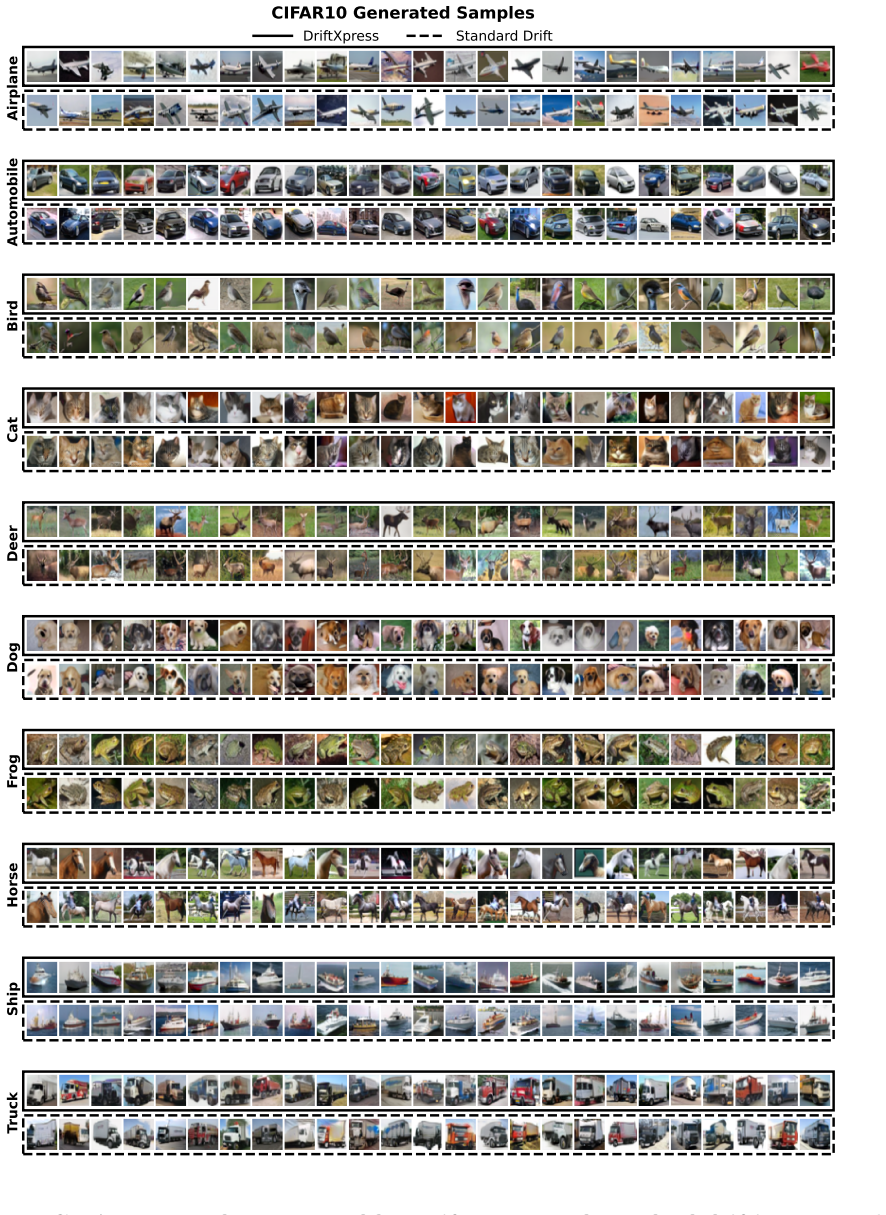

read the original abstract
Drifting Models have emerged as a new paradigm for one-step generative modeling, achieving strong image quality without iterative inference. The premise is to replace the iterative denoising process in diffusion models with a single evaluation of a generator. However, this creates a different trade-off: drifting reduces inference cost by moving much of the computation into training. We introduce DriftXpress, an accelerated formulation of drifting models based on projected RKHS fields. DriftXpress approximates the drifting kernel in a low-rank feature space. This preserves the attraction-repulsion structure of the original drifting field while reducing the cost of field evaluation. Across image-generation benchmarks, DriftXpress achieves comparable FID to standard drifting while reducing wall-clock training cost. These results show that the training-inference trade-off of drifting models can be pushed further without giving up their one-step inference advantage.
Editorial analysis
A structured set of objections, weighed in public.
Referee Report
Summary. DriftXpress introduces an accelerated formulation of drifting models for one-step generative modeling by approximating the drifting kernel via a low-rank projection onto a finite RKHS feature map. The method claims to preserve the attraction-repulsion structure of the original field, achieving comparable FID scores to standard drifting while reducing wall-clock training cost across image-generation benchmarks.
Significance. If the low-rank projection maintains the necessary flow properties, the approach could meaningfully improve the practicality of drifting models by lowering training overhead without sacrificing one-step inference. The RKHS projection is a direct way to trade rank for speed, but the current lack of approximation guarantees and experimental transparency limits the assessed significance.
major comments (2)
- Section 3.2: the projection replaces the original kernel K with ΦΦᵀ for a finite feature map Φ of rank r ≪ d. No theorem or analysis bounds the resulting change to the vector field, the ODE trajectories, or the fixed-point locations. This is load-bearing for the central claim that the one-step generator still reaches the data manifold with comparable fidelity, since directions in the null space of the projection can alter the attraction-repulsion balance.
- Abstract and experimental results: the manuscript asserts comparable FID and reduced training cost, yet supplies no experimental details, error bars, ablation studies, dataset specifications, or full methods. This prevents verification of whether the projected field truly preserves generation quality.
Simulated Author's Rebuttal
We thank the referee for the thoughtful and constructive report. The comments highlight important areas for improvement in both the theoretical grounding and the presentation of experimental results. We address each major comment below and commit to revisions that strengthen the manuscript without altering its core contributions.
read point-by-point responses
-
Referee: Section 3.2: the projection replaces the original kernel K with ΦΦᵀ for a finite feature map Φ of rank r ≪ d. No theorem or analysis bounds the resulting change to the vector field, the ODE trajectories, or the fixed-point locations. This is load-bearing for the central claim that the one-step generator still reaches the data manifold with comparable fidelity, since directions in the null space of the projection can alter the attraction-repulsion balance.
Authors: We agree that a formal bound on the approximation error induced by the low-rank projection would provide stronger support for the preservation of the drifting field's properties. The current manuscript does not contain such a theorem and instead relies on the construction of the feature map to retain the dominant attraction-repulsion directions together with extensive empirical validation. In the revision we will expand Section 3.2 with a qualitative analysis of the projection's effect on the vector field, including a discussion of how the chosen RKHS features mitigate null-space contributions in practice. We will also add a new set of controlled experiments on low-dimensional synthetic data that quantify trajectory and fixed-point deviations as a function of rank r. revision: partial
-
Referee: Abstract and experimental results: the manuscript asserts comparable FID and reduced training cost, yet supplies no experimental details, error bars, ablation studies, dataset specifications, or full methods. This prevents verification of whether the projected field truly preserves generation quality.
Authors: We apologize for the insufficient detail in the submitted version. The full experimental protocol, including dataset specifications, training hyperparameters, number of independent runs, and ablation studies on the projection rank, appears only in the supplementary material. In the revised manuscript we will move a concise but complete 'Experimental Details' subsection into the main text, report error bars for all FID numbers, and include additional ablations on feature-map rank and kernel approximation quality. These changes will make the empirical claims directly verifiable from the main paper. revision: yes
Circularity Check
No significant circularity in derivation chain
full rationale
The paper introduces a low-rank RKHS projection as a computational approximation to accelerate field evaluation in drifting models. This is presented as an engineering choice that preserves the attraction-repulsion structure sufficiently for comparable FID, with claims resting on empirical benchmark results rather than any equation that reduces to its own inputs by definition. No fitted parameters are relabeled as predictions, no self-citations form the load-bearing justification for uniqueness or the projection itself, and the core method does not smuggle an ansatz or rename a known result. The derivation chain is self-contained against external image-generation benchmarks.
Axiom & Free-Parameter Ledger
Reference graph
Works this paper leans on
-
[1]
Towards principled methods for training generative adversarial networks
[AB17] Martín Arjovsky and Léon Bottou. Towards principled methods for training generative adversarial networks. In5th International Conference on Learning Representations, ICLR 2017, Toulon, France, April 24-26, 2017, Conference Track Proceedings,
work page 2017
-
[2]
Flow map matching.arXiv preprint arXiv:2406.07507,
[BAVE24] Nicholas M Boffi, Michael S Albergo, and Eric Vanden-Eijnden. Flow map matching with stochastic interpolants: A mathematical framework for consistency models.arXiv preprint arXiv:2406.07507,
-
[3]
A Scalable Nystrom-Based Kernel Two-Sample Test with Permutations
12 [CLSR25] Antoine Chatalic, Marco Letizia, Nicolas Schreuder, and Lorenzo Rosasco. A scalable nystrom-based kernel two-sample test with permutations.arXiv preprint arXiv:2502.13570,
work page internal anchor Pith review Pith/arXiv arXiv
-
[4]
[CWL26] Jiarui Cao, Zixuan Wei, and Yuxin Liu. Gradient flow drifting: Generative model- ing via wasserstein gradient flows of kde-approximated divergences.arXiv preprint arXiv:2603.10592,
-
[5]
Generative Modeling via Drifting
[DLL+26] Mingyang Deng, He Li, Tianhong Li, Yilun Du, and Kaiming He. Generative modeling via drifting.arXiv preprint arXiv:2602.04770,
work page internal anchor Pith review arXiv
-
[6]
Training generative neural networks via Maximum Mean Discrepancy optimization
[DRG15] Gintare Karolina Dziugaite, Daniel M Roy, and Zoubin Ghahramani. Training gener- ative neural networks via maximum mean discrepancy optimization.arXiv preprint arXiv:1505.03906,
-
[7]
Density estimation using Real NVP
[DSDB16] Laurent Dinh, Jascha Sohl-Dickstein, and Samy Bengio. Density estimation using real nvp.arXiv preprint arXiv:1605.08803,
work page internal anchor Pith review Pith/arXiv arXiv
-
[8]
One Step Diffusion via Shortcut Models
[FHLA24] Kevin Frans, Danijar Hafner, Sergey Levine, and Pieter Abbeel. One step diffusion via shortcut models.arXiv preprint arXiv:2410.12557,
work page internal anchor Pith review arXiv
-
[9]
Drifting Fields are not Conservative
[FHM26] Leonard Franz, Sebastian Hoffmann, and Georg Martius. Drifting fields are not conservative.arXiv preprint arXiv:2604.06333,
work page internal anchor Pith review Pith/arXiv arXiv
-
[10]
Mean Flows for One-step Generative Modeling
[GDB+25] Zhengyang Geng, Mingyang Deng, Xingjian Bai, J Zico Kolter, and Kaiming He. Mean flows for one-step generative modeling.arXiv preprint arXiv:2505.13447,
work page internal anchor Pith review Pith/arXiv arXiv
-
[11]
Improved mean flows for one-step generation.arXiv preprint arXiv:2504.00000,
[GPL+25] Zhen Geng, Ashwini Pokle, Yan Luo, J Zico Kolter, and Nebojsa Jojic. Improved mean flows for one-step generation.arXiv preprint arXiv:2504.00000,
-
[12]
Attraction, Repulsion, and Friction: Introducing DMF, a Friction-Augmented Drifting Model
[KPB+26] Arkadii Kazanskii, Tatiana Petrova, Konstantin Bagrianskii, Aleksandr Puzikov, and Radu State. Attraction, repulsion, and friction: Introducing dmf, a friction-augmented drifting model.arXiv preprint arXiv:2604.18194,
work page internal anchor Pith review Pith/arXiv arXiv
-
[13]
Nystr\" om kernel stein discrepancy.arXiv preprint arXiv:2406.08401,
[KSS24] Florian Kalinke, Zoltán Szabó, and Bharath K Sriperumbudur. Nystr\" om kernel stein discrepancy.arXiv preprint arXiv:2406.08401,
-
[14]
Auto-Encoding Variational Bayes
[KW13] Diederik P Kingma and Max Welling. Auto-encoding variational bayes.arXiv preprint arXiv:1312.6114,
work page internal anchor Pith review Pith/arXiv arXiv
-
[15]
Identifiability and Stability of Generative Drifting with Companion-Elliptic Kernel Families
[Lee26] Hak Geun Lee. Identifiability and stability of generative drifting with companion- elliptic kernel families.arXiv preprint arXiv:2604.24196,
work page internal anchor Pith review Pith/arXiv arXiv
-
[16]
[LTH+23] Simian Luo, Yiqin Tan, Longbo Huang, Jian Li, and Hang Zhao. A comprehensive survey on knowledge distillation of diffusion models.arXiv preprint arXiv:2304.04262,
-
[17]
Reading digits in natural images with unsupervised feature learning
[NWC+11] Yuval Netzer, Tao Wang, Adam Coates, Alessandro Bissacco, Baolin Wu, Andrew Y Ng, et al. Reading digits in natural images with unsupervised feature learning. InNIPS workshop on deep learning and unsupervised feature learning, volume 2011, page
work page 2011
-
[18]
Goodfellow, Wojciech Zaremba, Vicki Cheung, Alec Radford, and Xi Chen
[SGZ+16] Tim Salimans, Ian J. Goodfellow, Wojciech Zaremba, Vicki Cheung, Alec Radford, and Xi Chen. Improved techniques for training gans. InAdvances in Neural Information Processing Systems 29: Annual Conference on Neural Information Processing Systems 2016, December 5-10, 2016, Barcelona, Spain, pages 2226–2234,
work page 2016
-
[19]
[SVS+25] Oriane Siméoni, Huy V Vo, Maximilian Seitzer, Federico Baldassarre, Maxime Oquab, Cijo Jose, Vasil Khalidov, Marc Szafraniec, Seungeun Yi, Michaël Ramamonjisoa, et al. Dinov3.arXiv preprint arXiv:2508.10104,
work page internal anchor Pith review Pith/arXiv arXiv
-
[20]
[TO26] Erkan Turan and Maks Ovsjanikov. Generative drifting is secretly score matching: a spectral and variational perspective.arXiv preprint arXiv:2603.09936,
-
[21]
[ZES25] Linqi Zhou, Stefano Ermon, and Jiaming Song. Inductive moment matching.arXiv preprint arXiv:2503.07565,
-
[22]
31 Table 8: Field approximation fidelity on CIFAR10
Thus, cosine similarity evaluates whether the projected field points in the right direction, relativeℓ2 error evaluates the normalized field-distortion magnitude, and target MSE evaluates the error in the actual regression target used by the drifting loss. 31 Table 8: Field approximation fidelity on CIFAR10. Landmarks / class Total landmarks Cosine simila...
discussion (0)
Sign in with ORCID, Apple, or X to comment. Anyone can read and Pith papers without signing in.