A practical investigation on time integration in the quantized tensor train format
Pith reviewed 2026-06-30 21:53 UTC · model grok-4.3
The pith
Time integrator choice, dissipation, and problem representation control rank growth and noise in long-time QTT simulations of advection problems.
A machine-rendered reading of the paper's core claim, the machinery that carries it, and where it could break.
Core claim
For advection-dominated test problems relevant to electromagnetic plasmas and electromagnetic fields, the choice of time integrator, the addition of numerical dissipation, and the choice in problem representation affect the efficiency and success of quantized tensor train calculations by altering the accumulation of numerical errors that otherwise increase rank and produce noise-dominated results over long times.
What carries the argument
Quantized tensor train (QTT) low-rank format applied to time-dependent PDE solutions, modulated by explicit or implicit integrators, added dissipation terms, and alternative problem representations.
If this is right
- An implicit time integrator can slow the growth of tensor rank compared with an explicit integrator on the same advection problem.
- Numerical dissipation can suppress noise accumulation and keep the QTT representation compact over longer simulation intervals.
- Reformulating the initial-value problem in a different variable or coordinate system can change how readily the solution stays low-rank under QTT truncation.
- These parameter adjustments can extend the practical duration of QTT-based plasma or field simulations before the approximation breaks down.
Where Pith is reading between the lines
- Guidelines derived from these advection tests could be checked on diffusion-dominated or nonlinear plasma models to see whether the same integrator and dissipation choices remain effective.
- The observed sensitivity to representation suggests that automatic reformulation tools might further improve QTT performance without manual tuning.
- If the error-accumulation mechanism is general, similar tuning may apply to QTT treatments of other hyperbolic or transport-dominated equations outside electromagnetics.
Load-bearing premise
That the observed accumulation of numerical errors from discretization and low-rank approximation is the primary driver of increased rank and noise in long-time QTT simulations, and that the selected advection-dominated test problems adequately represent the behavior of electromagnetic plasmas and fields.
What would settle it
Perform identical long-time QTT runs of one advection test problem using two different time integrators (or with and without added dissipation) and measure whether rank growth and solution noise differ measurably after a fixed number of steps.
Figures
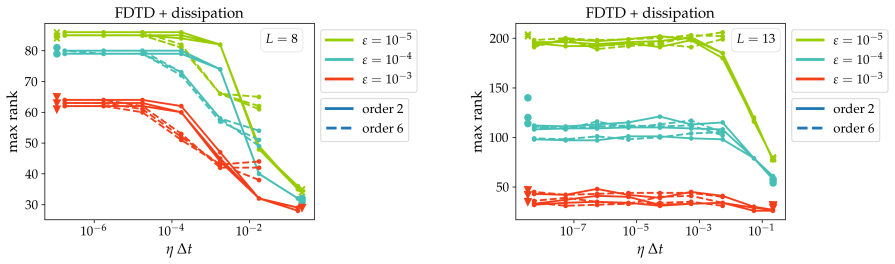
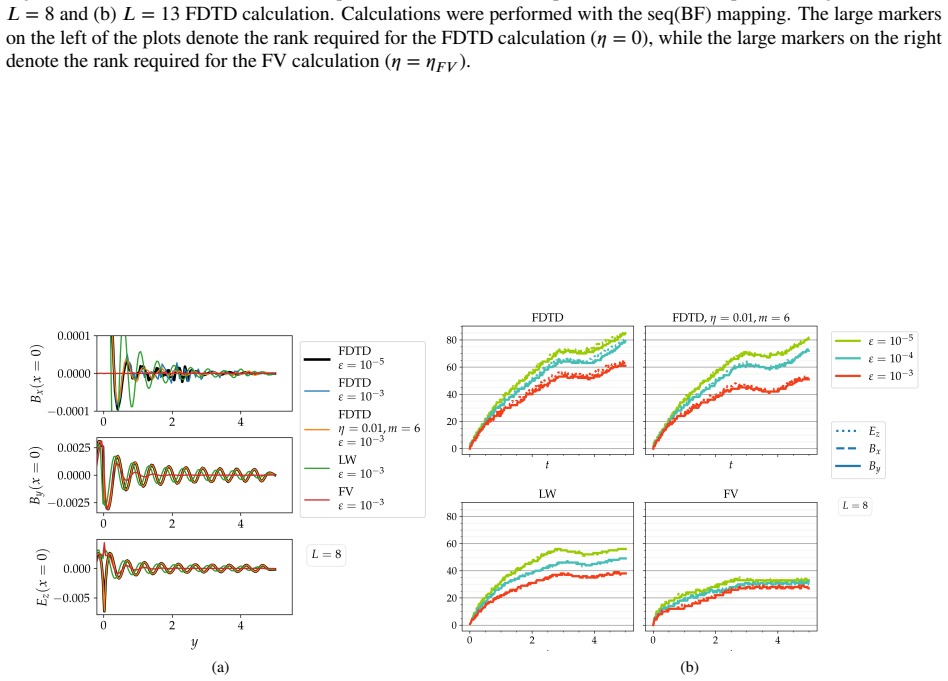
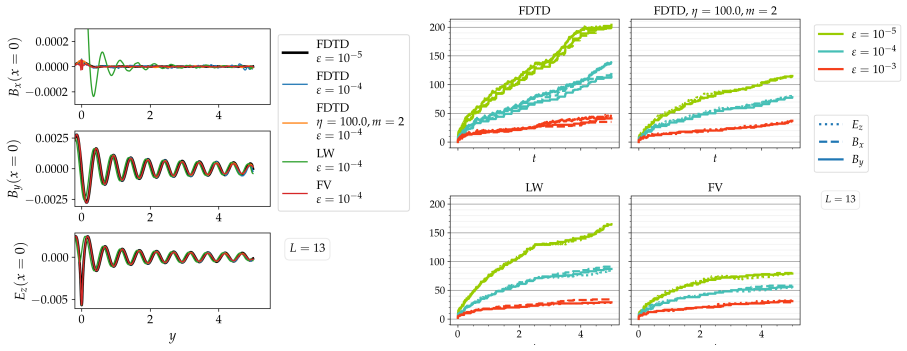
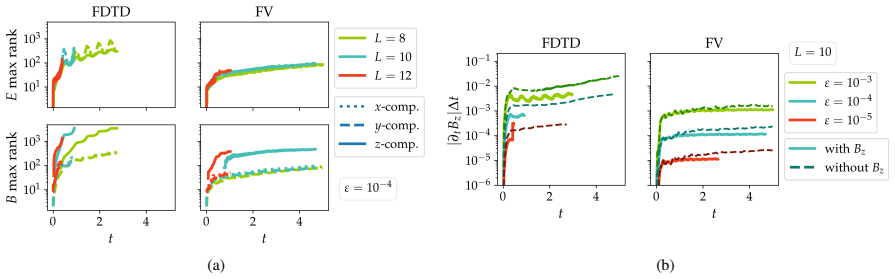
read the original abstract
Quantized tensor trains (QTTs) are a multiscale computational framework that can potentially reduce the computational cost of solving partial differential equations and initial value problems by making low-rank approximations. However, its use is somewhat limited in practice, in part due to the challenges that arise when making low-rank approximations of the quantized data. For example, when performing long-time dynamical numerical simulations, it has been observed that the accumulation of numerical errors arising from both the discretization of the partial differential equation itself and the low-rank approximation can lead to increased rank and noise-dominated results. Focusing on a set of advection-dominated test problems relevant to electromagnetic plasmas and electromagnetic fields, this work investigates how the choice in time integrator, the addition of numerical dissipation, and the choice in problem representation can affect the efficiency and success of the QTT calculations.
Editorial analysis
A structured set of objections, weighed in public.
Referee Report
Summary. The manuscript presents a numerical investigation of how time-integrator choice, numerical dissipation, and problem representation affect the efficiency and success of quantized tensor train (QTT) calculations. The focus is a set of advection-dominated test problems stated to be relevant to electromagnetic plasmas and fields, with the goal of mitigating rank growth and noise accumulation arising from discretization and low-rank approximation errors during long-time simulations.
Significance. If the reported experiments establish clear, reproducible guidelines for integrator and dissipation choices that demonstrably control rank growth on these problems, the work would supply practical guidance for deploying QTT methods in plasma and electromagnetic simulations.
major comments (2)
- [Abstract] Abstract: the scope is stated but no error metrics, baseline comparisons, data-exclusion criteria, or quantitative outcomes are supplied, preventing evaluation of whether the chosen integrators or representations actually improve long-time QTT performance.
- [Abstract (paragraph describing the focus)] The implicit claim that the selected advection-dominated tests adequately represent electromagnetic-plasma and field behavior (field-particle coupling, wave dispersion, source terms) is not supported by any explicit justification or sensitivity test; without this, conclusions about which integrators improve QTT success may not transfer to the target applications.
Simulated Author's Rebuttal
We thank the referee for the detailed comments on our manuscript. We address each major comment below and indicate where revisions will be made.
read point-by-point responses
-
Referee: [Abstract] Abstract: the scope is stated but no error metrics, baseline comparisons, data-exclusion criteria, or quantitative outcomes are supplied, preventing evaluation of whether the chosen integrators or representations actually improve long-time QTT performance.
Authors: We agree that the abstract would be strengthened by including key quantitative elements. The body of the manuscript reports relative L2 error norms, rank evolution, and comparisons against explicit and implicit integrators with and without dissipation. In revision we will condense these into the abstract, adding a brief statement of the primary error metric used, the baseline integrator, and the criterion (rank growth and noise dominance) for declaring a simulation unsuccessful. revision: yes
-
Referee: [Abstract (paragraph describing the focus)] The implicit claim that the selected advection-dominated tests adequately represent electromagnetic-plasma and field behavior (field-particle coupling, wave dispersion, source terms) is not supported by any explicit justification or sensitivity test; without this, conclusions about which integrators improve QTT success may not transfer to the target applications.
Authors: The manuscript states only that the tests are advection-dominated and relevant to electromagnetic plasmas and fields; it does not assert that they capture field-particle coupling, wave dispersion, or source terms. The focus is deliberately restricted to pure advection to isolate the effects of integrator choice and dissipation on rank growth. To remove any ambiguity we will insert a clarifying sentence in the abstract and introduction that explicitly limits the scope to advection-dominated regimes and notes that extension to full plasma models remains future work. revision: partial
Circularity Check
No circularity: empirical numerical investigation with no derivations or self-referential predictions
full rationale
The paper is framed as a practical numerical investigation of time integrators, dissipation, and representations on advection-dominated test problems for QTT methods. No derivation chain, fitted parameters renamed as predictions, uniqueness theorems, or ansatzes are present. The central content consists of empirical tests and observations of rank growth and noise, with the relevance to EM plasmas stated as a focus rather than a derived claim. This matches the default expectation of no significant circularity (score 0-2) for non-derivational work; the skeptic concern about test-problem representativeness is an external-validity issue, not a reduction of any claimed result to its own inputs by construction.
Axiom & Free-Parameter Ledger
Reference graph
Works this paper leans on
-
[1]
Density matrix algorithms for quantum renormalization groups
S. R. White. “Density matrix algorithms for quantum renormalization groups”. In:Phys. Rev. B48 (1993), p. 10345
1993
-
[2]
Density matrix renormalization group algorithms with a single center site
S. R. White. “Density matrix renormalization group algorithms with a single center site”. In:Phys. Rev. B72 (2005), 180403(R)
2005
-
[3]
Highly correlated calculations with polynomial cost algorithm: A study of the density matrix renormalization group
G. K.-L. Chan and M. Head-Gordon. “Highly correlated calculations with polynomial cost algorithm: A study of the density matrix renormalization group”. In:J. Chem. Phys.116 (2002), p. 4462
2002
-
[4]
Matrix product operators, matrix product states, and ab initio density matrix renormalization group algorithms
G. K. Chan et al. “Matrix product operators, matrix product states, and ab initio density matrix renormalization group algorithms”. In:The Journal of chemical physics145.1 (2016)
2016
-
[5]
Computationofextremeeigenvaluesinhigherdimensionsusingblocktensortrainformat
S.V.Dolgovetal.“Computationofextremeeigenvaluesinhigherdimensionsusingblocktensortrainformat”. In:Comput. Phys. Commun.185 (Apr. 2014), pp. 1207–1216.DOI:10.1016/j.cpc.2013.12.017
-
[6]
Solution of linear systems and matrix inversion in the TT-format
I. V. Oseledets and S. V. Dolgov. “Solution of linear systems and matrix inversion in the TT-format”. In:SIAM J. Sci. Comput.34.5 (2012), A2718–A2739
2012
-
[7]
Alternating minimal energy method for linear systems in higher dimen- sions
S. V. Dolgov and D. V. Savostyanov. “Alternating minimal energy method for linear systems in higher dimen- sions”. In:SIAM J. Sci. Comput36.5 (2014), A2248–A2271
2014
-
[8]
Einkemmer et al.A review of low-rank methods for time-dependent kinetic simulations
L. Einkemmer et al.A review of low-rank methods for time-dependent kinetic simulations. Dec. 2024.DOI: 10.48550/arXiv.2412.05912. arXiv:2412.05912 [math.NA]
-
[9]
L. Einkemmer and C. Lubich. “A Low-Rank Projector-Splitting Integrator for the Vlasov–Poisson Equation”. en. In:SIAM Journal on Scientific Computing40.5 (Jan. 2018), B1330–B1360.ISSN: 1064-8275, 1095-7197. DOI:10.1137/18M116383X
-
[10]
Christlieb et al.A Sampling-Based Adaptive Rank Approach to the Wigner-Poisson System
A. Christlieb et al.A Sampling-Based Adaptive Rank Approach to the Wigner-Poisson System. June 2025.DOI: 10.48550/arXiv.2506.21314. arXiv:2506.21314 [math.NA]
-
[11]
Zheng et al.A Semi-Lagrangian adaptive-rank (SLAR) method for high-dimensional Vlasov dynamics
N. Zheng et al.A Semi-Lagrangian adaptive-rank (SLAR) method for high-dimensional Vlasov dynamics. Nov. 2024.DOI:10.48550/arXiv.2510.24861. arXiv:2411.17963 [math.NA]
-
[12]
G. Manzini et al. “The tensor-train mimetic finite difference method for three-dimensional Maxwell’s wave propagation equations”. In:Mathematics and Computers in Simulation210 (2023), pp. 615–639.ISSN: 0378- 4754.DOI:https://doi.org/10.1016/j.matcom.2023.03.026
-
[13]
Tensor Train Accelerated Method of Moment Solution of Volume Integral Equations for Arbitrary Objects With Logarithmic Complexity
C. Nguyen, A. I. Boyko, and V. I. Okhmatovski. “Tensor Train Accelerated Method of Moment Solution of Volume Integral Equations for Arbitrary Objects With Logarithmic Complexity”. In:IEEE Transactions on Microwave Theory and Techniques(2026)
2026
-
[14]
Direct solution of the chemical master equation using quantized tensor trains
V. Kazeev et al. “Direct solution of the chemical master equation using quantized tensor trains”. In:PLOS Comput. Biol.10.3 (2014), e1003359. 16
2014
-
[15]
Tensornetworkreducedordermodelsforwall-boundedflows
M.KiffnerandD.Jaksch.“Tensornetworkreducedordermodelsforwall-boundedflows”.In:Phys.Rev.Fluids 8 (12 2023), p. 124101.DOI:10.1103/PhysRevFluids.8.124101
-
[16]
E. Kornev et al.Numerical solution of the incompressible Navier-Stokes equations for chemical mixers via quantum-inspired Tensor Train Finite Element Method. May 2023.DOI:10 . 48550 / arXiv . 2305 . 10784. arXiv:2305.10784 [physics.flu-dyn]
-
[17]
R.D.Peddintietal.Quantum-inspiredframeworkforcomputationalfluiddynamics.Aug.2024.DOI:10.1038/ s42005-024-01623-8
2024
-
[18]
A quantum inspired approach to exploit turbulence structures
N. Gourianov, M. Lubasch, S. Dolgov, et al. “A quantum inspired approach to exploit turbulence structures”. In:Nature Comput. Sci.2 (2022), pp. 30–37
2022
-
[19]
Exploiting the structure of turbulence with tensor networks
N. Gourianov. “Exploiting the structure of turbulence with tensor networks”. PhD thesis. University of Oxford, 2022
2022
-
[20]
Quantum-Inspired Simulation of 2D Turbulent Rayleigh-B\'enard Convection
N.-L.v.Hülstetal.Quantum-InspiredSimulationof2DTurbulentRayleigh-BénardConvection.Apr.17,2026. DOI:10.48550/arXiv.2604.16179. arXiv:2604.16179[physics]
work page internal anchor Pith review Pith/arXiv arXiv doi:10.48550/arxiv.2604.16179 2026
-
[21]
Non- linear excitation of zonal flows by turbulent energy flux
E.YeandN.F.G.Loureiro.“Quantum-inspiredmethodforsolvingtheVlasov-Poissonequations”.In:Physical Review E106.3 (Sept. 2022). Publisher: American Physical Society, p. 035208.DOI:10.1103/PhysRevE. 106.035208
-
[22]
QuantizedtensornetworksforsolvingtheVlasov–Maxwellequations
E.YeandN.F.Loureiro.“QuantizedtensornetworksforsolvingtheVlasov–Maxwellequations”.In:Journalof PlasmaPhysics90.3(June2024),p.805900301.ISSN:0022-3778,1469-7807.DOI:10.1017/S0022377824000503
-
[23]
(𝑑log𝑁)-quantics approximation of𝑁−𝑑tensors in high-dimensional numerical mod- eling
B. N. Khoromskij. “(𝑑log𝑁)-quantics approximation of𝑁−𝑑tensors in high-dimensional numerical mod- eling”. In:Constr. Approx.34 (2011), pp. 257–280
2011
- [24]
-
[25]
Quantum-inspiredalgorithmsformultivariateanalysis:frominterpolationtopartialdifferential equation
J.J.G.Ripoll.“Quantum-inspiredalgorithmsformultivariateanalysis:frominterpolationtopartialdifferential equation”. In:Quantum5 (2021), p. 431
2021
-
[26]
Tensor-train decomposition
I. V. Oseledets. “Tensor-train decomposition”. In:SIAM J. Sci. Comput.33.5 (2011), pp. 2295–2317
2011
-
[27]
Multilevel Toeplitz matrices generated by tensor- structuredvectorsandconvolutionwithlogarithmiccomplexity
V. A. Kazeev, B. N. Khoromskij, and E. E. Tyrtyshnikov. “Multilevel Toeplitz matrices generated by tensor- structuredvectorsandconvolutionwithlogarithmiccomplexity”.In:SIAMJ.Sci.Comput.35.3(2013),A1511– A1536
2013
-
[28]
U. Schollwöck. “The density-matrix renormalization group in the age of matrix product states”. In:Annals of Physics.January2011SpecialIssue326.1(Jan.1,2011),pp.96–192.ISSN:0003-4916.DOI:10.1016/j.aop. 2010.09.012
-
[29]
Minimallyentangledtypicalthermalstatealgorithms
E.M.StoudenmireandS.R.White.“Minimallyentangledtypicalthermalstatealgorithms”.en.In:NewJournal of Physics12.5 (May 2010), p. 055026.ISSN: 1367-2630.DOI:10.1088/1367-2630/12/5/055026
-
[30]
C.Camaño,E.N.Epperly,andJ.A.Tropp.Successiverandomizedcompression:Arandomizedalgorithmforthe compressed MPO-MPS product. arXiv:2504.06475 [quant-ph] version: 1. Apr. 2025.DOI:10.48550/arXiv. 2504.06475
work page internal anchor Pith review doi:10.48550/arxiv 2025
-
[31]
Two-Level QTT-Tucker Format for Optimized Tensor Calculus
S. Dolgov and B. Khoromskij. “Two-Level QTT-Tucker Format for Optimized Tensor Calculus”. In:SIAM Journal on Matrix Analysis and Applications34.2 (Jan. 2013), pp. 593–623.ISSN: 0895-4798.DOI:10.1137/ 120882597
2013
-
[32]
S. Fraschini, V. Kazeev, and I. Perugia.Symplectic QTT-FEM solution of the one-dimensional acoustic wave equationinthetimedomain.Nov.18,2024.DOI:10.48550/arXiv.2411.11321.arXiv:2411.11321[math]
work page doi:10.48550/arxiv.2411.11321.arxiv:2411.11321 2024
-
[33]
TT-crossapproximationformultidimensionalarrays
I.V.OseledetsandE.Tyrtyshnikov.“TT-crossapproximationformultidimensionalarrays”.In:LinearAlgebra Appl.432 (2010), pp. 70–88
2010
-
[34]
B. Ghahremani and H. Babaee. “Cross interpolation for solving high-dimensional dynamical systems on low- rank Tucker and tensor train manifolds”. In:Computer Methods in Applied Mechanics and Engineering432 (2024), p. 117385.DOI:https://doi.org/10.1016/j.cma.2024.117385
-
[35]
Dynamical Low-Rank Approximation
O. Koch and C. Lubich. “Dynamical Low-Rank Approximation”. In:SIAM Journal on Matrix Analysis and Applications29.2 (Jan. 2007). Publisher: Society for Industrial and Applied Mathematics, pp. 434–454.ISSN: 0895-4798.DOI:10.1137/050639703. 17
-
[36]
A projector-splitting integrator for dynamical low-rank approximation
C. Lubich and I. V. Oseledets. “A projector-splitting integrator for dynamical low-rank approximation”. en. In: BIT Numerical Mathematics54.1 (Mar. 2014), pp. 171–188.ISSN: 1572-9125.DOI:10.1007/s10543-013- 0454-0
-
[37]
M.Hochbruck,M.Neher,andS.Schrammer.“Rank-adaptivedynamicallow-rankintegratorsforfirst-orderand second-order matrix differential equations”. en. In:BIT Numerical Mathematics63.1 (Jan. 2023), p. 9.ISSN: 1572-9125.DOI:10.1007/s10543-023-00942-6
-
[38]
Ceruti et al.A robust second-order low-rank BUG integrator based on the midpoint rule
G. Ceruti et al.A robust second-order low-rank BUG integrator based on the midpoint rule. arXiv:2402.08607 [cs, math]. Feb. 2024
-
[39]
G.Ceruti,N.Crouseilles,andL.Einkemmer.AGalerkinAlternatingProjectionMethodforKineticEquationsin theDiffusiveLimit.May2025.DOI:10.48550/arXiv2505.19929.arXiv:2505.19929 [physics.math.NA]
-
[40]
E. Ye and C. Yang.Time integration of quantized tensor trains using the interpolative dynamical low-rank approximation. Dec. 17, 2025.DOI:10.48550/arXiv.2512.15703. arXiv:2512.15703[math]
-
[41]
Time-step targeting methods for real-time dynamics using the density matrix renormalization group
A. E. Feiguin and S. R. White. “Time-step targeting methods for real-time dynamics using the density matrix renormalization group”. In:Physical Review B72.2 (2005), p. 020404
2005
-
[42]
Unifying time evolution and optimization with matrix product states
J. Haegeman et al. “Unifying time evolution and optimization with matrix product states”. In:Phys. Rev. B94 (2016), p. 165116
2016
-
[43]
Time-evolution methods for matrix-product states
S. Paeckel et al. “Time-evolution methods for matrix-product states”. In:Ann. Phys.411 (2019), p. 167998. ISSN: 0003-4916.DOI:https://doi.org/10.1016/j.aop.2019.167998
-
[44]
Time-dependentvariationalprinciplewithancillaryKrylovsubspace
M.YangandS.R.White.“Time-dependentvariationalprinciplewithancillaryKrylovsubspace”.In:Phys.Rev. B102.9 (2020), p. 094315
2020
-
[45]
S. R. Fabio Nobile.Robust high-order low-rank BUG integrators based on explicit Runge-Kutta methods. Apr. 2025.DOI:10.48550/arXiv.2502.07040. arXiv:2502.07040 [math.NA]
-
[46]
Numerical Methods for Fluid Dynamics: With Applications to Geophysics
D. R. Durran. “Numerical Methods for Fluid Dynamics: With Applications to Geophysics”. In: 2nd ed. New York: Springer New York, 2010. Chap. 3.DOI:https://doi.org/10.1007/978-1-4419-6412-0. 18 Supplementary Information: A practical investigation on time integration in the quantized tensor train format 1 Step-and-truncate Time Integrators 1.1 MacCormack met...
discussion (0)
Sign in with ORCID, Apple, or X to comment. Anyone can read and Pith papers without signing in.