Recognition: unknown
Robust Mutation Analysis of Quantum Programs Under Noise
Pith reviewed 2026-05-14 18:19 UTC · model grok-4.3
The pith
Noise alters behavioral distances between quantum programs and mutants, requiring noise-specific thresholds for detection.
A machine-rendered reading of the paper's core claim, the machinery that carries it, and where it could break.
Core claim
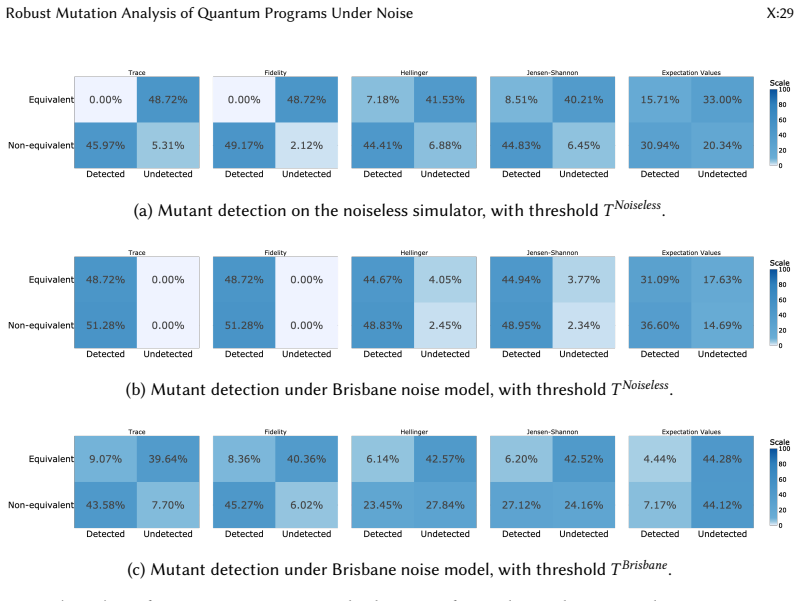
Our results show that noise significantly alters the behavioral distance between programs and mutants, making equivalent mutants harder to distinguish from real faults. Density-matrix metrics achieve the best discrimination, with misclassification rates up to 16.77%, but output-distribution metrics reach up to 73.03% accuracy and 74.89% F1-score. Noise-specific thresholds further improve detection compared to noiseless thresholds, and noise effects correlate more with algorithm and circuit characteristics than with mutation types.
What carries the argument
Behavioral distance metrics (density-matrix versus output-distribution) applied to circuit executions under emulated IBM-device noise profiles, together with noise-specific versus noiseless detection thresholds.
If this is right
- Equivalent mutants become harder to separate from actual faults once noise is present.
- Output-distribution metrics remain practical for hardware where density-matrix information is unavailable.
- Thresholds derived from noiseless runs underperform compared with thresholds tuned to each device's noise profile.
- Noise impact depends more on the underlying algorithm and circuit structure than on the type of mutation applied.
Where Pith is reading between the lines
- Quantum testing frameworks will need built-in support for device-calibrated noise models rather than generic assumptions.
- Simulator results should be cross-checked against actual hardware runs to confirm the reported accuracy differences.
- The same noise-aware adjustment principle could apply to other quantum program comparison tasks such as equivalence checking.
Load-bearing premise
The three emulated IBM-device noise profiles accurately represent real hardware behavior and the 41 programs plus mutation operators represent typical quantum software.
What would settle it
Run the identical mutation-analysis experiments on physical IBM quantum hardware and check whether the observed misclassification rates and accuracy figures match those obtained from the simulators.
Figures



read the original abstract
Mutation analysis has long been used in classical software testing and has recently been adopted for assessing the robustness of quantum software testing techniques. However, existing studies assume ideal, noiseless execution, overlooking the impact of quantum hardware noise. In this paper, we present an empirical study of noise-aware mutation analysis for quantum programs. We analyze how noise affects mutant detection using 41 quantum programs, executed on noiseless and noisy simulators emulating three IBM devices with different noise profiles. We compare several distance metrics and thresholding strategies to evaluate mutant detection under realistic noise. Our results show that noise significantly alters the behavioral distance between programs and mutants, making equivalent mutants harder to distinguish from real faults. Density-matrix metrics achieve the best discrimination, with misclassification rates up to 16.77%, but are not accessible on real hardware. Among practical alternatives, output-distribution metrics reach up to 73.03% accuracy and 74.89% F1-score. Noise-specific thresholds further improve detection compared to noiseless thresholds. We also find that noise effects correlate more with algorithm and circuit characteristics than with mutation types. Overall, our results highlight the need to adapt mutation analysis, and more generally quantum program comparison, to the noise profiles of target quantum devices.
Editorial analysis
A structured set of objections, weighed in public.
Referee Report
Summary. The paper presents an empirical study of noise-aware mutation analysis for quantum programs. Using 41 quantum programs executed on noiseless and noisy simulators emulating three IBM devices, it compares distance metrics (density-matrix and output-distribution) and thresholding strategies. The central claims are that noise significantly alters behavioral distances (making equivalent mutants harder to distinguish), density-matrix metrics achieve the lowest misclassification (up to 16.77%), output-distribution metrics reach 73.03% accuracy and 74.89% F1-score, and noise-specific thresholds improve detection over noiseless ones, with noise effects correlating more with algorithm/circuit characteristics than mutation types.
Significance. If the results hold under realistic conditions, the work is significant for quantum software engineering: it provides concrete evidence that standard noiseless mutation analysis assumptions break under hardware noise and supplies practical metrics and thresholds that could inform testing tools for near-term devices. The use of multiple emulated noise profiles and explicit metric comparisons adds value for reproducibility in the field.
major comments (3)
- [Methods] Experimental setup (methods section describing simulators): The central claim that noise-specific thresholds improve detection rests entirely on Qiskit emulations of three IBM-device noise profiles (depolarizing and thermal relaxation channels). No discussion or sensitivity analysis addresses whether omitted effects such as crosstalk, spectator errors, or non-Markovian noise would alter the reported distance changes or threshold superiority, weakening the practical applicability of the noise-specific thresholds.
- [Results] Results section (accuracy/F1 numbers and threshold comparisons): The reported gains for noise-specific thresholds (e.g., output-distribution accuracy 73.03%, F1 74.89%) are presented without statistical significance tests, confidence intervals, or per-program variance across the 41 programs. This makes it impossible to assess whether the improvement over noiseless thresholds is robust or could be due to program selection.
- [Discussion] Discussion (correlation claim): The statement that noise effects correlate more with algorithm and circuit characteristics than mutation types is load-bearing for the broader interpretation but lacks the specific quantification method (e.g., correlation coefficients, regression details, or feature importance scores) used to reach this conclusion.
minor comments (2)
- [Abstract] Abstract: The phrase 'misclassification rates up to 16.77%' for density-matrix metrics should clarify whether this is the maximum across devices or an average, to avoid ambiguity.
- [Results] Table/figure captions: Ensure all tables reporting accuracy/F1 include the exact number of programs and runs per noise profile for clarity.
Circularity Check
No circularity: empirical simulation results derive directly from metric computations on program outputs
full rationale
The paper conducts an empirical study by executing 41 quantum programs and their mutants on noiseless and noisy simulators emulating IBM devices, then computes behavioral distances using density-matrix and output-distribution metrics, derives misclassification rates, accuracy, and F1-scores from those direct comparisons, and evaluates threshold strategies. No equations, parameters, or claims reduce by construction to fitted inputs or self-citations; all reported effects of noise on distances follow from the simulation runs themselves. The central findings are falsifiable against external hardware and do not rely on self-referential definitions.
Axiom & Free-Parameter Ledger
free parameters (1)
- noise-specific detection thresholds
Reference graph
Works this paper leans on
-
[1]
Konstantinos Adamopoulos, Mark Harman, and Robert M. Hierons. 2004. How to Overcome the Equivalent Mutant Problem and Achieve Tailored Selective Mutation Using Co-evolution. InGenetic and Evolutionary Computation - GECCO 2004, Genetic and Evolutionary Computation Conference, Seattle, W A, USA, June 26-30, 2004, Proceedings, Part II (Lecture Notes in Compu...
-
[2]
Shaukat Ali, Paolo Arcaini, Xinyi Wang, and Tao Yue. 2021. Assessing the Effectiveness of Input and Output Coverage Criteria for Testing Quantum Programs. In14th IEEE Conference on Software Testing, Verification and Validation, ICST 2021, Porto de Galinhas, Brazil, April 12-16, 2021. IEEE, Porto de Galinhas, Brazil, 13–23. doi:10.1109/ICST49551.2021. 00014
-
[3]
R Alicki. 2004. Decoherence and the appearance of a classical world in quantum theory.Journal of Physics A: Mathematical and General37, 5 (2004), 1948–1949
work page 2004
-
[4]
James H. Andrews, Lionel C. Briand, Yvan Labiche, and Akbar Siami Namin. 2006. Using Mutation Analysis for Assessing and Comparing Testing Coverage Criteria.IEEE Trans. Software Eng.32, 8 (2006), 608–624. doi:10.1109/TSE.2006.83
-
[5]
Andrea Arcuri and Lionel C. Briand. 2014. A Hitchhiker’s guide to statistical tests for assessing randomized algorithms in software engineering.Softw. Test. Verification Reliab.24, 3 (2014), 219–250. doi:10.1002/STVR.1486
-
[6]
Pablo Arnault, Pablo Arrighi, Steven Herbert, Evi Kasnetsi, and Tianyi Li. 2024. A typology of quantum algorithms. CoRRabs/2407.05178 (2024). arXiv:2407.05178 doi:10.48550/ARXIV.2407.05178
-
[7]
Fowler, Matteo Mariantoni, John M
Jeff P. Barnes, Colin J. Trout, Dennis Lucarelli, and B. D. Clader. 2017. Quantum error-correction failure distributions: Comparison of coherent and stochastic error models.Phys. Rev. A95 (Jun 2017), 062338. Issue 6. doi:10.1103/PhysRevA. 95.062338
-
[8]
Khadeejah Bepari, Sarah Malik, Michael Spannowsky, and Simon Williams. 2021. Towards a quantum computing algorithm for helicity amplitudes and parton showers.Phys. Rev. D103 (Apr 2021), 076020. Issue 7. doi:10.1103/ PhysRevD.103.076020
work page 2021
-
[9]
Teresa Brecht, Wolfgang Pfaff, Chen Wang, Yiwen Chu, Luigi Frunzio, Michel H Devoret, and Robert J Schoelkopf
-
[10]
Multilayer microwave integrated quantum circuits for scalable quantum computing.npj Quantum Information2, ACM Trans. Softw. Eng. Methodol., Vol. X, No. X, Article X. Publication date: February 2026. X:46 Sophie Fortz, Eñaut Mendiluze Usandizaga, Shaukat Ali, Paolo Arcaini, and Mohammad Reza Mousavi 1 (Feb. 2016), 16002. doi:10.1038/npjqi.2016.2
-
[11]
Pascal Cerfontaine, René Otten, and Hendrik Bluhm. 2020. Self-Consistent Calibration of Quantum-Gate Sets.Phys. Rev. Appl.13 (Apr 2020), 044071. Issue 4. doi:10.1103/PhysRevApplied.13.044071
-
[12]
Kausthubh Chandramouli, Kelly Mae Allen, Christopher Mori, Dror Baron, and Mário A. T. Figueiredo. 2025. Statistical Signal Processing for Quantum Error Mitigation.CoRRabs/2506.00683 (2025). arXiv:2506.00683 doi:10.48550/ARXIV. 2506.00683
work page internal anchor Pith review doi:10.48550/arxiv 2025
-
[13]
Isaac L Chuang, Raymond Laflamme, Peter W Shor, and Wojciech H Zurek. 1995. Quantum computers, factoring, and decoherence.Science270, 5242 (1995), 1633–1635
work page 1995
-
[14]
Ton J. Cleophas and Aeilko H. Zwinderman. 2018.Bayesian Pearson Correlation Analysis. Springer International Publishing, Cham, 111–118. doi:10.1007/978-3-319-92747-3_11
-
[15]
Norman Cliff. 1993. Dominance statistics: Ordinal analyses to answer ordinal questions.Psychological bulletin114, 3 (1993), 494. doi:10.1037/0033-2909.114.3.494
-
[16]
William G Cochran. 1952. The𝜒2 test of goodness of fit.The Annals of mathematical statistics(1952), 315–345
work page 1952
-
[17]
2013.Statistical power analysis for the behavioral sciences
Jacob Cohen. 2013.Statistical power analysis for the behavioral sciences. Routledge, New York, NY, USA
work page 2013
-
[18]
James D. Cresser. 2011. Quantum Physics Notes
work page 2011
-
[19]
Andrew W Cross, Lev S Bishop, John A Smolin, and Jay M Gambetta. 2017. Open quantum assembly language.arXiv preprint arXiv:1707.03429(2017). doi:10.48550/arXiv.1707.03429
work page internal anchor Pith review Pith/arXiv arXiv doi:10.48550/arxiv.1707.03429 2017
-
[20]
Samudra Dasgupta and Travis S. Humble. 2022. Characterizing the Reproducibility of Noisy Quantum Circuits.Entropy 24, 2 (2022), 244. doi:10.3390/E24020244
-
[21]
Michael A Fligner and Timothy J Killeen. 1976. Distribution-Free Two-Sample Tests for Scale.J. Amer. Statist. Assoc. 71, 353 (1976), 210–213. arXiv:https://www.tandfonline.com/doi/pdf/10.1080/01621459.1976.10481517 doi:10.1080/ 01621459.1976.10481517
-
[22]
Daniel Fortunato, José Campos, and Rui Abreu. 2022. Mutation Testing of Quantum Programs: A Case Study With Qiskit.IEEE Transactions on Quantum Engineering3 (2022), 1–17. doi:10.1109/TQE.2022.3195061
-
[23]
Daniel Fortunato, José Campos, and Rui Abreu. 2022. Mutation Testing of Quantum Programs Written in QISKit. In44th IEEE/ACM International Conference on Software Engineering: Companion Proceedings, ICSE Companion 2022, Pittsburgh, PA, USA, May 22-24, 2022. ACM/IEEE, Pittsburgh, PA, USA, 358–359. doi:10.1145/3510454.3528649
-
[24]
Daniel Fortunato, José Campos, and Rui Abreu. 2022. QMutPy: a mutation testing tool for Quantum algorithms and applications in Qiskit. InISSTA ’22: 31st ACM SIGSOFT International Symposium on Software Testing and Analysis, Virtual Event, South Korea, July 18 - 22, 2022, Sukyoung Ryu and Yannis Smaragdakis (Eds.). ACM, Virtual Event, South Korea, 797–800. ...
-
[25]
Robust Mutation Analysis of Quantum Programs Under Noise
Sophie Fortz and Eñaut Mendiluze. 2026. Supplementary material for the paper “Robust Mutation Analysis of Quantum Programs Under Noise”. https://github.com/sfortz/Noise-aware_Mutants
work page 2026
-
[26]
Gordon Fraser and Andreas Zeller. 2012. Mutation-Driven Generation of Unit Tests and Oracles.IEEE Trans. Software Eng.38, 2 (2012), 278–292. doi:10.1109/TSE.2011.93
-
[27]
Alexei Gilchrist, Nathan K. Langford, and Michael A. Nielsen. 2005. Distance measures to compare real and ideal quantum processes.Phys. Rev. A71 (Jun 2005), 062310. Issue 6. doi:10.1103/PhysRevA.71.062310
- [28]
-
[29]
Frattini, Shruti Puri, Shantanu O
Alexander Grimm, Nicholas E. Frattini, Shruti Puri, Shantanu O. Mundhada, Steven Touzard, Mazyar Mirrahimi, Steven M. Girvin, Shyam Shankar, and Michel H. Devoret. 2020. Stabilization and operation of a Kerr-cat qubit.Nature 584, 7820 (Aug. 2020), 205–209. doi:10.1038/s41586-020-2587-z
-
[30]
Bernhard J. M. Grün, David Schuler, and Andreas Zeller. 2009. The Impact of Equivalent Mutants. InSecond International Conference on Software Testing Verification and Validation, ICST 2009, Denver, Colorado, USA, April 1-4, 2009, Workshops Proceedings. IEEE Computer Society, Denver, Colorado, USA, 192–199. doi:10.1109/ICSTW.2009.37
-
[31]
Lisa Hales and Sean Hallgren. 2000. An Improved Quantum Fourier Transform Algorithm and Applications. In41st Annual Symposium on Foundations of Computer Science, FOCS 2000, Redondo Beach, California, USA, November 12-14,
work page 2000
-
[32]
IEEE Computer Society, Redondo Beach, California, USA, 515–525. doi:10.1109/SFCS.2000.892139
-
[33]
Robin Harper, Steven T. Flammia, and Joel J. Wallman. 2020. Efficient learning of quantum noise.Nature Physics16, 12 (Dec. 2020), 1184–1188. doi:10.1038/s41567-020-0992-8
-
[34]
Shahin Honarvar, Mohammad Reza Mousavi, and Rajagopal Nagarajan. 2020. Property-based Testing of Quantum Programs in Q#. InICSE ’20: 42nd International Conference on Software Engineering, Workshops, Seoul, Republic of Korea, 27 June - 19 July, 2020. ACM, Seoul, Republic of Korea, 430–435. doi:10.1145/3387940.3391459
-
[35]
Yipeng Huang and Margaret Martonosi. 2019. Statistical assertions for validating patterns and finding bugs in quantum programs. InProceedings of the 46th International Symposium on Computer Architecture, ISCA 2019, Phoenix, AZ, USA, June 22-26, 2019, Srilatha Bobbie Manne, Hillery C. Hunter, and Erik R. Altman (Eds.). ACM, Phoenix, AZ, USA, 541–553. doi:1...
-
[36]
Ziwen Huang, Yao Lu, Eliot Kapit, David I. Schuster, and Jens Koch. 2018. Universal stabilization of single-qubit states using a tunable coupler.Phys. Rev. A97 (Jun 2018), 062345. Issue 6. doi:10.1103/PhysRevA.97.062345
-
[37]
Shih-Han Hung, Kesha Hietala, Shaopeng Zhu, Mingsheng Ying, Michael Hicks, and Xiaodi Wu. 2019. Quantitative robustness analysis of quantum programs.Proc. ACM Program. Lang.3, POPL (2019), 31:1–31:29. doi:10.1145/3290344
-
[38]
Yue Jia and Mark Harman. 2011. An Analysis and Survey of the Development of Mutation Testing.IEEE Trans. Software Eng.37, 5 (2011), 649–678. doi:10.1109/TSE.2010.62
-
[39]
Shelby Kimmel, Guang Hao Low, and Theodore J. Yoder. 2015. Robust calibration of a universal single-qubit gate set via robust phase estimation.Phys. Rev. A92 (Dec 2015), 062315. Issue 6. doi:10.1103/PhysRevA.92.062315
-
[40]
Jonas Klamroth, Max Scheerer, and Oliver Denninger. 2025. Detecting and Tolerating Faults in Hybrid Quantum Software Systems Using Architectural Redundancy. InIEEE International Conference on Quantum Software, QSW 2025, Helsinki, Finland, July 7-12, 2025, Rong N. Chang, Carl K. Chang, Jingwei Yang, Nimanthi Atukorala, Dan Chen, Sumi Helal, Sasu Tarkoma, Q...
-
[41]
Junyu Liu, Frederik Wilde, Antonio Anna Mele, Liang Jiang, and Jens Eisert. 2022. Noise can be helpful for variational quantum algorithms.CoRRabs/2210.06723 (2022). arXiv:2210.06723 doi:10.48550/ARXIV.2210.06723
-
[42]
Yao Lu, S. Chakram, N. Leung, N. Earnest, R. K. Naik, Ziwen Huang, Peter Groszkowski, Eliot Kapit, Jens Koch, and David I. Schuster. 2017. Universal Stabilization of a Parametrically Coupled Qubit.Phys. Rev. Lett.119 (Oct 2017), 150502. Issue 15. doi:10.1103/PhysRevLett.119.150502
-
[43]
Lech Madeyski, Wojciech Orzeszyna, Richard Torkar, and Mariusz Jozala. 2014. Overcoming the Equivalent Mutant Problem: A Systematic Literature Review and a Comparative Experiment of Second Order Mutation.IEEE Trans. Software Eng.40, 1 (2014), 23–42. doi:10.1109/TSE.2013.44
-
[44]
A. P. Majtey, P. W. Lamberti, and D. P. Prato. 2005. Jensen-Shannon divergence as a measure of distinguishability between mixed quantum states.Phys. Rev. A72 (Nov 2005), 052310. Issue 5. doi:10.1103/PhysRevA.72.052310
-
[45]
Henry B Mann and Donald R Whitney. 1947. On a test of whether one of two random variables is stochastically larger than the other.The annals of mathematical statistics(1947), 50–60
work page 1947
-
[46]
Kane Meissel and Esther S Yao. 2024. Using Cliff’s delta as a non-parametric effect size measure: an accessible web app and R tutorial.Practical Assessment, Research, and Evaluation29, 1 (2024). doi:10.7275/pare.1977
-
[47]
Eñaut Mendiluze, Shaukat Ali, Paolo Arcaini, and Tao Yue. 2021. Muskit: A Mutation Analysis Tool for Quantum Software Testing. In36th IEEE/ACM International Conference on Automated Software Engineering, ASE 2021, Melbourne, Australia, November 15-19, 2021. IEEE, Melbourne, Australia, 1266–1270. doi:10.1109/ASE51524.2021.9678563
-
[48]
Asmar Muqeet, Shaukat Ali, and Paolo Arcaini. 2024. Approximating Stochastic Quantum Noise Through Genetic Programming. InSearch-Based Software Engineering - 16th International Symposium, SSBSE 2024, Porto de Galinhas, Brazil, July 15, 2024, Proceedings (Lecture Notes in Computer Science, Vol. 14767), Gunel Jahangirova and Foutse Khomh (Eds.). Springer, P...
-
[49]
Asmar Muqeet, Shaukat Ali, and Paolo Arcaini. 2024. Quantum Program Testing Through Commuting Pauli Strings on IBM’s Quantum Computers. InProceedings of the 39th IEEE/ACM International Conference on Automated Software Engineering, ASE 2024, Sacramento, CA, USA, October 27 - November 1, 2024, Vladimir Filkov, Baishakhi Ray, and Minghui Zhou (Eds.). ACM, Sa...
-
[50]
Asmar Muqeet, Shaukat Ali, and Paolo Arcaini. 2025. Tool: QUIET: A Tool for Sampling-Based Quantum Noise Error Mitigation.IEEE Softw.42, 6 (2025), 28–34. doi:10.1109/MS.2025.3532106
-
[51]
Asmar Muqeet, Shaukat Ali, Tao Yue, and Paolo Arcaini. 2024. A Machine Learning-Based Error Mitigation Approach for Reliable Software Development on IBM’s Quantum Computers. InCompanion Proceedings of the 32nd ACM International Conference on the Foundations of Software Engineering, FSE 2024, Porto de Galinhas, Brazil, July 15-19, 2024, Marcelo d’Amorim (E...
-
[52]
Asmar Muqeet, Tao Yue, Shaukat Ali, and Paolo Arcaini. 2024. Mitigating Noise in Quantum Software Testing Using Machine Learning.IEEE Trans. Software Eng.50, 11 (2024), 2947–2961. doi:10.1109/TSE.2024.3462974
-
[53]
Michael A. Nielsen and Isaac L. Chuang. 2016.Quantum Computation and Quantum Information (10th Anniver- sary edition). Cambridge University Press, Cambridge, UK. https://www.cambridge.org/de/academic/subjects/ physics/quantum-physics-quantum-information-and-quantum-computation/quantum-computation-and-quantum- information-10th-anniversary-edition?format=HB
work page 2016
-
[54]
2025.Testing and analysis of quantum software
Matteo Paltenghi. 2025.Testing and analysis of quantum software. Ph. D. Dissertation. University of Stuttgart, Germany. https://nbn-resolving.org/urn:nbn:de:bsz:93-opus-ds-167500
work page 2025
-
[55]
Mike Papadakis, Márcio Eduardo Delamaro, and Yves Le Traon. 2014. Mitigating the effects of equivalent mutants with mutant classification strategies.Sci. Comput. Program.95 (2014), 298–319. doi:10.1016/J.SCICO.2014.05.012
-
[56]
Mike Papadakis, Yue Jia, Mark Harman, and Yves Le Traon. 2015. Trivial Compiler Equivalence: A Large Scale Empirical Study of a Simple, Fast and Effective Equivalent Mutant Detection Technique. In37th IEEE/ACM International Conference on Software Engineering, ICSE 2015, Florence, Italy, May 16-24, 2015, Volume 1, Antonia Bertolino, Gerardo ACM Trans. Soft...
-
[57]
Mike Papadakis, Marinos Kintis, Jie Zhang, Yue Jia, Yves Le Traon, and Mark Harman. 2019. Chapter Six - Mutation Testing Advances: An Analysis and Survey.Adv. Comput.112 (2019), 275–378. doi:10.1016/BS.ADCOM.2018.03.015
-
[58]
Mike Papadakis, Donghwan Shin, Shin Yoo, and Doo-Hwan Bae. 2018. Are mutation scores correlated with real fault detection?: a large scale empirical study on the relationship between mutants and real faults. InProceedings of the 40th International Conference on Software Engineering, ICSE 2018, Gothenburg, Sweden, May 27 - June 03, 2018, Michel Chaudron, Iv...
-
[59]
Tirthak Patel and Devesh Tiwari. 2021. Qraft: reverse your Quantum circuit and know the correct program output. In ASPLOS ’21: 26th ACM International Conference on Architectural Support for Programming Languages and Operating Systems, Virtual Event, USA, April 19-23, 2021, Tim Sherwood, Emery D. Berger, and Christos Kozyrakis (Eds.). ACM, Virtual Event, U...
-
[60]
Kai Petersen and Çigdem Gencel. 2013. Worldviews, Research Methods, and their Relationship to Validity in Empirical Software Engineering Research. In2013 Joint Conference of the 23rd International Workshop on Software Measurement and the 8th International Conference on Software Process and Product Measurement, Ankara, Turkey, October 23-26, 2013. IEEE Com...
-
[61]
Gabriel Pontolillo, Mohammad Reza Mousavi, and Marek Grzesiuk. 2025. QuCheck: A Property-based Testing Framework for Quantum Programs in Qiskit.CoRRabs/2503.22641 (2025). arXiv:2503.22641 doi:10.48550/ARXIV.2503. 22641
-
[62]
Gabriel Pontolillo, Asmar Muqeet, Shaukat Ali, and Mohammad Reza Mousavi. 2025. From Ideal to Noisy: Adapting Property-Based Testing for Real-World Noisy Quantum Computers. In2025 IEEE International Conference on Quantum Computing and Engineering (QCE), Vol. 01. 405–416. doi:10.1109/QCE65121.2025.00053
-
[63]
Gabriel Joseph Pontolillo and Mohammad Reza Mousavi. 2024. Delta Debugging for Property-Based Regression Testing of Quantum Programs. InProceedings of the 5th ACM/IEEE International Workshop on Quantum Software Engineering, Q-SE 2024, Lisbon, Portugal, 16 April 2024. ACM, Lisbon, Portugal, 1–8. doi:10.1145/3643667.3648219
-
[64]
J. S. Pratt and J. H. Eberly. 2001. Qubit cross talk and entanglement decay.Phys. Rev. B64 (Oct 2001), 195314. Issue 19. doi:10.1103/PhysRevB.64.195314
-
[65]
Nils Quetschlich, Lukas Burgholzer, and Robert Wille. 2023. MQT Bench: Benchmarking Software and Design Automation Tools for Quantum Computing.Quantum7 (2023), 1062. doi:10.22331/Q-2023-07-20-1062
-
[66]
Timothy C. Ralph. 2012. Howard Wiseman and Gerard Milburn: Quantum measurement and control.Quantum Inf. Process.11, 1 (2012), 313–315. doi:10.1007/S11128-011-0277-3
-
[67]
Salonik Resch and Ulya R. Karpuzcu. 2022. Benchmarking Quantum Computers and the Impact of Quantum Noise. ACM Comput. Surv.54, 7 (2022), 142:1–142:35. doi:10.1145/3464420
-
[68]
Diego Riste, Stefano Poletto, M-Z Huang, Alessandro Bruno, Visa Vesterinen, O-P Saira, and Leonardo DiCarlo. 2015. Detecting bit-flip errors in a logical qubit using stabilizer measurements.Nature Communications6, 1 (April 2015),
work page 2015
-
[69]
doi:10.1038/ncomms7983
-
[70]
Per Runeson and Martin Höst. 2009. Guidelines for conducting and reporting case study research in software engineering.Empir. Softw. Eng.14, 2 (2009), 131–164. doi:10.1007/S10664-008-9102-8
-
[71]
doi:10.22331/q-2020-09-11-321 , url =
Mohan Sarovar, Timothy Proctor, Kenneth Rudinger, Kevin C. Young, Erik Nielsen, and Robin Blume-Kohout. 2020. Detecting crosstalk errors in quantum information processors.Quantum4 (2020), 321. doi:10.22331/Q-2020-09-11-321
-
[72]
Runzhou Tao, Yunong Shi, Jianan Yao, John Hui, Frederic T. Chong, and Ronghui Gu. 2021. Gleipnir: toward practical error analysis for Quantum programs. InPLDI ’21: 42nd ACM SIGPLAN International Conference on Programming Language Design and Implementation, Virtual Event, Canada, June 20-25, 2021, Stephen N. Freund and Eran Yahav (Eds.). ACM, Virtual Event...
-
[73]
Ewa Tomczak and Maciej Tomczak. 2014. The need to report effect size estimates revisited. An overview of some recommended measures of effect size.TRENDS in Sport Sciences21, 1 (2014)
work page 2014
-
[74]
Eñaut Mendiluze Usandizaga, Shaukat Ali, Tao Yue, and Paolo Arcaini. 2025. Quantum circuit mutants: Empirical analysis and recommendations.Empir. Softw. Eng.30, 3 (2025), 100. doi:10.1007/S10664-025-10643-Z
-
[75]
Xinyi Wang, Paolo Arcaini, and Tao Yue and< Shaukat Ali. 2021. Quito: a Coverage-Guided Test Generator for Quantum Programs. In36th IEEE/ACM International Conference on Automated Software Engineering, ASE 2021, Melbourne, Australia, November 15-19, 2021. IEEE, Melbourne, Australia, 1237–1241. doi:10.1109/ASE51524.2021.9678798
-
[76]
Xinyi Wang, Paolo Arcaini, Tao Yue, and Shaukat Ali. 2021. Generating Failing Test Suites for Quantum Programs With Search. InSearch-Based Software Engineering - 13th International Symposium, SSBSE 2021, Bari, Italy, October 11-12, 2021, Proceedings (Lecture Notes in Computer Science, Vol. 12914), Una-May O’Reilly and Xavier Devroey (Eds.). Springer, Bari...
-
[77]
Dominic Widdows, Jyoti Rani, and Emmanuel M. Pothos. 2023. Quantum Circuit Components for Cognitive Decision- Making.Entropy25, 4 (2023), 548. doi:10.3390/E25040548 ACM Trans. Softw. Eng. Methodol., Vol. X, No. X, Article X. Publication date: February 2026. Robust Mutation Analysis of Quantum Programs Under Noise X:49
-
[78]
Ellis Wilson, Frank Mueller, Lindsay Bassman, and Costin Iancu. 2021. Empirical evaluation of circuit approximations on noisy quantum devices. InInternational Conference for High Performance Computing, Networking, Storage and Analysis, SC 2021, St. Louis, Missouri, USA, November 14-19, 2021, Bronis R. de Supinski, Mary W. Hall, and Todd Gamblin (Eds.). AC...
-
[79]
Nicolas Wittler, Federico Roy, Kevin Pack, Max Werninghaus, Anurag Saha Roy, Daniel J. Egger, Stefan Filipp, Frank K. Wilhelm, and Shai Machnes. 2021. Integrated Tool Set for Control, Calibration, and Characterization of Quantum Devices Applied to Superconducting Qubits.Phys. Rev. Appl.15 (Mar 2021), 034080. Issue 3. doi:10.1103/PhysRevApplied. 15.034080
-
[80]
William K. Wootters and Wojciech H. Zurek. 1982. A single quantum cannot be cloned.Nature299, 5886 (01 10 1982), 802–803. doi:10.1038/299802a0
discussion (0)
Sign in with ORCID, Apple, or X to comment. Anyone can read and Pith papers without signing in.