Achieving Gold-Medal-Level Olympiad Reasoning via Simple and Unified Scaling
Pith reviewed 2026-05-14 19:21 UTC · model grok-4.3
The pith
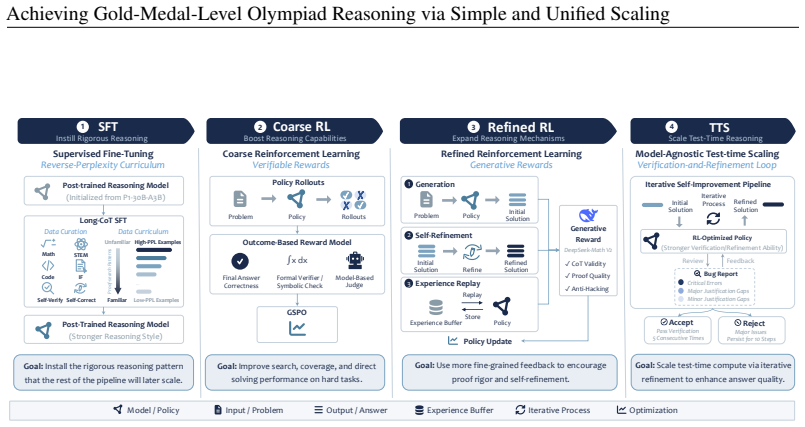
A simple scaling recipe turns a 30B reasoning model into a gold-medal olympiad solver.
A machine-rendered reading of the paper's core claim, the machinery that carries it, and where it could break.
Core claim
The authors demonstrate that applying a reverse-perplexity curriculum for SFT on around 340K sub-8K-token trajectories, followed by a two-stage RL pipeline of 200 steps and test-time scaling, produces the SU-01 model from a 30B-A3B backbone. This model achieves gold-medal-level performance on mathematical and physical olympiad competitions including IMO 2025, USAMO 2026, and IPhO 2024/2025 while maintaining stable reasoning on problems with trajectories exceeding 100K tokens and generalizing scientific reasoning beyond mathematics and physics.
What carries the argument
The reverse-perplexity curriculum for SFT combined with a two-stage RL pipeline that progresses from verifiable rewards to proof-level RL, which instills and scales proof-search and self-checking behaviors.
If this is right
- The model supports stable reasoning on problems with trajectories longer than 100K tokens.
- Gold-medal performance is reached on specific recent contests including IMO 2025 and IPhO 2024/2025.
- The learned behaviors generalize to scientific reasoning tasks outside mathematics and physics.
- A modest number of RL steps after SFT suffices to scale the instilled behaviors to olympiad difficulty.
Where Pith is reading between the lines
- The recipe may allow smaller base models to reach similar performance if the curriculum and RL stages are applied without increasing parameter count.
- Proof-search behaviors instilled this way could transfer to other long-horizon domains such as formal theorem proving or multi-step scientific hypothesis generation.
- Test-time scaling combined with the RL pipeline suggests that inference compute can be traded for training data volume in future reasoning systems.
- The method implies that curriculum design focused on perplexity ordering can reduce the need for hand-crafted olympiad-specific datasets.
Load-bearing premise
The reverse-perplexity curriculum and two-stage RL pipeline create generalizable proof-search and self-checking behaviors that transfer to new olympiad problems rather than overfitting to the training trajectories.
What would settle it
Evaluating the trained SU-01 model on a fresh set of IMO or IPhO problems withheld from all training data and finding that it solves substantially fewer than gold-medal thresholds would falsify the central claim.
Figures



read the original abstract
Recent progress in reasoning models has substantially advanced long-horizon mathematical and scientific problem solving, with several systems now reaching gold-medal-level performance on International Mathematical Olympiad (IMO) and International Physics Olympiad (IPhO) problems. In this paper, we introduce a simple and unified recipe for converting a post-trained reasoning backbone into a rigorous olympiad-level solver. The recipe first uses a reverse-perplexity curriculum for SFT to instill rigorous proof-search and self-checking behaviors, then scales these behaviors through a two-stage RL pipeline that progresses from RL with verifiable rewards to more delicate proof-level RL, and finally boosts solving performance with test-time scaling. Applying this recipe, we train a 30B-A3B backbone with SFT on around 340K sub-8K-token trajectories followed by 200 RL steps. The resulting model, SU-01, supports stable reasoning on difficult problems with trajectories exceeding 100K tokens, while achieving gold-medal-level performance on mathematical and physical olympiad competitions, including IMO 2025/USAMO 2026 and IPhO 2024/2025. It also demonstrates strong generalization of scientific reasoning to domains beyond mathematics and physics.
Editorial analysis
A structured set of objections, weighed in public.
Referee Report
Summary. The paper introduces a simple and unified recipe for converting a post-trained reasoning backbone into an olympiad-level solver. The recipe consists of a reverse-perplexity curriculum for SFT on approximately 340K sub-8K-token trajectories to instill proof-search and self-checking behaviors, followed by a two-stage RL pipeline (verifiable-reward RL then proof-level RL) and test-time scaling. Applied to a 30B-A3B backbone, this yields the SU-01 model, which is claimed to support stable reasoning on trajectories exceeding 100K tokens and to achieve gold-medal-level performance on IMO 2025, USAMO 2026, and IPhO 2024/2025 while generalizing to other scientific domains.
Significance. If the performance claims are substantiated with rigorous evidence, the work would be significant for the field of AI reasoning. It would demonstrate that a relatively straightforward combination of curriculum-based SFT and staged RL can produce models capable of solving some of the hardest olympiad problems in mathematics and physics, with implications for scaling long-horizon reasoning and scientific problem solving more broadly.
major comments (2)
- [Abstract] Abstract: The central claim that SU-01 achieves gold-medal-level performance on IMO 2025/USAMO 2026 and IPhO 2024/2025 is asserted without any quantitative results, baseline comparisons, solved-problem counts, or evaluation protocol. This absence leaves the headline empirical result without visible support and is load-bearing for the paper's contribution.
- [Abstract] Abstract: No ablations, held-out olympiad test sets, or trajectory-length scaling curves are referenced to establish that the reverse-perplexity SFT plus two-stage RL pipeline produces generalizable self-checking and proof-search behaviors rather than overfitting to the 340K training trajectories. This is a load-bearing gap for the generalization claim to unseen problems with >100K-token trajectories.
minor comments (2)
- [Abstract] The term '30B-A3B backbone' is used without definition or reference to prior work; a brief description of the base model architecture would improve clarity.
- The manuscript would benefit from an explicit experiments section containing tables of results, even if the current text is only a high-level description.
Simulated Author's Rebuttal
We thank the referee for the constructive feedback. We agree that the abstract should be more self-contained to better support the central claims. We address each major comment below and will revise the abstract accordingly in the next version.
read point-by-point responses
-
Referee: [Abstract] Abstract: The central claim that SU-01 achieves gold-medal-level performance on IMO 2025/USAMO 2026 and IPhO 2024/2025 is asserted without any quantitative results, baseline comparisons, solved-problem counts, or evaluation protocol. This absence leaves the headline empirical result without visible support and is load-bearing for the paper's contribution.
Authors: We agree that the abstract would benefit from including key quantitative support. In the revised manuscript we will update the abstract to report specific metrics such as the number of problems solved on IMO 2025, USAMO 2026, and IPhO 2024/2025, direct comparisons against prior baselines, and a concise statement of the evaluation protocol. These details already appear in the main experimental sections and will now be summarized in the abstract to make the headline result immediately substantiated. revision: yes
-
Referee: [Abstract] Abstract: No ablations, held-out olympiad test sets, or trajectory-length scaling curves are referenced to establish that the reverse-perplexity SFT plus two-stage RL pipeline produces generalizable self-checking and proof-search behaviors rather than overfitting to the 340K training trajectories. This is a load-bearing gap for the generalization claim to unseen problems with >100K-token trajectories.
Authors: The full manuscript already contains ablations, results on held-out olympiad problems, and trajectory-length scaling curves (see Experiments section and associated figures) that demonstrate generalization beyond the 340K training trajectories. The abstract, however, does not reference this evidence. We will revise the abstract to briefly note the supporting ablations and scaling results, thereby addressing the concern about visible evidence for generalizable self-checking and long-horizon reasoning. revision: yes
Circularity Check
No circularity: purely empirical training recipe with no derivations
full rationale
The paper describes an empirical procedure—reverse-perplexity SFT on ~340K trajectories followed by a two-stage RL pipeline on a 30B-A3B model—and reports observed performance on olympiad benchmarks. No equations, derivations, fitted parameters presented as predictions, or self-citation chains appear in the text. All claims reduce directly to the described training runs and measured outcomes rather than to any internal reduction or imported uniqueness result. The work is therefore self-contained with no load-bearing circular steps.
Axiom & Free-Parameter Ledger
Reference graph
Works this paper leans on
-
[1]
arXiv:2601.21165 , institution =
URLhttps://github.com/vllm-project/vllm. Miles Wang, Robi Lin, Kat Hu, Joy Jiao, Neil Chowdhury, Ethan Chang, and Tejal Patwardhan. FrontierScience: Evaluating AI’s ability to perform expert-level scientific tasks.arXiv preprint, abs/2601.21165, 2026. Jason Wei, Xuezhi Wang, Dale Schuurmans, Maarten Bosma, Brian Ichter, Fei Xia, Ed H. Chi, Quoc V . Le, an...
-
[2]
Please use LaTeX format to represent the variables and formulas used in the solution process and results
-
[3]
If the problem asks you to find specific values, please put the final answer(s) in\boxed{}
-
[4]
If the problem requires a proof, present a clear and rigorous argument. 17 Achieving Gold-Medal-Level Olympiad Reasoning via Simple and Unified Scaling C SFT Training Details The SFT stage is implemented with slime (THUDM, 2026), trained on 8 GPUs, initializes from P1- 30B, and optimizes the reverse-perplexity-ordered mixture described in Section 2.1; rol...
work page 2026
-
[5]
We follow the same model-agnostic verification-and-refinement setting as Huang & Yang (2025)
15. We follow the same model-agnostic verification-and-refinement setting as Huang & Yang (2025). Concretely, inference is organized as an iterative solve–verify–refine procedure: the solver first produces a candidate proof, the candidate is inspected by a verifier that returns a structured critique or bug report, and the solver then revises the proof con...
work page 2025
-
[6]
k= 0 Take thenhorizontal lines y= 1, y= 2,
Constructions fork= 0,1,3 We give explicit families ofndistinct lines that satisfy the two conditions. k= 0 Take thenhorizontal lines y= 1, y= 2, . . . , y=n. Each point (a, b)∈P n lies on the line y=b . No line is sunny (all are parallel to the x-axis). Hence k= 0 is attainable. k= 1 Take then−1horizontal lines y= 1, y= 2, . . . , y=n−1. These cover all ...
-
[7]
Proof.If L contains no integer point, then obviously |L∩P n| ≤1≤ ⌊(n+ 1)/2⌋ (since n≥3 )
Upper bound on points per sunny line Lemma 1.For any sunny lineL, we have|L∩P n| ≤ n+ 1 2 . Proof.If L contains no integer point, then obviously |L∩P n| ≤1≤ ⌊(n+ 1)/2⌋ (since n≥3 ). So assume L contains at least one integer point. Since L is sunny, it is not vertical, so we can write its equation asy=mx+d . ▷ If m is irrational, then L can contain at most...
-
[8]
No covering by all sunny lines forn≥4 Lemma 2.Forn≥4there is no set ofndistinct sunny lines that coversP n. Proof. Even n:Write n= 2m . By Lemma 1 each sunny line contains at most m points. Therefore the total number of incidences (counting each point as many times as lines through it) is at mostn·m= 2m 2. But 21 Achieving Gold-Medal-Level Olympiad Reason...
-
[9]
Base case n= 3 .Constructions in 1 show that k= 0,1,3 are attainable
Induction onn We now prove by strong induction that for everyn≥3 the number k of sunny lines in any covering of Pn by n distinct lines can only be0,1,3. Base case n= 3 .Constructions in 1 show that k= 0,1,3 are attainable. We must show that k= 2 is impossible. Assume three lines cover P3 with exactly two sunny. Let the sunny lines be L1, L2 and the third ...
-
[10]
Explicit constructions demonstrate that each of these values is indeed attainable
Conclusion We have shown that for everyn≥3 the only possible numbers of sunny lines in a covering of Pn by n distinct lines are0,1, and3. Explicit constructions demonstrate that each of these values is indeed attainable. k∈ {0,1,3}for alln≥3. IMO 2025 Problem 2. IMO 2025 Problem 2 Let Ω and Γ be circles with centres M and N, respectively, such that the ra...
work page 2025
-
[11]
Without loss of generality, setM N= 1(scale the figure appropriately)
Coordinate setup PlaceMandNon thex-axis. Without loss of generality, setM N= 1(scale the figure appropriately). Let M= (0,0), N= (1,0). 24 Achieving Gold-Medal-Level Olympiad Reasoning via Simple and Unified Scaling Denote the radius of Ω (with center M) by r and the radius of Γ (with center N) by R, with 0< r < R . Since the circles intersect in two dist...
-
[12]
Subtracting gives2x−1 =R 2 −r 2, so x=a= 1 +r 2 −R 2 2
Intersection pointsAandB The equations of the circles are (x2 +y 2 =r 2,(Ω) (x−1) 2 +y 2 =R 2,(Γ). Subtracting gives2x−1 =R 2 −r 2, so x=a= 1 +r 2 −R 2 2 . Leth >0be such thata 2 +h 2 =r 2. The two intersections are symmetric about thex-axis; we take A= (a, h), B= (a,−h)
-
[13]
Intersection of Ω with the x-axis: x2 =r 2 ⇒x=±r
PointsCandDon lineM N The line M N is the x-axis. Intersection of Ω with the x-axis: x2 =r 2 ⇒x=±r . Because the order on the line isC,M,N,D, pointCmust lie left ofMandDright ofN. Hence C= (−r,0), D= (1 +R,0)
-
[14]
CircumcenterPof△ACD Points C and D lie on the x-axis, so the perpendicular bisector of CD is the vertical line through the midpoint ofCD: midpoint= −r+ 1 +R 2 ,0 = 1 +R−r 2 ,0 . Thus xP = 1 +R−r 2 . To findy P , useP A=P C: (xP −a) 2 + (yP −h) 2 = (xP +r) 2 +y 2 P . Expanding and usinga 2 +h 2 =r 2 yields −2hyP = 2(r+a)x P =⇒y P =− (r+a)x P h . Hence P= 1...
-
[15]
Then r= p−q 2 , R= p+q 2 , a= 1−pq 2 , x P = 1 +q 2
Simplifying notation with auxiliary parameters Introduce p=R+r, q=R−r, S= 1 +R+r= 1 +p. Then r= p−q 2 , R= p+q 2 , a= 1−pq 2 , x P = 1 +q 2 . Fromh 2 =r 2 −a 2 we obtain h2 = (p2 −1)(1−q 2) 4 . Also r+a= S(1−q) 2 . 25 Achieving Gold-Medal-Level Olympiad Reasoning via Simple and Unified Scaling
-
[16]
v1 =x P −a= 1 +q 2 − 1−pq 2 = q+pq 2 = qS 2
Vector − →AP Set⃗ v= − →AP= (v 1, v 2). v1 =x P −a= 1 +q 2 − 1−pq 2 = q+pq 2 = qS 2 . Forv 2: v2 =y P −h=− (r+a)x P h −h=− (r+a)x P +h 2 h . Sinceh 2 = (r−a)(r+a), (r+a)x P +h 2 = (r+a)(x P +r−a). Computex P +r−a: xP +r−a= 1 +q 2 +r− 1−pq 2 = q+ 2r+pq 2 . But2r=p−q, so q+ 2r+pq=q+ (p−q) +pq=p+pq=p(1 +q). Thus xP +r−a= p(1 +q) 2 . Now(r+a) = S(1−q) 2 , so ...
-
[17]
Substitute intoΩ:|A+λ⃗ v| 2 =r 2
PointsEandF(second intersections ofAPwith the circles) Parameterize lineAPasA+λ⃗ v. Substitute intoΩ:|A+λ⃗ v| 2 =r 2. Because|A| 2 =r 2, we get 2λ(⃗ v·A) +λ2|⃗ v|2 = 0. Henceλ= 0(pointA) or λE =− 2⃗ v·A |⃗ v|2 . Similarly, forΓsubstitute into|(A+λ⃗ v)−N| 2 =R 2 (sinceN= (1,0)).|A−N| 2 =R 2, so λF =− 2⃗ v·(A−N) |⃗ v|2 . Now compute the needed dot products....
-
[18]
SideM Nis horizontal, so the altitude fromPis the vertical linex=x P
OrthocenterHof△P M N Vertices:M= (0,0),N= (1,0),P= (x P , yP ). SideM Nis horizontal, so the altitude fromPis the vertical linex=x P . Altitude from M is the line through M perpendicular to P N. Vector − − →P N= (1−x P ,−y P ). A vector perpendicular to P N is (yP ,1−x P ) (since (1−x P )yP + (−yP )(1−x P ) = 0 ). Parametric equation: t(y P ,1−x P ). The ...
-
[19]
Because E and F lie on line AP , the segment EF is collinear with ⃗ v
CircumcenterO ′ of△BEF We will determineO ′ = (x, y)that is equidistant fromB,E,F. Because E and F lie on line AP , the segment EF is collinear with ⃗ v. The perpendicular bisector of EF consists of pointsXsatisfying⃗ v·(X−M EF ) = 0, whereM EF is the midpoint ofEF. The midpoint: MEF = E+F 2 =A+ λE +λ F 2 ⃗ v. Sinceλ E +λ F = (r+R)S |⃗ v|2 = pS |⃗ v|2 , M...
-
[20]
Hence v2 1 = q2S2 4 , v2 2 = p2S2(1−q 2)2 16h2
Computation of|⃗ v|2 We have v1 = qS 2 , v 2 =− pS(1−q 2) 4h . Hence v2 1 = q2S2 4 , v2 2 = p2S2(1−q 2)2 16h2 . Usingh 2 = (p2 −1)(1−q 2) 4 , v2 2 = p2S2(1−q 2) 4(p2 −1) . Therefore |⃗ v|2 = S2 4 q2 + p2(1−q 2) p2 −1 = S2 4 · q2(p2 −1) +p 2(1−q 2) p2 −1 . The numerator simplifies: q2(p2 −1) +p 2(1−q 2) =p 2 −q 2. Thus 28 Achieving Gold-Medal-Level Olympia...
-
[21]
Simplifyyfrom (4) Insert (5) into (4): y=− rRS 2 4h · R+r−1 SRr =− S(R+r−1) 4h .(6)
-
[22]
We knowv 1 = qS 2 , and from (6) we havey
Determinexfrom equation (1) Equation (1):⃗ v·O ′ =v 1x+v 2y= RS 2 . We knowv 1 = qS 2 , and from (6) we havey. Computev 2y. v2 =− pS(1−q 2) 4h , y=− S(R+r−1) 4h . Thus v2y= pS2(1−q 2)(R+r−1) 16h2 . Recall4h 2 = (R+r−1)S(1−q 2). Then16h 2 = 4(R+r−1)S(1−q 2). v2y= pS2(1−q 2)(R+r−1) 4(R+r−1)S(1−q 2) = pS 4 . Now (1) becomes qS 2 x+ pS 4 = RS 2 . Divide byS̸=...
-
[23]
Distance fromO ′ to the line throughHparallel to⃗ v Letℓbe the line throughHwith direction⃗ v. The distance from a point to a line with direction⃗ vthroughHis d= |(O′ −H)×⃗ v| |⃗ v| , where the cross product (in the plane) is taken as the scalar∆x·v 2 −∆y·v 1. 29 Achieving Gold-Medal-Level Olympiad Reasoning via Simple and Unified Scaling Coordinates: H= ...
-
[24]
Squared distance fromO ′ toℓ 30 Achieving Gold-Medal-Level Olympiad Reasoning via Simple and Unified Scaling d2 = (R−r)SRr 2h 2 |⃗ v|2 = (R−r) 2S2R2r2 4h2 · 1 |⃗ v|2 . Substitute|⃗ v|2 = SRr R+r−1 : d2 = (R−r) 2S2R2r2 4h2 · R+r−1 SRr = (R−r) 2SRr(R+r−1) 4h2 .(10) Now use4h 2 = (R+r−1)S(1−q 2): d2 = (R−r) 2SRr(R+r−1) (R+r−1)S(1−q 2) = (R−r) 2Rr 1−(R−r) 2 .(11)
-
[25]
∆x′ = 1 2 −a= 1 2 − 1−pq 2 = pq 2
Radius of the circumcircle of△BEF ComputeR c =|O ′ −B|, withB= (a,−h)andO ′ as in (7). ∆x′ = 1 2 −a= 1 2 − 1−pq 2 = pq 2 . ∆y′ =y O′ +h=− S(R+r−1) 4h +h= 4h2 −S(R+r−1) 4h . Again,4h 2 = (R+r−1)S(1−q 2), ∆y′ = (R+r−1)S(1−q 2)−S(R+r−1) 4h = S(R+r−1)(1−q 2 −1) 4h =− S(R+r−1)q 2 4h . Thus R2 c = pq 2 2 + − S(R+r−1)q 2 4h 2 = p2q2 4 + S2(R+r−1) 2q4 16h2 . Subs...
-
[26]
Conclusion Comparing (11) and (12) we obtain d2 =R 2 c, sod=R c (all quantities are nonnegative). Hence the distance from the circumcenter O′ of △BEF to the line ℓ (through H parallel to AP ) equals the radius of its circumcircle. Thereforeℓis tangent to the circumcircle of△BEF. IMO 2025 Problem 3. 31 Achieving Gold-Medal-Level Olympiad Reasoning via Simp...
work page 2025
-
[27]
Proof.Takinga=b= 1givesf(1)|1 1 −f(1) f(1) = 1−f(1) f(1)
Preliminary lemmas Lemma 1.f(1) = 1. Proof.Takinga=b= 1givesf(1)|1 1 −f(1) f(1) = 1−f(1) f(1) . Sincef(1)|f(1) f(1) , we havef(1)|1. Hencef(1) = 1. Lemma 2.For every positive integera,f(a)|a a. Proof.Putb=ain the definition:f(a)|a a −f(a) f(a) . Becausef(a)|f(a) f(a) , it follows thatf(a)|a a. Corollary.If a primepdividesf(a), thenpdividesa. Proof.Fromf(a...
-
[28]
f(5)|5 5 = 3125 =⇒f(5) = 5 δ with0≤δ≤5
Determination off(2),f(3)andf(5) From Lemma 2 we have: f(2)|2 2 = 4 =⇒f(2)∈ {1,2,4}, f(3)|3 3 = 27 =⇒f(3)∈ {1,3,9,27}. f(5)|5 5 = 3125 =⇒f(5) = 5 δ with0≤δ≤5. Now use the mixed conditions(a, b) = (2,3)and(3,2): (2,3) :f(2)|3 2 −f(3) f(2) = 9−f(3) f(2) , (3,2) :f(3)|2 3 −f(2) f(3) = 8−f(2) f(3) . Letx=f(2), y=f(3). We test allx∈ {1,2,4}, y∈ {1,3,9,27}(note...
-
[29]
Pair(x, y) = (1,1). ▷(2,5)automatic. ▷(3,5)automatic. ▷(5,2):5 δ |32−1 5δ = 31. So5 δ |31forcesδ= 0. ▷(5,3):5 δ |243−1 5δ = 242. Again onlyδ= 0works. ⇒(f(2), f(3), f(5)) = (1,1,1)
-
[30]
▷(2,5):2|25−5 2δ - difference even, automatic
Pair(x, y) = (2,1). ▷(2,5):2|25−5 2δ - difference even, automatic. ▷(3,5):1divides everything. ▷(5,3):5 δ |243−1 = 242. Since5∤242, onlyδ= 0. ▷(5,2)withδ= 0:1|32−2 = 30- true. ⇒(2,1,1)
-
[31]
Pair(x, y) = (4,1). ▷(2,5):4|25−5 2δ. Mod 4:25≡1,5 2δ ≡1, difference divisible by 4 - automatic. ▷(3,5): automatic. ▷(5,3):5 δ |242- forcesδ= 0. ▷(5,2)withδ= 0:1|32−4 = 28- true. ⇒(4,1,1)
-
[32]
▷(2,5): automatic (even difference)
Pair(x, y) = (2,3). ▷(2,5): automatic (even difference). ▷(3,5):3|125−5 3δ. ▷(5,2):5 δ |32−2 5δ . ▷(5,3):5 δ |243−3 5δ . Testδ: ▷ δ= 0:f(5) = 1. Then3|125−1 = 124- false. ▷ δ= 1:f(5) = 5. ▷3|125−5 3 = 0- true. ▷5|32−2 5 = 0- true. ▷5|243−3 5 = 0- true. Soδ= 1works. ▷ δ= 2 : f(5) = 25 . 3|125−5 6. Mod 3: 125≡2 , 56 ≡(5 3)2 ≡2 2 = 4≡1 , so difference 2−1 = ...
-
[33]
Testδ: ▷ δ= 0:3|125−1 = 124- false
Pair(x, y) = (2,9). Testδ: ▷ δ= 0:3|125−1 = 124- false. ▷ δ= 1 : 5|125−5 9. 59 mod 9: 56 ≡1 (mod 9) (since φ(9) = 6 ), so 59 ≡5 3 = 125≡8 (mod 9) . 125≡8, difference0- true. (5,2) : 5|32−2 5 = 0 - true. (5,3) : 5|243−9 5. 9≡4 (mod 5) , 45 = 1024≡4 (mod 5) . 243≡3 (mod 5), so3−4 =−1̸≡0 (mod 5)- false. 33 Achieving Gold-Medal-Level Olympiad Reasoning via Si...
-
[34]
Proof.From(q, q)we havef(q)|q q, sof(q) =q k for some0≤k≤q
Analysis of Family A (f(3) = 1) Lemma 3.Iff(3) = 1, thenf(q) = 1for every odd primeq. Proof.From(q, q)we havef(q)|q q, sof(q) =q k for some0≤k≤q. Consider(q,3): f(q)|3 q −f(3) f(q) = 3q −1 f(q) = 3q −1. If k≥1 , then q|f(q)|3 q −1 . By Fermat’s little theorem,3q ≡3 (modq) , so q|3−1 = 2 . Hence q= 2 , contradicting thatqis odd. Thereforek= 0andf(q) = 1. L...
-
[35]
Proof.We proceed by strong induction onp
Analysis of Family B (f(2) = 2, f(3) = 3, f(5) = 5) Proposition 7.For every primep,f(p) =p. Proof.We proceed by strong induction onp. The base casesp= 2,3,5are given. Assumep >5and that for every primeq < pwe already knowf(q) =q. From(p, p)we havef(p)|p p, sof(p) =p k for some integerkwith0≤k≤p. We show thatkmust be 1. Step 1 - Eliminatek= 0andk= 2. Take ...
-
[36]
Upper bound summary We have shown: ▷In Family A,f(n)≤4nfor alln. ▷In Family B,f(n) =n≤4n. Thereforefor every bonza functionfand everyn∈N, f(n)≤4n
-
[37]
We verify thathis bonza, i.e., h(a)|b a −h(b) h(a) for alla, b∈N
Sharpness: a bonza function attaining4n Define a functionh:N→Nby h(1) = 1, and forn≥2: h(n) = 1ifnis odd, 4ifn= 2, 2v2(n)+2 ifnis even andn >2. We verify thathis bonza, i.e., h(a)|b a −h(b) h(a) for alla, b∈N. Verification We consider cases based ona. ▷Case 1:ais odd. Then h(a) = 1 (by definition: for odd n >1 , h(n) = 1; and a= 1 gives 1). Since ...
-
[38]
Conclusion We have proved that4 is an upper bound for f(n)/n and that this bound is attainable. Consequently, the smallest real constantcwith the property thatf(n)≤cnfor every bonza functionfand everyn∈Nis 4 . IMO 2025 Problem 4. IMO 2025 Problem 4 An infinite sequence a1, a2, . . . consists of positive integers has each of which has at least three proper...
work page 2025
-
[39]
The three largest proper divisors aredk−3, dk−2, dk−1
A useful formula forf(N) Let the positive divisors ofNbe 1 =d 1 < d 2 <· · ·< d k =N, where k≥4 because N has at least three proper divisors. The three largest proper divisors aredk−3, dk−2, dk−1. Using the divisor pairingd i ·d k+1−i =N, we get 39 Achieving Gold-Medal-Level Olympiad Reasoning via Simple and Unified Scaling dk−1 = N d2 , d k−2 = N d3 , d ...
-
[40]
From (1) this is equivalent to 1 d2 + 1 d3 + 1 d4 = 1.(2) Leta=d 2, b=d 3, c=d 4 (so2≤a < b < c)
Fixed points A fixed point satisfiesf(N) =N. From (1) this is equivalent to 1 d2 + 1 d3 + 1 d4 = 1.(2) Leta=d 2, b=d 3, c=d 4 (so2≤a < b < c). Solve1/a+ 1/b+ 1/c= 1. ▷ If a= 2 , then 1/b+ 1/c= 1/2 . Multiplying gives 2(b+c) =bc or (b−2)(c−2) = 4 . With b < c , the only solution isb−2 = 1, c−2 = 4, i.e.,(a, b, c) = (2,3,6). ▷ If a= 3 , then 1/b+ 1/c= 2/3 ....
-
[41]
Then f(N) = N 2 + N 3 + N 4 = 13 12 N.(3)
Special case:12|N If 12|N , then 2,3,4|N and these are the three smallest proper divisors (since 4 is the smallest possible after 2,3). Then f(N) = N 2 + N 3 + N 4 = 13 12 N.(3)
-
[42]
Lemma on odd numbers Lemma 1.Let X be an odd positive integer with at least three proper divisors. Then f(X)< X and f(X) is odd. Proof.All divisors of an odd number are odd. The three smallest divisors greater than 1 are at least 3,5,7 . Therefore 1 d2 + 1 d3 + 1 d4 ≤ 1 3 + 1 5 + 1 7 = 71 105 <1, so f(X)< X . Moreover, each quotient X/di is odd (odd divid...
-
[43]
If the orbit of Y is infinite, thenY∈ F
Lemma for even numbers not divisible by12 Lemma 2.Let Y be an even integer with at least three proper divisors and 12∤Y . If the orbit of Y is infinite, thenY∈ F. Proof.Since12∤YandYis even, we have either4∤Yor3∤Y(or both). Consider two cases. Case 1:3|Y Because 12∤Y , we must have 4∤Y ; thus ν2(Y) = 1 . Write Y= 2M with M odd. Since 3|Y and gcd(2,3) = 1,...
-
[44]
Necessity - form ofa 1 in an infinite orbit Assume the sequence is infinite. LetN=a 1. Define t= max{k≥0|12 k |N}. WriteN= 12 tRwith12∤R. We claim that for i= 1, . . . , t , the term ai is divisible by 12. Proof by induction: a1 = 12tR is divisible by 12 (if t≥1 ). Suppose ai is divisible by 12. Since 12|a i, we have by (3) that ai+1 = 13 12 ai. If we wri...
-
[45]
Sufficiency - every such number works We prove by induction ontthat ifa 1 = 12tKwithK∈ F, then the sequence is infinite. ▷ Base case t= 0 : a1 =K∈ F . By definition of a fixed point, f(K) =K . Hence the sequence is constant: an =K for all n. Since K has at least three proper divisors (as shown when characterizing F), the sequence is infinite. ▷ Inductive ...
-
[46]
Equivalently, in terms of prime exponents: ν2(a1)is odd, ν 3(a1)> 1 2 ν2(a1),5∤a 1
Final characterization Combining necessity and sufficiency, the possible values ofa1 are exactly those positive integers that can be written as a1 = 12 t ·K(t≥0, K∈ F), where 42 Achieving Gold-Medal-Level Olympiad Reasoning via Simple and Unified Scaling F= K∈N ν2(K) = 1,3|K,5∤K . Equivalently, in terms of prime exponents: ν2(a1)is odd, ν 3(a1)> 1 2 ν2(a1...
work page 2025
-
[47]
The caseλ > 1√ 2 - Alice wins Alice will force a win in a finite number of moves. Choose an integerMlarge enough so that λ(2M+ 1)−M √ 2> √ 2.(1) (Such M exists because λ >1/ √ 2 implies 2λ− √ 2>0 , so the left-hand side tends to +∞ as M→ ∞ .) Her strategy is: ▷On turns1,3,5, . . . ,2M−1(all odd turns before2M+ 1) she playsx n = 0. ▷On turn2M+ 1she playsx ...
-
[48]
SinceS 2k ≤k √ 2, it suffices to showk √ 2< λ(2k+ 1)
For the odd turn 2k+ 1 , Alice wants to choose0; this is allowed iff S2k + 0≤λ(2k+ 1). SinceS 2k ≤k √ 2, it suffices to showk √ 2< λ(2k+ 1). Rewrite asλ > k √ 2 2k+ 1 . The functionk7→ k √ 2 2k+ 1 increases with k (its limit is √ 2/2 = 1/ √ 2). Because λ >1/ √ 2, we have λ > k √ 2 2k+ 1 for every k; hence k √ 2< λ(2k+ 1). Thus each0is legal. The decisive ...
-
[49]
Define a=x 2M+1 =λ(2M+ 1)−S 2M . From (1) and the bound onS 2M , a≥λ(2M+ 1)−M √ 2> √ 2>0, soais nonnegative and satisfiesS 2M +a=λ(2M+ 1), hence the sum constraint on turn2M+ 1is met. Now we analyze the sum of squares after this move. LetS=S 2M . Then Q2M+1 =Q 2M +a 2. By Cauchy-Schwarz applied to theMnumbersx 2, x4, . . . , x2M we have S2 ≤M·Q 2M =⇒Q 2M ...
-
[50]
Consequently its minimum on the interval is attained atS=M √ 2: min 0≤S≤M √ 2 f(S) =f(M √
Hence f is strictly decreasing on[0, M √ 2]. Consequently its minimum on the interval is attained atS=M √ 2: min 0≤S≤M √ 2 f(S) =f(M √
-
[51]
Thus Q2M+1 ≥2M+ λ(2M+ 1)−M √ 2 2
= (M √ 2)2 M + λ(2M+ 1)−M √ 2 2 = 2M+ λ(2M+ 1)−M √ 2 2 . Thus Q2M+1 ≥2M+ λ(2M+ 1)−M √ 2 2 . But condition (1) saysλ(2M+ 1)−M √ 2> √ 2, so λ(2M+ 1)−M √ 2 2 >2. Therefore Q2M+1 >2M+ 2. Now it is Bazza’s turn (turn2M+ 2). He must choosex 2M+2 ≥0such that Q2M+2 =Q 2M+1 +x 2 2M+2 ≤2M+ 2. Even if he plays x2M+2 = 0, we obtain Q2M+2 =Q 2M+1 >2M+ 2 , which violat...
-
[52]
In words, he takes the largest possible number that still keeps the sum of squares at most n
The caseλ < 1√ 2 - Bazza wins Bazza will use the following strategy on every even turnn: xn = p n−Q n−1 . In words, he takes the largest possible number that still keeps the sum of squares at most n. We will prove by induction that after each of his moves (i.e., after turn2m) we have (i)Q 2m = 2m,(ii)S 2m ≥m √ 2.(2) Base casem= 1(turn2).After turn 1, Alic...
-
[53]
For the sum, S2 =a 1 + q 2−a 2 1
= 2. For the sum, S2 =a 1 + q 2−a 2 1. Squaring gives S2 2 =a 2 1 + (2−a 2
-
[54]
+ 2a1 q 2−a 2 1 = 2 + 2a1 q 2−a 2 1 ≥2, soS 2 ≥ √
-
[55]
Thus (2) holds form= 1. Inductive step.Assume (2) is true form−1, i.e., after turn2(m−1)we have 45 Achieving Gold-Medal-Level Olympiad Reasoning via Simple and Unified Scaling Q2(m−1) = 2(m−1), S 2(m−1) ≥(m−1) √ 2. Turn2m−1(odd):Alice choosesa≥0with S2(m−1) +a≤λ(2m−1).(3) Turn2m(even):Bazza computes x2m = p 2m−Q 2m−1. First we verify that the square root ...
-
[56]
To see that this always holds, use (3) and the inductive lower bound on S2(m−1): a≤λ(2m−1)−S 2(m−1) ≤λ(2m−1)−(m−1) √ 2.(4) We claim that the right-hand side of (4) is at most √
-
[57]
Becauseλ <1/ √ 2, we have2λ < √
Indeed, λ(2m−1)−(m−1) √ 2≤ √ 2⇐ ⇒λ(2m−1)≤m √ 2. Becauseλ <1/ √ 2, we have2λ < √
-
[58]
More formally: λ(2m−1)≤ √ 2m⇐ ⇒(2λ− √ 2)m≤λ
Then λ(2m−1) = 2λm−λ≤ √ 2m−λ < √ 2m, so the inequality holds (the left side is 2λm−λ , the right side is √ 2m ; since 2λm≤ √ 2m , we get λ(2m−1)≤ √ 2m. More formally: λ(2m−1)≤ √ 2m⇐ ⇒(2λ− √ 2)m≤λ. The left-hand side is ≤0 (because 2λ− √ 2<0 ), while the right-hand side is positive, so the inequality is true for allm≥1. Thereforea≤ √ 2, soa 2 ≤2, and the s...
-
[59]
Using the inductive boundS 2(m−1) ≥(m−1) √ 2, we obtain S2m ≥(m−1) √ 2 + √ 2 =m √ 2. This completes the induction. Alice loses From (2) we have S2m ≥m √ 2 for every m. Since λ <1/ √ 2, we have √ 2−2λ >0 . Choose m large enough so that m √ 2> λ(2m+ 1).(5) (Suchmexists becausem( √ 2−2λ)> λeventually holds.) Consider turn2m+ 1. After turn2m, S2m ≥m √ 2> λ(2m...
-
[60]
The caseλ= 1√ 2 - Draw We show that neither player has a winning strategy by exhibiting a strategy for each that prevents the opponent from winning. Bazza prevents Alice from winning Bazza uses the same maximal strategy as in case 2: on each even turn n, set xn = √n−Q n−1. We check that the induction in case 2 still works whenλ= 1/ √ 2. For the inductive ...
work page 2025
-
[61]
Reduction to the diagonal configuration Let the uncovered square in row i be at column ci; then c1, c2, . . . , cn is a permutation of {1, . . . , n}. Consider the column permutation σ defined by σ(ci) =i . Applying σ to the column indices (i.e., renaming column j to σ(j)) transforms the uncovered squares into the diagonal positions (i, i). The tiling is ...
-
[62]
▷ Lower triangle( i > j ): For each column j= 1,2,
A construction using2n−2tiles We now exhibit a tiling of the board with the diagonal uncovered, using exactly2n−2rectangles. ▷ Lower triangle( i > j ): For each column j= 1,2, . . . , n−1 , place a vertical tile that covers every cell in columnjwhose row index is greater thanj. Formally, R(L) j ={(i, j)|j+ 1≤i≤n}. Thesen−1rectangles are pairwise disjoint ...
-
[63]
Lower bound: at least2n−2tiles Now take any tiling T of the board that leaves exactly the diagonal squares uncovered. Partition the off-diagonal squares into two sets: 48 Achieving Gold-Medal-Level Olympiad Reasoning via Simple and Unified Scaling L={(i, j)|i > j}, U={(i, j)|i < j}. Lemma 1.Every tileT∈ Tis entirely contained either inLor inU. Proof.Suppo...
-
[64]
▷Any tiling uses at least2n−2tiles (Lower bound)
Minimum number of tiles We have shown: ▷There exists a tiling with2n−2tiles (Construction). ▷Any tiling uses at least2n−2tiles (Lower bound). Therefore the minimum possible number of tiles is exactly2n−2. Substitutingn= 2025gives 49 Achieving Gold-Medal-Level Olympiad Reasoning via Simple and Unified Scaling 2×2025−2 = 4050−2 = 4048. 4048 H.2 USAMO 2026 U...
work page 2025
-
[65]
Denote the points by A=a, B=b, C=c,|a|=|b|=|c|= 1
Complex numbers on the unit circle Place the circumcircleωas the unit circle in the complex plane. Denote the points by A=a, B=b, C=c,|a|=|b|=|c|= 1. The triangle is acute, scalene and none of its angles is60 ◦. Lemma 1 (Line through two points on the unit circle).For distinct u, v on the unit circle, the line uv is given by z+uv¯z=u+v. Proof.A point z is...
-
[66]
The equilateral triangle ∆B inscribed in ω with vertex B has the other two vertices Bζ and Bζ 2
Equations of the relevant lines Let ζ=e 2πi/3. The equilateral triangle ∆B inscribed in ω with vertex B has the other two vertices Bζ and Bζ 2. The side opposite B is ℓB, the line through Bζ and Bζ 2. Applying Lemma 1 with u=bζ , v=bζ 2 yieldsuv=b 2 andu+v=b(ζ+ζ 2) =−b. Hence ℓB :z+b 2¯z=−b.(1) Analogously, ℓC :z+c 2¯z=−c.(2) The point N is the midpoint o...
-
[67]
Intersection pointsYandZ The lineAChas equation (by Lemma 1) AC:z+ac¯z=a+c.(5) IntersectACwithℓ B. Subtract (5) from (1): 57 Achieving Gold-Medal-Level Olympiad Reasoning via Simple and Unified Scaling (b2 −ac) ¯z=−b−(a+c) =−(a+b+c). Set S=a+b+c, D 1 =ac−b 2. Then¯z=S/D 1. Substitute into (1) to find the coordinatey: y=−b−b 2¯y=−b− b2S D1 =− bD1 +b 2S D1 ...
-
[68]
We choose the rotation so that N= 1
A convenient rotation The configuration is invariant under rotations of the circle. We choose the rotation so that N= 1 . Then (3) yieldsbc= 1, hencec= ¯b. Write b=e iα, c=e −iα, where α=∠A (by the inscribed angle theorem, the central angle subtended by BC is 2α). Since the triangle is acute,α∈(0 ◦,90 ◦)and, by hypothesis,α̸= 60 ◦. Let k= cosα. The remain...
-
[69]
A key algebraic identity Lemma 2.With the above notation, (a+ 2k) 2 =Q T+ ∆.(8) Proof.ExpandQ T+ ∆: Q T= (4k 2 −1)(1 + 2ka) = (4k 2 −1) + 2k(4k 2 −1)a, ∆ =a 2 −2acos 3α+ 1. Recallcos 3α= 4k 3 −3k. Then 58 Achieving Gold-Medal-Level Olympiad Reasoning via Simple and Unified Scaling Q T+ ∆ =a 2 + 2k(4k2 −1)−2 cos 3α a+ (4k2 −1) + 1 =a 2 + 8k3 −2k−(8k 3 −6k)...
-
[70]
Let us verify that it is equidistant fromA,YandZ
The circumcenterOof△AY Z We claim that the point O=− aQT ∆ (9) is the circumcenter of△AY Z. Let us verify that it is equidistant fromA,YandZ. Distance toA O−a=− aQT ∆ −a=−a QT ∆ + 1 =− a(QT+ ∆) ∆ . By Lemma 2,QT+ ∆ = (a+ 2k) 2, so O−a=− a(a+ 2k) 2 ∆ .(10) Hence |O−a|= |a+ 2k| 2 |∆| .(11) Distance toY Using (6),¯y=S/D 1 andy=−bT /D 1. Compute O−y=− aQT ∆ +...
-
[71]
Cartesian description of triangleR Now we work in the rotated coordinate system where N= 1 , b=e iα, c=e −iα. Write a complex number z=x+iy. Equation ofℓ B From (1): z+b 2¯z=−b . Substituting b= cosα+isinα , b2 = cos 2α+isin 2α , we separate real and imaginary parts: (x(1 + cos 2α) +ysin 2α=−cosα, xsin 2α+y(1−cos 2α) =−sinα. Using the identities 1 + cos 2...
-
[72]
▷ P=ℓ B ∩ℓ C: solving (16) and (17) gives 2xcosα=−1 =⇒x=− 1 2 cosα , y= 0
Vertices and interior ofR The three vertices are the pairwise intersections of the lines. ▷ P=ℓ B ∩ℓ C: solving (16) and (17) gives 2xcosα=−1 =⇒x=− 1 2 cosα , y= 0. 60 Achieving Gold-Medal-Level Olympiad Reasoning via Simple and Unified Scaling ▷ Q′ =ℓ C ∩tangentx= 1: plugx= 1into (17): cosα−ysinα=− 1 2 =⇒y= cosα+ 1 2 sinα . ▷ R′ =ℓ B ∩tangentx= 1: plugx=...
-
[73]
Hence the incenter lies on thex-axis:I= (p,0)
IncenterIand inradiusrofR The triangle is symmetric with respect to the x-axis (the lines ℓB and ℓC are symmetric, the tangent is vertical). Hence the incenter lies on thex-axis:I= (p,0). For a point(x,0)insideR(so satisfying the inequalities), the distances to the three lines are: ▷ To ℓB: the line is xcosα+ysinα+ 1 2 = 0; distance = xcosα+ 1 2p cos2 α+ ...
-
[74]
Then O−I=− aQT ∆ −p=− aQT+p∆ ∆
DistanceOI We have the circumcenter 61 Achieving Gold-Medal-Level Olympiad Reasoning via Simple and Unified Scaling O=− aQT ∆ , and the incenter I=p= 1 2(1 + cosα) = 1 D0 , where we denote D0 = 2(1 + cosα) = 2(1 +k). Then O−I=− aQT ∆ −p=− aQT+p∆ ∆ . SetU=aQT+p∆; thenOI=|U|/|∆|. Now substitute the expressions foraQT,pand∆. Write aQT=a(4k 2 −1)(1 + 2ka) = (...
-
[75]
RelatingOItoRandr Recall the circumradius of△AY Z: R= |a+ 2k| 2 |∆| .(27) The inradius ofRis r= 1 + 2k D0 .(28) Now compute |Xa+ 1| 2 D0 =|a+ 2k| 2 +L, where L= |Xa+ 1| 2 D0 − |a+ 2k| 2. From (26), OI= |a+ 2k| 2 +L |∆| =R+ L |∆| .(29) Thus if we can showL=±r|∆|, we will haveOI=R±r, which implies tangency. Lett=a+ ¯a= 2 cosθ. Then |Xa+ 1| 2 = (Xa+ 1)(X¯a+ ...
-
[76]
Remarks on non-vanishing denominators ▷ D1 = 0 would imply ac=b 2. In our rotated frame, this gives a=e i3α, which forces AB=BC (since then |a−b|=|e i3α −e iα|= 2 sinα and |b−c|=|e iα −e −iα|= 2 sinα ), contradicting the scalene hypothesis. HenceD 1 ̸= 0; similarlyD 2 ̸= 0, so∆̸= 0. ▷ a+ 2k= 0 would give a=−2k real; with |a|= 1 we get 2k= 1 i.e. cosα= 1/2...
work page 2026
-
[77]
Equivalent formulation Let S={x∈N 0 |the decimal representation ofxcontains no digit1}. (Note that0∈Sbecause its representation ”0” has no digit1.) If n=a+b with a, b∈S , then the pair (a, b) shows that n isnotsolitary (both a and b lack a digit 1). Conversely, if for every representation n=a+b at least one of a, b contains a digit 1, then certainly no re...
work page 2026
-
[78]
Digit-wise analysis and carries Every integermwith0≤m <10 N can be written uniquely as m= N−1X i=0 di10i, where each digit di is in {0,1, . . . ,9} . To have a uniform treatment, we pad the representation with leading zeros so that every suchmuses exactlyNdigits. Ifa, b∈S, then each of their digits belongs to D={0,2,3,4,5,6,7,8,9}(all digits except1). Wri...
-
[79]
Possible sums of two digits fromD Define Σ ={a i +b i |a i, bi ∈D}. Since the only digit missing fromDis1, the sums that can be obtained are Σ ={0} ∪ {2,3,4,5,6,7,8,9,10,11,12,13,14,15,16,17,18}. (Indeed,1cannot be expressed as a sum of two digits fromD; all other integers from0to18can.)
-
[80]
,9}, let T(s, d) = t∈ {0,1} ∃ai, bi ∈Dwitha i +b i +s=d+ 10t
Transition setsT(s, d) For a fixed carryins∈ {0,1}and a target digitd∈ {0, . . . ,9}, let T(s, d) = t∈ {0,1} ∃ai, bi ∈Dwitha i +b i +s=d+ 10t . UsingΣ, we can computeT(s, d). Cases= 0 Here the total sum before splitting is simplys 0 withs 0 ∈Σ. 65 Achieving Gold-Medal-Level Olympiad Reasoning via Simple and Unified Scaling ▷Ifs 0 ≤9, we may taket= 0and th...
discussion (0)
Sign in with ORCID, Apple, or X to comment. Anyone can read and Pith papers without signing in.