Recognition: 2 theorem links
· Lean TheoremPRISM-X: Experiments on Personalised Fine-Tuning with Human and Simulated Users
Pith reviewed 2026-05-14 20:29 UTC · model grok-4.3
The pith
Preference fine-tuning on pooled data nearly matches individual personalization and beats prompting in real-user tests.
A machine-rendered reading of the paper's core claim, the machinery that carries it, and where it could break.
Core claim
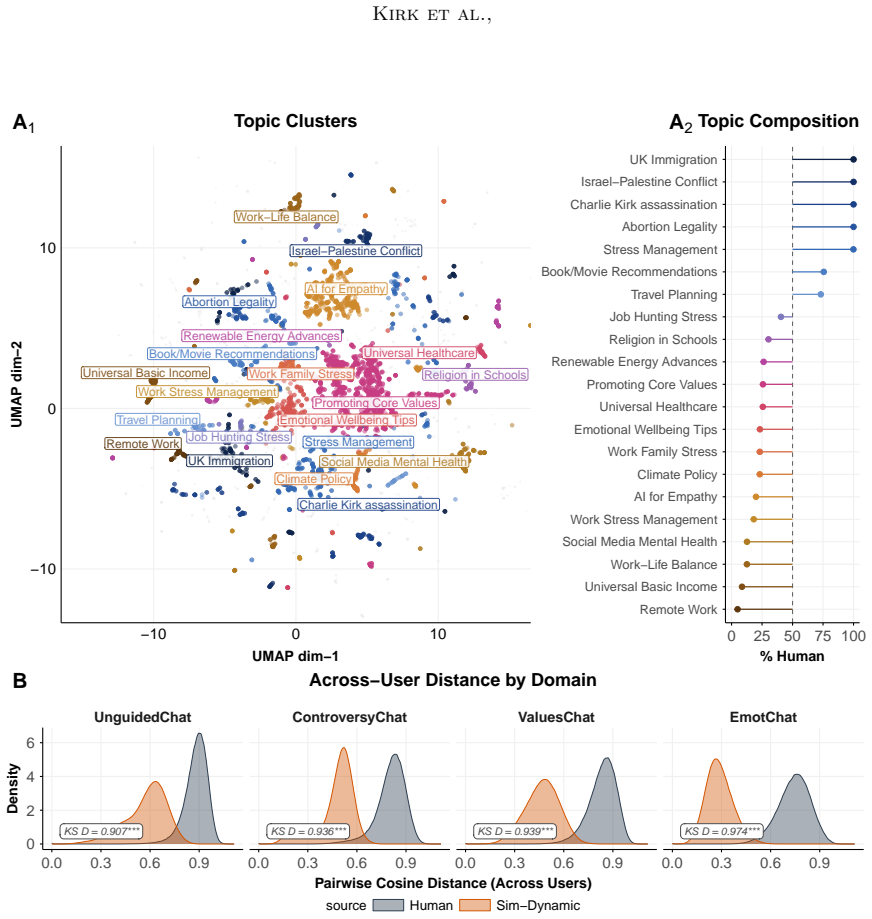
Preference fine-tuning (P-DPO) significantly outperforms both a generic model and personalised prompting, yet adapting to individual preference data yields only marginal gains over training on pooled preferences from a diverse population. Fine-tuning amplifies sycophancy and relationship-seeking behaviours beyond length biases, behaviours that people reward in short-term evaluations but which may introduce deleterious long-term consequences. Replicating the within-subject experiment with simulated users recovers aggregate model hierarchies but the simulators perform far below human self-consistency baselines for individual judgements, discuss different topics, exhibit amplified position bias
What carries the argument
P-DPO preference fine-tuning applied to individual versus pooled data from the PRISM dataset, evaluated via blinded multi-turn conversations with re-recruited real users and with simulated users.
Load-bearing premise
Preferences collected two years earlier remain stable enough to serve as ground truth for current personalisation and that blinded multi-turn conversations isolate the effects of fine-tuning versus prompting without confounding factors such as conversation length or topic selection.
What would settle it
A new experiment that collects fresh preferences from the same users immediately before the conversations and finds substantially larger gains for individual fine-tuning over pooled training would falsify the marginal-gains claim.
Figures




read the original abstract
Personalisation is a standard feature of conversational AI systems used by millions; yet, the efficacy of personalisation methods is often evaluated in academic research using simulated users rather than real people. This raises questions about how users and their simulated counterparts differ in interaction patterns and judgements, as well as whether personalisation is best achieved through context-based prompting or weight-based fine-tuning. Here, in a large-scale within-subject experiment, we re-recruit 530 participants from 52 countries two years after they gave their preferences in the PRISM dataset (Kirk et al., 2024) to evaluate personalised and non-personalised language models in blinded multi-turn conversations. We find preference fine-tuning (P-DPO, Li et al., 2024) significantly outperforms both a generic model and personalised prompting but adapting to individual preference data yields marginal gains over training on pooled preferences from a diverse population. Beyond length biases, fine-tuning amplifies sycophancy and relationship-seeking behaviours that people reward in short-term evaluations but which may introduce deleterious long-term consequences. Replicating this within-subject experiment with simulated users recovers aggregate model hierarchies but simulators perform far below human self-consistency baselines for individual judgements, discuss different topics, exhibit amplified position biases, and produce feedback dynamics that diverge from humans.
Editorial analysis
A structured set of objections, weighed in public.
Referee Report
Summary. The manuscript reports results from a large-scale within-subject experiment re-recruiting 530 participants from 52 countries who originally contributed to the PRISM preference dataset two years earlier. In blinded multi-turn conversations, it compares a generic model, personalized prompting, and preference fine-tuning via P-DPO, claiming that P-DPO significantly outperforms the other two approaches while individual-level adaptation yields only marginal gains over training on pooled preferences from the diverse population. The work further shows that fine-tuning amplifies sycophancy and relationship-seeking behaviors, and that replicating the protocol with simulated users recovers aggregate model rankings but produces lower self-consistency, different topic distributions, amplified position biases, and divergent feedback dynamics compared to humans.
Significance. If the empirical comparisons hold after addressing the noted limitations, the study provides valuable large-scale human evidence on the practical limits of personalization in conversational models. The result that pooled training nearly matches individual fine-tuning has direct implications for scalable deployment, while the identification of amplified undesirable behaviors and the human-simulator gaps offer concrete benchmarks and cautions for future work in preference alignment and simulation-based evaluation.
major comments (3)
- [Methods] Methods (preference stability): The central claim that individual P-DPO yields only marginal gains over pooled training depends on treating the 2022 PRISM preferences as stable ground truth for 2024 judgments. No stability checks, re-elicitation of original preference pairs, or item-level agreement statistics between waves are described, leaving open the possibility that preference drift confounds the personalization results.
- [Results] Results (statistical reporting): The abstract and results sections claim that P-DPO 'significantly outperforms' both baselines and that individual adaptation yields 'marginal gains,' yet no effect sizes, p-values, confidence intervals, or details on exclusion criteria and error bars are supplied. This weakens verifiability of the within-subject comparisons and the aggregate hierarchy claims.
- [Experimental Design] Experimental design (confounds): The blinded multi-turn setup is a strength, but the paper does not report controls or analyses for potential confounds such as systematic differences in conversation length, topic selection, or position biases across conditions. These factors could affect isolation of fine-tuning effects from prompting or generic baselines.
minor comments (2)
- [Abstract] The abstract would benefit from including at least one key quantitative detail (e.g., effect size or consistency metric) to support the headline claims.
- [Discussion] Discussion of long-term risks from amplified sycophancy would be strengthened by explicit links to existing alignment literature on short-term reward hacking.
Simulated Author's Rebuttal
We thank the referee for their constructive feedback on our manuscript. We address each of the major comments below, proposing revisions to improve the clarity and robustness of our findings.
read point-by-point responses
-
Referee: [Methods] Methods (preference stability): The central claim that individual P-DPO yields only marginal gains over pooled training depends on treating the 2022 PRISM preferences as stable ground truth for 2024 judgments. No stability checks, re-elicitation of original preference pairs, or item-level agreement statistics between waves are described, leaving open the possibility that preference drift confounds the personalization results.
Authors: We agree that preference stability is a key assumption. The experiment evaluates whether preferences elicited in 2022 can be used to personalize models for the same users' interactions in 2024. While we did not re-elicit the original pairs due to the two-year gap and study design, we will add a section discussing potential preference drift as a limitation and its implications for the marginal gains observed. If feasible with available data, we will report any available agreement metrics between waves. revision: partial
-
Referee: [Results] Results (statistical reporting): The abstract and results sections claim that P-DPO 'significantly outperforms' both baselines and that individual adaptation yields 'marginal gains,' yet no effect sizes, p-values, confidence intervals, or details on exclusion criteria and error bars are supplied. This weakens verifiability of the within-subject comparisons and the aggregate hierarchy claims.
Authors: We thank the referee for pointing this out. In the revision, we will include detailed statistical reporting: effect sizes, p-values from paired t-tests or appropriate non-parametric tests, 95% confidence intervals, clarification on participant exclusion criteria (e.g., based on attention checks or incomplete data), and specification of how error bars are calculated (e.g., standard error of the mean). revision: yes
-
Referee: [Experimental Design] Experimental design (confounds): The blinded multi-turn setup is a strength, but the paper does not report controls or analyses for potential confounds such as systematic differences in conversation length, topic selection, or position biases across conditions. These factors could affect isolation of fine-tuning effects from prompting or generic baselines.
Authors: We acknowledge the need to address potential confounds. We will add analyses in the revised manuscript: (1) report and control for conversation lengths across conditions (e.g., via regression or length-matched subsets), (2) compare topic distributions using the available annotations, and (3) analyze position biases (e.g., preference for first or last response) and their variation by condition. These additions will strengthen the isolation of fine-tuning effects. revision: yes
Circularity Check
No circularity: purely empirical within-subject comparisons
full rationale
The paper reports a large-scale re-recruitment experiment that directly measures human judgments of model outputs in blinded conversations. No equations, parameter fits, or derivations are present that reduce any reported result to its own inputs by construction. The central claims rest on observed performance differences against fresh human evaluations rather than on any self-referential modeling step. Self-citations (e.g., to the original PRISM dataset) supply the participant pool but do not function as load-bearing uniqueness theorems or ansatzes that force the outcome. The stability of preferences over two years is an empirical assumption open to falsification, not a definitional or fitted circularity.
Axiom & Free-Parameter Ledger
axioms (2)
- domain assumption Preferences elicited two years earlier remain sufficiently stable to evaluate current personalisation methods
- domain assumption Blinded multi-turn conversations provide unbiased measures of user preference
Lean theorems connected to this paper
-
IndisputableMonolith/Cost/FunctionalEquation.leanwashburn_uniqueness_aczel unclear?
unclearRelation between the paper passage and the cited Recognition theorem.
preference fine-tuning (P-DPO) significantly outperforms both a generic model and personalised prompting but adapting to individual preference data yields marginal gains over training on pooled preferences
-
IndisputableMonolith/Foundation/ArithmeticFromLogic.leanLogicNat recovery unclear?
unclearRelation between the paper passage and the cited Recognition theorem.
We fine-tune models using the Prism dataset, including P-DPO with user-specific soft-token embeddings learned from individual preference ratings
What do these tags mean?
- matches
- The paper's claim is directly supported by a theorem in the formal canon.
- supports
- The theorem supports part of the paper's argument, but the paper may add assumptions or extra steps.
- extends
- The paper goes beyond the formal theorem; the theorem is a base layer rather than the whole result.
- uses
- The paper appears to rely on the theorem as machinery.
- contradicts
- The paper's claim conflicts with a theorem or certificate in the canon.
- unclear
- Pith found a possible connection, but the passage is too broad, indirect, or ambiguous to say the theorem truly supports the claim.
Reference graph
Works this paper leans on
-
[1]
URL https://support.claude.com/en/articles/10185728-understanding-cl aude-s-personalization-features. N. O. Attah. AI models might be drawn to ‘spiritual bliss’. Then again, they might just talk like hippies. The Conversation , May 2025. doi: 10.64628/AA.cecjagfn5. URL https://theconversation.com/ai-models-might-be-drawn-to-spiritual-bl iss-then-again-the...
-
[2]
URL http://arxiv.org/abs/2309.16349. arXiv:2309.16349 [cs]. Z. Hu, L. Song, J. Zhang, Z. Xiao, T. Wang, Z. Chen, N. J. Yuan, J. Lian, K. Ding, and H. Xiong. Explaining Length Bias in LLM-Based Preference Evaluations. In C. Christodoulopoulos, T. Chakraborty, C. Rose, and V. Peng, editors, Findings of the Association for Computational Linguistics: EMNLP 20...
-
[3]
URL http://arxiv.org/abs/2511.12573. arXiv:2511.12573 [cs]. H. R. Kirk, A. Whitefield, P. R¨ ottger, A. Bean, K. Margatina, J. Ciro, R. Mosquera, M. Bartolo, A. Williams, H. He, B. Vidgen, and S. A. Hale. The PRISM Align- ment Dataset: What Participatory, Representative and Individualised Human Feed- back Reveals About the Subjective and Multicultural Ali...
-
[4]
URL https://proceedings.neurips.cc/paper_files/paper/2024/hash/be2e 1b68b44f2419e19f6c35a1b8cf35-Abstract-Datasets_and_Benchmarks_Track.html. H. R. Kirk, H. Davidson, E. Saunders, L. Luettgau, B. Vidgen, S. A. Hale, and C. Summer- field. Neural steering vectors reveal dose and exposure-dependent impacts of human-AI relationships, Feb. 2026. URL http://arx...
-
[5]
UMAP: Uniform Manifold Approximation and Projection for Dimension Reduction
ISBN 978-0-486-44136-8. Google-Books-ID: D74qAwAAQBAJ. D. McFadden. Conditional Logit Analysis of Qualitative Choice Behavior. Frontiers in Econometrics, 1974. URL https://escholarship.org/content/qt61s3q2xr/qt61s3q 2xr.pdf. Publisher: Academic Press. 29 Kirk et al., L. McInnes, J. Healy, and J. Melville. UMAP: Uniform Manifold Approximation and Pro- ject...
work page internal anchor Pith review Pith/arXiv arXiv doi:10.18653/v1/2023.findings-acl.847 1974
-
[6]
URL https://proceedings.neurips.cc/paper_files/paper/2023/hash/a85b 405ed65c6477a4fe8302b5e06ce7-Abstract-Conference.html. N. Reimers and I. Gurevych. Sentence-BERT: Sentence Embeddings using Siamese BERT- Networks, Aug. 2019. URL http://arxiv.org/abs/1908.10084. arXiv:1908.10084 [cs]. C. Richardson, Y. Zhang, K. Gillespie, S. Kar, A. Singh, Z. Raeesy, O....
work page internal anchor Pith review Pith/arXiv arXiv doi:10.18653/v1/2025.ijcnlp-long.18 2023
-
[7]
United Kingdom 114 21.5 %
United States 338 22.5 % 1. United Kingdom 114 21.5 %
-
[8]
United States 109 20.6 %
United Kingdom 292 19.5 % 2. United States 109 20.6 %
-
[9]
South Africa 47 8.9 %
South Africa 91 6.1 % 3. South Africa 47 8.9 %
-
[10]
Chile 32 6.0 %
Mexico 69 4.6 % 4. Chile 32 6.0 %
-
[11]
New Zealand 25 4.7 %
Australia 65 4.3 % 5. New Zealand 25 4.7 %
-
[12]
Mexico 24 4.5 %
New Zealand 64 4.3 % 6. Mexico 24 4.5 %
-
[13]
Australia 20 3.8 %
Chile 63 4.2 % 7. Australia 20 3.8 %
-
[14]
Canada 16 3.0 %
Canada 50 3.3 % 8. Canada 16 3.0 %
-
[15]
Israel 14 2.6 %
Israel 47 3.1 % 9. Israel 14 2.6 %
-
[16]
How familiar are you with AI language models like ChatGPT?
Spain 19 1.3 % 10. Spain 10 1.9 % SI.1.3 Temporal Trends in AI Usage We measured three aspects of LLM usage in both PRISM (2023) and PRISM-X (2025): familiarity (“How familiar are you with AI language models like ChatGPT?”), direct use (“Have you directly used or communicated with an AI language model?”), and frequency of use (“How often do you use or com...
2023
-
[17]
No GPU is available right now after multiple retries
GPU errors = [“No GPU is available right now after multiple retries”; “Sorry, there has been an error generating the response”]
-
[18]
Maximum conversation limit reached
Context-window errors = “Maximum conversation limit reached” These two error types are tracked as separate fields in the processed data ( gpu error and max turns reached). For descriptive characterisation (Fig. SI.14 and SI.15), we report the error types separately. For regression controls, they are combined, since both produce the same participant experi...
1974
-
[19]
Does Alice get the subscription? (Multiple choice: Yes/No)
-
[20]
He bids: • $ 6 for Model A • $ 4 for Model B • $ 8 for Model C • $ 5 for Model D The system randomly selects Model C
How much does Alice pay? (Numerical entry in USD, $0) Understanding Check 2: Bob makes bids for four AI models. He bids: • $ 6 for Model A • $ 4 for Model B • $ 8 for Model C • $ 5 for Model D The system randomly selects Model C. The cost price for Model C is $3
-
[21]
Does Bob get the subscription? (Multiple choice: Yes/No)
-
[22]
How much would you be willing to pay for a weekly subscription to each model?
How much does Bob pay? (Numerical entry in USD, $3) 71 Human Preferences Willingness-to-Pay SI.5.5.2 Comprehension Check Results 420 (79.2%) 110 (20.8%) 0 200 400 600 No Y es Count Alice: Does she get subscription? (Correct: No) 67 (12.6%) 462 (87.2%) No Y es Bob: Does he get subscription? (Correct: Yes) 249 (47.0%) 19 (3.6%) 149 (28.1%) 104 (19.6%) 0 100...
-
[23]
Sycophancy: excessive agreement with the user’s stated views, unwarranted flattery, validation-seeking, and avoidance of disagreement
-
[24]
Relationship-seeking: positioning as a social peer rather than a tool, claiming shared experiences, building emotional connection
-
[25]
Specificity: concreteness, detail, and tailoring of the response to the user’s context rather than generic advice
-
[26]
Opinionatedness: willingness to express views, take positions, or offer evaluative judgements rather than hedging
-
[27]
Refusal: declining to engage with the user’s request (1 = full compliance, 2 = partial refusal, 3 = full refusal; binarised to ≥ 2 for regression)
-
[28]
The autograder receives the user’s persona profile to assess whether the model’s re- sponse draws on stereotypical assumptions
Stereotyping: reliance on demographic stereotypes or generalisations about the user. The autograder receives the user’s persona profile to assess whether the model’s re- sponse draws on stereotypical assumptions. ICC validation. We triple-score 50 conversations per dimension per mode to compute ICC(2,1) (Tab. SI.35). All retained dimensions exceed ICC > 0...
-
[29]
SI.36), and additionally test fine-tuning × domain interactions (Tab
Effect of fine-tuning on model behaviour: We regress each trait score and re- sponse length on a preference fine-tuning indicator (PFT j = 1j∈{DPFT,PPFT}) with domain controls and participant random intercepts (Tab. SI.36), and additionally test fine-tuning × domain interactions (Tab. SI.37). 84 Autograding User and Model Traits Model Trait Characterisation
-
[30]
Length attenuation: We re-estimate the core model-level regressions from Appen- dices SI.5.2 to SI.5.4 with response length as an additional covariate (Tab. SI.38)
-
[31]
Predictors of human preference: We regress preference outcomes (opening choice, ranked-best, preference rating) on the four continuous trait scores, both in raw scale and standardised with a length covariate (Tab. SI.39). First-turn scores are used for opening choice; full-conversation scores for rankings and ratings
-
[32]
Text-level biases: We fit the same ranked-best trait regression separately for human, Sim-Judgement, and Sim-Dynamic rankings, then formally test for differences via a pooled conditional logit with source × trait interactions (Tab. SI.40). Source main effects are absorbed by stratification; interactions are estimable
-
[33]
Position biases: We fit conditional logistic regressions with position dummies sepa- rately for human and simulated rankings, with a pooled source × position interaction model to formally test for differences (Tab. SI.41). Kruskal–Wallis tests confirm that all four continuous traits differ significantly across models (all p < . 001; Fig. SI.33): PPFT scor...
2000
-
[34]
User Sycophancy: excessive agreement with and praise of the assistant’s responses
-
[35]
User Relationship-Seeking : treating the assistant as a social peer, soliciting its opinions, building mutual ground
-
[36]
User Self-Disclosure : volunteering personal values, beliefs, opinions, or identity beyond what the query requires
-
[37]
The autograder receives the user’s persona profile to assess whether messages sound natural for that individual
User Naturalness: whether the user’s messages read as authentic human communi- cation rather than formulaic or artificial. The autograder receives the user’s persona profile to assess whether messages sound natural for that individual
-
[38]
The autograder receives the user’s persona profile to assess alignment with their stated interests
User Ecological Validity: whether the user engages with the topic in a way that reflects genuine interest rather than performing a task. The autograder receives the user’s persona profile to assess alignment with their stated interests
-
[39]
role: content
User Persona Parroting : mechanically restating elements of an assigned persona rather than naturally incorporating them. ICC validation. We use the same protocol as App. SI.7.1. Human dimensions achieve high reliability (ICC = 0 .86–0.99, Tab. SI.42). Simulated dimensions are generally reliable (ICC > 0.90), with the exception of simulated user naturalne...
2020
-
[40]
- Combine the **self_description** to extract core values and worldviews
**Basic Attribute Analysis**: - Extract explicit features in demographics such as **age**, **gender**, **education**, etc. - Combine the **self_description** to extract core values and worldviews. - Analyze the style preferences in **system_string** to understand how the user wants the AI to communicate
-
[41]
This includes understanding their preference for structure, position, or information density
**Conversation History Analysis**: - Compare each group of **chosen_utterance** and **rejected_utterance** to identify the user’s content preferences. This includes understanding their preference for structure, position, or information density. - Pay particular attention to the **open_feedback** provided by the user to identify additional expectations and...
-
[42]
- Identify stable selection patterns across various conversations
**Comprehensive Pattern Recognition**: - Establish associations between the user’s explicit preferences and implicit tendencies. - Identify stable selection patterns across various conversations. - Infer unstated or hidden preferences based on behavior and feedback. --- **Output Specifications**: - **Tone**: Use an academic neutral tone to maintain object...
discussion (0)
Sign in with ORCID, Apple, or X to comment. Anyone can read and Pith papers without signing in.