Recognition: no theorem link
Interface controlled spin filtering and nonreciprocal transport in Altermagnet/Ising superconductor junctions
Pith reviewed 2026-05-14 18:35 UTC · model grok-4.3
The pith
Altermagnet/Ising superconductor junctions with spin-active interfaces produce spin filtering up to 86 percent efficiency and nonreciprocal transport.
A machine-rendered reading of the paper's core claim, the machinery that carries it, and where it could break.
Core claim
Using a scattering approach based on the modified Bogoliubov-de Gennes equations, the work shows that increasing spin mixing at the interface produces spin-selective Andreev reflection, finite spin filtering with efficiencies reaching approximately 86 percent, and asymmetric conductance patterns indicating nonreciprocal transport, all modulated by the relative orientation between the altermagnet spin texture and the interface magnetization.
What carries the argument
Modified Bogoliubov-de Gennes scattering formalism that incorporates spin-dependent interfacial scattering and the anisotropic altermagnet spin texture to compute spin-resolved conductances.
If this is right
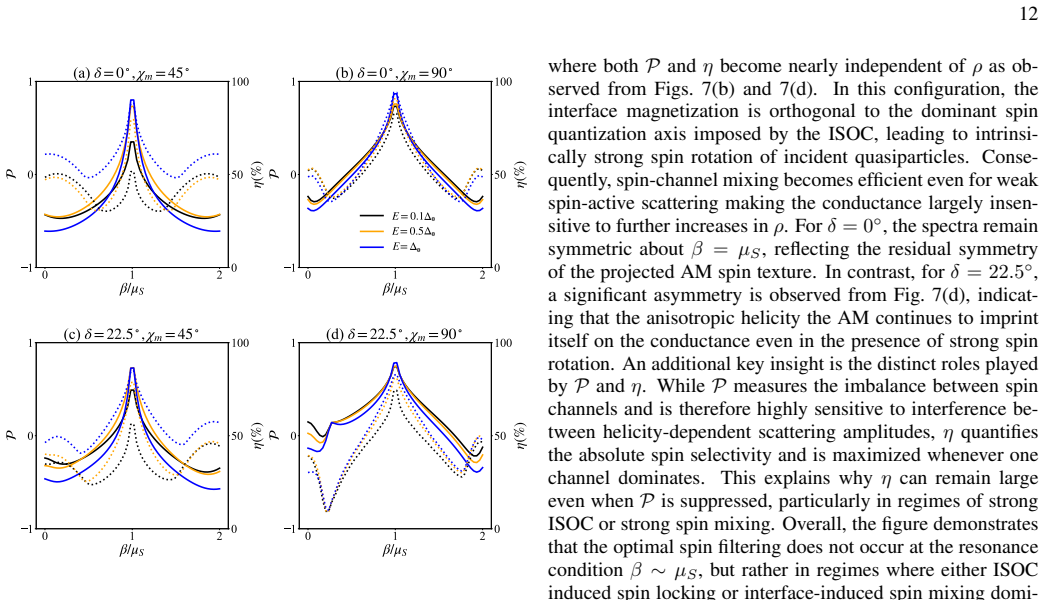
- Spin polarization and spin-filter efficiency depend nonmonotonically on parameters such as spin-orbit strength and interface magnetization, reaching up to approximately 86 percent.
- Nonreciprocal transport persists across the single-band, intermediate, and double-band regimes of the Ising superconductor.
- Strong spin mixing suppresses conventional Andreev reflection and produces substantial spectral redistribution.
- Angular modulation of conductance follows the altermagnet spin texture, with enhanced spin selectivity at low energies and suppression near the gap.
Where Pith is reading between the lines
- Measuring angular dependence of conductance in experiment could map the underlying altermagnet spin texture directly.
- The same interface control may generate comparable directional spin effects when other altermagnets are paired with different superconductors.
- Persistence across band regimes implies the predicted filtering remains usable under moderate variations in doping or film thickness.
Load-bearing premise
The scattering model with selected spin-mixing strengths and single-to-double band regimes fully captures the transport physics without disorder, finite temperature, or extra band effects.
What would settle it
Measurement of symmetric conductance under bias reversal in a fabricated AM/ISC junction at strong spin mixing would falsify the predicted nonreciprocity.
Figures



read the original abstract
We investigate theoretically spin-resolved transport, spin filtering, and nonreciprocal effects in an Altermagnet/Ising superconductor (AM/ISC) junction with a spin-active interface. Using a modified Bogoliubov-de Gennes framework within the scattering formalism, we demonstrate that the interplay among intrinsic spin-orbit coupling (ISOC), anisotropic AM spin texture and spin-dependent interfacial scattering gives rise to strongly anisotropic charge and spin conductance. In the weak spin-mixing regime, transport remains predominantly helicity conserving and exhibits pronounced angular dependence governed by the relative orientation between the AM spin texture and interface magnetization. Increasing ISOC enhances spin conductance and leads to spin-selective Andreev reflection resulting in finite spin filtering. In contrast, the strong spin-mixing regime exhibits enhanced angular anisotropy and robust spin-polarized transport over a broad energy range. Conventional Andreev reflection becomes strongly suppressed, accompanied by substantial spectral redistribution. We further show that nonreciprocal transport persists throughout the single-band, intermediate and double-band ISC regime. The spin polarization and spin-filter efficiency exhibit nonmonotonic dependence on system parameters, reaching values up to $\sim 86\%$, with characteristic angular modulation determined by the AM spin texture. Finite-energy analysis reveals enhanced spin selectivity at low energies and suppression near the superconducting gap. Furthermore, strong spin mixing at the AM/ISC junction produces asymmetric conductance patterns, indicating nonreciprocal transport. Our results establish AM/ISC junctions as a versatile platform for tunable superconducting spintronics and directional spin transport.
Editorial analysis
A structured set of objections, weighed in public.
Referee Report
Summary. The manuscript investigates spin-resolved transport, spin filtering, and nonreciprocal effects in Altermagnet/Ising superconductor (AM/ISC) junctions with a spin-active interface. Employing a modified Bogoliubov-de Gennes scattering formalism, it claims that the interplay of intrinsic spin-orbit coupling, anisotropic AM spin texture, and spin-dependent interfacial scattering produces strongly anisotropic charge and spin conductance, with spin-filter efficiency reaching up to ~86% and nonreciprocal transport persisting across single-band, intermediate, and double-band ISC regimes.
Significance. If the numerical results hold under the stated assumptions, the work provides concrete predictions for tunable spin filtering and directional transport in superconducting heterostructures, potentially guiding experiments in altermagnetic spintronics. The reported nonmonotonic parameter dependence and angular modulation tied to AM texture offer falsifiable signatures.
major comments (3)
- [Scattering formalism section] Scattering formalism section (near Eq. defining spin-mixing regimes): The weak and strong spin-mixing regimes are introduced by hand with fixed interface magnetization and ISOC strength as external parameters. This choice is load-bearing for the ~86% efficiency and asymmetric conductance claims; without self-consistent solution for interface magnetization or explicit disorder averaging, the results risk overestimating spin selectivity.
- [Results on spin polarization and filtering] Results on spin polarization and filtering (figures showing nonmonotonic dependence): The peak efficiency of ~86% and angular modulation are demonstrated only for discrete parameter sets in the two regimes. A systematic scan over the free parameters (spin-mixing strength, ISOC) with error bars or robustness checks is needed to support the central claim that these features are generic.
- [Section on single- to double-band crossover] Section on single- to double-band crossover: Nonreciprocity is asserted to persist across the parametrized band regimes, but the crossover itself is not derived from a microscopic band-structure calculation. This leaves open whether the asymmetric conductance survives when the ISC density of states is obtained self-consistently rather than imposed.
minor comments (2)
- [Figure captions] Figure captions for angular plots: Explicitly state the relative angle between AM spin texture and interface magnetization in each panel to aid reproducibility.
- [Notation for helicity-conserving channels] Notation for helicity-conserving channels: Define the helicity operator and its conservation condition more explicitly when discussing suppression of conventional Andreev reflection.
Simulated Author's Rebuttal
We thank the referee for the careful reading and constructive feedback on our manuscript. We address each major comment below, clarifying our approach and indicating revisions where appropriate.
read point-by-point responses
-
Referee: [Scattering formalism section] Scattering formalism section (near Eq. defining spin-mixing regimes): The weak and strong spin-mixing regimes are introduced by hand with fixed interface magnetization and ISOC strength as external parameters. This choice is load-bearing for the ~86% efficiency and asymmetric conductance claims; without self-consistent solution for interface magnetization or explicit disorder averaging, the results risk overestimating spin selectivity.
Authors: We agree that parameterizing the spin-mixing regimes via fixed interface magnetization and ISOC strength is a modeling choice that isolates the effects of spin-dependent scattering within the scattering formalism. This is standard in Bogoliubov-de Gennes transport studies of heterostructures to highlight the interplay with altermagnetic texture. A fully self-consistent treatment of interface magnetization would require a microscopic interface model (e.g., including disorder or proximity effects), which lies beyond the present scope. In the revised manuscript we have expanded the discussion near the relevant equation to explicitly state the assumptions, note the idealized nature of the results, and add a brief remark on how disorder averaging could be incorporated in follow-up work. We have also performed limited checks with varied interface parameters to confirm that the reported efficiencies remain qualitatively robust. revision: partial
-
Referee: [Results on spin polarization and filtering] Results on spin polarization and filtering (figures showing nonmonotonic dependence): The peak efficiency of ~86% and angular modulation are demonstrated only for discrete parameter sets in the two regimes. A systematic scan over the free parameters (spin-mixing strength, ISOC) with error bars or robustness checks is needed to support the central claim that these features are generic.
Authors: We accept the referee's point that discrete parameter sets limit the generality claim. In the revised manuscript we have added a new supplementary figure that systematically scans spin-filter efficiency versus spin-mixing strength and ISOC strength over a continuous grid. The nonmonotonic dependence and the ~86% peak in the strong-mixing regime are confirmed across the scanned range, with numerical convergence error bars included. The main text now references this scan to support that the angular modulation tied to the altermagnetic texture is generic within the explored parameter space. revision: yes
-
Referee: [Section on single- to double-band crossover] Section on single- to double-band crossover: Nonreciprocity is asserted to persist across the parametrized band regimes, but the crossover itself is not derived from a microscopic band-structure calculation. This leaves open whether the asymmetric conductance survives when the ISC density of states is obtained self-consistently rather than imposed.
Authors: The single- to double-band crossover is implemented by tuning the chemical potential and pairing amplitude within the BdG scattering framework, which directly modulates the density of states while preserving the essential superconducting gap structure of Ising superconductors. Although we do not perform a first-principles band-structure calculation for a specific material, the parametrization is chosen to be consistent with established models of Ising superconductivity. The nonreciprocity originates primarily from the interface spin mixing and altermagnetic texture rather than fine details of the DOS; we have added a clarifying paragraph in the revised section explaining this and noting that self-consistent DOS calculations would require material-specific inputs not available in the current phenomenological approach. revision: partial
Circularity Check
No significant circularity; derivation follows standard scattering formalism with external parameters
full rationale
The paper applies a modified Bogoliubov-de Gennes scattering formalism to compute spin-resolved transport, polarization, and nonreciprocity in AM/ISC junctions. Spin-mixing regimes, ISOC strength, and interface magnetization are introduced as external parameters, with results (nonmonotonic spin filtering up to ~86%, angular modulation, asymmetric conductance) obtained by solving the scattering problem across single-band to double-band regimes. No equations reduce predictions to fitted inputs by construction, no self-citations bear load for uniqueness or ansatzes, and no known results are merely renamed. The framework is self-contained against external benchmarks of scattering theory.
Axiom & Free-Parameter Ledger
free parameters (2)
- spin-mixing strength at interface
- intrinsic spin-orbit coupling strength
axioms (1)
- domain assumption Modified Bogoliubov-de Gennes framework within scattering formalism
Reference graph
Works this paper leans on
-
[1]
The corresponding energy band structure of the AM is depicted in Fig
To ensure a physically relevant regime with a closed Fermi surface, the parameters must satisfy the constraint¯α < αc ≡ℏ 2/m, such that the resulting Fermi surface remains elliptic rather than hyperbolic. The corresponding energy band structure of the AM is depicted in Fig. 1(b). The orientation angleδcon- trols the momentum-space structure of the AM spin...
-
[2]
ˇZuti´c, J
I. ˇZuti´c, J. Fabian, and S. D. Sarma, Spintronics: Fundamentals and applications, Rev. Mod. Phys.76, 323 (2004)
2004
-
[3]
A. I. Buzdin, Proximity effects in superconductor-ferromagnet heterostructures, Rev. Mod. Phys.77, 935 (2005)
2005
-
[4]
F. S. Bergeret, A. F. V olkov, and K. B. Efetov, Odd triplet superconductivity and related phenomena in superconductor- ferromagnet structures, Rev. Mod. Phys.77, 1321 (2005)
2005
-
[5]
S. S. Saxena, P. Agarwal, K. Ahilan, F. M. Grosche, R. K. W. Haselwimmer, M. J. Steiner, E. Pugh, I. R. Walker, S. R. Julian, P. Monthouxet al., Superconductivity on the bor- der of itinerant-electron ferromagnetism in UGe 2, Nature406, 587 (2000)
2000
-
[6]
Pfleiderer, M
C. Pfleiderer, M. Uhlarz, S. M. Hayden, R. V ollmer, H. v. L¨ohneysen, N. R. Bernhoeft, and G. G. Lonzarich, Coex- istence of superconductivity and ferromagnetism in the d-band metal ZrZn2, Nature412, 58 (2001)
2001
-
[7]
Linder and J
J. Linder and J. W. A. Robinson, Superconducting spintronics, Nat. Phys.11, 307 (2015)
2015
-
[8]
F. S. Bergeret, M. Silaev, P. Virtanen, and T. T. Heikkil ¨a, Nonequilibrium effects in superconductors with a spin-splitting field, Rev. Mod. Phys.90, 041001 (2018)
2018
-
[9]
D. Aoki, A. Huxley, E. Ressouche, D. Braithwaite, J. Flouquet, J.-P. Brison, E. Lhotel, and C. Paulsen, Coexistence of super- conductivity and ferromagnetism in URhGe, Nature413, 613 (2001)
2001
-
[10]
Jacobsen, I
S. Jacobsen, I. Kulagina, and J. Linder, Controlling supercon- ducting spin flow with spin-flip immunity using a single homo- geneous ferromagnet, Sci. Rep.6, 23926 (2016)
2016
-
[11]
W. Han, S. Maekawa, and X. C. Xie, Spin current as a probe of quantum materials, Nat. Mater.19, 139-152 (2020)
2020
-
[12]
A. V . Samokhvalov, A. A. Kopasov, A. G. Kutlin, S. V . Mironov, A. I. Buzdin, and A. S. Mel’nikov, Spontaneous currents and topologically protected states in superconducting hybrid structures with spin-orbit coupling, JETP Lett.113, 34- 46 (2021)
2021
-
[13]
Tokuyasu, J
T. Tokuyasu, J. A. Sauls, and D. Rainer, Proximity effect of a ferromagnetic insulator in contact with a superconductor, Phys. Rev. B38, 8823 (1988)
1988
-
[14]
Shevtsov and T
O. Shevtsov and T. L¨ofwander, Spin imbalance in hybrid super- conducting structures with spin-active interfaces, Phys. Rev. B 90, 085432 (2014)
2014
-
[15]
Eschrig, Spin-polarized supercurrents for spintronics: A re- view of current progress, Rep
M. Eschrig, Spin-polarized supercurrents for spintronics: A re- view of current progress, Rep. Prog. Phys.78, 104501 (2015)
2015
-
[16]
Nadeem, M
M. Nadeem, M. S. Fuhrer, and X. Wang, The superconducting diode effect, Nat. Rev. Phys.5, 558-577 (2023)
2023
-
[17]
C. Sun, J. B. Tjernshaugen, and J. Linder, V oltage-tunable spin supercurrent nonreciprocity reaching 100% efficiency, Phys. Rev. B112, 064504 (2025)
2025
-
[18]
Zhang, A
F. Zhang, A. S. Rashid, M. T. Ahari, G. J. de Coster, T. Taniguchi, K. Watanabe, M. J. Gilbert, N. Samarth, and M. Kayyalha, Magnetic-field-free nonreciprocal transport in graphene multiterminal Josephson junctions, Phys. Rev. Ap- plied21, 034011 (2024)
2024
-
[19]
Linder, M
J. Linder, M. Cuoco, and A. Sudbø, Spin-active interfaces and unconventional pairing in half-metal/superconductor junctions, Phys. Rev. B81, 174526 (2010)
2010
-
[20]
Q. Lu, Z. Lin, L. Liang, J. Liu, Y . Jiang, Y . Wang, B. Peng, Z. Hu, Z. Wang, and M. Liu, V oltage control spin mixing con- ductance in TMDCs/ferromagnet heterostructures, Appl. Phys. Lett.127, 112401 (2025)
2025
-
[21]
S. N. Panda, N. Mao, N. Peshcherenkoet al., Efficient spin- pumping and spin transport across epitaxial Mn3Sn(0001) non- collinear antiferromagnet/permalloy interfaces, npj Spintronics 4, 17 (2026)
2026
-
[22]
Li and W
S. Li and W. Qin, Manipulating spins in organic and chiral sys- tems: From injection and transport to photon control, Appl. Phys. Rev.13, 011308 (2026)
2026
-
[23]
V . P. Amin and M. D. Stiles, Spin transport at interfaces with spin-orbit coupling: Formalism, Phys. Rev. B94, 104419 (2016)
2016
-
[24]
Ouassou, A
J. Ouassou, A. Di Bernardo, J. W. A. Robinson, and M. Eschrig, Electric control of superconducting transition through a spin- orbit coupled interface, Sci. Rep.6, 29312 (2016)
2016
-
[25]
Triola, E
C. Triola, E. Rossi, and A. V . Balatsky, Effect of a spin-active interface on proximity-induced superconductivity in topologi- cal insulators, Phys. Rev. B89, 165309 (2014)
2014
-
[26]
Hirai, Y
T. Hirai, Y . Tanaka, N. Yoshida, Y . Asano, J. Inoue, and S. Kashiwaya, Temperature dependence of spin-polarized transport in ferromagnet/unconventional superconductor junc- tions, Phys. Rev. B67, 174501 (2003)
2003
-
[27]
Acharjee and U
S. Acharjee and U. D. Goswami, Current induced magnetiza- tion dynamics and magnetization switching in superconduct- ing ferromagnet hybrid (F|S|F) structures, J. Appl. Phys.120, 243902 (2016)
2016
-
[28]
ˇSmejkal, R
L. ˇSmejkal, R. Gonz´alez-Hern´ndez, T. Jungwirth, and J. Sinova, Crystal time-reversal symmetry breaking and spontaneous Hall effect in collinear antiferromagnets, Sci. Adv.6, eaaz8809 (2020)
2020
-
[29]
ˇSmejkal, J
L. ˇSmejkal, J. Sinova and T. Jungwirth, Emerging Research Landscape of Altermagnetism, Phys. Rev. X12, 040501 (2022). 17
2022
-
[30]
Z. Feng, X. Zhou, L. ˇSmejkal, L. Wu, Z. Zhu, H. Guo, R. G.- Hern´andez, X. Wang, H. Yan, P. Qin, et. al., An anomalous Hall effect in altermagnetic ruthenium dioxide, Nat. Electron.5, 735 (2022)
2022
-
[31]
C. A. Occhialini, L. G. P. Martins, S. Fan, V . Bisogni, T. Ya- sunami, M. Musashi, M. Kawasaki, M. Uchida, R. Comin and J. Pelliciari, Strain-modulated anisotropic electronic structure in superconducting RuO 2 films. Phys. Rev. Mater.6, 084802 (2022)
2022
-
[32]
J. Rial, M. Leivisk ¨a, G. Skobjin, A. Bad’ura, G. Gaudin, F. Dis- dier, R. Schlitz, I. Kounta, S. Beckertet al., Altermagnetic vari- ants in thin films of Mn5Si3, Phys. Rev. B110, L220411 (2024)
2024
-
[33]
V . C. Morano, Z. Maesen, S. E. Nikitin, J. Lass, D. G. Maz- zone, and O. Zaharko, Absence of altermagnetic magnon band splitting in MnF2, Phys. Rev. Lett.134, 226702 (2025)
2025
-
[34]
S. W. Cheong and F. T. Huang, Altermagnetism with non- collinear spins, npj Quantum Mater.9, 13 (2024)
2024
-
[35]
ˇSmejkal, J
L. ˇSmejkal, J. Sinova and T. Jungwirth, Beyond Conventional Ferromagnetism and Antiferromagnetism: A Phase with Non- relativistic Spin and Crystal Rotation Symmetry, Phys. Rev. X 12, 031042 (2022)
2022
-
[36]
Boruah, S
A. Boruah, S. Acharjee, and P. K. Saikia, Field-free Joseph- son diode effect in an Ising-superconductor/altermagnet/Ising- superconductor Josephson junction, Phys. Rev. B112, 054505 (2025)
2025
-
[37]
Cheng and Q.-F
Q. Cheng and Q.-F. Sun, Orientation-dependent Josephson ef- fect in spin-singlet superconductor/altermagnet/spin-triplet su- perconductor junctions, Phys. Rev. B109, 024517 (2024)
2024
-
[38]
Papaj, Andreev reflection at the altermagnet-superconductor interface, Phys
M. Papaj, Andreev reflection at the altermagnet-superconductor interface, Phys. Rev. B108, L060508 (2023)
2023
-
[39]
C. Sun, A. Brataas, and J. Linder, Andreev reflection in alter- magnets, Phys. Rev. B108, 054511 (2023)
2023
-
[40]
J. A. Ouassou, A. Brataas, and J. Linder, dc Josephson Effect in Altermagnets, Phys. Rev. Lett.131, 076003 (2023)
2023
-
[41]
C.W. J. Beenakker and T. Vakhtel, Phase-shifted Andreev levels in an altermagnet Josephson junction, Phys. Rev. B108, 075425 (2023)
2023
-
[42]
S. C. de la Barrera, M. R. Sinko, D. P. Gopalan, N. Sivadas, K. L. Seyler, K. Watanabe, T. Taniguchi, A. W. Tsen, X. Xu, D. Xiao, et al., Tuning Ising superconductivity with layer and spin–orbit coupling in two-dimensional transition-metal dichalcogenides, Nat. Commun.9, 1427 (2018)
2018
-
[43]
Idzuchi, F
H. Idzuchi, F. Pientka, K.-F. Huang, K. Harada, ¨O. G ¨ul, Y . J. Shin, L. T. Nguyen, N. H. Jo, D. Shindo, R. J. Cava, et al., Unconventional supercurrent phase in Ising superconduc- tor Josephson junction with atomically thin magnetic insulator, Nat. Commun.12, 5332 (2021)
2021
-
[44]
G. Tang, R. L. Klees, C. Bruder, and W. Belzig, Controlling charge and spin transport in an Ising-superconductor Josephson junction, Phys. Rev. B104, L241413 (2021)
2021
-
[45]
J. M. Lu, O. Zheliuk, I. Leermakers, N. F. Q. Yuan, U. Zeitler, K. T. Law, and J. T. Ye, Evidence for two-dimensional Ising superconductivity in gated MoS2, Science350, 1353 (2015)
2015
-
[46]
Saito, Y
Y . Saito, Y . Nakamura, M. S. Bahramy, Y . Kohama, J. Ye, Y . Kasahara, Y . Nakagawa, M. Onga, M. Tokunaga, T. Nojima, et al., Superconductivity protected by spin–valley locking in ion- gated MoS2, Nat. Phys.12, 144 (2016)
2016
-
[47]
X. Xi, Z. Wang, W. Zhao, J. H. Park, K. T. Law, H. Berger, L. Forr´o, J. Shan and K. F. Mak, Ising pairing in superconducting NbSe2 atomic layers, Nat. Phys.12, 139 (2016)
2016
-
[48]
T. Dvir, F. Massee, L. Attias, M. Khodas, M. Aprili, C. H. L. Quay and H. Steinberg , Spectroscopy of bulk and few-layer superconducting NbSe 2 with van der Waals tunnel junctions, Nat. Commun.9, 598 (2018)
2018
-
[49]
Costanzo, H
D. Costanzo, H. Zhang, B. A. Reddy, H. Berger and A. F. Mor- purgo, Tunnelling spectroscopy of gate-induced superconduc- tivity in MoS2, Nat. Nanotechnol.13, 483 (2018)
2018
-
[50]
J. Li, P. Song, J. Zhao, K. Vaklinova, X. Zhao, Z. Li, Z. Qiu, Z. Wang, L. Lin, M. Zhao, et al., Printable two-dimensional superconducting monolayers, Nat. Mater.20, 181 (2021)
2021
-
[51]
Acharjee, A
S. Acharjee, A. Boruah, N. Dutta and R. Devi, Tunability of Andreev levels in a spin-active Ising Superconductor/Half Metal Josephson junction, Supercond. Sci. Technol.36125014 (2023)
2023
-
[52]
E. Sohn, X. Xi, W. Y . He, S. Jiang, Z. Wang, K. Kang, J. H. Park, H. Berger, L. Forr´o, K. T. Law, et al., An unusual contin- uous paramagnetic-limited superconducting phase transition in 2D NbSe2, Nat. Mater.17, 504 (2018)
2018
-
[53]
Hamill, B
A. Hamill, B. Heischmidt, E. Sohn, D. Shaffer, K. T. Tsai, X. Zhang, X. Xi, A. Suslov, H. Berger, L. Forr ´o, et al., Two-fold symmetric superconductivity in few-layer NbSe 2, Nat. Phys. 17, 949 (2021)
2021
-
[54]
S. B. Zhang, L. H. Hu, and T. Neupert, Finite-momentum Cooper pairing in proximitized altermagnets, Nat. Commun. 15, 1801 (2024)
2024
-
[55]
Gløckner Giil and J
H. Gløckner Giil and J. Linder, Superconductor-altermagnet memory functionality without stray fields, Phys. Rev. B109, 134511 (2024)
2024
-
[56]
Yi, Y .-X
X.-J. Yi, Y .-X. Dai, Y . Mao, and Q.-F. Sun, Spin transport in a normal metal-altermagnetic superconducting nanowire junc- tion, Phys. Rev. B113, 134502 (2026)
2026
-
[57]
Trifunovic, Z
L. Trifunovic, Z. Popovi´c, and Z. Radovi´c, Josephson effect and spin-triplet pairing correlations in SF1F2S junctions, Phys. Rev. B84, 064511 (2011)
2011
-
[58]
Annunziata, M
G. Annunziata, M. Cuoco, C. Noce, A. Sudbø, and J. Linder, Spin-sensitive long-range proximity effect in ferromagnet/spin- triplet-superconductor bilayers, Phys. Rev. B83, 060508(R) (2011)
2011
-
[59]
H. Meng, J. Wu, X. Wu, M. Ren and Y . Ren, Long-range su- perharmonic Josephson current and spin-triplet pairing corre- lations in a junction with ferromagnetic bilayers, Sci. Rep.6, 21308 (2016)
2016
-
[60]
M. Ge, Z. Liu, T. Chen, L. Xu, and L. Huang, Interface-driven spin filtering and diode effects in van der Waals junctions based on magnetic metal-organic frameworks, Phys. Chem. Chem. Phys.27, 6255 (2025)
2025
-
[61]
Dal Din, O
A. Dal Din, O. J. Amin, P. Wadleyet al., Antiferromagnetic spintronics and beyond, npj Spintronics2, 25 (2024)
2024
-
[62]
Mart ´ınez, P
I. Mart ´ınez, P. H¨ogl, C. Gonz´alez-Ruano, J. P. Cascales, C. Tiu- san, Y . Lu, M. Hehn, A. Matos-Abiague, J. Fabianet al., In- terfacial spin-orbit coupling: A platform for superconducting spintronics, Phys. Rev. Applied13, 014030 (2020)
2020
-
[63]
Mishra, Y
V . Mishra, Y . Li, F.-C. Zhang, and S. Kirchner, Effects of spin- orbit coupling in superconducting proximity devices: Applica- tion to CoSi2/TiSi2 heterostructures, Phys. Rev. B103, 184505 (2021)
2021
discussion (0)
Sign in with ORCID, Apple, or X to comment. Anyone can read and Pith papers without signing in.