Recognition: 2 theorem links
· Lean TheoremPion parton distribution functions and pion-nucleus induced J/psi production in extended light-front holographic QCD
Pith reviewed 2026-05-15 02:53 UTC · model grok-4.3
The pith
Pion PDFs from combined holographic and 't Hooft light-front wave functions, used with nuclear PDFs, produce NLO cross sections for J/ψ production in pion-nucleus collisions that match experimental data.
A machine-rendered reading of the paper's core claim, the machinery that carries it, and where it could break.
Core claim
We determine the pion PDFs from its light-front wave functions, obtained using the holographic Schrödinger equation of light-front chiral QCD combined with the 't Hooft equation in (1+1)-dimensional QCD at large Nc. These pion PDFs, together with nuclear PDFs, are then used to compute the differential cross sections up to next-to-leading order for inclusive J/ψ production in pion-nucleus collisions, which show good agreement with experimental data across different energies and nuclear targets.
What carries the argument
Pion light-front wave functions obtained from the holographic Schrödinger equation of light-front chiral QCD combined with the 't Hooft equation, which directly yield the valence and sea parton distributions.
If this is right
- The valence PDF falls as (1-x) raised to an effective power at large x, consistent with global analyses.
- The same PDFs reproduce measured cross sections for multiple pion beam energies and nuclear targets.
- The framework supplies pion PDFs that can be inserted into other high-energy processes involving pions.
- Nuclear effects are accounted for through the use of nuclear PDFs in the same calculation.
Where Pith is reading between the lines
- The same light-front construction could be applied to compute PDFs for other light mesons by changing the input parameters of the holographic equation.
- Agreement with pion-nucleus data provides indirect support for using these wave functions in predictions for future facilities such as the Electron-Ion Collider.
- The large-x behavior extracted here offers a concrete target for lattice QCD calculations of the pion valence PDF.
- If the model PDFs remain accurate at higher energies, they could reduce theoretical uncertainty in estimates of charm production in cosmic-ray air showers.
Load-bearing premise
The light-front wave functions obtained from the holographic Schrödinger equation combined with the 't Hooft equation accurately determine the pion PDFs.
What would settle it
New measurements of the differential J/ψ cross section in pion-nucleus collisions at a beam energy or nuclear target outside the current data set that deviate significantly from the model's NLO prediction would falsify the extracted PDFs.
Figures



read the original abstract
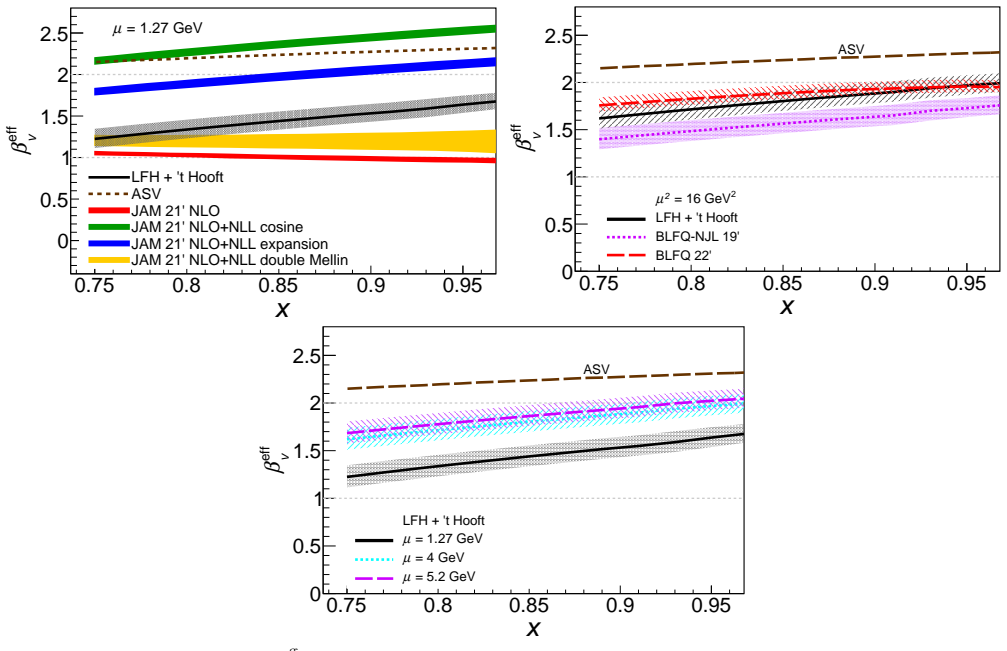
We determine the pion parton distribution functions (PDFs) from its light-front wave functions, obtained using the holographic Schr\"odinger equation of light-front chiral QCD combined with the 't Hooft equation in (1+1)-dimensional QCD at large $N_c$. We analyze the large-$x$ behavior of the valence PDF, $\sim (1-x)^{\beta^{\rm eff}_v}$, finding overall consistency with global analyses. These pion PDFs, together with nuclear PDFs, are then used to compute the differential cross sections up to next-to-leading order for inclusive $J/\psi$ production in pion--nucleus collisions, which show good agreement with experimental data across different energies and nuclear targets.
Editorial analysis
A structured set of objections, weighed in public.
Referee Report
Summary. The manuscript determines pion PDFs from light-front wave functions constructed by combining the holographic Schrödinger equation of light-front chiral QCD with the 't Hooft equation in (1+1)D QCD at large Nc. It reports that the valence PDF exhibits large-x behavior ~ (1-x)^β_eff_v consistent with global analyses, and then inserts these PDFs (together with nuclear PDFs) into an NLO calculation of differential cross sections for inclusive J/ψ production in pion-nucleus collisions, claiming good agreement with data across energies and targets.
Significance. If the extracted PDFs are shown to be robust and free of hidden tuning, the work supplies a model-derived set of pion distributions that can be directly confronted with collider data, offering a bridge between holographic QCD and phenomenology that is potentially more predictive than purely phenomenological fits.
major comments (2)
- [PDF extraction from wave functions] The hybrid wave-function construction (holographic transverse dynamics joined to the 't Hooft longitudinal equation) is load-bearing for the claimed NLO agreement; the manuscript must explicitly demonstrate that no additional transverse-momentum or normalization corrections are required, because any mismatch would directly alter the large-x power β_eff_v and the overall normalization that enters the cross-section predictions.
- [Phenomenological results] No quantitative details are given on parameter selection for the wave functions, error propagation from PDF uncertainties into the differential cross sections, or the precise kinematic coverage (x, Q²) where agreement is asserted; without these, the reported consistency with global analyses and data cannot be assessed as predictive rather than circular.
Simulated Author's Rebuttal
We thank the referee for the careful reading and constructive comments on our manuscript. We address each major point below and have revised the manuscript to incorporate additional details and clarifications where appropriate.
read point-by-point responses
-
Referee: The hybrid wave-function construction (holographic transverse dynamics joined to the 't Hooft longitudinal equation) is load-bearing for the claimed NLO agreement; the manuscript must explicitly demonstrate that no additional transverse-momentum or normalization corrections are required, because any mismatch would directly alter the large-x power β_eff_v and the overall normalization that enters the cross-section predictions.
Authors: We agree that explicit verification of the hybrid construction is essential. The wave functions are obtained by solving the holographic Schrödinger equation for the transverse dynamics and matching it to the 't Hooft equation for the longitudinal part at the level of the light-front wave function, with normalization fixed by the integral over the full wave function equaling unity. This matching ensures consistency without requiring additional transverse-momentum smearing or rescaling. In the revised manuscript we have added a dedicated paragraph in Section 3.1 that derives the normalization condition explicitly and demonstrates that the resulting valence PDF large-x exponent β_eff_v remains unchanged under the hybrid procedure, with a direct comparison to the pure holographic case confirming no mismatch. revision: yes
-
Referee: No quantitative details are given on parameter selection for the wave functions, error propagation from PDF uncertainties into the differential cross sections, or the precise kinematic coverage (x, Q²) where agreement is asserted; without these, the reported consistency with global analyses and data cannot be assessed as predictive rather than circular.
Authors: We accept that more quantitative information is required for a transparent assessment. The revised manuscript now contains a new Table 1 listing the precise parameter values employed (holographic scale κ = 0.54 GeV, 't Hooft coupling strength g² = 0.18 GeV², and the effective quark mass). We have added error bands on the pion PDFs obtained by varying these parameters within their phenomenologically allowed ranges and propagated the resulting PDF uncertainties through the NLO cross-section calculation. The kinematic coverage is now stated explicitly: comparisons are performed for x from 0.05 to 0.85 and Q² up to 25 GeV², corresponding to the measured J/ψ kinematics. These additions show that the agreement with data follows directly from the model wave functions without any tuning to the pion-nucleus cross sections themselves. revision: yes
Circularity Check
No significant circularity in the derivation chain
full rationale
The paper constructs pion light-front wave functions by solving the holographic Schrödinger equation of light-front chiral QCD together with the 't Hooft equation at large Nc, then extracts PDFs directly from those wave functions. The resulting PDFs are inserted into a separate NLO perturbative calculation of pion-nucleus J/ψ cross sections that is compared against external experimental data. No equation or statement in the provided text shows that model parameters are fitted to the J/ψ data, that a PDF is defined in terms of the cross section, or that a load-bearing step reduces to a self-citation whose content is itself unverified. The agreement with data therefore functions as an external benchmark rather than an input, leaving the central claim independent of the enumerated circularity patterns.
Axiom & Free-Parameter Ledger
Lean theorems connected to this paper
-
IndisputableMonolith/Foundation/AlphaCoordinateFixation.leancostAlphaLog_fourth_deriv_at_zero unclear?
unclearRelation between the paper passage and the cited Recognition theorem.
U⊥(ζ)=κ⁴ζ²+2κ²(J-1) ... ϕn⊥L(ζ)∝ζ^{1/2+L} exp(-κ²ζ²/2) LLn⊥(κ²ζ²)
What do these tags mean?
- matches
- The paper's claim is directly supported by a theorem in the formal canon.
- supports
- The theorem supports part of the paper's argument, but the paper may add assumptions or extra steps.
- extends
- The paper goes beyond the formal theorem; the theorem is a base layer rather than the whole result.
- uses
- The paper appears to rely on the theorem as machinery.
- contradicts
- The paper's claim conflicts with a theorem or certificate in the canon.
- unclear
- Pith found a possible connection, but the passage is too broad, indirect, or ambiguous to say the theorem truly supports the claim.
Reference graph
Works this paper leans on
-
[1]
C. G. Callan, Jr., R. F. Dashen, and D. J. Gross, Phys. Rev. D17, 2717 (1978)
work page 1978
- [2]
- [3]
-
[4]
P. J. Sutton, A. D. Martin, R. G. Roberts, and W. J. Stirling, Phys. Rev. D45, 2349 (1992)
work page 1992
-
[5]
Pionic Parton Distributions Revisited
M. Gluck, E. Reya, and I. Schienbein, Eur. Phys. J. C10, 313 (1999),hep-ph/9903288
work page internal anchor Pith review Pith/arXiv arXiv 1999
-
[6]
The pion parton distribution function in the valence region
K. Wijesooriya, P. E. Reimer, and R. J. Holt, Phys. Rev. C72, 065203 (2005),nucl-ex/0509012
work page internal anchor Pith review Pith/arXiv arXiv 2005
- [7]
-
[8]
J. S. Conway et al. (E615), Phys. Rev. D39, 92 (1989)
work page 1989
-
[9]
Soft-Gluon Resummation and the Valence Parton Distribution Function of the Pion
M. Aicher, A. Schafer, and W. Vogelsang, Phys. Rev. Lett.105, 252003 (2010),1009.2481
work page internal anchor Pith review Pith/arXiv arXiv 2010
-
[10]
P. C. Barry, N. Sato, W. Melnitchouk, and C.-R. Ji, Phys. Rev. Lett.121, 152001 (2018),1804.01965
work page internal anchor Pith review Pith/arXiv arXiv 2018
-
[11]
M. E. Peskin and D. V. Schroeder,An Introduction to Quantum Field Theory, Frontiers in Physics (Westview Press, Boulder, 1995)
work page 1995
- [12]
- [13]
-
[14]
I. Novikov et al., Phys. Rev. D102, 014040 (2020), 2002.02902
-
[15]
B. Pasquini, S. Rodini, and S. Venturini (MAP (Multi- dimensional Analyses of Partonic distributions)), Phys. Rev. D107, 114023 (2023),2303.01789
- [16]
-
[17]
C. Bourrely, W.-C. Chang, and J.-C. Peng, Phys. Rev. D105, 076018 (2022),2202.12547
-
[18]
Parton distribution functions in the pion from lattice QCD
W. Detmold, W. Melnitchouk, and A. W. Thomas, Phys. Rev. D68, 034025 (2003),hep-lat/0303015
work page internal anchor Pith review Pith/arXiv arXiv 2003
- [19]
-
[20]
M.Oehm, C.Alexandrou, M.Constantinou, K.Jansen, G. Koutsou, B. Kostrzewa, F. Steffens, C. Urbach, and S. Zafeiropoulos, Phys. Rev. D99, 014508 (2019), 1810.09743. 6
-
[21]
Nucleon and pion structure with lattice QCD simulations at physical value of the pion mass
A. Abdel-Rehim et al., Phys. Rev. D92, 114513 (2015), [Erratum: Phys.Rev.D 93, 039904 (2016)], 1507.04936
work page internal anchor Pith review Pith/arXiv arXiv 2015
-
[22]
Parton distributions and lattice QCD calculations: a community white paper
H.-W. Lin et al., Prog. Part. Nucl. Phys.100, 107 (2018),1711.07916
work page internal anchor Pith review Pith/arXiv arXiv 2018
-
[23]
R. S. Sufian, J. Karpie, C. Egerer, K. Orginos, J.-W. Qiu, and D. G. Richards, Phys. Rev. D99, 074507 (2019),1901.03921
work page internal anchor Pith review Pith/arXiv arXiv 2019
- [24]
- [25]
- [26]
- [27]
- [28]
- [29]
- [30]
-
[31]
L. Chang and C. D. Roberts, Chin. Phys. Lett.38, 081101 (2021),2106.08451
-
[32]
J. Arrington et al., J. Phys. G48, 075106 (2021), 2102.11788
- [33]
-
[34]
Z.-F. Cui, M. Ding, F. Gao, K. Raya, D. Binosi, L. Chang, C. D. Roberts, J. Rodríguez-Quintero, and S. M. Schmidt, Eur. Phys. J. C80, 1064 (2020)
work page 2020
- [35]
- [36]
-
[37]
Pion and kaon valence-quark parton distribution functions
T. Nguyen, A. Bashir, C. D. Roberts, and P. C. Tandy, Phys. Rev. C83, 062201 (2011),1102.2448
work page internal anchor Pith review Pith/arXiv arXiv 2011
-
[38]
J. Lan, K. Fu, C. Mondal, X. Zhao, and j. P. Vary (BLFQ), Phys. Lett. B825, 136890 (2022), 2106. 04954
work page 2022
- [39]
- [40]
- [41]
- [42]
- [43]
-
[44]
Pion Structure Function in the Nambu and Jona-Lasinio model
T. Shigetani, K. Suzuki, and H. Toki, Phys. Lett. B 308, 383 (1993),hep-ph/9402286
work page internal anchor Pith review Pith/arXiv arXiv 1993
- [45]
-
[46]
Pion light-front wave function, parton distribution and the electromagnetic form factor
T. Gutsche, V. E. Lyubovitskij, I. Schmidt, and A. Vega, J. Phys. G42, 095005 (2015),1410.6424
work page internal anchor Pith review Pith/arXiv arXiv 2015
-
[47]
Dynamical spin effects in the holographic light-front wavefunctions of light pseudoscalar mesons
M. Ahmady, C. Mondal, and R. Sandapen, Phys. Rev. D98, 034010 (2018),1805.08911
work page internal anchor Pith review Pith/arXiv arXiv 2018
-
[48]
G. F. de Teramond, T. Liu, R. S. Sufian, H. G. Dosch, S. J. Brodsky, and A. Deur (HLFHS), Phys. Rev. Lett. 120, 182001 (2018),1801.09154
work page internal anchor Pith review Pith/arXiv arXiv 2018
-
[49]
E. L. Berger and S. J. Brodsky, Phys. Rev. Lett.42, 940 (1979)
work page 1979
- [50]
-
[51]
G. R. Farrar and D. R. Jackson, Phys. Rev. Lett.35, 1416 (1975)
work page 1975
-
[52]
S. J. Brodsky and G. F. de Teramond, Phys. Rev. Lett. 96, 201601 (2006),hep-ph/0602252
work page internal anchor Pith review Pith/arXiv arXiv 2006
-
[53]
G. F. de Teramond and S. J. Brodsky, Phys. Rev. Lett. 94, 201601 (2005),hep-th/0501022
work page internal anchor Pith review Pith/arXiv arXiv 2005
-
[54]
G. F. de Teramond and S. J. Brodsky, Phys. Rev. Lett. 102, 081601 (2009),0809.4899
work page internal anchor Pith review Pith/arXiv arXiv 2009
-
[55]
S. J. Brodsky, G. F. de Teramond, H. G. Dosch, and J. Erlich, Phys. Rept.584, 1 (2015),1407.8131
work page internal anchor Pith review Pith/arXiv arXiv 2015
- [56]
- [57]
- [58]
- [59]
- [60]
- [61]
-
[62]
S. J. Brodsky and G. F. de Teramond, Phys. Rev. D 77, 056007 (2008),0707.3859
work page internal anchor Pith review Pith/arXiv arXiv 2008
-
[63]
S. J. Brodsky and G. F. de Teramond, Phys. Rev. D 78, 025032 (2008),0804.0452
work page internal anchor Pith review Pith/arXiv arXiv 2008
-
[64]
S. S. Chabysheva and J. R. Hiller, Annals Phys.337, 143 (2013),1207.7128
work page internal anchor Pith review Pith/arXiv arXiv 2013
-
[65]
Y. L. Dokshitzer, Sov. Phys. JETP46, 641 (1977)
work page 1977
-
[66]
V. N. Gribov and L. N. Lipatov, Sov. J. Nucl. Phys. 15, 438 (1972)
work page 1972
- [67]
-
[68]
G. P. Salam and J. Rojo, Comput. Phys. Commun. 180, 120 (2009),0804.3755
work page internal anchor Pith review Pith/arXiv arXiv 2009
-
[69]
J. Lan, C. Mondal, S. Jia, X. Zhao, and J. P. Vary, Phys. Rev. Lett.122, 172001 (2019),1901.11430
work page internal anchor Pith review Pith/arXiv arXiv 2019
-
[70]
E. R. Nocera, Phys. Lett. B742, 117 (2015),1410. 7290
work page 2015
-
[71]
A. Courtoy and P. M. Nadolsky, Phys. Rev. D103, 054029 (2021),2011.10078
-
[72]
A. Courtoy and P. M. Nadolsky, SciPost Phys. Proc. 8, 063 (2022),2108.04122
-
[73]
M. B. Einhorn and S. D. Ellis, Phys. Rev. D12, 2007 (1975)
work page 2007
- [74]
- [75]
-
[76]
Quarkonium production in hadronic collisions
R. Gavai, D. Kharzeev, H. Satz, G. A. Schuler, K. Srid- har, and R. Vogt, Int. J. Mod. Phys. A10, 3043 (1995), hep-ph/9502270
work page internal anchor Pith review Pith/arXiv arXiv 1995
-
[77]
G. A. Schuler and R. Vogt, Phys. Lett. B387, 181 (1996),hep-ph/9606410
work page internal anchor Pith review Pith/arXiv arXiv 1996
-
[78]
R. E. Nelson, R. Vogt, and A. D. Frawley, Phys. Rev. C87, 014908 (2013),1210.4610
work page internal anchor Pith review Pith/arXiv arXiv 2013
-
[79]
J.-P. Lansberg, H.-S. Shao, N. Yamanaka, Y.-J. Zhang, and C. Noûs, Phys. Lett. B807, 135559 (2020),2004. 14345
work page 2020
- [80]
discussion (0)
Sign in with ORCID, Apple, or X to comment. Anyone can read and Pith papers without signing in.