Recognition: 2 theorem links
· Lean TheoremPath-independent Flow Matching for Multi-parameter Generative Dynamics
Pith reviewed 2026-05-14 20:32 UTC · model grok-4.3
The pith
Path-independent Flow Matching learns vector fields whose flows produce transport that depends only on start and end distributions, not the path taken.
A machine-rendered reading of the paper's core claim, the machinery that carries it, and where it could break.
Core claim
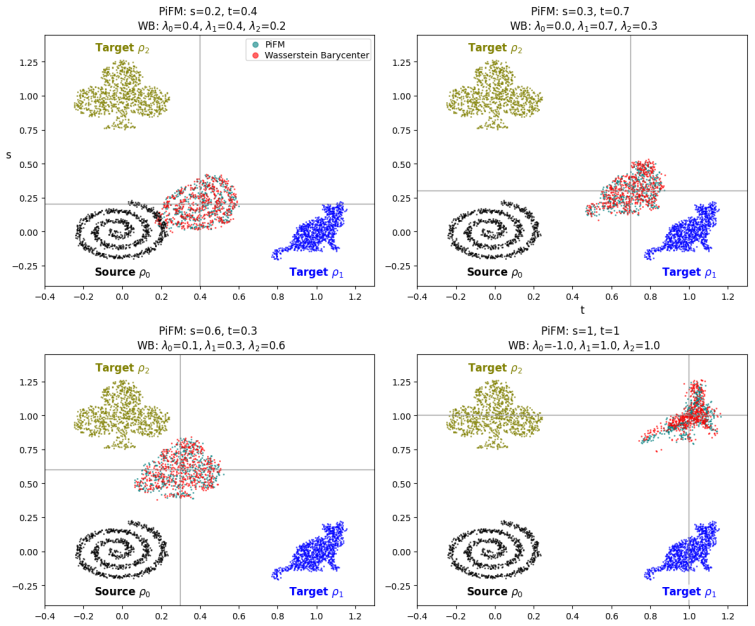
We introduce Path-independent Flow Matching (PiFM), a method for learning vector fields whose induced flows yield path-independent transport between distributions. We show that PiFM generalizes Flow Matching to higher-dimensional parameter domains while enforcing structural conditions that ensure consistency of composed transformations. In addition, we show that, under suitable assumptions, PiFM approximates the Wasserstein barycenter, linking the framework to a notion of distributional interpolation. To enable practical training, we propose a tractable, simulation-free objective that regresses onto multi-parameter conditional probability paths.
What carries the argument
The PiFM objective that regresses vector fields onto multi-parameter conditional probability paths while enforcing structural conditions for path-independence.
If this is right
- Transport maps remain identical for any pair of distributions no matter which parameter path is followed.
- The method approximates Wasserstein barycenters, enabling consistent distributional interpolation.
- Training uses a simulation-free regression objective on multi-parameter probability paths.
- Empirical results show improved interpolation of path-independent trajectories and better out-of-distribution sample generation.
Where Pith is reading between the lines
- The framework may extend naturally to other conditional generation tasks where path consistency is required.
- Higher-dimensional parameter spaces could be tested to check whether the structural conditions scale without added computational cost.
- Connections to optimal transport suggest possible combinations with existing barycenter algorithms to reduce training time.
Load-bearing premise
Suitable structural conditions exist that can enforce path-independence across higher-dimensional parameter domains while still allowing the flows to approximate the Wasserstein barycenter.
What would settle it
An experiment in which the same pair of start and end distributions produces measurably different transport maps when reached via two different paths through the multi-parameter space.
Figures




read the original abstract
Flow Matching is a powerful framework for learning transport maps between probability distributions. Yet its standard single-parameter formulation is not designed to capture multi-parameter variations where the resulting transport should be path-independent. Path independence is crucial because it ensures that transformations depend only on the initial and target distributions, not on the specific path. In this work, we introduce Path-independent Flow Matching (PiFM), a method for learning vector fields whose induced flows yield path-independent transport between distributions. We show that PiFM generalizes Flow Matching to higher-dimensional parameter domains while enforcing structural conditions that ensure consistency of composed transformations. In addition, we show that, under suitable assumptions, PiFM approximates the Wasserstein barycenter, linking the framework to a notion of distributional interpolation. To enable practical training, we propose a tractable, simulation-free objective that regresses onto multi-parameter conditional probability paths. We showcase empirically that PiFM outperforms other approaches on both synthetic and real world data in interpolating path-independent trajectories and generating desired out of distribution samples.
Editorial analysis
A structured set of objections, weighed in public.
Referee Report
Summary. The manuscript introduces Path-independent Flow Matching (PiFM) as a generalization of Flow Matching to multi-parameter domains. It learns vector fields whose induced flows are path-independent by imposing a curl-free structural constraint together with a multi-parameter conditional path regression objective. The authors derive an explicit integral representation showing that, under suitable assumptions, the resulting flows approximate the Wasserstein barycenter; a simulation-free loss is proposed for training, and empirical results on synthetic and real-world data demonstrate improved trajectory interpolation and out-of-distribution generation compared with baselines.
Significance. If the derivations hold, the work supplies a theoretically grounded extension of flow matching that guarantees consistency of composed transport maps across different parameter paths, directly linking the framework to Wasserstein barycenters via an integral representation of the flow. The simulation-free objective and internal consistency between the curl-free constraint, the ODE formulation, and the regression loss are notable strengths that enhance practicality and reproducibility.
major comments (1)
- §3.2, Eq. (8): the claim that the learned vector field yields the Wasserstein barycenter rests on the integral representation; however, the precise regularity conditions on the multi-parameter domain (e.g., convexity or Lipschitz continuity of the conditional paths) are stated only informally, which leaves the scope of the approximation result unclear and requires an explicit statement or counter-example to confirm generality.
minor comments (2)
- §4.1, Figure 2: the synthetic interpolation plots would benefit from overlaying the ground-truth barycenter trajectories (when available) to allow direct visual assessment of the approximation error.
- The related-work section omits recent multi-marginal optimal-transport baselines that also target path-independent interpolation; adding a brief comparison would strengthen the positioning.
Simulated Author's Rebuttal
We thank the referee for the positive evaluation and the recommendation of minor revision. We address the single major comment below and will update the manuscript accordingly.
read point-by-point responses
-
Referee: §3.2, Eq. (8): the claim that the learned vector field yields the Wasserstein barycenter rests on the integral representation; however, the precise regularity conditions on the multi-parameter domain (e.g., convexity or Lipschitz continuity of the conditional paths) are stated only informally, which leaves the scope of the approximation result unclear and requires an explicit statement or counter-example to confirm generality.
Authors: We agree that the regularity conditions require a more explicit statement. The integral representation in Eq. (8) holds when the multi-parameter domain is convex and the conditional paths are Lipschitz continuous; these ensure the vector field is curl-free and the induced flow is path-independent. In the revised manuscript we will add a formal assumption statement at the beginning of §3.2, together with a short paragraph discussing necessity and a simple counter-example (non-convex domain) where path independence fails. This will precisely delineate the scope of the Wasserstein-barycenter approximation. revision: yes
Circularity Check
Derivation chain self-contained; no circular reductions identified
full rationale
The paper defines PiFM via an explicit curl-free constraint on the vector field together with a multi-parameter conditional path regression objective, both derived directly from the underlying ODE formulation. The Wasserstein barycenter approximation is obtained through an explicit integral representation of the flow under stated assumptions, without reducing any prediction to a fitted parameter or to a self-citation chain. The simulation-free loss is constructed to regress onto the same conditional paths used in the objective, preserving internal consistency rather than creating a definitional loop. No load-bearing step collapses to its own inputs by construction.
Axiom & Free-Parameter Ledger
axioms (1)
- domain assumption standard assumptions of the Flow Matching framework for learning vector fields from conditional probability paths
Lean theorems connected to this paper
-
IndisputableMonolith/Foundation/AlexanderDuality.leanalexander_duality_circle_linking unclear?
unclearRelation between the paper passage and the cited Recognition theorem.
We say the transport flow is distributionally path-independent (or commutative) if (Φ_{t,s})# ◦ (Ψ_{0,s})# p_{0,0} = (Ψ_{t,s})# ◦ (Φ_{t,0})# p_{0,0} ... sufficient if ... ∂_s u_{t,s} − ∂_t v_{t,s} = [u_{t,s}, v_{t,s}] (Prop. 3.2)
-
IndisputableMonolith/Cost/FunctionalEquation.leanwashburn_uniqueness_aczel unclear?
unclearRelation between the paper passage and the cited Recognition theorem.
Theorem 3.5 ... under σ→0, PiFM approximates the Wasserstein barycenter ... admissible family of deformations
What do these tags mean?
- matches
- The paper's claim is directly supported by a theorem in the formal canon.
- supports
- The theorem supports part of the paper's argument, but the paper may add assumptions or extra steps.
- extends
- The paper goes beyond the formal theorem; the theorem is a base layer rather than the whole result.
- uses
- The paper appears to rely on the theorem as machinery.
- contradicts
- The paper's claim conflicts with a theorem or certificate in the canon.
- unclear
- Pith found a possible connection, but the passage is too broad, indirect, or ambiguous to say the theorem truly supports the claim.
Reference graph
Works this paper leans on
-
[1]
ESAIM: Mathematical Modelling and Numerical Analysis , pages =
Pass, Brendan , title =. ESAIM: Mathematical Modelling and Numerical Analysis , pages =. 2015 , publisher =. doi:10.1051/m2an/2015020 , mrnumber =
-
[2]
Unbalanced Multi-marginal Optimal Transport , volume=
Beier, Florian and von Lindheim, Johannes and Neumayer, Sebastian and Steidl, Gabriele , year=. Unbalanced Multi-marginal Optimal Transport , volume=. Journal of Mathematical Imaging and Vision , publisher=. doi:10.1007/s10851-022-01126-7 , number=
-
[3]
Characterization of barycenters in the Wasserstein space by averaging optimal transport maps , author=. 2017 , eprint=
work page 2017
-
[4]
Marsden and Tudor Ratiu , title =
Ralph Abraham, Jerrold E. Marsden and Tudor Ratiu , title =. SIAM Review , volume =. 1984 , doi =
work page 1984
-
[5]
Foundations of Differentiable Manifolds and Lie Groups , author=. 1983 , publisher=
work page 1983
-
[6]
Advances in Neural Information Processing Systems (NeurIPS) , pages=
Sinkhorn Distances: Lightspeed Computation of Optimal Transport , author=. Advances in Neural Information Processing Systems (NeurIPS) , pages=
-
[7]
SIAM Journal on Mathematical Analysis , volume =
Barycenters in the Wasserstein Space , author =. SIAM Journal on Mathematical Analysis , volume =
-
[8]
Advances in Neural Information Processing Systems , volume =
Multi-Marginal Wasserstein GAN , author =. Advances in Neural Information Processing Systems , volume =
-
[9]
arXiv preprint arXiv:2310.03695 , year =
Multimarginal Generative Modeling with Stochastic Interpolants , author =. arXiv preprint arXiv:2310.03695 , year =
-
[10]
Fast computation of Wasserstein barycenters , volume =
Cuturi, M and Doucet, A , editor =. Fast computation of Wasserstein barycenters , volume =. Proceedings of Machine Learning Research , booktitle =. 2014 , organizer =
work page 2014
- [11]
-
[12]
Proceedings of the 38th International Conference on Machine Learning , pages =
Unbalanced minibatch Optimal Transport; applications to Domain Adaptation , author =. Proceedings of the 38th International Conference on Machine Learning , pages =. 2021 , editor =
work page 2021
- [13]
-
[14]
Improving and generalizing flow-based generative models with minibatch optimal transport , author=. 2023 , eprint=
work page 2023
-
[15]
Rectified Flow: A Marginal Preserving Approach to Optimal Transport , author=. 2022 , eprint=
work page 2022
-
[16]
Building Normalizing Flows with Stochastic Interpolants , author=. 2023 , eprint=
work page 2023
- [17]
-
[18]
POT: Python Optimal Transport , journal =
Flamary, R. POT: Python Optimal Transport , journal =. 2021 , volume =
work page 2021
- [19]
-
[20]
FFJORD: Free-form Continuous Dynamics for Scalable Reversible Generative Models , author=. 2018 , eprint=
work page 2018
-
[21]
Score-Based Generative Modeling through Stochastic Differential Equations , author=. 2021 , eprint=
work page 2021
- [22]
-
[23]
Statistical Efficiency of Score Matching: The View from Isoperimetry , author=. 2022 , eprint=
work page 2022
-
[24]
NeurIPS 2022 Workshop on Score-Based Methods , year=
An optimal control perspective on diffusion-based generative modeling , author=. NeurIPS 2022 Workshop on Score-Based Methods , year=
work page 2022
-
[25]
A survey of the Schrödinger problem and some of its connections with optimal transport , author=. 2013 , eprint=
work page 2013
-
[26]
Diffusion Schrödinger Bridge with Applications to Score-Based Generative Modeling , author=. 2023 , eprint=
work page 2023
- [27]
-
[28]
Molecular Systems Biology , pages=
Predicting cellular responses to complex perturbations in high-throughput screens , author=. Molecular Systems Biology , pages=
-
[29]
Jiang, Longda and Dalgarno, Carol and Papalexi, Efthymia and Mascio, Isabella and Wessels, Hans-Hermann and Yun, Huiyoung and Iremadze, Nika and Lithwick-Yanai, Gila and Lipson, Doron and Satija, Rahul , year =. Systematic reconstruction of molecular pathway signatures using scalable single-cell perturbation screens , volume =. Nature Cell Biology , doi =
-
[30]
Scene Graph Disentanglement and Composition for Generalizable Complex Image Generation , author=. 2024 , eprint=
work page 2024
-
[31]
Compositional Learning of Dynamical System Models Using Port-Hamiltonian Neural Networks , author=. 2023 , eprint=
work page 2023
-
[32]
Introduction to smooth manifolds , pages=
Introduction to Smooth manifolds , author=. Introduction to smooth manifolds , pages=. 2003 , publisher=
work page 2003
-
[33]
Meta Flow Matching: Integrating Vector Fields on the Wasserstein Manifold , author=. 2025 , eprint=
work page 2025
-
[34]
Curly Flow Matching for Learning Non-gradient Field Dynamics , author=. 2025 , eprint=
work page 2025
-
[35]
Flow Matching on General Geometries
Chen, Ricky TQ and Lipman, Yaron. Flow Matching on General Geometries. 2024
work page 2024
-
[36]
Proceedings of the IEEE international conference on computer vision , pages=
Deep learning face attributes in the wild , author=. Proceedings of the IEEE international conference on computer vision , pages=
-
[37]
Simulation-free Schrödinger bridges via score and flow matching , author=. 2024 , eprint=
work page 2024
- [38]
-
[39]
Diederik, P. Kingma and Max, Welling , year=. An Introduction to Variational Autoencoders , volume=. Foundations and Trends® in Machine Learning , publisher=. doi:10.1561/2200000056 , number=
- [40]
-
[41]
S, Karthika. and Durgadevi, M. , booktitle=. Generative Adversarial Network (GAN): a general review on different variants of GAN and applications , year=
- [42]
-
[43]
Filippo Santambrogio , title =. 2015 , publisher =. doi:10.1007/978-3-319-20828-2 , isbn =
-
[44]
Distribution's template estimate with Wasserstein metrics , author=. 2013 , eprint=
work page 2013
-
[45]
Optimal-Transport Analysis of Single-Cell Gene Expression Identifies Developmental Trajectories in Reprogramming , author =. Cell , volume =. 2019 , doi =
work page 2019
-
[46]
Nature biotechnology , volume=
Visualizing structure and transitions in high-dimensional biological data , author=. Nature biotechnology , volume=. 2019 , publisher=
work page 2019
discussion (0)
Sign in with ORCID, Apple, or X to comment. Anyone can read and Pith papers without signing in.