Ghost State of Light
Pith reviewed 2026-05-14 18:57 UTC · model grok-4.3
The pith
A single-mode optical cavity sustains a ghost state of light with lifetimes exceeding the photon lifetime by over ten orders of magnitude.
A machine-rendered reading of the paper's core claim, the machinery that carries it, and where it could break.
Core claim
We report the observation of a long-lived non-stationary state of light in a single-mode optical cavity. The observed state is a ghost of a saddle-node bifurcation which creates a bottleneck in phase space. While such ghosts are known to exist, accessing them is challenging because it requires a mechanism that steers the relaxation pathway away from the true attractor and into the bottleneck where the ghost emerges. Here we identify such a mechanism, namely a nonlinear response with memory. Our experimental system leverages this mechanism, enabling us to observe ghost states with lifetimes exceeding the cavity photon lifetime by more than ten orders of magnitude, even in the presence of силь
What carries the argument
The ghost of a saddle-node bifurcation, which forms a bottleneck in phase space when accessed by a nonlinear response that possesses memory and steers trajectories into the bottleneck.
If this is right
- Ghost lifetimes vary systematically with the memory time of the nonlinear response and the distance to the bifurcation.
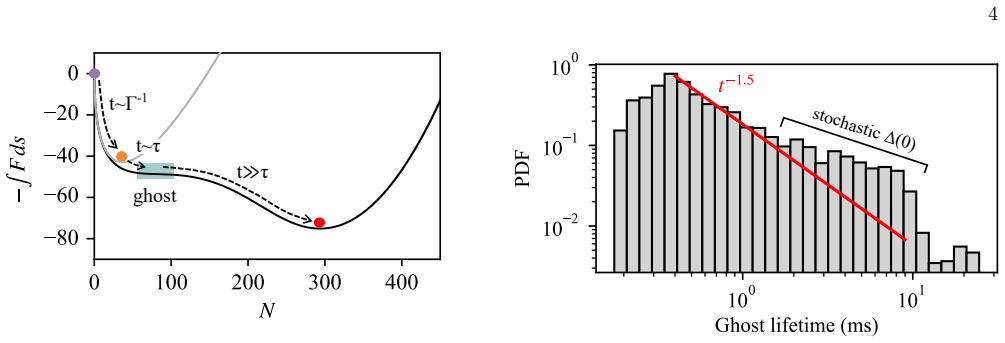
- The distribution of ghost lifetimes at fixed driving conditions shows scaling signatures.
- The ghost state manifests as a plateau in cavity transmission relaxation dynamics that resembles prethermalization.
- These parametrically long-lived non-stationary states remain observable even when strong fluctuations are present.
Where Pith is reading between the lines
- The same memory-steering mechanism could generate long-lived transients in other driven nonlinear systems such as mechanical resonators or chemical oscillators near saddle-node points.
- Controlling the memory time might allow deliberate extension or suppression of these bottlenecks for applications in optical delay lines or information storage.
- The observed scaling in lifetime distributions may connect to universal statistics of critical slowing down near bifurcations in dissipative systems.
Load-bearing premise
The observed plateau in cavity transmission relaxation arises because memory in the nonlinear response steers trajectories into the phase-space bottleneck created by the ghost of the saddle-node bifurcation.
What would settle it
Recording cavity transmission relaxation curves with the memory removed from the nonlinear response and finding no extended plateau or lifetimes comparable to the photon lifetime would falsify the central claim.
Figures




read the original abstract
We report the observation of a long-lived non-stationary state of light in a single-mode optical cavity. The observed state is a ghost of a saddle-node bifurcation which creates a bottleneck in phase space. While such ghosts are known to exist, accessing them is challenging because it requires a mechanism that steers the relaxation pathway away from the true attractor and into the bottleneck where the ghost emerges. Here we identify such a mechanism, namely a nonlinear response with memory. Our experimental system leverages this mechanism, enabling us to observe ghost states with lifetimes exceeding the cavity photon lifetime by more than ten orders of magnitude, even in the presence of strong fluctuations. The ghost manifests as a plateau in the relaxation dynamics of the cavity transmission, reminiscent of prethermalization. We show how the ghost lifetime depends on the memory time and the distance to the bifurcation, and we observe signatures of scaling in the distribution of ghost lifetimes at fixed driving conditions. Our work establishes minimal conditions for realizing parametrically long-lived non-stationary states.
Editorial analysis
A structured set of objections, weighed in public.
Referee Report
Summary. The paper claims to experimentally observe a long-lived non-stationary 'ghost' state of light in a single-mode optical cavity, arising as the ghost of a saddle-node bifurcation that creates a phase-space bottleneck. This state is accessed via a nonlinear response possessing memory, which steers relaxation trajectories into the bottleneck rather than the true attractor. The ghost manifests as a plateau in cavity transmission relaxation dynamics, with reported lifetimes exceeding the cavity photon lifetime by more than ten orders of magnitude even under strong fluctuations. The work further claims that the ghost lifetime scales with memory time and distance to the bifurcation, and presents signatures of scaling in the distribution of ghost lifetimes under fixed driving conditions, establishing minimal conditions for such parametrically long-lived states.
Significance. If the central experimental claims and their interpretation hold, the result would be significant for nonlinear optics and dynamical systems by providing a concrete, accessible realization of saddle-node ghost dynamics in a physical system. The extreme lifetime ratio (ten orders of magnitude) and the explicit dependence on memory time plus bifurcation distance would constitute a notable experimental benchmark for bottleneck phenomena, with the prethermalization analogy offering a bridge to broader concepts in nonequilibrium statistical mechanics. The identification of memory in the nonlinear response as the steering mechanism is a useful minimal condition that could guide future studies of long-lived transients.
minor comments (3)
- [Abstract and §3] Abstract and §3: the precise definition of the 'memory time' (e.g., whether it is the relaxation time of the nonlinear medium or a fitted parameter) should be stated explicitly with its experimental extraction method, as this quantity is central to the claimed scaling.
- [Figure 4] Figure 4 (or equivalent distribution panel): the reported scaling signatures in the ghost-lifetime distribution would be strengthened by an explicit comparison to the expected functional form from saddle-node ghost theory (e.g., the inverse-square-root divergence or exponential tail), including a quantitative fit statistic.
- [§2] §2: the cavity photon lifetime used as the reference for the ten-order-of-magnitude claim should be given with its measured value and uncertainty; without this, the ratio cannot be independently verified from the text.
Simulated Author's Rebuttal
We thank the referee for their supportive summary and recommendation of minor revision. We appreciate the recognition of the experimental significance of the ghost-state observation and the role of memory in the nonlinear response.
Circularity Check
No significant circularity; experimental observation is self-contained
full rationale
The paper reports direct experimental measurements of cavity transmission relaxation showing a plateau whose lifetime scales with memory time and bifurcation distance. The central claim identifies the nonlinear response with memory as the steering mechanism based on the physical setup and observed dynamics, without any derivation step that defines the ghost lifetime from fitted parameters or reduces a prediction to an input by construction. Known saddle-node ghost phenomenology is invoked as background, but the extreme lifetime ratio and distribution signatures are presented as measured outcomes, not tautological outputs of the model.
Axiom & Free-Parameter Ledger
axioms (1)
- standard math Saddle-node bifurcations produce ghost states that create bottlenecks in phase space
Lean theorems connected to this paper
-
IndisputableMonolith/Cost/FunctionalEquation.leanwashburn_uniqueness_aczel unclear?
unclearRelation between the paper passage and the cited Recognition theorem.
The ghost manifests as a plateau in the relaxation dynamics of the cavity transmission... proximity to a SNB is insufficient... A nonzero memory time is also needed.
What do these tags mean?
- matches
- The paper's claim is directly supported by a theorem in the formal canon.
- supports
- The theorem supports part of the paper's argument, but the paper may add assumptions or extra steps.
- extends
- The paper goes beyond the formal theorem; the theorem is a base layer rather than the whole result.
- uses
- The paper appears to rely on the theorem as machinery.
- contradicts
- The paper's claim conflicts with a theorem or certificate in the canon.
- unclear
- Pith found a possible connection, but the passage is too broad, indirect, or ambiguous to say the theorem truly supports the claim.
Reference graph
Works this paper leans on
-
[1]
Goldenfeld,Lectures on phase transitions and the renormalization group(CRC Press, 2018)
N. Goldenfeld,Lectures on phase transitions and the renormalization group(CRC Press, 2018)
work page 2018
-
[2]
W. H. Zurek, U. Dorner, and P. Zoller, Dynamics of a quantum phase transition, Phys. Rev. Lett.95, 105701 (2005)
work page 2005
-
[3]
B. Damski, The simplest quantum model supporting the kibble-zurek mechanism of topological defect produc- tion: Landau-zener transitions from a new perspective, Phys. Rev. Lett.95, 035701 (2005)
work page 2005
-
[4]
Dziarmaga, Dynamics of a quantum phase transition and relaxation to a steady state, Adv
J. Dziarmaga, Dynamics of a quantum phase transition and relaxation to a steady state, Adv. Phys.59, 1063 (2010)
work page 2010
- [5]
-
[6]
K. Du, X. Fang, C. Won, C. De, F.-T. Huang, W. Xu, H. You, F. J. G´ omez-Ruiz, A. Del Campo, and S.-W. Cheong, Kibble–zurek mechanism of ising domains, Nat. Phys.19, 1495 (2023)
work page 2023
-
[7]
K. Lee, S. Kim, T. Kim, and Y.-i. Shin, Universal kibble–zurek scaling in an atomic fermi superfluid, Nat. Phys.20, 1570 (2024)
work page 2024
-
[8]
R. Nandkishore and D. A. Huse, Many-body localiza- tion and thermalization in quantum statistical mechan- ics, Annu. Rev. Condens. Matter Phys.6, 15 (2015)
work page 2015
-
[9]
D. A. Abanin, E. Altman, I. Bloch, and M. Serbyn, Col- loquium: Many-body localization, thermalization, and entanglement, Rev. Mod. Phys.91, 021001 (2019)
work page 2019
-
[10]
M. Schreiber, S. S. Hodgman, P. Bordia, H. P. L¨ uschen, M. H. Fischer, R. Vosk, E. Altman, U. Schneider, and I. Bloch, Observation of many-body localization of inter- acting fermions in a quasirandom optical lattice, Science 349, 842 (2015)
work page 2015
-
[11]
H. P. L¨ uschen, P. Bordia, S. Scherg, F. Alet, E. Alt- man, U. Schneider, and I. Bloch, Observation of slow dynamics near the many-body localization transition in one-dimensional quasiperiodic systems, Phys. Rev. Lett. 119, 260401 (2017)
work page 2017
- [12]
- [13]
-
[14]
M. Moeckel and S. Kehrein, Interaction quench in the hubbard model, Phys. Rev. Lett.100, 175702 (2008)
work page 2008
-
[15]
F. H. L. Essler and M. Fagotti, Quench dynamics and relaxation in isolated integrable quantum spin chains, J. Stat. Mech.: Theory Exp.2016(6), 064002
work page 2016
-
[16]
P. Reimann and L. Dabelow, Typicality of prethermal- ization, Phys. Rev. Lett122, 080603 (2019)
work page 2019
-
[17]
D. J. Luitz, R. Moessner, S. Sondhi, and V. Khemani, Prethermalization without temperature, Phys. Rev. X 10, 021046 (2020)
work page 2020
-
[18]
Y. Pomeau and P. Manneville, Intermittent transition to turbulence in dissipative dynamical systems, Commun. Math. Phys.74, 189 (1980)
work page 1980
-
[19]
S. H. Strogatz,Nonlinear Dynamics and Chaos: With Applications to Physics, Biology, Chemistry, and Engi- neering(Addison-Wesley, 1994)
work page 1994
-
[20]
J. Sardany´ es, C. Raich, and T. Alarcon, Noise-induced stabilization of saddle-node ghosts, New J. Phys.22, 093064 (2020)
work page 2020
- [21]
-
[22]
D. Koch, A. Nandan, G. Ramesan, I. Tyukin, A. Gor- ban, and A. Koseska, Ghost channels and ghost cy- cles guiding long transients in dynamical systems, Phys. Rev. Lett.133, 047202 (2024)
work page 2024
- [23]
- [24]
-
[25]
M. Fucho-Rius, S. Maretvadakethope, `A. Haro, T. Alarc´ on, J. Sardany´ es, and R. P´ erez-Carrasco, Local nearby bifurcations lead to synergies in critical slowing down: The case of mushroom bifurcations, Phys. Rev. E111, 024213 (2025). 6
work page 2025
-
[26]
A. Abouelela, M. Turaev, R. Kramer, M. Janning, M. Kajan, S. Ray, and J. Kroha, Stabilizing open photon condensates by ghost-attractor dynamics, Phys. Rev. Lett.135, 053402 (2025)
work page 2025
-
[27]
D. Koch, U. Feudel, and A. Koseska, Criticality gov- erns response dynamics and entrainment of periodically forced ghost cycles, Phys. Rev. E112, 014205 (2025)
work page 2025
-
[28]
H. Su, D. Li, J. Duan, X. Zhang, Y. Yue, and C. Gre- bogi, Chaotic ghosts in systems with parameter drift: Delay and control critical transitions, Phys. Rev. E113, 044207 (2026)
work page 2026
-
[29]
S. T. Trickey and L. N. Virgin, Bottlenecking phe- nomenon near a saddle-node remnant in a duffing os- cillator, Phys. Lett. A248, 185 (1998)
work page 1998
-
[30]
J. Noh, P. Kim, and Y.-J. Yoon, Nonlinear shock isola- tion using the bottleneck phenomenon near a saddle– node ghost, Mech. Syst. Signal Process.223, 111889 (2025)
work page 2025
-
[31]
Z. Geng, K. Peters, A. Trichet, K. Malmir, R. Kolkowski, J. Smith, and S. Rodriguez, Universal scaling in the dynamic hysteresis, and non-markovian dynamics, of a tunable optical cavity, Phys. Rev. Lett. 124, 153603 (2020)
work page 2020
- [32]
-
[33]
K. Peters and S. Rodriguez, Limit cycles and chaos in- duced by a nonlinearity with memory, Eur. Phys. J. Spec. Top.231, 247 (2022)
work page 2022
-
[34]
B. Braeckeveldt, K. Peters, B. Verdonschot, B. Maes, and S. Rodriguez, Memory-induced excitability in opti- cal cavities, Phys. Rev. Res.6, 023008 (2024)
work page 2024
-
[35]
See Supplemental Material for details about the experi- mental thermal relaxation time, the scaling of the ghost lifetime withτ, and the ghost lifetime distributions un- der the influence of noise
-
[36]
I. Carusotto and C. Ciuti, Quantum fluids of light, Rev. Mod. Phys.85, 299 (2013)
work page 2013
-
[37]
W. Casteels, R. Fazio, and C. Ciuti, Critical dynamical properties of a first-order dissipative phase transition, Phys. Rev. A95, 012128 (2017)
work page 2017
-
[38]
S. R. K. Rodriguez, W. Casteels, F. Storme, N. Car- lon Zambon, I. Sagnes, L. Le Gratiet, E. Galopin, A. Lemaˆ ıtre, A. Amo, C. Ciuti, and J. Bloch, Prob- ing a dissipative phase transition via dynamical optical hysteresis, Phys. Rev. Lett.118, 247402 (2017)
work page 2017
- [39]
-
[40]
T. Fink, A. Schade, S. H¨ ofling, C. Schneider, and A. Imamoglu, Signatures of a dissipative phase transi- tion in photon correlation measurements, Nat. Phys.14, 365 (2018)
work page 2018
- [41]
-
[42]
S. H. Strogatz and R. M. Westervelt, Predicted power laws for delayed switching of charge-density waves, Phys. Rev. B40, 10501 (1989)
work page 1989
-
[43]
3 is slightly further away from the SNB than in Fig
∆ in Fig. 3 is slightly further away from the SNB than in Fig. 1, but still within the red circle in Fig. 2(a). ∆ was changed for illustration purposes only. Otherwise, infinitesimally close to the SNB (as in Fig. 1) the phase- space region of slow evolution is too small to be seen in Fig. 3
-
[44]
Redner, A first look at first-passage processes, Physica A Stat
S. Redner, A first look at first-passage processes, Physica A Stat. Mech. Appl.631, 128545 (2023)
work page 2023
-
[45]
J. L. Doob, The brownian movement and stochastic equations, Ann. Math.43, 351 (1942)
work page 1942
-
[46]
G. Beaulieu, F. Minganti, S. Frasca, V. Savona, S. Fe- licetti, R. Di Candia, and P. Scarlino, Observation of first-and second-order dissipative phase transitions in a two-photon driven kerr resonator, Nat. Commun.16, 1954 (2025)
work page 1954
-
[47]
A. Jayesh Shah, P. Kirton, S. Felicetti, and H. Alaeian, Dissipative phase transition in the two-photon dicke model, Phys. Rev. Lett.135, 173602 (2025)
work page 2025
-
[48]
A. Vivas-Via˜ na, A. Gonz´ alez-Tudela, and C. S. Mu˜ noz, Unconventional mechanism of virtual-state population through dissipation, Phys. Rev. A106, 012217 (2022)
work page 2022
- [49]
-
[50]
A. Miguel-Torcal, A. Gonz´ alez-Tudela, F. J. Garc´ ıa- Vidal, and A. I. Fern´ andez-Dom´ ınguez, Multiqubit quantum state preparation enabled by topology opti- mization, Opt. quantum2, 371 (2024)
work page 2024
-
[51]
M. Cotrufo, A. Cordaro, D. L. Sounas, A. Polman, and A. Al` u, Passive bias-free non-reciprocal metasurfaces based on thermally nonlinear quasi-bound states in the continuum, Nat. Photon.18, 81 (2024)
work page 2024
-
[52]
J. King, C. Wan, T. J. Park, S. Deshpande, Z. Zhang, S. Ramanathan, and M. A. Kats, Electrically tun- able VO2–metal metasurface for mid-infrared switching, limiting and nonlinear isolation, Nat. Photon.18, 74 (2024)
work page 2024
-
[53]
A. Barulin, O. Pashina, D. Riabov, O. Sergaeva, Z. Sadrieva, A. Shcherbakov, V. Rutckaia, J. Schilling, A. Bogdanov, I. Sinev, A. Chernov, and M. Petrov, Thermo-optical bistability enabled by bound states in the continuum in silicon metasurfaces, Laser Photonics Rev.18, 2301399 (2024)
work page 2024
-
[54]
D. Sanvitto and S. K´ ena-Cohen, The road towards po- laritonic devices, Nat. Mater.15, 1061 (2016)
work page 2016
-
[55]
A. Kavokin, T. C. Liew, C. Schneider, P. G. Lagoudakis, S. Klembt, and S. Hoefling, Polariton condensates for classical and quantum computing, Nat. Rev. Phys.4, 435 (2022)
work page 2022
-
[56]
P. M. Walker, L. Tinkler, B. Royall, D. V. Skryabin, I. Farrer, D. A. Ritchie, M. S. Skolnick, and D. N. Krizhanovskii, Dark Solitons in High Velocity Waveg- uide Polariton Fluids, Phys. Rev. Lett.119, 097403 (2017)
work page 2017
-
[57]
P. Stepanov, I. Amelio, J.-G. Rousset, J. Bloch, A. Lemaˆ ıtre, A. Amo, A. Minguzzi, I. Carusotto, and M. Richard, Dispersion relation of the collective excita- tions in a resonantly driven polariton fluid, Nat. Com- mun.10, 3869 (2019)
work page 2019
- [58]
-
[59]
E. Estrecho, T. Gao, N. Bobrovska, D. Comber-Todd, M. D. Fraser, M. Steger, K. West, L. N. Pfeiffer, J. Levinsen, M. M. Parish, T. C. H. Liew, M. Ma- tuszewski, D. W. Snoke, A. G. Truscott, and E. A. Ostrovskaya, Direct measurement of polariton-polariton interaction strength in the thomas-fermi regime of exciton-polariton condensation, Phys. Rev. B100, 03...
work page 2019
-
[60]
A. M. Grudinina and N. S. Voronova, Dark and thermal reservoir contributions to polariton sound velocity, Phys. Rev. B106, L121301 (2022)
work page 2022
-
[61]
M. Vretenar, M. Puplauskis, and J. Klaers, Mir- ror surface nanostructuring via laser direct writ- ing—characterization and physical origins, Adv. Opt. Mater.11, 2202820 (2023)
work page 2023
-
[62]
C. Kurtscheid, D. Dung, A. Redmann, E. Busley, J. Klaers, F. Vewinger, J. Schmitt, and M. Weitz, Re- alizing arbitrary trapping potentials for light via direct laser writing of mirror surface profiles, EPL130, 54001 (2020)
work page 2020
-
[63]
K. J. H. Peters and S. R. K. Rodriguez, Exceptional precision of a nonlinear optical sensor at a square-root singularity, Phys. Rev. Lett.129, 013901 (2022)
work page 2022
-
[64]
S. Kiesewetter, R. Polkinghorne, B. Opanchuk, and P. D. Drummond, xspde: Extensible software for stochastic equations, SoftwareX5, 12 (2016)
work page 2016
-
[65]
K. Peters, J. Busink, P. Ackermans, K. Cogn´ ee, and S. Rodriguez, Scalar potentials for light in a cavity, Phys. Rev. Res.5, 013154 (2023). END MA TTER Appendix A: Experimental setup—The cavity is made by a planar and a concave distributed Bragg reflector (DBR) mirror, each with a peak reflectance of 99.9% at 530 nm. The DBRs of the planar and concave mi...
work page 2023
discussion (0)
Sign in with ORCID, Apple, or X to comment. Anyone can read and Pith papers without signing in.