Recognition: 2 theorem links
· Lean TheoremCosmological perturbations in the theory of gravity with non-minimal derivative coupling. I. Modes of perturbations
Pith reviewed 2026-05-14 17:45 UTC · model grok-4.3
The pith
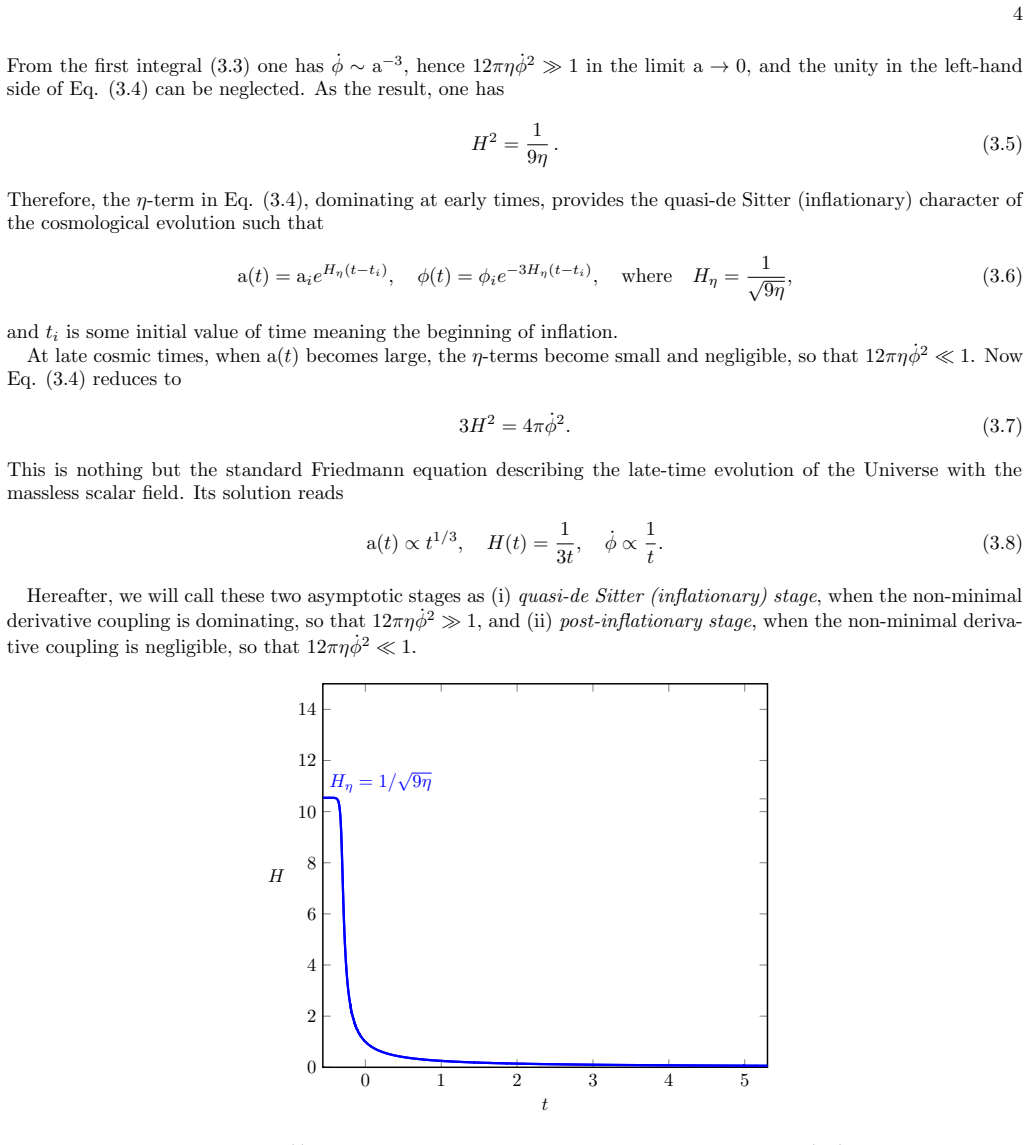
In gravity with non-minimal derivative coupling, all cosmological perturbation modes including vectors amplify during the early quasi-de Sitter stage, unlike in standard Friedmann cosmology.
A machine-rendered reading of the paper's core claim, the machinery that carries it, and where it could break.
Core claim
The non-minimal derivative coupling produces a primary quasi-de Sitter stage at early times without fine-tuned potential; during this stage the complete set of perturbation equations yields amplification for scalar, vector, and tensor modes alike, as confirmed by both analytic limits and exact numerical integration across the subsequent transition to standard evolution.
What carries the argument
The non-minimal derivative coupling term η G^{μν} ∇_μ φ ∇_ν φ that dominates the background dynamics at early times and enters the linearized equations for all perturbation modes.
If this is right
- Vector modes grow instead of decaying, altering the expected spectrum of initial conditions for later cosmic evolution.
- The model transitions automatically to standard post-inflationary cosmology once the coupling becomes negligible at late times.
- No special tuning of the scalar potential is required to achieve the early accelerated phase.
- Both scalar and tensor modes experience growth during the same early interval, affecting predictions for primordial gravitational waves.
Where Pith is reading between the lines
- The vector-mode growth may produce detectable signatures in future CMB polarization or gravitational-wave background measurements.
- The same coupling mechanism could be examined in related Horndeski models to test whether amplification of all modes is generic.
- Extending the linear analysis to second-order perturbations would clarify whether the amplified modes source observable non-Gaussianities.
Load-bearing premise
The non-minimal derivative coupling must dominate early enough to generate the quasi-de Sitter stage without a fine-tuned scalar potential, and the linear perturbation analysis must remain valid throughout the evolution.
What would settle it
An explicit calculation or numerical run in which the non-minimal coupling is switched off or made subdominant and the vector modes are shown to decay rather than amplify would falsify the claimed amplification.
Figures



read the original abstract
We consider perturbations in the isotropic and homogeneous cosmological model with the spatially flat Friedmann-Lemaitre-Robertson-Walker metric in the framework of the theory of gravity with non-minimal derivative coupling. The Lagrangian of the theory contains the coupling term $\eta G^{\mu\nu}\nabla_\mu\phi \nabla_\nu\phi$ and represents the particular example of a general Horndeski Lagrangian, which results in second-order field equations. It is known that the non-minimal derivative coupling crucially changes scenarios of the Universe evolution on early times. In particular, the $\eta$-term is dominating on early times and leads to a primary quasi-de Sitter (inflationary) stage which needs no fine-tuned potential. On late times the influence of non-minimal derivative coupling on the Universe evolution completely disappears, and this naturally leads to the transition to the standard cosmological evolution (post-inflationary stage). We have derived a complete set of equations which describe an evolution of scalar, vector and tensor modes of perturbations. All modes are analyzed analytically in two asymptotic cases, and then we construct exact numerical solutions which describe an entire evolution of the modes. We show that all modes, including vector ones, are amplified in the quasi-de Sitter (inflationary) stage, and such the behavior is cardinally distinct from that in Friedmann cosmology.
Editorial analysis
A structured set of objections, weighed in public.
Referee Report
Summary. The manuscript analyzes linear cosmological perturbations in a flat FLRW background within the Horndeski subclass defined by the non-minimal derivative coupling term η G^{μν} ∇_μ ϕ ∇_ν ϕ. It derives the complete set of second-order equations for scalar, vector, and tensor modes, obtains analytic solutions in the early quasi-de Sitter and late-time regimes, and constructs numerical solutions spanning the full evolution. The central result is that all modes—including vector modes—are amplified during the primary quasi-de Sitter stage driven by the η term, in contrast to their behavior in standard Friedmann cosmology.
Significance. If the results hold, the work is significant for furnishing a detailed perturbation analysis in a model that generates an early inflationary phase without fine-tuned potentials. The explicit treatment of vector modes and their reported amplification, together with the combination of analytic limits and full numerical evolution, provides concrete predictions that could be tested against observations of primordial fluctuations or gravitational waves.
major comments (1)
- [Background evolution] Background evolution section: the quasi-de Sitter phase is introduced as known from η-term dominance, yet no explicit background solution (a(t), ϕ(t)) or numerical integration of the background equations from the full action is supplied. Because the perturbation equations and the reported amplification rates assume an exactly constant-H stage, any slow-roll corrections or transition dynamics would affect the growth factors, especially for vector modes.
minor comments (2)
- [Perturbation equations] The notation for metric perturbations and the coupling parameter η should be checked for consistency across the scalar, vector, and tensor equations.
- [Numerical results] Numerical plots of mode evolution would benefit from explicit markers indicating the transition between the quasi-de Sitter and post-inflationary regimes.
Simulated Author's Rebuttal
We are grateful to the referee for the careful review and constructive feedback. We address the major comment point by point below.
read point-by-point responses
-
Referee: Background evolution section: the quasi-de Sitter phase is introduced as known from η-term dominance, yet no explicit background solution (a(t), ϕ(t)) or numerical integration of the background equations from the full action is supplied. Because the perturbation equations and the reported amplification rates assume an exactly constant-H stage, any slow-roll corrections or transition dynamics would affect the growth factors, especially for vector modes.
Authors: We appreciate the referee's concern regarding the background evolution. While the quasi-de Sitter phase driven by the dominance of the η-term is a known feature of this model from prior literature, we acknowledge that providing an explicit demonstration strengthens the paper. In the revised manuscript, we will add the numerical integration of the background equations, presenting the solutions for a(t) and ϕ(t). This will illustrate the early quasi-de Sitter stage and the transition to standard cosmology. Our numerical solutions for the perturbation modes are already computed on this full background evolution, not assuming a strictly constant Hubble parameter throughout. The analytic solutions in the asymptotic regimes use the constant-H approximation, which is valid during the early phase, but we will include a brief discussion on how slow-roll corrections and transitions impact the growth, particularly for vector modes. revision: yes
Circularity Check
No significant circularity; perturbation analysis is independent
full rationale
The paper derives the full set of linear perturbation equations for scalar, vector, and tensor modes directly from the Horndeski action containing the η G^{μν} ∇_μ ϕ ∇_ν ϕ term. Background evolution is stated as known from prior work and taken as input for the quasi-de Sitter phase, but the mode equations are obtained by standard second-order variation and then solved analytically in asymptotic regimes plus numerically across the full evolution. The reported amplification of all modes, including vectors, is an explicit outcome of integrating those equations rather than a quantity fitted to data or defined in terms of itself. No self-citation chain, ansatz smuggling, or renaming of known results reduces the central claim to its inputs by construction.
Axiom & Free-Parameter Ledger
free parameters (1)
- η
axioms (2)
- domain assumption The theory is a particular example of a general Horndeski Lagrangian that yields second-order field equations.
- domain assumption The background is a spatially flat FLRW metric describing an isotropic homogeneous universe.
Lean theorems connected to this paper
-
IndisputableMonolith/Foundation/RealityFromDistinction.leanreality_from_one_distinction unclear?
unclearRelation between the paper passage and the cited Recognition theorem.
It is known that the non-minimal derivative coupling crucially changes scenarios... the η-term is dominating on early times and leads to a primary quasi-de Sitter (inflationary) stage which needs no fine-tuned potential.
-
IndisputableMonolith/Cost/FunctionalEquation.leanwashburn_uniqueness_aczel unclear?
unclearRelation between the paper passage and the cited Recognition theorem.
We have derived a complete set of equations which describe an evolution of scalar, vector and tensor modes of perturbations... all modes, including vector ones, are amplified
What do these tags mean?
- matches
- The paper's claim is directly supported by a theorem in the formal canon.
- supports
- The theorem supports part of the paper's argument, but the paper may add assumptions or extra steps.
- extends
- The paper goes beyond the formal theorem; the theorem is a base layer rather than the whole result.
- uses
- The paper appears to rely on the theorem as machinery.
- contradicts
- The paper's claim conflicts with a theorem or certificate in the canon.
- unclear
- Pith found a possible connection, but the passage is too broad, indirect, or ambiguous to say the theorem truly supports the claim.
Reference graph
Works this paper leans on
-
[1]
Scalar modes in the post-inflationary stage In this case one can neglect theη-terms in Eqs. (4.5)–(4.7). Then, the equation (4.7) gives that Φ = Ψ,(4.8) 7 and Eqs. (4.5), (4.6) reduce to 3H(Ψ′ +HΨ) +k 2Ψ = 4π ϕ′2Ψ−ϕ ′2δφ−ϕϕ ′δφ′ ,(4.9) Ψ′ +HΨ = 4πϕϕ ′δφ.(4.10) Using (4.10) to excludeδφfrom Eq.(4.9) and taking into account thatH= 1/2τand 3H 2 = 4πϕ ′2, we ...
-
[2]
Scalar modes in the quasi-de Sitter (inflationary) stage First, let us rewrite Eq. (4.7) as follows (1−4πηa −2ϕ′2)Ψ−(1 + 4πηa −2ϕ′2)Φ = 8πηa −2ϕϕ′′δφ.(4.15) Taking into account that in the quasi-de Sitter (inflationary) stage 4πηa −2ϕ′2 ≫1 and using the solution (3.14) for ϕ(τ), one can obtain from the above equation that δφ=− 3 4(Ψ + Φ).(4.16) Performing...
-
[3]
Results are presented graphically in Fig
General behavior of the scalar modes Here we present results of numerical analysis of the system (4.5)-(4.7), which describes the entire evolution of the scalar modes. Results are presented graphically in Fig. 3. − 2 − 1 0 1 2 3 − 4 − 3 − 2 − 1 0 1 2 3 ·10−2 × 104 × 104 τ Ψ k = 10 −1 k = 10 0 k = 10 1 − 2 − 1 0 1 2 3− 2 ·10−2 0 2 ·10−2 4 ·10−2 6 ·10−2 8 ·...
-
[4]
Tensor modes in the post-inflationary stage Neglecting theη-terms in Eq. (4.24) and substitutingH= 1/2τ, we obtain the following equation for tensor modes in the post-inflationary stage: h′′ + 1 τ h′ +k 2h= 0.(4.25) Its general solution is h(τ, k) =C (t) 1,kJ0(kτ) +C (t) 2,kY0(kτ),(4.26) whereJ 0(kτ) andY 0(kτ) are the Bessel functions, andC (t) 1,k andC ...
-
[5]
(4.24) the background expressions for a(τ), H(τ),ϕ(τ) given by Eq
Tensor modes in the quasi-de Sitter (inflationary) stage Taking into account that 4πηa −2ϕ′2 ≫1 and substituting into Eq. (4.24) the background expressions for a(τ), H(τ),ϕ(τ) given by Eq. (3.14), we obtain the following equation describing the tensor perturbations in the quasi-de Sitter (inflationary) stage: h′′ + 4 τ h′ −k 2h= 0.(4.29) Its general solut...
-
[6]
Results are presented graphically in Fig
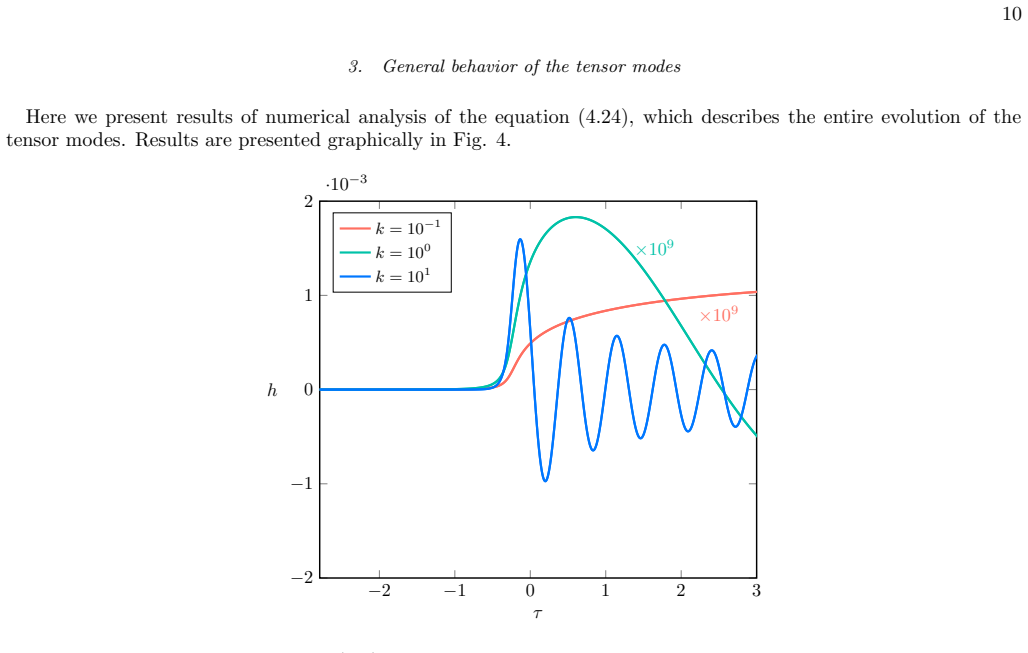
General behavior of the tensor modes Here we present results of numerical analysis of the equation (4.24), which describes the entire evolution of the tensor modes. Results are presented graphically in Fig. 4. − 2 − 1 0 1 2 3− 2 − 1 0 1 2 ·10−3 × 109 × 109 τ h k = 10 −1 k = 10 0 k = 10 1 Figure 4. Graphs for the tensor modesh(τ, k) are given for three val...
-
[7]
Vector modes in the post-inflationary stage Neglecting theη-terms in Eq. (4.32) and substitutingH= 1/2τ, we obtain the following equation for vector modes in the post-inflationary stage: Q′ + 1 τ Q= 0.(4.33) From here we get Q= C (v) k kτ ∝ 1 a2 ,(4.34) whereC (v) k is a constant of integration. Therefore, as was expected, the vector modes decay as a −2 i...
-
[8]
(4.24) the background expressions for a(τ), H(τ),ϕ(τ) given by Eq
Vector modes in the quasi-de Sitter (inflationary) stage Taking into account that 4πηa −2ϕ′2 ≫1 and substituting into Eq. (4.24) the background expressions for a(τ), H(τ),ϕ(τ) given by Eq. (3.14), we obtain the following equation describing the vector perturbations in the quasi-de Sitter (inflationary) stage: Q′ + 4 τ Q= 0.(4.35) Its solution is Q(τ, k) =...
-
[9]
Results are presented graphically in Fig
General behavior of the vector modes In this section we present results of numerical analysis of the equation (4.32), which describes the entire evolution of the vector modes. Results are presented graphically in Fig. 5. − 2 − 1 0 1 2 30 0.5 1 1.5 2 2.5 3 ·10−3 τ Q η = 10 −3 η = 5 · 10−4 η = 10 −4 Figure 5. Graphs for the vector modesQ(τ, k) are given for...
work page 2015
-
[10]
Smoot, G.F.,et al: Structure in the COBE differential microwave radiometer first year maps, Astrophys. J.396, L1 (1992)
work page 1992
- [11]
-
[12]
Riess, A.G.,et al[Supernova Search Team Collaboration]: Astron. J.116, 1009 (1998)
work page 1998
-
[13]
Perlmutter, S.,et al[Supernova Cosmology Project Collaboration]: Astrophys. J.517, 565 (1999)
work page 1999
-
[14]
Bennett, C.L.,et al: Astrophys. J. Suppl.148, 1 (2003)
work page 2003
-
[15]
Tegmark, M.,et al[SDSS Collaboration]: Phys. Rev. D69, 103501 (2004)
work page 2004
-
[16]
Allen, S.W.,et al: Mon. Not. Roy. Astron. Soc.353, 457 (2004)
work page 2004
- [17]
- [18]
-
[19]
Susuki, N.,et al[The Supernova Cosmology Project]: Astrophys. J.746, 85 (2012)
work page 2012
- [20]
-
[21]
Padmanabhan, N.,et al: The Clustering of Luminous Red Galaxies in the Sloan Digital Sky Survey Imaging Data. Mon. Not. R. Astron. Soc.378, 852 (2007)
work page 2007
-
[22]
Gaztanaga, E., Cabre, A., Hui, L.: Clustering of Luminous Red Galaxies IV: Baryon Acoustic Peak in the Line-of-Sight Direction and a Direct Measurement ofH(z). Mon. Not. R. Astron. Soc.399, 1663 (2009)
work page 2009
- [23]
-
[24]
Percival, W.J.,et al: Baryon Acoustic Oscillations in the Sloan Digital Sky Survey Data Release 7 Galaxy Sample. Mon. Not. R. Astron. Soc.401, 2148 (2010)
work page 2010
-
[25]
Blake, C.,et al: The WiggleZ Dark Energy Survey: mapping the distance-redshift relation with baryon acoustic oscillations. (2011) [arXiv:1108.2635]
work page internal anchor Pith review Pith/arXiv arXiv 2011
-
[26]
Beutler, F.,et al: The 6dF Galaxy Survey: Baryon Acoustic Oscillations and the Local Hubble Constant (2011) [arXiv:1106.3366]
work page internal anchor Pith review Pith/arXiv arXiv 2011
-
[27]
Observational Probes of Cosmic Acceleration
Weinberg, D.H.,et al:Observational Probes of Cosmic Acceleration. (2012) [arXiv:1201.2434]
work page internal anchor Pith review Pith/arXiv arXiv 2012
-
[28]
Will, C.M.: The Confrontation between General Relativity and Experiment. Living Rev. Rel.17, 4 (2014)
work page 2014
-
[29]
Capozziello, S., De Laurentis, M.: Extended Theories of Gravity, Phys. Rep.509, Issues 4–5, pp. 167-321 (2011)
work page 2011
-
[30]
Clifton, T., Ferreira, P.G., Padilla, A., Skordis, C.: Modified Gravity and Cosmology, Phys. Rept.513, 1–189 (2012)
work page 2012
-
[31]
Myrzakulov, R., Sebastiani, L., Zerbini, S.: Some aspects of generalized modified gravity models, Int. J. Mod. Phys. D22, no.8, 1330017 (2013)
work page 2013
-
[32]
Berti E., et al.: Testing General Relativity with Present and Future Astrophysical Observations. Class. Quant. Grav.32, 243001 (2015)
work page 2015
-
[33]
Nojiri, S., Odintsov, S.D., Oikonomou, V.K.: Modified gravity theories on a nutshell: Inflation, bounce and late-time evolution. Phys. Rep.692, pp. 1-104 (2017)
work page 2017
-
[34]
Langlois, D.: Dark energy and modified gravity in degenerate higher-order scalar–tensor (DHOST) theories: A review. Int. J. Mod. Phys. D28, no. 05, 1942006 (2019)
work page 2019
-
[35]
Horndeski, G.W.: Second-order scalar-tensor field equations in a four-dimensional space. Int. J. Theor. Phys.10, 363–384 (1974)
work page 1974
-
[36]
Kobayashi, T., Yamaguchi, M., Yokoyama, J.: Prog. Theor. Phys.126, 511 (2011)
work page 2011
-
[37]
Rinaldi, M.: Black holes with non-minimal derivative coupling, Phys. Rev. D86, 084048 (2012)
work page 2012
-
[38]
Minamitsuji, M.: Solutions in the scalar-tensor theory with nonminimal derivative coupling. Phys. Rev. D89, 064017 (2014)
work page 2014
-
[39]
Anabalon, A., Cisterna, A., Oliva, J.: Asymptotically locally AdS and flat black holes in Horndeski theory. Phys. Rev. D 89, 084050 (2014)
work page 2014
-
[40]
Babichev, E., Charmousis, C.: Dressing a black hole with a time-dependent Galileon. JHEP08, 106 (2014)
work page 2014
-
[41]
Kobayashi, T., Tanahashi, N.: Exact black hole solutions in shift symmetric scalar–tensor theories. PTEP2014, 073E02 (2014)
work page 2014
-
[42]
Babichev, E., Charmousis, C., Hassaine, M.: Charged Galileon black holes, JCAP05, 031 (2015)
work page 2015
-
[43]
Sushkov, S.V., Korolev, R.: Scalar wormholes with nonminimal derivative coupling, Class. Quant. Grav.29, 085008 (2012)
work page 2012
-
[44]
Korolev, R.V., Sushkov, S.V.: Exact wormhole solutions with nonminimal kinetic coupling. Phys. Rev. D90, 124025 (2014)
work page 2014
-
[45]
Cisterna, A., Delsate, T., Rinaldi, M.: Neutron stars in general second order scalar-tensor theory: The case of nonminimal derivative coupling. Phys. Rev. D92, 044050 (2015)
work page 2015
-
[46]
Cisterna, A., Delsate, T., Ducobu, L., Rinaldi, M.: Slowly rotating neutron stars in the nonminimal derivative coupling sector of Horndeski gravity. Phys. Rev. D93, 084046 (2016)
work page 2016
-
[47]
Maselli, A., Silva, H.O., Minamitsuji, M., Berti, E.: Neutron stars in Horndeski gravity, Phys. Rev. D93, 124056 (2016)
work page 2016
-
[48]
Bl´ azquez-Salcedo, J.L., Eickhoff, K.: Axial quasinormal modes of static neutron stars in the nonminimal derivative coupling sector of Horndeski gravity: Spectrum and universal relations for realistic equations of state. Phys. Rev. D97, 104002 (2018)
work page 2018
-
[49]
Silva, H.O., Maselli, A., Minamitsuji, M., Berti, E.: Compact objects in Horndeski gravity. Int. J. Mod. Phys. D25, 09, 1641006 (2016)
work page 2016
-
[50]
Kashargin, P.E., Sushkov, S.V.: Anti-de Sitter neutron stars in the theory of gravity with nonminimal derivative coupling. JCAP01, 005 (2023)
work page 2023
-
[51]
Kashargin, P.E., Lebedev, A.A., Sushkov, S.V.: Neutron Stars in the Theory of Gravity with Non-Minimal Derivative Coupling and Realistic Equations of State. Symmetry17, no.6, 910 (2025)
work page 2025
-
[52]
Sushkov, S.V.: Exact cosmological solutions with nonminimal derivative coupling. Phys. Rev. D80, 103505 (2009)
work page 2009
-
[53]
Saridakis E.N.,Sushkov, S.V.: Quintessence and phantom cosmology with non-minimal derivative coupling. Phys. Rev. D 81, 083510 (2010)
work page 2010
-
[54]
Sushkov, S.V.: Realistic cosmological scenario with nonminimal kinetic coupling. Phys. Rev. D85, 123520 (2012)
work page 2012
-
[55]
Skugoreva, M.A., Sushkov, S.V., Toporensky, A.V.: Phys. Rev. D88, 083539 (2013)
work page 2013
- [56]
-
[57]
Starobinsky, A.A., Sushkov, S.V., Volkov, M.S.: The screening Horndeski cosmologies. JCAP1606, no. 06, 007, (2016) 14
work page 2016
-
[58]
Starobinsky, A.A., Sushkov, S.V., Volkov, M.S.: Anisotropy screening in Horndeski cosmologies. Phys. Rev. D101, no. 6 064039 (2020)
work page 2020
-
[59]
Galeev, R., Muharlyamov, R., Starobinsky, A.A., Sushkov, S.V., Volkov, M.S.: Anisotropic cosmological models in Horn- deski gravity. Phys. Rev. D103, 104015 (2021)
work page 2021
-
[60]
Sushkov, S.V., Galeev, R.: Cosmological models with arbitrary spatial curvature in the theory of gravity with nonminimal derivative coupling. Phys. Rev. D108, 044028 (2023)
work page 2023
-
[61]
Sushkov, S.V., Galeev, R.G.: Singular bounce in the theory of gravity with nonminimal derivative coupling. Phys. Rev. D 111, no.8, 083554 (2025)
work page 2025
-
[62]
George F. R. Ellis, Roy Maartens, Malcolm A. H. MacCallum, Relativistic Cosmology. Cambridge University Press, 2012
work page 2012
-
[63]
C. P. Ma and E. Bertschinger, Astrophys. J.455, 7-25 (1995)
work page 1995
- [64]
-
[65]
J. B. Dent, S. Dutta, E. N. Saridakis and J. Q. Xia, JCAP11, 058 (2013)
work page 2013
- [66]
- [67]
- [68]
- [69]
-
[70]
S. A. Mironov and A. M. Shtennikova, Pisma Zh. Eksp. Teor. Fiz.119, no.5, 330-335 (2024)
work page 2024
-
[71]
F. F. Santos and J. Levi Said, Symmetry17, no.5, 675 (2025)
work page 2025
- [72]
-
[73]
B. Ahmedov, K. F. Dialektopoulos, J. Levi Said, A. Nosirov, Z. Oikonomopoulou and O. Yunusov, JCAP08, 074 (2023)
work page 2023
-
[74]
Cosmology with non-minimal coupled gravity: inflation and perturbation analysis
F. Darabi and A. Parsiya, “Cosmology with non-minimal coupled gravity: inflation and perturbation analysis,” Class. Quant. Grav.32, no.15, 155005 (2015) doi:10.1088/0264-9381/32/15/155005 [arXiv:1312.1322 [gr-qc]]
work page internal anchor Pith review Pith/arXiv arXiv doi:10.1088/0264-9381/32/15/155005 2015
-
[75]
Gravitation: Foundations and frontiers,
T. Padmanabhan, “Gravitation: Foundations and frontiers,” Cambridge University Press, 2014
work page 2014
-
[76]
Planck constraints on the tensor-to-scalar ratio,
M. Tristram, A. J. Banday, K. M. G´ orski, R. Keskitalo, C. R. Lawrence, K. J. Andersen, R. B. Barreiro, J. Borrill, H. K. Eriksen and R. Fernandez-Cobos,et al.“Planck constraints on the tensor-to-scalar ratio,” Astron. Astrophys.647, A128 (2021)
work page 2021
discussion (0)
Sign in with ORCID, Apple, or X to comment. Anyone can read and Pith papers without signing in.