Recognition: no theorem link
A New PSF Deconvolution Algorithm: Simultaneous Spatial Resolution Enhancement and Point Source Removal for Morphological Analysis of AGN Host Galaxies
Pith reviewed 2026-05-15 02:49 UTC · model grok-4.3
The pith
A deconvolution algorithm enhances the resolution of AGN host galaxy images to Hubble levels while cleanly removing the central point source.
A machine-rendered reading of the paper's core claim, the machinery that carries it, and where it could break.
Core claim
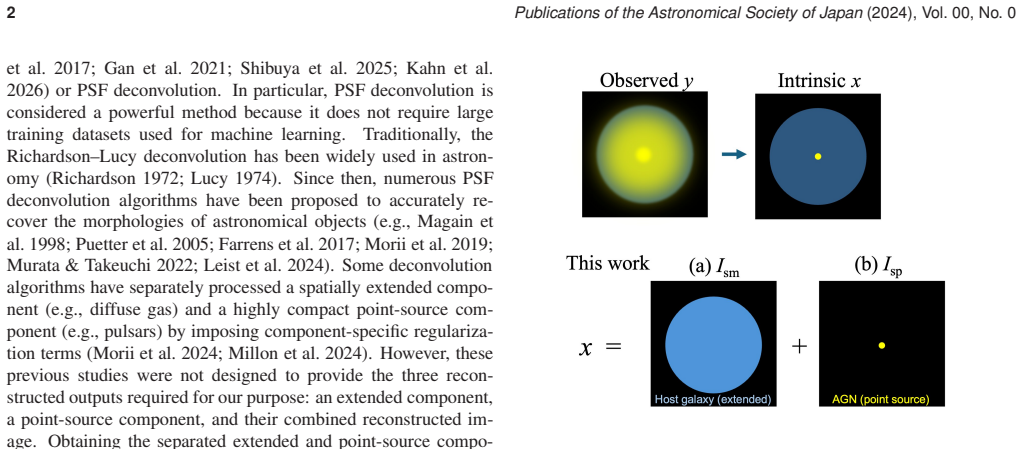
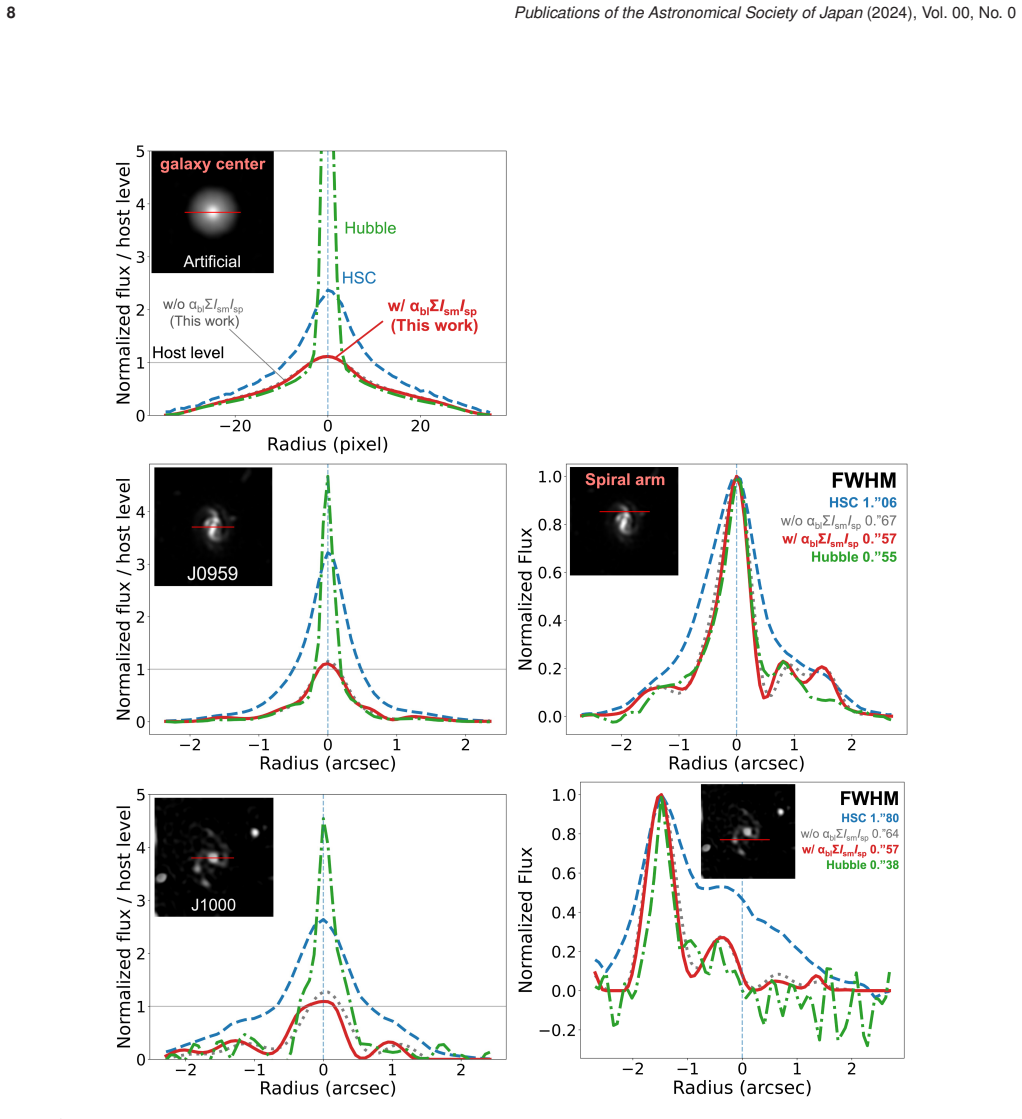
By decomposing an observed image into I_sm for the extended host galaxy and I_sp for the point-source AGN, and enforcing smoothness on I_sm, sparsity on I_sp, and a point-source balance constraint via the product I_sm × I_sp, the algorithm reconstructs images with improved spatial resolution and removed central sources, achieving levels comparable to Hubble Space Telescope data for z ~ 0-1 AGNs observed with Hyper Suprime-Cam.
What carries the argument
The decomposition of the observed image into smooth extended component I_sm and sparse point-source component I_sp, governed by smoothness, sparsity, and point-source balance constraints based on their pixel-wise product.
If this is right
- Host-galaxy images from ground-based telescopes reach spatial resolutions matching those from the Hubble Space Telescope.
- Bright central AGN point sources are removed without over- or under-subtraction in the host galaxy.
- The method enables statistical morphological analyses of distant AGN hosts using data from wide-field surveys like those planned for the Vera C. Rubin Observatory, Euclid, and Roman Space Telescope.
Where Pith is reading between the lines
- Similar decomposition techniques could apply to other astronomical images where a bright point source obscures extended structures, such as in exoplanet imaging or crowded stellar fields.
- Integration with machine learning could further automate the parameter tuning for the constraints across large datasets.
- Testing on higher-redshift AGNs or different filter bands might reveal limitations in the sparsity assumption for more complex nuclear structures.
Load-bearing premise
The point-source balance constraint from the pixel-wise product of the smooth and sparse images removes the central source accurately without introducing artifacts or residuals in real astronomical data.
What would settle it
Applying the algorithm to a set of AGN images with known Hubble Space Telescope counterparts and finding that the recovered host galaxy morphology or central flux residuals differ significantly from the space-based reference.
Figures




read the original abstract
We propose a new point-spread function (PSF) deconvolution algorithm for images of galaxies hosting an active galactic nucleus (AGN), designed to simultaneously enhance the spatial resolution of the host galaxy and remove the bright central point source. In this algorithm, an intrinsic image is reconstructed by decomposing an observed image into two components: an image $I_{\rm sm}$ of an extended component (i.e., a host galaxy) and an image $I_{\rm sp}$ of a point-source component (i.e., an AGN). During image reconstruction, three constraints are imposed: (1) a smooth constraint on the image $I_{\rm sm}$ , which spatially smooths the host-galaxy structures; (2) a sparse constraint on the image $I_{\rm sp}$ , which localizes the point source to a small number of pixels; and (3) a new constraint, the point-source balance constraint, based on the pixel-wise product $I_{\rm sm} \times I_{\rm sp}$ , which removes the point source from the host galaxy without over- or under-subtraction. As a test, we apply this algorithm to images of artificial and $z \sim 0-1$ real AGNs observed with Hyper Suprime-Cam on the Subaru Telescope. We find that the spatial resolution of the host-galaxy images is improved to a level comparable to that of images from the Hubble Space Telescope and that the bright central point sources are removed. This algorithm is expected to enable statistical morphological studies of distant AGN host galaxies when applied to wide-field survey data from the Vera C. Rubin Observatory, the Euclid Space Telescope, and the Roman Space Telescope.
Editorial analysis
A structured set of objections, weighed in public.
Referee Report
Summary. The manuscript presents a new PSF deconvolution algorithm for AGN host galaxy images that decomposes the observed image into a smooth extended component I_sm for the host galaxy and a sparse point-source component I_sp for the AGN. Three constraints are applied during reconstruction: smoothness on I_sm, sparsity on I_sp, and a point-source balance constraint using the pixel-wise product I_sm × I_sp to prevent over- or under-subtraction of the point source. Tests on artificial images and real z~0-1 AGN data from Subaru's Hyper Suprime-Cam are reported to show that the host galaxy resolution is enhanced to levels comparable to HST images while removing the central point sources. The method is positioned to enable morphological studies with future wide-field survey data from Rubin, Euclid, and Roman telescopes.
Significance. If quantitatively validated, the algorithm would provide a practical tool for enhancing ground-based imaging resolution and removing AGN contamination, enabling large-scale morphological studies of distant AGN hosts that would otherwise require space-based data. This has clear utility for upcoming wide-field surveys.
major comments (2)
- [Abstract and Results] Abstract and Results: No quantitative metrics (e.g., recovered host flux fractions, pre/post-deconvolution FWHM values, residual RMS levels, or error estimates) are reported for the artificial or real-data tests, leaving the central claims of HST-comparable resolution and accurate point-source removal only moderately supported.
- [Algorithm description] Algorithm description (point-source balance constraint): The I_sm × I_sp product term assumes negligible central surface brightness in the intrinsic host on PSF-core scales. In galaxies with steep bulges or nuclear star clusters (common at z~0-1), the optimizer may trade smoothness against the balance term, causing flux misallocation. Artificial tests use idealized profiles that do not expose this; real-data examples rely on visual inspection rather than quantitative recovery metrics.
Simulated Author's Rebuttal
We thank the referee for the constructive and detailed comments, which have helped improve the clarity and rigor of our manuscript. We address each major comment below and have revised the manuscript to incorporate quantitative metrics and additional discussion of the algorithm's assumptions.
read point-by-point responses
-
Referee: [Abstract and Results] Abstract and Results: No quantitative metrics (e.g., recovered host flux fractions, pre/post-deconvolution FWHM values, residual RMS levels, or error estimates) are reported for the artificial or real-data tests, leaving the central claims of HST-comparable resolution and accurate point-source removal only moderately supported.
Authors: We agree that the absence of quantitative metrics weakens the support for our central claims. In the revised manuscript, we have added comprehensive quantitative metrics for both the artificial and real-data tests. These include recovered host flux fractions, pre- and post-deconvolution FWHM values, residual RMS levels, and associated error estimates. The new results confirm that the host-galaxy resolution reaches levels comparable to HST imaging while the point-source component is accurately removed. revision: yes
-
Referee: [Algorithm description] Algorithm description (point-source balance constraint): The I_sm × I_sp product term assumes negligible central surface brightness in the intrinsic host on PSF-core scales. In galaxies with steep bulges or nuclear star clusters (common at z~0-1), the optimizer may trade smoothness against the balance term, causing flux misallocation. Artificial tests use idealized profiles that do not expose this; real-data examples rely on visual inspection rather than quantitative recovery metrics.
Authors: We acknowledge the validity of this concern regarding the point-source balance constraint. The assumption of negligible central host surface brightness on PSF-core scales may not hold for galaxies with steep bulges or nuclear star clusters. Although the smoothness constraint on I_sm and sparsity on I_sp are intended to limit flux misallocation, we recognize that idealized artificial tests do not fully probe this regime. In the revised manuscript, we have added an explicit discussion of this assumption and its limitations, together with new tests using simulated galaxies that include steep central profiles. We have also replaced visual inspection of real-data results with the quantitative metrics described in the first response. revision: partial
Circularity Check
No significant circularity; constraints defined independently
full rationale
The paper presents an explicit image decomposition into I_sm and I_sp with three directly stated constraints (smoothness on I_sm, sparsity on I_sp, and balance via the pixel-wise product I_sm × I_sp). These are introduced as new algorithmic choices rather than derived from or fitted to the target outputs. Validation uses separate artificial and real Subaru data with visual and resolution comparisons to HST, without reducing any prediction to the inputs by construction or relying on self-citation chains for the core claims. The derivation chain remains self-contained.
Axiom & Free-Parameter Ledger
axioms (1)
- domain assumption An observed image can be decomposed into a spatially smooth extended component and a sparse point-source component
Reference graph
Works this paper leans on
- [1]
- [2]
- [3]
- [4]
- [5]
- [6]
-
[7]
Conselice, C. J. 2003, ApJS, 147, 1
work page 2003
- [8]
- [9]
-
[10]
2024, A&A, 689, A219 Di Matteo, T., et al
Decarli, R., et al. 2024, A&A, 689, A219 Di Matteo, T., et al. 2005, Nature, 433, 604
work page 2024
- [11]
- [12]
- [13]
- [14]
- [15]
- [16]
- [17]
- [18]
- [19]
- [20]
- [21]
- [22]
- [23]
- [24]
-
[25]
Kahn, S., et al. 2026, arXiv e-prints, arXiv:2604.20195
work page internal anchor Pith review Pith/arXiv arXiv 2026
- [26]
- [27]
- [28]
-
[29]
Kormendy, J., & Ho, L. C. 2013, ARA&A, 51, 511 La Marca, A., et al. 2026, A&A, 708, A373
work page 2013
- [30]
- [31]
- [32]
- [33]
- [34]
- [35]
- [36]
- [37]
- [38]
- [39]
- [40]
- [41]
-
[42]
Murata, K., & Takeuchi, T. T. 2022, PASJ, 74, 1329
work page 2022
- [43]
- [44]
- [45]
- [46]
-
[47]
Richardson, W. H. 1972, J. Opt. Soc. Am., 62, 55
work page 1972
-
[48]
2017, MNRAS, 467, L110 Sérsic, J
Schawinski, K., et al. 2017, MNRAS, 467, L110 Sérsic, J. L. 1963, BAAA, 6, 41
work page 2017
- [49]
- [50]
- [51]
- [52]
- [53]
-
[54]
Tikhonov, A. N. 1963, Soviet Math. Dokl., 4, 1035
work page 1963
- [55]
- [56]
- [57]
- [58]
- [59]
discussion (0)
Sign in with ORCID, Apple, or X to comment. Anyone can read and Pith papers without signing in.