Recognition: unknown
Photometric Super-Resolution for Improving Galaxy Morphological Measurements using Conditional Generative Adversarial Networks
Pith reviewed 2026-05-09 23:53 UTC · model grok-4.3
The pith
A conditional generative adversarial network transforms ground-based galaxy images into sharper space-based equivalents, improving morphological parameter accuracy by factors of 2-10.
A machine-rendered reading of the paper's core claim, the machinery that carries it, and where it could break.
Core claim
Neo improves the accuracy of measured morphological parameters by factors of 2-10 when trained to translate Subaru Hyper Suprime-Camera images to approximate Hubble Space Telescope data.
What carries the argument
Neo, a conditional generative adversarial network that learns to map ground-based images to space-based resolution while preserving galaxy features for morphological analysis.
If this is right
- Enables higher-precision morphological measurements from existing and future ground-based survey data without additional observing costs.
- Supports improved cosmological weak lensing and galaxy evolution analyses that rely on accurate galaxy shapes and light profiles.
- Integrates with ongoing large surveys such as LSST in combination with space-based data from HST, JWST, or Roman.
- Provides open-source code for application to other ground-to-space image translation tasks.
Where Pith is reading between the lines
- The method could be retrained on other instrument pairs to enhance resolution across different wavelengths or telescopes.
- If biases are minimal, it might allow reprocessing of archival ground-based datasets for new science results.
- Extensions could test performance on varied galaxy populations, redshifts, or survey depths to identify limits.
Load-bearing premise
The GAN-generated super-resolved images preserve true galaxy light profiles and do not introduce systematic biases or artifacts that invalidate the claimed accuracy gains.
What would settle it
Direct comparison of morphological parameters from the same galaxies measured in actual HST images versus Neo-enhanced HSC images, testing whether the 2-10x accuracy improvement holds and no new biases appear.
Figures




read the original abstract
The measurement of galaxy morphological parameters from astronomical images features in a wide range of modern analyses, including galaxy evolution and cosmological weak lensing studies. The precision and accuracy of morphological parameter estimation can be influenced by several key factors. The effective seeing of the image, summarized by the point spread function (PSF), limits how galaxy features or light profiles are resolved. The pixel scale of the detector also influences the resolution and the amount of statistical information available for a given object. The depth of the observations determines the signal-to-noise ratio of the image. Improving each of these factors is very costly, either in terms of detector upgrades, observatory design, or observing time. Here, we develop a conditional generative adversarial network, called Neo, trained to transform existing ground-based images into sharper, finer-scale images comparable to space-based image quality. We demonstrate that Neo improves the accuracy of measured morphological parameters by factors of $2$-$10$ when trained to translate Subaru Hyper Suprime-Camera (HSC) images to approximate Hubble Space Telescope (HST) data. Neo is designed for applicability to ongoing, large-scale surveys such as the Legacy Survey of Space and Time (LSST) conducted by Vera C. Rubin Observatory in combination with space telescopes such as HST, James Webb Space Telescope, and Nancy Grace Roman Space Telescope. These results suggest that Neo could be used to improve both cosmological and galaxy evolution analyses based on massive, ground-based survey datasets like LSST. The model code is open source and available at https://purl.archive.org/neo/code.
Editorial analysis
A structured set of objections, weighed in public.
Referee Report
Summary. The manuscript introduces a conditional generative adversarial network called Neo that translates ground-based Subaru Hyper Suprime-Camera (HSC) images into sharper images approximating Hubble Space Telescope (HST) quality. The central claim is that this super-resolution step improves the accuracy of measured galaxy morphological parameters by factors of 2-10, with applicability to large surveys such as LSST when combined with space-based data.
Significance. If the claimed accuracy gains prove robust and free of systematic artifacts, the work could meaningfully advance galaxy evolution and weak-lensing analyses by extracting higher-fidelity morphological information from existing and future ground-based datasets without requiring new hardware or deeper exposures. The open-source release of the model code is a clear strength that supports reproducibility and community adoption.
major comments (3)
- [Abstract] Abstract: the headline result (factors of 2-10 improvement) is presented without any description of the training set size or composition, the construction of the validation/test sets (real overlapping HST fields versus simulated degradations), the precise morphological parameters evaluated, or the error metrics underlying the quoted improvement factors; these omissions make it impossible to judge whether the empirical comparison supports the central claim.
- [Methods] Methods: no information is supplied on whether the cGAN loss includes explicit photometric conservation terms (e.g., total flux, ellipticity, or Sérsic-index penalties) or on the precise training hyperparameters; without such constraints the generator could learn statistical correlations rather than PSF-deconvolved light profiles, directly undermining the assertion that measured morphology gains reflect recovered information rather than introduced artifacts.
- [Results] Results: the comparison to independent HST observations is invoked to support the accuracy gains, yet the manuscript supplies no quantitative bias checks, residual maps, or controls that would demonstrate preservation of integrated flux and light-profile parameters on a held-out test set; this gap is load-bearing for the factor-of-2-10 claim.
minor comments (2)
- [Abstract] The abstract would be strengthened by a single sentence summarizing the size of the training and test sets and the specific morphological parameters (e.g., effective radius, Sérsic index, ellipticity) for which the 2-10 improvement is reported.
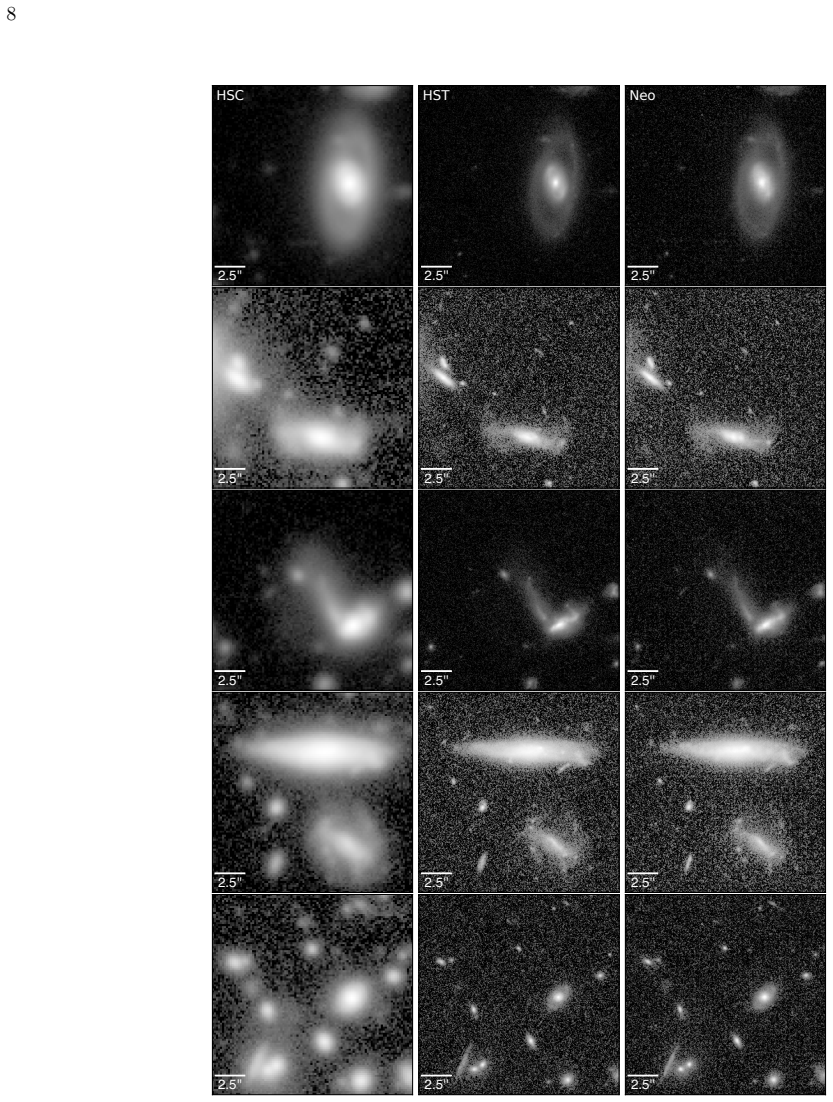
- Figure captions should explicitly state whether the displayed super-resolved images are from the training, validation, or test split and whether they are real or simulated data.
Simulated Author's Rebuttal
We thank the referee for their constructive and detailed review of our manuscript. The comments have identified important areas where additional clarity and supporting analyses are needed. We address each major comment below and have revised the manuscript to incorporate the requested information and checks.
read point-by-point responses
-
Referee: [Abstract] Abstract: the headline result (factors of 2-10 improvement) is presented without any description of the training set size or composition, the construction of the validation/test sets (real overlapping HST fields versus simulated degradations), the precise morphological parameters evaluated, or the error metrics underlying the quoted improvement factors; these omissions make it impossible to judge whether the empirical comparison supports the central claim.
Authors: We agree that the abstract would benefit from additional context on the experimental design. In the revised manuscript we have expanded the abstract to briefly describe the training set size and composition, the use of real overlapping HST fields for constructing the validation and test sets, the specific morphological parameters evaluated, and the error metrics used to derive the improvement factors. These additions provide the necessary framing for readers to assess the central claim. revision: yes
-
Referee: [Methods] Methods: no information is supplied on whether the cGAN loss includes explicit photometric conservation terms (e.g., total flux, ellipticity, or Sérsic-index penalties) or on the precise training hyperparameters; without such constraints the generator could learn statistical correlations rather than PSF-deconvolved light profiles, directly undermining the assertion that measured morphology gains reflect recovered information rather than introduced artifacts.
Authors: We acknowledge that the loss formulation and training hyperparameters were not stated with sufficient explicitness. The revised Methods section now includes the precise loss function (adversarial term plus L1 reconstruction loss for photometric fidelity) and all training hyperparameters. No explicit penalties on ellipticity or Sérsic index were used, as these would risk introducing model-dependent biases; the L1 term instead encourages conservation of total flux and light distribution. This documentation clarifies that the network is constrained toward recovering PSF-deconvolved profiles. revision: yes
-
Referee: [Results] Results: the comparison to independent HST observations is invoked to support the accuracy gains, yet the manuscript supplies no quantitative bias checks, residual maps, or controls that would demonstrate preservation of integrated flux and light-profile parameters on a held-out test set; this gap is load-bearing for the factor-of-2-10 claim.
Authors: We accept that the original Results section lacked the quantitative validation needed to fully substantiate the accuracy claims. The revised manuscript adds bias analysis (mean offsets and scatter in morphological parameters versus magnitude and size), example residual maps between Neo outputs and HST images, and controls on the held-out test set confirming preservation of integrated flux and light-profile parameters. These additions directly address the concern that the reported gains could reflect artifacts rather than recovered information. revision: yes
Circularity Check
No significant circularity: empirical validation on independent HST data
full rationale
The paper trains a conditional GAN (Neo) on paired HSC-to-HST image translations and reports 2-10x gains in morphological parameter accuracy via direct comparison to real overlapping HST observations. This constitutes an externally falsifiable empirical test rather than any derivation that reduces to fitted parameters, self-defined quantities, or self-citation chains. No equations or claims in the provided text equate outputs to inputs by construction, and the central result rests on independent ground-truth data rather than internal consistency alone.
Axiom & Free-Parameter Ledger
free parameters (1)
- GAN training hyperparameters
axioms (1)
- domain assumption A learnable conditional mapping exists between ground-based and space-based image domains that preserves morphological information.
Forward citations
Cited by 2 Pith papers
-
A New PSF Deconvolution Algorithm: Simultaneous Spatial Resolution Enhancement and Point Source Removal for Morphological Analysis of AGN Host Galaxies
A new deconvolution algorithm separates AGN host galaxies from central point sources via smoothness, sparsity, and a pixel-wise product balance constraint, achieving HST-comparable resolution on Subaru HSC data.
-
A New PSF Deconvolution Algorithm: Simultaneous Spatial Resolution Enhancement and Point Source Removal for Morphological Analysis of AGN Host Galaxies
A new deconvolution algorithm sharpens host-galaxy images to HST-like resolution while removing central AGN point sources through smoothness, sparsity, and a pixel-product balance constraint.
Reference graph
Works this paper leans on
-
[1]
2018 , eprint=
The Unreasonable Effectiveness of Deep Features as a Perceptual Metric , author=. 2018 , eprint=
2018
-
[2]
2024 , eprint=
Deep Feature Consistent Variational Autoencoder , author=. 2024 , eprint=
2024
-
[15]
Boletin de la Asociacion Argentina de Astronomia La Plata Argentina , year = 1963, month = feb, volume =
Influence of the atmospheric and instrumental dispersion on the brightness distribution in a galaxy. Boletin de la Asociacion Argentina de Astronomia La Plata Argentina , year = 1963, month = feb, volume =
1963
-
[29]
Proceedings of the IEEE conference on computer vision and pattern recognition , pages=
Real-time single image and video super-resolution using an efficient sub-pixel convolutional neural network , author=. Proceedings of the IEEE conference on computer vision and pattern recognition , pages=
-
[31]
Proceedings of the IEEE conference on computer vision and pattern recognition , pages=
Image-to-image translation with conditional adversarial networks , author=. Proceedings of the IEEE conference on computer vision and pattern recognition , pages=
-
[36]
and Villasenor, Bruno and Robertson, Brant E
Drakos, Nicole E. and Villasenor, Bruno and Robertson, Brant E. and Hausen, Ryan and Dickinson, Mark E. and Ferguson, Henry C. and Furlanetto, Steven R. and Greene, Jenny E. and Madau, Piero and Shapley, Alice E. and Stark, Daniel P. and Wechsler, Risa H. , doi =. Deep Realistic Extragalactic Model (DREaM) Galaxy Catalogs: Predictions for a Roman Ultra-de...
2022
-
[44]
Dropout: A Simple Way to Prevent Neural Networks from Overfitting , url =
Nitish Srivastava and Geoffrey Hinton and Alex Krizhevsky and Ilya Sutskever and Ruslan Salakhutdinov , journal =. Dropout: A Simple Way to Prevent Neural Networks from Overfitting , url =. 2014 , Bdsk-Url-1 =
2014
-
[53]
Astronomical Data Analysis Software and Systems XII , editor =
-
[54]
SEP: Source Extractor as a library , url =
Kyle Barbary , doi =. SEP: Source Extractor as a library , url =. Journal of Open Source Software , number =. 2016 , Bdsk-Url-1 =
2016
-
[57]
International Conference on Medical image computing and computer-assisted intervention , pages=
U-net: Convolutional networks for biomedical image segmentation , author=. International Conference on Medical image computing and computer-assisted intervention , pages=. 2015 , organization=
2015
-
[58]
Proceedings of the IEEE conference on computer vision and pattern recognition , pages=
Photo-realistic single image super-resolution using a generative adversarial network , author=. Proceedings of the IEEE conference on computer vision and pattern recognition , pages=
-
[60]
Ground-based and Airborne Instrumentation for Astronomy IV , month = sep, series =
-
[64]
Super-resolution sub-band image reconstruction with prescribed
Sukurdeep, Yashil and Navarro, Fausto and Budavari, Tamas , journal =. Super-resolution sub-band image reconstruction with prescribed
-
[66]
Generative Adversarial Networks recover features in astrophysical images of galaxies beyond the deconvolution limit , url =
Kevin Schawinski and Ce Zhang and Hantian Zhang and Lucas Fowler and Gokula Krishnan Santhanam , doi =. Generative Adversarial Networks recover features in astrophysical images of galaxies beyond the deconvolution limit , url =. Monthly Notices of the Royal Astronomical Society: Letters , month =
-
[67]
Dabbech and M
A. Dabbech and M. Terris and A. Jackson and M. Ramatsoku and O. M. Smirnov and Y. Wiaux , doi =. First. The Astrophysical Journal Letters , month =
-
[80]
International conference on machine learning , pages=
Batch normalization: Accelerating deep network training by reducing internal covariate shift , author=. International conference on machine learning , pages=. 2015 , organization=
2015
-
[81]
Proceedings of the IEEE international conference on computer vision , pages=
Delving deep into rectifiers: Surpassing human-level performance on imagenet classification , author=. Proceedings of the IEEE international conference on computer vision , pages=
-
[82]
Very deep convolutional networks for large-scale image recognition , volume =
Simonyan, K and Zisserman, A , editor =. Very deep convolutional networks for large-scale image recognition , volume =. 3rd International Conference on Learning Representations (ICLR 2015) , booktitle =. 2015 , organizer =
2015
-
[83]
Advances in neural information processing systems , volume=
Denoising diffusion probabilistic models , author=. Advances in neural information processing systems , volume=
-
[84]
IEEE transactions on pattern analysis and machine intelligence , volume=
Image super-resolution via iterative refinement , author=. IEEE transactions on pattern analysis and machine intelligence , volume=. 2022 , publisher=
2022
-
[85]
2017 , eprint=
Adam: A Method for Stochastic Optimization , author=. 2017 , eprint=
2017
-
[86]
Glow: Generative Flow with Invertible 1x1 Convolutions , url =
Kingma, Diederik P and Dhariwal, Prafulla , booktitle =. Glow: Generative Flow with Invertible 1x1 Convolutions , url =
-
[87]
Densely connected normalizing flows , url =
Grci\'. Densely connected normalizing flows , url =. Advances in Neural Information Processing Systems , editor =
-
[88]
Normalization Techniques in Training DNNs: Methodology, Analysis and Application , volume =
Huang, Lei and Qin, Jie and Zhou, Yi and Zhu, Fan and Liu, Li and Shao, Ling , doi =. Normalization Techniques in Training DNNs: Methodology, Analysis and Application , volume =. IEEE Transactions on Pattern Analysis and Machine Intelligence , keywords =. 2023 , Bdsk-Url-1 =
2023
-
[90]
A Generative Adversarial Network to Upscale the Resolution of Low-Resolution Galaxy Images , year=
Hettiarachchi, Anuththara and Rathnayake, Samadhi and Dissanayaka, Kapila , booktitle=. A Generative Adversarial Network to Upscale the Resolution of Low-Resolution Galaxy Images , year=
-
[91]
, journal =
Rahman, Md Mushfiqur and Warren, Harry P. , journal =. 2025 , doi =
2025
-
[92]
Attention is All you Need , url =
Vaswani, Ashish and Shazeer, Noam and Parmar, Niki and Uszkoreit, Jakob and Jones, Llion and Gomez, Aidan N and Kaiser, ukasz and Polosukhin, Illia , booktitle =. Attention is All you Need , url =
-
[94]
, booktitle=
Torralba, Antonio and Efros, Alexei A. , booktitle=. Unbiased look at dataset bias , year=
-
[97]
2010 IEEE Computer Society Conference on computer vision and pattern recognition , pages=
Deconvolutional networks , author=. 2010 IEEE Computer Society Conference on computer vision and pattern recognition , pages=. 2010 , organization=
2010
-
[98]
8446, Ground-based and Airborne Instrumentation for Astronomy IV
2012, Society of Photo-Optical Instrumentation Engineers (SPIE) Conference Series, Vol. 8446, Ground-based and Airborne Instrumentation for Astronomy IV
2012
-
[99]
Abbott , T. M. C., Aguena , M., Alarcon , A., et al. 2022, title Dark Energy Survey Year 3 results: Cosmological constraints from galaxy clustering and weak lensing , , 105, 023520, 10.1103/PhysRevD.105.023520
-
[100]
G., van den Bergh , S., Glazebrook , K., et al
Abraham , R. G., van den Bergh , S., Glazebrook , K., et al. 1996, title The Morphologies of Distant Galaxies. II. Classifications from the Hubble Space Telescope Medium Deep Survey , , 107, 1, 10.1086/192352
-
[101]
2019, PASJ, 71, 114, doi: 10.1093/pasj/psz103 —
Aihara , H., AlSayyad , Y., Ando , M., et al. 2019, title Second data release of the Hyper Suprime-Cam Subaru Strategic Program , , 71, 114, 10.1093/pasj/psz103
-
[102]
The Wide Field Infrared Survey Telescope: 100 Hubbles for the 2020s
Akeson , R., Armus , L., Bachelet , E., et al. 2019, title The Wide Field Infrared Survey Telescope: 100 Hubbles for the 2020s , arXiv e-prints, arXiv:1902.05569, 10.48550/arXiv.1902.05569
-
[103]
Allen , N., Oesch , P. A., Toft , S., et al. 2025, title Galaxy size and mass build-up in the first 2 Gyr of cosmic history from multi-wavelength JWST NIRCam imaging , , 698, A30, 10.1051/0004-6361/202452690
-
[104]
Asgari , M., Lin , C.-A., Joachimi , B., et al. 2021, title KiDS-1000 cosmology: Cosmic shear constraints and comparison between two point statistics , , 645, A104, 10.1051/0004-6361/202039070
-
[105]
Astropy Collaboration , Robitaille , T. P., Tollerud , E. J., et al. 2013, title Astropy: A community Python package for astronomy , , 558, A33, 10.1051/0004-6361/201322068
-
[106]
The Astronomical Journal , author =
Astropy Collaboration , Price-Whelan , A. M., Sip o cz , B. M., et al. 2018, title The Astropy Project: Building an Open-science Project and Status of the v2.0 Core Package , , 156, 123, 10.3847/1538-3881/aabc4f
-
[107]
Astropy Collaboration , Price-Whelan , A. M., Lim , P. L., et al. 2022, title The Astropy Project: Sustaining and Growing a Community-oriented Open-source Project and the Latest Major Release (v5.0) of the Core Package , , 935, 167, 10.3847/1538-4357/ac7c74
work page internal anchor Pith review doi:10.3847/1538-4357/ac7c74 2022
-
[108]
B., Pirzkal , N., Finkelstein , S
Bagley , M. B., Pirzkal , N., Finkelstein , S. L., et al. 2024, title The Next Generation Deep Extragalactic Exploratory Public (NGDEEP) Survey , , 965, L6, 10.3847/2041-8213/ad2f31
-
[109]
The Journal of Open Source Software , year = 2016, month = oct, volume =
Barbary, K. 2016, title SEP: Source Extractor as a library, Journal of Open Source Software, 1, 58, 10.21105/joss.00058
-
[110]
Bartelmann , M. 2010, title TOPICAL REVIEW Gravitational lensing , Classical and Quantum Gravity, 27, 233001, 10.1088/0264-9381/27/23/233001
-
[111]
Bell , E. F., van der Wel , A., Papovich , C., et al. 2012, title What Turns Galaxies Off? The Different Morphologies of Star-forming and Quiescent Galaxies since z -0.5ex 2 from CANDELS , , 753, 167, 10.1088/0004-637X/753/2/167
-
[113]
Bertin , E., & Arnouts , S. 1996 b , title SExtractor: Software for source extraction. , , 117, 393, 10.1051/aas:1996164
-
[114]
Bradley, L., Sip o cz, B., Robitaille, T., et al. 2022, astropy/photutils: 1.5.0, 1.5.0 Zenodo, 10.5281/zenodo.6825092
-
[115]
2025,, 2.2.0 Zenodo, doi: 10.5281/zenodo.14889440
Bradley, L., Sip o cz, B., Robitaille, T., et al. 2025, astropy/photutils: 2.2.0, 2.2.0 Zenodo, 10.5281/zenodo.14889440
-
[116]
Brennan , R., Pandya , V., Somerville , R. S., et al. 2017, title The relationship between star formation activity and galaxy structural properties in CANDELS and a semi-analytic model , , 465, 619, 10.1093/mnras/stw2690
-
[117]
Carreira , C., Robertson , B. E., Danhaive , A. L., et al. 2026, title JWST Advanced Deep Extragalactic Survey (JADES) Data Release 5: Catalogs of inferred morphological properties of galaxies from JWST/NIRCam imaging in GOODS-N and GOODS-S , arXiv e-prints, arXiv:2601.15957, 10.48550/arXiv.2601.15957
-
[118]
Casey , C. M., Kartaltepe , J. S., Drakos , N. E., et al. 2023, title COSMOS-Web: An Overview of the JWST Cosmic Origins Survey , , 954, 31, 10.3847/1538-4357/acc2bc
-
[119]
Conselice , C. J. 2014, title The Evolution of Galaxy Structure Over Cosmic Time , , 52, 291, 10.1146/annurev-astro-081913-040037
-
[120]
Dabbech, A., Terris, M., Jackson, A., et al. 2022, title First AI for Deep Super-resolution Wide-field Imaging in Radio Astronomy: Unveiling Structure in ESO 137-006, The Astrophysical Journal Letters, 939, L4, 10.3847/2041-8213/ac98af
-
[121]
doi:10.1103/PhysRevD.108.123519 , archiveprefix =
Dalal , R., Li , X., Nicola , A., et al. 2023, title Hyper Suprime-Cam Year 3 results: Cosmology from cosmic shear power spectra , , 108, 123519, 10.1103/PhysRevD.108.123519
-
[122]
DES Collaboration , Abbott , T. M. C., Aguena , M., et al. 2026, title Dark Energy Survey Year 6 Results: Cosmological Constraints from Cosmic Shear , arXiv e-prints, arXiv:2602.10065, 10.48550/arXiv.2602.10065
-
[123]
E., Villasenor, B., Robertson, B
Drakos, N. E., Villasenor, B., Robertson, B. E., et al. 2022, title Deep Realistic Extragalactic Model (DREaM) Galaxy Catalogs: Predictions for a Roman Ultra-deep Field, The Astrophysical Journal, 926, 194, 10.3847/1538-4357/ac46fb
-
[124]
Duncan , C. A. J., Joachimi , B., Heavens , A. F., Heymans , C., & Hildebrandt , H. 2014, title On the complementarity of galaxy clustering with cosmic shear and flux magnification , , 437, 2471, 10.1093/mnras/stt2060
-
[125]
J., Willott, C., Alberts, S., et al
Eisenstein , D. J., Willott , C., Alberts , S., et al. 2026, title Overview of the JWST Advanced Deep Extragalactic Survey (JADES) , , 283, 6, 10.3847/1538-4365/ae3163
-
[126]
2022, title Euclid preparation
Euclid Collaboration , Bretonni \`e re , H., Huertas-Company , M., et al. 2022, title Euclid preparation. XIII. Forecasts for galaxy morphology with the Euclid Survey using deep generative models , , 657, A90, 10.1051/0004-6361/202141393
-
[127]
Finkelstein , S. L., Bagley , M. B., Arrabal Haro , P., et al. 2025, title The Cosmic Evolution Early Release Science Survey (CEERS) , , 983, L4, 10.3847/2041-8213/adbbd3
-
[128]
Franx , M., van Dokkum , P. G., F \"o rster Schreiber , N. M., et al. 2008, title Structure and Star Formation in Galaxies out to z = 3: Evidence for Surface Density Dependent Evolution and Upsizing , , 688, 770, 10.1086/592431
- [129]
-
[130]
2021, title Densely connected normalizing flows, in Advances in Neural Information Processing Systems, ed
Grci\' c , M., Grubi s i\' c , I., & S egvi\' c , S. 2021, title Densely connected normalizing flows, in Advances in Neural Information Processing Systems, ed. M. Ranzato, A. Beygelzimer, Y. Dauphin, P. Liang, & J. W. Vaughan, Vol. 34 (Curran Associates, Inc.), 23968--23982. https://proceedings.neurips.cc/paper_files/paper/2021/file/c950cde9b3f83f41721788...
2021
-
[131]
Guo , Y., Ferguson , H. C., Bell , E. F., et al. 2015, title Clumpy Galaxies in CANDELS. I. The Definition of UV Clumps and the Fraction of Clumpy Galaxies at 0.5 < z < 3 , , 800, 39, 10.1088/0004-637X/800/1/39
-
[132]
Hausen , R., & Robertson , B. E. 2020, title Morpheus: A Deep Learning Framework for the Pixel-level Analysis of Astronomical Image Data , , 248, 20, 10.3847/1538-4365/ab8868
-
[133]
He, K., Zhang, X., Ren, S., & Sun, J. 2015, title Delving deep into rectifiers: Surpassing human-level performance on imagenet classification, in Proceedings of the IEEE international conference on computer vision, 1026--1034
2015
-
[134]
Hettiarachchi, A., Rathnayake, S., & Dissanayaka, K. 2024, title A Generative Adversarial Network to Upscale the Resolution of Low-Resolution Galaxy Images, , 55 10.1109/ICAC64487.2024.10851119
-
[135]
Heymans , C., Tr \"o ster , T., Asgari , M., et al. 2021, title KiDS-1000 Cosmology: Multi-probe weak gravitational lensing and spectroscopic galaxy clustering constraints , , 646, A140, 10.1051/0004-6361/202039063
-
[137]
Hikage , C., Oguri , M., Hamana , T., et al. 2019 b , title Cosmology from cosmic shear power spectra with Subaru Hyper Suprime-Cam first-year data , , 71, 43, 10.1093/pasj/psz010
-
[138]
2020, title Denoising diffusion probabilistic models, Advances in neural information processing systems, 33, 6840
Ho, J., Jain, A., & Abbeel, P. 2020, title Denoising diffusion probabilistic models, Advances in neural information processing systems, 33, 6840
2020
-
[139]
Hoekstra , H., & Jain , B. 2008, title Weak Gravitational Lensing and Its Cosmological Applications , Annual Review of Nuclear and Particle Science, 58, 99, 10.1146/annurev.nucl.58.110707.171151
-
[140]
2024, Deep Feature Consistent Variational Autoencoder, 1610.00291
Hou, X., Shen, L., Sun, K., & Qiu, G. 2024, Deep Feature Consistent Variational Autoencoder, 1610.00291
-
[141]
Huang, L., Qin, J., Zhou, Y., et al. 2023, title Normalization Techniques in Training DNNs: Methodology, Analysis and Application, IEEE Transactions on Pattern Analysis and Machine Intelligence, 45, 10173, 10.1109/TPAMI.2023.3250241
-
[142]
Huertas-Company , M., P \'e rez-Gonz \'a lez , P. G., Mei , S., et al. 2015, title The Morphologies of Massive Galaxies from z -0.5ex 3 Witnessing the Two Channels of Bulge Growth , , 809, 95, 10.1088/0004-637X/809/1/95
-
[143]
Huertas-Company , M., Iyer , K. G., Angeloudi , E., et al. 2024, title Galaxy morphology from z 6 through the lens of JWST , , 685, A48, 10.1051/0004-6361/202346800
-
[144]
2015, title Batch normalization: Accelerating deep network training by reducing internal covariate shift, in International conference on machine learning, pmlr, 448--456
Ioffe, S., & Szegedy, C. 2015, title Batch normalization: Accelerating deep network training by reducing internal covariate shift, in International conference on machine learning, pmlr, 448--456
2015
-
[145]
Isola, P., Zhu, J.-Y., Zhou, T., & Efros, A. A. 2017, title Image-to-image translation with conditional adversarial networks, in Proceedings of the IEEE conference on computer vision and pattern recognition, 1125--1134
2017
-
[146]
Ivezi \'c , Z ., Kahn , S. M., Tyson , J. A., et al. 2019, title LSST: From Science Drivers to Reference Design and Anticipated Data Products , , 873, 111, 10.3847/1538-4357/ab042c
-
[147]
A., & Mandel , E
Joye , W. A., & Mandel , E. 2003, title New Features of SAOImage DS9 , in Astronomical Society of the Pacific Conference Series, Vol. 295, Astronomical Data Analysis Software and Systems XII, ed. H. E. Payne , R. I. Jedrzejewski , & R. N. Hook , 489
2003
-
[148]
Kartaltepe , J. S., Dickinson , M., Alexander , D. M., et al. 2012, title GOODS-Herschel and CANDELS: The Morphologies of Ultraluminous Infrared Galaxies at z -0.5ex 2 , , 757, 23, 10.1088/0004-637X/757/1/23
-
[149]
S., Mozena , M., Kocevski , D., et al
Kartaltepe , J. S., Mozena , M., Kocevski , D., et al. 2015, title CANDELS Visual Classifications: Scheme, Data Release, and First Results , , 221, 11, 10.1088/0067-0049/221/1/11
-
[150]
S., et al., 2023, @doi [ ] 10.3847/2041-8213/acad01 , 946, L15
Kartaltepe , J. S., Rose , C., Vanderhoof , B. N., et al. 2023, title CEERS Key Paper. III. The Diversity of Galaxy Structure and Morphology at z = 3-9 with JWST , , 946, L15, 10.3847/2041-8213/acad01
discussion (0)
Sign in with ORCID, Apple, or X to comment. Anyone can read and Pith papers without signing in.