Recognition: no theorem link
Neural Fields for NV-Center Inverse Sensing
Pith reviewed 2026-05-15 05:55 UTC · model grok-4.3
The pith
A coordinate neural field recovers sparse spin sources from NV-center magnetic noise by coupling to a tensor dipolar forward model.
A machine-rendered reading of the paper's core claim, the machinery that carries it, and where it could break.
Core claim
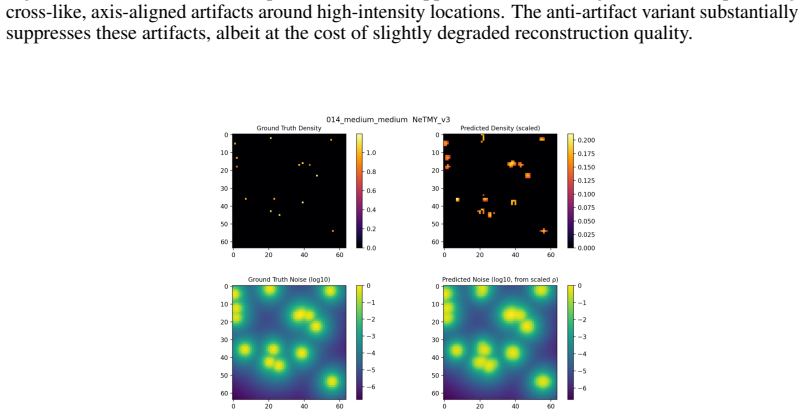
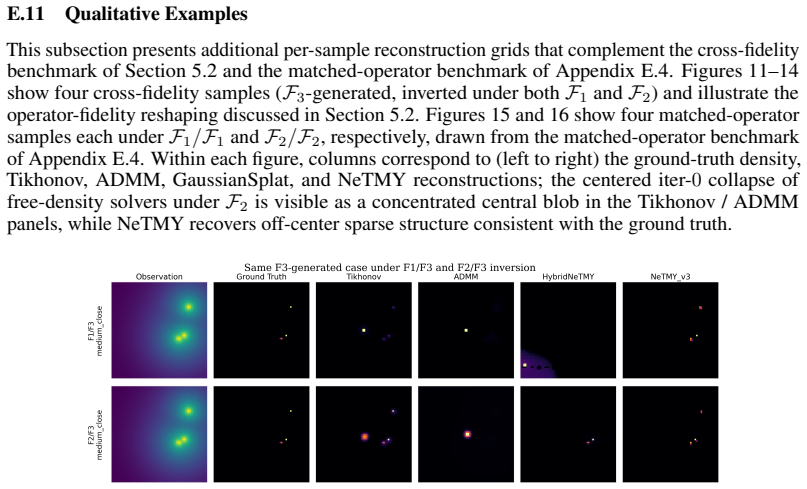
NeTMY is an amortization-free coordinate neural field coupled to the differentiable NV forward model, using annealed positional encoding, multiscale optimization, sparsity/gating, and spectrum-fidelity losses. When the forward model is upgraded to a tensor power-summed dipolar operator, NeTMY produces the best localization and distributional metrics across the tested sparse synthetic reconstructions. Its parameterization smooths updates and thereby mitigates the center-collapse failure mode that appears in raw density-space optimization.
What carries the argument
NeTMY, a coordinate neural field with annealed positional encoding and multiscale optimization, coupled to the tensor power-summed dipolar NV forward model for density reconstruction.
If this is right
- Upgrading the forward model from scalar to tensor dipolar changes the inverse landscape and reveals a center-collapse mode in direct density optimization.
- NeTMY achieves the best localization and distributional metrics among tested methods on sparse synthetic data generated by the corrected operator.
- The neural-field parameterization smooths and redistributes gradient updates, avoiding the raw density-space pathology.
- NV quantum sensing becomes a practical testbed for physics-faithful neural inverse problems.
Where Pith is reading between the lines
- The same neural-field-plus-differentiable-physics pattern could be applied to other nonlinear quantum sensing modalities such as atomic magnetometers or superconducting qubit arrays.
- If the neural field can be evaluated and differentiated at high speed, the method could support real-time or adaptive sensing protocols.
- Transfer from the current synthetic benchmarks to laboratory data will require explicit handling of calibration drift and sensor-specific noise correlations.
Load-bearing premise
The tensor power-summed dipolar operator accurately represents real NV-center physics and the synthetic data distributions capture experimental challenges including noise and model mismatch.
What would settle it
Running free-density optimization and NeTMY on the same experimental NV-center measurements and checking whether center-collapse appears in the density-based result but not in the neural-field result.
Figures





read the original abstract
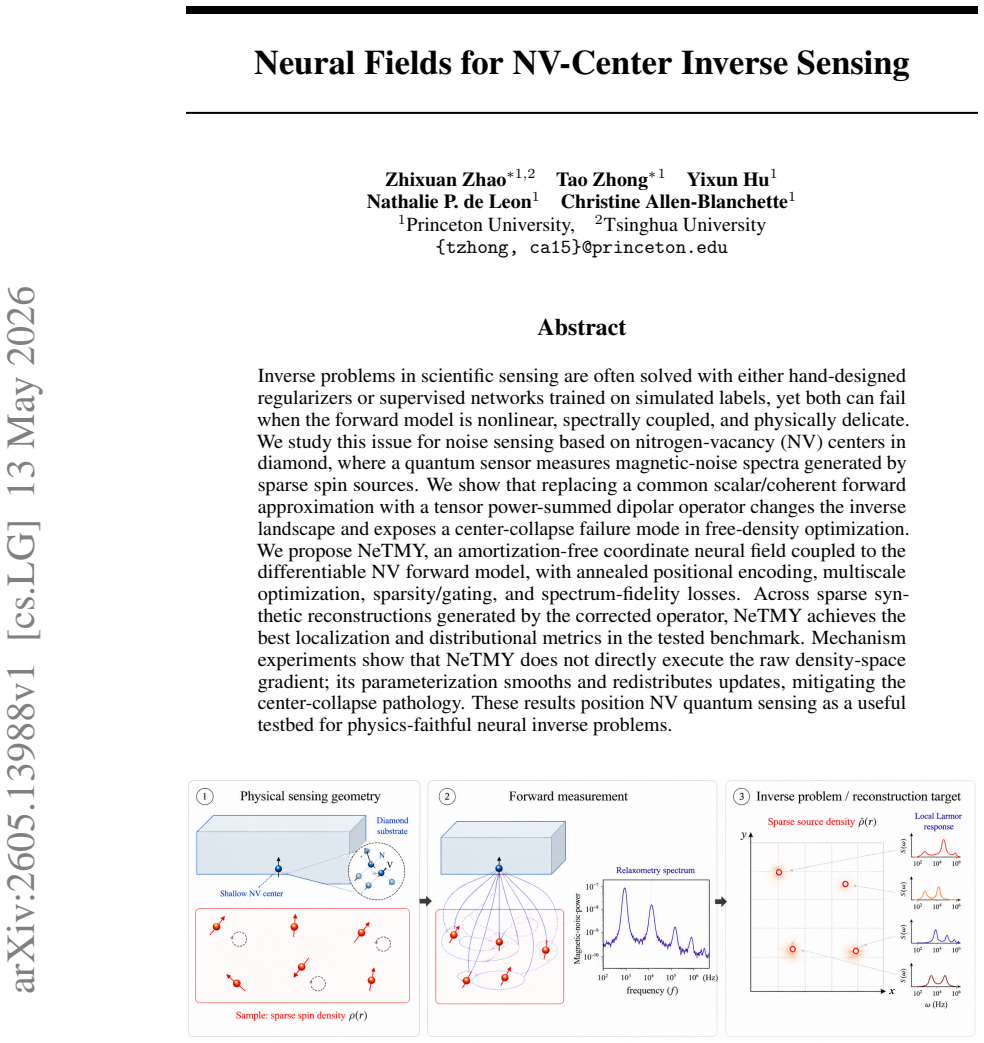
Inverse problems in scientific sensing are often solved with either hand-designed regularizers or supervised networks trained on simulated labels, yet both can fail when the forward model is nonlinear, spectrally coupled, and physically delicate. We study this issue for noise sensing based on nitrogen-vacancy (NV) centers in diamond, where a quantum sensor measures magnetic-noise spectra generated by sparse spin sources. We show that replacing a common scalar/coherent forward approximation with a tensor power-summed dipolar operator changes the inverse landscape and exposes a center-collapse failure mode in free-density optimization. We propose NeTMY, an amortization-free coordinate neural field coupled to the differentiable NV forward model, with annealed positional encoding, multiscale optimization, sparsity/gating, and spectrum-fidelity losses. Across sparse synthetic reconstructions generated by the corrected operator, NeTMY achieves the best localization and distributional metrics in the tested benchmark. Mechanism experiments show that NeTMY does not directly execute the raw density-space gradient; its parameterization smooths and redistributes updates, mitigating the center-collapse pathology. These results position NV quantum sensing as a useful testbed for physics-faithful neural inverse problems.
Editorial analysis
A structured set of objections, weighed in public.
Referee Report
Summary. The paper proposes NeTMY, an amortization-free coordinate neural field for inverse sensing of sparse spin sources via NV-center magnetic noise measurements. It replaces scalar/coherent forward approximations with a tensor power-summed dipolar operator, which changes the inverse landscape and exposes center-collapse in free-density optimization. The method couples the neural field to a differentiable NV forward model using annealed positional encoding, multiscale optimization, sparsity/gating, and spectrum-fidelity losses. On sparse synthetic reconstructions generated by the corrected operator, NeTMY reports the best localization and distributional metrics, with mechanism experiments indicating that its parameterization smooths and redistributes updates to mitigate collapse.
Significance. If the results hold, the work supplies a concrete testbed for physics-faithful neural inverse methods in quantum sensing. Strengths include the explicit differentiable forward model, identification of a specific optimization pathology, and the amortization-free formulation. These elements could inform broader use of neural fields for nonlinear, spectrally coupled inverse problems where hand-designed regularizers or purely supervised approaches fall short.
major comments (3)
- [Abstract] Abstract: the central claim that NeTMY 'achieves the best localization and distributional metrics in the tested benchmark' is stated at a high level without numerical values, error bars, baseline definitions, or data-exclusion rules. This leaves the magnitude of improvement and reproducibility unverifiable from the provided information.
- [Experimental evaluation] Experimental evaluation (implied Section 4): all reported results use synthetic data generated by the identical tensor power-summed dipolar operator that the network inverts. This closed-loop setup does not test the paper's stated concerns about model mismatch, experimental noise, or unmodeled interactions, weakening the claim of practical utility for real NV-center measurements.
- [Mechanism experiments] Mechanism experiments: the assertion that NeTMY 'does not directly execute the raw density-space gradient' and instead smooths updates is presented without quantitative ablation isolating the contribution of annealed positional encoding, multiscale optimization, or sparsity/gating to the collapse mitigation. It is therefore unclear which components are load-bearing.
minor comments (2)
- [Methods] The tensor power-summed dipolar operator should be given an explicit equation number and derivation sketch in the methods section to allow readers to reproduce the forward model.
- [Methods] Notation for the spectrum-fidelity loss and gating mechanism could be standardized with a single table of symbols.
Simulated Author's Rebuttal
We thank the referee for the constructive comments. We address each major point below, agreeing where the manuscript can be strengthened and providing clarifications or planned revisions where appropriate.
read point-by-point responses
-
Referee: [Abstract] Abstract: the central claim that NeTMY 'achieves the best localization and distributional metrics in the tested benchmark' is stated at a high level without numerical values, error bars, baseline definitions, or data-exclusion rules. This leaves the magnitude of improvement and reproducibility unverifiable from the provided information.
Authors: We agree that the abstract would benefit from greater specificity. In the revised manuscript we will insert the key quantitative results (localization error and distributional metrics with error bars), together with concise definitions of the baselines and data-exclusion criteria used in the benchmark. revision: yes
-
Referee: [Experimental evaluation] Experimental evaluation (implied Section 4): all reported results use synthetic data generated by the identical tensor power-summed dipolar operator that the network inverts. This closed-loop setup does not test the paper's stated concerns about model mismatch, experimental noise, or unmodeled interactions, weakening the claim of practical utility for real NV-center measurements.
Authors: The referee correctly identifies that all quantitative results are obtained in a closed synthetic loop using the same forward operator. This controlled setting was chosen to isolate the center-collapse pathology and the effect of our mitigation strategies without confounding experimental noise. We acknowledge that the current experiments do not address model mismatch or real-device noise. In the revision we will add an explicit limitations subsection that discusses these gaps and sketches the path toward incorporating experimental noise models and real NV-center measurements. revision: partial
-
Referee: [Mechanism experiments] Mechanism experiments: the assertion that NeTMY 'does not directly execute the raw density-space gradient' and instead smooths updates is presented without quantitative ablation isolating the contribution of annealed positional encoding, multiscale optimization, or sparsity/gating to the collapse mitigation. It is therefore unclear which components are load-bearing.
Authors: We will expand the mechanism section with quantitative ablation studies that individually disable or vary annealed positional encoding, multiscale optimization, and sparsity/gating, reporting their separate effects on collapse frequency and final metrics. This will make clear which elements are primarily responsible for the observed smoothing of updates. revision: yes
Circularity Check
No circularity in derivation chain
full rationale
The paper's central method couples a coordinate neural field to an external differentiable physical forward model (tensor power-summed dipolar operator) and optimizes via explicit spectrum-fidelity losses, annealed encoding, and sparsity terms. Evaluation occurs on synthetic data generated by that same operator, which is standard practice for inverse-problem benchmarks and does not reduce any claimed prediction or result to a quantity defined by the method's own fitted parameters or self-citations. No load-bearing self-citations, uniqueness theorems, or ansatz smuggling appear in the provided text; the derivation remains self-contained against the stated physical model.
Axiom & Free-Parameter Ledger
axioms (1)
- domain assumption The tensor power-summed dipolar operator correctly models NV-center magnetic interactions
invented entities (1)
-
NeTMY neural field
no independent evidence
Reference graph
Works this paper leans on
-
[1]
Nv center based nano-nmr enhanced by deep learning.Scientific reports, 9(1):17802, 2019
Nati Aharon, Amit Rotem, Liam P McGuinness, Fedor Jelezko, Alex Retzker, and Zohar Ringel. Nv center based nano-nmr enhanced by deep learning.Scientific reports, 9(1):17802, 2019
work page 2019
-
[2]
Ali Ahmed, Benjamin Recht, and Justin Romberg. Blind deconvolution using convex programming.IEEE Transactions on Information Theory, 60(3):1711–1732, 2013
work page 2013
-
[3]
Ismail Alkhouri, Evan Bell, Avrajit Ghosh, Shijun Liang, Rongrong Wang, and Saiprasad Ravishankar. Understanding untrained deep models for inverse problems: Algorithms and theory.arXiv preprint arXiv:2502.18612, 2025
-
[4]
Vegard Antun, Francesco Renna, Clarice Poon, Ben Adcock, and Anders C Hansen. On instabilities of deep learning in image reconstruction and the potential costs of ai.Proceedings of the National Academy of Sciences, 117(48):30088–30095, 2020
work page 2020
-
[5]
Solving inverse problems using data-driven models.Acta numerica, 28:1–174, 2019
Simon Arridge, Peter Maass, Ozan Öktem, and Carola-Bibiane Schönlieb. Solving inverse problems using data-driven models.Acta numerica, 28:1–174, 2019
work page 2019
-
[6]
Nicolas Bonneel, Julien Rabin, Gabriel Peyré, and Hanspeter Pfister. Sliced and radon wasserstein barycenters of measures.Journal of Mathematical Imaging and Vision, 51(1):22–45, 2015
work page 2015
-
[7]
Compressed sensing using generative models
Ashish Bora, Ajil Jalal, Eric Price, and Alexandros G Dimakis. Compressed sensing using generative models. InInternational conference on machine learning, pages 537–546. PMLR, 2017
work page 2017
-
[8]
Multiscale seismic waveform inversion.Geophysics, 60(5):1457–1473, 1995
Carey Bunks, Fatimetou M Saleck, Stephane Zaleski, and Guy Chavent. Multiscale seismic waveform inversion.Geophysics, 60(5):1457–1473, 1995
work page 1995
-
[9]
Emmanuel J Candès, Justin Romberg, and Terence Tao. Robust uncertainty principles: Exact signal reconstruction from highly incomplete frequency information.IEEE Transactions on information theory, 52(2):489–509, 2006
work page 2006
-
[10]
Francesco Casola, Toeno Van Der Sar, and Amir Yacoby. Probing condensed matter physics with magnetometry based on nitrogen-vacancy centres in diamond.Nature Reviews Materials, 3(1):17088, 2018
work page 2018
-
[11]
Antonin Chambolle and Thomas Pock. A first-order primal-dual algorithm for convex problems with applications to imaging.Journal of mathematical imaging and vision, 40(1):120–145, 2011
work page 2011
-
[12]
Massively multiplexed nanoscale magnetometry with diamond quantum sensors
Kai-Hung Cheng, Zeeshawn Kazi, Jared Rovny, Bichen Zhang, Lila S Nassar, Jeff D Thompson, and Nathalie P De Leon. Massively multiplexed nanoscale magnetometry with diamond quantum sensors. Physical Review X, 15(3):031014, 2025
work page 2025
-
[13]
Yuejie Chi, Yue M Lu, and Yuxin Chen. Nonconvex optimization meets low-rank matrix factorization: An overview.IEEE Transactions on Signal Processing, 67(20):5239–5269, 2019
work page 2019
-
[14]
Salvatore Cuomo, Vincenzo Schiano Di Cola, Fabio Giampaolo, Gianluigi Rozza, Maziar Raissi, and Francesco Piccialli. Scientific machine learning through physics–informed neural networks: Where we are and what’s next.Journal of Scientific Computing, 92(3):88, 2022
work page 2022
-
[15]
Quantum sensing.Reviews of modern physics, 89(3):035002, 2017
Christian L Degen, Friedemann Reinhard, and Paola Cappellaro. Quantum sensing.Reviews of modern physics, 89(3):035002, 2017
work page 2017
-
[16]
The benchmark lottery.arXiv preprint arXiv:2107.07002, 2021
Mostafa Dehghani, Yi Tay, Alexey A Gritsenko, Zhe Zhao, Neil Houlsby, Fernando Diaz, Donald Metzler, and Oriol Vinyals. The benchmark lottery.arXiv preprint arXiv:2107.07002, 2021
-
[17]
The nitrogen-vacancy colour centre in diamond.Physics Reports, 528(1):1–45, 2013
Marcus W Doherty, Neil B Manson, Paul Delaney, Fedor Jelezko, Jörg Wrachtrup, and Lloyd CL Hollen- berg. The nitrogen-vacancy colour centre in diamond.Physics Reports, 528(1):1–45, 2013
work page 2013
-
[18]
Compressed sensing.IEEE Transactions on information theory, 52(4):1289–1306, 2006
David L Donoho. Compressed sensing.IEEE Transactions on information theory, 52(4):1289–1306, 2006
work page 2006
-
[19]
Incomplete spectrum qsm using support information.Frontiers in Neuroscience, 17:1130524, 2023
Patrick Fuchs and Karin Shmueli. Incomplete spectrum qsm using support information.Frontiers in Neuroscience, 17:1130524, 2023
work page 2023
-
[20]
Davis Gilton, Gregory Ongie, and Rebecca Willett. Deep equilibrium architectures for inverse problems in imaging.IEEE Transactions on Computational Imaging, 7:1123–1133, 2021. 10
work page 2021
-
[21]
Generative adversarial nets.Advances in neural information processing systems, 27, 2014
Ian J Goodfellow, Jean Pouget-Abadie, Mehdi Mirza, Bing Xu, David Warde-Farley, Sherjil Ozair, Aaron Courville, and Yoshua Bengio. Generative adversarial nets.Advances in neural information processing systems, 27, 2014
work page 2014
-
[22]
Roberta Grech, Tracey Cassar, Joseph Muscat, Kenneth P Camilleri, Simon G Fabri, Michalis Zervakis, Petros Xanthopoulos, Vangelis Sakkalis, and Bart Vanrumste. Review on solving the inverse problem in eeg source analysis.Journal of neuroengineering and rehabilitation, 5(1):25, 2008
work page 2008
-
[23]
Peimeng Guan, Naveed Iqbal, Mark A Davenport, and Mudassir Masood. Solving inverse problems with model mismatch using untrained neural networks within model-based architectures.arXiv preprint arXiv:2403.04847, 2024
-
[24]
Harshit Gupta, Kyong Hwan Jin, Ha Q Nguyen, Michael T McCann, and Michael Unser. Cnn-based projected gradient descent for consistent ct image reconstruction.IEEE transactions on medical imaging, 37(6):1440–1453, 2018
work page 2018
-
[25]
Andreas Habring and Martin Holler. Neural-network-based regularization methods for inverse problems in imaging.GAMM-Mitteilungen, 47(4):e202470004, 2024
work page 2024
-
[26]
Kerstin Hammernik, Teresa Klatzer, Erich Kobler, Michael P Recht, Daniel K Sodickson, Thomas Pock, and Florian Knoll. Learning a variational network for reconstruction of accelerated mri data.Magnetic resonance in medicine, 79(6):3055–3071, 2018
work page 2018
-
[27]
Deep Decoder: Concise Image Representations from Untrained Non-convolutional Networks
Reinhard Heckel and Paul Hand. Deep decoder: Concise image representations from untrained non- convolutional networks.arXiv preprint arXiv:1810.03982, 2018
work page internal anchor Pith review Pith/arXiv arXiv 2018
-
[28]
Compressive sensing with un-trained neural networks: Gradient descent finds a smooth approximation
Reinhard Heckel and Mahdi Soltanolkotabi. Compressive sensing with un-trained neural networks: Gradient descent finds a smooth approximation. InInternational conference on machine learning, pages 4149–4158. PMLR, 2020
work page 2020
-
[29]
Deep reinforcement learning that matters
Peter Henderson, Riashat Islam, Philip Bachman, Joelle Pineau, Doina Precup, and David Meger. Deep reinforcement learning that matters. InProceedings of the AAAI conference on artificial intelligence, volume 32, 2018
work page 2018
-
[30]
Ridge regression: applications to nonorthogonal problems
Arthur E Hoerl and Robert W Kennard. Ridge regression: applications to nonorthogonal problems. Technometrics, 12(1):69–82, 1970
work page 1970
-
[31]
Ridge regression: Biased estimation for nonorthogonal problems
Arthur E Hoerl and Robert W Kennard. Ridge regression: Biased estimation for nonorthogonal problems. Technometrics, 12(1):55–67, 1970
work page 1970
-
[32]
Jonas Homrighausen, Ludwig Horsthemke, Jens Pogorzelski, Sarah Trinschek, Peter Glösekötter, and Markus Gregor. Edge-machine-learning-assisted robust magnetometer based on randomly oriented nv- ensembles in diamond.Sensors, 23(3):1119, 2023
work page 2023
-
[33]
Adan Jafet Garcia Inda, Shao Ying Huang, Nevrez ˙Imamo˘glu, Ruian Qin, Tianyi Yang, Tiao Chen, Zilong Yuan, and Wenwei Yu. Physics informed neural networks (pinn) for low snr magnetic resonance electrical properties tomography (mrept).Diagnostics, 12(11):2627, 2022
work page 2022
-
[34]
Gauri Jagatap and Chinmay Hegde. Algorithmic guarantees for inverse imaging with untrained network priors.Advances in neural information processing systems, 32, 2019
work page 2019
-
[35]
Jari Kaipio and Erkki Somersalo. Statistical inverse problems: discretization, model reduction and inverse crimes.Journal of computational and applied mathematics, 198(2):493–504, 2007
work page 2007
-
[36]
Physics-informed machine learning.Nature Reviews Physics, 3(6):422–440, 2021
George Em Karniadakis, Ioannis G Kevrekidis, Lu Lu, Paris Perdikaris, Sifan Wang, and Liu Yang. Physics-informed machine learning.Nature Reviews Physics, 3(6):422–440, 2021
work page 2021
-
[37]
3d gaussian splatting for real-time radiance field rendering.ACM Trans
Bernhard Kerbl, Georgios Kopanas, Thomas Leimkühler, George Drettakis, et al. 3d gaussian splatting for real-time radiance field rendering.ACM Trans. Graph., 42(4):139–1, 2023
work page 2023
-
[38]
Adam: A Method for Stochastic Optimization
Diederik P Kingma and Jimmy Ba. Adam: A method for stochastic optimization.arXiv preprint arXiv:1412.6980, 2014
work page internal anchor Pith review Pith/arXiv arXiv 2014
-
[39]
Harold W Kuhn. The hungarian method for the assignment problem.Naval research logistics quarterly, 2 (1-2):83–97, 1955
work page 1955
-
[40]
Jitender Kumar, Dan Yudilevich, Ariel Smooha, Inbar Zohar, Arnab K Pariari, Rainer Stöhr, Andrej Denisenko, Markus Hücker, and Amit Finkler. Room temperature relaxometry of single nitrogen vacancy centers in proximity toα-rucl3 nanoflakes.Nano Letters, 24(16):4793–4800, 2024
work page 2024
-
[41]
Kiryung Lee, Yanjun Li, Marius Junge, and Yoram Bresler. Blind recovery of sparse signals from subsampled convolution.IEEE Transactions on Information Theory, 63(2):802–821, 2016
work page 2016
-
[42]
Are we learning yet? a meta review of evaluation failures across machine learning
Thomas Liao, Rohan Taori, Inioluwa Deborah Raji, and Ludwig Schmidt. Are we learning yet? a meta review of evaluation failures across machine learning. InThirty-fifth Conference on Neural Information Processing Systems Datasets and Benchmarks Track (Round 2), 2021
work page 2021
-
[43]
Self-calibration and biconvex compressive sensing.Inverse Problems, 31(11):115002, 2015
Shuyang Ling and Thomas Strohmer. Self-calibration and biconvex compressive sensing.Inverse Problems, 31(11):115002, 2015. 11
work page 2015
-
[44]
On the limited memory bfgs method for large scale optimization
Dong C Liu and Jorge Nocedal. On the limited memory bfgs method for large scale optimization. Mathematical programming, 45(1):503–528, 1989
work page 1989
-
[45]
Keqing Liu, Jiazhao Tian, Bokun Duan, Hao Zhang, Kangze Li, Guofeng Zhang, Fedor Jelezko, Ressa S Said, Jianming Cai, and Liantuan Xiao. High-resolution wide-field magnetic imaging with sparse sampling using nitrogen-vacancy centers.arXiv preprint arXiv:2602.00679, 2026
-
[46]
HJ Mamin, M Kim, MH Sherwood, Charles T Rettner, K Ohno, DD Awschalom, and D Rugar. Nanoscale nuclear magnetic resonance with a nitrogen-vacancy spin sensor.Science, 339(6119):557–560, 2013
work page 2013
-
[47]
Julien NP Martel, David B Lindell, Connor Z Lin, Eric R Chan, Marco Monteiro, and Gordon Wetzstein. Acorn: Adaptive coordinate networks for neural scene representation.arXiv preprint arXiv:2105.02788, 2021
-
[48]
Deepred: Deep image prior powered by red
Gary Mataev, Peyman Milanfar, and Michael Elad. Deepred: Deep image prior powered by red. In Proceedings of the IEEE/CVF international conference on computer vision workshops, pages 0–0, 2019
work page 2019
-
[49]
Michael T McCann, Kyong Hwan Jin, and Michael Unser. Convolutional neural networks for inverse problems in imaging: A review.IEEE Signal Processing Magazine, 34(6):85–95, 2017
work page 2017
-
[50]
Optimized current-density reconstruction from wide-field quantum diamond magnetic field maps
Siddhant Midha, Madhur Parashar, Anuj Bathla, David A Broadway, Jean-Philippe Tetienne, and Kasturi Saha. Optimized current-density reconstruction from wide-field quantum diamond magnetic field maps. Physical Review Applied, 22(1):014015, 2024
work page 2024
-
[51]
Ben Mildenhall, Pratul P Srinivasan, Matthew Tancik, Jonathan T Barron, Ravi Ramamoorthi, and Ren Ng. Nerf: Representing scenes as neural radiance fields for view synthesis.Communications of the ACM, 65 (1):99–106, 2021
work page 2021
-
[52]
Implicit neural representation in medical imaging: A comparative survey
Amirali Molaei, Amirhossein Aminimehr, Armin Tavakoli, Amirhossein Kazerouni, Bobby Azad, Reza Azad, and Dorit Merhof. Implicit neural representation in medical imaging: A comparative survey. In Proceedings of the IEEE/CVF International Conference on Computer Vision, pages 2381–2391, 2023
work page 2023
-
[53]
Vishal Monga, Yuelong Li, and Yonina C Eldar. Algorithm unrolling: Interpretable, efficient deep learning for signal and image processing.IEEE Signal Processing Magazine, 38(2):18–44, 2021
work page 2021
-
[54]
Aldona Mzyk, Alina Sigaeva, and Romana Schirhagl. Relaxometry with nitrogen vacancy (nv) centers in diamond.Accounts of chemical research, 55(24):3572–3580, 2022
work page 2022
-
[55]
Parikh Neal, Chu Eric, Peleato Borja, and Eckstein Jonathan. Distributed optimization and statistical learning via the alternating direction method of multipliers.Foundations and Trends® in Machine learning, 3(1):1–122, 2011
work page 2011
-
[56]
Gregory Ongie, Ajil Jalal, Christopher A Metzler, Richard G Baraniuk, Alexandros G Dimakis, and Rebecca Willett. Deep learning techniques for inverse problems in imaging.IEEE Journal on Selected Areas in Information Theory, 1(1):39–56, 2020
work page 2020
-
[57]
Nerfies: Deformable neural radiance fields
Keunhong Park, Utkarsh Sinha, Jonathan T Barron, Sofien Bouaziz, Dan B Goldman, Steven M Seitz, and Ricardo Martin-Brualla. Nerfies: Deformable neural radiance fields. InProceedings of the IEEE/CVF international conference on computer vision, pages 5865–5874, 2021
work page 2021
-
[58]
Unsupervised Representation Learning with Deep Convolutional Generative Adversarial Networks
Alec Radford, Luke Metz, and Soumith Chintala. Unsupervised representation learning with deep convolutional generative adversarial networks.arXiv preprint arXiv:1511.06434, 2015
work page internal anchor Pith review Pith/arXiv arXiv 2015
-
[59]
Maziar Raissi, Paris Perdikaris, and George E Karniadakis. Physics-informed neural networks: A deep learning framework for solving forward and inverse problems involving nonlinear partial differential equations.Journal of Computational physics, 378:686–707, 2019
work page 2019
-
[60]
Ai and the everything in the whole wide world benchmark.arXiv preprint arXiv:2111.15366, 2021
Inioluwa Deborah Raji, Emily M Bender, Amandalynne Paullada, Emily Denton, and Alex Hanna. Ai and the everything in the whole wide world benchmark.arXiv preprint arXiv:2111.15366, 2021
-
[61]
Benjamin Recht, Rebecca Roelofs, Ludwig Schmidt, and Vaishaal Shankar. Do imagenet classifiers generalize to imagenet? InInternational conference on machine learning, pages 5389–5400. PMLR, 2019
work page 2019
-
[62]
Albert W Reed, Hyojin Kim, Rushil Anirudh, K Aditya Mohan, Kyle Champley, Jingu Kang, and Suren Jayasuriya. Dynamic ct reconstruction from limited views with implicit neural representations and parametric motion fields. InProceedings of the IEEE/CVF International Conference on Computer Vision, pages 2258–2268, 2021
work page 2021
-
[63]
Yaniv Romano, Michael Elad, and Peyman Milanfar. The little engine that could: Regularization by denoising (red).SIAM journal on imaging sciences, 10(4):1804–1844, 2017
work page 2017
-
[64]
U-net: Convolutional networks for biomedical image segmentation
Olaf Ronneberger, Philipp Fischer, and Thomas Brox. U-net: Convolutional networks for biomedical image segmentation. InInternational Conference on Medical image computing and computer-assisted intervention, pages 234–241. Springer, 2015
work page 2015
-
[65]
Nanoscale diamond quantum sensors for many-body physics.Nature Reviews Physics, 6(12):753–768, 2024
Jared Rovny, Sarang Gopalakrishnan, Ania C Bleszynski Jayich, Patrick Maletinsky, Eugene Demler, and Nathalie P de Leon. Nanoscale diamond quantum sensors for many-body physics.Nature Reviews Physics, 6(12):753–768, 2024. 12
work page 2024
-
[66]
Nonlinear total variation based noise removal algorithms
Leonid I Rudin, Stanley Osher, and Emad Fatemi. Nonlinear total variation based noise removal algorithms. Physica D: nonlinear phenomena, 60(1-4):259–268, 1992
work page 1992
-
[67]
Liyue Shen, John Pauly, and Lei Xing. Nerp: implicit neural representation learning with prior embedding for sparsely sampled image reconstruction.IEEE transactions on neural networks and learning systems, 35(1):770–782, 2022
work page 2022
-
[68]
Improved implicit neural representation with fourier reparameterized training
Kexuan Shi, Xingyu Zhou, and Shuhang Gu. Improved implicit neural representation with fourier reparameterized training. InProceedings of the IEEE/CVF Conference on Computer Vision and Pattern Recognition, pages 25985–25994, 2024
work page 2024
-
[69]
Vincent Sitzmann, Julien Martel, Alexander Bergman, David Lindell, and Gordon Wetzstein. Implicit neural representations with periodic activation functions.Advances in neural information processing systems, 33:7462–7473, 2020
work page 2020
-
[70]
Sensing single-molecule magnets with nitrogen-vacancy centers.Nano Letters, 2026
Ariel Smooha, Jitender Kumar, Dan Yudilevich, John W Rosenberg, Valentin Bayer, Rainer Stöhr, Andrej Denisenko, Tatyana Bendikov, Anna Kossoy, Iddo Pinkas, et al. Sensing single-molecule magnets with nitrogen-vacancy centers.Nano Letters, 2026
work page 2026
-
[71]
Matthew Tancik, Pratul Srinivasan, Ben Mildenhall, Sara Fridovich-Keil, Nithin Raghavan, Utkarsh Singhal, Ravi Ramamoorthi, Jonathan Barron, and Ren Ng. Fourier features let networks learn high frequency functions in low dimensional domains.Advances in neural information processing systems, 33: 7537–7547, 2020
work page 2020
-
[72]
J-P Tetienne, Thomas Hingant, Loïc Rondin, Adrien Cavaillès, Ludovic Mayer, Géraldine Dantelle, Thierry Gacoin, Jörg Wrachtrup, J-F Roch, and Vincent Jacques. Spin relaxometry of single nitrogen-vacancy defects in diamond nanocrystals for magnetic noise sensing.arXiv preprint arXiv:1304.1197, 2013
work page internal anchor Pith review Pith/arXiv arXiv 2013
-
[73]
Accurate magnetic field imaging using nanodiamond quantum sensors enhanced by machine learning
Moeta Tsukamoto, Shuji Ito, Kensuke Ogawa, Yuto Ashida, Kento Sasaki, and Kensuke Kobayashi. Accurate magnetic field imaging using nanodiamond quantum sensors enhanced by machine learning. Scientific reports, 12(1):13942, 2022
work page 2022
-
[74]
Dmitry Ulyanov, Andrea Vedaldi, and Victor Lempitsky. Deep image prior. InProceedings of the IEEE conference on computer vision and pattern recognition, pages 9446–9454, 2018
work page 2018
-
[75]
Toeno Van der Sar, Francesco Casola, Ronald Walsworth, and Amir Yacoby. Nanometre-scale probing of spin waves using single electron spins.Nature communications, 6(1):7886, 2015
work page 2015
-
[76]
Plug-and-play priors for model based reconstruction
Singanallur V Venkatakrishnan, Charles A Bouman, and Brendt Wohlberg. Plug-and-play priors for model based reconstruction. In2013 IEEE global conference on signal and information processing, pages 945–948. IEEE, 2013
work page 2013
-
[77]
An overview of full-waveform inversion in exploration geophysics
Jean Virieux and Stéphane Operto. An overview of full-waveform inversion in exploration geophysics. 2010
work page 2010
-
[78]
Zhou Wang, Alan C Bovik, Hamid R Sheikh, and Eero P Simoncelli. Image quality assessment: from error visibility to structural similarity.IEEE transactions on image processing, 13(4):600–612, 2004
work page 2004
-
[79]
Wufeng Xue, Lei Zhang, Xuanqin Mou, and Alan C Bovik. Gradient magnitude similarity deviation: A highly efficient perceptual image quality index.IEEE transactions on image processing, 23(2):684–695, 2013
work page 2013
-
[80]
Yan Yang, Jian Sun, Huibin Li, and Zongben Xu. Admm-csnet: A deep learning approach for image compressive sensing.IEEE transactions on pattern analysis and machine intelligence, 42(3):521–538, 2018
work page 2018
discussion (0)
Sign in with ORCID, Apple, or X to comment. Anyone can read and Pith papers without signing in.