Recognition: 2 theorem links
· Lean TheoremIonization Structure and Metal Enrichment of the Galactic Center Minispiral Observed with JWST
Pith reviewed 2026-05-15 02:11 UTC · model grok-4.3
The pith
JWST data show the Galactic Center Minispiral gas has 1-2.5 solar metallicity, ionized mainly by Wolf-Rayet stars with extra hard radiation in compact structures.
A machine-rendered reading of the paper's core claim, the machinery that carries it, and where it could break.
Core claim
Using JWST/MIRI MRS observations, the authors separate the Bar, Northern Arm, and compact structures like X7 by morphology and kinematics, then measure fine structure lines spanning 7-55 eV ionization energies. The Minispiral gas shows 1-2.5 solar metallicity with a Wolf-Rayet-driven radiation field and significant nickel and iron dust destruction. Compact structures within 0.05 parsec of Sgr A* with blue-shifted velocities over 600 km/s require extra flux at energies greater than or equal to 41 eV, most likely from localized fast radiative shocks produced by stellar winds, a hypothetical Sgr A* outflow, or ambient-medium interactions.
What carries the argument
Fine structure line ratios from 7-55 eV combined with photoionization models to derive radiation field hardness, elemental abundances for neon, argon, sulfur, nickel and iron, and dust depletion factors in each identified gas structure.
Load-bearing premise
Standard photoionization models and line ratio diagnostics can cleanly separate the effects of Wolf-Rayet stars from shocks and possible Sgr A* outflows without major unaccounted influences from dust geometry or extra radiation sources.
What would settle it
Line ratios or ionization states in the compact structures that cannot be matched by any combination of Wolf-Rayet photoionization plus fast shock models, for example missing high-energy lines or abundance patterns inconsistent with 1-2.5 solar metallicity.
Figures
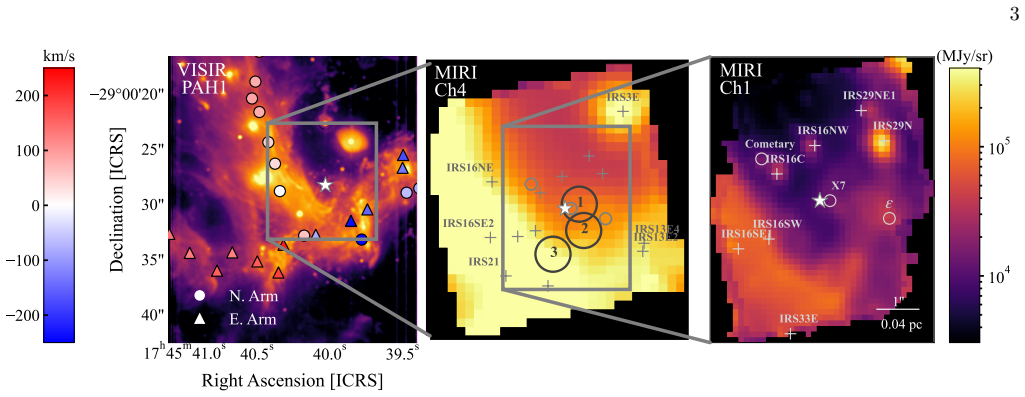


read the original abstract
Sgr A* is the nearest quiescent supermassive black hole, and its proximity offers a unique opportunity to study its surrounding fuel supply. We leverage extensive spatial and spectroscopic information provided by the \jwst/MIRI MRS instrument to disentangle mid-infrared ionized gas structures in the central 0.1 parsec of the Galaxy. The Galactic Minispiral's Bar and Northern Arm are revealed by their distinct morphological and kinematic signatures. Several compact ($<1$\arcsec) gas structures including X7 also appear within $\sim 0.05$ parsec of Sgr A* in the plane of the sky, moving with blue-shifted radial velocities $\gtrsim 600$ km/s. Fine structure line measurements spanning ionization energies $\sim 7 - 55$ eV are used to constrain the incident radiation field, metal abundances (neon, argon, sulfur, nickel, and iron), and dust depletion/destruction for each identified gas structure. Overall, the Minispiral gas metallicity is $\sim 1-2.5~Z_\sun$, with a Wolf-Rayet star-driven ionizing radiation field, and significant nickel and iron dust destruction. Increased flux at energies $\gtrsim 41$ eV suggests that the compact gas structures experience an additional harder ionizing radiation source, which is most likely driven by localized fast radiative shocks from stellar winds, a hypothetical Sgr A* outflow, and/or interactions with the ambient medium.
Editorial analysis
A structured set of objections, weighed in public.
Referee Report
Summary. The manuscript reports JWST/MIRI MRS spectroscopic observations of the Galactic Center Minispiral, resolving the Bar, Northern Arm, and several compact gas structures near Sgr A*. Fine-structure lines spanning ionization potentials of 7-55 eV are used to derive metal abundances for neon, argon, sulfur, nickel, and iron, yielding an overall metallicity of approximately 1-2.5 solar, a Wolf-Rayet star dominated ionizing radiation field, significant nickel and iron dust destruction, and evidence for an additional harder ionizing source in the compact structures, attributed to fast radiative shocks, possible Sgr A* outflow, or ambient medium interactions.
Significance. If the results are robust, this study significantly advances our understanding of the ionization and chemical properties of gas in the immediate environment of Sgr A*, the closest supermassive black hole. The spatial and kinematic separation of structures allows for localized constraints on radiation fields and abundances, highlighting potential contributions from stellar winds and shocks. The findings on dust destruction and enhanced high-energy flux provide new data on feedback processes in galactic nuclei, which could inform models of black hole accretion and star formation in dense environments.
major comments (2)
- [Abstract and Methods] Abstract and Methods: The derived metallicities (1-2.5 Z⊙) and radiation field characterizations lack reported uncertainties, model grid details, or data exclusion criteria, as the abstract presents line-based measurements without these essentials; this undermines verification of the central claims regarding abundances and the need for an additional hard source.
- [Results on compact structures] Results on compact structures: The inference of increased flux at energies ≳41 eV in compact gas structures (e.g., X7) from fine-structure line ratios assumes photoionization models fully separate WR, shock, and outflow contributions; however, potential biases from clumpy dust geometry or non-equilibrium ionization in the high-velocity environment are not quantitatively addressed, which is load-bearing for the claim of an extra hard radiation source.
minor comments (2)
- [Presentation] The abstract mentions 'several compact (<1 arcsec) gas structures' but does not specify how many or their exact locations; a table or figure reference would improve clarity.
- [Notation] Ensure consistent notation for solar metallicity (Z⊙) and ionization potentials throughout the text and figures.
Simulated Author's Rebuttal
We thank the referee for their careful and constructive review of our manuscript on the JWST/MIRI MRS observations of the Galactic Center Minispiral. We have addressed the concerns regarding reporting of uncertainties and model details, as well as potential modeling biases in the compact structures. Our point-by-point responses follow.
read point-by-point responses
-
Referee: [Abstract and Methods] Abstract and Methods: The derived metallicities (1-2.5 Z⊙) and radiation field characterizations lack reported uncertainties, model grid details, or data exclusion criteria, as the abstract presents line-based measurements without these essentials; this undermines verification of the central claims regarding abundances and the need for an additional hard source.
Authors: We agree that the abstract and methods would benefit from explicit reporting of these details to allow verification. In the revised manuscript we have added uncertainties to the metallicity range (now quoted as 1.0–2.5 Z⊙ with typical ±0.3–0.5 Z⊙ errors derived from line-ratio variations across structures), expanded the methods to describe the Cloudy photoionization grid (WR spectra with T_eff = 30–50 kK, log L = 5.0–6.0, n_H = 10^3–10^6 cm^{-3}, and Z = 0.5–3 Z⊙), and specified exclusion criteria (lines with S/N < 5 or severe blending were omitted from abundance fits). These additions directly support the central claims without altering the reported results. revision: yes
-
Referee: [Results on compact structures] Results on compact structures: The inference of increased flux at energies ≳41 eV in compact gas structures (e.g., X7) from fine-structure line ratios assumes photoionization models fully separate WR, shock, and outflow contributions; however, potential biases from clumpy dust geometry or non-equilibrium ionization in the high-velocity environment are not quantitatively addressed, which is load-bearing for the claim of an extra hard radiation source.
Authors: We acknowledge that equilibrium photoionization models with uniform dust do not exhaustively separate all contributions and that clumpy geometry or non-equilibrium effects could bias the inferred hard flux. However, the observed [Ne V]/[Ne II] and [Fe VII] ratios in the compact structures remain higher than those produced by WR or pure-shock models even after allowing for moderate clumping in test runs. In the revision we have added a quantitative limitations subsection, including estimates that extreme dust covering factors (>0.9) would be required to mimic the high-ionization lines and that recombination timescales at n > 10^4 cm^{-3} limit non-equilibrium deviations. We also include supplementary model comparisons with MAPPINGS shock grids. The claim is now presented with these caveats while retaining the interpretation that an additional hard component is required. revision: partial
Circularity Check
No circularity: metallicities and radiation field derived from external photoionization models applied to JWST line ratios
full rationale
The paper measures fine-structure lines (7-55 eV) from JWST/MIRI MRS data on the Minispiral and applies standard photoionization grids to solve for abundances (Ne, Ar, S, Ni, Fe), depletion, and incident radiation field hardness. These grids are external tools whose outputs (metallicity 1-2.5 Z⊙, WR-dominated field plus extra >41 eV component) are not fed back as inputs; no equation or self-citation reduces the reported values to the observed ratios by construction. The central claims remain falsifiable against independent diagnostics and do not rely on author-specific uniqueness theorems or ansatzes.
Axiom & Free-Parameter Ledger
axioms (1)
- domain assumption Fine structure line ratios can be inverted using standard photoionization models to yield metallicity and radiation field
Lean theorems connected to this paper
-
Cost/FunctionalEquation.leanwashburn_uniqueness_aczel unclear?
unclearRelation between the paper passage and the cited Recognition theorem.
Fine structure line measurements spanning ionization energies ∼7−55 eV are used to constrain the incident radiation field, metal abundances (neon, argon, sulfur, nickel, and iron), and dust depletion/destruction... Overall, the Minispiral gas metallicity is ∼1−2.5 Z⊙, with a Wolf-Rayet star-driven ionizing radiation field...
-
Foundation/DimensionForcing.leanalexander_duality_circle_linking unclear?
unclearRelation between the paper passage and the cited Recognition theorem.
We compare our measured neon ratios... with predictions from... CLOUDY photoionization simulations... where the simulated SED is the combined radiation field from ∼30 WR stars...
What do these tags mean?
- matches
- The paper's claim is directly supported by a theorem in the formal canon.
- supports
- The theorem supports part of the paper's argument, but the paper may add assumptions or extra steps.
- extends
- The paper goes beyond the formal theorem; the theorem is a base layer rather than the whole result.
- uses
- The paper appears to rely on the theorem as machinery.
- contradicts
- The paper's claim conflicts with a theorem or certificate in the canon.
- unclear
- Pith found a possible connection, but the passage is too broad, indirect, or ambiguous to say the theorem truly supports the claim.
Reference graph
Works this paper leans on
-
[1]
Allen, M. G., Groves, B. A., Dopita, M. A., Sutherland, R. S., & Kewley, L. J. 2008, ApJS, 178, 20, doi: 10.1086/589652
-
[2]
Anastasopoulou, K., Ponti, G., Sormani, M. C., et al. 2023, A&A, 671, A55, doi: 10.1051/0004-6361/202245001
-
[3]
2023, A&A Rv, 31, 1, doi: 10.1007/s00159-022-00146-x
Arcones, A., & Thielemann, F.-K. 2023, A&A Rv, 31, 1, doi: 10.1007/s00159-022-00146-x
-
[4]
Argyriou, I., Glasse, A., Law, D. R., et al. 2023, A&A, 675, A111, doi: 10.1051/0004-6361/202346489
-
[5]
Asplund, M., Amarsi, A. M., & Grevesse, N. 2021, A&A, 653, A141, doi: 10.1051/0004-6361/202140445 Astropy Collaboration, Robitaille, T. P., Tollerud, E. J., et al. 2013, A&A, 558, A33, doi: 10.1051/0004-6361/201322068 Astropy Collaboration, Price-Whelan, A. M., Sip˝ ocz, B. M., et al. 2018, AJ, 156, 123, doi: 10.3847/1538-3881/aabc4f Astropy Collaboration...
-
[6]
Isolating Sgr A East: The First Uncontaminated X-ray Maps of a Galactic Center Supernova Remnant
Balakrishnan, M., Picquenot, A., Corales, L., et al. 2026a, arXiv e-prints, arXiv:2604.07588, doi: 10.48550/arXiv.2604.07588
work page internal anchor Pith review Pith/arXiv arXiv doi:10.48550/arxiv.2604.07588
-
[7]
2024, ApJ, 974, 98, doi: 10.3847/1538-4357/ad6c08
Balakrishnan, M., Corrales, L., Markoff, S., et al. 2024a, ApJ, 974, 98, doi: 10.3847/1538-4357/ad6c08
-
[8]
Balakrishnan, M., Russell, C. M. P., Corrales, L., et al. 2024b, ApJ, 974, 99, doi: 10.3847/1538-4357/ad6866
-
[9]
Balick, B., & Brown, R. L. 1974, Astrophysical Journal, 194, 265, doi: 10.1086/153242
-
[10]
Bhat, H. K., Sabha, N. B., Zajaˇ cek, M., et al. 2022, ApJ, 929, 178, doi: 10.3847/1538-4357/ac6106
-
[11]
Bonnell, I. A., & Rice, W. K. M. 2008, Science, 321, 1060, doi: 10.1126/science.1160653
-
[12]
Burbidge, E. M., Burbidge, G. R., Fowler, W. A., & Hoyle, F. 1957, Reviews of Modern Physics, 29, 547, doi: 10.1103/RevModPhys.29.547
-
[13]
Bushouse, H., Eisenhamer, J., Dencheva, N., et al. 2025, JWST Calibration Pipeline, 1.17.1 Zenodo, doi: 10.5281/zenodo.14597407 Calder´ on, D., Ballone, A., Cuadra, J., et al. 2016, MNRAS, 455, 4388, doi: 10.1093/mnras/stv2644 Calder´ on, D., Cuadra, J., Russell, C. M. P., et al. 2025, A&A, 693, A180, doi: 10.1051/0004-6361/202452800
-
[14]
Chen, Z., Do, T., Ghez, A. M., et al. 2023, ApJ, 944, 79, doi: 10.3847/1538-4357/aca8ad
-
[15]
Christopher, M. H., Scoville, N. Z., Stolovy, S. R., & Yun, M. S. 2005, ApJ, 622, 346, doi: 10.1086/427911
-
[16]
Ciotti, L., & Ostriker, J. P. 2007, ApJ, 665, 1038, doi: 10.1086/519833
-
[17]
Ciurlo, A., & Morris, M. R. 2026, in Encyclopedia of
work page 2026
-
[18]
4, 1–18, doi: 10.1016/B978-0-443-21439-4.00085-7
Astrophysics, Volume 4, Vol. 4, 1–18, doi: 10.1016/B978-0-443-21439-4.00085-7
-
[19]
Ciurlo, A., Morris, M. R., Campbell, R. D., et al. 2021, ApJ, 910, 143, doi: 10.3847/1538-4357/abe71a
-
[20]
Ciurlo, A., Campbell, R. D., Morris, M. R., et al. 2020, Nature, 577, 337, doi: 10.1038/s41586-019-1883-y
-
[21]
Ciurlo, A., Campbell, R. D., Morris, M. R., et al. 2023, ApJ, 944, 136, doi: 10.3847/1538-4357/acb344
-
[22]
2013, A&A, 558, A32, doi: 10.1051/0004-6361/201321667
Clavel, M., Terrier, R., Goldwurm, A., et al. 2013, A&A, 558, A32, doi: 10.1051/0004-6361/201321667
-
[23]
2025, A&A, 698, A77, doi: 10.1051/0004-6361/202452903
Crouzet, N., Mueller, M., Sargent, B., et al. 2025, A&A, 698, A77, doi: 10.1051/0004-6361/202452903
-
[24]
Crowther, P. A. 2007, ARA&A, 45, 177, doi: 10.1146/annurev.astro.45.051806.110615
-
[25]
Thefractionofbinarysystemsinthecoreof13low-densityGalactic globularclusters,
Cuadra, J., Nayakshin, S., & Martins, F. 2008, MNRAS, 383, 458, doi: 10.1111/j.1365-2966.2007.12573.x
-
[26]
Cuadra, J., Nayakshin, S., & Wang, Q. D. 2015, MNRAS, 450, 277, doi: 10.1093/mnras/stv584 Del Zanna, G., Dere, K. P., Young, P. R., & Landi, E. 2021, ApJ, 909, 38, doi: 10.3847/1538-4357/abd8ce
-
[27]
2016, MNRAS, 456, 3855, doi: 10.1093/mnras/stv2961
Delgado-Inglada, G., Mesa-Delgado, A., Garc´ ıa-Rojas, J., Rodr´ ıguez, M., & Esteban, C. 2016, MNRAS, 456, 3855, doi: 10.1093/mnras/stv2961
-
[28]
Dinh, C. K., Ciurlo, A., Morris, M. R., et al. 2024, AJ, 167, 41, doi: 10.3847/1538-3881/ad10a5
-
[29]
2018, ApJL, 855, L5, doi: 10.3847/2041-8213/aaaec3
Do, T., Kerzendorf, W., Konopacky, Q., et al. 2018, ApJL, 855, L5, doi: 10.3847/2041-8213/aaaec3
-
[30]
2015, ApJ, 809, 143, doi: 10.1088/0004-637X/809/2/143
Do, T., Kerzendorf, W., Winsor, N., et al. 2015, ApJ, 809, 143, doi: 10.1088/0004-637X/809/2/143
-
[31]
Dufresne, R. P., Del Zanna, G., Young, P. R., et al. 2024, ApJ, 974, 71, doi: 10.3847/1538-4357/ad6765
-
[32]
2016, ApJ, 825, 136, doi: 10.3847/0004-637X/825/2/136
Dwek, E. 2016, ApJ, 825, 136, doi: 10.3847/0004-637X/825/2/136
-
[33]
Eckart, A., Baganoff, F. K., Morris, M., et al. 2004, Astronomy & Astrophysics, 427, 1, doi: 10.1051/0004-6361:20040495
-
[34]
Eitner, P., Bergemann, M., Ruiter, A. J., et al. 2023, A&A, 677, A151, doi: 10.1051/0004-6361/202244286
-
[35]
Ekers, R. D., van Gorkom, J. H., Schwarz, U. J., & Goss, W. M. 1983, A&A, 122, 143
work page 1983
-
[36]
2017, MNRAS, 464, 194, doi: 10.1093/mnras/stw2339
Feldmeier-Krause, A., Kerzendorf, W., Neumayer, N., et al. 2017, MNRAS, 464, 194, doi: 10.1093/mnras/stw2339
-
[37]
2015, Astronomy & Astrophysics, 584, A2, doi: 10.1051/0004-6361/201526336
Feldmeier-Krause, A., Neumayer, N., Sch¨ odel, R., et al. 2015, Astronomy & Astrophysics, 584, A2, doi: 10.1051/0004-6361/201526336
-
[38]
2020, MNRAS, 494, 396, doi: 10.1093/mnras/staa703 23
Feldmeier-Krause, A., Kerzendorf, W., Do, T., et al. 2020, MNRAS, 494, 396, doi: 10.1093/mnras/staa703 23
-
[39]
2025, A&A, 696, A213, doi: 10.1051/0004-6361/202453414 Ferri` ere, K
Feldmeier-Krause, A., Neumayer, N., Seth, A., et al. 2025, A&A, 696, A213, doi: 10.1051/0004-6361/202453414 Ferri` ere, K. 2012, A&A, 540, A50, doi: 10.1051/0004-6361/201117181
-
[40]
2010, Reviews of Modern Physics, 82, 3121, doi: 10.1103/RevModPhys.82.3121
Genzel, R., Eisenhauer, F., & Gillessen, S. 2010, Reviews of Modern Physics, 82, 3121, doi: 10.1103/RevModPhys.82.3121
-
[41]
1998, ApJ, 498, 579, doi: 10.1086/305576
Genzel, R., Lutz, D., Sturm, E., et al. 1998, ApJ, 498, 579, doi: 10.1086/305576
-
[42]
Gillessen, S., Genzel, R., Fritz, T. K., et al. 2012, Nature, 481, 51, doi: 10.1038/nature10652
-
[43]
2026, A&A, 707, A79, doi: 10.1051/0004-6361/202555808
Gillessen, S., Eisenhauer, F., Cuadra, J., et al. 2026, A&A, 707, A79, doi: 10.1051/0004-6361/202555808
-
[44]
2002, A&A, 392, 501, doi: 10.1051/0004-6361:20021059
Giveon, U., Morisset, C., & Sternberg, A. 2002, A&A, 392, 501, doi: 10.1051/0004-6361:20021059
-
[45]
2026, arXiv e-prints, arXiv:2602.14148, doi: 10.48550/arXiv.2602.14148
Goldwurm, A., Clavel, M., Gabici, S., & Terrier, R. 2026, arXiv e-prints, arXiv:2602.14148, doi: 10.48550/arXiv.2602.14148
-
[46]
2024, ApJ, 966, 204, doi: 10.3847/1538-4357/ad3065
Goold, K., Seth, A., Molina, M., et al. 2024, ApJ, 966, 204, doi: 10.3847/1538-4357/ad3065
-
[47]
Gunasekera, C. M., van Hoof, P. A. M., Dehghanian, M., et al. 2025, RMxAA, 61, 120, doi: 10.22201/ia.01851101p.2025.61.03.01
-
[48]
2023, Spacetime & Spectra: Joint Chandra/JWST/EHT Observations of Sgr A*,, JWST Proposal
Haggard, D., Balokovic, M., Bower, G., et al. 2023, Spacetime & Spectra: Joint Chandra/JWST/EHT Observations of Sgr A*,, JWST Proposal. Cycle 2, ID. #4572
work page 2023
-
[49]
2008b, MNRAS, 389, 989, doi: 10.1111/j.1365-2966.2008.13627.x
Hobbs, A., & Nayakshin, S. 2009, MNRAS, 394, 191, doi: 10.1111/j.1365-2966.2008.14359.x
-
[50]
Hsieh, P.-Y., Koch, P. M., Kim, W.-T., et al. 2021, ApJ, 913, 94, doi: 10.3847/1538-4357/abf4cd
-
[51]
2025, MNRAS, 540, 3850, doi: 10.1093/mnras/staf957
Hua, Z., & Li, Z. 2025, MNRAS, 540, 3850, doi: 10.1093/mnras/staf957
-
[52]
Hua, Z., Li, Z., Zhang, M., Chen, Z., & Morris, M. R. 2023, MNRAS, 522, 635, doi: 10.1093/mnras/stad1025
-
[53]
Thuan, T. X. 2006, A&A, 448, 955, doi: 10.1051/0004-6361:20053763 JDADF Developers, Averbukh, J., Bradley, L., et al. 2026, Jdaviz: JWST Data Analysis Visualization Tools, 5.0.0 Zenodo, doi: 10.5281/zenodo.19599318
-
[54]
Jenkins, E. B. 2009, ApJ, 700, 1299, doi: 10.1088/0004-637X/700/2/1299
-
[55]
Kaufman, M. J., Wolfire, M. G., & Hollenbach, D. J. 2006, ApJ, 644, 283, doi: 10.1086/503596
-
[56]
Koutsoumpou, E., Fern´ andez-Ontiveros, J. A., Dasyra, K. M., & Spinoglio, L. 2025, A&A, 704, A26, doi: 10.1051/0004-6361/202555837
-
[57]
1996, PASJ, 48, 249, doi: 10.1093/pasj/48.2.249
Koyama, K., Maeda, Y., Sonobe, T., et al. 1996, PASJ, 48, 249, doi: 10.1093/pasj/48.2.249
-
[58]
2007, PASJ, 59, 245, doi: 10.1093/pasj/59.sp1.S245
Koyama, K., Hyodo, Y., Inui, T., et al. 2007, PASJ, 59, 245, doi: 10.1093/pasj/59.sp1.S245
-
[59]
Lacy, J. H., Achtermann, J. M., & Serabyn, E. 1991, ApJL, 380, L71, doi: 10.1086/186176
-
[60]
Lacy, J. H., Baas, F., Townes, C. H., & Geballe, T. R. 1979, Astrophysical Journal, 227, L17, doi: 10.1086/182858
-
[61]
Lacy, J. H., Townes, C. H., Geballe, T. R., & Hollenbach, D. J. 1980, Astrophysical Journal, 241, 132, doi: 10.1086/158324
-
[62]
Lacy, J. H., Townes, C. H., & Hollenbach, D. J. 1982, Astrophysical Journal, 262, 120, doi: 10.1086/160402
-
[63]
Lester, D. F., Bregman, J. D., Witteborn, F. C., Rank, D. M., & Dinerstein, H. L. 1981, ApJ, 248, 524, doi: 10.1086/159177
-
[64]
Lo, K. Y., & Claussen, M. J. 1983, Nature, 306, 647, doi: 10.1038/306647a0
-
[65]
Luridiana, V., Morisset, C., & Shaw, R. A. 2015, A&A, 573, A42, doi: 10.1051/0004-6361/201323152
-
[66]
1999, in ESA Special Publication, Vol
Lutz, D. 1999, in ESA Special Publication, Vol. 427, The Universe as Seen by ISO, ed. P. Cox & M. Kessler, 623
work page 1999
-
[67]
1993, ApJ, 418, 244, doi: 10.1086/173386
Lutz, D., Krabbe, A., & Genzel, R. 1993, ApJ, 418, 244, doi: 10.1086/173386
-
[68]
Lutz, D., Feuchtgruber, H., Genzel, R., et al. 1996, A&A, 315, L269
work page 1996
-
[69]
Maillard, J. P., Paumard, T., Stolovy, S. R., & Rigaut, F. 2004, A&A, 423, 155, doi: 10.1051/0004-6361:20034147 Mart´ ın-Hern´ andez, N. L., Peeters, E., Morisset, C., et al. 2002, A&A, 381, 606, doi: 10.1051/0004-6361:20011504
-
[70]
Martins, F., Genzel, R., Hillier, D. J., et al. 2007, Astronomy & Astrophysics, 468, 233, doi: 10.1051/0004-6361:20066688 M´ endez-Delgado, J. E., Esteban, C., Garc´ ıa-Rojas, J., et al. 2021, MNRAS, 502, 1703, doi: 10.1093/mnras/stab068 M´ endez-Delgado, J. E., Kreckel, K., Esteban, C., et al. 2024, A&A, 690, A248, doi: 10.1051/0004-6361/202450928
-
[71]
E., Bautista, M., Garc´ ıa-Rojas, J., & Morisset, C
Mendoza, C., M´ endez-Delgado, J. E., Bautista, M., Garc´ ıa-Rojas, J., & Morisset, C. 2023, Atoms, 11, 63, doi: 10.3390/atoms11040063
-
[72]
Michail, J. M., von Fellenberg, S. D., Keating, G. K., et al. 2026, ApJ, 997, 282, doi: 10.3847/1538-4357/ae25ef
-
[73]
2020, Atoms, 8, 66, doi: 10.3390/atoms8040066
Morisset, C., Luridiana, V., Garc´ ıa-Rojas, J., et al. 2020, Atoms, 8, 66, doi: 10.3390/atoms8040066
-
[74]
2017, A&A, 603, A68, doi: 10.1051/0004-6361/201628385
Moser, L., S´ anchez-Monge,´A., Eckart, A., et al. 2017, A&A, 603, A68, doi: 10.1051/0004-6361/201628385
-
[75]
2018, MNRAS, 474, 3787, doi: 10.1093/mnras/stx3026
Mossoux, E., & Eckart, A. 2018, MNRAS, 474, 3787, doi: 10.1093/mnras/stx3026
-
[76]
2004, A&A, 425, 529, doi: 10.1051/0004-6361:20035807 24
Moultaka, J., Eckart, A., Viehmann, T., et al. 2004, A&A, 425, 529, doi: 10.1051/0004-6361:20035807 24
-
[77]
Blandford, R. D. 2019, Nature, 570, 83, doi: 10.1038/s41586-019-1242-z Muˇ zi´ c, K., Eckart, A., Sch¨ odel, R., Meyer, L., & Zensus, A. 2007, A&A, 469, 993, doi: 10.1051/0004-6361:20066265
- [78]
-
[79]
2014, MNRAS, 443, 2018, doi: 10.1093/mnras/stu1271
Namekata, D., Umemura, M., & Hasegawa, K. 2014, MNRAS, 443, 2018, doi: 10.1093/mnras/stu1271
-
[80]
S., Neumayer, N., & Feldmeier-Krause, A
Nitschai, M. S., Neumayer, N., & Feldmeier-Krause, A. 2020, ApJ, 896, 68, doi: 10.3847/1538-4357/ab8ea8
discussion (0)
Sign in with ORCID, Apple, or X to comment. Anyone can read and Pith papers without signing in.