Recognition: 1 theorem link
· Lean TheoremSheaf-Theoretic Transport and Obstruction for Detecting Scientific Theory Shift in AI Agents
Pith reviewed 2026-05-15 05:41 UTC · model grok-4.3
The pith
Sheaf obstruction measures rank the intended theory deformation or extension as the lowest-failure candidate in AI agent transitions.
A machine-rendered reading of the paper's core claim, the machinery that carries it, and where it could break.
Core claim
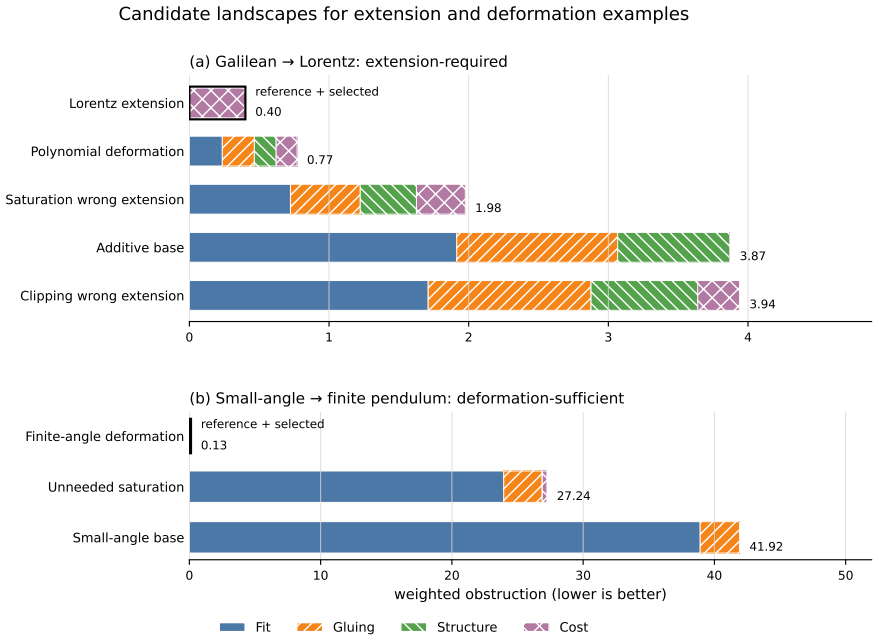
The central claim is that obstruction measures computed from residual fit, overlap incompatibility, constraint violation, limiting-relation failure, and representational cost allow direct ranking of transition candidates, with the intended deformation or extension emerging as the lowest-obstruction choice and transition type separated in the benchmark.
What carries the argument
Finite sheaf structure on contexts with source, overlap, target, and validation charts fitted, restricted, and tested for gluing; obstruction aggregates the five failure modes to rank transition candidates.
If this is right
- The intended deformation or extension ranks as the lowest-obstruction candidate on the controlled benchmark.
- Obstruction profiles distinguish deformation within a source language from extension of that language.
- A constellation kernel over the same signatures supplies a secondary representational-similarity probe.
Where Pith is reading between the lines
- The same obstruction-ranking procedure could monitor live AI learning to flag when representations require branching.
- Obstruction ideas might transfer to detecting incoherence across multiple agents sharing overlapping knowledge bases.
- Extending the charts dynamically could turn the diagnostic into an incremental update rule for ongoing agent operation.
Load-bearing premise
The five obstruction components can be defined and combined in a way that reliably separates deformation from extension without post-hoc tuning on the benchmark itself.
What would settle it
A new benchmark of transitions where the lowest-obstruction candidate is not the intended deformation or extension, or where the obstruction profiles fail to separate the two transition types.
Figures




read the original abstract
Scientific theory shift in AI agents requires more than fitting equations to data. An artificial scientific agent must detect whether an existing representational framework remains transportable into a new regime, or whether its language has become locally-to-globally obstructed and must be extended. This paper develops a finite sheaf-theoretic framework for detecting theory-shift candidates through transport and obstruction. Contexts are organized as a local-to-global structure in which source, overlap, target, and validation charts are fitted, restricted, and tested for gluing. Obstruction measures failure of coherence through residual fit, overlap incompatibility, constraint violation, limiting-relation failure, and representational cost. We evaluate the framework on a controlled transition-card benchmark designed to separate deformation within a source language from extension of that language. The main result is direct obstruction ranking: the intended deformation or extension is usually the lowest-obstruction candidate, and transition type is separated in the benchmark. A constellation kernel over the same signatures is included only as a secondary representational-similarity probe. The aim is not to reconstruct historical paradigm shifts or solve open-ended autonomous theory invention, but to isolate a finite diagnostic subproblem for AI agents: detecting when representational transport fails and extension becomes the coherent next move.
Editorial analysis
A structured set of objections, weighed in public.
Referee Report
Summary. The paper develops a finite sheaf-theoretic framework for detecting scientific theory shifts in AI agents. Contexts are structured as source, overlap, target, and validation charts that are fitted and tested for gluing; obstruction is measured via five components (residual fit, overlap incompatibility, constraint violation, limiting-relation failure, representational cost). On a controlled transition-card benchmark the central claim is that direct obstruction ranking identifies the intended deformation or extension as the lowest-obstruction candidate and separates transition types.
Significance. If the obstruction scores can be shown to be canonically extracted from the sheaf gluing data without benchmark-derived weights or post-hoc selection, the approach would supply a concrete, finite diagnostic for when an AI agent's representational language must be extended rather than merely deformed, addressing a recognized gap between fitting and genuine theory change.
major comments (3)
- [Abstract] Abstract: the five obstruction components are enumerated but no equations define how residual fit, overlap incompatibility, constraint violation, limiting-relation failure, or representational cost are computed from the source/overlap/target charts or how they are aggregated into a scalar ranking.
- [§4] §4 (benchmark evaluation): the reported separation result lacks error bars, statistical tests, or an explicit statement that the component weights and selection were fixed independently of the benchmark labels; without this the ranking may reduce to a fitted diagnostic.
- [§3] §3 (framework definition): the claim that obstruction is sheaf-theoretic requires an explicit derivation showing each component arises from local-to-global gluing failure rather than an ad-hoc linear combination; the current description leaves open the possibility that the measures presuppose the very transition labels they are meant to predict.
minor comments (2)
- [Abstract] The constellation kernel is introduced as a secondary probe; its precise relationship to the primary obstruction ranking and whether it uses the same charts should be stated explicitly.
- Pseudocode or an algorithmic description of the full obstruction computation pipeline would improve reproducibility.
Simulated Author's Rebuttal
We thank the referee for their constructive and detailed comments. We address each major point below and have revised the manuscript to improve clarity, rigor, and statistical presentation where the comments identify gaps.
read point-by-point responses
-
Referee: [Abstract] Abstract: the five obstruction components are enumerated but no equations define how residual fit, overlap incompatibility, constraint violation, limiting-relation failure, or representational cost are computed from the source/overlap/target charts or how they are aggregated into a scalar ranking.
Authors: We agree that the abstract would benefit from greater precision. In the revised manuscript we will insert concise defining expressions for each of the five components (residual fit as the L2 norm of the restriction mismatch, overlap incompatibility as the failure of the cocycle condition on pairwise restrictions, etc.) together with the weighted sum that produces the scalar obstruction score, with pointers to the full derivations in §3. revision: yes
-
Referee: [§4] §4 (benchmark evaluation): the reported separation result lacks error bars, statistical tests, or an explicit statement that the component weights and selection were fixed independently of the benchmark labels; without this the ranking may reduce to a fitted diagnostic.
Authors: We accept this criticism. The revised §4 will report standard errors or bootstrap confidence intervals for all separation metrics, include a non-parametric statistical test (Wilcoxon rank-sum) comparing obstruction ranks across transition types, and add an explicit paragraph stating that the five component weights were fixed a priori from the sheaf axioms and never tuned on the benchmark labels. revision: yes
-
Referee: [§3] §3 (framework definition): the claim that obstruction is sheaf-theoretic requires an explicit derivation showing each component arises from local-to-global gluing failure rather than an ad-hoc linear combination; the current description leaves open the possibility that the measures presuppose the very transition labels they are meant to predict.
Authors: We will expand §3 with a dedicated subsection that derives each obstruction term directly from the sheaf gluing axioms. Starting from the equalizer diagram for the source-overlap-target triple, we show that residual fit measures the failure of the restriction maps to equalize, overlap incompatibility quantifies the non-vanishing of the Čech 1-cocycle, and so on; the linear combination is therefore the canonical obstruction class in the first cohomology of the sheaf. The benchmark labels appear only in the validation step and play no role in the computation of the measures themselves. revision: yes
Circularity Check
No significant circularity detected
full rationale
The paper introduces a sheaf-theoretic framework for obstruction measures (residual fit, overlap incompatibility, constraint violation, limiting-relation failure, representational cost) and reports empirical ranking results on a controlled benchmark. No equations, self-citations, or derivations are quoted in the available text that reduce the obstruction ranking or transition separation to a fitted parameter or input by construction. The benchmark is presented as an external test of the framework rather than the source of its definitions, leaving the central claim independent of the evaluation data.
Axiom & Free-Parameter Ledger
free parameters (1)
- obstruction component weights
axioms (1)
- standard math Sheaf gluing condition: local sections on overlapping charts must agree on overlaps to define a global section.
Reference graph
Works this paper leans on
-
[1]
author Abramsky, S. , & author Brandenburger, A. ( year 2011 ). title The sheaf-theoretic structure of non-locality and contextuality . journal New Journal of Physics \/ , volume 13 \/ , pages 113036 . :10.1088/1367-2630/13/11/113036
-
[2]
author Ayzenberg, A. , author Gebhart, T. , author Magai, G. , & author Solomadin, G. ( year 2025 ). title Sheaf theory: from deep geometry to deep learning . arXiv:2502.15476 http://arxiv.org/abs/2502.15476
-
[3]
author Bodnar, C. , author Di Giovanni, F. , author Chamberlain, B. P. , author Li \`o , P. , & author Bronstein, M. M. ( year 2022 ). title Neural sheaf diffusion: A topological perspective on heterophily and oversmoothing in GNN s . In booktitle Advances in Neural Information Processing Systems \/ . volume volume 35
work page 2022
-
[4]
author Borgwardt, K. M. , & author Kriegel, H.-P. ( year 2005 ). title Shortest-path kernels on graphs . In booktitle Proceedings of the Fifth IEEE International Conference on Data Mining \/ (pp. pages 74--81 ). publisher IEEE . :10.1109/ICDM.2005.132
-
[5]
author Brunton, S. L. , author Proctor, J. L. , & author Kutz, J. N. ( year 2016 ). title Discovering governing equations from data by sparse identification of nonlinear dynamical systems . journal Proceedings of the National Academy of Sciences \/ , volume 113 \/ , pages 3932--3937 . :10.1073/pnas.1517384113
-
[6]
author Caramello, O. ( year 2018 ). title Theories, Sites, Toposes: Relating and Studying Mathematical Theories through Topos-Theoretic Bridges \/ . address Oxford : publisher Oxford University Press
work page 2018
-
[7]
author Chen, Z. , author Chen, S. , author Ning, Y. , author Zhang, Q. , author Wang, B. , author Yu, B. , author Li, Y. , author Liao, Z. , author Wei, C. , author Lu, Z. , author Dey, V. , author Xue, M. , author Baker, F. N. , author Burns, B. , author Adu-Ampratwum, D. , author Huang, X. , author Ning, X. , author Gao, S. , author Su, Y. , & author Su...
-
[8]
author Cranmer, M. , author Sanchez Gonzalez, A. , author Battaglia, P. , author Xu, R. , author Cranmer, K. , author Spergel, D. , & author Ho, S. ( year 2020 ). title Discovering symbolic models from deep learning with inductive biases . In booktitle Advances in Neural Information Processing Systems \/ (pp. pages 17429--17442 ). volume volume 33
work page 2020
-
[9]
author Curry, J. M. ( year 2014 ). title Sheaves, Cosheaves and Applications \/ . Ph.D. thesis University of Pennsylvania. note Available as arXiv:1303.3255
work page internal anchor Pith review Pith/arXiv arXiv 2014
-
[10]
editor Danks, D. , & editor Ippoliti, E. (Eds.) ( year 2018 ). title Building Theories: Heuristics and Hypotheses in Sciences \/ volume volume 41 of series Studies in Applied Philosophy, Epistemology and Rational Ethics \/ . address Cham : publisher Springer . :10.1007/978-3-319-72787-5
-
[11]
author Felber, S. , author Hummes Flores, B. , & author Rincon Galeana, H. ( year 2025 ). title A sheaf-theoretic characterization of tasks in distributed systems . arXiv:2503.02556 http://arxiv.org/abs/2503.02556
-
[12]
author Feynman, R. P. , author Leighton, R. B. , & author Sands, M. ( year 2011 ). title The Feynman Lectures on Physics \/ . ( edition The new millennium edition ed.). address New York : publisher Basic Books
work page 2011
-
[13]
author G \"a rdenfors, P. ( year 2000 ). title Conceptual Spaces: The Geometry of Thought \/ . address Cambridge, MA : publisher MIT Press
work page 2000
-
[14]
author G \"a rtner, T. , author Flach, P. , & author Wrobel, S. ( year 2003 ). title On graph kernels: Hardness results and efficient alternatives . In booktitle Learning Theory and Kernel Machines \/ (pp. pages 129--143 ). publisher Springer volume volume 2777 of series Lecture Notes in Computer Science \/ . :10.1007/978-3-540-45167-9_11
-
[15]
author Gebhart, T. , author Hansen, J. , & author Schrater, P. ( year 2023 ). title Knowledge sheaves: A sheaf-theoretic framework for knowledge graph embedding . In booktitle Proceedings of The 26th International Conference on Artificial Intelligence and Statistics \/ . publisher PMLR volume volume 206 of series Proceedings of Machine Learning Research \/
work page 2023
-
[16]
author Hansen, J. , & author Ghrist, R. ( year 2019 ). title Toward a spectral theory of cellular sheaves . journal Journal of Applied and Computational Topology \/ , volume 3 \/ , pages 315--358 . :10.1007/s41468-019-00038-7
-
[17]
author Hastie, T. , author Tibshirani, R. , & author Friedman, J. ( year 2009 ). title The Elements of Statistical Learning: Data Mining, Inference, and Prediction \/ . ( edition 2nd ed.). address New York : publisher Springer
work page 2009
-
[18]
author Haussler, D. ( year 1999 ). title Convolution Kernels on Discrete Structures \/ . type Technical Report number UCSC-CRL-99-10 University of California, Santa Cruz
work page 1999
-
[19]
author Hofmann, T. , author Sch \"o lkopf, B. , & author Smola, A. J. ( year 2008 ). title Kernel methods in machine learning . journal The Annals of Statistics \/ , volume 36 \/ , pages 1171--1220 . :10.1214/009053607000000677
-
[20]
author Jansen, P. , author C \^o t \'e , M.-A. , author Khot, T. , author Bransom, E. , author Dalvi Mishra, B. , author Majumder, B. P. , author Tafjord, O. , & author Clark, P. ( year 2024 ). title DiscoveryWorld : A virtual environment for developing and evaluating automated scientific discovery agents . In booktitle Advances in Neural Information Proc...
work page 2024
-
[21]
author Johnstone, P. T. ( year 2002 ). title Sketches of an Elephant: A Topos Theory Compendium \/ . address Oxford : publisher Oxford University Press
work page 2002
-
[22]
author Kuhn, T. S. ( year 1962 ). title The Structure of Scientific Revolutions \/ . address Chicago : publisher University of Chicago Press
work page 1962
-
[23]
author Langley, P. , author Simon, H. A. , author Bradshaw, G. L. , & author Zytkow, J. M. ( year 1987 ). title Scientific Discovery: Computational Explorations of the Creative Processes \/ . address Cambridge, MA : publisher MIT Press
work page 1987
-
[24]
author Lieto, A. , author Perrone, F. , author Pozzato, G. L. , & author Chiodino, E. ( year 2019 ). title Beyond subgoaling: A dynamic knowledge generation framework for creative problem solving in cognitive architectures . journal Cognitive Systems Research \/ , volume 58 \/ , pages 305--316 . :10.1016/j.cogsys.2019.08.005
-
[25]
The AI Scientist: Towards Fully Automated Open-Ended Scientific Discovery
author Lu, C. , author Lu, C. , author Lange, R. T. , author Foerster, J. , author Clune, J. , & author Ha, D. ( year 2024 ). title The AI scientist: Towards fully automated open-ended scientific discovery . journal arXiv preprint arXiv:2408.06292 \/ ,
work page internal anchor Pith review Pith/arXiv arXiv 2024
-
[26]
author Mac Lane, S. , & author Moerdijk, I. ( year 1992 ). title Sheaves in Geometry and Logic: A First Introduction to Topos Theory \/ . address New York : publisher Springer
work page 1992
-
[27]
author Majumder, B. P. , author Surana, H. , author Agarwal, D. , author Dalvi Mishra, B. , author Meena, A. , author Prakhar, A. , author Vora, T. , author Khot, T. , author Sabharwal, A. , & author Clark, P. ( year 2025 ). title DiscoveryBench : Towards data-driven discovery with large language models . In booktitle International Conference on Learning ...
-
[28]
author Matsubara, Y. , author Chiba, N. , author Igarashi, R. , & author Ushiku, Y. ( year 2022 ). title Rethinking symbolic regression datasets and benchmarks for scientific discovery . journal arXiv preprint arXiv:2206.10540 \/ , . arXiv:2206.10540 http://arxiv.org/abs/2206.10540
-
[29]
editor Morgan, M. S. , & editor Morrison, M. (Eds.) ( year 1999 ). title Models as Mediators: Perspectives on Natural and Social Science \/ . address Cambridge : publisher Cambridge University Press
work page 1999
-
[30]
author Nersessian, N. J. ( year 2008 ). title Creating Scientific Concepts \/ . address Cambridge, MA : publisher MIT Press
work page 2008
-
[31]
author Popper, K. R. ( year 1959 ). title The Logic of Scientific Discovery \/ . address London : publisher Hutchinson
work page 1959
-
[32]
author Robinson, M. ( year 2017 ). title Sheaves are the canonical data structure for sensor integration . journal Information Fusion \/ , volume 36 \/ , pages 208--224 . :10.1016/j.inffus.2016.12.002
-
[33]
author Romera-Paredes, B. , author Barekatain, M. , author Novikov, A. , author Balog, M. , author Kumar, M. P. , author Dupont, E. , author Ruiz, F. J. R. , author Ellenberg, J. S. , author Wang, P. , author Fawzi, O. , author Kohli, P. , & author Fawzi, A. ( year 2024 ). title Mathematical discoveries from program search with large language models . jou...
-
[34]
Science324(5923), 81–85 (2009).https://doi.org/10.1126/science.1165893
author Schmidt, M. , & author Lipson, H. ( year 2009 ). title Distilling free-form natural laws from experimental data . journal Science \/ , volume 324 \/ , pages 81--85 . :10.1126/science.1165893
-
[35]
author Sch \"o lkopf, B. , & author Smola, A. J. ( year 2002 ). title Learning with Kernels: Support Vector Machines, Regularization, Optimization, and Beyond \/ . address Cambridge, MA : publisher MIT Press
work page 2002
-
[36]
author Shawe-Taylor, J. , & author Cristianini, N. ( year 2004 ). title Kernel Methods for Pattern Analysis \/ . address Cambridge : publisher Cambridge University Press
work page 2004
-
[37]
author Shervashidze, N. , author Schweitzer, P. , author van Leeuwen, E. J. , author Mehlhorn, K. , & author Borgwardt, K. M. ( year 2011 ). title Weisfeiler--lehman graph kernels . journal Journal of Machine Learning Research \/ , volume 12 \/ , pages 2539--2561
work page 2011
-
[38]
author Stone, M. ( year 1974 ). title Cross-validatory choice and assessment of statistical predictions . journal Journal of the Royal Statistical Society: Series B \/ , volume 36 \/ , pages 111--147
work page 1974
-
[39]
author Sun, R. ( year 2009 ). title Theoretical status of computational cognitive modeling . journal Cognitive Systems Research \/ , volume 10 \/ , pages 124--140 . :10.1016/j.cogsys.2008.07.002
-
[40]
author Thagard, P. ( year 2012 ). title The Cognitive Science of Science: Explanation, Discovery, and Conceptual Change \/ . address Cambridge, MA : publisher MIT Press
work page 2012
-
[41]
Science Advances6(16), eaay2631 (2020).https: //doi.org/10.1126/sciadv.aay2631
author Udrescu, S.-M. , & author Tegmark, M. ( year 2020 ). title AI Feynman : A physics-inspired method for symbolic regression . journal Science Advances \/ , volume 6 \/ , pages eaay2631 . :10.1126/sciadv.aay2631
-
[42]
author Vishwanathan, S. V. N. , author Schraudolph, N. N. , author Kondor, R. , & author Borgwardt, K. M. ( year 2010 ). title Graph kernels . journal Journal of Machine Learning Research \/ , volume 11 \/ , pages 1201--1242
work page 2010
-
[43]
author Wang, R. , author Jansen, P. , author C \^o t \'e , M.-A. , & author Ammanabrolu, P. ( year 2022 ). title ScienceWorld : Is your agent smarter than a 5th grader? In booktitle Proceedings of the 2022 Conference on Empirical Methods in Natural Language Processing \/ (pp. pages 11279--11298 ). address Abu Dhabi, United Arab Emirates : publisher Associ...
discussion (0)
Sign in with ORCID, Apple, or X to comment. Anyone can read and Pith papers without signing in.