Recognition: 3 theorem links
· Lean TheoremImage Restoration via Diffusion Models with Dynamic Resolution
Pith reviewed 2026-05-15 02:50 UTC · model grok-4.3
The pith
Dynamic resolution diffusion models project images into lower-dimensional subspaces to speed up restoration.
A machine-rendered reading of the paper's core claim, the machinery that carries it, and where it could break.
Core claim
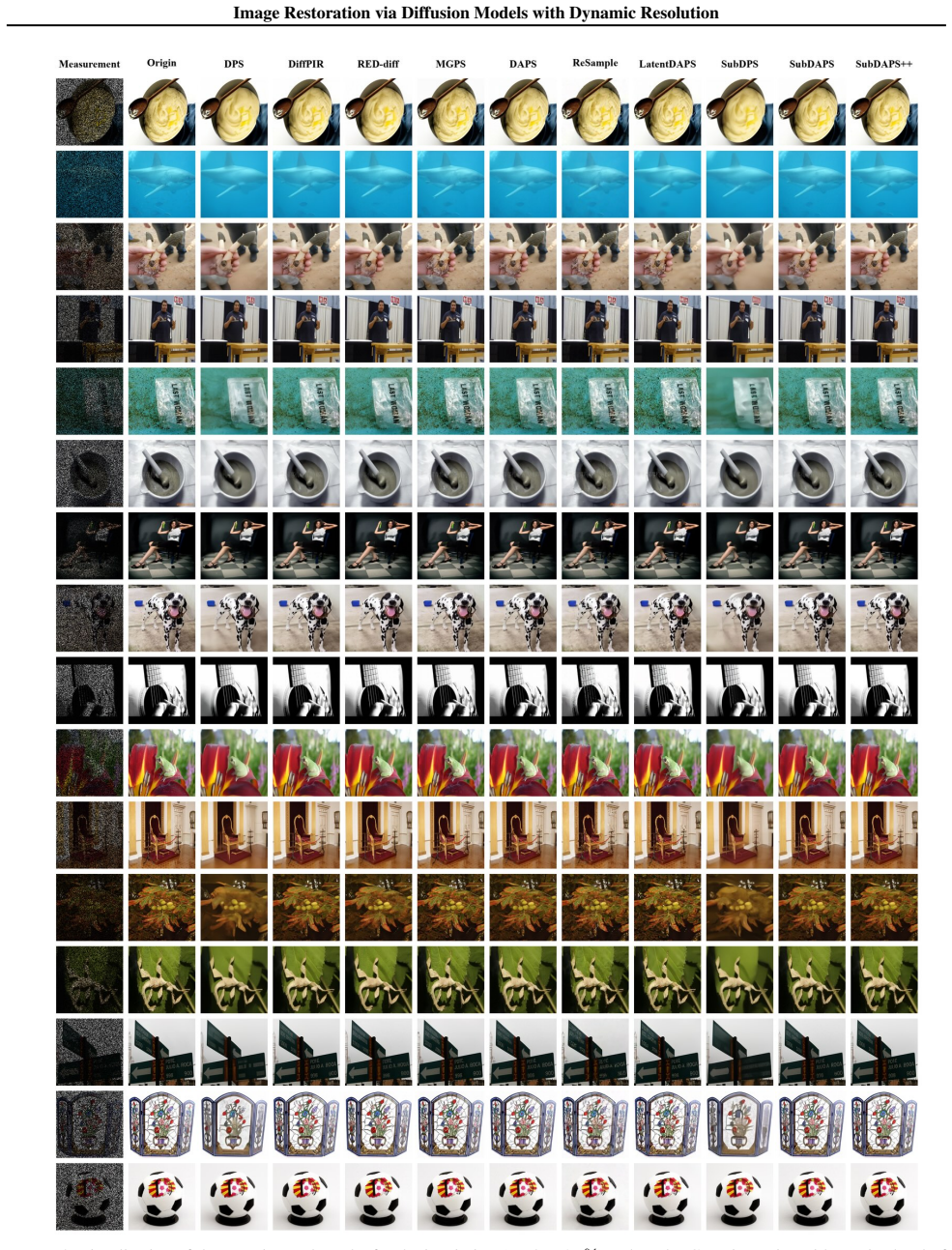
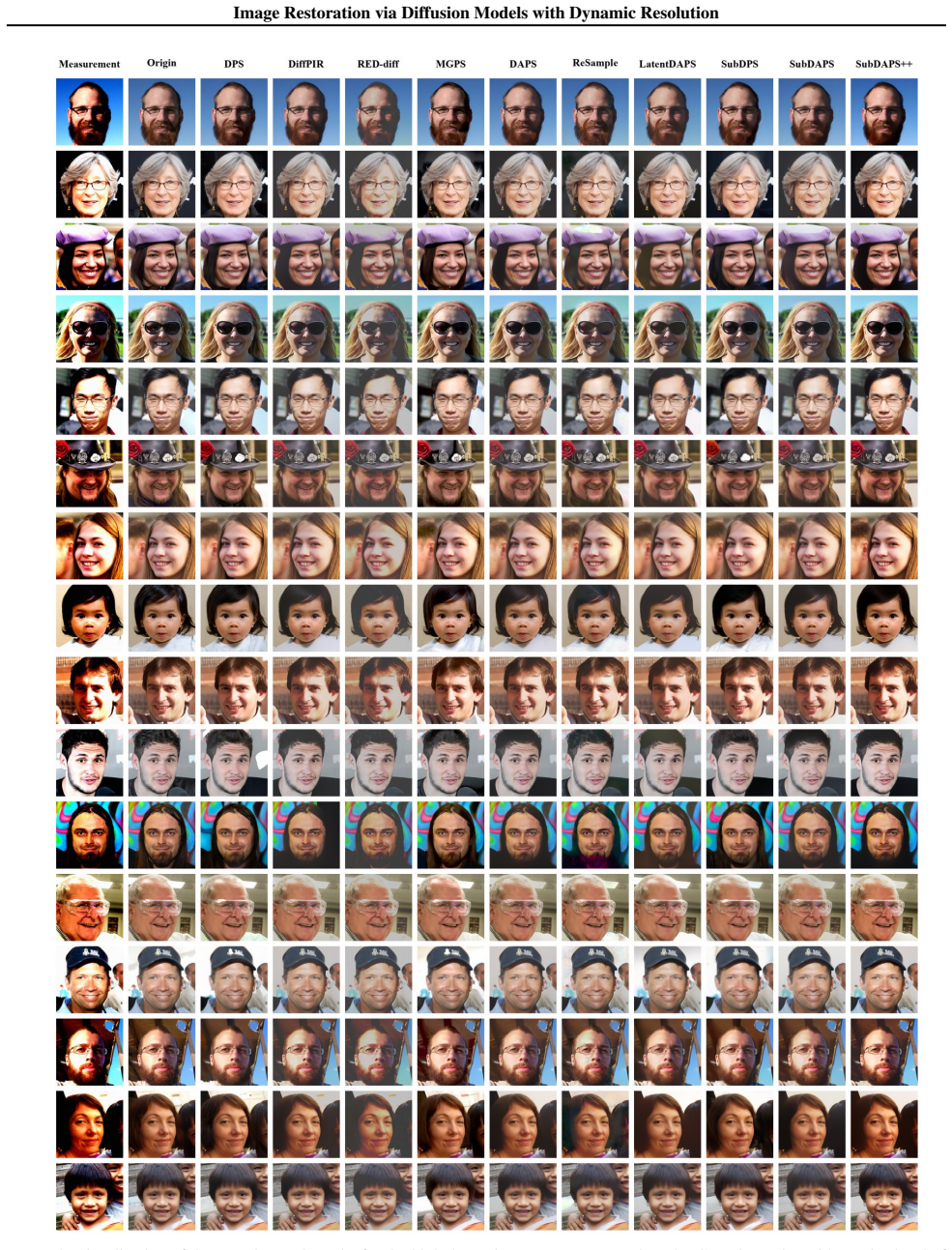
By fine-tuning pre-trained diffusion models for dynamic resolution priors, the work projects restoration problems into lower-dimensional subspaces, adapting DPS and DAPS to create SubDPS and SubDAPS, with SubDAPS++ further enhancing both speed and fidelity over recent diffusion-based approaches in most tested scenarios.
What carries the argument
Dynamic resolution priors from fine-tuned pre-trained diffusion models, which support subspace projection and the adapted restoration procedures SubDPS and SubDAPS.
If this is right
- SubDAPS and SubDAPS++ achieve faster inference than pixel-space methods while avoiding the extra encoder-decoder cost of latent diffusion approaches.
- The methods outperform recent DM-based approaches across the majority of tested datasets and restoration tasks.
- SubDAPS++ adds further gains in both efficiency and reconstruction quality over the base SubDAPS version.
- The framework applies to diverse image restoration problems without requiring full high-dimensional sampling at every step.
Where Pith is reading between the lines
- The subspace idea could transfer to other diffusion-based generative tasks such as editing or synthesis where speed matters.
- Reduced compute opens the door to running these models on edge hardware for near-real-time restoration.
- Combining dynamic resolution with other accelerations like sampling shortcuts might compound the efficiency gains.
- The method may scale to video restoration if temporal consistency can be maintained in the lower-dimensional space.
Load-bearing premise
Fine-tuning pre-trained diffusion models for dynamic resolution priors preserves sufficient information in the lower-dimensional subspaces to maintain reconstruction fidelity without introducing new artifacts.
What would settle it
Direct measurements showing that SubDAPS or SubDAPS++ produces lower PSNR, SSIM, or visibly worse details than standard DPS on the same deblurring or denoising benchmarks would disprove the claim of maintained or improved fidelity.
Figures




read the original abstract
Diffusion models (DMs) have exhibited remarkable efficacy in various image restoration tasks. However, existing approaches typically operate within the high-dimensional pixel space, resulting in high computational overhead. While methods based on latent DMs seek to alleviate this issue by utilizing the compressed latent space of a variational autoencoder, they require repeated encoder-decoder inference. This introduces significant additional computational burdens, often resulting in runtime performance that is even inferior to that of their pixel-space counterparts. To mitigate the computational inefficiency, this work proposes projecting data into lower-dimensional subspaces using dynamic resolution DMs to accelerate the inference process. We first fine-tune pre-trained DMs for dynamic resolution priors and adapt DPS and DAPS, which are two widely used pixel-space methods for general image restoration tasks, into the proposed framework, yielding methods we refer to as SubDPS and SubDAPS, respectively. Given the favorable inference speed and reconstruction fidelity of SubDAPS, we introduce an enhanced variant termed SubDAPS++ to further boost both reconstruction efficiency and quality. Empirical evaluations across diverse image datasets and various restoration tasks demonstrate that the proposed methods outperform recent DM-based approaches in the majority of experimental scenarios. The code is available at https://github.com/StarNextDay/SubDAPS.git.
Editorial analysis
A structured set of objections, weighed in public.
Referee Report
Summary. The manuscript proposes projecting images into lower-dimensional subspaces via dynamic resolution diffusion models to accelerate inference for image restoration tasks. Pre-trained DMs are fine-tuned to learn dynamic resolution priors; DPS and DAPS are then adapted into SubDPS and SubDAPS (with an enhanced SubDAPS++ variant). Experiments across multiple datasets and restoration tasks are reported to show outperformance versus recent DM-based methods in the majority of scenarios, with code released.
Significance. If the empirical gains hold after proper validation, the work would provide a practical route to lower the computational cost of diffusion-based restoration while preserving quality, addressing a clear limitation of pixel-space DMs. The public code release is a positive factor for reproducibility.
major comments (2)
- [Abstract and §5] Abstract and §5 (Experiments): the central claim of outperformance 'in the majority of experimental scenarios' lacks reported error bars, statistical significance tests, or ablations isolating the dynamic-resolution component from other implementation choices; without these the evidence remains moderate and the claim is not yet load-bearing.
- [§3] §3 (Method, dynamic-resolution fine-tuning and projection): no quantitative analysis, bounds, or ablation is given on information retention or high-frequency loss in the subspace projection after fine-tuning; this assumption is load-bearing for the fidelity claim yet untested.
minor comments (2)
- [§3] Notation for SubDAPS++ could be introduced more explicitly when first defined.
- [§5] Table captions should state the exact metrics and number of runs used.
Simulated Author's Rebuttal
We thank the referee for the constructive feedback. The comments highlight important aspects for strengthening the empirical support and methodological analysis, and we will revise the manuscript to address them.
read point-by-point responses
-
Referee: [Abstract and §5] Abstract and §5 (Experiments): the central claim of outperformance 'in the majority of experimental scenarios' lacks reported error bars, statistical significance tests, or ablations isolating the dynamic-resolution component from other implementation choices; without these the evidence remains moderate and the claim is not yet load-bearing.
Authors: We agree that additional statistical validation would make the outperformance claims more robust. In the revised manuscript we will report error bars (standard deviation over 3–5 random seeds) for all PSNR/SSIM/LPIPS numbers, include paired t-tests or Wilcoxon tests to assess statistical significance of the reported gains, and add an ablation that fixes the resolution schedule while varying only the dynamic-resolution fine-tuning and projection steps. These changes will isolate the contribution of the dynamic-resolution component. revision: yes
-
Referee: [§3] §3 (Method, dynamic-resolution fine-tuning and projection): no quantitative analysis, bounds, or ablation is given on information retention or high-frequency loss in the subspace projection after fine-tuning; this assumption is load-bearing for the fidelity claim yet untested.
Authors: We acknowledge that a direct quantitative assessment of information retention is currently missing. In the revised §3 we will add (i) a high-frequency retention metric obtained by wavelet decomposition (comparing energy in detail coefficients before and after projection), (ii) an ablation varying the subspace dimension while measuring both restoration quality and high-frequency loss, and (iii) a brief discussion of the observed loss and how the fine-tuning objective mitigates it for restoration tasks. These additions will directly test the load-bearing assumption. revision: yes
Circularity Check
No significant circularity; work is empirical adaptation of existing methods without self-referential derivations.
full rationale
The paper proposes projecting into lower-dimensional subspaces via dynamic resolution DMs, fine-tunes pre-trained models, and adapts DPS/DAPS into SubDPS/SubDAPS/SubDAPS++. All central claims rest on empirical evaluations across datasets rather than any derivation chain. No equations, parameters, or uniqueness results are shown to reduce by construction to fitted inputs, self-definitions, or self-citation load-bearing premises. The approach is self-contained against external benchmarks and does not invoke ansatzes or renamings that loop back to the paper's own inputs.
Axiom & Free-Parameter Ledger
axioms (1)
- domain assumption Pre-trained diffusion models can be fine-tuned for dynamic resolution priors while retaining generative capability for restoration tasks.
Lean theorems connected to this paper
-
IndisputableMonolith/Foundation/AbsoluteFloorClosure.leanreality_from_one_distinction unclear?
unclearRelation between the paper passage and the cited Recognition theorem.
projecting data into lower-dimensional subspaces using dynamic resolution DMs... fine-tune pre-trained DMs for dynamic resolution priors and adapt DPS and DAPS... yielding SubDPS and SubDAPS
-
IndisputableMonolith/Foundation/AlexanderDuality.leanalexander_duality_circle_linking unclear?
unclearRelation between the paper passage and the cited Recognition theorem.
G(x_t,t)=g(t)U_i U_i^T ... resolution increases from 64x64x3 to 128x128x3 to 256x256x3
-
IndisputableMonolith/Cost/FunctionalEquation.leanJ_uniquely_calibrated_via_higher_derivative unclear?
unclearRelation between the paper passage and the cited Recognition theorem.
SubDAPS++ ... conjugate gradient method ... threshold parameter τ
What do these tags mean?
- matches
- The paper's claim is directly supported by a theorem in the formal canon.
- supports
- The theorem supports part of the paper's argument, but the paper may add assumptions or extra steps.
- extends
- The paper goes beyond the formal theorem; the theorem is a base layer rather than the whole result.
- uses
- The paper appears to rely on the theorem as machinery.
- contradicts
- The paper's claim conflicts with a theorem or certificate in the canon.
- unclear
- Pith found a possible connection, but the passage is too broad, indirect, or ambiguous to say the theorem truly supports the claim.
Reference graph
Works this paper leans on
-
[1]
Agustsson, E. and Timofte, R. NTIRE 2017 challenge on single image super-resolution: Dataset and study. In CVPRW,
work page 2017
-
[2]
Chang, J., Duan, C., Jiao, Y ., Li, R., Yang, J. Z., and Yuan, C. Provable diffusion posterior sampling for Bayesian inversion.arXiv preprint arXiv:2512.08022,
-
[3]
Chen, H., Zhang, R., and Howard, S. S. DAPS++: Rethink- ing diffusion inverse problems with decoupled posterior annealing.arXiv preprint arXiv:2511.17038, 2025a. Chen, J., Ng, M. K., and Liu, Z. Solving quadratic systems with full-rank matrices using sparse or generative priors. IEEE Transactions on Signal Processing, 73:477–492, 2025b. Chung, H., Lee, E....
work page internal anchor Pith review Pith/arXiv arXiv
- [4]
-
[5]
Hen, L., Tirer, T., Giryes, R., and Abu-Hussein, S. Robust posterior diffusion-based sampling via adaptive guidance scale.arXiv preprint arXiv:2511.18471,
- [6]
- [7]
- [8]
-
[9]
Li, X., Kwon, S. M., Liang, S., Alkhouri, I. R., Ravishankar, S., and Qu, Q. Decoupled data consistency with diffu- sion purification for image restoration.arXiv preprint arXiv:2403.06054,
-
[10]
P., Kumar, A., Er- mon, S., and Poole, B
Song, Y ., Sohl-Dickstein, J., Kingma, D. P., Kumar, A., Er- mon, S., and Poole, B. Score-based generative modeling through stochastic differential equations. InICLR, 2021b. Sun, W., Li, J., and Liu, Z. Just-in-time: Training-free spatial acceleration for diffusion Transformers.arXiv preprint arXiv:2603.10744,
-
[11]
Training-free diffusion acceleration with bottleneck sampling.arXiv preprint arXiv:2503.18940,
Tian, Y ., Xia, X., Ren, Y ., Lin, S., Wang, X., Xiao, X., Tong, Y ., Yang, L., and Cui, B. Training-free diffusion acceleration with bottleneck sampling.arXiv preprint arXiv:2503.18940,
-
[12]
Zheng, S., Chen, G., He, L., Liu, J., Lin, Y ., Zou, C., and Zhang, L. From sketch to fresco: Efficient diffusion transformer with progressive resolution.arXiv preprint arXiv:2601.07462, 2026a. Zheng, Y ., Li, W., and Liu, Z. Integrating intermediate layer optimization and projected gradient descent for solving inverse problems with diffusion models. InICML,
-
[13]
Outlier-Robust Diffusion Solvers for Inverse Problems
Zheng, Y ., Li, W., and Liu, Z. Blind image deblurring with decoupled diffusion reversion. InICASSP, 2026b. Zheng, Y ., Li, W., and Liu, Z. Solving Poisson inverse problems with diffusion models via the plug-and-play scheme. InICASSP, 2026c. Zheng, Y ., Liu, J., Pang, T., Li, W., and Liu, Z. Outlier- robust diffusion solvers for inverse problems.arXiv pre...
work page internal anchor Pith review Pith/arXiv arXiv
-
[14]
12 Image Restoration via Diffusion Models with Dynamic Resolution Image Restoration via Dynamic Resolution Diffusion Prior Supplementary Material A. Detailed Architectural D‘iagram of SubDAPS++ We provide a detailed architectural diagram of the proposed SubDAPS++ framework to clarify how the dynamic resolution prior is integrated into the diffusion sampli...
work page 2022
-
[15]
are utilized with a known Gaussian-shaped kernel. All experimental configurations for linear and nonlinear tasks align with those established in prior studies (Chung et al., 2023; Wang et al., 2024; Zhang et al., 2025a). The hyperparameter configurations of SubDAPS++ for different tasks are detailed in Table
work page 2023
discussion (0)
Sign in with ORCID, Apple, or X to comment. Anyone can read and Pith papers without signing in.