Complete one-loop self-energies of the linear sigma model coupled to quarks at finite temperature and in a magnetic field
Pith reviewed 2026-06-30 20:44 UTC · model grok-4.3
The pith
One-loop self-energies for every field in the linear sigma model with quarks are derived at finite temperature and magnetic field strength.
A machine-rendered reading of the paper's core claim, the machinery that carries it, and where it could break.
Core claim
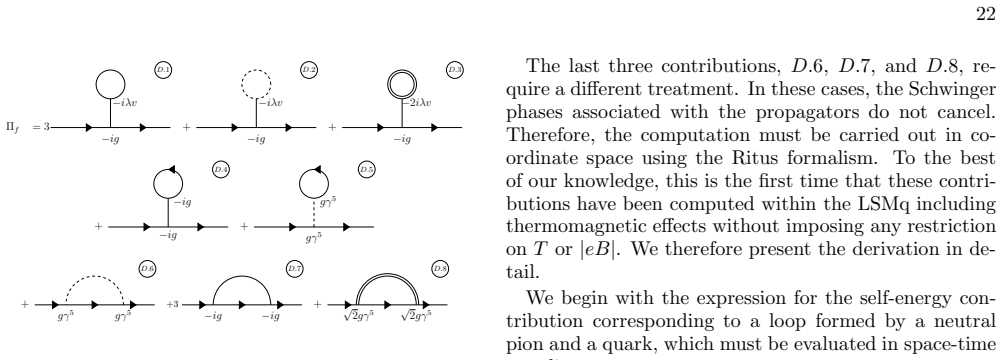
We present a complete calculation of the one-loop self-energies for all fields in the linear sigma model coupled to quarks at finite temperature and in the presence of a uniform magnetic field. The analysis consistently incorporates thermal and magnetic effects for both neutral and charged degrees of freedom, providing a unified framework valid for arbitrary values of the temperature and the field strength. The computation is performed using the Matsubara formalism to account for finite temperature effects and the Schwinger proper-time representation for charged propagators in a magnetic background. Special attention is given to loop contributions involving particles with different electric
What carries the argument
The full set of one-loop self-energies for scalar and quark fields, obtained by summing all diagrams while retaining the phase factors that arise when charged and neutral particles circulate in the same loop.
If this is right
- Ultraviolet divergences in the thermomagnetic corrections can be identified term by term.
- Vacuum pieces separate cleanly from temperature- and field-dependent pieces in every self-energy.
- The expressions supply a consistent starting point for studying effective models of QCD that include both temperature and magnetic field.
- Neutral and charged fields receive their corrections within the same calculational scheme.
Where Pith is reading between the lines
- The self-energies could be inserted into gap equations to locate possible shifts in the chiral transition line as the magnetic field grows.
- The separation of vacuum and matter pieces may simplify renormalization when these self-energies are used in higher-order calculations.
- The same loop structure could be reused for related models that also contain both charged mesons and quarks.
Load-bearing premise
The phase factors that appear when a loop contains particles of unequal electric charge can be evaluated in position space and then converted to momentum space without loss of consistency.
What would settle it
An explicit numerical mismatch between the derived self-energy expression for a charged scalar and an independent evaluation of the same diagram at a chosen nonzero temperature and magnetic field value.
Figures
read the original abstract
We present a complete calculation of the one-loop self-energies for all fields in the linear sigma model coupled to quarks at finite temperature and in the presence of a uniform magnetic field. The analysis consistently incorporates thermal and magnetic effects for both neutral and charged degrees of freedom, providing a unified framework valid for arbitrary values of the temperature and the field strength. The computation is performed using the Matsubara formalism to account for finite temperature effects and the Schwinger proper-time representation for charged propagators in a magnetic background. Special attention is given to loop contributions involving particles with different electric charges, for which the associated Schwinger phases do not cancel. We show that these terms can be systematically evaluated in coordinate space using the Ritus formalism, which provides the appropriate framework for treating external charged states in the presence of a magnetic background, and consistently expressed in momentum space. The resulting expressions exhibit a nontrivial interplay between thermal fluctuations and magnetic effects and allow for a clear separation between vacuum and matter contributions, providing a well-defined structure for the identification of ultraviolet divergences. Our results establish a consistent and systematic framework for the computation of thermomagnetic one-loop corrections in effective models of QCD, capturing the full interplay between thermal and magnetic effects for all dynamical degrees of freedom.
Editorial analysis
A structured set of objections, weighed in public.
Referee Report
Summary. The manuscript claims to deliver a complete one-loop calculation of the self-energies for all fields (including neutral and charged mesons and quarks) in the linear sigma model coupled to quarks, at arbitrary finite temperature T and magnetic field strength B. The computation employs the Matsubara formalism for thermal effects and the Schwinger proper-time representation for charged propagators; special emphasis is placed on loops involving particles of unequal electric charges, where Schwinger phases do not cancel, and these are evaluated in coordinate space via the Ritus formalism before conversion to momentum space, yielding expressions that separate vacuum and matter contributions while isolating UV divergences.
Significance. If the central technical step is executed correctly, the work supplies a unified, gauge-consistent framework for thermomagnetic one-loop corrections in an effective QCD model. This would be a useful reference for subsequent studies of chiral symmetry restoration, meson masses, and transport coefficients in strong magnetic fields at finite temperature. The paper does not ship machine-checked proofs or reproducible code, but the explicit separation of vacuum/matter pieces and the claim of a parameter-free derivation (in the sense of no ad-hoc fitting) would constitute a concrete technical advance if verified.
major comments (1)
- [Abstract and method description of Ritus formalism application] The central claim that non-cancelling Schwinger phases from mixed-charge loops can be systematically evaluated in coordinate space with the Ritus formalism and then converted to momentum space while preserving a clean vacuum/matter separation and identifiable UV divergences is load-bearing for the entire framework. No explicit intermediate identities, cancellation checks after Matsubara summation, or verification that the conversion introduces neither gauge artifacts nor spurious infrared terms are supplied in the manuscript. This directly affects the validity of the resulting self-energy expressions for both neutral and charged degrees of freedom at arbitrary T and B.
Simulated Author's Rebuttal
We thank the referee for the careful reading of our manuscript and the constructive feedback. We address the single major comment below.
read point-by-point responses
-
Referee: The central claim that non-cancelling Schwinger phases from mixed-charge loops can be systematically evaluated in coordinate space with the Ritus formalism and then converted to momentum space while preserving a clean vacuum/matter separation and identifiable UV divergences is load-bearing for the entire framework. No explicit intermediate identities, cancellation checks after Matsubara summation, or verification that the conversion introduces neither gauge artifacts nor spurious infrared terms are supplied in the manuscript. This directly affects the validity of the resulting self-energy expressions for both neutral and charged degrees of freedom at arbitrary T and B.
Authors: We agree that the absence of explicit intermediate identities and verification steps limits the transparency of the derivation. The manuscript presents the final self-energy expressions after applying the Ritus formalism in coordinate space and converting to momentum space, with separation into vacuum and matter parts, but does not display the intermediate cancellation checks or explicit gauge-invariance verifications. In the revised version we will add these details in the sections describing the mixed-charge loops (currently Sections 3.3 and 4), including sample identities after Matsubara summation and explicit checks confirming the absence of gauge artifacts and spurious IR terms. These additions will not change the reported expressions or conclusions. revision: yes
Circularity Check
No circularity: direct perturbative computation using established formalisms
full rationale
The paper performs an explicit one-loop calculation of self-energies via Matsubara sums and Schwinger proper-time propagators, with coordinate-space evaluation of non-cancelling Schwinger phases converted to momentum space via the Ritus formalism. No parameters are fitted to subsets of data and then relabeled as predictions; no result is defined in terms of itself; no uniqueness theorem or ansatz is imported solely via self-citation; and no known empirical pattern is merely renamed. The central expressions are obtained by direct integration of the loop integrals under the stated assumptions, making the derivation chain independent of its own outputs.
Axiom & Free-Parameter Ledger
axioms (3)
- standard math Matsubara formalism correctly sums over thermal modes at finite temperature
- standard math Schwinger proper-time representation gives the correct propagator for charged particles in a constant magnetic field
- domain assumption Ritus formalism provides the appropriate basis for treating external charged states when Schwinger phases do not cancel
Reference graph
Works this paper leans on
-
[1]
+ eB 2 x1]2 |eB| } , ∫ dy1e { i ( − |eB| 4 (y1)2+y1[(p1 2− p1 1)− eB 2 x2] )} = √ 4π |eB|exp { − [ (p1 2 − p1
-
[2]
(105) We substitute the expressions in Eq
− eB 2 x2]2 |eB| } , e− (p1 2 − p1 1)2 |eB| ∫ dx2e { − |eB| 2 (x2)2+x2 [ eB(p1 2− p1 1) |eB| +i(p2 1− p2 2) ]} = √ 2π |eB|e− (p1 2− p1 1)2 |eB| e { 2 |eB| [ eB(p1 2 − p1 1) |eB| +i(p2 1− p2 2) ]2 } , e− (p2 2 − p2 1)2 |eB| ∫ dx1e { − |eB| 2 (x1)2+x1 [ i(p1 1− p1 2)− eB(p2 2 − p2 1) |eB| ]} = √ 2π |eB|e− (p2 2− p2 1)2 |eB| e { 2 |eB| [ i(p1 1− p1 2)− eB(p2...
-
[3]
(126) Since Eq
− 1 ) (−i) q+1e− iqϕ 0 q +n − (k1 1 − k2 1) ( ei2π (q+n− (k1 1− k2 1)) − 1 )∫ ∞ 0 dr r(k1 1 − k2 1)+1e− |qu B|r2 4 ×Lk1 1− k2 1 k2 1 (|quB|r 2 ) Jq ( r √ (p1 2 − p1 1)2 + (p2 2 − p2 1)2 ) ∫ ∞ 0 dr′r′(k1 2 − k2 2)+1e− |quB|r′2 4 Lk1 2− k2 2 k2 2 (|quB|r′ 2 ) ×Jm ( r′ √ (p1 2 − p1 1)2 + (p2 2 − p2 1)2 ) Jn ((qu − qd)Brr ′ 2 ) ×δ(2)(k1∥ +p1∥ − p2∥)δ(2)(p2∥ −...
-
[4]
+γ 3p3 1 ) + /p2⊥ cos(|qfB|s) ] . (166) For the integrals over p2⊥ , we use the following results ∫ d2p2⊥e − (p2⊥ )2 |qf B| [ i tan(|qf B|s)+1 ] e 2p2⊥ ·p1⊥ |qf B| = |qfB|π i tan(|qfB|s) + 1e p2 1⊥ |qf B|J, ∫ d2p2⊥ p2⊥e − (p2⊥ )2 |qf B| [i tan(|qf B|s)+1] e 2p2⊥ ·p1⊥ |qf B| = p1⊥ |qfB|π (i tan(|qfB|s) + 1)2e p2 1⊥ |qf B|J, (167) 27 and we obtain −iΠ (D. 6...
-
[5]
(168) We now rewrite the neutral pion propagator in the Schwinger prope r time representation and get −iΠ (D
+γ 3p3 1 ) + 1 i tan(|qfB|s) + 1 γ 1p1 1 +γ 2p2 1 cos(|qfB|s) ] . (168) We now rewrite the neutral pion propagator in the Schwinger prope r time representation and get −iΠ (D. 6) f =g2(2π ) ∫ ∞ 0 ds cos(|qfB|s) ∫ d4p1 (2π )4 ∫ ∞ 0 ds′eis′ ( p2 1− m2 π +iǫ ) e (p1⊥ )2 |qf B| ( 1 i tan(|qf B|s)+1 − 1 ) eis ( (p0 1+k0 1)2− (p3 1)2− m2 f +iǫ ) × ( 1 i tan(|qf...
-
[6]
(169) We now compute the integrals over p1⊥ and p3
+γ 3p3 1 ) + 1 i tan(|qfB|s) + 1 γ 1p1 1 +γ 2p2 1 cos(|qfB|s) ] . (169) We now compute the integrals over p1⊥ and p3
-
[7]
6 becomes −iΠ (D
For this purpose, we use ∫ dp3 1 e− i(p3 1)2(s+s′) = √ π i(s +s′), ∫ dp1⊥e − p2 1⊥ [ 1 |qf B| (1− 1 i tan(|qf B|s)+1 )+is′ ] = π 1 |qf B|(1 − 1 i tan(|qf B|s)+1 ) +is′, ∫ dp1⊥ p1⊥e − p2 1⊥ [ 1 |qf B| (1− 1 i tan(|qf B|s)+1 )+is′ ] = ∫ dp3 1 p3 1 e− (p3 1)2(s+s′) = 0, (170) and the contribution D. 6 becomes −iΠ (D. 6) f =g2 4π ∫ ∞ 0 ds cos(|qfB|s) ∫ ∞ 0 ds...
-
[8]
+ e′B 2 x1]2 |qf ′B| } , ∫ dy1e i ( i |qf ′ B| 4 (y1)2+y1 [ (p1 2− p1 1)− e′B 2 x2 ]) = √ 4π |qf ′B|exp { − [ (p1 1 − p1
-
[9]
Therefore, after a straightforward algebra, the expression for D
− e′B 2 x2]2 |qf ′B| } , e − (p1 1 − p1 2)2 |qf ′ B| ∫ dx2e − (x2 )2 4 ( |qf ′ B|+ (e′B)2 |qf ′ B| ) e x2 [ e′B |qf ′ B| (p1 1− p1 2)+i(p2 2− p2 1) ] = √ 4π Me − (p1 1 − p1 2)2 |qf ′ B| e 1 M [ e′B |qf ′ B| (p1 1− p1 2)+i(p2 2− p2 1) ]2 , e − (p2 1 − p2 2)2 |qf ′ B| ∫ dx1e − (x1 )2 4 ( |qf ′ B|+ (e′B)2 |qf ′ B| ) e x2 [ i(p1 2− p1 1)− e′B |qf ′ B| (p2 1− ...
-
[10]
+γ 3p3 1 ) + /p2⊥ cos(|qfB|s′) ] × ∫ ∞ 0 ds cos(|eB|s)eis ( p2 1∥− p2 1⊥ tan(|eB|s) |eB|s − m2 π +iǫ ) e − (p1 1− p1 2 )2 |qf ′ B| e − (p2 1 − p2 2)2 |qf ′ B| e − ( 1+ (e′B)2 |qf ′ B|2 ) M [ (p1 2− p1 1)2+(p2 2− p2 1)2 ] . (195) We then integrate over the perpendicular components, using ∫ d2p2⊥e − ip2 2⊥ tan(|qf B|s) |qf B| e− Q(p2⊥ − p1⊥ )2 = π |qfB||qf ...
-
[11]
+γ 3p3 1 ) + 2|qfB| 2|qfB|+i|qf ′B|tan(|qfB|s′) (γ 1p1 1 +γ 2p2 1)γ 1p1 1 +γ 2p2 1 cos(|qfB|s′) ] . (198) We proceed to compute the integrals over p1⊥ and p3 1, for which we use ∫ d2p1⊥e − p2 2⊥ [ 2i tan(|qf B|s′) 2|qf B|+i|qf ′ B| tan(|qf B|s′) +i tan(|eB|s′) |eB| ] = π Z, ∫ dp3 1e− i(p3 1)2(s+s′) = √ π i(s +s′), ∫ d2p1⊥ /p1⊥ e − p2 1⊥ [ Q− Q2 R +i tan(|...
2025
-
[12]
Estimate of the magnetic field strength in heavy-ion collisions
V. Skokov, A. Y. Illarionov, and V. Toneev, Estimate of the magnetic field strength in heavy-ion collisions, Int. J. Mod. Phys. A 24, 5925 (2009), arXiv:0907.1396 [nucl-th]
work page internal anchor Pith review Pith/arXiv arXiv 2009
- [13]
- [14]
-
[15]
W. C. G. Ho, Evolution of a buried magnetic field in the central compact object neutron stars, Mon. Not. Roy. Astron. Soc. 414, 2567 (2011), arXiv:1102.4870 [astro- ph.HE]
work page internal anchor Pith review Pith/arXiv arXiv 2011
-
[16]
M. E. Gusakov, E. M. Kantor, and D. D. Ofengeim, On the evolution of magnetic field in neutron stars, Phys. Rev. D 96, 103012 (2017), arXiv:1705.00508 [astro- ph.HE]
work page internal anchor Pith review Pith/arXiv arXiv 2017
- [17]
-
[18]
D. Grasso and H. R. Rubinstein, Magnetic fields in the early universe, Phys. Rept. 348, 163 (2001), arXiv:astro- ph/0009061
-
[19]
Magnetic fields in the early universe
K. Subramanian, Magnetic fields in the early universe, Astron. Nachr. 331, 110 (2010), arXiv:0911.4771 [astro- ph.CO]
work page internal anchor Pith review Pith/arXiv arXiv 2010
-
[20]
Adhikari et al
P. Adhikari et al. , Strongly interacting matter in extreme magnetic fields, Prog. Part. Nucl. Phys. , 104199 (2025)
2025
-
[21]
K. Hattori, K. Itakura, and S. Ozaki, Strong-field physics in QED and QCD: From fundamentals to ap- plications, Prog. Part. Nucl. Phys. 133, 104068 (2023), arXiv:2305.03865 [hep-ph]
-
[22]
QCD Phase Transition in a Strong Magnetic Background
M. D’Elia, S. Mukherjee, and F. Sanfilippo, QCD Phase Transition in a Strong Magnetic Background, Phys. Rev. D 82, 051501 (2010), arXiv:1005.5365 [hep-lat]
work page internal anchor Pith review Pith/arXiv arXiv 2010
-
[23]
G. S. Bali, F. Bruckmann, G. Endrodi, Z. Fodor, S. D. Katz, S. Krieg, A. Schafer, and K. K. Szabo, The QCD phase diagram for external magnetic fields, JHEP 02, 044, arXiv:1111.4956 [hep-lat]
work page internal anchor Pith review Pith/arXiv arXiv
-
[24]
G. S. Bali, F. Bruckmann, G. Endrodi, Z. Fodor, S. D. Katz, and A. Schafer, QCD quark condensate in exter- nal magnetic fields, Phys. Rev. D 86, 071502 (2012), arXiv:1206.4205 [hep-lat]
work page internal anchor Pith review Pith/arXiv arXiv 2012
-
[25]
G. S. Bali, F. Bruckmann, G. Endr¨ odi, S. D. Katz, and A. Sch¨ afer, The QCD equation of state in background magnetic fields, JHEP 08, 177, arXiv:1406.0269 [hep-lat]
work page internal anchor Pith review Pith/arXiv arXiv
-
[26]
Critical point in the QCD phase diagram for extremely strong background magnetic fields
G. Endrodi, Critical point in the QCD phase diagram for extremely strong background magnetic fields, JHEP 07, 173, arXiv:1504.08280 [hep-lat]
work page internal anchor Pith review Pith/arXiv arXiv
- [27]
-
[28]
G. Endrodi, QCD with background electromagnetic fields on the lattice: A review, Prog. Part. Nucl. Phys. 141, 104153 (2025), arXiv:2406.19780 [hep-lat]
-
[29]
A. J. Mizher, M. N. Chernodub, and E. S. Fraga, Phase diagram of hot QCD in an external magnetic field: pos- sible splitting of deconfinement and chiral transitions, Phys. Rev. D 82, 105016 (2010), arXiv:1004.2712 [hep- ph]
work page internal anchor Pith review Pith/arXiv arXiv 2010
-
[30]
E. S. Fraga, J. Noronha, and L. F. Palhares, Large Nc Deconfinement Transition in the Presence of a Magnetic Field, Phys. Rev. D 87, 114014 (2013), arXiv:1207.7094 [hep-ph]
work page internal anchor Pith review Pith/arXiv arXiv 2013
-
[31]
J. O. Andersen, W. R. Naylor, and A. Tranberg, Phase diagram of QCD in a magnetic field: A review, Rev. Mod. Phys. 88, 025001 (2016), arXiv:1411.7176 [hep-ph]
work page internal anchor Pith review Pith/arXiv arXiv 2016
-
[32]
Inverse magnetic catalysis in the linear sigma model with quarks
A. Ayala, M. Loewe, and R. Zamora, Inverse magnetic catalysis in the linear sigma model with quarks, Phys. Rev. D 91, 016002 (2015), arXiv:1406.7408 [hep-ph]
work page internal anchor Pith review Pith/arXiv arXiv 2015
-
[33]
The magnetized effective QCD phase diagram
A. Ayala, C. A. Dominguez, L. A. Hernandez, M. Loewe, and R. Zamora, Magnetized effective QCD phase di- agram, Phys. Rev. D 92, 096011 (2015), [Addendum: Phys.Rev.D 92, 119905 (2015)], arXiv:1509.03345 [hep- ph]
work page internal anchor Pith review Pith/arXiv arXiv 2015
-
[34]
V. P. Pagura, D. Gomez Dumm, S. Noguera, and N. N. Scoccola, Magnetic catalysis and inverse magnetic catal- ysis in nonlocal chiral quark models, Phys. Rev. D 95, 034013 (2017), arXiv:1609.02025 [hep-ph]
work page internal anchor Pith review Pith/arXiv arXiv 2017
-
[35]
A. Bandyopadhyay and R. L. S. Farias, Inverse magnetic catalysis: how much do we know about?, Eur. Phys. J. ST 230, 719 (2021), arXiv:2003.11054 [hep-ph]
- [36]
-
[37]
A. Ayala, L. A. Hern´ andez, M. Loewe, and C. Villav- icencio, QCD phase diagram in a magnetized medium from the chiral symmetry perspective: the linear sigma model with quarks and the Nambu–Jona-Lasinio model effective descriptions, Eur. Phys. J. A 57, 234 (2021), arXiv:2104.05854 [hep-ph]
-
[38]
J. Moreira, P. Costa, and T. E. Restrepo, Phase dia- gram for strongly interacting matter in the presence of a magnetic field using the Polyakov–Nambu–Jona-Lasinio model with magnetic field dependent coupling strengths, Eur. Phys. J. A 57, 123 (2021), arXiv:2101.12004 [hep- ph]
- [39]
-
[40]
G. Cao, Recent progresses on QCD phases in a strong magnetic field: views from Nambu–Jona-Lasinio model, Eur. Phys. J. A 57, 264 (2021), arXiv:2103.00456 [hep- ph]
- [41]
- [42]
-
[43]
G. Fern´ andez, L. A. Hern´ andez, and A. Mizher, Inverse magnetic catalysis in the linear sigma model: a be- yond mean field approach, J. Phys. G 53, 035001 (2026), arXiv:2510.02747 [hep-ph]
-
[44]
A. V. Zayakin, QCD Vacuum Properties in a Magnetic Field from AdS/CFT: Chiral Condensate and Goldstone Mass, JHEP 07, 116, arXiv:0807.2917 [hep-th]
work page internal anchor Pith review Pith/arXiv arXiv
-
[45]
V. G. Filev, C. V. Johnson, and J. P. Shock, Universal Holographic Chiral Dynamics in an External Magnetic Field, JHEP 08, 013, arXiv:0903.5345 [hep-th]
work page internal anchor Pith review Pith/arXiv arXiv
-
[46]
The QCD phase diagram from Schwinger-Dyson Equations
E. Gutierrez, A. Ahmad, A. Ayala, A. Bashir, and A. Raya, The QCD phase diagram from Schwinger–Dyson equations, J. Phys. G 41, 075002 (2014), arXiv:1304.8065 [hep-ph]
work page internal anchor Pith review Pith/arXiv arXiv 2014
-
[47]
D. M. Rodrigues, E. Folco Capossoli, and H. Boschi- Filho, Deconfinement phase transition in a magnetic field in 2 + 1 dimensions from holographic models, Phys. Lett. B 780, 37 (2018), arXiv:1709.09258 [hep-th]
work page internal anchor Pith review Pith/arXiv arXiv 2018
-
[48]
A. Ballon-Bayona, J. P. Shock, and D. Zoakos, Magnetic catalysis and the chiral condensate in holographic QCD, JHEP 10, 193, arXiv:2005.00500 [hep-th]
-
[49]
Gursoy, Holographic QCD and magnetic fields, Eur
U. Gursoy, Holographic QCD and magnetic fields, Eur. Phys. J. A 57, 247 (2021), arXiv:2104.02839 [hep-th]
- [50]
- [51]
-
[52]
M. A. Andreichikov, B. O. Kerbikov, V. D. Orlovsky, and Y. A. Simonov, Meson Spectrum in Strong Magnetic Fields, Phys. Rev. D 87, 094029 (2013), arXiv:1304.2533 [hep-ph]
work page internal anchor Pith review Pith/arXiv arXiv 2013
-
[53]
C. S. Machado, S. I. Finazzo, R. D. Matheus, and J. Noronha, Modification of the B Meson Mass in a Magnetic Field from QCD Sum Rules, Phys. Rev. D 89, 074027 (2014), arXiv:1307.1797 [hep-ph]
work page internal anchor Pith review Pith/arXiv arXiv 2014
-
[54]
Dynamical quark mass generation in a strong external magnetic field
N. Mueller, J. A. Bonnet, and C. S. Fischer, Dynami- cal quark mass generation in a strong external magnetic field, Phys. Rev. D 89, 094023 (2014), arXiv:1401.1647 [hep-ph]
work page internal anchor Pith review Pith/arXiv arXiv 2014
-
[55]
H. Liu, L. Yu, and M. Huang, Charged and neutral vector ρ mesons in a magnetic field, Phys. Rev. D 91, 014017 (2015), arXiv:1408.1318 [hep-ph]
work page internal anchor Pith review Pith/arXiv arXiv 2015
-
[56]
M. Loewe and R. Zamora, Renormalons in a scalar self- interacting theory: Thermal, thermomagnetic, and ther- moelectric corrections for all values of the temperature, Phys. Rev. D 105, 076011 (2022), arXiv:2202.08873 [hep- ph]
- [57]
-
[58]
Hadron Masses in Strong Magnetic Fields
H. Taya, Hadron Masses in Strong Magnetic Fields, Phys. Rev. D 92, 014038 (2015), arXiv:1412.6877 [hep-ph]
work page internal anchor Pith review Pith/arXiv arXiv 2015
-
[59]
Y. A. Simonov, Pion decay constants in a strong magnetic field, Phys. Atom. Nucl. 79, 455 (2016), arXiv:1503.06616 [hep-ph]
work page internal anchor Pith review Pith/arXiv arXiv 2016
-
[60]
P. Gubler, K. Hattori, S. H. Lee, M. Oka, S. Ozaki, and K. Suzuki, D mesons in a magnetic field, Phys. Rev. D 93, 054026 (2016), arXiv:1512.08864 [hep-ph]
work page internal anchor Pith review Pith/arXiv arXiv 2016
-
[61]
Mesons in strong magnetic fields: (I) General analyses
K. Hattori, T. Kojo, and N. Su, Mesons in strong mag- netic fields: (I) General analyses, Nucl. Phys. A 951, 1 39 (2016), arXiv:1512.07361 [hep-ph]
work page internal anchor Pith review Pith/arXiv arXiv 2016
-
[62]
Heavy meson spectroscopy under strong magnetic field
T. Yoshida and K. Suzuki, Heavy meson spectroscopy under strong magnetic field, Phys. Rev. D 94, 074043 (2016), arXiv:1607.04935 [hep-ph]
work page internal anchor Pith review Pith/arXiv arXiv 2016
-
[63]
Properties of Mesons in a Strong Magnetic Field
R. Zhang, W.-j. Fu, and Y.-x. Liu, Properties of Mesons in a Strong Magnetic Field, Eur. Phys. J. C 76, 307 (2016), arXiv:1604.08888 [hep-ph]
work page internal anchor Pith review Pith/arXiv arXiv 2016
-
[64]
Thermo-magnetic properties of the strong coupling in the local Nambu--Jona-Lasinio model
A. Ayala, C. A. Dominguez, L. A. Hernandez, M. Loewe, A. Raya, J. C. Rojas, and C. Villavicencio, Thermo- magnetic properties of the strong coupling in the local Nambu–Jona-Lasinio model, Phys. Rev. D 94, 054019 (2016), arXiv:1603.00833 [hep-ph]
work page internal anchor Pith review Pith/arXiv arXiv 2016
-
[65]
Spectral properties of $\rho$ meson in a magnetic field
S. Ghosh, A. Mukherjee, M. Mandal, S. Sarkar, and P. Roy, Spectral properties of ρ meson in a magnetic field, Phys. Rev. D 94, 094043 (2016), arXiv:1612.02966 [nucl- th]
work page internal anchor Pith review Pith/arXiv arXiv 2016
-
[66]
G. S. Bali, B. B. Brandt, G. Endr˝ odi, and B. Gl¨ aßle, Meson masses in electromagnetic fields with Wil- son fermions, Phys. Rev. D 97, 034505 (2018), arXiv:1707.05600 [hep-lat]
work page internal anchor Pith review Pith/arXiv arXiv 2018
-
[67]
Thermal effects on $\rho$ meson properties in an external magnetic field
S. Ghosh, A. Mukherjee, M. Mandal, S. Sarkar, and P. Roy, Thermal effects on ρ meson properties in an ex- ternal magnetic field, Phys. Rev. D 96, 116020 (2017), arXiv:1704.05319 [hep-ph]
work page internal anchor Pith review Pith/arXiv arXiv 2017
-
[68]
M. Coppola, D. G´ omez Dumm, and N. N. Scoc- cola, Charged pion masses under strong magnetic fields in the NJL model, Phys. Lett. B 782, 155 (2018), arXiv:1802.08041 [hep-ph]
-
[69]
H. Liu, X. Wang, L. Yu, and M. Huang, Neutral and charged scalar mesons, pseudoscalar mesons, and di- quarks in magnetic fields, Phys. Rev. D 97, 076008 (2018), arXiv:1801.02174 [hep-ph]
work page internal anchor Pith review Pith/arXiv arXiv 2018
-
[70]
R. M. Aguirre, In medium properties of K 0 and φ mesons under an external magnetic field, Eur. Phys. J. A 55, 28 (2019), arXiv:1808.04404 [nucl-th]
work page internal anchor Pith review Pith/arXiv arXiv 2019
-
[71]
A. Ayala, R. L. S. Farias, S. Hern´ andez-Ortiz, L. A. Hern´ andez, D. M. Paret, and R. Zamora, Magnetic field- dependence of the neutral pion mass in the linear sigma model coupled to quarks: The weak field case, Phys. Rev. D 98, 114008 (2018), arXiv:1809.08312 [hep-ph]
work page internal anchor Pith review Pith/arXiv arXiv 2018
-
[72]
S. S. Avancini, R. L. S. Farias, and W. R. Tavares, Neutral meson properties in hot and magnetized quark matter: a new magnetic field independent regularization scheme applied to NJL-type model, Phys. Rev. D 99, 056009 (2019), arXiv:1812.00945 [hep-ph]
work page internal anchor Pith review Pith/arXiv arXiv 2019
- [73]
- [74]
- [75]
- [76]
-
[77]
A. Ayala, R. L. S. Farias, L. A. Hern´ andez, A. J. Mizher, J. Rend´ on, C. Villavicencio, and R. Zamora, Magnetic field dependence of the neutral pion longitudinal screen- ing mass in the linear sigma model with quarks, Phys. Rev. D 109, 074019 (2024), arXiv:2311.13068 [hep-ph]
- [78]
- [79]
-
[80]
A. Ayala, J. D. Castano-Yepes, C. A. Dominguez, L. A. Hernandez, S. Hernandez-Ortiz, and M. E. Tejeda- Yeomans, Prompt photon yield and elliptic flow from gluon fusion induced by magnetic fields in relativistic heavy-ion collisions, Phys. Rev. D 96, 014023 (2017), [Er- ratum: Phys.Rev.D 96, 119901 (2017)], arXiv:1704.02433 [hep-ph]
work page internal anchor Pith review Pith/arXiv arXiv 2017
discussion (0)
Sign in with ORCID, Apple, or X to comment. Anyone can read and Pith papers without signing in.