Parametrization of the primordial power spectrum in loop quantum cosmology
Pith reviewed 2026-06-30 20:48 UTC · model grok-4.3
The pith
A parametrization of the primordial power spectrum in loop quantum cosmology adds dependence on bounce e-folds and suppression scale set by bounce energy density.
A machine-rendered reading of the paper's core claim, the machinery that carries it, and where it could break.
Core claim
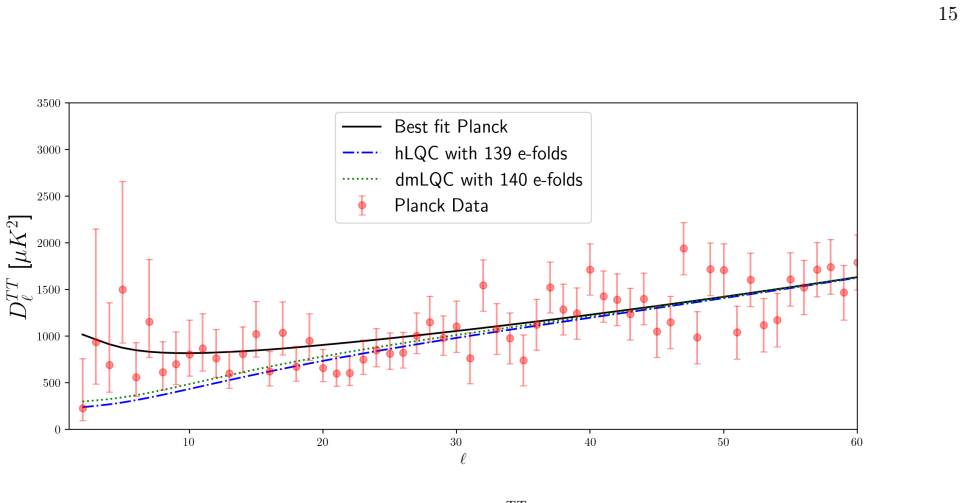
We derive a new parametrization of the primordial power spectrum at the end of the inflationary regime that depends on slow-roll coefficients and cosmological parameters plus the number of e-folds during the bounce epoch and a characteristic suppression scale determined by the energy density at the bounce. With the NO-AHD vacuum the tensor-to-scalar ratio in both the hybrid and dressed metric approaches coincides with its expression in the standard ΛCDM model when the observed scales are not much smaller than the power-suppressed region. For a total cosmic expansion of about 140 e-folds both approaches exhibit excellent agreement with Planck data at high multipoles while apparently improving
What carries the argument
The new parametrization of the primordial power spectrum that encodes pre-inflationary physics through the bounce e-folds and the suppression scale fixed by bounce energy density.
If this is right
- The tensor-to-scalar ratio matches its standard ΛCDM expression for observed scales not much smaller than the suppressed region.
- Both the hybrid and dressed metric approaches produce equivalent results for the tensor-to-scalar ratio under the chosen vacuum.
- For a total of about 140 e-folds the angular power spectra agree with Planck data at high multipoles.
- The same total expansion yields an apparent improvement over ΛCDM at low multipoles.
- The parametrization remains robust because it depends only on pre-inflationary quantities once slow-roll and cosmological parameters are fixed.
Where Pith is reading between the lines
- Future CMB experiments with improved low-multipole sensitivity could test whether the reported improvement persists or is an artifact of the specific vacuum choice.
- If the suppression scale inferred from data aligns with the LQG bounce density, it would indirectly constrain the Immirzi parameter and area gap without direct Planck-scale measurements.
- The same parametrization form could be applied to other bounce models in quantum cosmology to compare their predicted low-multipole behavior.
- Absence of the expected suppression in high-precision polarization data at the relevant scales would require either more e-folds or a different vacuum prescription.
Load-bearing premise
The NO-AHD vacuum is the appropriate choice because it selects a state optimally adapted to the background dynamics and produces a non-oscillatory spectrum.
What would settle it
Detection of oscillatory features in the low-multipole angular power spectrum at the scales corresponding to the bounce suppression would contradict the reported agreement obtained with the NO-AHD vacuum.
Figures
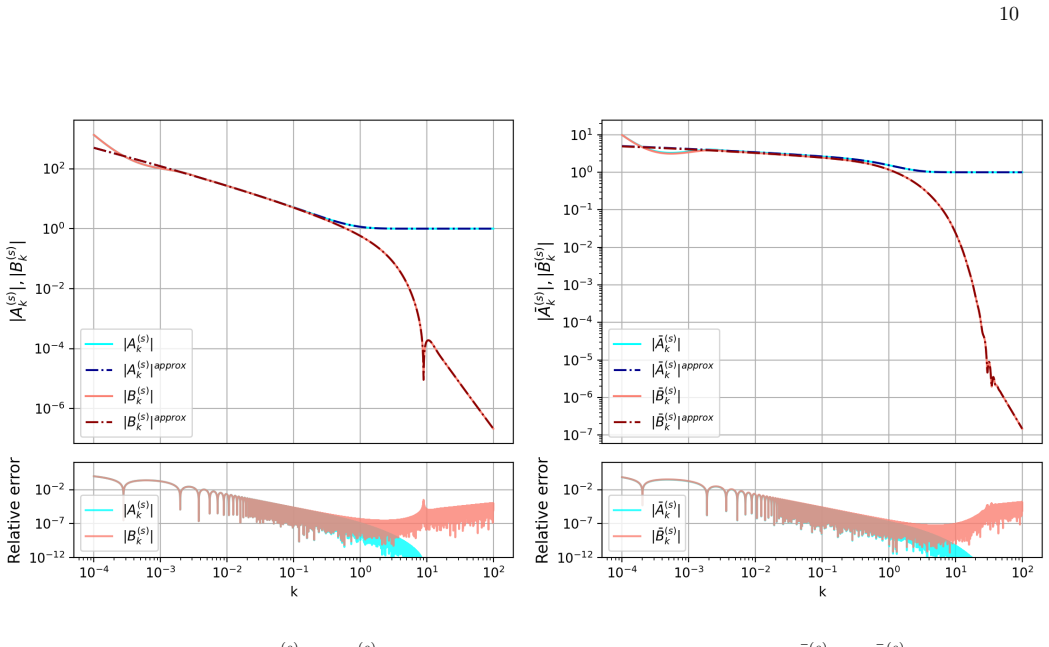
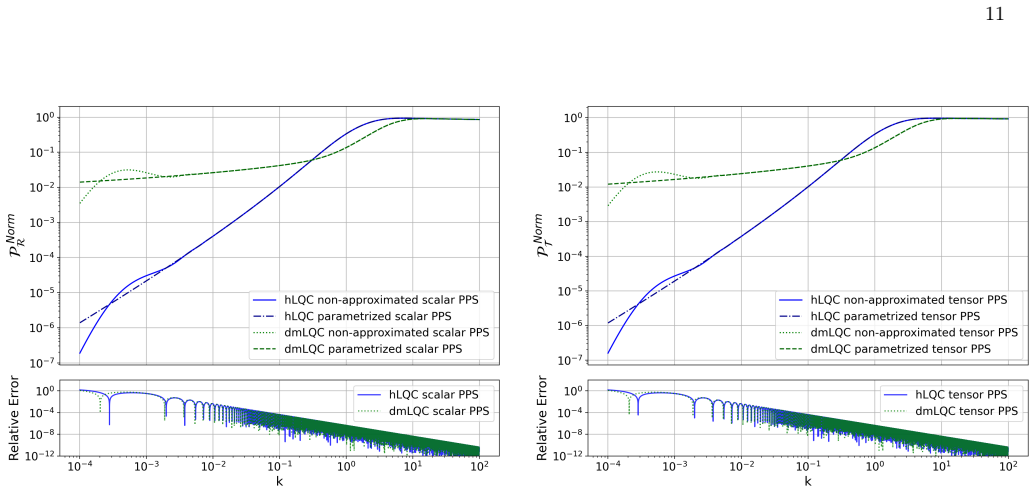
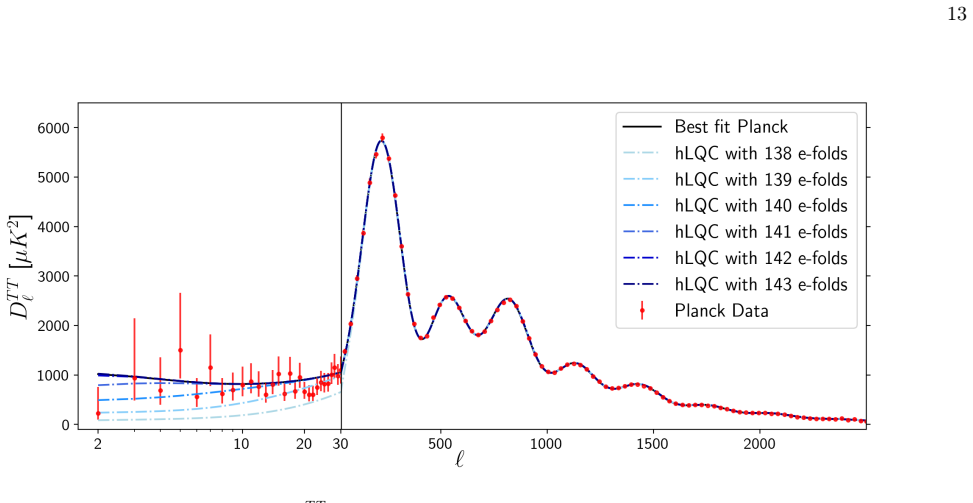
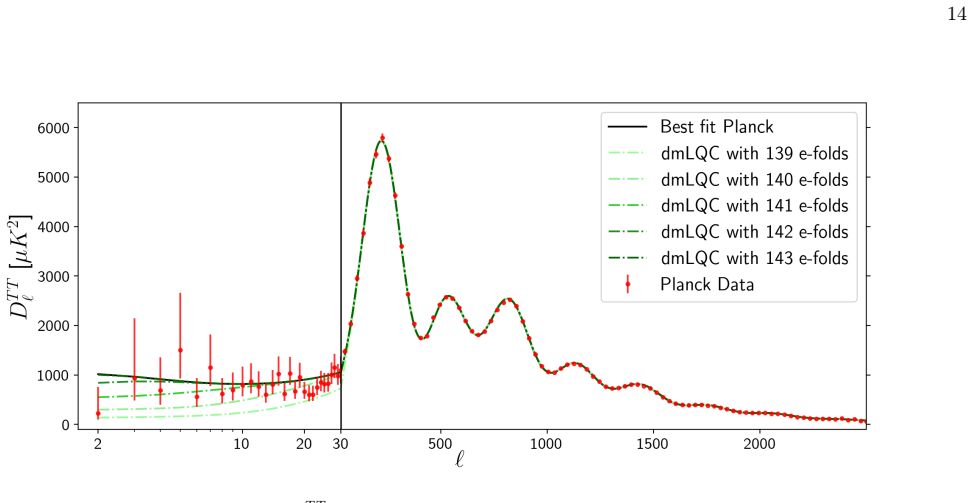
read the original abstract
We investigate the imprints on the angular power spectra of cosmological perturbations of a pre-inflationary bounce phase, as described by the hybrid and dressed metric approaches to loop quantum cosmology. For this purpose, we derive a new parametrization of the primordial power spectrum at the end of the inflationary regime. Apart from slow-roll coefficients and cosmological parameters that are present in the standard cosmological scenario without quantum modifications, this parametrization additionally depends only on pre-inflationary physics. More specifically, we find a dependence on the number of e-folds during the bounce epoch and on a characteristic suppression scale which, given the e-folds accumulated during cosmic evolution, is determined by the energy density at the bounce. Recall that this density depends on the Immirzi parameter and the area gap known from LQG. This leads to a robust and accurate parametrization of the primordial power spectrum. Since in pre-inflationary scenarios there is no preferred vacuum state, we adopt the NO-AHD proposal, which selects a vacuum that is optimally adapted to the background dynamics and yields a non-oscillatory primordial power spectrum. With this choice, we show that the tensor-to-scalar ratio in both quantization approaches coincides with its expression in the standard $\Lambda$CDM model when the observed scales are not much smaller than the power-suppressed region. Computing also the angular power spectrum, we find that, for a total cosmic expansion of about 140 e-folds, both the hybrid and the dressed metric approaches exhibit excellent agreement with Planck data at high multipoles, while apparently improving the fit with respect to $\Lambda$CDM for low multipole numbers.
Editorial analysis
A structured set of objections, weighed in public.
Referee Report
Summary. The manuscript derives a parametrization of the primordial power spectrum at the end of inflation in loop quantum cosmology, using both the hybrid and dressed metric approaches to incorporate a pre-inflationary bounce. Apart from standard slow-roll and cosmological parameters, the form depends on the number of e-folds during the bounce epoch and a suppression scale fixed by the bounce energy density (set by the Immirzi parameter and area gap). Adopting the NO-AHD vacuum (chosen for background adaptation and non-oscillatory output), the paper shows that the tensor-to-scalar ratio coincides with the standard ΛCDM expression when observed scales are not much smaller than the suppressed region, and that for a total expansion of ~140 e-folds both approaches agree well with Planck data at high multipoles while appearing to improve the low-multipole fit.
Significance. If the explicit functional form and its derivation are robust, and the reported agreement holds without fine-tuning of the total e-fold count, the work would supply a concrete, observationally testable link between LQC bounce dynamics and CMB observables, extending standard slow-roll predictions in a controlled way.
major comments (1)
- [Abstract] The central claim of Planck agreement at high multipoles and improvement at low multipoles is presented for a total of ~140 e-folds; however, the abstract and claim description indicate this specific total expansion is selected to achieve the reported fit, while the suppression scale is stated to be independently fixed by the bounce density. This raises a load-bearing question of whether the low-multipole improvement is a genuine prediction or an artifact of the e-fold choice (see abstract and the paragraph on vacuum selection).
minor comments (1)
- [Abstract] The abstract states that the parametrization 'additionally depends only on pre-inflationary physics' yet lists dependence on the number of e-folds during the bounce epoch; an explicit functional form or derivation steps would clarify whether this is fully determined by LQG parameters or retains free parameters.
Simulated Author's Rebuttal
We thank the referee for the careful reading of our manuscript and the constructive feedback. We address the major comment below.
read point-by-point responses
-
Referee: [Abstract] The central claim of Planck agreement at high multipoles and improvement at low multipoles is presented for a total of ~140 e-folds; however, the abstract and claim description indicate this specific total expansion is selected to achieve the reported fit, while the suppression scale is stated to be independently fixed by the bounce density. This raises a load-bearing question of whether the low-multipole improvement is a genuine prediction or an artifact of the e-fold choice (see abstract and the paragraph on vacuum selection).
Authors: We agree that the specific value of approximately 140 e-folds is chosen to position the suppression scale such that it can affect the low-multipole region of the CMB spectrum. This total expansion is a representative value motivated by the requirement to solve the horizon and flatness problems in a manner consistent with standard slow-roll inflation, while allowing pre-inflationary LQC effects to remain potentially observable. The suppression scale is fixed by the bounce energy density (set by the Immirzi parameter and area gap), but the mapping of this scale to comoving wavenumbers and thus to multipoles depends on the total post-bounce expansion. We will revise the abstract and the relevant discussion (including the paragraph on vacuum selection) to clarify that the reported agreement and apparent improvement constitute a demonstration for this representative choice, and that the parametrization is general: different total e-fold values simply shift the multipole range where suppression appears. This makes the low-multipole feature a testable prediction of the model rather than an arbitrary artifact. The NO-AHD vacuum is selected independently for its background adaptation and non-oscillatory properties. revision: yes
Circularity Check
No significant circularity; derivation self-contained with external LQG inputs
full rationale
The paper derives a parametrization of the primordial power spectrum from the hybrid and dressed metric LQC approaches. It depends on slow-roll coefficients, standard cosmological parameters, bounce e-folds, and a suppression scale fixed by the bounce energy density (itself set by Immirzi parameter and area gap from LQG). The NO-AHD vacuum is adopted explicitly for its adaptation to background dynamics and non-oscillatory output; this is a deliberate selection criterion, not a self-definition. The tensor-to-scalar ratio coincidence with ΛCDM is stated to hold under the condition that observed scales are not much smaller than the suppressed region. The ~140 e-fold total expansion is presented as a specific value yielding Planck agreement at high multipoles (with apparent low-multipole improvement), but this is a parameter choice within the model rather than a fitted input renamed as a forced prediction. No equation reduces by construction to its inputs, no load-bearing self-citation chain is quoted, and the central results remain independent of the target data. The derivation is self-contained against the stated LQG benchmarks.
Axiom & Free-Parameter Ledger
free parameters (2)
- number of e-folds during bounce epoch
- suppression scale
axioms (2)
- domain assumption NO-AHD vacuum proposal selects a state optimally adapted to the background dynamics and produces a non-oscillatory spectrum
- domain assumption Total cosmic expansion of about 140 e-folds
Reference graph
Works this paper leans on
-
[1]
First, the scalar and tensor masses coincide with their counterparts in GR when the quantum corrections to the background are switched off
Hybrid approach In the case of the hybrid approach to the quantization of primordial perturbations within LQC, the background- dependent masses of the tensor and scalar perturbations,s(t) ands (s) respectively, are given by [23, 41] s(t) =− 4π 3 a2(ρ−3P), s (s) =s (t) +U,U=a 2 V,ϕϕ + 48πV+ 6 a′ϕ′ a3ρ V,ϕ − 48π ρ V 2 .(2.9) Two important points should be n...
-
[2]
Dressed metric approach In the case of the dressed metric approach to the quantization of tensor and scalar perturbations within LQC, the background-dependent masses for the tensor and scalar perturbations,¯s(t) and¯s(s), are given by [41] ¯s(t) =− 4π 3 a2ρ 1 + 2 ρ ρc + 4πa2P 1−2 ρ ρc =− a′′ a ,¯s (s) = ¯s(t) +V,(2.11) where we have used the second identi...
-
[3]
As mentioned in Sec
Hybrid approach In this Appendix, we summarize the most important details of the analytic solution to the mode equations in the hybrid approach. As mentioned in Sec. IIB1, during the bounce period an analytic solution to these equations is not known for the exact background-dependent mass (2.11). For this reason, an approximation to this mass is necessary...
-
[4]
2F1 1 6 , 1 2; 3 2; 1−a 6 0 , bk 3 = 1−i k k0 p a6 0 −1 3a2 0 arcosh(a2
-
[5]
2F1 1 6 , 1 2; 3 2; 1−a 6 0 .(A3) Here, we have used thatρc = 3k2 0a4 0/(8π)and the expressions of the conformal time, the scale factor, and the parameter αin the hybrid approach. During the purely kinetic period, the general solution to the mode equations is [45] µ(t,s) k =C k r πy 4 H(1) 0 (ky) +D k r πy 4 H(2) 0 (ky),(A4) 8 In the dressed metric case,k...
-
[6]
Dressed metric approach For the dressed metric approach, during the bounce period we can obtain an analytic solution to the mode equations usingasimilarPöschl-Tellerapproximationbutaddingaconstant, asinEq. (2.13). Thecorrespondinggeneralsolution is ¯µ(t,s) k = ¯Mk [¯x(1−¯x)]− i¯k 2¯α 2F1 ¯b ¯k 1,¯b ¯k 2,¯b ¯k 3; ¯x + ¯Nk ¯x 1−¯x i¯k 2¯α 2F1 ¯b ¯k 1 − ¯b ¯...
-
[7]
In this way, different approximations for individual periods can be tested efficiently using an abstract code for the computations
Transformation matrix method Starting with the general solution to the mode equations in each of the considered periods, expressed as a linear combination of two independent solutions that we know analytically, and recalling the requirement of continuity up to the first derivative at the matching points between those periods, a useful method to calculate ...
-
[8]
Penzias and R.W
A.A. Penzias and R.W. Wilson, A measurement of excess antenna temperature at 4080 Mc/s, ApJ142, 419 (1964)
1964
-
[9]
Bennettet al., Nine-year Wilkinson Microwave Anisotropy Probe (WMAP) observations: Final maps and results, ApJS208, 20 (2013)
C.L. Bennettet al., Nine-year Wilkinson Microwave Anisotropy Probe (WMAP) observations: Final maps and results, ApJS208, 20 (2013)
2013
-
[10]
Aghanimet al.(Planck Collaboration), Planck 2018 results
N. Aghanimet al.(Planck Collaboration), Planck 2018 results. I. Overview and the cosmological legacy of Planck, A&A 641, A1 (2020)
2018
-
[11]
Aghanimet al.(Planck Collaboration), Planck 2018 results
N. Aghanimet al.(Planck Collaboration), Planck 2018 results. I. VI. Cosmological parameters, A&A641, A6 (2020)
2018
-
[12]
Akramiet al.(Planck Collaboration), Planck 2018 results
Y. Akramiet al.(Planck Collaboration), Planck 2018 results. X. Constraints on inflation, A&A641, A10 (2020)
2018
-
[13]
Wrightet al., KiDS-Legacy: Cosmological constraints from cosmic shear with the complete Kilo-Degree Survey, A&A 703, A158 (2025)
A.H. Wrightet al., KiDS-Legacy: Cosmological constraints from cosmic shear with the complete Kilo-Degree Survey, A&A 703, A158 (2025)
2025
-
[14]
Abbottet al.(DES Collaboration), Dark Energy Survey year 3 results: Cosmological constraints from galaxy clustering and weak lensing, Phys
T.M.C. Abbottet al.(DES Collaboration), Dark Energy Survey year 3 results: Cosmological constraints from galaxy clustering and weak lensing, Phys. Rev. D105, 023520 (2022)
2022
-
[15]
Ashtekar, B
A. Ashtekar, B. Gupt, D. Jeong, and V. Sreenath, Alleviating the tension in the cosmic microwave background using Planck-scale physics, Phys. Rev. Lett.125, 051302 (2020)
2020
-
[16]
Ashtekar, B
A. Ashtekar, B. Gupt, and V. Sreenath, Cosmic tango between the very small and the very large: Addressing CMB anomalies through loop quantum cosmology, Front. Astron. Space Sci.8, 685288 (2021)
2021
-
[17]
Agullo, D
I. Agullo, D. Kranas, and V. Sreenath, Large scale anomalies in the CMB and non-Gaussianity in bouncing cosmologies, Class. Quantum Grav.38, 065010 (2021)
2021
-
[18]
Agullo, D
I. Agullo, D. Kranas, and V. Sreenath, Anomalies in the cosmic microwave background and their non-Gaussian origin in loop quantum cosmology, Front. Astron. Space Sci.8, 703845 (2021)
2021
-
[19]
Tsujikawa, P
S. Tsujikawa, P. Singh, and R. Maartens, Loop quantum gravity effects on inflation and the CMB, Class. Quantum Grav. 21, 5767 (2004)
2004
-
[20]
Iqbal, J
A. Iqbal, J. Prasad, T. Souradeep, and M.A. Manzoor, Joint Planck and WMAP assessment of low CMB multipoles, JCAP 06, 014 (2015). 21
2015
-
[21]
Santos da Costa, M
S. Santos da Costa, M. Benetti, and J. Alcaniz, A Bayesian analysis of inflationary primordial spectrum models using Planck data, JCAP03, 004 (2018)
2018
-
[22]
Melia, Q
F. Melia, Q. Ma, and M. Lopez-Corredoira, Evidence of a truncated spectrum in the angular correlation function of the cosmic microwave background, A&A610, A87 (2018)
2018
-
[23]
Melia, Q
F. Melia, Q. Ma, J.J. Wei, and B. Yu, Hint of a truncated primordial spectrum from the CMB large-scale anomalies, A&A 655, A70 (2021)
2021
-
[24]
Ashtekar and J
A. Ashtekar and J. Lewandowski, Background independent quantum gravity: A status report, Class. Quantum Grav.21, R53 (2004)
2004
-
[25]
Thiemann,Modern Canonical Quantum General Relativity(Cambridge University Press, Cambridge, England, 2007)
T. Thiemann,Modern Canonical Quantum General Relativity(Cambridge University Press, Cambridge, England, 2007)
2007
-
[26]
Ashtekar and P
A. Ashtekar and P. Singh, Loop quantum cosmology: A status report, Class. Quantum Grav.28, 213001 (2011)
2011
-
[27]
Ashtekar, T
A. Ashtekar, T. Pawłowski, and P. Singh, Quantum nature of the big bang, Phys. Rev. Lett.96, 141301 (2006)
2006
-
[28]
Ashtekar, T
A. Ashtekar, T. Pawłowski, and P. Singh, Quantum nature of the big bang: Improved dynamics, Phys. Rev. D74, 084003 (2006)
2006
-
[29]
Agullo, A
I. Agullo, A. Wang, and E. Wilson-Ewing, Loop quantum cosmology: Relation between theory and observations, in Handbook of Quantum Gravity, edited by C. Bambi, L. Modesto, and I. Shapiro (Springer Nature, Singapore, 2024), pp. 4039–4084
2024
-
[30]
Elizaga Navascués and G.A
B. Elizaga Navascués and G.A. Mena Marugán, Hybrid loop quantum cosmology: An overview, Front. Astron. Space Sci. 8, 624824 (2021)
2021
-
[31]
Agullo, A
I. Agullo, A. Ashtekar, and W. Nelson, A quantum gravity extension of the inflationary scenario, Phys. Rev. Lett.109, 251301 (2012)
2012
-
[32]
Agullo, A
I. Agullo, A. Ashtekar, and W. Nelson, Extension of the quantum theory of cosmological perturbations to the Planck era, Phys. Rev. D87, 043507 (2013)
2013
-
[33]
Fernández-Méndez, G.A
M. Fernández-Méndez, G.A. Mena Marugán, and J. Olmedo, Hybrid quantization of an inflationary universe, Phys. Rev. D86, 024003 (2012)
2012
-
[34]
Bojowald, G
M. Bojowald, G. Calcagni, and S. Tsujikawa, Observational constraints on loop quantum cosmology, Phys. Rev. Lett.107, 211302 (2011)
2011
-
[35]
Quantum Grav.29, 085005 (2012)
E.Wilson-Ewing, Holonomy corrections in the effective equations for scalar mode perturbations in loop quantum cosmology, Class. Quantum Grav.29, 085005 (2012)
2012
-
[36]
Cailleteau, L
T. Cailleteau, L. Linsefors, and A. Barreau, Anomaly-free perturbations with inverse-volume and holonomy corrections in loop quantum cosmology, Class. Quantum Grav.31, 125011 (2014)
2014
-
[37]
Bolliet, J
B. Bolliet, J. Grain, C. Stahl, L. Linsefors, and A. Barrau, Comparison of primordial tensor power spectra from the deformed algebra and dressed metric approaches in loop quantum cosmology, Phys. Rev. D91, 084035 (2015)
2015
-
[38]
Castelló Gomar, G.A
L. Castelló Gomar, G.A. Mena Marugán, D. Martín de Blas, and J. Olmedo, Hybrid loop quantum cosmology and predictions for the cosmic microwave background, Phys. Rev. D96, 103528 (2017)
2017
-
[39]
Fernández-Méndez, G.A
M. Fernández-Méndez, G.A. Mena Marugán, and J. Olmedo, Hybrid quantization of an inflationary model: The flat case, Phys. Rev. D88, 044013 (2013)
2013
-
[40]
Benítez Martínez and J
F. Benítez Martínez and J. Olmedo, Primordial tensor modes of the early universe, Phys. Rev. D93, 124008 (2016)
2016
-
[41]
Agullo, A
I. Agullo, A. Ashtekar, and W. Nelson, The pre-inflationary dynamics of loop quantum cosmology: Confronting quantum gravity with observations, Class. Quantum Grav.30, 085014 (2013)
2013
-
[42]
Agullo and N.A
I. Agullo and N.A. Morris, Detailed analysis of the predictions of loop quantum cosmology for the primordial power spectra, Phys. Rev. D92, 124040 (2015)
2015
-
[43]
Agullo, W
I. Agullo, W. Nelson, and A. Ashtekar, Preferred instantaneous vacuum for linear scalar fields in cosmological space-times, Phys. Rev. D91, 064051 (2015)
2015
-
[44]
Mukhanov, Quantum theory of gauge-invariant cosmological perturbations, Zh
V. Mukhanov, Quantum theory of gauge-invariant cosmological perturbations, Zh. Eksp. Teor. Fiz.94, 1 (1998) [Sov. Phys. JETP67, 1297 (1988)]
1998
-
[45]
Sasaki, Gauge invariant scalar perturbations in the new inflationary universe, Prog
M. Sasaki, Gauge invariant scalar perturbations in the new inflationary universe, Prog. Theor. Phys.70, 394 (1983)
1983
-
[46]
Kodama and M
H. Kodama and M. Sasaki, Cosmological perturbation theory, Prog. Theor. Phys. Suppl.78, 1 (1984)
1984
-
[47]
Taveras, Corrections to the Friedmann equations from loop quantum gravity for a universe with a free scalar field, Phys
V. Taveras, Corrections to the Friedmann equations from loop quantum gravity for a universe with a free scalar field, Phys. Rev. D78, 064072 (2008)
2008
-
[48]
Elizaga Navascués, D
B. Elizaga Navascués, D. Martín de Blas, and G.A. Mena Marugán, Time-dependent mass of cosmological perturbations in the hybrid and dressed metric approaches to loop quantum cosmology, Phys. Rev. D97, 043523 (2018)
2018
-
[49]
Bunch and P.C.W
T.S. Bunch and P.C.W. Davies, Quantum field theory in de Sitter space: Renormalization by point splitting, Proc. Roy. Soc. Lond. A360, 117 (1978)
1978
-
[50]
Mukhanov,Physical Foundations of Cosmology(Cambridge University Press, Cambridge, England, 2005)
V. Mukhanov,Physical Foundations of Cosmology(Cambridge University Press, Cambridge, England, 2005)
2005
-
[51]
Wald,Quantum Field Theory in Curved Spacetime and Black Hole Thermodynamics(University of Chicago Press, Chicago, 1994)
R.M. Wald,Quantum Field Theory in Curved Spacetime and Black Hole Thermodynamics(University of Chicago Press, Chicago, 1994)
1994
-
[52]
Elizaga Navascués and G.A
B. Elizaga Navascués and G.A. Mena Marugán, Analytical investigation of preinflationary effects in the primordial power spectrum: From general relativity to hybrid loop quantum cosmology, JCAP09, 030 (2021)
2021
-
[53]
Elizaga Navascués, G.A
B. Elizaga Navascués, G.A. Mena Marugán, and T. Thiemann, Hamiltonian diagonalization in hybrid quantum cosmology, Class. Quantum Grav.36, 185010 (2019)
2019
-
[54]
Elizaga Navascués, G.A
B. Elizaga Navascués, G.A. Mena Marugán, and S. Prado, Non-oscillating power spectra in loop quantum cosmology, Class. Quantum Grav.38, 035001 (2021)
2021
-
[55]
Liddle and S.M
A.R. Liddle and S.M. Leach, How long before the end of inflation were observable perturbations produced?, Phys. Rev. D 68, 103503 (2003). 22
2003
-
[56]
Elizaga Navascués, G.A
B. Elizaga Navascués, G.A. Mena Marugán, and J. Yébana Carrilero, Effects of the inflaton potential on the primordial power spectrum in loop quantum cosmology scenarios, Phys. Rev. D108, 083521 (2023)
2023
-
[57]
Alonso-Serrano, G.A
A. Alonso-Serrano, G.A. Mena Marugán, and A. Vicente-Becerril, Analytic primordial power spectrum in the dressed metric approach to loop quantum cosmology and thermodynamics of spacetime, Int. J. Mod. Phys. D09, 2450062 (2025)
2025
-
[58]
Mena Marugán, A
G.A. Mena Marugán, A. Vicente-Becerril, and J. Yébana Carrilero, Comparing analytic and numerical studies of tensor perturbations in loop quantum cosmology, Universe10, 365 (2024)
2024
-
[59]
Mena Marugán, A
G.A. Mena Marugán, A. Vicente-Becerril, and J. Yébana Carrilero, Analytic and numerical study of scalar perturbations in loop quantum cosmology, Phys. Rev. D110, 043508 (2024)
2024
-
[60]
Immirzi, Real and complex connections for canonical gravity, Class
G. Immirzi, Real and complex connections for canonical gravity, Class. Quantum Grav.14, L177 (1997)
1997
-
[61]
Ashtekar and J
A. Ashtekar and J. Lewandowski, Quantum theory of geometry. 1: Area operators, Class. Quantum Grav.14, A55 (1997)
1997
-
[62]
J. Yang, Y. Ding, and Y. Ma, Alternative quantization of the Hamiltonian in loop quantum cosmology. II: Including the Lorentz term, Phys. Lett. B682, 1 (2009)
2009
-
[63]
Singh and A.Toporensky, Big crunch avoidance in k=1 semiclassical loop quantum cosmology, Phys
P. Singh and A.Toporensky, Big crunch avoidance in k=1 semiclassical loop quantum cosmology, Phys. Rev. D69, 104008 (2004)
2004
-
[64]
Langlois, Inflation and cosmological perturbations, Lect
D. Langlois, Inflation and cosmological perturbations, Lect. Notes Phys.800, 1 (2010)
2010
-
[65]
Baumann, Inflation, inPhysics of the Large and the Small, TASI 2009, edited by C
D. Baumann, Inflation, inPhysics of the Large and the Small, TASI 2009, edited by C. Csaki and S. Dodelson (World Scientific, Singapore, 2011), pp. 523–686
2009
-
[66]
Castelló Gomar, M
L. Castelló Gomar, M. Martín-Benito, and G.A. Mena Marugán, Gauge-invariant perturbations in hybrid quantum cos- mology, JCAP06, 045 (2015)
2015
-
[67]
Q. Wu, T. Zhu, and A. Wang, Nonadiabatic evolution of primordial perturbations and non-Gaussinity in hybrid approach of loop quantum cosmology, Phys. Rev. D98, 103528 (2018)
2018
-
[68]
T. Zhu, A. Wang, G. Cleaver, K. Kirsten, and Q. Sheng, Pre-inflationary universe in loop quantum cosmology, Phys. Rev. D96, 083520 (2017)
2017
-
[69]
Kowalczyk and G.A
M. Kowalczyk and G.A. Mena Marugán, Choice of vacuum state and the relation between inflationary and Planck scales, Phys. Rev. D110, 103502 (2024)
2024
-
[70]
Abramowitz and I.A
M. Abramowitz and I.A. Stegun,Handbook of Mathematical Functions with Formulas, Graphs, and Mathematical Tables, revised 9th edition, Natl. Bur. Stand. Appl. Math. Ser. No. 55 (U.S. Government Printing Office, Washington D.C., 1972)
1972
-
[71]
Adeet al.(Planck Collaboration), Planck 2013 results
P.A.R. Adeet al.(Planck Collaboration), Planck 2013 results. XVI. Cosmological parameters, A&A571, A16 (2014)
2013
-
[72]
Adeet al.(Planck Collaboration), Planck 2015 results
P.A.R. Adeet al.(Planck Collaboration), Planck 2015 results. XIII. Cosmological parameters, A&A594, A13 (2016)
2015
-
[73]
Adeet al.(Planck Collaboration), Planck 2015 results
P.A.R. Adeet al.(Planck Collaboration), Planck 2015 results. XX. Constraints on inflation, A&A594, A20 (2016)
2015
-
[74]
Liu and F
J. Liu and F. Melia, Challenges to inflation in the post-Planck era, ApJ967, 109 (2024)
2024
-
[75]
Ashtekar and B
A. Ashtekar and B. Gupt, Quantum gravity in the sky: Interplay between fundamental theory and observations, Class. Quantum Grav.34, 014002 (2016)
2016
-
[76]
Morris, Detailed analysis of the predictions of loop quantum cosmology for the primordial power spectra
I.Agullo and N.A. Morris, Detailed analysis of the predictions of loop quantum cosmology for the primordial power spectra. Phys. Rev. D92, 124040 (2015)
2015
-
[77]
D.Blas, J.Lesgourgues, andT.Tram, TheCosmicLinearAnisotropySolvingSystem(CLASS).II:Approximationschemes, JCAP07, 034 (2011)
2011
-
[78]
B.-F. Li, P. Singh, and A. Wang, Genericness of preinflationary dynamics and probability of the desired slow-roll inflation in modified loop quantum cosmologies, Phys. Rev. D100, 063513 (2019)
2019
-
[79]
Saeed, R
J. Saeed, R. Pan, C. Brown, G. Clevear, and A. Wang, Universal properties of the evolution of the Universe in modified loop quantum cosmology, Universe10, 397 (2024)
2024
-
[80]
Martín-Benito, R.B
M. Martín-Benito, R.B. Neves, and J. Olmedo, Alleviation of anomalies from the nonoscillatory vacuum in loop quantum cosmology, Phys. Rev. D108103508 (2023)
2023
discussion (0)
Sign in with ORCID, Apple, or X to comment. Anyone can read and Pith papers without signing in.