Telecom-Wavelength-Compatible Quantum Information Transcription Using Nitrogen-Vacancy Centers
Pith reviewed 2026-06-30 20:34 UTC · model grok-4.3
The pith
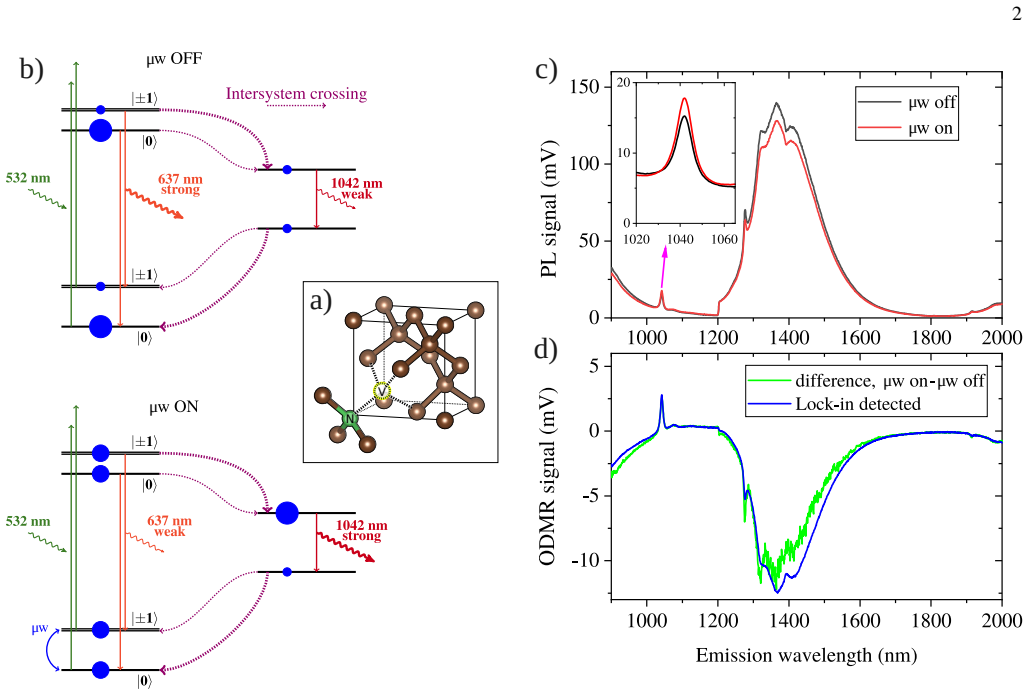
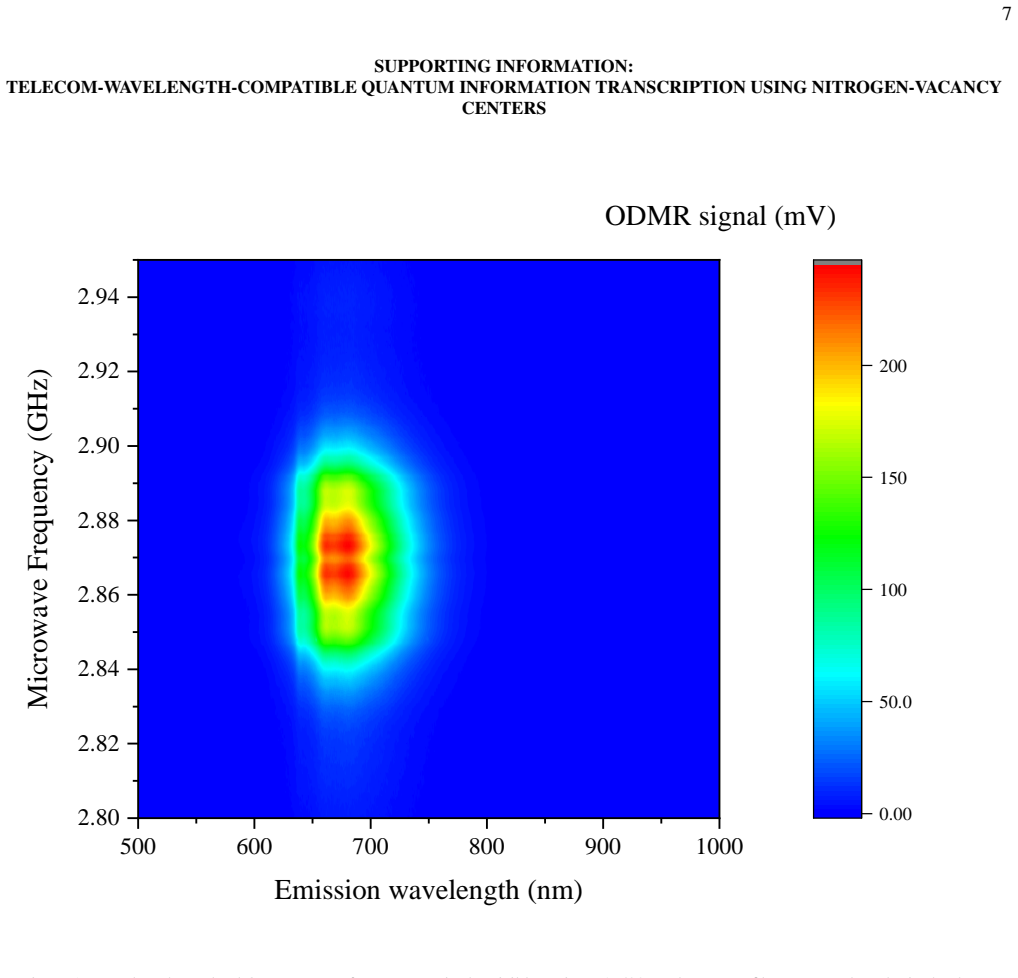
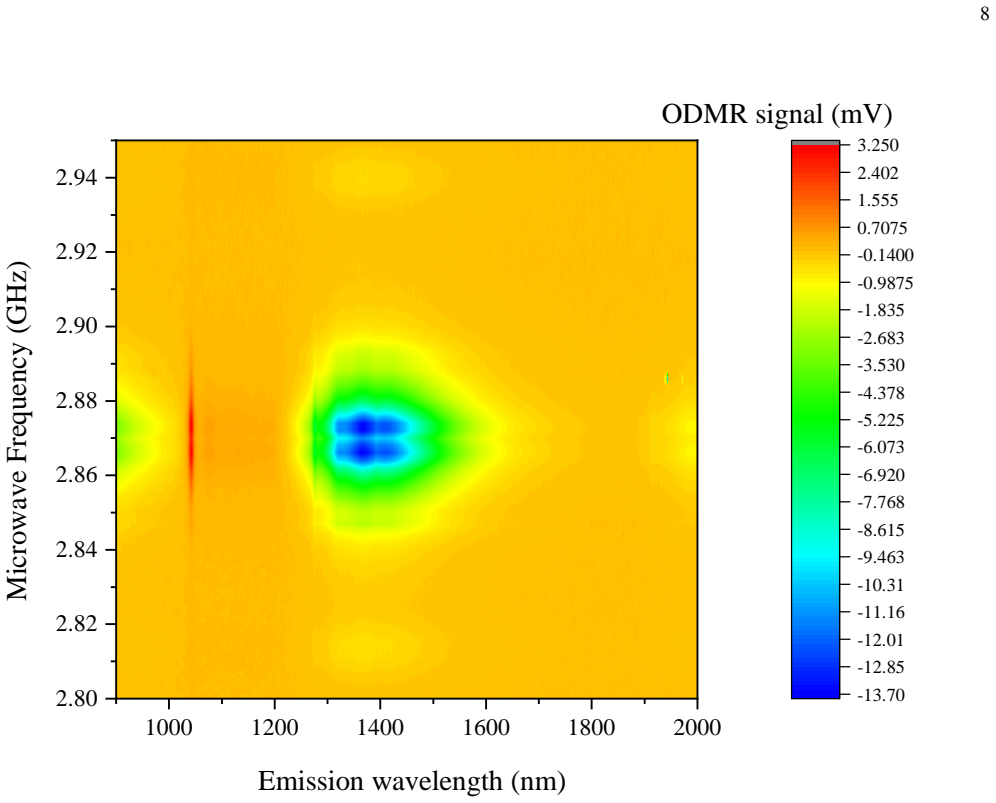
Spin information from NV centers is transcribed to their 1042 nm infrared emission through spin-selective intersystem crossing.
A machine-rendered reading of the paper's core claim, the machinery that carries it, and where it could break.
Core claim
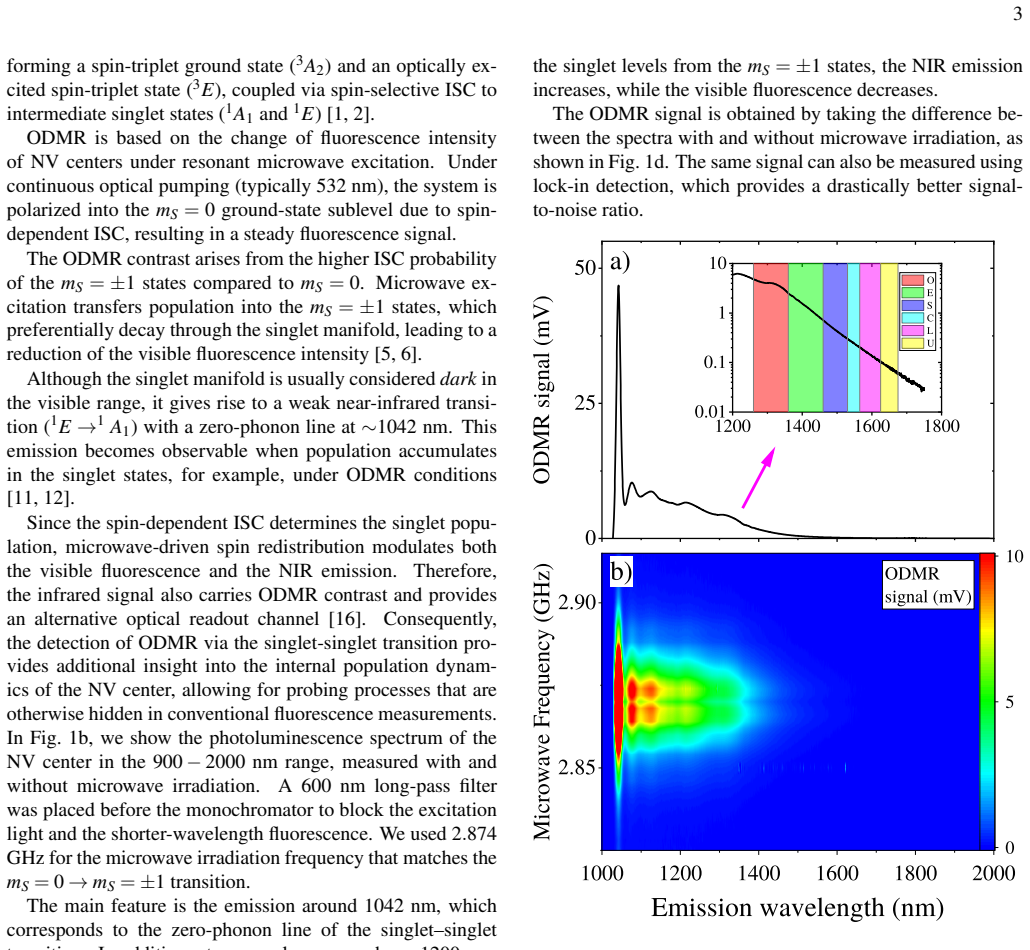
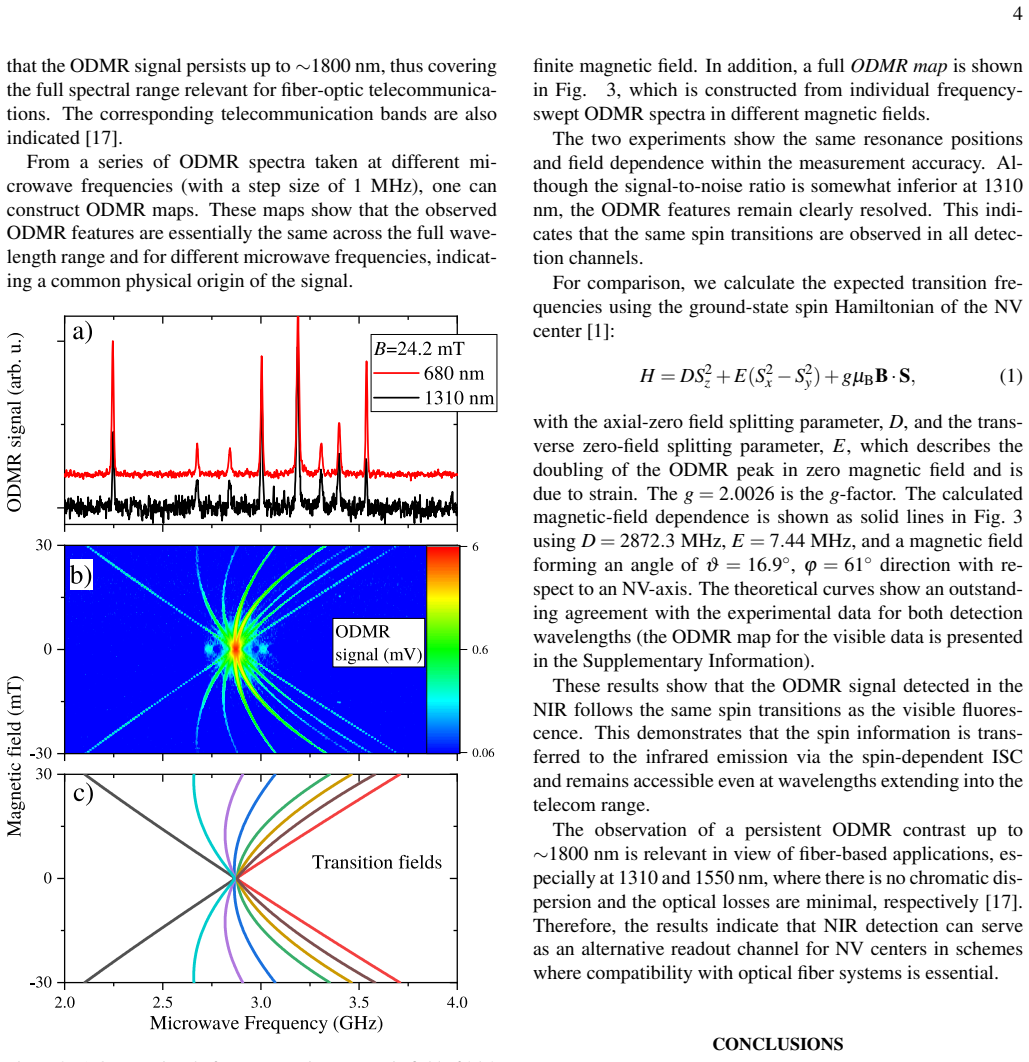
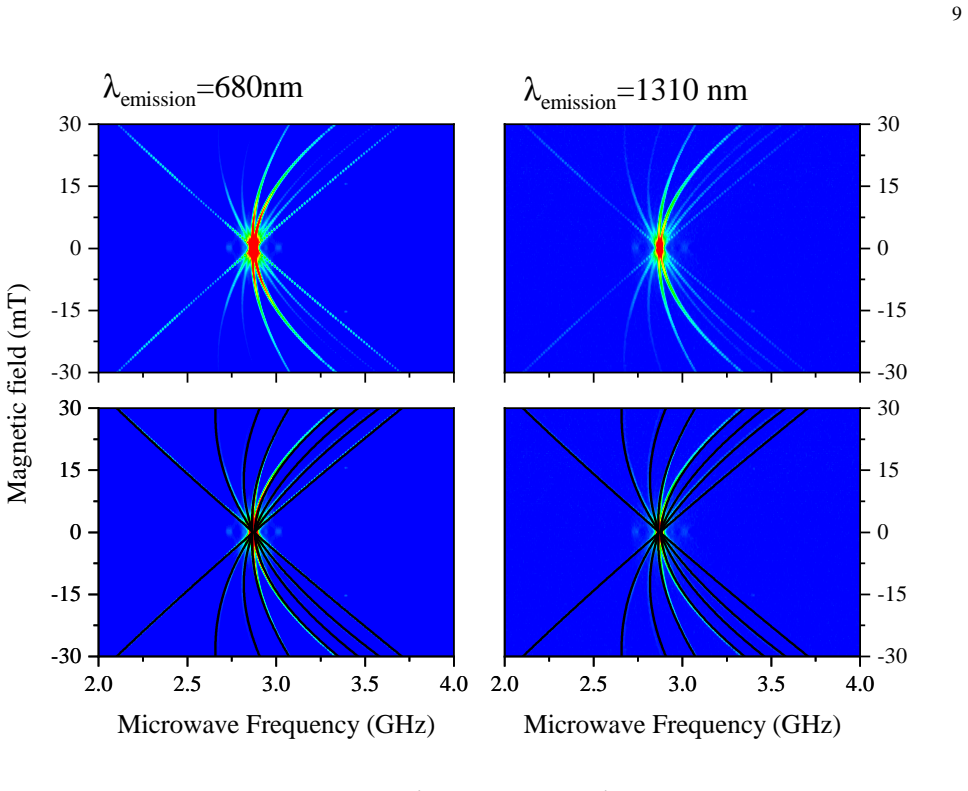
The field-dependent spectral dispersion of the ODMR signal demonstrates that the spin-state information encoded in the NV center is transcribed to the infrared singlet emission through the spin-selective intersystem crossing, in close analogy to the visible fluorescence readout. These results establish infrared ODMR as a high-fidelity optical readout pathway. By extending spin-state transcription directly into the 1300-1600 nm range, this work demonstrates a direct, conversion-free interface between diamond spin-qubits and standard telecommunication infrastructure.
What carries the argument
The 1042 nm infrared singlet emission read out by ODMR, which receives the transcribed spin information via spin-selective intersystem crossing from the NV center.
If this is right
- Infrared ODMR functions as a high-fidelity optical readout pathway for NV centers.
- Spin-state transcription extends directly into the 1300-1600 nm telecom range.
- A conversion-free interface is created between diamond spin qubits and telecommunication infrastructure.
- NV centers gain access to the well-developed technologies already available in the telecom spectrum.
Where Pith is reading between the lines
- Quantum networks could route NV spin information over existing fiber links without intermediate conversion hardware.
- Avoiding active frequency conversion may lower cumulative loss when multiple NV centers communicate across distance.
- The transcription approach could be tested at actual telecom wavelengths to quantify readout fidelity in deployed fiber systems.
Load-bearing premise
That the ODMR contrast and its magnetic-field dependence measured at 1042 nm are enough to confirm spin transcription and that the identical mechanism operates at 1300-1600 nm.
What would settle it
Absence of ODMR contrast or absence of field-dependent spectral dispersion in the 1042 nm emission under the reported conditions would show that spin information is not transcribed to the infrared singlet state.
Figures
read the original abstract
Nitrogen-vacancy (NV) centers in diamond are a leading platform for solid-state quantum sensing and quantum information processing. While most optical studies rely on the visible fluorescence associated with the triplet transitions, the infrared singlet transition near $1042$ nm, which is typically considered dark within the singlet manifold of the NV optical cycle, provides an alternative optical channel. Here, we report wavelength-resolved optically detected magnetic resonance (ODMR) measurements of this infrared emission. We directly observe ODMR contrast in the $1042$ nm emission and analyze its dependence on the magnetic field. The field-dependent spectral dispersion of the ODMR signal demonstrates that the spin-state information encoded in the NV center is transcribed to the infrared singlet emission through the spin-selective intersystem crossing, in close analogy to the visible fluorescence readout. These results establish infrared ODMR as a high-fidelity optical readout pathway. Crucially, by extending spin-state transcription directly into the $1300-1600$ nm range, this work demonstrates a direct, conversion-free interface between diamond spin-qubits and standard telecommunication infrastructure, bypassing the efficiency bottlenecks of active frequency conversion and benefiting from the already well-developed technologies in this range of the electromagnetic spectrum.
Editorial analysis
A structured set of objections, weighed in public.
Referee Report
Summary. The manuscript reports wavelength-resolved ODMR measurements on the ~1042 nm infrared singlet emission from NV centers. It observes ODMR contrast whose magnetic-field-dependent spectral dispersion is interpreted as evidence that spin-state information is transcribed to the singlet manifold via spin-selective intersystem crossing, in direct analogy to the visible fluorescence channel. The work concludes that this establishes infrared ODMR as a high-fidelity readout and, by extension, provides a conversion-free interface to the 1300–1600 nm telecom band.
Significance. If the 1042 nm ODMR observation and its field dependence are robustly quantified, the result would demonstrate an additional optical readout channel for NV centers that lies closer to telecom wavelengths than the usual visible fluorescence. This could reduce the need for frequency conversion in quantum-network applications, provided the mechanism generalizes.
major comments (3)
- [Abstract] Abstract, final paragraph: the claim that the results 'extend spin-state transcription directly into the 1300-1600 nm range' and thereby 'demonstrate a direct, conversion-free interface' is unsupported. All data, spectra, and field-dependent analysis are confined to 1042 nm; no spectra, branching ratios, ISC rates, or extrapolation model are presented for 1300–1600 nm.
- [Abstract] Abstract and main text: the repeated assertion of a 'high-fidelity optical readout pathway' is not accompanied by any reported contrast values (in percent), error bars, signal-to-noise ratios, or control measurements. Without these numbers the fidelity claim cannot be evaluated.
- [Discussion] The interpretation that the observed spectral dispersion at 1042 nm directly confirms the same spin-selective ISC mechanism that would operate at telecom wavelengths rests on an untested assumption that the singlet emission properties and ISC branching are wavelength-independent across this range.
minor comments (1)
- [Methods] Sample details (NV concentration, diamond type, surface preparation) and excitation/collection wavelengths are not stated in the abstract or summary text; these should be supplied in the methods section for reproducibility.
Simulated Author's Rebuttal
We appreciate the referee's thorough review and insightful comments, which have helped us identify areas for improvement in our manuscript. Below, we provide detailed responses to each major comment. We will make revisions where appropriate to address the concerns raised.
read point-by-point responses
-
Referee: [Abstract] Abstract, final paragraph: the claim that the results 'extend spin-state transcription directly into the 1300-1600 nm range' and thereby 'demonstrate a direct, conversion-free interface' is unsupported. All data, spectra, and field-dependent analysis are confined to 1042 nm; no spectra, branching ratios, ISC rates, or extrapolation model are presented for 1300–1600 nm.
Authors: We agree with the referee that the experimental results are confined to the 1042 nm wavelength and that no direct data or model for 1300-1600 nm is provided. The phrasing in the abstract does overstate the direct applicability to the full telecom band. In the revised manuscript, we will modify the abstract to state that the spin-state transcription is demonstrated at 1042 nm, establishing the underlying mechanism, and note that this approach is compatible with telecom wavelengths in principle, without claiming a direct interface without further work. This addresses the unsupported claim. revision: yes
-
Referee: [Abstract] Abstract and main text: the repeated assertion of a 'high-fidelity optical readout pathway' is not accompanied by any reported contrast values (in percent), error bars, signal-to-noise ratios, or control measurements. Without these numbers the fidelity claim cannot be evaluated.
Authors: The full manuscript includes quantitative ODMR contrast measurements in the results and discussion sections, including contrast percentages and field-dependent data. However, we acknowledge that the abstract and introductory claims do not explicitly quote these values. We will revise the abstract to include specific contrast values (with error bars) and signal-to-noise considerations, and ensure the main text highlights the control measurements performed. This will allow readers to evaluate the fidelity claim directly. revision: yes
-
Referee: [Discussion] The interpretation that the observed spectral dispersion at 1042 nm directly confirms the same spin-selective ISC mechanism that would operate at telecom wavelengths rests on an untested assumption that the singlet emission properties and ISC branching are wavelength-independent across this range.
Authors: The observed magnetic-field-dependent spectral dispersion at 1042 nm directly reflects the Zeeman splitting of the triplet sublevels, indicating that the population transfer to the singlet manifold via ISC is spin-selective. The ISC process itself is determined by the spin-orbit coupling and selection rules between the triplet and singlet states, which are independent of the subsequent emission wavelength from the singlet. While we do not claim wavelength-independence of all emission properties, the spin transcription mechanism is validated by the data at 1042 nm. We will add a clarifying paragraph in the discussion to explain why this mechanism is expected to hold for other potential emission lines in the singlet manifold, including those closer to telecom wavelengths. revision: partial
Circularity Check
No circularity; purely experimental report with no derivations or load-bearing self-citations
full rationale
The manuscript is an experimental report of wavelength-resolved ODMR contrast observed in the 1042 nm infrared emission from NV centers, with analysis of its magnetic-field dependence. No equations, fitted parameters, ansatzes, uniqueness theorems, or derivation chains are present in the provided text. The claim of extension to 1300-1600 nm is an interpretive analogy from the 1042 nm data rather than a mathematical reduction or self-referential prediction. No self-citation load-bearing steps or renamings of known results appear. The work is therefore self-contained against external benchmarks with no circularity by the enumerated patterns.
Axiom & Free-Parameter Ledger
Reference graph
Works this paper leans on
-
[1]
M. W. Doherty, N. B. Manson, P. Delaney, F. Jelezko, J. Wrachtrup, and L. C. L. Hollenberg, The nitrogen-vacancy colour centre in diamond, Physics Reports528, 1 (2013)
2013
-
[2]
Schirhagl, K
R. Schirhagl, K. Chang, M. Loretz, and C. L. Degen, Nitrogen- vacancy centers in diamond: nanoscale sensors for physics and biology, Annual Review of Physical Chemistry65, 83 (2014)
2014
-
[3]
Casola, T
F. Casola, T. Van Der Sar, and A. Yacoby, Probing condensed matter physics with magnetometry based on nitrogen-vacancy centres in diamond, Nat Rev Mater3, 17088 (2018)
2018
-
[4]
Kollarics, B
S. Kollarics, B. G. Márkus, R. Kucsera, G. Thiering, Á. Gali, G. Németh, K. Kamarás, L. Forró, and F. Simon, Terahertz emission from diamond nitrogen-vacancy centers, Sci. Adv.10, eadn0616 (2024)
2024
-
[5]
Gruber, A
A. Gruber, A. Dräbenstedt, C. Tietz, L. Fleury, J. Wrachtrup, and C. von Borczyskowski, Scanning confocal optical mi- croscopy and magnetic resonance on single defect centers, Sci- ence276, 2012 (1997)
2012
-
[6]
Jelezko and J
F. Jelezko and J. Wrachtrup, Single defect centres in diamond: A review, Physica Status Solidi A203, 3207 (2006)
2006
-
[7]
J. M. Tayloret al., High-sensitivity diamond magnetometer with nanoscale resolution, Nature Physics4, 810 (2008)
2008
-
[8]
Rondin, J.-P
L. Rondin, J.-P. Tetienne, T. Hingant, J.-F. Roch, P. Maletinsky, and V . Jacques, Magnetometry with nitrogen-vacancy defects in diamond, Reports on Progress in Physics77, 056503 (2014)
2014
-
[9]
C. Du, T. Van Der Sar, T. X. Zhou, P. Upadhyaya, F. Ca- sola, H. Zhang, M. C. Onbasli, C. A. Ross, R. L. Walsworth, Y . Tserkovnyak, and A. Yacoby, Control and local measurement of the spin chemical potential in a magnetic insulator, Science 357, 195 (2017)
2017
-
[10]
Arunkumar, D
N. Arunkumar, D. B. Bucher, M. J. Turner, P. TomHon, D. Glenn, S. Lehmkuhl, M. D. Lukin, H. Park, M. S. Rosen, T. Theis, and R. L. Walsworth, Micron-Scale NV-NMR Spec- troscopy with Signal Amplification by Reversible Exchange, PRX Quantum2, 010305 (2021)
2021
-
[11]
L. J. Rogers, S. Armstrong, M. J. Sellars, and N. B. Manson, Infrared emission of the nv centre in diamond: Zeeman and uni- axial stress studies, New Journal of Physics10, 103024 (2008)
2008
-
[12]
V . M. Acostaet al., Optical properties of the nitrogen-vacancy singlet levels in diamond, Physical Review B82, 201202 (2010)
2010
-
[13]
Jensen, N
K. Jensen, N. Leefer, A. Jarmola, Y . Dumeige, V . M. Acosta, P. Kehayias, B. Patton, and D. Budker, Cavity-enhanced room-temperature magnetometry using absorption by nitrogen- vacancy centers in diamond, Physical Review Letters112, 160802 (2014)
2014
-
[14]
Albrecht, A
R. Albrecht, A. Bommer, C. Deutsch, J. Reichel, and C. Becher, Coupling of a single nitrogen-vacancy center in diamond to a fiber-based microcavity, Physical Review Letters110, 243602 (2013)
2013
-
[15]
Bernienet al., Heralded entanglement between solid-state qubits separated by three metres, Nature497, 86 (2013)
H. Bernienet al., Heralded entanglement between solid-state qubits separated by three metres, Nature497, 86 (2013)
2013
-
[16]
Robledo, L
L. Robledo, L. Childress, H. Bernien, B. Hensen, P. F. A. Alke- made, and R. Hanson, High-fidelity projective read-out of a solid-state spin quantum register, Nature477, 574 (2011)
2011
-
[17]
G. P. Agrawal,Fiber-Optic Communication Systems, 4th ed. (Wiley, 2010)
2010
-
[18]
Kollarics, F
S. Kollarics, F. Simon, A. Bojtor, K. Koltai, G. Klujber, M. Szieberth, B. G. Márkus, D. Beke, K. Kamarás, A. Gali, D. Amirari, R. Berry, S. Boucher, D. Gavryushkin, G. Jeschke, J. P. Cleveland, S. Takahashi, P. Szirmai, L. Forró, E. Em- manouilidou, R. Singh, and K. Holczer, Ultrahigh nitrogen- vacancy center concentration in diamond, Carbon188, 393 (2022)
2022
-
[19]
Negyedi, F
M. Negyedi, F. Simon,et al., An optically detected magnetic resonance spectrometer with tunable laser excitation and tun- able microwave excitation, Review of Scientific Instruments88, 013902 (2017)
2017
-
[20]
J. Palotás, M. Negyedi, S. Kollarics, A. Bojtor, P. Rohringer, T. Pichler, and F. Simon, Incidence of quantum confinement on dark triplet excitons in carbon nanotubes, ACS Nano14, 11254 (2020). 7 SUPPORTING INFORMA TION: TELECOM-W A VELENGTH-COMPA TIBLE QUANTUM INFORMA TION TRANSCRIPTION USING NITROGEN-V ACANCY CENTERS 5 006 007 008 009 001 0002.802.822.8...
discussion (0)
Sign in with ORCID, Apple, or X to comment. Anyone can read and Pith papers without signing in.