Nonlinear Hamiltonians and Boolean satisfiability
Pith reviewed 2026-06-30 20:11 UTC · model grok-4.3
The pith
Nonlinear Hamiltonians on an ancilla qubit can determine the number of satisfying assignments to a Boolean formula and thereby solve UNIQUE SAT, 3SAT, and #SAT.
A machine-rendered reading of the paper's core claim, the machinery that carries it, and where it could break.
Core claim
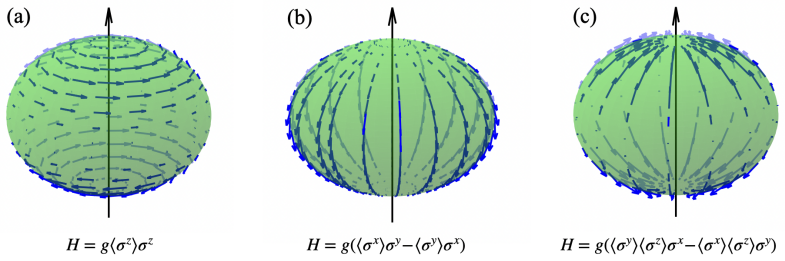
Given an efficient quantum circuit that prepares an ancilla qubit whose state encodes the number s of satisfying assignments (0 ≤ s ≤ 2^n) to a Boolean formula in conjunctive normal form, three nonlinear Hamiltonians acting on the ancilla perform state discrimination. The term ⟨σ^z⟩ σ^z distinguishes s = 0 from s = 1 and thereby solves UNIQUE SAT under the promise of at most one solution. The term ⟨σ^x⟩ σ^y − ⟨σ^y⟩ σ^x distinguishes s = 0 from s > 0 and thereby solves 3SAT. The term ⟨σ^y⟩ ⟨σ^z⟩ σ^x − ⟨σ^x⟩ ⟨σ^z⟩ σ^y extracts the exact integer s and thereby solves #SAT. The nonlinear models are of mean-field type.
What carries the argument
Nonlinear state-discrimination gates on the ancilla qubit generated by mean-field Hamiltonians whose coefficients depend on expectation values taken in the current state.
If this is right
- UNIQUE SAT is solved in polynomial time by the ⟨σ^z⟩ σ^z nonlinearity under the promise 0 ≤ s ≤ 1.
- 3SAT is solved by the ⟨σ^x⟩ σ^y − ⟨σ^y⟩ σ^x nonlinearity that distinguishes s = 0 from s > 0.
- The exact integer s is obtained by the double-expectation nonlinearity, solving #SAT.
- All three solvers require a scalable fault-tolerant quantum computer to prepare the initial encoding of s.
Where Pith is reading between the lines
- Physical realization of the required mean-field nonlinearities with ultracold atoms would provide a concrete experimental test of the proposed solvers.
- The same encoding-plus-discrimination pattern could be applied to other counting or decision problems whose solution multiplicity can be prepared in superposition.
Load-bearing premise
The ancilla qubits evolve according to a nonlinear Schrödinger equation of mean-field type.
What would settle it
A laboratory demonstration or numerical simulation in which the proposed nonlinear evolution applied to the two ancilla states encoding s = 0 and s = 1 fails to produce distinguishable final states.
Figures

read the original abstract
We consider an extended model of quantum computation where a scalable fault-tolerant quantum computer is coupled to one or more ancilla qubits that evolve according to a nonlinear Schr\"odinger equation. Following the approach of Abrams and Lloyd, an efficient quantum circuit evaluating an $n$-bit Boolean function in conjunctive normal form is used to prepare an ancilla encoding its number $s$ of satisfying assignments ($0 \le s \le 2^n$). This is followed by a nonlinear quantum state discrimination gate on the ancilla qubit that is used to learn properties of $s$. Here we consider three types of state discriminators generated by different nonlinear Hamiltonians. First, given a restricted Boolean satisfiability problem with the promise of at most one satisfying assignment ($ 0 \le s \le 1$), we show that a qubit with $\langle \sigma^z \rangle \sigma^z$ nonlinearity can be used to efficiently determine whether $s = 0$ or $s = 1$, solving the UNIQUE SAT problem. Here $\langle A \rangle := \langle \psi | A |\psi \rangle $ denotes expectation in the current state. UNIQUE SAT is NP-hard under a randomized polynomial-time reduction (of course any discussion of complexity assumes a scalable, fault-tolerant implementation). Second, for unrestricted satisfiability problems with $ 0 \le s \le 2^n$, a Hamiltonian with $ \langle \sigma^x \rangle \sigma^y - \langle \sigma^y \rangle \sigma^x$ nonlinearity can be used to efficiently determine whether $s=0$ or $s>0$, thereby solving 3SAT, which is NP-complete. Finally, we show that $ \langle \sigma^y \rangle \langle \sigma^z \rangle \sigma^x - \langle \sigma^x \rangle \langle \sigma^z \rangle \sigma^y $ nonlinearity can be used to efficiently measure $s$ and solve #SAT, which is #P-complete. The nonlinear models are of mean field type and might be simulated with ultracold atoms.
Editorial analysis
A structured set of objections, weighed in public.
Referee Report
Summary. The paper proposes extending quantum computation by coupling a fault-tolerant linear quantum computer to ancilla qubits governed by nonlinear Schrödinger equations of mean-field type. A standard quantum circuit prepares an ancilla state encoding the number s of satisfying assignments for a Boolean formula in CNF; three specific nonlinear Hamiltonians are then applied to the ancilla to discriminate properties of s, yielding efficient solutions to UNIQUE-SAT (via ⟨σ^z⟩σ^z), 3SAT (via ⟨σ^x⟩σ^y − ⟨σ^y⟩σ^x), and #SAT (via ⟨σ^y⟩⟨σ^z⟩σ^x − ⟨σ^x⟩⟨σ^z⟩σ^y). The nonlinear models are suggested to be simulable with ultracold atoms.
Significance. If the nonlinear dynamics can be consistently defined on entangled states and physically realized, the construction would place NP-complete and #P-complete problems in polynomial time, with direct implications for complexity theory. The explicit gate constructions for the three cases and the reference to Abrams-Lloyd provide a concrete starting point; the mean-field form is a clear modeling choice.
major comments (1)
- [Abstract and model statement] Abstract and model statement: the central claim requires that the nonlinear Hamiltonian (e.g., H = ⟨σ^z⟩ σ^z) acts on the ancilla after a linear circuit has entangled it with the main register. No definition is given for lifting the expectation-value-dependent term to the joint Hilbert space, nor for evaluating ⟨A⟩ on the reduced ancilla state without an auxiliary measurement. This definition is load-bearing for the claimed deterministic discrimination between s=0 and s=1 (and the analogous claims for 3SAT and #SAT).
Simulated Author's Rebuttal
We thank the referee for their careful reading of the manuscript and for highlighting the need for an explicit definition of the nonlinear Hamiltonian on the joint system. We address the major comment below and will incorporate the requested clarification in a revised version.
read point-by-point responses
-
Referee: [Abstract and model statement] Abstract and model statement: the central claim requires that the nonlinear Hamiltonian (e.g., H = ⟨σ^z⟩ σ^z) acts on the ancilla after a linear circuit has entangled it with the main register. No definition is given for lifting the expectation-value-dependent term to the joint Hilbert space, nor for evaluating ⟨A⟩ on the reduced ancilla state without an auxiliary measurement. This definition is load-bearing for the claimed deterministic discrimination between s=0 and s=1 (and the analogous claims for 3SAT and #SAT).
Authors: We agree that an explicit definition is required. In the revised manuscript we will state that the nonlinear Hamiltonian acts on the joint space as the identity on the main register tensored with an ancilla Hamiltonian whose coefficients are determined by expectation values computed on the reduced density operator of the ancilla (obtained by partial trace over the main register). The time-dependent Schrödinger equation is then integrated deterministically using these reduced-state expectations at each instant; no auxiliary measurement is performed. This construction follows the mean-field nonlinear models referenced via Abrams and Lloyd and is sufficient to realize the claimed state discrimination for UNIQUE-SAT, 3SAT, and #SAT. revision: yes
Circularity Check
No circularity: independent nonlinear model proposed without reduction to inputs
full rationale
The paper introduces a new mean-field nonlinear Schrödinger model on ancilla qubits (with terms such as ⟨σ^z⟩σ^z) to discriminate the number s of satisfying assignments prepared by a linear circuit, thereby claiming solutions to UNIQUE-SAT, 3SAT and #SAT. No step reduces a claimed result to a fitted parameter, self-defined quantity, or self-citation chain; the nonlinear Hamiltonians are posited as external assumptions rather than derived from the target complexity statements. The derivation therefore remains self-contained against external benchmarks and receives the default non-circularity finding.
Axiom & Free-Parameter Ledger
axioms (2)
- domain assumption Ancilla qubits evolve under a nonlinear Schrödinger equation
- domain assumption Mean-field nonlinear models can be simulated with ultracold atoms
invented entities (1)
-
Nonlinear Hamiltonians (⟨σ^z⟩σ^z, ⟨σ^x⟩σ^y − ⟨σ^y⟩σ^x, ⟨σ^y⟩⟨σ^z⟩σ^x − ⟨σ^x⟩⟨σ^z⟩σ^y)
no independent evidence
Forward citations
Cited by 1 Pith paper
-
Quantum algorithm for Valiant-Vazirani reduction
Constructs quantum filtered oracle for Valiant-Vazirani theorem reducing SAT to UNIQUE SAT, enabling polynomial-time NP solution via torsion nonlinearity in noise-free limit but not #P.
Reference graph
Works this paper leans on
-
[1]
Wootters and W
W. Wootters and W. A. Zurek. A single quantum cannot be cloned.Nature, 299:802,
-
[2]
DOI: 10.1038/299802a0
-
[3]
M. B. Ruskai. Beyond strong subadditivity? Improved bounds on the con- traction of generalized relative entropy.Rev. Math. Phys., 6:1147, 1994. DOI: 10.1142/S0129055X94000407
-
[4]
M. M. Wilde.Quantum Information Theory. Cambridge University Press, 2017
2017
-
[5]
S. M. Barnet and S. Croke. Quantum state discrimination. arXiv: 0810.1970. URL https://arxiv.org/abs/0810.1970
work page internal anchor Pith review Pith/arXiv arXiv 1970
-
[7]
J. Bae and L.-C. Kwek. Quantum state discrimination and its applications.J. Phys. A: Math. Theor., 48:083001, 2015. DOI: 10.1088/1751-8113/48/8/083001
-
[8]
M. Rouhbakhsh N and S. A. Ghoreishi. Geometric bloch vector solution to minimum- error discriminations of mixed qubit states.Quantum Inf. Process., 22:323, 2023. DOI: 10.1007/s11128-023-04080-4
-
[9]
D. S. Abrams and S. Lloyd. Nonlinear quantum mechanics implies polynomial- time solution for NP-Complete and#P problems.Phys. Rev. Lett., 81:3992, Nov
-
[10]
URLhttps://link.aps.org/doi/10
DOI: 10.1103/PhysRevLett.81.3992. URLhttps://link.aps.org/doi/10. 1103/PhysRevLett.81.3992
-
[11]
A. M. Childs and J. Young. Optimal state discrimination and unstruc- tured search in nonlinear quantum mechanics.Phys. Rev. A, 93:022314, 2016. DOI: 10.1103/PhysRevA.93.022314. URLhttps://link.aps.org/doi/10.1103/ PhysRevA.93.022314
-
[12]
H. Bechmann-Pasquinucci, B. Huttner, and N. Gisin. Nonlinear quantum state transformation of spin-1/2.Phys. Lett. A, 242:198, 1998. DOI: 10.1016/S0375- 9601(98)00189-3
-
[13]
M. Czachor. Notes on nonlinear quantum algorithms.Acta Phys. Slov., 48:157, 1998. DOI: 10.48550/arXiv.quant-ph/9802051
work page internal anchor Pith review Pith/arXiv arXiv doi:10.48550/arxiv.quant-ph/9802051 1998
- [14]
-
[15]
D. R. Terno. Nonlinear operations in quantum-information theory.Phys. Rev. A, 59: 3320, 1999. DOI: 10.1103/PhysRevA.59.3320
-
[16]
D. Bacon. Quantum computational complexity in the presence of closed timelike curves.Phys. Rev. A, 70:032309, Sep 2004. DOI: 10.1103/PhysRevA.70.032309. URLhttps://link.aps.org/doi/10.1103/PhysRevA.70.032309
-
[17]
Aaronson
S. Aaronson. NP-complete problems and physical reality.SIGACT News, 36:30,
-
[18]
NP-complete Problems and Physical Reality
DOI: 10.48550/arXiv.quant-ph/0502072. arXiv:quant-ph/0502072
work page internal anchor Pith review Pith/arXiv arXiv doi:10.48550/arxiv.quant-ph/0502072
-
[19]
T. A. Brun, J. Harrington, and M. M. Wilde. Localized closed timelike curves can perfectly distinguish quantum states.Phys. Rev. Lett., 102:210402, 2009. 12 DOI: 10.1103/PhysRevLett.102.210402. URLhttps://link.aps.org/doi/10. 1103/PhysRevLett.102.210402
-
[20]
C. H. Bennett, D. Leung, G. Smith, and J. A. Smolin. Can closed timelike curves or nonlinear quantum mechanics improve quantum state discrimination or help solve hard problems?Phys. Rev. Lett., 103:170502, 2009. DOI: 10.1103/Phys- RevLett.103.170502. URLhttps://link.aps.org/doi/10.1103/PhysRevLett. 103.170502
-
[21]
M. E. Kahou and D. L. Feder. Quantum search with interacting Bose-Einstein con- densates.Phys. Rev. A, 88:032310, 2013. DOI: 10.1103/PhysRevA.88.032310. URL https://link.aps.org/doi/10.1103/PhysRevA.88.032310
-
[23]
D. A. Meyer and T. G. Wong. Quantum search with general nonlinearities.Phys. Rev. A, 89:012312, 2014. DOI: doi:10.1088/1367-2630/15/6/063014
-
[24]
G. Di Molfetta and B. Herzog. Searching via nonlinear quantum walk on the 2D-grid. arXiv: 2009.07800. URLhttps://arxiv.org/abs/2009.07800
-
[25]
S. Deffner. Nonlinear speed-ups in ultracold quantum gases.Europhys. Lett., 140: 48001, 2022. DOI: 10.1209/0295-5075/ac9fed
-
[26]
S. Xu, J. Schmiedmayer, and B. C. Sanders. Nonlinear quantum gates for a Bose- Einstein condensate.Phys. Rev. Research, 4:023071, 2022. DOI: 10.1103/PhysRevRe- search.4.023071
-
[27]
M. R. Geller. Fast quantum state discrimination with nonlinear PTP channels. Adv. Quantum Technol., page 2200156, 2023. DOI: 10.1002/qute.202200156. arXiv: 2111.05977
-
[28]
M. R. Geller. Protocol for nonlinear state discrimination in rotating condensate.Adv. Quantum Technol., page 202300431, 2024. DOI: 10.1002/qute.202300431. arXiv: 2404.16288
- [29]
-
[30]
D. A. Meyer and T. G. Wong. Conserved quantities in linear and nonlinear quantum search.Quantum Inf. Comp., 25:315, 2025. DOI: 10.2478/qic-2025-0017
-
[31]
Arora and B
S. Arora and B. Barak.Computational Complexity: A Modern Approach. Cambridge University Press, 2009
2009
-
[32]
B. Mielnik. Mobility of nonlinear systems.J. Math. Phys., 21:44, 1980. DOI: 10.1063/1.524331
-
[33]
M. R. Geller. From spin squeezing to fast state discrimination.Quantum, 2026. URL https://doi.org/10.48550/arXiv.2410.22032. arXiv: 2410.22032
work page internal anchor Pith review Pith/arXiv arXiv doi:10.48550/arxiv.2410.22032 2026
-
[34]
T. Nikuni and J. E. Williams. Kinetic theory of a spin-1/2 Bose-condensed gas.J. Low Temp. Phys., 133:323, 2003. DOI: 10.1023/A:1026206724886
-
[35]
A. Farolfi, A. Zenesini, R. Cominotti, D. Trypogeorgos, A. Recati, G. Lamporesi, and G. Ferrari. Manipulation of an elongated internal Josephson junction of bosonic atoms.Phys. Rev. A, 104:023326, 2021. DOI: 10.1103/PhysRevA.104.023326
-
[36]
A. Farolfi, A. Zenesini, D. Trypogeorgos, C. Mordini, A. Gallem´ ı, A. Roy, A. Re- cati, G. Lamporesi, and G. Ferrari. Quantum-torque-induced breaking of magnetic interfaces in ultracold gases.Nature Physics, 17:1359, 2021. DOI: 10.1038/s41567- 021-01369-y
-
[37]
C. Luo, H. Zhang, A. Chu, C. Maruko, A. M. Rey, and J. K. Thompson. Hamiltonian engineering of collective XYZ spin models in an optical cavity.Nature Physics, 21: 916, 2025. DOI: 10.1038/s41567-025-02866-0. 13
-
[38]
C. J. Pethick and H. Smith.Bose–Einstein Condensation in Dilute Gases. Cambridge University Press, 2008
2008
-
[39]
A. Blass and Y. Gurevich. On the unique satisfiability problem.Information and Control, 55:80, 1982. DOI: 10.1016/S0019-9958(82)90439-9
-
[40]
L. G. Valiant and V. V. Vazirani. NP is as easy as detecting unique solutions.Theo- retical Computer Science, 47:85, 1986. DOI: 10.1016/0304-3975(86)90135-0
-
[41]
I. S. Gradshteyn and I. M. Ryzhik.Tables of Integrals, Series, and Products. Academic Press, San Diego, 6th edition, 2000
2000
-
[42]
M. W. Hirsch, S. Smale, and R. L. Devaney.Differential Equations, Dynamical Systems, and an Introduction to Chaos. Academic Press, 2013
2013
-
[43]
S. H. Strogatz.Nonlinear Dynamics and Chaos. Westview Press, 2015. 14
2015
discussion (0)
Sign in with ORCID, Apple, or X to comment. Anyone can read and Pith papers without signing in.