Towards Gaze-Informed AI Disclosure Interfaces: Eye-Tracking Attentional and Cognitive Load While Reading AI-Assisted News
Pith reviewed 2026-06-30 19:58 UTC · model grok-4.3
The pith
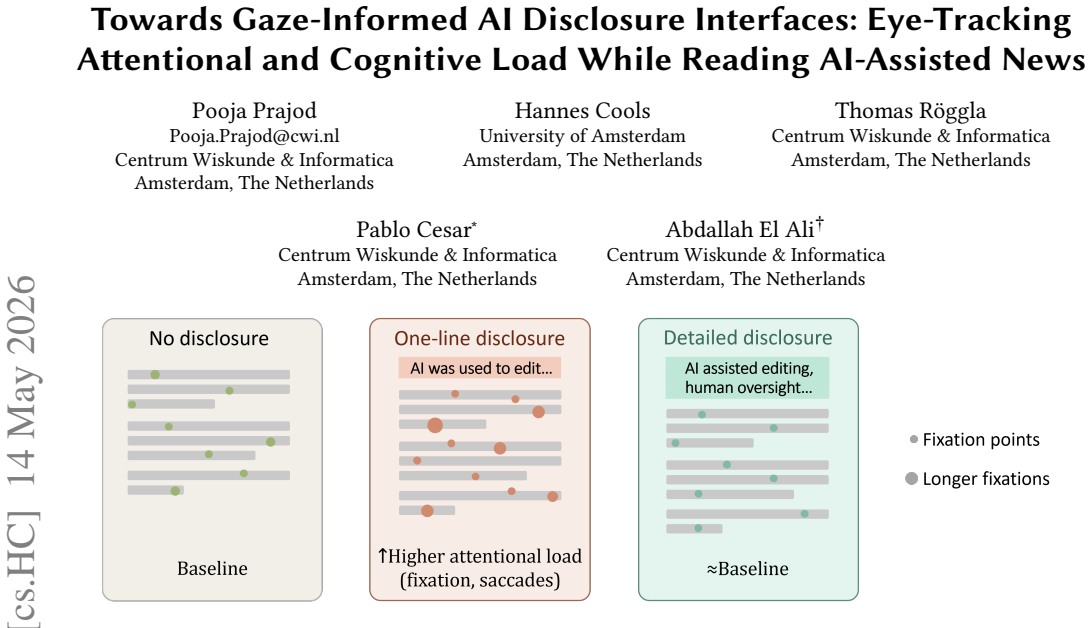
One-line AI disclosures in news increase readers' fixation durations and saccade counts without raising cognitive load.
A machine-rendered reading of the paper's core claim, the machinery that carries it, and where it could break.
Core claim
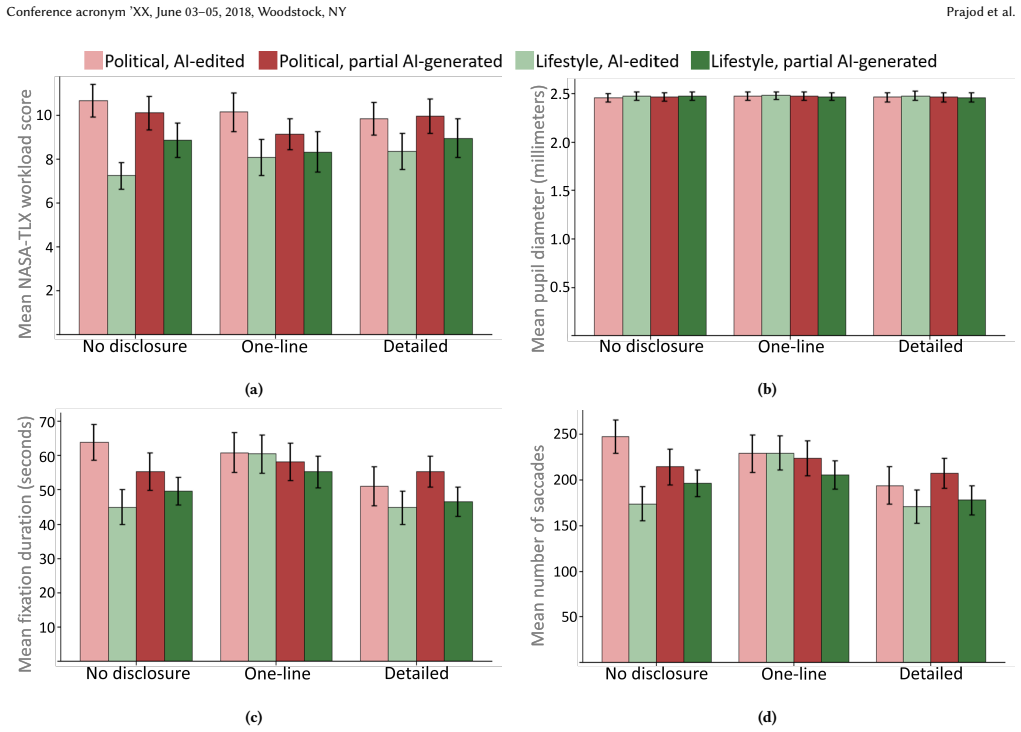
In a 3×2×2 mixed factorial experiment, one-line AI disclosures produced reliably higher fixation durations and saccade counts than the no-disclosure or detailed-disclosure conditions, with the effect strongest for AI-edited stories; detailed disclosures added no further visual cost. Neither NASA-TLX ratings nor pupil-diameter measures differed across disclosure levels, indicating that disclosure detail affects attentional allocation but not cognitive load.
What carries the argument
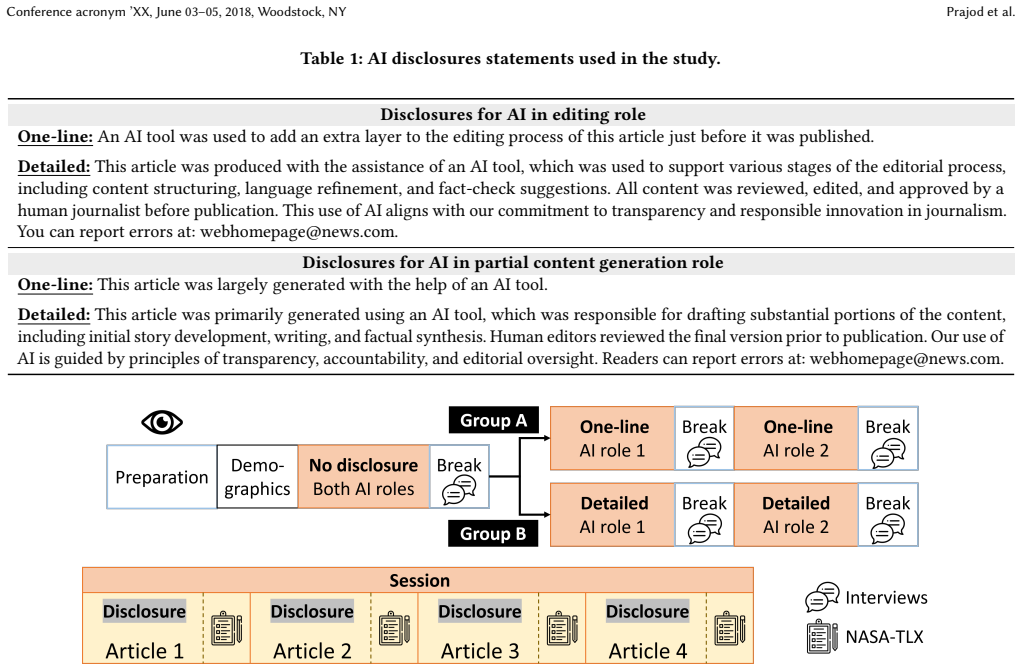
Eye-tracking measures (fixation duration, saccade count) contrasted with NASA-TLX and pupil diameter to separate attentional from cognitive load during reading of AI-assisted news under varying disclosure detail.
If this is right
- Detailed disclosures avoid the extra visual scrutiny triggered by one-line labels.
- AI-use disclosures impose no detectable cognitive burden at any tested level of detail.
- Readers express preference for detailed or on-demand disclosure formats in follow-up interviews.
- Gaze patterns can serve as a signal for adaptive disclosure interfaces that change transparency level.
Where Pith is reading between the lines
- Interfaces could monitor gaze in real time and expand a brief label into full text when fixations rise.
- The attentional-cost finding may generalize to other short-form AI labels such as social-media or product summaries.
- Field studies outside the lab would be needed to check whether the same gaze patterns appear during ordinary news consumption.
Load-bearing premise
That the chosen eye-tracking metrics and NASA-TLX scores isolate the effect of disclosure detail rather than differences in story interest or reading strategy.
What would settle it
A replication in which participants read the same articles on their own devices and show no elevation in fixation duration or saccades for one-line disclosures compared with no disclosure.
Figures
read the original abstract
As generative AI becomes increasingly integrated into journalism, designing effective AI-use disclosures that inform readers without imposing unnecessary burden is a key challenge. While prior research has primarily focused on trust and credibility, the impact of disclosures on readers' attentional and cognitive load remains underexplored. To address this gap, we conducted a $3\times2\times2$ mixed factorial study manipulating the level of AI-use disclosure detail (none, one-line, detailed), news type (politics, lifestyle), and role of AI (editing, partial content generation), measuring load via NASA-TLX and eye-tracking. Our results reveal a significant attentional cost: one-line disclosures resulted in significantly higher fixation durations and saccade counts, particularly for AI-edited content. Detailed disclosures did not impose additional burden. Drawing on Information-Gap Theory, we argue that brief labels may trigger increased visual scrutiny by alerting readers to AI use without providing enough information. NASA-TLX scores and pupil diameter showed no significant differences across conditions, suggesting that AI-use disclosures do not impose cognitive burden regardless of the detail level. Interview insights contextualize these findings and reveal a strong preference for detailed or ``detail-on-demand'' designs. Our findings inform the design of gaze-informed adaptive disclosure interfaces that dynamically adjust transparency levels based on readers' attentional patterns and news context.
Editorial analysis
A structured set of objections, weighed in public.
Referee Report
Summary. The paper reports results from a 3×2×2 mixed factorial study on attentional and cognitive load during reading of AI-assisted news. Factors are disclosure detail (none, one-line, detailed), news type (politics, lifestyle), and AI role (editing vs. partial content generation). Load is measured via eye-tracking (fixation duration, saccade count, pupil diameter) plus NASA-TLX, supplemented by interviews. Central claim: one-line disclosures produce significantly higher fixation durations and saccade counts (especially for AI-edited content) while detailed disclosures do not; NASA-TLX and pupil measures show no differences, interpreted as attentional scrutiny without cognitive burden per Information-Gap Theory. The work advocates gaze-informed adaptive disclosure interfaces.
Significance. If the eye-movement effects survive controls for stimulus properties, the multi-method design (eye-tracking + subjective scales + qualitative data) offers useful evidence for disclosure design in AI journalism. The null cognitive-load findings and preference for detailed or on-demand formats could inform practical interface guidelines. The study is empirical rather than theoretical and does not include machine-checked proofs or parameter-free derivations.
major comments (2)
- [Methods] Methods (stimulus materials subsection): No report that articles were matched or covaried for length, sentence complexity, lexical difficulty, or readability metrics (e.g., Flesch-Kincaid) across disclosure conditions. This is load-bearing for the central claim because the reported increases in fixation duration and saccade count for one-line disclosures could be driven by bottom-up text features rather than the disclosure manipulation.
- [Results] Results (and abstract): Statistically significant differences are asserted for fixation/saccade metrics, yet sample size (N), exact tests (e.g., mixed ANOVA details, post-hoc corrections), effect sizes, and data-exclusion criteria are not provided. These omissions prevent evaluation of the reliability of both the positive attentional-cost finding and the null results on NASA-TLX and pupil diameter.
minor comments (2)
- [Abstract] Abstract: Could state the total participant count and clarify which factors are within- vs. between-subjects to aid immediate assessment of design power.
- [Discussion] Discussion: The appeal to Information-Gap Theory would be strengthened by a one-sentence summary of the theory's relevant predictions and a supporting citation.
Simulated Author's Rebuttal
We thank the referee for the constructive and detailed feedback. The two major comments identify important gaps in methodological transparency and statistical reporting that we will address in revision.
read point-by-point responses
-
Referee: [Methods] Methods (stimulus materials subsection): No report that articles were matched or covaried for length, sentence complexity, lexical difficulty, or readability metrics (e.g., Flesch-Kincaid) across disclosure conditions. This is load-bearing for the central claim because the reported increases in fixation duration and saccade count for one-line disclosures could be driven by bottom-up text features rather than the disclosure manipulation.
Authors: We agree this detail is necessary to rule out stimulus confounds. Articles were drawn from the same news outlets and selected to be comparable in approximate length and topic, but formal readability metrics and covariate reporting were omitted. In the revised manuscript we will add a table or paragraph reporting mean article length, sentence count, and Flesch-Kincaid scores per condition, and we will re-run the primary analyses with these metrics as covariates where appropriate. revision: yes
-
Referee: [Results] Results (and abstract): Statistically significant differences are asserted for fixation/saccade metrics, yet sample size (N), exact tests (e.g., mixed ANOVA details, post-hoc corrections), effect sizes, and data-exclusion criteria are not provided. These omissions prevent evaluation of the reliability of both the positive attentional-cost finding and the null results on NASA-TLX and pupil diameter.
Authors: We accept that the current version lacks sufficient statistical detail. The revised Results section will report the final sample size after exclusions, the precise mixed ANOVA models (including any sphericity corrections), post-hoc procedures and adjustments, effect sizes for all reported effects, and the full data-exclusion criteria. We will also ensure the abstract references the key statistical outcomes. revision: yes
Circularity Check
Empirical measurement study with no derivations or self-referential reductions
full rationale
The paper describes a 3×2×2 mixed factorial experiment collecting eye-tracking metrics (fixation duration, saccade count, pupil diameter) and NASA-TLX scores, then reports direct statistical comparisons across disclosure levels, news types, and AI roles. No equations, fitted parameters, predictions derived from inputs, or load-bearing self-citations appear in the abstract or design. Results are presented as observations from the collected data rather than any derivation chain that reduces to its own inputs by construction. The Information-Gap Theory reference is interpretive framing, not a mathematical premise. This is a standard empirical HCI study whose central claims rest on experimental measurements, not on any of the enumerated circularity patterns.
Axiom & Free-Parameter Ledger
axioms (2)
- domain assumption Eye-tracking metrics (fixation duration, saccade count) and NASA-TLX validly index attentional and cognitive load in news reading tasks
- standard math Standard statistical assumptions hold for the 3x2x2 mixed factorial analysis
Forward citations
Cited by 1 Pith paper
-
Designed by Journalists, but Is It for Readers? Rethinking AI Disclosures and Transparency in News
User study finds detailed AI disclosures in news reduce trust and one-line labels leave gaps, with readers proposing agency-focused alternatives like detail-on-demand and proportional visualizations.
Reference graph
Works this paper leans on
-
[1]
Ashwaq Alhargan, Neil Cooke, and Tareq Binjammaz. 2017. Multimodal affect recognition in an interactive gaming environment using eye tracking and speech signals. InProceedings of the 19th ACM international conference on multimodal interaction. 479–486
2017
-
[2]
Sacha Altay and Fabrizio Gilardi. 2024. People are skeptical of headlines la- beled as AI-generated, even if true or human-made, because they assume full AI automation.PNAS nexus3, 10 (2024), pgae403
2024
-
[3]
Oberiri Destiny Apuke, Bahiyah Omar, Elif Asude Tunca, and Celestine Verlumun Gever. 2024. Information overload and misinformation sharing behaviour of social media users: Testing the moderating role of cognitive ability.Journal of Information Science50, 6 (2024), 1371–1381
2024
-
[4]
Oswald Barral, Sébastien Lallé, Grigorii Guz, Alireza Iranpour, and Cristina Conati. 2020. Eye-tracking to predict user cognitive abilities and performance for user-adaptive narrative visualizations. InProceedings of the 2020 international conference on multimodal interaction. 163–173
2020
-
[5]
Michael Barz, Roman Bednarik, Andreas Bulling, Cristina Conati, and Daniel Sonntag. 2024. HumanEYEze 2024: Workshop on Eye Tracking for Multimodal Human-Centric Computing. InProceedings of the 26th International Conference on Multimodal Interaction. 696–697. Towards Gaze-Informed AI Disclosure Interfaces Conference acronym ’XX, June 03–05, 2018, Woodstock, NY
2024
-
[6]
2025.How we’re designing user-centred AI labels at the BBC
BBC. 2025.How we’re designing user-centred AI labels at the BBC. https://www. bbc.co.uk/mediacentre/articles/user-centred-ai-labels
2025
-
[7]
Kim Björn Becker, Felix M Simon, and Christopher Crum. 2025. Policies in parallel? A comparative study of journalistic AI policies in 52 global news organ- isations.Digital Journalism13, 9 (2025), 1578–1598
2025
-
[8]
Yoav Benjamini and Yosef Hochberg. 1995. Controlling the false discovery rate: a practical and powerful approach to multiple testing.Journal of the Royal statistical society: series B (Methodological)57, 1 (1995), 289–300
1995
-
[9]
Virginia Braun and Victoria Clarke. 2006. Using thematic analysis in psychology. Qualitative research in psychology3, 2 (2006), 77–101
2006
-
[10]
Garvin Brod and Jasmin Breitwieser. 2019. Lighting the wick in the candle of learning: generating a prediction stimulates curiosity.NPJ science of learning4, 1 (2019), 17
2019
-
[11]
Cecilia Ka Yuk Chan and Wenjie Hu. 2023. Students’ voices on generative AI: Perceptions, benefits, and challenges in higher education.International journal of educational technology in higher education20, 1 (2023), 43
2023
-
[12]
Jingruo Chen, Tung-Yen Wang, Marie Williams, Natalia Andrea Jordan, Mingyi Shao, Linda Zhang, and Susan R Fussell. 2025. Examining the Impact of Label Detail and Content Stakes on User Perceptions of AI-Generated Images on Social Media. InCompanion Publication of the 2025 Conference on Computer-Supported Cooperative Work and Social Computing. 270–275
2025
-
[13]
Francesco Chiossi, Ekaterina R Stepanova, Benjamin Tag, Monica Perusquia- Hernandez, Alexandra Kitson, Arindam Dey, Sven Mayer, and Abdallah El Ali
-
[14]
InExtended Abstracts of the CHI Conference on Human Factors in Computing Systems
PhysioCHI: Towards Best Practices for Integrating Physiological Signals in HCI. InExtended Abstracts of the CHI Conference on Human Factors in Computing Systems. 1–7
-
[15]
Anne-Françoise de Chambrier, Marco Pedrotti, Paolo Ruggeri, Jasinta Dewi, Myrto Atzemian, Catherine Thevenot, Catherine Martinet, and Philippe Terrier
-
[16]
Acta Psychologica237 (2023), 103942
Reading numbers is harder than reading words: An eye-tracking study. Acta Psychologica237 (2023), 103942
2023
-
[17]
Nicolas Debue and Cécile Van De Leemput. 2014. What does germane load mean? An empirical contribution to the cognitive load theory.Frontiers in psychology5 (2014), 1099
2014
-
[18]
Abdallah El Ali, Karthikeya Puttur Venkatraj, Sophie Morosoli, Laurens Naudts, Natali Helberger, and Pablo Cesar. 2024. Transparent AI disclosure obligations: Who, what, when, where, why, how. InExtended Abstracts of the CHI Conference on Human Factors in Computing Systems. 1–11
2024
-
[19]
Rudolph Flesch. 1948. A new readability yardstick.Journal of applied psychology 32, 3 (1948), 221
1948
-
[20]
Dilrukshi Gamage, Dilki Sewwandi, Min Zhang, and Arosha K Bandara. 2025. Labeling Synthetic Content: User Perceptions of Label Designs for AI-Generated Content on Social Media. InProceedings of the 2025 CHI Conference on Human Factors in Computing Systems. 1–29
2025
-
[21]
Fabrizio Gilardi, Sabrina Di Lorenzo, Juri Ezzaini, Beryl Santa, Benjamin Streiff, Eric Zurfluh, and Emma Hoes. 2024. Willingness to Read AI-Generated News Is Not Driven by Their Perceived Quality.arXiv preprint arXiv:2409.03500(2024)
work page internal anchor Pith review Pith/arXiv arXiv 2024
-
[22]
Parul Gupta, Komal Chugh, Abhinav Dhall, and Ramanathan Subramanian. 2020. The eyes know it: Fakeet-an eye-tracking database to understand deepfake percep- tion. InProceedings of the 2020 international conference on multimodal interaction. 519–527
2020
-
[23]
Christian Hansen, Casper Hansen, Jakob Grue Simonsen, Birger Larsen, Stephen Alstrup, and Christina Lioma. 2020. Factuality checking in news headlines with eye tracking. InProceedings of the 43rd international ACM SIGIR conference on research and development in information retrieval. 2013–2016
2020
-
[24]
Sandra G Hart and Lowell E Staveland. 1988. Development of NASA-TLX (Task Load Index): Results of empirical and theoretical research. InAdvances in psy- chology. Vol. 52. Elsevier, 139–183
1988
-
[25]
Alexander Heimerl, Pooja Prajod, Silvan Mertes, Tobias Baur, Matthias Kraus, Ailin Liu, Helen Risack, Nicolas Rohleder, Elisabeth André, and Linda Becker
-
[26]
The ForDigitStress dataset: A multi-modal dataset for automatic stress recognition.IEEE transactions on affective computing16, 2 (2024), 1219–1234
2024
-
[27]
Natali Helberger and Nicholas Diakopoulos. 2023. The European AI act and how it matters for research into AI in media and journalism.Digital Journalism11, 9 (2023), 1751–1760
2023
-
[28]
Mohammad Sohorab Hossain, Joshua D Clapp, and Vesna D Novak. 2025. Effects of Algorithmic Transparency on User Experience and Physiological Responses in Affect-Aware Task Adaptation.IEEE Transactions on Affective Computing(2025)
2025
-
[29]
Chaudhary Muhammad Aqdus Ilyas, Sifat-E Noor, Ashkan Tashk, Bart Cooreman, Sofie Beier, and Per Bækgaard. 2025. Reading the Readers Mind through Eye Tracking: Can AI Generated Texts Match Human Authors?. InProceedings of the 2025 Symposium on Eye Tracking Research and Applications. 1–7
2025
-
[30]
2024.AI transparency in journalism
Nordic AI Journalism in collaboration with Utgivarna. 2024.AI transparency in journalism. https://www.nordicaijournalism.com/ai-transparency
2024
-
[31]
Fengfeng Ke, Ruohan Liu, Zlatko Sokolikj, Ibrahim Dahlstrom-Hakki, and Maya Israel. 2024. Using eye-tracking in education: review of empirical research and technology.Educational technology research and development72, 3 (2024), 1383– 1418
2024
-
[32]
Thomas Kosch, Jakob Karolus, Johannes Zagermann, Harald Reiterer, Albrecht Schmidt, and Paweł W Woźniak. 2023. A survey on measuring cognitive workload in human-computer interaction.Comput. Surveys55, 13s (2023), 1–39
2023
-
[33]
Amber Kusters, Pooja Prajod, Pablo Cesar, and Abdallah El Ali. 2026. More Human or More AI? Visualizing Human-AI Collaboration Disclosures in Journalistic News Production. InProceedings of the 2026 CHI Conference on Human Factors in Computing Systems. 1–22
2026
-
[34]
Matteo Lavit Nicora, Pooja Prajod, Marta Mondellini, Giovanni Tauro, Rocco Vertechy, Elisabeth André, and Matteo Malosio. 2024. Gaze detection as a social cue to initiate natural human-robot collaboration in an assembly task.Frontiers in Robotics and AI11 (2024), 1394379
2024
-
[35]
Robin Leuppert, Carina Weinmann, and Jan Eiden. 2025. AI-reporters as the future of journalism? Investigating recipients’ credibility evaluations of AI-authored news.Journalism(2025), 14648849251382484
2025
-
[36]
Ailin Liu, Yesmine Karoui, Fiona Draxler, Frauke Kreuter, and Francesco Chiossi
- [37]
-
[38]
Yuhan Liu, Shuining Wang, and Guoming Yu. 2023. The nudging effect of AIGC labeling on users’ perceptions of automated news: evidence from EEG.Frontiers in Psychology14 (2023), 1277829
2023
-
[39]
George Loewenstein. 1994. The psychology of curiosity: A review and reinter- pretation.Psychological bulletin116, 1 (1994), 75
1994
-
[40]
Long, Tabitha Oyewole, Maryam Goli, Jacqueline M
Jacob A. Long, Tabitha Oyewole, Maryam Goli, Jacqueline M. Keisler, Saud Alyaqout, Michael D. Rodgers, and Arielle N’Diaye. 2025. The Disclosure Dilemma: How AI Attribution Affects Reactions to Public Health Messages. Poster presented at the 108th Annual Conference of the Association for Educa- tion in Journalism and Mass Communication (AEJMC)
2025
-
[41]
Chiara Longoni, Andrey Fradkin, Luca Cian, and Gordon Pennycook. 2022. News from generative artificial intelligence is believed less. InProceedings of the 2022 ACM Conference on Fairness, Accountability, and Transparency. 97–106
2022
-
[42]
Raphael Menges, Chandan Kumar, and Steffen Staab. 2019. Improving user expe- rience of eye tracking-based interaction: Introspecting and adapting interfaces. ACM Transactions on Computer-Human Interaction (TOCHI)26, 6 (2019), 1–46
2019
-
[43]
Sophie Morosoli, Emma van der Goot, Valeria Resendez, Claes de Vreese, and Natali Helberger. 2025. The Transparency Dilemma: An Experiment on How AI Disclosures Affect Credibility Perceptions and Engagement Across Topics. InProceedings of the AAAI/ACM Conference on AI, Ethics, and Society, Vol. 8. 1748–1757
2025
-
[44]
Haruka Murakami and Tetusnari Inamura. 2025. Inferring User State from Gaze Dynamics in a VR Throwing Task: Toward Adaptive and User-Centered Rehabil- itation Support. InCompanion Proceedings of the 27th International Conference on Multimodal Interaction. 235–239
2025
-
[45]
Andreas Nanz, Alice Binder, and Jörg Matthes. 2025. AI in the Newsroom: Does the Public Trust Automated Journalism and Will They Pay for It?Journalism Studies(2025), 1–20
2025
-
[46]
Vu Minh Ngo. 2025. Balancing AI transparency: Trust, Certainty, and Adoption. Information Development(2025), 02666669251346124
2025
-
[47]
Alexander Plopski, Teresa Hirzle, Nahal Norouzi, Long Qian, Gerd Bruder, and Tobias Langlotz. 2022. The eye in extended reality: A survey on gaze interaction and eye tracking in head-worn extended reality.ACM Computing Surveys (CSUR) 55, 3 (2022), 1–39
2022
-
[48]
Pooja Prajod, Hannes Cools, Thomas Röggla, Karthikeya Puttur Venkatraj, Amber Kusters, Alia ElKattan, Pablo Cesar, and Abdallah El Ali. 2026. Full Disclosure, Less Trust? How the Level of Detail about AI Use in News Writing Affects Readers’ Trust.arXiv preprint arXiv:2601.09620(2026)
work page internal anchor Pith review Pith/arXiv arXiv 2026
-
[49]
Pooja Prajod, Matteo Lavit Nicora, Matteo Malosio, and Elisabeth André. 2023. Gaze-based attention recognition for human-robot collaboration. InProceedings of the 16th International Conference on PErvasive Technologies Related to Assistive Environments. 140–147
2023
-
[50]
Pooja Prajod, Matteo Lavit Nicora, Marta Mondellini, Matteo Meregalli Falerni, Rocco Vertechy, Matteo Malosio, and Elisabeth André. 2024. Flow in human- robot collaboration—multimodal analysis and perceived challenge detection in industrial scenarios.Frontiers in Robotics and AI11 (2024), 1393795
2024
-
[51]
1967.Automated readability index
Richard J Senter and Edgar A Smith. 1967.Automated readability index. Technical Report
1967
-
[52]
Li Shi, Nilavra Bhattacharya, Anubrata Das, and Jacek Gwizdka. 2023. True or false? Cognitive load when reading COVID-19 news headlines: an eye-tracking study. InProceedings of the 2023 Conference on Human Information Interaction and Retrieval. 107–116
2023
-
[53]
Vasileios Skaramagkas, Giorgos Giannakakis, Emmanouil Ktistakis, Dimitris Manousos, Ioannis Karatzanis, Nikolaos S Tachos, Evanthia Tripoliti, Kostas Marias, Dimitrios I Fotiadis, and Manolis Tsiknakis. 2021. Review of eye tracking metrics involved in emotional and cognitive processes.IEEE reviews in biomedical engineering16 (2021), 260–277
2021
-
[54]
Aaron Springer and Steve Whittaker. 2020. Progressive disclosure: When, why, and how do users want algorithmic transparency information?ACM Transactions on Interactive Intelligent Systems (TiiS)10, 4 (2020), 1–32. Conference acronym ’XX, June 03–05, 2018, Woodstock, NY Prajod et al
2020
-
[55]
Ömer Sümer, Efe Bozkir, Thomas Kübler, Sven Grüner, Sonja Utz, and Enkelejda Kasneci. 2021. FakeNewsPerception: An eye movement dataset on the perceived believability of news stories.Data in brief35 (2021), 106909
2021
-
[56]
Xin Sun, Rongjun Ma, Shu Wei, Pablo Cesar, Jos A Bosch, and Abdallah El Ali
-
[57]
Understanding trust toward human versus AI-generated health information through behavioral and physiological sensing.International Journal of Human- Computer Studies(2025), 103714
2025
-
[58]
Xin Sun, Shu Wei, Ting Pan, Yajing Wang, Jos A Bosch, Isao Echizen, Abdallah El Ali, and Saku Sugawara. 2026. Eyes Can’t Always Tell: Fusing Eye Tracking and User Priors for User Modeling under AI Advice Conditions.arXiv preprint arXiv:2604.01741(2026)
work page internal anchor Pith review Pith/arXiv arXiv 2026
-
[59]
Or they could just not use it?
Benjamin Toff and Felix M Simon. 2025. “Or they could just not use it?”: The dilemma of AI disclosure for audience trust in news.The International Journal of Press/Politics30, 4 (2025), 881–903
2025
-
[60]
Sebastián Valenzuela, Ingrid Bachmann, Porismita Borah, and Natalia Solís Valdés
-
[61]
The Effects of Generative AI in News on Media Credibility and Selectivity: Evidence from a Conjoint Experiment in Chile.Digital Journalism(2026), 1–22
2026
-
[62]
Wu, Pooja Prajod, Abdallah El Ali, and Pablo Cesar
Lian A. Wu, Pooja Prajod, Abdallah El Ali, and Pablo Cesar. 2025.Characterizing Physiological and Behavioral Responses to Human- and AI-Generated Real and Fake News. https://sites.google.com/view/newsfutures/accepted-submissions News Futures Workshop at the 2025 CHI Conference on Human Factors in Computing Systems
2025
-
[63]
Yan Zhang, Yawen Xu, Li Li, Tianyi Wen, and Jie Ding. 2024. You Can’t Beat the Affects: How Emotional News Written by AI Affect the Psychophysiological Responses of Young Readers.A vailable at SSRN 4950484(2024)
2024
-
[64]
Jessica Zier and Nicholas Diakopoulos. 2024. Labeling AI-Generated News Con- tent: Matching Journalist Intentions with Audience Expectations. InProceedings of the Computafion and Journalism Symposium 2024
2024
discussion (0)
Sign in with ORCID, Apple, or X to comment. Anyone can read and Pith papers without signing in.